# AI for Candidate Screening: A Practical Guide for 2026
*Published 2026-09-20*
> Discover how AI for candidate screening works in 2026, what to automate, how to avoid bias, and what to look for when choosing a vendor.
Source: https://www.talentpronto.ai/blog-posts/ai-for-candidate-screening
---
Most advice about AI for candidate screening is still stuck in the wrong decade. It tells buyers to chase speed, automate resume review, and cut recruiter workload. That's incomplete, and in regulated hiring it's dangerous.
The question isn't whether AI screens faster. It does. The question is whether your process is defensible when a candidate challenges it, when legal asks for an audit trail, or when a hiring manager wants to know why one applicant advanced and another didn't. If your vendor can't answer those questions clearly, you didn't buy screening software. You bought risk.
I've rolled out AI screening in environments where every workflow had to stand up to compliance review. What worked wasn't the flashiest model. It was structured evaluation, clean documentation, explicit candidate disclosure, and a hard rule that AI advises while people decide.
## Table of Contents
- [Why AI Screening Is Now a Governance Decision](#why-ai-screening-is-now-a-governance-decision)
- [Speed matters less than accountability](#speed-matters-less-than-accountability)
- [Procurement, legal, and HR ops all belong in vendor selection](#procurement-legal-and-hr-ops-all-belong-in-vendor-selection)
- [The questions that separate serious platforms from demo ware](#the-questions-that-separate-serious-platforms-from-demo-ware)
- [How AI Candidate Screening Actually Works](#how-ai-candidate-screening-actually-works)
- [Resume parsing and normalization](#resume-parsing-and-normalization)
- [Conversational screening and structured scoring](#conversational-screening-and-structured-scoring)
- [Outreach, opt-outs, and status updates](#outreach-opt-outs-and-status-updates)
- [A concrete candidate flow](#a-concrete-candidate-flow)
- [AI Screening vs Legacy ATS Chatbots](#ai-screening-vs-legacy-ats-chatbots)
- [Where the distinction actually matters](#where-the-distinction-actually-matters)
- [Where legacy tools still win](#where-legacy-tools-still-win)
- [The trap to avoid](#the-trap-to-avoid)
- [Bias, Compliance, and Candidate Trust Risks](#bias-compliance-and-candidate-trust-risks)
- [Disparate impact is the first thing to test](#disparate-impact-is-the-first-thing-to-test)
- [Regulatory exposure starts with sloppy process](#regulatory-exposure-starts-with-sloppy-process)
- [Candidate trust drops faster than most employers realize](#candidate-trust-drops-faster-than-most-employers-realize)
- [Integrating AI Screening with Your ATS and HRIS](#integrating-ai-screening-with-your-ats-and-hris)
- [What a production-grade integration actually includes](#what-a-production-grade-integration-actually-includes)
- [The difference between clean sync and brittle sync](#the-difference-between-clean-sync-and-brittle-sync)
- [Data quality before automation](#data-quality-before-automation)
- [Choosing the Right AI Screening Vendor](#choosing-the-right-ai-screening-vendor)
- [Capability fit and industry fit](#capability-fit-and-industry-fit)
- [Customization and explainability](#customization-and-explainability)
- [Analytics, audit, and implementation terms](#analytics-audit-and-implementation-terms)
- [A 90-Day Rollout Plan and What Success Looks Like](#a-90-day-rollout-plan-and-what-success-looks-like)
- [Weeks 1 through 2](#weeks-1-through-2)
- [Weeks 3 through 6](#weeks-3-through-6)
- [Weeks 7 through 10](#weeks-7-through-10)
- [Weeks 11 and beyond](#weeks-11-and-beyond)
## Why AI Screening Is Now a Governance Decision
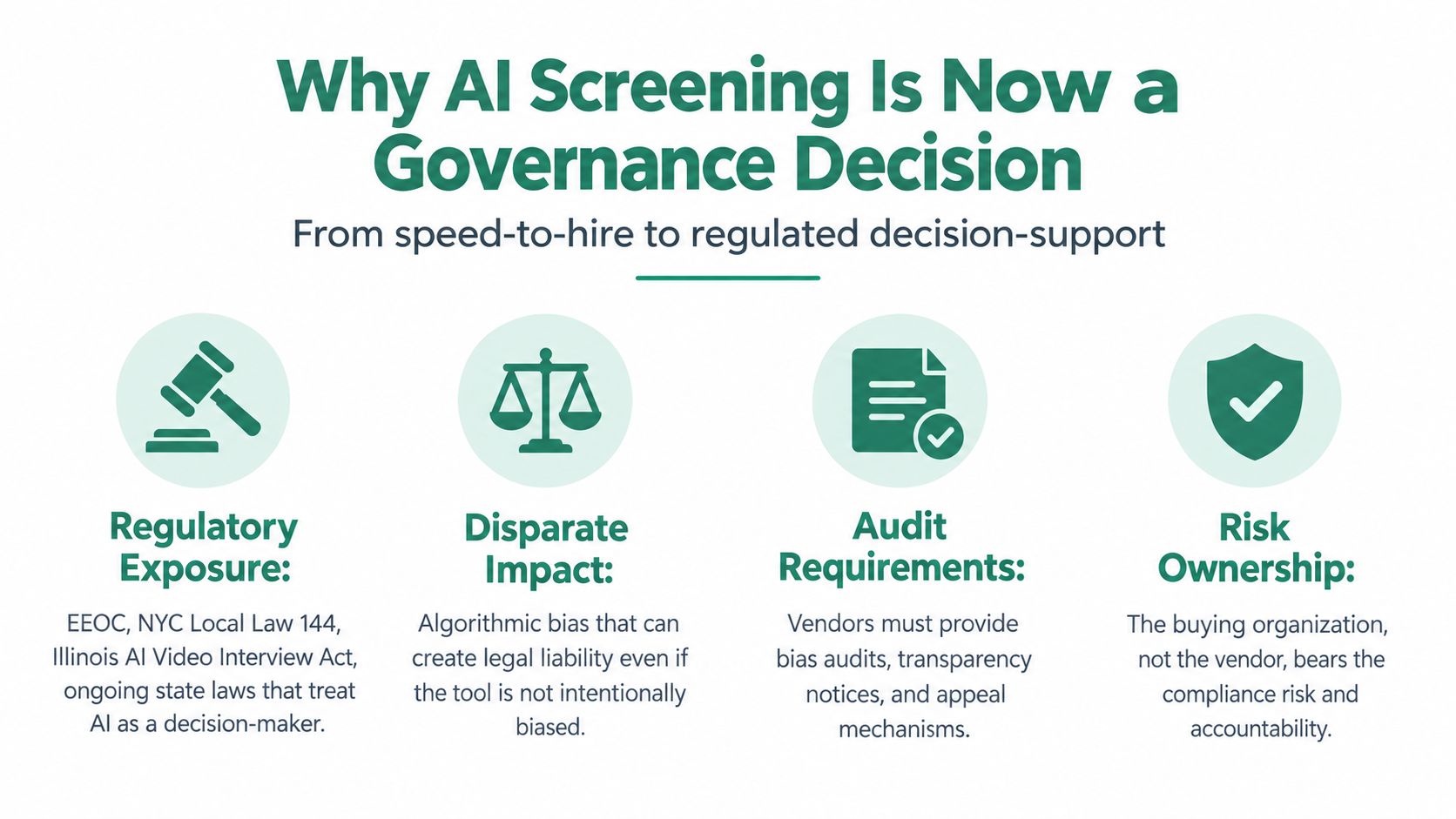
The most common buying mistake is treating AI screening like a productivity feature. That mindset is outdated. Screening now sits directly inside employment selection, which means it belongs in the same risk category as assessments, interview scorecards, and disposition rules.
That shift isn't theoretical. **Stanford HAI reported in 2026 that 90% of U.S. employers use AI screening tools to sort and rank job seekers**, and a 2025/2026 employer survey found **42% of organizations using AI in hiring apply it specifically to resume screening**. In practice, that means screening has moved from a back-office experiment to a mainstream gatekeeper in who reaches a recruiter first ([hiring adoption data](https://www.hiretruffle.com/blog/best-ai-recruitment-statistics)).
### Speed matters less than accountability
Buyers still walk into demos asking about time-to-hire. That's a fair operational question, but it shouldn't be the lead question. The lead questions should be these:
- **Who owns the decision logic:** Can your team inspect the criteria, or are you trusting a black box?
- **What does the vendor log:** Do they store model version, inputs, outputs, overrides, and candidate-facing notices?
- **How is retraining controlled:** Can the model shift behavior without your approval?
- **What happens when a candidate objects:** Is there a path to human review, re-evaluation, and documented response?
The EEOC has already made the baseline clear. Federal anti-discrimination laws apply to AI and other employment technologies the same way they apply to any other selection practice, including disparate impact risk and intentional design issues ([EEOC AI guidance](https://www.eeoc.gov/sites/default/files/2024-04/20240429_What%20is%20the%20EEOCs%20role%20in%20AI.pdf)).
> **Practical rule:** If the system influences who advances, treat it like a regulated selection mechanism on day one.
### Procurement, legal, and HR ops all belong in vendor selection
If TA buys alone, you'll miss the deal-breaking questions until implementation, or worse, until an audit. Legal needs disclosure language and jurisdictional review. Procurement needs data-processing terms, security posture, and retention controls. HR ops needs to validate field mapping, recruiter workflow impact, and override mechanics.
I'd also insist on a written internal standard before you shortlist vendors. A lightweight [AI governance policy for hiring teams](https://www.talentpronto.ai/ai-governance-policy) is far more useful than a vague promise to “use AI responsibly.”
For teams broader than recruiting, this is part of a larger operating model shift. Benely's [AI-driven HR strategies guide](https://benely.com/the-future-of-hr-how-ai-is-reshaping-human-resources-management/) is useful because it places hiring automation inside a wider HR governance conversation instead of treating it as a standalone tool purchase.
### The questions that separate serious platforms from demo ware
Ask these before pricing:
1. **Data residency:** Where is candidate data stored, and can you control region?
2. **Human review rights:** Can candidates request it, and can recruiters trigger it easily?
3. **Adverse-action mechanics:** How do notices, explanations, and disposition reasons work?
4. **Model change control:** What changes without your approval, and what never should?
If a vendor answers with marketing language instead of operational detail, move on.
## How AI Candidate Screening Actually Works
Teams that buy AI for candidate screening without understanding the moving parts end up surprised by parser errors, duplicate records, or score outputs nobody can explain.
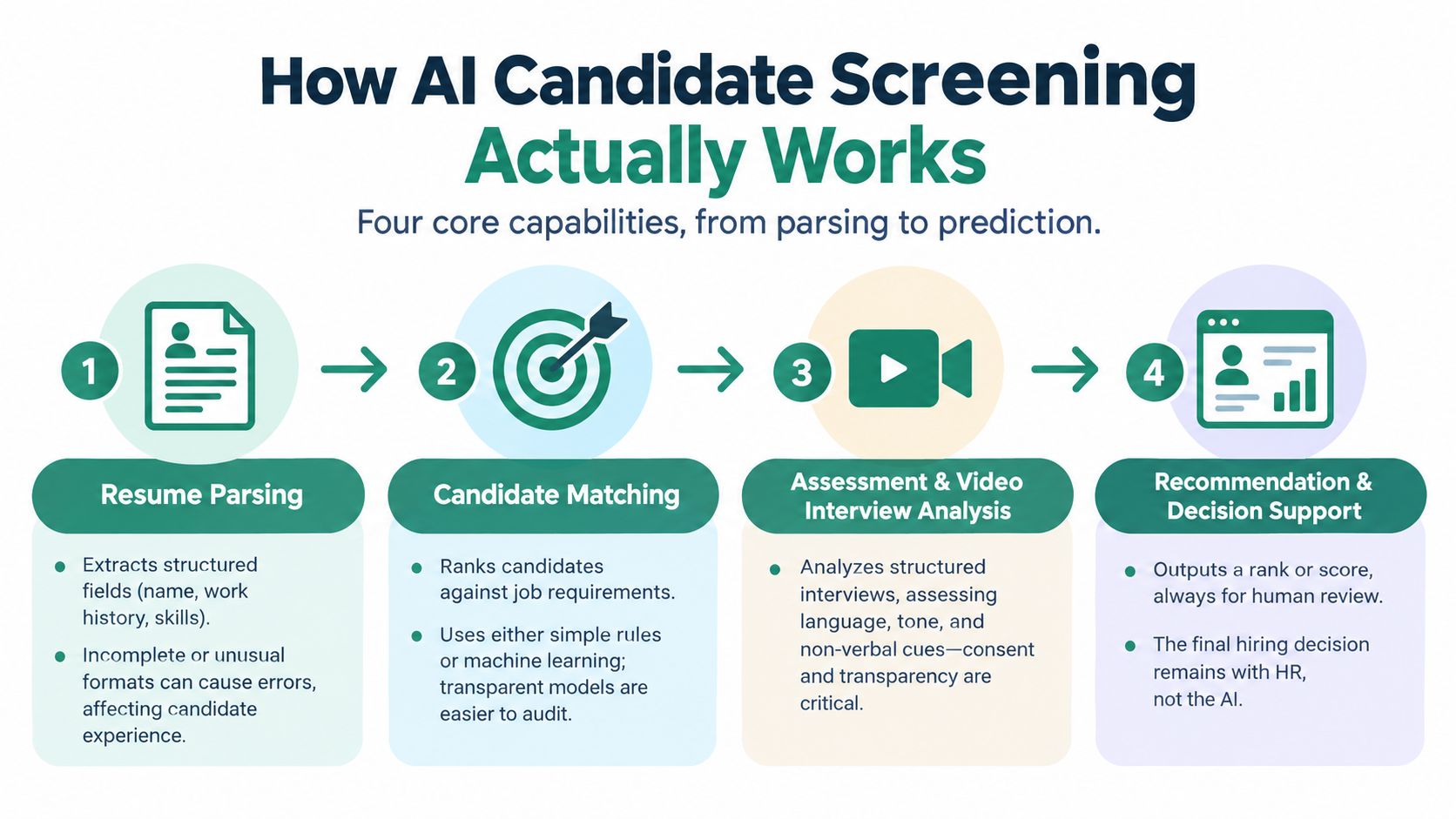
At a basic level, modern screening has four jobs: ingest candidate data, ask structured follow-up questions, keep communication moving, and attach a usable recommendation for recruiter review.
### Resume parsing and normalization
The first layer is resume parsing. The system extracts work history, education, certifications, licenses, locations, and skills into structured fields. That sounds simple until you hit contractor histories, overlapping dates, military experience, multilingual resumes, or unusual formatting.
A parser can misread end dates, flatten multiple roles into one employer record, or ignore special characters in names and certifications. When that happens, the downstream score is wrong before the candidate ever answers a question.
What you want is normalization with recruiter visibility. If a parser inferred something questionable, your team should be able to inspect and correct it.
### Conversational screening and structured scoring
The second layer is what the candidate experiences. Instead of asking a recruiter to call every applicant, the system launches a structured screening flow. Good systems don't just collect free text. They ask job-specific questions tied to criteria such as shift availability, license status, years in a relevant setting, willingness to travel, or experience with named tools.
A solid explainer on this workflow is [how conversational AI works in hiring](https://www.talentpronto.ai/blog-posts/how-conversational-ai-works). The important distinction is that the conversation is structured enough to score consistently and flexible enough to feel like a real interaction.
Later in the process, teams sometimes add a product walkthrough or stakeholder training video so recruiters understand what candidates are seeing.
### Outreach, opt-outs, and status updates
The third layer is outreach. That usually means SMS and email nudges tied to response windows. If a candidate applies at night, the system can respond immediately, invite them into screening, and update status when they finish.
That sounds operationally minor. It isn't. Candidates notice when the process moves and when it stalls. A good system also handles opt-outs cleanly and routes people back to an alternative path if they don't want automated interaction.
> The candidate experience isn't separate from screening logic. It is the screening logic from the candidate's point of view.
### A concrete candidate flow
Here's a typical sequence:
1. **Application lands:** The ATS sends the profile and requisition data into the screening layer.
2. **Immediate outreach fires:** The candidate gets a text inviting them to answer a few role-specific questions.
3. **Structured answers are scored:** The system evaluates responses against weighted criteria and knockout rules.
4. **Status updates post back:** The recruiter sees a scorecard, rationale, and recommended next step.
A candidate might apply for a patient access role, receive an SMS ten minutes later, answer three questions about scheduling flexibility, call-center experience, and EHR familiarity, then see a clear status update after completion. That's what buyers should visualize when comparing platforms. Not abstract “AI matching.”
## AI Screening vs Legacy ATS Chatbots
A lot of vendors still sell dressed-up automation as AI screening. If the product mostly asks preset questions, stores replies, and hands recruiters a transcript, that's not intelligent screening. That's form collection.
Legacy ATS chatbots were built for convenience. They're useful for intake, FAQs, and basic routing. They are not built for structured candidate evaluation across a large funnel.
### Where the distinction actually matters
A legacy chatbot usually does three things well. It asks fixed questions, captures answers, and pushes data into the ATS. That's predictable and easy to explain in an audit. It's also limited.
Modern AI screening does more. It compares responses against role criteria, applies knockout logic, flags contradictions, and produces a consistent score with readable reasoning. That makes recruiter review faster and more comparable across applicants.
Here's the practical comparison.
| Capability | Legacy ATS Chatbot | AI Screening |
|---|---|---|
| Primary role | Collects information | Evaluates against job criteria |
| Question flow | Fixed and rule-based | Structured but adaptable by role |
| Output | Transcript or form response | Scorecard with rationale |
| Candidate comparison | Hard to compare across applicants | Easier to compare on common criteria |
| Knockout handling | Basic yes/no branching | Weighted criteria plus knockout logic |
| Recruiter usability | Manual reading required | Shortlist and justification ready for review |
| Audit defense | Simple because logic is static | Strong if logs, criteria, and overrides are visible |
| Bias detection | Minimal signal | More reviewable if adverse-impact testing exists |
| Analytics value | Limited | Better funnel and evaluation insight |
### Where legacy tools still win
They still have a place.
- **Predictability:** Static rules are easier to understand.
- **Cost control:** They're often bundled into an ATS contract.
- **Low-risk use cases:** For FAQs, scheduling prompts, and simple prequalification, they're enough.
But here's where they fail: they don't create scoring parity between candidates, they don't give recruiters a reliable basis for ranking, and they don't produce much insight beyond completion status.
### The trap to avoid
Some vendors market “AI screening” when they're really doing keyword weighting plus scripted branching. Ask to see the scoring rationale on five anonymized candidates for one requisition. If the output looks like a prettier ATS note, it's not a real evaluation layer.
I'd rather buy an honest rule-based tool than a fake AI product with weak controls and vague claims.
## Bias, Compliance, and Candidate Trust Risks
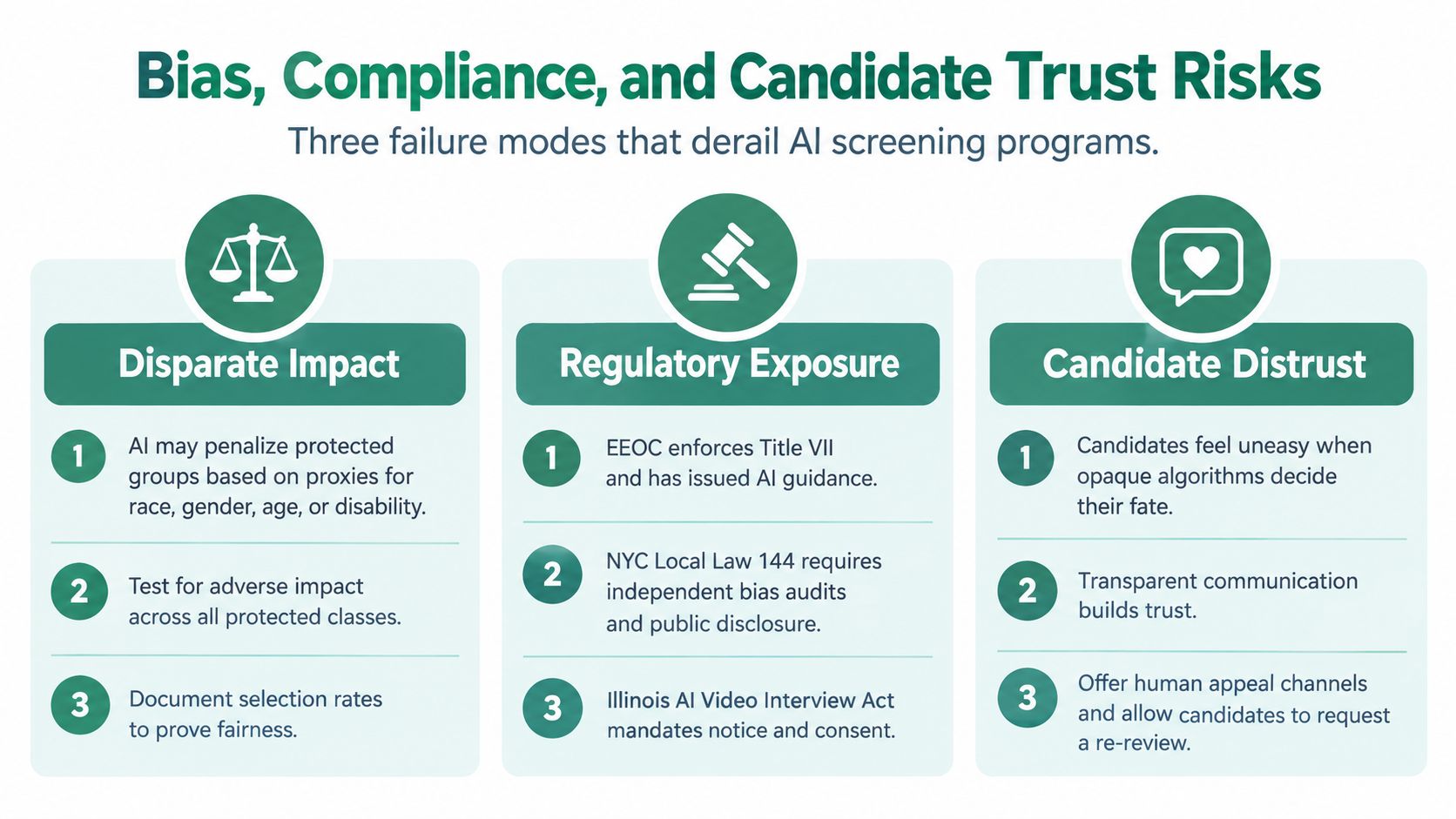
Most AI screening programs don't fail because the model was slow. They fail because the organization ignored one of three predictable risks: disparate impact, regulatory exposure, or candidate distrust.
The evidence is already strong enough to stop pretending these are edge cases. Research from 2025 on GPT-based recruitment screening found measurable appearance and gender effects, including a beauty premium for women and stronger penalties for plain candidates in some roles, especially when gender stereotypes were involved ([bias research paper](https://www.atlantis-press.com/article/126024822.pdf)).
### Disparate impact is the first thing to test
If your screening process consistently filters protected groups at materially different rates, you have a problem whether the system intended it or not.
Watch for:
- **Selection-rate variance:** Review outcomes across protected classes using your internal compliance method.
- **Proxy criteria:** Requirements that appear neutral but track age, disability, language background, or other protected characteristics.
- **No borderline review:** Candidates near a threshold shouldn't be auto-disposed without human eyes.
Mitigation isn't mysterious. Run pre-deployment bias audits on historical requisitions. Re-test after any major scoring or workflow change. Keep structured scorecards so reviewers can challenge outputs.
### Regulatory exposure starts with sloppy process
Compliance problems usually come from missing basics. No notice. No consent where required. No record of what version of the system scored the candidate. No clean explanation for a disposition.
Use this pressure-test checklist:
- **Candidate notice exists:** It clearly explains automated evaluation, data retention, and next steps.
- **Human review exists:** Recruiters can review borderline or disputed cases.
- **Audit log is immutable:** Inputs, outputs, timestamps, model version, and overrides are retained.
- **Vendor documentation exists:** Bias audit materials and process documentation are available before procurement signs.
> If your vendor can't show dated audit artifacts, you're taking their word on the highest-risk part of the system.
### Candidate trust drops faster than most employers realize
Candidate experience is where many AI rollouts bleed value. **Only 21% of candidates think most employers use AI responsibly, 70% say they were not clearly told upfront that AI would evaluate them, and 38% have walked away from a hiring process because it included an AI interview** ([candidate trust findings](http://staffinghub.com/candidate-experience/49-of-job-seekers-think-your-ai-screening-is-biased-heres-the-documentation-that-answers-them/)).
That problem gets sharper in more recent reporting. **A 2026 candidate survey summary reported 27% of candidates experienced age bias in AI interviews, 17% cited race or ethnicity bias, and 47.7% agreed AI hiring tools are biased, with neurodivergent candidates reporting even higher concern** ([candidate bias concerns](https://www.peoplemanagement.co.uk/article/1956592/third-candidates-drop-hiring-process-ai-led-interviews-survey-finds)).
What to do about it:
1. **Disclose early:** Tell candidates before screening begins.
2. **Explain plainly:** Don't bury the process in legal copy.
3. **Offer an alternative:** Give people a non-penalized path to continue.
4. **Prepare recruiters:** If a candidate asks how they were assessed, the recruiter should have an answer.
Trust doesn't come from saying your AI is fair. It comes from showing your process is reviewable.
## Integrating AI Screening with Your ATS and HRIS
Integration is where polished demos meet real life. A screening platform can look impressive in isolation and still create a mess once it touches Workday Recruiting, Greenhouse, Lever, iCIMS, SmartRecruiters, or SuccessFactors.
The requirement is two-way sync. If recruiters have to re-enter statuses, copy notes, or manually move candidates between stages, the system isn't integrated. It's bolted on.
### What a production-grade integration actually includes
At minimum, I expect sync coverage for:
- **Candidate profile data:** Name, contact info, resume, application answers, source, and requisition association.
- **Job requisitions:** Open roles, locations, hiring teams, stage maps, and knockout requirements.
- **Stage movement:** Advance, hold, disqualify, and interview-ready statuses.
- **Disposition codes:** Standardized reasons that map back to the ATS cleanly.
- **Scheduling events:** Interview invitations, confirmations, and completion status.
A useful technical reference for buyers is this overview of [HRIS integration patterns in hiring systems](https://www.talentpronto.ai/blog-posts/hris-integration). It's the sync logic that matters most, not the slide that says “integrates with major ATS platforms.”
### The difference between clean sync and brittle sync
Here's what I look for in vendor architecture reviews:
| System | Integration Type | Sync Direction | Typical Sync Method |
|---|---|---|---|
| Workday Recruiting | Native connector or API-based | Bidirectional | API plus webhooks where available |
| Greenhouse | Native integration | Bidirectional | Harvest API and webhook events |
| Lever | Native integration | Bidirectional | API and webhook triggers |
| iCIMS | Marketplace or API integration | Bidirectional | API with event-based updates |
| SmartRecruiters | Native or partner integration | Bidirectional | API and webhook sync |
| SuccessFactors | API or middleware-based | Bidirectional | API through integration layer |
| HRIS handoff after offer | API or flat-file depending on stack | Usually one-way to HRIS | API, middleware, or secure batch |
The best setups use webhook-driven updates for real-time movement, not nightly batches that leave recruiters and candidates out of sync. They also use idempotent matching by email and phone so duplicate candidate records don't multiply every time someone reapplies.
### Data quality before automation
Bad contact data will break outreach long before scoring breaks. If you're cleaning inbound candidate records or trying to reduce false duplicates, a practical reference point is this [Gmail account verification solution](https://lineverifier.com/google-gmail-verification), which shows the kind of email validation discipline many hiring teams overlook until response rates suffer.
One product example worth noting is Talent Pronto, which supports integrations with systems such as Greenhouse, iCIMS, Paylocity, ADP, and Workday while syncing candidate data and statuses as part of conversational screening workflows.
SSO and SCIM also matter more than most TA teams realize. If recruiter access isn't provisioned cleanly, your rollout slows down. If data residency isn't resolved before launch, legal will stop the project later.
## Choosing the Right AI Screening Vendor
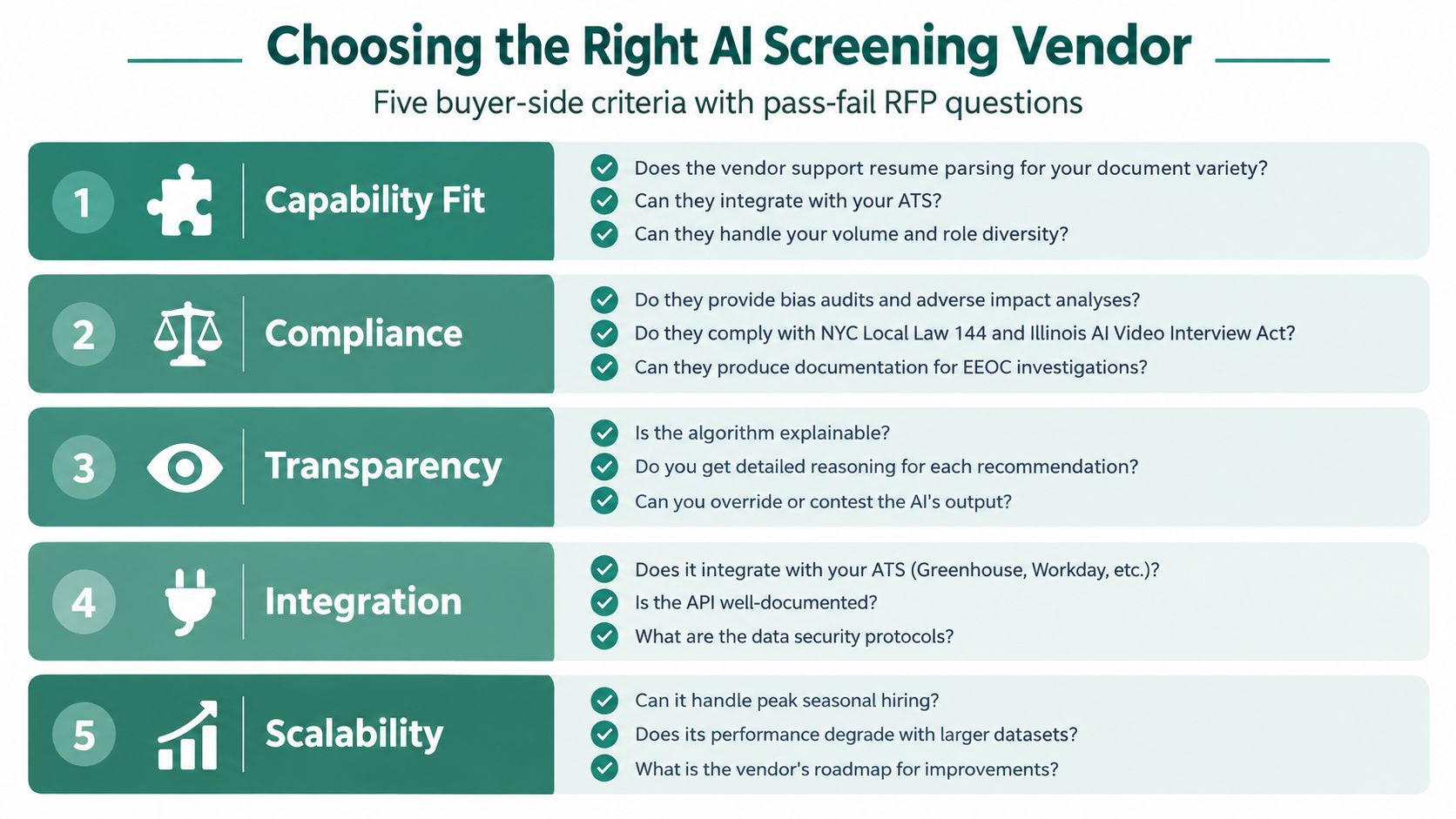
Most vendor evaluations go off the rails because the shortlist is built around demos instead of pass-fail requirements. Don't start with “Which one feels smartest?” Start with “Which one can we safely operate at scale?”
The right evaluation frame has five buyer-side criteria. Each one needs hard questions, not vague assurances.
### Capability fit and industry fit
First, confirm the platform can do the job in one workflow. Resume parsing, conversational screening, structured interview scoring, and automated outreach should work together. If the vendor stitched together separate tools through acquisition or partnerships, ask where data gets normalized and where scoring happens.
Second, force industry proof. A model that works on generic corporate roles may stumble on nurse licensure, manufacturing shifts, union constraints, or public-sector screening rules.
Ask:
- Can you support our document formats and role mix?
- Can we inspect score logic by requisition?
- Can you show anonymized examples from our industry?
### Customization and explainability
Weak tools get exposed here. If you can't configure per-requisition weighting or knockout criteria, you're going to end up bending your hiring process around the software.
I'd require:
1. **Role-specific weighting:** Different jobs need different criteria.
2. **Editable knockout logic:** Legal and HR ops should approve it.
3. **Plain-English rationale:** Recruiters need to explain outcomes internally, and candidates may ask for clarity.
> Buy explainability before you buy automation depth.
### Analytics, audit, and implementation terms
Every serious vendor should show dashboards and exportable logs. I want visibility into time-to-screen, candidate dropoff, selection patterns, and recruiter overrides. I also want logs that can be preserved for litigation hold without heroic effort from IT.
Commercially, get specific fast:
- **Pilot structure:** Fixed-fee beats open-ended experimentation.
- **Implementation scope:** Name the ATS, workflows, and owners.
- **Data portability:** You should be able to leave with your data.
- **Security posture:** Ask for current certifications and security documentation.
A weighted scoring sheet keeps everyone honest. Give legal, TA, HR ops, IT, and procurement their own scoring columns. If one flashy vendor wins the demo but fails auditability, the sheet should make that visible immediately.
## A 90-Day Rollout Plan and What Success Looks Like
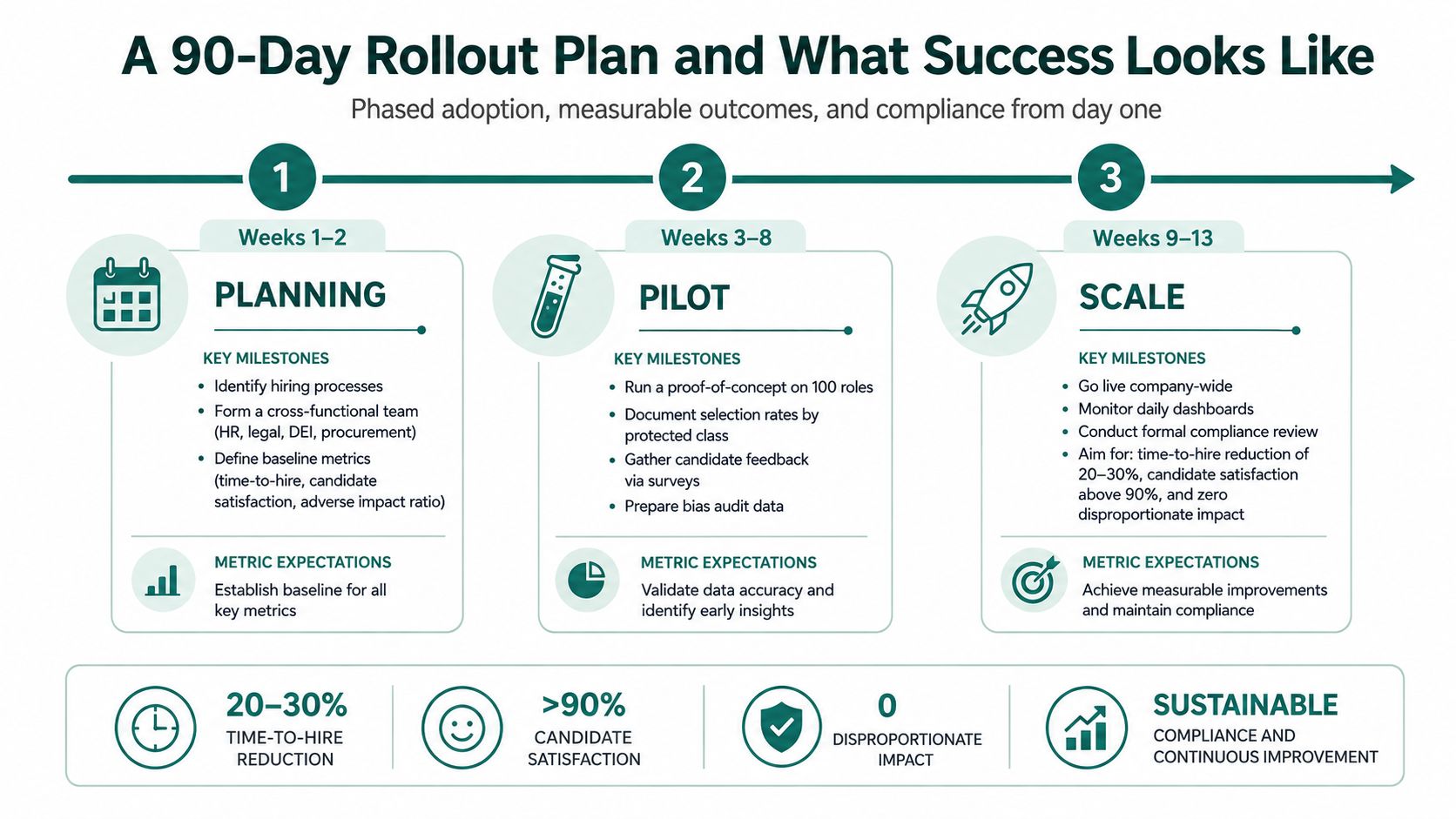
AI screening rollouts fail when companies treat go-live as the finish line. It isn't. Launch is the start of governance, measurement, and correction.
The rollout I trust is phased, supervised, and intentionally narrow at first. You don't need a giant transformation program. You need disciplined sequencing.
### Weeks 1 through 2
Start with baseline and control points. Map your current funnel, current stage names, current disposition reasons, and current review bottlenecks. Decide which requisition family goes first.
This is also where you lock your governance rules:
- **Disclosure language:** Approved by legal before pilot launch.
- **Escalation path:** Who reviews disputes or edge cases.
- **Override process:** Recruiters need a simple way to challenge the score.
- **Audit owner:** One person must own log completeness and retention.
### Weeks 3 through 6
Build the integration, configure scorecards, and run internal test cases. Don't rely on vendor QA. Use your own historical applications and edge-case resumes.
The operational reason for speed is real, but it should be tied to candidate leakage, not vendor hype. **A 2026 report summary said 42% of candidates withdrew because interview scheduling took too long, 47% cited poor communication, and separate 2026 reporting said 39% of qualified candidates drop out when initial response times exceed five business days** ([candidate drop-off and response timing data](https://onehour.digital/blog/interview-rate-per-application-statistics)).
### Weeks 7 through 10
Launch on one role family with close supervision. High-volume hourly roles work well because you get enough throughput to inspect scoring, response rates, and recruiter behavior quickly.
Success in this phase looks like:
- Recruiters are reviewing scorecards instead of raw transcripts.
- Candidates receive timely outreach and clear notices.
- Overrides are being logged, not handled off-system.
- Legal and HR ops can inspect actual records, not screenshots.
A second trust check belongs here too. **CNBC reported in 2026 that nearly 4 in 10 U.S. job seekers have withdrawn from a hiring process over an AI interview, and the same report said 70% were never told AI would be evaluating them. It also noted 33% of abandonments were tied to pre-recorded video interviews scored by AI with no human present, 27% to failure to disclose AI use, and 26% to AI monitoring during the process** ([CNBC coverage of AI interview abandonment](https://www.cnbc.com/2026/09/15/job-seekers-refusing-ai-interviews-blacklisting-employers.html)).
### Weeks 11 and beyond
Expand only after you've reviewed outcomes weekly. Keep three recurring checkpoints in place:
1. **Weekly adverse-impact review**
2. **Monthly vendor performance review**
3. **Quarterly model and workflow re-validation**
Success isn't “the tool is live.” Success is a system that screens consistently, communicates clearly, and holds up when someone audits it.
If you treat AI for candidate screening as a governed decision-support layer, it becomes useful and defensible. If you treat it like a fast filter, it will eventually embarrass you.
---
Talent Pronto offers conversational AI screening that engages applicants right after they apply, asks structured role-specific questions, and returns recruiter-ready scorecards for human review. If you want a screening layer that fits into existing ATS and HRIS workflows without handing final decisions to automation, visit [Talent Pronto](https://talentpronto.ai).