# Candidate Ranking System: How AI Transforms Hiring
*Published 2026-08-30*
> Discover how a candidate ranking system uses AI, structured rubrics, and role-aware criteria to streamline hiring. Learn benefits, limitations, and real-world
Source: https://www.talentpronto.ai/blog-posts/candidate-ranking-system
---
A hiring manager opens the applicant tracking system and sees a familiar problem: hundreds of applications for one role, each filled with polished bullet points, overlapping job titles, and different ways of describing similar work. The first few resumes receive careful attention. By the middle of the queue, the reviewer is searching for shortcuts. By the end, a strong applicant may be rejected because the resume used “collaborative delivery” instead of “cross-functional leadership.”
A **candidate ranking system** addresses that bottleneck by applying a consistent, role-specific evaluation framework to every applicant. It isn't merely a faster keyword filter. Properly designed, it combines structured criteria, weighted scoring, interview evidence, and human review. The difficult question is what happens after the ranked list appears, because a fair algorithm can still influence biased human decisions.
## Table of Contents
- [The Hiring Bottleneck That Won't Go Away](#the-hiring-bottleneck-that-wont-go-away)
- [From resume pile to evaluation framework](#from-resume-pile-to-evaluation-framework)
- [How Candidate Ranking Systems Work](#how-candidate-ranking-systems-work)
- [Start with a scoring rubric](#start-with-a-scoring-rubric)
- [Weight what matters most](#weight-what-matters-most)
- [Keep criteria role-aware](#keep-criteria-role-aware)
- [Measurable Benefits of Structured Candidate Ranking](#measurable-benefits-of-structured-candidate-ranking)
- [What the improvement looks like in practice](#what-the-improvement-looks-like-in-practice)
- [Auditability is an operational benefit](#auditability-is-an-operational-benefit)
- [Limitations and Bias Concerns You Can't Ignore](#limitations-and-bias-concerns-you-cant-ignore)
- [The overlooked stage comes after the ranking](#the-overlooked-stage-comes-after-the-ranking)
- [Test the edges, not only the average](#test-the-edges-not-only-the-average)
- [Modern AI Systems Versus Legacy ATS Chatbots](#modern-ai-systems-versus-legacy-ats-chatbots)
- [Capability comparison](#capability-comparison)
- [Context matters more than keyword density](#context-matters-more-than-keyword-density)
- [Implementing a Candidate Ranking System](#implementing-a-candidate-ranking-system)
- [Build the process in stages](#build-the-process-in-stages)
- [Monitor what happens after launch](#monitor-what-happens-after-launch)
- [Making the Decision for Your Organization](#making-the-decision-for-your-organization)
- [A practical decision matrix](#a-practical-decision-matrix)
## The Hiring Bottleneck That Won't Go Away
A product manager role receives a crowded application pool. The hiring manager searches for “roadmap,” “SaaS,” and “stakeholder management,” then opens resumes one by one. A candidate who built roadmaps but described the work as “product planning” disappears from the search. Another candidate's familiar company name creates an immediate sense of confidence, even though the evidence of role-relevant performance is thin.
The process gets harder as the review continues. Recruiters and managers may begin with a clear standard, but repeated comparisons encourage shortcuts. They may favor recognizable employers, continuous career histories, or resumes that mirror the language of the job description. Meanwhile, qualified applicants wait for a response and competing employers continue their conversations.
The problem isn't applicant volume alone. It's the absence of a repeatable way to compare evidence.
### From resume pile to evaluation framework
A candidate ranking system creates that missing structure. Instead of asking whether an applicant “feels like a fit,” the hiring team defines what success requires, identifies observable evidence, and gives each criterion an agreed place in the decision.
That framework can begin with resume screening and continue through interviews. Automated candidate ranking is now closely connected to applicant tracking and AI screening. A **2025 SHRM Talent Trends finding** reported that **43% of organizations used AI in HR or recruiting tasks, up from 26% in 2024**, and **44% of organizations using AI for recruiting applied it to resume screening**. The figures are summarized in [AI resume screening statistics and recruiting trends](https://stealthagents.com/research/ai-resume-screening-statistics-2026).
The same reporting places AI-assisted recruiting in a mainstream workflow, with **51% of organizations using AI to support recruiting overall** and **89% of adopters saying it saves time or improves efficiency**. Those figures don't prove that every system produces good hiring decisions. They do show why candidate ranking has moved beyond a niche experiment and into high-volume recruiting operations.
> **Practical rule:** Automate the comparison, not the accountability.
A ranking engine can organize evidence and surface applicants who deserve attention. It shouldn't define merit, decide who gets hired, or excuse a manager from examining the reasons behind a recommendation. The scalable solution is a documented evaluation process that gives people more consistent information before they make a consequential decision.
## How Candidate Ranking Systems Work
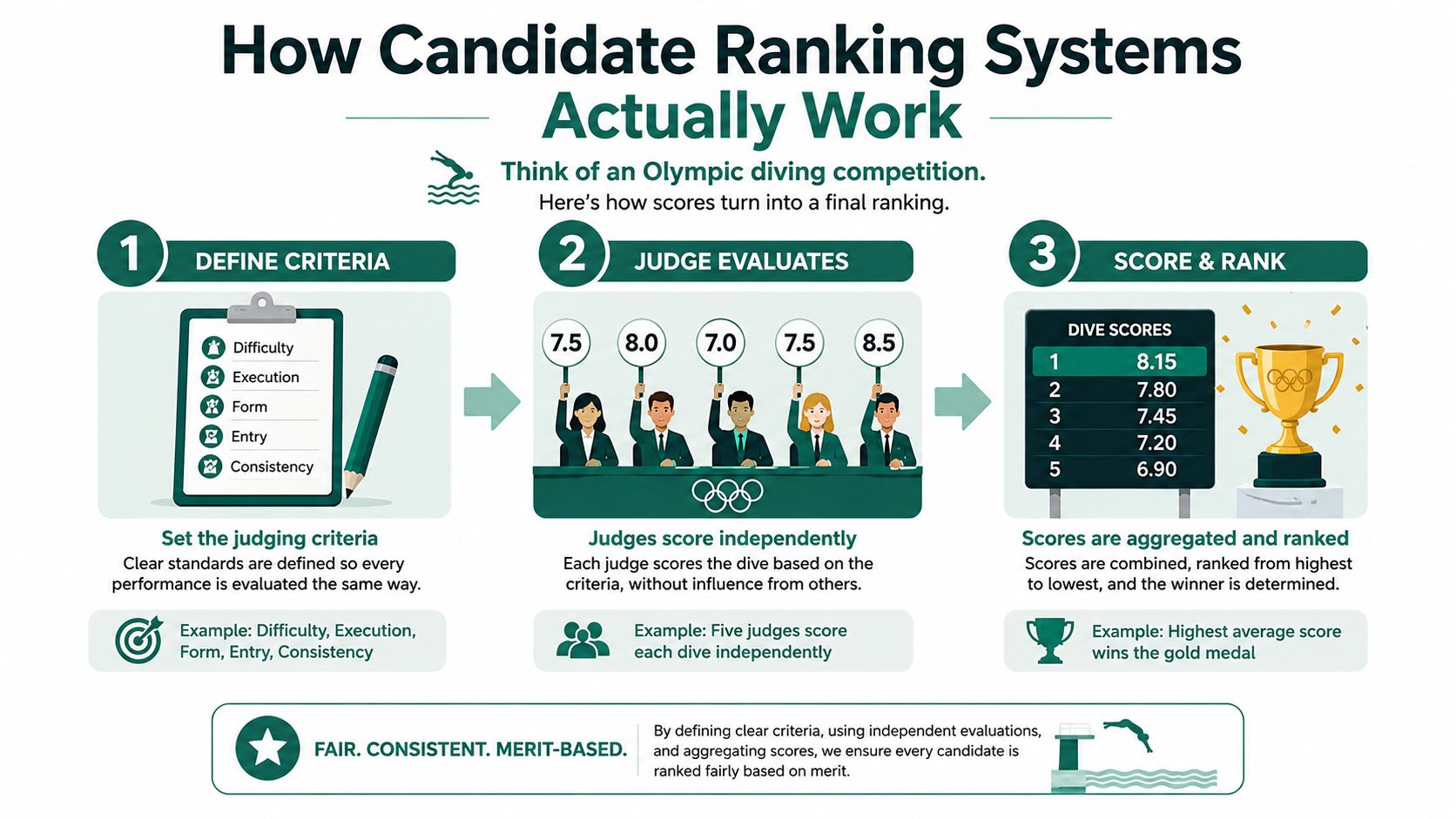
A hiring team may review two applicants for the same role and leave with opposite impressions. One interviewer remembers a polished presentation; another focuses on a missing technical example. A candidate ranking system creates a shared way to examine those observations. It works like an Olympic diving competition, where judges score defined elements instead of rewarding a familiar name or an overall feeling. Job performance is more complex than a dive, but the need for consistent criteria is similar.
### Start with a scoring rubric
Begin by defining the competencies that matter for the role. “Communication” is too broad for consistent scoring. A usable criterion could assess whether a candidate can explain a complex product decision to nontechnical stakeholders, supported by a specific example from their experience.
Each competency needs behavioral anchors. A high score might require clear ownership, relevant scope, and a measurable outcome. A middle score might show exposure without independent responsibility. A low score might indicate limited relevant experience or insufficient evidence.
Structured interviews provide a defensible foundation. The [U.S. Office of Personnel Management guidance on structured interviews](https://www.opm.gov/policy-data-oversight/assessment-and-selection/other-assessment-methods/structured-interviews/) connects greater structure with higher validity, rater reliability, rater agreement, and less adverse impact. It also explains how questions tied to job competencies identified through job analysis can support several forms of validity.
Hiring teams can use this [interview scoring rubric guide](https://www.talentpronto.ai/blog-posts/interview-scoring-rubric) to organize questions, behavioral anchors, and interviewer feedback in one process.
### Weight what matters most
Competencies do not need equal influence. A senior engineering role may place more weight on system design, while an early-career role may emphasize learning agility, problem solving, and foundational technical ability. The weights should follow the job's demands rather than the preferences of its most vocal stakeholder.
The calculation is straightforward:
**Candidate score = criterion score × criterion weight, added across all criteria.**
Consider a hypothetical product operations role with four dimensions:
- **Process design:** 30%
- **Cross-functional communication:** 25%
- **Analytical problem solving:** 25%
- **Change management:** 20%
A candidate could score strongly in process design and communication, adequately in analysis, and lower in change management. The composite score helps create a reasoned shortlist. Reviewers can still inspect the component scores, supporting evidence, and unanswered questions instead of accepting an unexplained rank.
### Keep criteria role-aware
A useful system changes its evaluation dimensions by job family, seniority, and team context. A hospital operations role may require compliance-related behaviors and coordination across shifts. A software role may focus on architecture decisions and technical collaboration. A customer-facing position may give more weight to empathy, communication, and problem resolution.
The ranking should answer one focused question: **How well does this candidate's evidence match the requirements of this role?** Comparing candidates with previous hires or rewarding a generally impressive presentation can pull the process away from that question.
Research supports standardization. A meta-analysis found **mean operational validity of .44 for structured interviews across 106 studies and 12,847 participants, compared with .33 for unstructured interviews across 39 studies and 9,330 participants** in [the meta-analysis of interview validity](https://home.ubalt.edu/tmitch/645/articles/McDanieletal1994CriterionValidityInterviewsMeta.pdf). A rubric does not remove human judgment. It gives evaluators a common scale, records the evidence behind a score, and makes disagreement visible.
That final point matters after the rankings appear. An algorithm can apply criteria consistently while managers still favor confidence, familiarity, or a candidate who resembles successful colleagues. The scalable solution is a documented evaluation process that gives people more consistent information before they make a consequential decision.
## Measurable Benefits of Structured Candidate Ranking
Structured ranking improves the decision process because it changes what hiring teams compare. Instead of comparing overall impressions, interviewers compare evidence against the same competencies. That distinction can improve selection quality, reduce avoidable debate, and create a record that other stakeholders can review.
The strongest evidence concerns structured evaluation rather than every commercial AI ranking product. In an experimental recruiting study, structured conditions produced **higher-quality applicant selections, M = 3.31 versus 3.09, F(1,245) = 31.17, p < .001, partial η² = 0.71**, and a **higher proportion of outgroup applicants selected, M = 0.56 versus 0.46, F(1,101) = 7.94, p = .006, d = 0.56**. The findings are available in [the experimental study of structured recruiting decisions](https://pmc.ncbi.nlm.nih.gov/articles/PMC5724833/).
### What the improvement looks like in practice
A ranked shortlist can reduce repetitive discussion about who deserves the next interview. Recruiters can see which applicants meet the defined bar, which competencies remain untested, and where reviewers disagree. That doesn't guarantee a faster hire, because scheduling, approvals, candidate availability, and offer decisions still affect the process. It does remove one common source of delay, the unstructured argument over whose resume seems most promising.
Structured scoring can also support more consistent opportunity. When evaluators must assess job-related criteria for every applicant, pedigree signals and personal familiarity have less room to dominate the first review. The result is not automatic fairness, but a clearer basis for detecting inconsistent treatment.
| Hiring Metric | Unstructured Screening | Structured Ranking System | Improvement |
|---|---|---|---|
| Applicant comparison | Varies by reviewer and memory | Uses common role-specific criteria | More consistent evaluation |
| Interview selection | Often driven by overall impression | Driven by documented evidence and weights | Clearer shortlist rationale |
| Quality assessment | Informal judgment | Standardized scoring and behavioral anchors | More defensible decisions |
| Auditability | Notes may be incomplete or inconsistent | Criteria, scores, and rationale can be reviewed | Stronger decision trail |
| Fairness review | Often focuses on final outcomes only | Can examine criteria and rank patterns | Better visibility into risk |
### Auditability is an operational benefit
A documented ranking system helps HR teams answer practical questions. Which criteria influenced the recommendation? Did interviewers use the scorecard consistently? Did a particular group receive lower scores on one criterion? Did human reviewers override recommendations, and why?
Fairness evaluation must account for rank position, not just final selection. A survey of algorithmic ranking research explains that ranking-specific measures should be used where possible, while noting that adoption is complicated by browsing behavior and the need to model exposure. Its [survey of fairness in algorithmic ranking](https://pmc.ncbi.nlm.nih.gov/articles/PMC10587596/) also identifies demographic parity as one commonly used definition in ranked recommender systems.
For hiring, that means teams should examine who reaches the top positions, who receives visibility, and whether the ordering changes downstream attention. A system can be accurate on average while still producing harmful patterns in a particular role or subgroup.
## Limitations and Bias Concerns You Can't Ignore
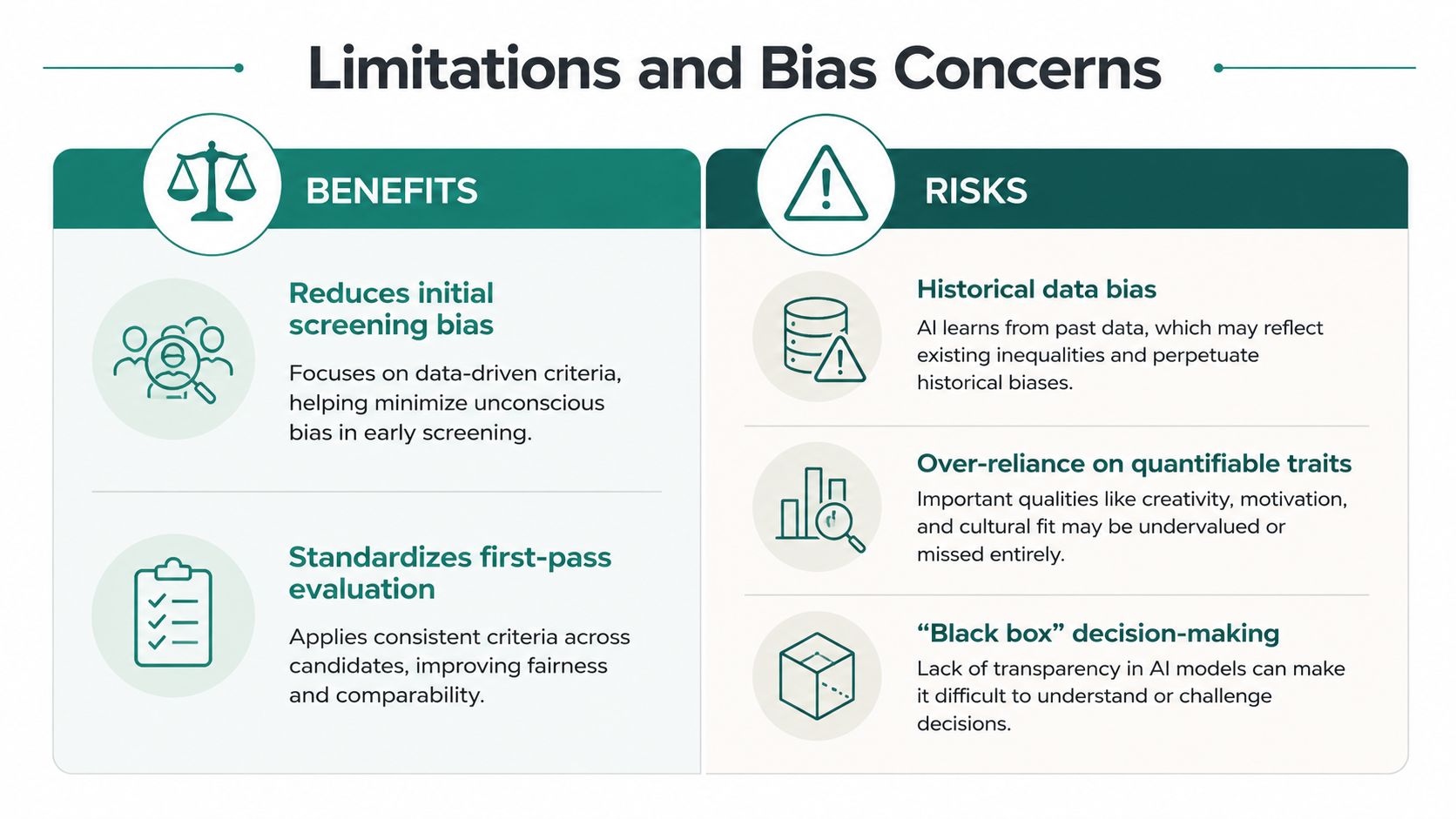
A ranked list can look objective because it contains numbers. Numbers don't remove judgment. They often move judgment upstream into the choice of criteria, the training data, the scoring model, and the human response to the output.
Historical hiring data may reflect an organization's past preferences rather than genuine job requirements. If previous hiring favored a narrow set of schools, employers, career paths, or communication styles, a model trained on those outcomes may learn to reproduce those patterns. Configuration creates another risk. A team that gives excessive weight to a particular credential may encode an assumption that has never been tested against job performance.
### The overlooked stage comes after the ranking
The central risk is often not the first automated score. It's the human reaction to the list.
A recruiter may treat the top-ranked candidate as the safe choice and give that applicant more attention. A manager may dismiss a lower-ranked candidate without examining the evidence. Interviewers may interpret a high rank as confirmation and a low rank as a warning, even when the score reflects incomplete information rather than weak capability.
A 2025 study focused on ranking recruitment fairness and position bias. Related recent work found that people can mirror an AI hiring system's preference patterns when paired with a moderately biased system, as described in [the research on ranking recruitment fairness](https://chato.cl/papers/fabris_2025_ranking_recruitment_fairness.pdf). This creates a practical distinction between **model fairness** and **decision-process fairness**. A model may meet a chosen fairness test, while its ordering still changes where human attention goes.
> A fair ranking is not the same as a fair hiring outcome.
### Test the edges, not only the average
Aggregate fairness metrics can conceal localized harm. Independent research found that **26% of Black applicants and 15% of Asian applicants applied to roles where the system discriminated against their racial group**, according to [Stanford research on racial bias in AI hiring tools](https://hai.stanford.edu/news/ai-hiring-tools-can-yield-racial-bias-and-systemic-rejection). The finding illustrates why employers should test roles, occupations, geographies, and protected intersections separately instead of relying on one overall pass or fail result.
Teams should establish controls that keep the list useful without making it authoritative:
- **Require evidence review:** Ask the hiring manager to inspect the criteria and supporting evidence behind a rank.
- **Track overrides:** Record when reviewers advance or reject candidates contrary to the recommendation, then examine recurring patterns.
- **Audit exposure:** Review who appears near the top and whether position affects interview invitations.
- **Separate missing data from low ability:** A candidate with limited resume detail shouldn't automatically be treated as unqualified.
- **Train reviewers:** Explain automation bias, confirmation bias, and the risk of dismissing unconventional experience.
For managers who want a plain-language explanation of how group-level hiring harm can occur, this resource on [what is disparate impact in employment](https://paradigmie.com/post/what-is-disparate-impact-discrimination) provides useful context from Paradigm International Inc. Teams can also consult this guide to [reduce hiring bias](https://www.talentpronto.ai/blog-posts/how-to-reduce-hiring-bias), particularly when designing scorecards and review procedures.
## Modern AI Systems Versus Legacy ATS Chatbots
A legacy ATS chatbot usually handles a narrow exchange. It collects application details, answers predefined questions, and applies conditional rules. Its understanding often depends on exact terms, so a qualified applicant can be overlooked when their resume uses different language from the job description.
Modern AI ranking systems take a broader approach. Natural language processing can recognize that “managed cross-functional teams” and “led collaborative projects” may signal related leadership experience, while still checking the context, scope, and evidence behind those phrases. The system should not treat semantic similarity as proof of competence. It should use it to find relevant information for review.
### Capability comparison
| Capability | Legacy ATS Chatbots | Modern AI Ranking Systems |
|---|---|---|
| Primary function | Collects information and applies rules | Screens, questions, evaluates, and organizes evidence |
| Language handling | Often depends on exact keyword matches | Interprets related language and contextual meaning |
| Evaluation | Basic eligibility checks | Role-specific criteria and structured scorecards |
| Interview behavior | Scripted prompts or simple branching | Conversational behavioral and technical questioning |
| Candidate profile | Application fields and resume data | Resume, responses, scores, notes, and status information |
| Ranking logic | Keyword presence or knockout rules | Weighted criteria, evidence, and qualification signals |
| Workflow connection | May require manual exports | Can connect with recruiting and HR systems |
| Human role | Reviews filtered applicants | Interprets recommendations and makes decisions |
### Context matters more than keyword density
A modern system can examine career progression, skill adjacency, and achievement indicators that a simple filter misses. For example, a candidate may not have held the title “program manager,” but may have coordinated launches, managed dependencies, and reported delivery risks across teams. Those signals may be relevant even without a title match.
The technology still needs a sound rubric. A model using poorly chosen criteria will produce a polished version of a bad process. Hiring teams evaluating AI assistants can use this overview of [how AI assistants work](https://www.talentpronto.ai/blog-posts/how-do-ai-assistants-work) to distinguish conversational capability from simple form collection.
Integration also affects practical value. A system that connects screening results with the ATS, interview scheduling, assessment data, and HR records reduces duplicate work and preserves the candidate's evaluation history. That connected workflow matters because ranking is most useful when it carries consistent evidence from application review into human interviews.
## Implementing a Candidate Ranking System
Implementation works best as a controlled process, not a sudden switch from manual screening to automated decisions. Start by mapping the current workflow. Identify where applicants wait, where reviewers repeat the same checks, where scorecards go missing, and where hiring managers disagree about what “qualified” means.
Then build the rubric with the people who understand the job. Include the hiring manager, recruiters, recent successful hires where available, and HR or compliance partners. Ask what outcomes the person must deliver, what behaviors demonstrate readiness, and which qualifications are necessary.
### Build the process in stages
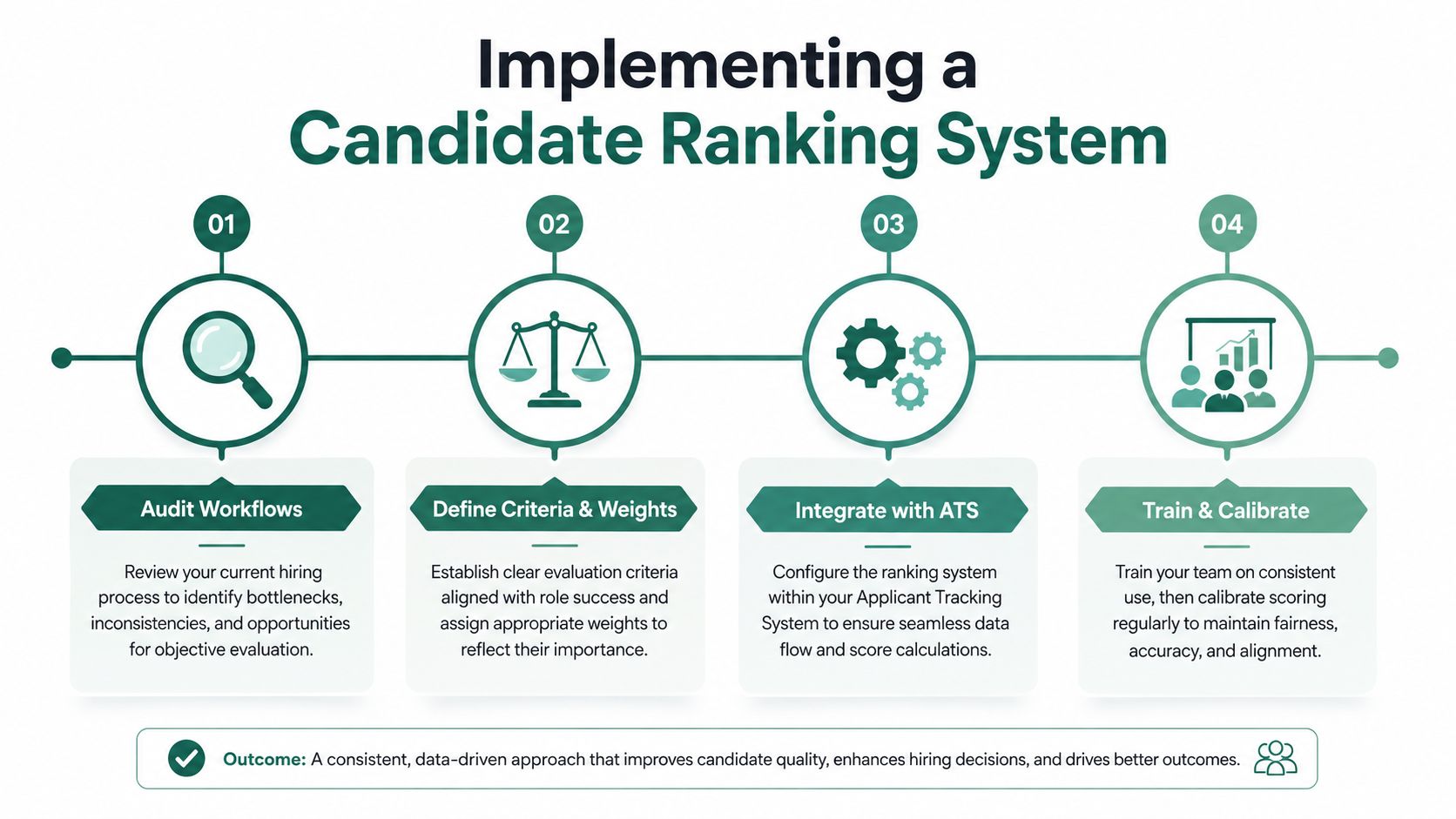
**Audit the workflow first.** Document application sources, screening questions, interview stages, decision owners, and handoffs. Don't automate a step because it exists. Remove unnecessary work before configuring software.
**Define criteria and weights.** Translate broad requirements into observable behaviors. “Strong leader” might become “sets priorities, explains trade-offs, and gives a specific example of guiding a team through a difficult change.” Review the weights for unintended emphasis on pedigree, narrow career paths, or easy-to-measure signals.
**Integrate with the ATS.** Confirm which candidate fields, scores, transcripts, statuses, and interview outcomes move between systems. Integration work depends on existing infrastructure and data quality. The broader job-management context may be useful when evaluating [Osher Digital job management](https://osher.com.au/services/custom-job-management-software/) alongside recruiting workflow requirements.
**Train and calibrate reviewers.** Show hiring managers how to interpret a rank, inspect supporting evidence, record an override, and distinguish a missing signal from a negative signal. Run sample evaluations so reviewers can compare how they apply the rubric.
A phased rollout reduces operational risk. Start with high-volume roles where the team can observe patterns and refine criteria, then expand to more complex positions. Talent Pronto describes typical implementation in **1 to 3 weeks** in its publisher information, but actual timing depends on the integration scope, data readiness, and internal approvals.
### Monitor what happens after launch
Create a regular audit cycle before the first candidate enters the workflow. Review score distributions, rank movement, recruiter overrides, interview progression, and subgroup outcomes. Check whether candidates ranked highly provide useful evidence in interviews, and whether valuable candidates are repeatedly appearing lower for the same criterion.
Keep the system in a decision-support role. The employer should retain advancement and rejection authority, with documented reasons for consequential decisions. Feedback from interviews and later performance can help refine the rubric, but teams should change criteria deliberately rather than optimizing toward historical hiring outcomes without scrutiny.
## Making the Decision for Your Organization
A candidate ranking system makes the most sense when hiring teams face repeated comparison work and can define success in observable terms. High-volume technical recruiting, multi-location hiring, and roles with clear competency frameworks are strong candidates for structured ranking. A small executive search with a carefully curated pool may need a lighter process, particularly when each candidate receives extensive direct review.
Use five questions to assess readiness:
1. **Does the tool match the hiring problem?** If delays come from interview scheduling or unclear approvals, ranking alone won't solve them.
2. **Can the team define job-related criteria?** A system can't compensate for a vague or politically negotiated rubric.
3. **Is the existing data reliable?** Incomplete resumes, inconsistent interview notes, and fragmented ATS records weaken the output.
4. **Will managers use the recommendations responsibly?** Adoption requires training and a clear expectation that people will examine evidence.
5. **Can HR monitor outcomes?** Someone must own fairness reviews, rubric updates, access controls, and escalation procedures.
### A practical decision matrix
| Organizational condition | Likely fit | Recommended approach |
|---|---|---|
| Repeated high-volume applications and clear criteria | Strong | Pilot automated screening and structured ranking |
| Moderate volume with inconsistent interviewer feedback | Strong after preparation | Standardize the rubric before automation |
| Small candidate pool and highly bespoke executive evaluation | Limited | Use lightweight scorecards and human review |
| Poor ATS data and unclear process ownership | Weak initially | Repair workflow and data quality first |
| Strong manager resistance to algorithmic recommendations | Conditional | Pilot with transparent evidence and override tracking |
Cost shouldn't be judged only against software spend. Consider recruiter review time, delayed interviews, inconsistent evaluations, candidate drop-off, and the work required to defend decisions. The expected value comes from improving the whole decision process, not from producing a score more quickly.
AI-assisted recruiting is already part of many talent workflows, as the adoption figures cited earlier indicate. That doesn't mean every organization needs the same platform or level of automation. It does mean hiring leaders should evaluate their process now, establish safeguards, and decide where structured assistance can improve consistency without transferring accountability to a machine.
---
Talent Pronto offers conversational screening, role-specific questions, customized scoring rubrics, structured scorecards, candidate ranking, scheduling support, and ATS or HRIS integrations for employers managing early-stage hiring. Visit [Talent Pronto](https://talentpronto.ai) to evaluate how its decision-support workflow could help your team compare applicants more consistently while keeping final hiring decisions with your organization.