# Competency Based Questions: A Complete Hiring Guide
*Published 2026-09-03*
> Master competency based questions for fairer, more predictive hiring. Learn STAR frameworks, scoring rubrics, role-specific examples, and AI screening
Source: https://www.talentpronto.ai/blog-posts/competency-based-questions
---
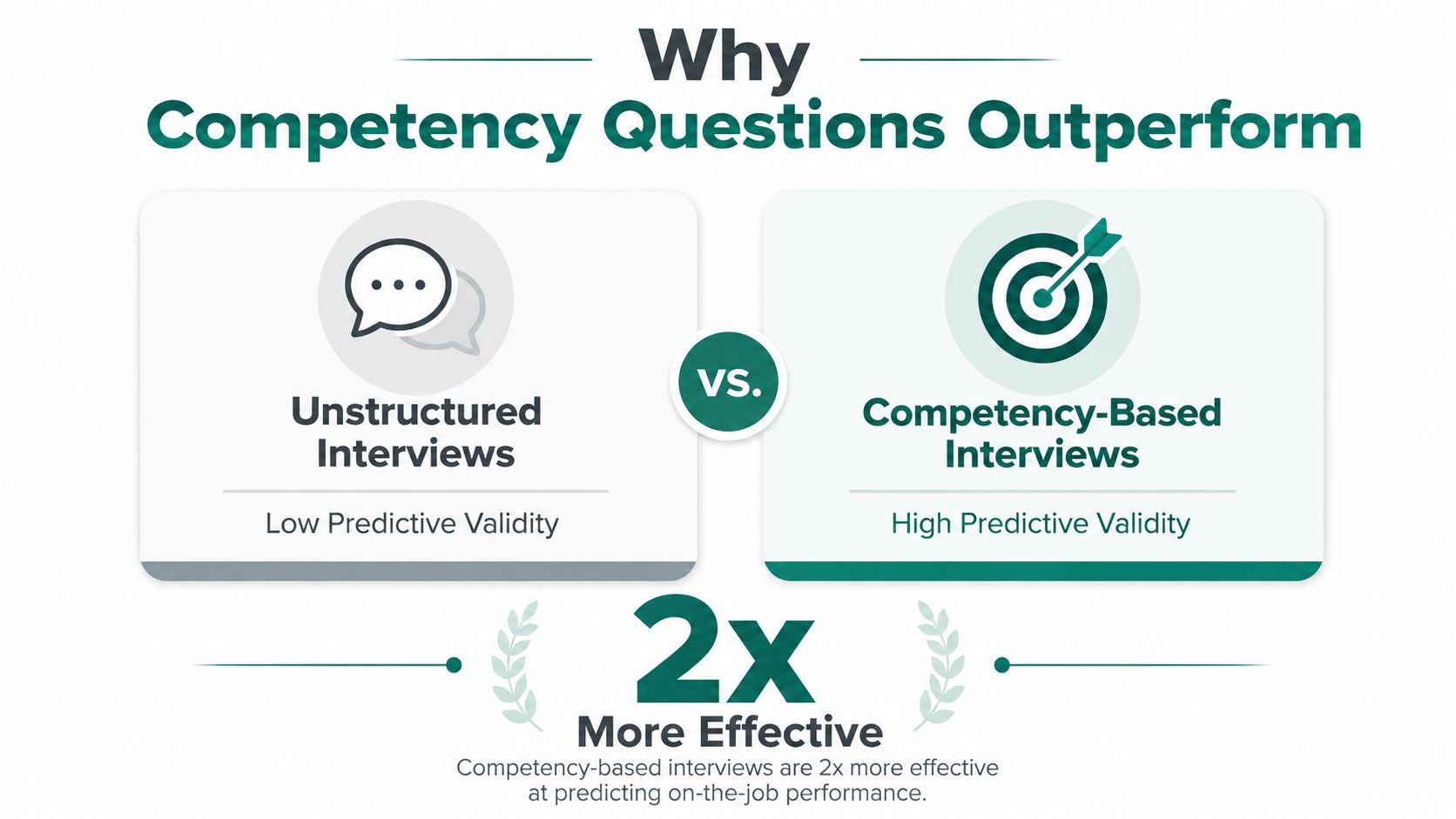
A major meta-analytic review of employment interviews covering **12,847 structured interviews** found a mean corrected validity of **.63 for structured interviews, compared with .20 for unstructured interviews**. The same review found structured interviews predicted job performance more effectively overall, with validity of **.44 versus .33** for unstructured interviews, according to the [employment interview meta-analysis](https://home.ubalt.edu/tmitch/645/articles/McDanieletal1994CriterionValidityInterviewsMeta.pdf).
That evidence changes how hiring teams should view **competency based questions**. They aren't polished prompts for a better conversation. Used properly, they form the measurement layer of a hiring workflow, connecting job analysis, behavioral evidence, scoring rubrics, automation, and human judgment. The difficult part isn't writing a long list of questions. It's making sure the right candidates receive the same role-specific assessment, produce comparable evidence, and understand how the process treats their answers.
## Table of Contents
- [Why Competency Based Questions Outperform Traditional Interviews](#why-competency-based-questions-outperform-traditional-interviews)
- [The evidence behind the method](#the-evidence-behind-the-method)
- [Why this matters across industries](#why-this-matters-across-industries)
- [The Anatomy of an Effective Competency Question](#the-anatomy-of-an-effective-competency-question)
- [From vague prompt to measurable assessment](#from-vague-prompt-to-measurable-assessment)
- [Build the rubric before the interview](#build-the-rubric-before-the-interview)
- [Answering Competency Questions Using the STAR Framework](#answering-competency-questions-using-the-star-framework)
- [What each part should reveal](#what-each-part-should-reveal)
- [Role-Specific Competency Questions by Industry](#role-specific-competency-questions-by-industry)
- [Competency Priorities by Industry](#competency-priorities-by-industry)
- [Adapt the follow-ups, not just the opening line](#adapt-the-follow-ups-not-just-the-opening-line)
- [Addressing Bias and Candidate Fairness Concerns](#addressing-bias-and-candidate-fairness-concerns)
- [Where fairness breaks down](#where-fairness-breaks-down)
- [Integrating Competency Questions into Automated Screening](#integrating-competency-questions-into-automated-screening)
- [A practical screening architecture](#a-practical-screening-architecture)
- [What automation shouldn't do](#what-automation-shouldnt-do)
- [Building Your Competency-Based Hiring Workflow](#building-your-competency-based-hiring-workflow)
- [A practical implementation sequence](#a-practical-implementation-sequence)
## Why Competency Based Questions Outperform Traditional Interviews
Unstructured interviews give interviewers wide latitude to decide what to ask, what to remember, and what to value. One candidate may spend the conversation discussing technical judgment, while another receives questions about personality or career aspirations. Even when interviewers have good intentions, those differences make comparisons unreliable.
Structured behavioral interviewing solves part of that problem by asking candidates about past actions in a standardized way. The interviewer defines the competency first, asks a consistent question, probes for evidence, and scores the response against written criteria. That sequence turns a subjective conversation into a repeatable assessment.
### The evidence behind the method
The research foundation is stronger than many hiring teams realize. The meta-analytic review cited above found a **.63 mean corrected validity for structured interviews versus .20 for unstructured interviews**, while structured interviews overall showed higher job-performance prediction, **.44 versus .33**. In practical terms, standardized questions help hiring teams gather evidence that is more consistent and more useful for predicting how someone may perform.
The review also found that **structured board interviews using consensus ratings reached a corrected validity of .64**, which helps explain why competency questions often appear in panel-based hiring. A panel doesn't automatically create fairness, though. Without a shared rubric and a disciplined consensus process, multiple interviewers can introduce multiple forms of subjectivity.
> **Practical rule:** Structure the decision, not just the conversation.
### Why this matters across industries
A nurse, maintenance technician, software engineer, and public-sector program manager need different competencies. The method still transfers because each role can be assessed through job-related questions, observable behavior, and defined scoring standards.
In healthcare, a question might examine escalation and patient safety judgment. In manufacturing, it may test how a supervisor responds to a production interruption. In tech, it could explore incident ownership or communication during a system failure. The wording changes, but the operating principle stays the same: **ask every candidate for evidence tied to the work, then evaluate that evidence consistently**.
The operational gap appears after the script is written. Many organizations have structured questions in a document but still rely on free-form notes, memory, and inconsistent interviewer interpretation. Competency based questions only deliver their full value when the workflow preserves standardization from screening through final panel review.
## The Anatomy of an Effective Competency Question
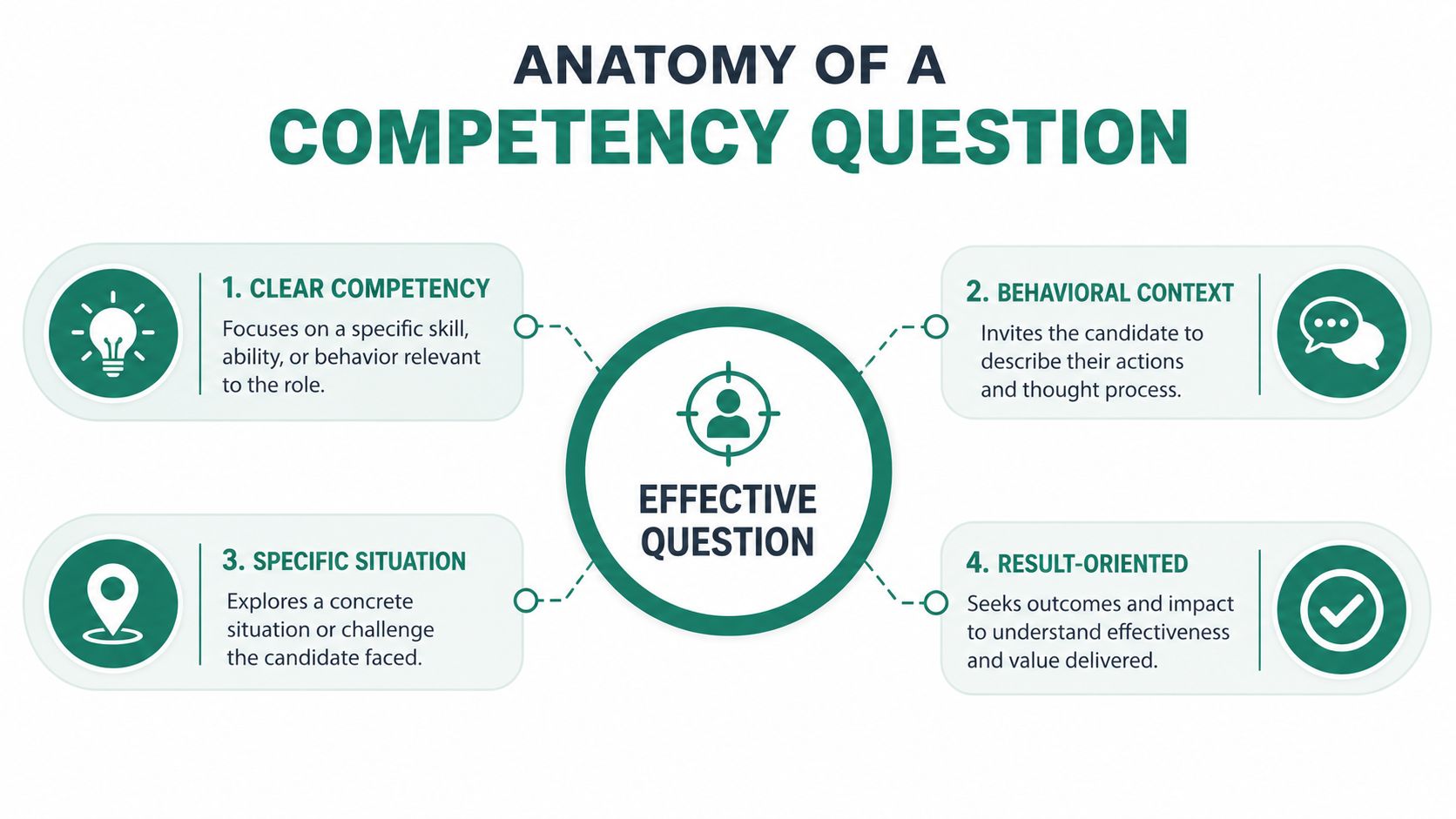
A strong competency question has four connected parts: a defined competency, a behavioral context, a specific situation, and an outcome that can be examined. The question itself matters, but the scoring logic matters more. A beautifully worded prompt still fails if interviewers don't know what strong, acceptable, or weak evidence looks like.
Start with job analysis. Identify what successful performance requires, then translate those requirements into competencies such as clinical judgment, prioritization, collaboration, initiative, compliance, or technical troubleshooting. Avoid copying a generic question list into every requisition. A competency is useful only when it maps to actual job duties.
### From vague prompt to measurable assessment
Weak question: “Are you good at handling pressure?”
That prompt invites self-description. Candidates can answer confidently without demonstrating anything, and interviewers may reward fluency rather than evidence.
Structured question: “Tell me about a time you had to manage competing priorities during a high-pressure shift. What was happening, what responsibility did you own, what actions did you take, and what was the outcome?”
The second version gives the candidate a defined path to a real example. It also gives the interviewer a basis for follow-up:
- **Context:** What made the situation high pressure?
- **Ownership:** Which decisions belonged to the candidate?
- **Action:** What did the candidate personally do?
- **Judgment:** How did the candidate decide what came first?
- **Outcome:** What changed, and what did the candidate learn?
A rubric should convert those observations into a consistent rating scale. A fair rubric can use **defined criteria, behavioral indicators, and a consistent scale such as 1–5**, with each score tied to observable behavior rather than personal impressions, as described in this [interview rubric guidance](https://vidcruiter.com/interview/structured/interview-rubric/).
### Build the rubric before the interview
For example, a prioritization rubric might distinguish evidence this way:
| Rating | Observable evidence |
|---|---|
| Low | Gives a general opinion, can't describe a specific situation, or focuses mainly on what the team did |
| Developing | Describes a relevant situation but provides limited ownership or unclear decision logic |
| Strong | Explains priorities, actions, stakeholder communication, and the resulting outcome |
| Exceptional | Shows sound judgment, anticipates risk, reflects on trade-offs, and improves the process afterward |
Don't let the scale become a personality score. “Seemed confident” isn't an anchored behavior. “Explained a decision, identified the risk, and communicated the trade-off to affected stakeholders” is much more defensible.
Current practice typically uses **three to six competency questions in a standard 45- to 60-minute interview**, according to [structured behavioral interview guidance from Arizona public-sector HR](https://hr.az.gov/structured-behavioral-interviews). Sequence the questions from accessible experiences to more demanding scenarios, and leave enough time for consistent probes. For further design guidance, see [how to write interview questions](https://www.talentpronto.ai/blog-posts/how-to-write-interview-questions).
## Answering Competency Questions Using the STAR Framework
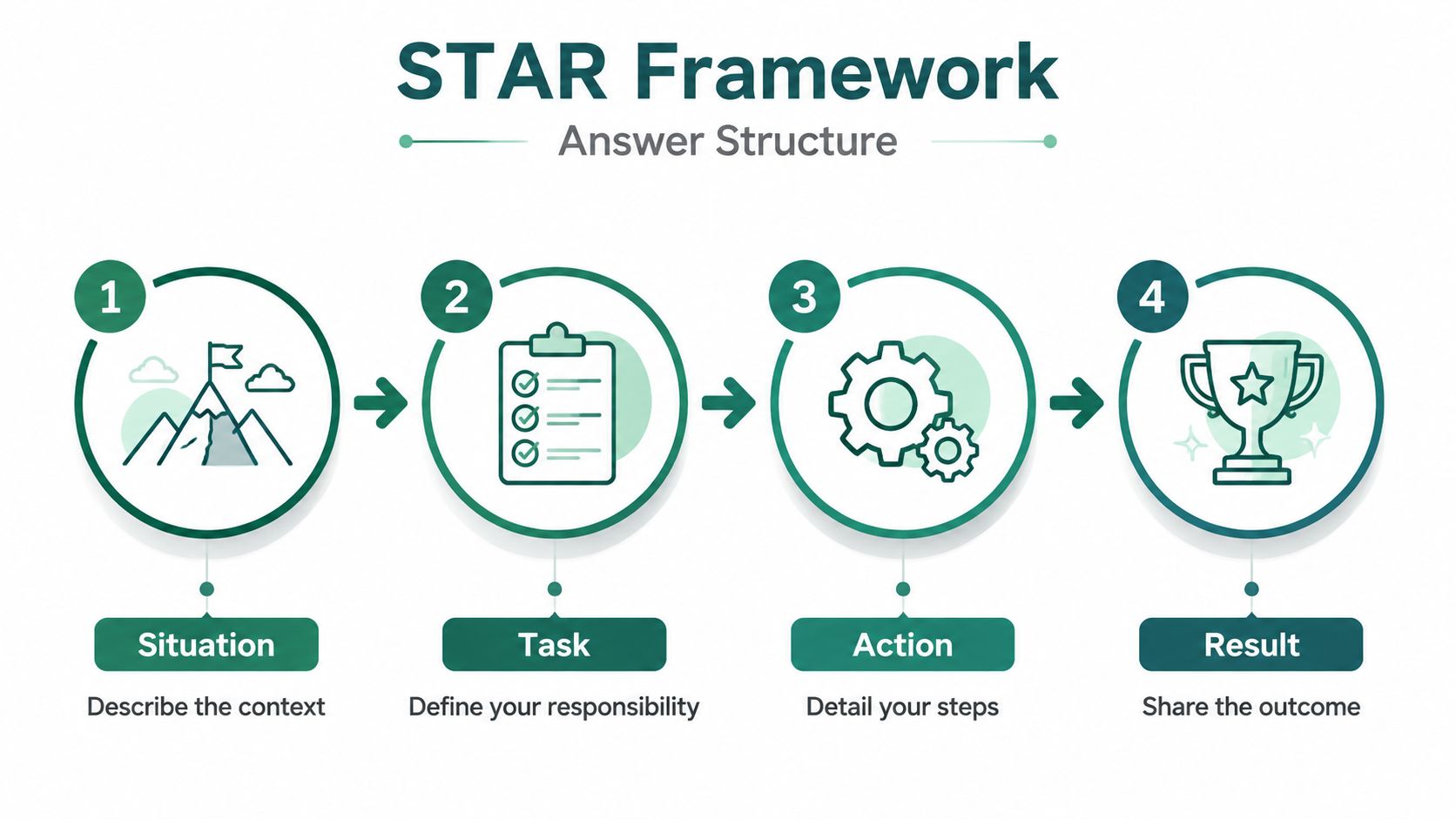
Candidates often know what they did but struggle to explain it in a way an interviewer can score. Hiring managers face the opposite problem. They may hear a polished story but fail to separate the context from the candidate's actual contribution. The **STAR framework**, Situation, Task, Action, and Result, gives both sides a shared structure.
Behavioral interviewing commonly uses STAR to surface specific past examples and assess how the candidate acted in a real context rather than in a hypothetical one, as explained in this [competency-based interview scoring resource](https://www.shineinterview.com/competency-based-interview-scoring/).
### What each part should reveal
**Situation** establishes the setting. The candidate should explain the relevant context without spending the entire answer on background.
**Task** clarifies responsibility. Listen for what the candidate needed to accomplish and what constraints shaped the work.
**Action** carries the most assessment value. Strong answers use “I” where appropriate and describe decisions, trade-offs, communication, and execution. “We created a solution” doesn't tell you what the candidate contributed.
**Result** closes the loop. The outcome may involve quality, safety, customer experience, delivery, team performance, or learning. A candidate doesn't need a dramatic success story, but should explain what changed and what they took from the experience.
> **Listen for ownership before eloquence.** A concise answer with clear decisions is more useful than a polished story filled with team-level language.
Interviewers can use neutral probes when an answer is incomplete:
1. “What was your specific responsibility?”
2. “What options did you consider?”
3. “How did you decide what to do?”
4. “What happened after you took that action?”
5. “What would you change if you faced the situation again?”
Red flags include hypothetical answers to a behavioral prompt, excessive credit assigned to the team, an inability to describe personal actions, and a missing result. None of these signals should trigger automatic rejection. They should trigger a consistent follow-up, followed by scoring against the rubric rather than intuition.
Candidates can prepare by selecting examples that demonstrate the competencies in the job description, then practicing concise STAR responses. Interviewers should avoid coaching candidates toward a preferred story. Their responsibility is to create enough structure for evidence to emerge while giving every applicant a comparable opportunity to provide it.
## Role-Specific Competency Questions by Industry
A generic competency library is a starting point, not a hiring system. The same label can describe very different behavior depending on the environment. “Adaptability” for a hospital nurse involves changing clinical priorities safely, while adaptability for a manufacturing lead may involve responding to equipment downtime, staffing changes, or revised production requirements.
Recent behavioral-question trend guides identify repeated themes around **adaptability, initiative, complex problem solving, communication style differences, and change management** in **2025–2026**, as reported by [HR Cloud's competency question guide](https://www.hrcloud.com/resources/interview-questions/competency-based-interview-questions). Those themes still need role-specific translation.
### Competency Priorities by Industry
| Industry | Top Competencies | Example Question |
|---|---|---|
| Healthcare | Patient safety judgment, empathy, escalation, compliance | “Tell me about a time you identified a risk to patient care. What did you do, and how did you involve the right people?” |
| Manufacturing | Safety discipline, troubleshooting, shift leadership, process improvement | “Describe a production disruption you managed. How did you protect safety, restore operations, and communicate the impact?” |
| Retail | Customer judgment, resilience, prioritization, initiative | “Tell me about a time you handled an upset customer while keeping other customers and team needs moving.” |
| Hospitality | Service recovery, teamwork, adaptability, communication | “Describe a time a guest request conflicted with operational constraints. How did you resolve it?” |
| Government | Accountability, policy application, public service, impartiality | “Tell me about a time you had to apply a policy while responding to an unusual or sensitive circumstance.” |
| Technology | Complex problem solving, ownership, collaboration, change management | “Describe an incident where you had incomplete information. How did you investigate, decide, and communicate?” |
### Adapt the follow-ups, not just the opening line
Healthcare interviewers should probe documentation, escalation, and safety boundaries. Manufacturing interviewers should ask about lockout procedures, production priorities, and team coordination. Public-sector hiring teams should examine policy consistency and accountability, while tech teams should distinguish individual technical action from group activity.
Role variation also affects the evidence threshold. A frontline role may require a short, concrete example of following procedure under pressure. A senior role may require evidence of influencing stakeholders, anticipating second-order effects, and improving systems.
The practical test is simple: remove the job title from the question and ask whether the prompt would still make sense for several unrelated roles. If it would, the question probably needs more job context.
## Addressing Bias and Candidate Fairness Concerns
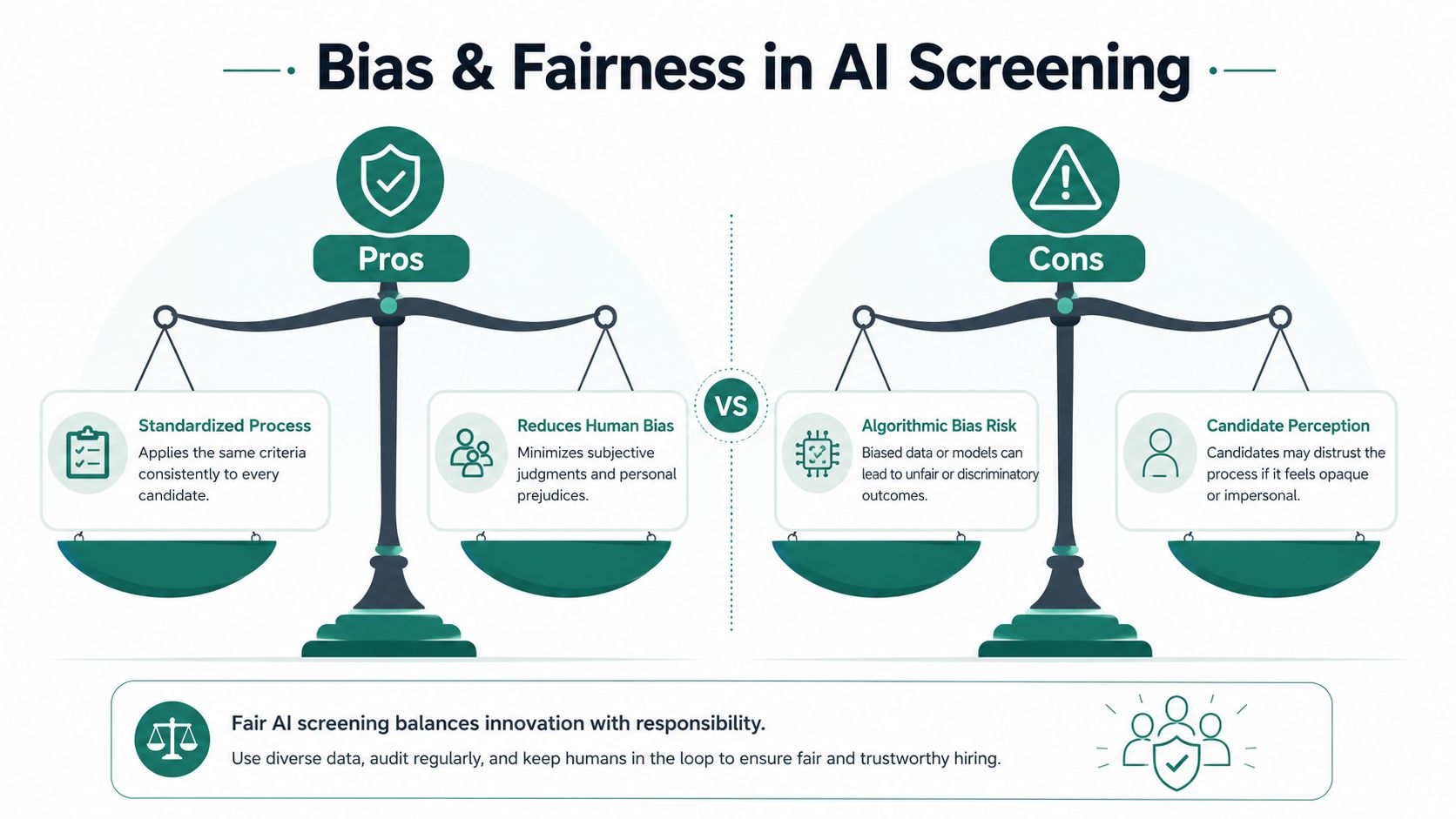
Structure can reduce bias, but it can't eliminate it. A rubric may standardize scoring while preserving a flawed competency definition, rewarding a communication style unrelated to job performance, or failing to recognize valid experience gained outside conventional workplaces.
Candidate perception adds another layer. A **2025 study found applicants expect AI-based interviews to be more objective than human interviews, while also worrying more about bias differences and uniqueness neglect**, meaning automation can appear fairer while raising concern that context and individuality may be ignored, according to the [study of applicant expectations about AI interviews](https://arxiv.org/html/2501.14110v1).
### Where fairness breaks down
A standardized workflow can create actual consistency because candidates receive the same role-related questions and answers are evaluated against predefined criteria. Federal guidance describes structured interviews as improving validity, rater reliability, and agreement while reducing adverse impact relative to unstructured interviews, provided the process is designed and administered correctly, as outlined by the [U.S. Office of Personnel Management](https://www.opm.gov/policy-data-oversight/assessment-and-selection/other-assessment-methods/structured-interviews/).
The risks appear when teams automate a weak process:
- **Poorly defined competencies:** “Executive presence” or “culture fit” can conceal personal preference.
- **Unanchored rubrics:** A rating without behavioral examples invites individual interpretation.
- **Context blindness:** A system may miss transferable experience, accommodations, or constraints that shaped an outcome.
- **Interaction bias:** Candidates may be judged on speed, accent, eye contact, or conversational style rather than job evidence.
- **Power imbalance:** Applicants may feel unable to question a process that affects their livelihood.
Transparency should be practical. Tell candidates what the interview measures, whether responses are reviewed by people, how the information supports the assessment, and how they can request help or an alternative route. Some employers and platforms offer a job-specific opt-out from AI or resume screening, although at least one documented example limits that choice to the individual job posting rather than all applications, as reflected in this [candidate discussion of screening opt-outs](https://www.reddit.com/r/recruitinghell/comments/15hqvl9/should_i_opt_out_of_having_my_resume_reviewed_by/).
Use [guidance on reducing hiring bias](https://www.talentpronto.ai/blog-posts/how-to-reduce-hiring-bias) as a design prompt, not a compliance shortcut. Audit the question, rubric, completion patterns, human overrides, and candidate feedback. Keep final advancement and rejection decisions with accountable employers rather than treating an automated score as a verdict.
## Integrating Competency Questions into Automated Screening
Automation improves screening when it preserves structured interviewing rather than reducing assessment to a faster form submission. A role-aware workflow begins with job analysis, maps relevant competencies to the role, presents consistent questions, captures answer evidence, and applies a predefined scorecard. The operating goal is consistent treatment without hiding the reasoning behind a candidate's result.

Use the structured-interview principle described in the [U.S. Office of Personnel Management's structured interview guidance](https://www.opm.gov/policy-data-oversight/assessment-and-selection/other-assessment-methods/structured-interviews/): connect questions to prior job analysis, ask role-specific questions consistently, and score answers against defined criteria. The automation layer should support that discipline, not replace it.
### A practical screening architecture
A workable system separates the process into layers:
1. **Role configuration:** Set required competencies, technical requirements, compliance topics, disqualifying conditions, and acceptable evidence.
2. **Question selection:** Assign behavioral and technical prompts to the role instead of relying on a universal script.
3. **Conversational delivery:** Allow neutral clarification when an answer is incomplete, while keeping the core assessment consistent.
4. **Evidence extraction:** Record the situation, responsibility, actions, decisions, and outcomes described by the candidate.
5. **Rubric scoring:** Apply anchored criteria and retain the underlying response for review.
6. **Human review:** Give recruiters and hiring managers access to evidence, ambiguity, and score rationale before advancement decisions.
7. **System synchronization:** Send candidate data and statuses to the ATS or HRIS, avoiding duplicate manual entry.
Talent Pronto illustrates this model. Its AI interviewer, **Anna**, conducts conversational screening, asks behavioral and technical questions based on employer-provided role criteria, prepares structured scorecards, supports scheduling, and integrates with Greenhouse, iCIMS, Paylocity, ADP, and Workday. The employer still makes advancement and rejection decisions. Candidates can use an opt-out route when they prefer traditional application submission, as described in the [AI interview assistant overview](https://www.talentpronto.ai/blog-posts/ai-interview-assistant).
### What automation shouldn't do
Do not automate final judgment. A score can organize evidence, identify missing information, and prioritize review, but recruiters need to see the response, the rubric applied, and any uncertainty the system flags.
Do not let the platform change competency standards during screening. Set weighting before launch, test the workflow with representative answers, and check whether equivalent evidence receives equivalent treatment. Consistency depends on stable, job-related, explainable criteria and accountable human review.
## Building Your Competency-Based Hiring Workflow
A reliable competency-based workflow starts with a controlled rollout, not a company-wide launch. Use one role to test the questions, rubric, automation, and human review before expanding.
### A practical implementation sequence
**Begin with one role.** Select a position with meaningful applicant volume or inconsistent evaluation. Document its duties, success behaviors, technical requirements, and compliance boundaries.
**Map competencies to evidence.** Define what a strong response must show for each competency. Separate job-related evidence from polished language or background advantages.
**Write questions and probes.** Use behavioral prompts for past actions, situational prompts for judgment, and technical prompts for role capability. Keep core questions consistent, while allowing neutral follow-ups when answers lack detail.
**Create anchored scoring.** Describe weak, developing, strong, and exceptional evidence through observable behaviors. Score the response against the rubric, not the candidate's communication style.
**Pilot the workflow.** Compare automated scorecards with recruiter notes, interviewer ratings, completion patterns, and advancement decisions. Investigate disagreements, overrides, and questions that measure access to prior opportunities rather than job capability.
**Scale with governance.** Assign an owner for rubric changes, review question sets as roles change, and audit reliability and adverse impact. Automation can manage early-funnel volume, while accountable human panels assess finalists.
The meta-analytic evidence favors structured interviews and consensus ratings, which is the operating model automated early screening plus accountable human review is designed to support. Talent Pronto helps employers convert competency based questions into role-aware conversational screening, structured scorecards, scheduling, and ATS or HRIS workflows. The hiring team retains final advancement and rejection decisions. Visit [Talent Pronto](https://talentpronto.ai) to review its approach to a consistent, auditable early-stage process.