# High Volume Recruiting Playbook That Scales Without Chaos
*Published 2026-08-14*
> Master high volume recruiting with a proven playbook for sourcing, 24/7 screening, scoring, ATS integration and analytics that converts applicants to hires.
Source: https://www.talentpronto.ai/blog-posts/high-volume-recruiting
---
You already know the feeling. The requisitions stack up, hiring managers want starts next week, and the screen queue keeps growing while good candidates slip away to whoever replies first. In high volume recruiting, the problem usually isn't just finding applicants, it's keeping the process fast, fair, and reliable once the volume hits your team all at once.
## Table of Contents
- [What High Volume Recruiting Really Means for Modern Teams](#what-high-volume-recruiting-really-means-for-modern-teams)
- [The workload math changes the job](#the-workload-math-changes-the-job)
- [Setting Goals KPIs and Scoring Rubrics Before You Scale](#setting-goals-kpis-and-scoring-rubrics-before-you-scale)
- [Start with the outcome, then build the rubric](#start-with-the-outcome-then-build-the-rubric)
- [What the scorecard should actually capture](#what-the-scorecard-should-actually-capture)
- [Building Your Sourcing and Always On Screening Engine](#building-your-sourcing-and-always-on-screening-engine)
- [Design the application for speed and relevance](#design-the-application-for-speed-and-relevance)
- [Use automation for the repetitive work, not the judgment call](#use-automation-for-the-repetitive-work-not-the-judgment-call)
- [Connecting ATS Integrations Scheduling and Candidate Experience](#connecting-ats-integrations-scheduling-and-candidate-experience)
- [Integrations should remove friction, not add another layer](#integrations-should-remove-friction-not-add-another-layer)
- [Candidate experience still decides whether the system scales](#candidate-experience-still-decides-whether-the-system-scales)
- [Using Analytics and Coordinator Workflows to Fix Drop Off and No Shows](#using-analytics-and-coordinator-workflows-to-fix-drop-off-and-no-shows)
- [Track where the funnel breaks](#track-where-the-funnel-breaks)
- [Use coordinator workflows to cut ghosting](#use-coordinator-workflows-to-cut-ghosting)
- [Your Implementation Timeline Templates and Next Steps](#your-implementation-timeline-templates-and-next-steps)
- [Week by week launch plan](#week-by-week-launch-plan)
- [Templates to keep the process consistent](#templates-to-keep-the-process-consistent)
## What High Volume Recruiting Really Means for Modern Teams
A hiring team knows it has entered **high volume recruiting** when manual work stops keeping up with the funnel. The shift is not just more applicants, it is more pressure on post-application reliability, fair screening, and audit-ready scoring after candidates hit the system. [Aptitude Research report](https://www.aptituderesearch.com/wp-content/uploads/2021/09/Apt_Fountain-HighVolume_Report-0821_Final11.pdf) defines the category around hiring more than **1,000 positions at a time** or receiving more than **1,000 applications per position**, and it found that **65% of companies** said they had high-volume recruitment needs today. That makes it a standard operating problem, not a niche one.
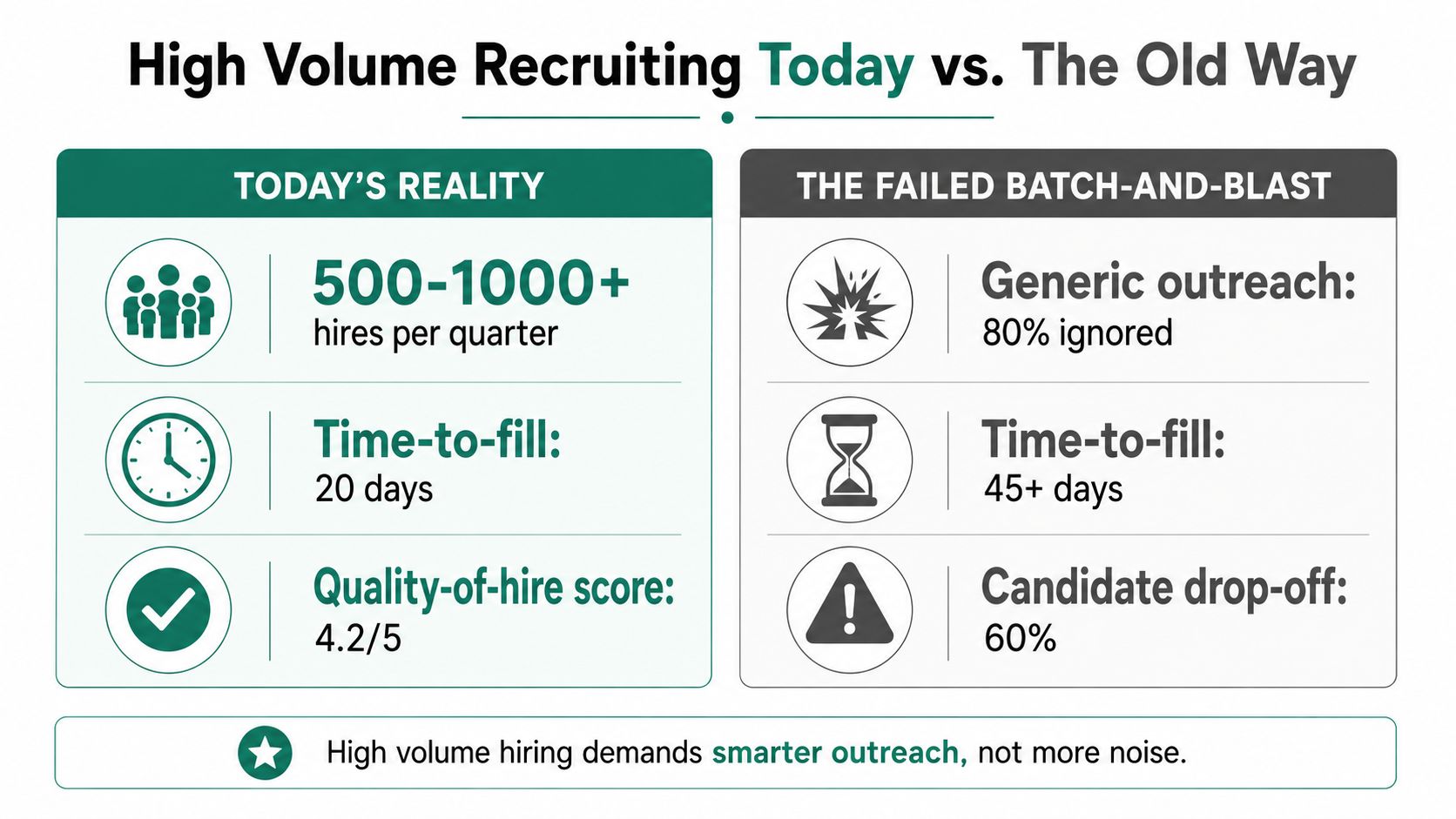
A more recent employer study showed the same trend from another angle, with **46% of all organizations** currently running active high-volume recruitment initiatives and another **30%** having done so historically ([Aptitude Research report](https://www.aptituderesearch.com/wp-content/uploads/2021/09/Apt_Fountain-HighVolume_Report-0821_Final11.pdf)). In practice, the old batch-and-blast approach breaks down quickly. When every location wants speed, every requisition behaves a little differently, and every candidate expects mobile-first communication, the team needs a repeatable process that holds up under pressure rather than heroic effort.
### The workload math changes the job
The recruiter workload numbers explain why the operating model has to change. Ashby's talent trends report says **applications per hire tripled from 2021 to 2024** and stayed above **300 applications per hire throughout 2025**, while the average recruiter was processing **291 applications per hire** compared with about **100** in early 2021 ([Ashby recruiter productivity trends](https://www.ashbyhq.com/talent-trends-report/reports/2023-recruiter-productivity-trends-report)). Gem reported the same structural pressure in a different way, with recruiters handling **93% more applications**, **40% more open roles**, and teams that were **14% smaller** than in 2021, while hires per recruiter dropped **43%** ([Ashby recruiter productivity trends](https://www.ashbyhq.com/talent-trends-report/reports/2023-recruiter-productivity-trends-report)).
> **Practical rule:** if the screen queue keeps growing faster than recruiters can return calls, you are already in a volume model whether the team has named it that or not.
The metrics that matter shift as well. In Aptitude Research's benchmark, the top measures were **time to hire/time to fill (67%)**, **retention rate (62%)**, and **quality of hire (59%)**, which is a reminder that speed alone does not define success. For teams using a [high volume hiring strategy framework](https://www.talentpronto.ai/blog-posts/high-volume-hiring-strategies), the category is not just “more applicants.” It is structured screening at scale, with enough consistency that hiring managers can trust the output and candidates get a fair read even when volume spikes.
That definition is the right filter for deciding whether your team needs a volume operating model now. If the answer is yes, the next move is to set goals and scoring before sourcing starts, because that is where scale stays controlled or turns into chaos.
## Setting Goals KPIs and Scoring Rubrics Before You Scale
A volume hire fails fast when the team starts sourcing before it has agreed on what good looks like. The fix starts with the role, the service level, and the scorecard. If managers cannot explain the gap between a workable candidate and a strong one, automation will only speed up inconsistency.
### Start with the outcome, then build the rubric
The operating model should begin with headcount goals and role criteria, then turn those into a structured scorecard. Hiring managers, recruiters, and coordinators need to agree on what matters in the first screen, the interview, and the final decision. Once that is set, the team can standardize behavioral, technical, cultural, and compliance checks without turning the process into guesswork.
Treat each stage as an evidence checkpoint. The goal is not to force every interviewer to think the same way, it is to make their notes comparable. That gives you fairer decisions at scale, because candidates are measured against the role rather than against whoever happened to run the interview.
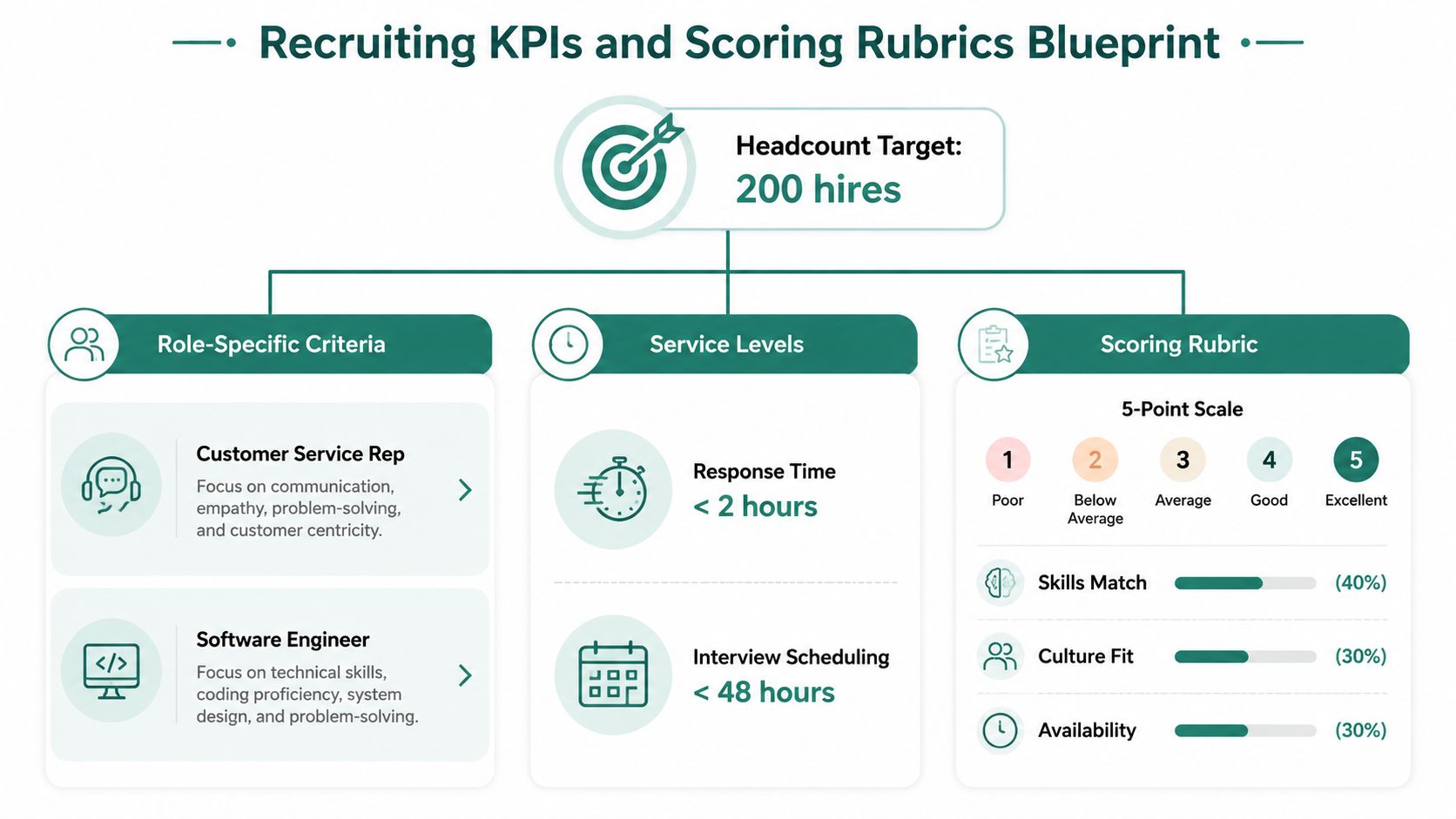
The KPI mix should match that same discipline. As noted earlier, Aptitude Research found that the most common measures for high-volume recruiting were **time to hire/time to fill (67%)**, **retention rate (62%)**, and **quality of hire (59%)**, which is a reminder that speed alone does not define success ([Aptitude Research report](https://www.aptituderesearch.com/wp-content/uploads/2021/09/Apt_Fountain-HighVolume_Report-0821_Final11.pdf)). If a team only reports time-to-fill, it will optimize for motion instead of outcomes.
### What the scorecard should actually capture
Keep the scorecard narrow enough that people can use it the same way every time, but detailed enough to separate candidates who are merely available from candidates who can perform. In most volume environments, the most useful scoring areas are:
- **Role readiness:** can the candidate do the job on day one or close to it.
- **Behavioral fit:** do they show the right habits, pacing, and reliability.
- **Availability match:** can they work the shift, location, or schedule you need.
- **Compliance checkpoints:** do they meet the core requirements of the role.
The scorecard should make bad decisions harder, not just make decisions faster.
Calibration is what keeps it honest. Hiring managers need sample answers, a clear read on the rubric, and practice scoring before live volume hits. Otherwise one interviewer's “strong hire” becomes another interviewer's “maybe,” and the funnel turns subjective again. At that point, high volume recruiting loses the consistency advantage that makes it workable in the first place.
## Building Your Sourcing and Always On Screening Engine
Once hiring volume rises, manual screening turns into the first bottleneck. Fountain notes that high-volume hiring often means filling **dozens to thousands of roles** on a compressed timeline, and its implementation guidance keeps the application **under 5 minutes** so people do not drop out before they are screened ([Fountain high-volume hiring strategy](https://www.fountain.com/posts/high-volume-hiring-strategy)). That matters because the front end of the funnel is where reliability gets won or lost, and where audit-ready scoring either starts cleanly or gets messy fast.
A strong sourcing engine is only half the job. If the post-application process is slow, inconsistent, or hard to review later, the team is still stuck reacting to volume instead of controlling it.
### Design the application for speed and relevance
The first test is practical. How quickly can someone apply on a phone without hitting friction? If the flow asks for duplicate work, account creation, or fields that do not change the hiring decision, candidates stall or abandon the form. A short application does not mean a careless process, it means you collect only what you need to route the candidate correctly.
In high volume recruiting, that usually means three moves. Ask role-specific questions that sort by availability, location, and work type. Move basic screening into a conversational flow that stays open around the clock. Use automated outreach so qualified people do not sit in a queue waiting for someone to notice them.
> **Practical rule:** every extra field has to earn its place by improving routing, not by making the form feel more complete.
The conversational layer carries more weight than many teams expect. A 24/7 screening assistant can ask the same core questions every time, answer candidate questions about pay, benefits, and culture from employer-provided information, and surface promising applicants for recruiter review without building a backlog. That matters in retail, logistics, hospitality, and healthcare, where candidates often apply outside standard office hours and expect a quick response.
The next question is reliability. If the first interaction happens after the applicant has already cooled off, the funnel slows even when sourcing is healthy.
### Use automation for the repetitive work, not the judgment call
The strongest workflow is not about piling on more automation. It is about clean handoff. [How AI assistants work in high-volume screening](https://www.talentpronto.ai/blog-posts/how-do-ai-assistants-work) is a useful reference point here, because the useful part of automation is not the replacement of judgment, it is the consistent collection of the same inputs every time so reviewers can score them fairly.
Talent Pronto is one option that fits this pattern. It conducts conversational screening, ranks candidates against role-specific criteria, and leaves final decisions to the employer rather than making them itself.
A workable screening flow usually looks like this. Source broadly, then segment fast so the response path splits by role and availability. Ask a small set of high-signal questions focused on work history, schedule, location, and any role-specific capability. Advance qualified candidates right away, and park everyone else in a respectful exit or nurture path. Keep humans focused on exceptions, borderline profiles, and final shortlists.
That structure matters because screening overload is not fixed by adding more people to a manual queue. It is fixed by making the queue smaller, cleaner, and easier to trust. Once the front end stays on all the time, the team can spend more attention on candidates who need review and less time chasing the same basic information twice.
## Connecting ATS Integrations Scheduling and Candidate Experience
A high volume recruiting system breaks down fast when candidate data lives in too many places. Status updates in one tool, interview notes in another, and scheduling in a third create duplicate entry, slower handoffs, and errors that are easy to miss until they affect a hire. The cleaner setup is to keep the ATS or HRIS as the source of truth, then connect the other systems so candidates move through the workflow without the team retyping the same information.
### Integrations should remove friction, not add another layer
Strong integrations make candidate movement feel routine for the recruiter. When ATS and scheduling tools are synced, qualified applicants can be advanced, reviewed, and booked without a coordinator rebuilding the same record over and over. That matters even more when hiring spans multiple locations or departments, because consistency breaks down quickly when each team invents its own workaround.
Scheduling deserves more attention than it usually gets. If qualified candidates wait for manual follow-up, the funnel slows even when sourcing is healthy. If they can self-schedule or get routed quickly to a coordinator for review, you keep momentum without giving up control of the process. The right setup depends on the role, but the operating rule stays the same, reduce the time between interest and interaction.
Compliance has to sit inside that same workflow. As shown earlier, top metrics prioritize time to hire, retention, and quality of hire over speed alone, so the system has to support both throughput and defensible decisions. The EEOC guidance discussed by [Cisive on EEOC guidance](https://www.cisive.com/blog/what-you-need-to-know-about-high-volume-hiring) makes that point plainly, because automated tools can create discrimination risk if they screen out qualified applicants or fail to provide reasonable accommodations. Audit-ready rubrics, documented scorecards, accommodation pathways, and human review checkpoints need to be part of the operating design, not an extra layer added later.
The scheduling workflow should also fit the way coordinators work. A clean ATS integration can route candidates by location, shift, or role, then surface only the cases that need judgment. That keeps coordinators from spending their day on data entry and lets them focus on exceptions, candidate questions, and the few profiles that need a closer look.
### Candidate experience still decides whether the system scales
Candidates feel the process long before your dashboard does. If the application is smooth but the interview invite is confusing, they still drop off. If the recruiter promises one next step and the coordinator sends another, trust erodes.
A few rules hold up across frontline and high-change environments:
- **Keep the decision criteria visible.** Candidates do better when the process feels predictable.
- **Offer an opt-out path.** Some applicants will always prefer a traditional application route.
- **Preserve human review where it matters.** Automation should support advancement, not make final hiring decisions.
- **Use consistent messaging.** Pay, schedule expectations, and role details should match across every touchpoint.
The scheduling layer is where that consistency either holds or falls apart. [Automated interview scheduling](https://www.talentpronto.ai/blog-posts/automated-interview-scheduling) helps when the problem is speed and candidate response, but it only works if the rules behind it are clear enough for recruiters, coordinators, and applicants to trust. The objective is not to remove people from the process. It is to make sure the right people reach the right calendar slot before they go cold.
## Using Analytics and Coordinator Workflows to Fix Drop Off and No Shows
A high volume funnel can look healthy right up until the handoff from application to attendance. Candidates apply, then disappear before the interview, skip the first shift, or stall after a quick reply. That is not always a sourcing problem. In many frontline hiring programs, the failure starts after the candidate has already shown interest.
### Track where the funnel breaks
The dashboard needs to show more than application counts. It should surface where candidates stop moving, how long each stage sits idle, and which locations or recruiters create delays. If one site brings in solid applicants but interview attendance stays weak, the fix may be faster follow-up, clearer expectations, or tighter scheduling rather than another burst of sourcing.
Automation changes the speed of that funnel. Manual frontline processes average **14+ days** to time-to-hire, while automated screening and scheduling commonly bring that down to **6-8 days** ([High-volume hiring guide](https://cs-recruiters.com/resources/industry-trends/what-is-high-volume-hiring-a-guide-for-hr-teams/)). The operational question is whether the team can keep quality steady while the process moves faster.
> **Coordinator rule:** review the daily funnel before you answer email, because broken pipelines usually show up in yesterday's stage movement first.
Reliability after application is the metric that gets missed. Independent 2026 data summarized by HiringBranch says **61%** of HR respondents identified no-shows at interviews or first shifts as their biggest challenge, ahead of turnover (**58%**) and hiring-manager process inefficiency (**50%**) ([HiringBranch statistics summary](https://www.hiringbranch.com/blog/25-high-volume-recruiting-statistics-to-supercharge-your-2025-hiring-strategy)). That points to a simple reality. More applicants do not solve the problem if they never arrive.
### Use coordinator workflows to cut ghosting
Once the front end is automated, coordinators matter more, not less. Their job shifts toward re-engagement, expectation setting, and quick recovery when someone misses a step. They can send follow-up messages, confirm interview details, and reschedule in one action instead of rebuilding the workflow by hand.
The best protection against drop-off usually comes from a few habits. Respond quickly, because waiting candidates keep applying elsewhere. Set expectations early, with shift details, location, pay range, and timing clear before the interview. Add a commitment step before the interview or first shift so candidates confirm intent instead of just receiving a reminder.
A lighter-touch workflow works best when it is tied to the actual failure points. If the issue is missed interviews, the team should watch response time and confirmation rates. If the issue is first-shift no-shows, the coordinator should focus on reminders, manager handoff, and any step where the candidate can still drift away. That keeps human follow-up targeted, instead of sending every stalled applicant through the same generic chase sequence.
If the team wants fewer no-shows, the goal is reliability, not just volume. More applicants do not help if they never arrive. The strongest high volume recruiting teams build around fast response, clear communication, audit-ready scoring, and human follow-up for the candidates most likely to convert.
## Your Implementation Timeline Templates and Next Steps
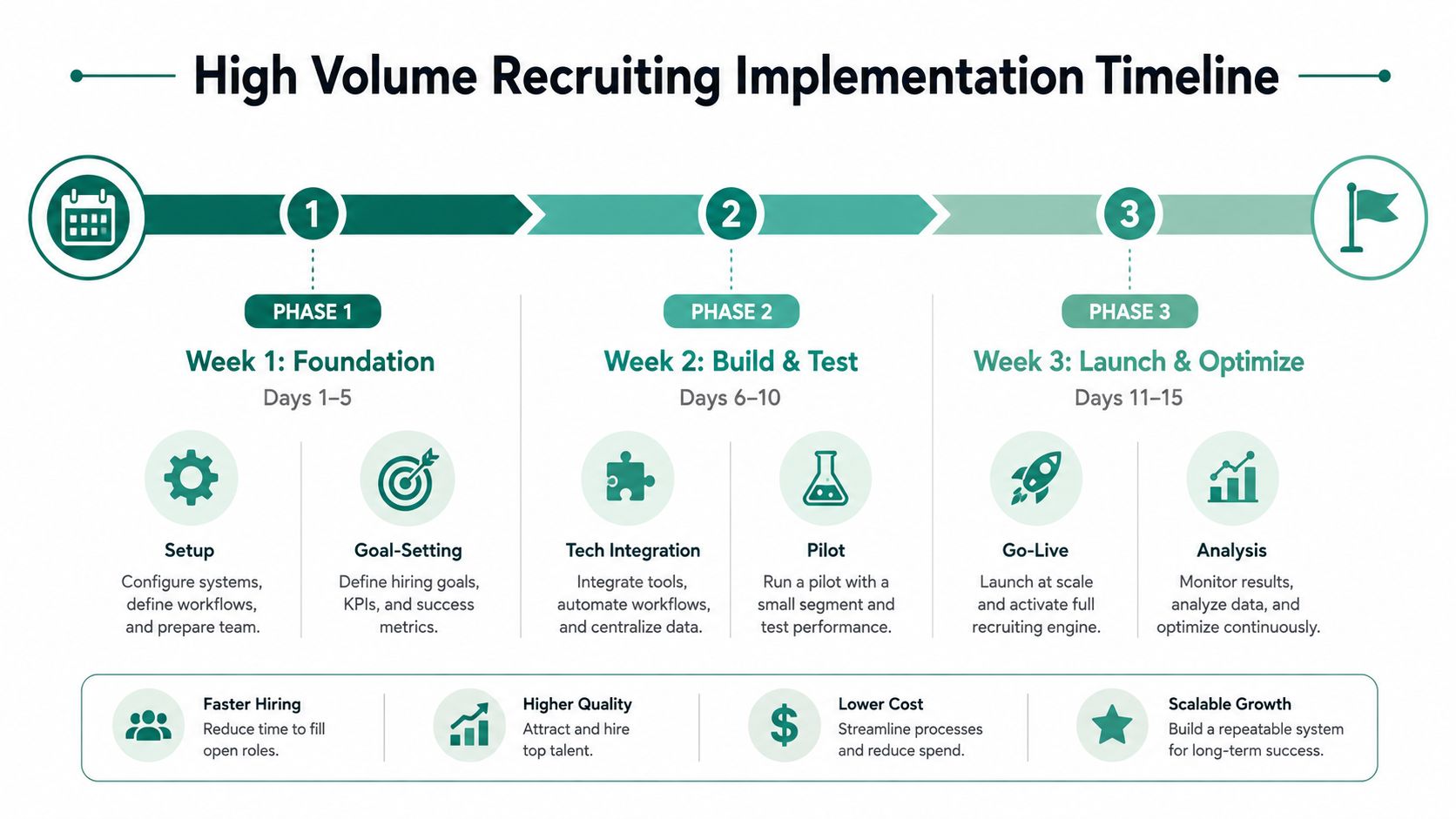
A clean rollout doesn't need months. It needs a short sequence that gets the operating model working before the volume spikes again. The simplest path is to define the rules first, test the workflow second, and launch only after the recruiter, coordinator, and hiring manager can all follow the same playbook.
### Week by week launch plan
In **Week 1**, lock the headcount goal, role criteria, and scorecard. Confirm who owns screening, who owns scheduling, and who approves final advancement. If your ATS or HRIS integration needs setup, do it here so the candidate record doesn't become fragmented later.
In **Week 2**, build and test the screening flow, interview questions, and routing rules. You check whether the candidate experience works on mobile, whether the questions surface useful signals, and whether the coordinator can move people without manual re-entry. If the process feels clunky in pilot, it will feel worse under real volume.
In **Week 3**, launch, then watch the first funnel report every day. Look for stalls, no-shows, and any place where the same issue repeats across locations. The goal isn't perfection on day one, it's removing the obvious friction before it becomes a pattern.
### Templates to keep the process consistent
Use a simple set of templates so each role follows the same logic:
- **Scoring rubric template:** define the criteria, weight them, and write one clear description of what a pass looks like.
- **Structured interview template:** keep the same core questions for each candidate in the same job family.
- **Candidate scorecard template:** capture evidence, not just opinions.
- **Outreach message template:** confirm the next step, timing, and expectation in plain language.
- **Coordinator SOP:** define what happens when a candidate doesn't respond, reschedules, or misses a shift.
Applications per hire **tripled from 2021 to 2024** and stayed above **300 applications per hire throughout 2025**, while the average recruiter was processing **291 applications per hire** compared with about **100** in early 2021 ([Ashby recruiter productivity trends](https://www.ashbyhq.com/talent-trends-report/reports/2023-recruiter-productivity-trends-report)). That workload reality is why templates matter. Without them, every new spike turns into improvisation.
The decision rule is straightforward. Automate repetitive screening, scheduling, and status updates. Keep human review for exceptions, final validation, and anything that carries compliance or judgment risk. Then measure the first **30**, **60**, and **90** days against the same KPIs you set at the start so you can tell whether the model is scaling or just looking busy.
---
Talent Pronto helps teams run conversational screening, structured scorecards, and automated interview scheduling for high volume recruiting without forcing recruiters to manage every application manually. If you're trying to tighten candidate reliability, standardize early-stage scoring, and keep the funnel moving at scale, visit [Talent Pronto](https://talentpronto.ai) and see how the workflow fits your hiring process.