# 8 Rubric Assessment Examples for Better Hiring
*Published 2026-09-17*
> Explore 8 rubric assessment examples for behavioral, technical, cultural, and compliance hiring, with scoring anchors and calibration tips.
Source: https://www.talentpronto.ai/blog-posts/rubric-assessment-examples
---
A numerical score doesn't automatically make hiring objective. A rubric can give biased preferences a polished appearance, especially when evaluators score vague traits such as “culture fit,” “confidence,” or “passion” without defining the evidence that should earn each rating. Research on rubrics shows that reliability improves when criteria are **analytic, topic-specific, and paired with exemplars or rater training**, while a rubric alone doesn't guarantee valid judgment ([research review of rubric design and scoring](https://westcollections.wcsu.edu/server/api/core/bitstreams/ae8600ed-c842-4fb6-96e1-fbe86b49d65b/content)).
Useful **rubric assessment examples** connect role requirements to observable evidence. They distinguish must-have gates from weighted competencies, give evaluators consistent language for documenting decisions, and preserve human review instead of converting a score into an automatic hiring outcome. The eight examples below organize assessment around distinct hiring decisions, from behavioral evidence and technical depth to compliance risk, growth potential, and measurable outcomes. They also show how to customize anchors, calibrate evaluators, and use structured scorecards responsibly. Tools such as Talent Pronto can support role-specific questions and structured scorecards, while employers retain advancement and rejection decisions.
## Table of Contents
- [1. Behavioral Competency Rubric](#1-behavioral-competency-rubric)
- [Customize the dimensions to the work](#customize-the-dimensions-to-the-work)
- [2. Technical Skills Proficiency Rubric](#2-technical-skills-proficiency-rubric)
- [3. Cultural Fit, Values and Diversity Inclusion Rubric](#3-cultural-fit-values-and-diversity-inclusion-rubric)
- [Test the criteria before scoring](#test-the-criteria-before-scoring)
- [4. Competency-Based STAR Method Rubric](#4-competency-based-star-method-rubric)
- [5. Critical Role Requirements Matrix Rubric](#5-critical-role-requirements-matrix-rubric)
- [Separate requirements from preferences](#separate-requirements-from-preferences)
- [6. Industry-Specific Compliance and Knowledge Rubric](#6-industry-specific-compliance-and-knowledge-rubric)
- [Score decisions in realistic scenarios](#score-decisions-in-realistic-scenarios)
- [7. Growth Potential and Learning Agility Rubric](#7-growth-potential-and-learning-agility-rubric)
- [Balance future potential with immediate readiness](#balance-future-potential-with-immediate-readiness)
- [8. Performance Indicators and Outcome-Based Rubric](#8-performance-indicators-and-outcome-based-rubric)
- [Verify attribution and the way results were achieved](#verify-attribution-and-the-way-results-were-achieved)
- [8-Point Rubric Assessment Comparison](#8-point-rubric-assessment-comparison)
- [Turn These Rubrics Into a Calibrated System](#turn-these-rubrics-into-a-calibrated-system)
- [Calibrate before the rubric reaches candidates](#calibrate-before-the-rubric-reaches-candidates)
## 1. Behavioral Competency Rubric
Behavioral competencies are useful only when they describe **what a candidate did**, not what an evaluator intuitively thinks the candidate is like. Communication, teamwork, problem-solving, and adaptability can support standardized comparisons, but each dimension needs observable anchors tied to the role.
A three-to-five-level scale can work well when the levels describe increasing evidence. A lower anchor for communication might show that the candidate gave an incomplete example and didn't clarify stakeholders, while a higher anchor could show that the candidate adapted a difficult message, confirmed understanding, and resolved a specific work problem. The score should follow the evidence in the response or work history, not the candidate's fluency, charisma, or familiarity with interview conventions.
### Customize the dimensions to the work
A healthcare system may prioritize communication and empathy for nursing or patient-facing roles. A technology company may emphasize problem-solving and innovation across engineering positions. Retail and hospitality employers may need customer service and adaptability in fast-moving environments.
Keep the rubric focused. The planning guidance for this example recommends defining **5 to 7 core competencies per role**, but that set should still reflect the most consequential success factors rather than every desirable behavior. Teams can use [questions to assess decision making and adaptability](https://synopsix.ai/blog/behavioral-assessment-questions) to build prompts that expose those behaviors.
Useful operating practices include:
- **Write behavioral anchors:** Describe actions, decisions, context, and consequences rather than labels such as “strong communicator.”
- **Use consistent prompts:** Ask candidates the same competency question, then permit equivalent evidence from different experiences.
- **Calibrate ambiguity:** Review incomplete and borderline responses together so evaluators learn when to seek clarification and when evidence remains insufficient.
- **Review the rubric regularly:** Recalibrate it quarterly as hiring outcomes, organizational values, and role demands change.
Conversational AI can probe for missing behavioral evidence, but it shouldn't infer a competency from tone or personality. The hiring team must decide whether the recorded behavior meets the job-related standard.
> **Practical rule:** Limit each role to the competencies that most affect successful performance. More dimensions don't necessarily create a fairer decision.

## 2. Technical Skills Proficiency Rubric
A technical rubric should test performance, not familiarity with terminology. Keyword checks show that a candidate has encountered a tool, while realistic tasks expose technical depth, judgment, troubleshooting, and safe execution.
Start with the hiring decision. Identify which capabilities must be present on entry and which tools can be learned after hiring. Subject-matter experts and hiring managers can then divide broad domains into discrete skills and describe foundational, working, and advanced performance for the role. A candidate may explain a programming concept accurately yet produce difficult-to-maintain code, or name a cloud platform without diagnosing a deployment failure.
Use a scenario as the scoring anchor. For example, ask, “A production deployment fails after a configuration change. How would you isolate the cause?” Score the investigation sequence, test selection, explanation of trade-offs, and attention to recovery or prevention. Do not award points merely because the candidate uses a preferred phrase.
The rubric may cover:
- **Foundational knowledge:** Can the candidate explain relevant principles accurately and identify their limits?
- **Applied performance:** Can the candidate use those principles to solve a role-specific problem?
- **Risk judgment:** Does the candidate recognize failure modes, safety concerns, and quality requirements?
- **Transferability:** Can the candidate learn a comparable tool when the exact platform differs?
Industry examples should change the anchors, not just the skill names. Healthcare roles may require evidence with Epic, Cerner, or another electronic health record platform. Manufacturing roles may assess CNC programming, PLC troubleshooting, and lean manufacturing certifications. Technology roles may examine programming languages, AWS, Azure, GCP, and DevOps tools. Pharma and biotech roles may require regulatory knowledge and analytical laboratory techniques.
Mark skills that affect safety, legal obligations, or immediate job performance as gates. Treat environment-specific tools as weighted competencies when the role allows learning time. Evaluators should review sample responses together, especially borderline cases, and record the evidence supporting each score. The scorecard organizes judgment; it should not convert an interview performance into an automatic hiring decision.
Technology changes can make examples obsolete. Update platforms and scenarios as the role evolves, while preserving the underlying capability being measured. This prevents vendor familiarity from outweighing durable technical judgment.

## 3. Cultural Fit, Values and Diversity Inclusion Rubric
“Culture fit” can reward familiarity instead of job performance. A defensible rubric measures **job-related values in action**, while allowing candidates to contribute perspectives that differ from existing team norms. The hiring decision should therefore focus on observable behavior, not social similarity.
Start with the decision the rubric must support. A health tech startup might assess commitment to patient outcomes and healthcare access. A hospitality chain could examine customer-first behavior and relevant multilingual capability. Government agencies may assess service orientation and experience with diverse communities. Retail, hospitality, and manufacturing employers may value language, cultural, or community knowledge that helps them serve customers.
### Test the criteria before scoring
The University of Maryland ADVANCE research brief explains that templates, checklists, and specific criteria can reduce implicit bias, while warning that rubrics may still contain intrinsically biased criteria ([brief on rubrics and bias in faculty hiring](https://advance.umd.edu/sites/default/files/2024-01/DoRubricsLiveuptoTheirPromiseExaminingHowRubricsMitigateBiasinFacultyHiringFINAL.pdf)). Review every criterion for job relevance. Ask whether candidates can demonstrate it through different communication styles, and whether it rewards a dominant-group norm rather than a work requirement.
Define **4 to 6 concrete cultural pillars**, then convert each into evidence-based anchors. For example, “collaborates inclusively” might require an example of inviting relevant expertise, handling disagreement, and sharing credit. Higher scores should describe specific actions and consequences. Lower scores should identify missing evidence, such as vague claims or no explanation of how the candidate treated others. Do not score accent, social similarity, or polished values language.
- **Separate the scores:** Keep values-related behavior distinct from diversity contribution. Demographic identity is not a competency.
- **Offer accessible formats:** Use flexible interview formats and communication options so the rubric measures evidence rather than avoidable barriers.
- **Calibrate evaluators:** Have panel members compare sample responses, explain their scores, and check whether they applied the same evidence standard.
- **Review outcomes:** Examine hiring and advancement results by relevant diversity dimensions to identify possible exclusion of qualified candidates.
A [culture fit assessment](https://www.talentpronto.ai/blog-posts/culture-fit-assessment) should clarify shared ways of working without preserving homogeneity. The scorecard structures judgment, but it cannot determine suitability automatically. Interviewers must inspect the evidence and challenge scores that appear to reflect personal preference.

## 4. Competency-Based STAR Method Rubric
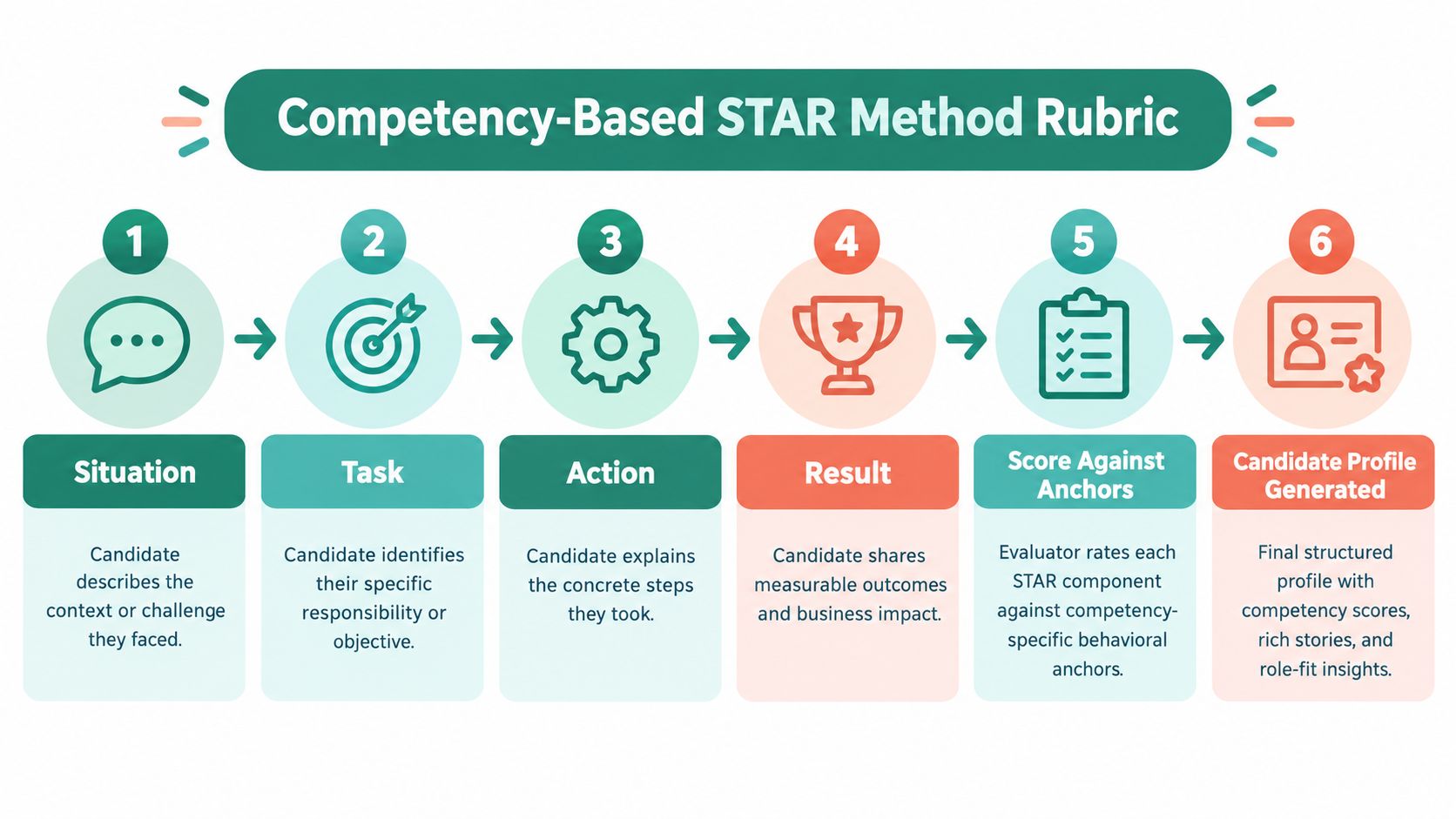
A polished STAR answer can conceal weak evidence. The **Situation, Task, Action, Result** structure should therefore support a hiring decision, not replace one. A candidate may describe an impressive outcome without showing personal ownership, or explain an action without defining the original problem. Score each component separately so fluent storytelling cannot compensate for missing evidence.
Build anchors around **situation clarity, ownership, action specificity, and results**. A high score requires a clear context, a personally owned objective, decisions the candidate controlled, and an outcome whose significance can be assessed. A low score may reflect repeated use of “we,” generic actions, unclear attribution, or no explanation of what changed.
The rubric should match the decision being made. Healthcare employers can examine clinical judgment and patient outcomes. Technology teams can assess problem-solving, project management, and innovation. Retail and hospitality employers can test responses to customer conflict and team leadership. Manufacturing employers can examine continuous improvement or safety decisions. These examples measure behavioral evidence, not storytelling style.
Use **4 to 6 competency-specific prompts** tied to the role's success factors, then set follow-up questions in advance. Ask what the candidate personally changed, how the result was assessed, and what they would revise. Follow-ups should fill evidence gaps rather than steer candidates toward a preferred narrative.
A practical scorecard can weight:
- **Result relevance:** Give outcomes meaningful weight, while recording ethical process, team effects, and constraints outside the candidate's control.
- **Ownership evidence:** Distinguish the candidate's decisions from collective activity.
- **Action quality:** Look for specific choices, trade-offs, and reasoning rather than confident delivery.
- **Learning signal:** Record whether the candidate applied the experience to later decisions.
Allow thinking time and accept concise answers. This reduces the chance that speed, accent, or verbal polish becomes an unplanned scoring criterion. Interviewers should compare sample responses before interviews, explain their ratings, and calibrate what counts as sufficient evidence. A scorecard organizes judgment; it does not make the hiring decision automatically.
Conversational AI can ask a follow-up when a STAR element is absent and preserve the transcript for review. Employers still need to verify attribution, context, and evidence before using the score. Interviewers seeking a consistent question sequence can use this [guide to the STAR method for interviewing](https://www.talentpronto.ai/blog-posts/star-method-for-interviewing).
The following video can help interviewers standardize how they listen for structured behavioral evidence.
## 5. Critical Role Requirements Matrix Rubric
A requirements matrix should make two different hiring decisions visible: whether a candidate can proceed, and how strongly the candidate compares with others who pass. Some conditions function as **pass or fail gates**. A high overall rating cannot compensate for missing active licensure in a clinical role, an absent security clearance where it is required, or a safety condition the employer cannot waive.
The matrix should therefore begin with a short gate review, followed by weighted criteria for capabilities that can distinguish qualified candidates. Healthcare systems may check active licensure and relevant certification. Manufacturing employers may require CNC certification or substantial equipment-operation experience for a lead position. Technology companies may assess fluency in a specific programming language or a cloud certification. Government agencies may require security clearance or citizenship, while pharma and biotech employers may assess advanced academic preparation and regulatory knowledge.
### Separate requirements from preferences
A requirement belongs in the gate column only when the job, law, safety conditions, or operating model provides a clear reason. Hiring managers should review each proposed gate with subject-matter experts, compare it with capabilities shown by successful employees, and distinguish mandated conditions from preferences inherited from an old job description. Recheck the matrix as the role, technology, or labor market changes.
Use evidence fields beside each criterion: credential status, relevant experience, verification source, and reviewer notes. A candidate who passes every gate can proceed to weighted evaluation. A trainable gap should prompt human review, not automatic rejection. A true legal or safety gap should end the process with an accurate explanation. Someone who meets most requirements may fit an alternate role or development path.
Tell candidates which conditions are required when possible. This supports informed self-selection and limits wasted effort. Conversational screening can verify credentials early, but it should preserve the evidence and route exceptions to an employer for review.
The [candidate screening matrix](https://www.talentpronto.ai/blog-posts/candidate-screening-matrix) offers a starting structure for mapping requirements. Evaluators still need calibrated interpretations, job-related rationales, and periodic review. The matrix organizes evidence. It does not make the hiring decision automatically.
## 6. Industry-Specific Compliance and Knowledge Rubric
Compliance assessment should answer a practical question: can the candidate recognize and respond to risks that the role creates? It shouldn't become a trivia contest that rewards memorized regulatory language while ignoring judgment, communication, and execution.
Healthcare employers may assess HIPAA knowledge, patient safety protocols, and clinical compliance awareness. Pharma and biotech organizations may examine FDA regulations, GMP standards, and data integrity. Financial services and fintech teams may need AML, KYC, and broader regulatory knowledge. Government agencies may evaluate security-clearance suitability, conflicts of interest, and procurement compliance.
### Score decisions in realistic scenarios
Start with compliance, legal, and quality specialists. Ask them to identify the obligations that are essential at each role level, then create tiered expectations. Entry-level candidates may need to recognize a risk and escalate it, while experienced candidates may need to investigate, document, and coordinate remediation.
A prompt such as “You notice a HIPAA breach. What do you do?” should score the candidate's sequence of actions. Strong evidence might include containing the issue appropriately, reporting through the correct channel, protecting affected information, documenting facts, and avoiding unsupported conclusions. The exact anchor must reflect the employer's policies and applicable requirements, not an invented universal response.
Verify certifications and training separately from interview answers. A credential check establishes one kind of evidence, while a scenario establishes practical judgment. Neither should replace assessment of the broader job responsibilities.
Update this rubric when regulations or internal procedures change. Conversational AI can identify knowledge gaps early and ask consistent scenario questions, but compliance specialists and hiring teams should review edge cases. The system should support documented, comparable evidence, not issue an irreversible decision based on a single answer.
## 7. Growth Potential and Learning Agility Rubric
Growth potential is easy to confuse with enthusiasm. A candidate who speaks energetically about learning may have less evidence of adapting than a quieter candidate who taught themselves a new system, recovered from a failed project, or transferred skills across industries.
Score **observable learning behavior**. Ask about a time the candidate had to learn something unfamiliar, what resources they used, how they handled uncertainty, and how their performance changed. Probe setbacks directly. The useful signal isn't whether the candidate claims to welcome failure, but whether they can explain what they learned and what they changed afterward.
### Balance future potential with immediate readiness
A technology startup may need people who can scale with changing business demands. Healthcare systems may look for clinicians or administrators with leadership and innovation potential. Manufacturing employers can assess continuous-improvement behavior and lean-methodology thinking. Pharma and biotech organizations may value researchers who adapt as scientific priorities evolve.
Use several evidence channels:
- **Self-directed learning:** Look for relevant certifications, courses, side projects, or cross-functional work, then ask how the candidate applied the learning.
- **Feedback response:** Ask for a specific piece of difficult feedback and the behavior that followed.
- **Ambiguity management:** Explore how the candidate prioritized work when instructions or requirements changed.
- **Quality of questions:** Notice whether the candidate asks role-relevant questions that reveal deeper thinking, without scoring extroversion or conversational dominance.
Keep a separate score for current-role capability. Hiring for potential alone can leave a team without the skills it needs now. Career tracks can also recognize different forms of growth, including technical specialization and people management, rather than treating promotion into management as the only successful trajectory.
## 8. Performance Indicators and Outcome-Based Rubric
An outcome-based rubric evaluates impact, not activity. “Managed a project” says little by itself. A stronger answer identifies the relevant result, the candidate's contribution, the constraints, and the method used to achieve the outcome.
Choose **3 to 5 role-relevant performance indicators** that reflect genuine success factors. Healthcare systems might assess patient outcomes, operational efficiency, and cost management. Technology teams could examine product adoption, revenue impact, or engineering velocity. Retail and hospitality managers may be assessed on sales, customer satisfaction, and labor-cost management. Manufacturing leaders might discuss safety, throughput, quality, and equipment uptime. Pharma and biotech leaders may need evidence involving project completion, regulatory submissions, and time to market.
### Verify attribution and the way results were achieved
Ask, “Tell me about a significant business result. What was the metric?” Then ask what changed because of the candidate's work, what other people contributed, and what constraints shaped the result. A candidate who inherited a high-performing operation shouldn't receive the same attribution as someone who diagnosed and corrected the underlying problem.
A fair scorecard also accounts for context. Support roles, career changers, and candidates from different industries may influence outcomes without owning the headline KPI. Look for credible evidence of contribution, such as improved processes, reduced risk, stronger service quality, or better team performance. Don't require every candidate to produce the same type of metric.
- **Define the outcome:** State what success means for this role and which indicators matter most.
- **Test causation:** Separate the candidate's actions from team, market, or organizational effects.
- **Assess sustainability:** Ask whether the result depended on unsafe, unethical, or damaging shortcuts.
- **Record evidence:** Preserve the metric, timeframe, baseline, candidate contribution, and relevant context.
Conversational AI can probe unclear claims and ask for attribution, while humans decide whether the evidence is credible and job-related. For broader measurement guidance, see these [data-driven employee performance tips](https://majc.ai/post/how-to-measure-employee-performance/).
## 8-Point Rubric Assessment Comparison
| Rubric | 🔄 Implementation Complexity | ⚡ Resource Requirements | 📊 Expected Outcomes | Ideal Use Cases | ⭐ Key Advantages / 💡 Tips |
|---|---:|---:|---|---|---|
| Behavioral Competency Rubric | Moderate, define anchors, role customization, rater calibration | Moderate, HR/SMEs, rater training, periodic recalibration | Standardized behavioral comparisons; actionable feedback | Customer-facing, clinical, cross-role hiring, AI-guided interviews | ⭐ Consistency & bias reduction; 💡 Limit to 5–7 core competencies; calibrate quarterly |
| Technical Skills Proficiency Rubric | High, requires deep SME input and task-level indicators | High, technical tests, certifications, subject-matter experts, frequent updates | Objective assessment of technical fit; faster elimination of unqualified candidates | Engineering, IT, clinical systems, manufacturing, cloud/devops roles | ⭐ Measurable technical validity; 💡 Use scenario-based tasks; update as tech evolves |
| Cultural Fit, Values & Diversity Inclusion Rubric | High, design to separate fit from inclusion and avoid bias | Moderate‑High, DEI expertise, diverse panels, calibration | Better retention and team cohesion when inclusive; risk of homogeneity if poorly designed | Mission-driven orgs, customer-diverse roles, DEI-prioritized hiring | ⭐ Improves retention & DEI outcomes; 💡 Define 4–6 clear values; include bias safeguards |
| Competency-Based STAR Method Rubric | Moderate, structured STAR prompts and per-component anchors | Moderate, interviewer training, scoring guides, follow-up probes | Rich, evidence-based stories tied to outcomes; comparable candidate data | Leadership, project management, clinical decision-making, outcome-focused roles | ⭐ Strong evidence of past impact; 💡 Train probes for completeness; weight results heavily |
| Critical Role Requirements Matrix Rubric | Low–Moderate, decision trees and pass/fail gates; requires honest prioritization | Low–Moderate, SMEs to set deal‑breakers, automation for routing | Rapid triage; clear go/no-go decisions; transparent screening | High-volume hiring, roles with legal/certification must-haves, security-clearance roles | ⭐ Fast, transparent screening; 💡 Audit deal-breakers regularly; distinguish legal vs preference |
| Industry-Specific Compliance & Knowledge Rubric | High, legal/compliance input and scenario validation required | High, compliance/legal review, credential verification, frequent updates | Reduces regulatory risk; defensible hiring for regulated roles | Healthcare, pharma, finance, government, regulated operations | ⭐ Minimizes compliance exposure; 💡 Partner with compliance/legal and update quarterly |
| Growth Potential & Learning Agility Rubric | Moderate, create observable anchors for future-oriented traits | Moderate, behavioral probes, longitudinal tracking, calibration | Identifies high-potential hires for pipelines and mobility | Startups, growth-stage firms, succession planning, leadership development | ⭐ Good for long-term talent development; 💡 Balance potential with immediate role needs |
| Performance Indicators & Outcome-Based Rubric | Moderate–High, define KPIs, test attribution and context | Moderate, data collection, evidence validation, follow-up questioning | High predictive validity in results-driven roles; aligns hiring to business metrics | Sales, operations, product leadership, roles tied to measurable KPIs | ⭐ Strong outcome prediction; 💡 Define 3–5 KPIs, probe attribution, consider context
## Turn These Rubrics Into a Calibrated System
A collection of templates won't create consistent hiring by itself. Research has shown that rubric-based scoring can vary by project type and assessment stage, with one study finding that rubric scoring accounted for **19.27% to 39.55% of total variance** (study of rubric-based assessment variation). The finding matters because score differences can also come from raters, tasks, and interpretation. A rubric improves structure, but teams still need to test whether the structure measures what they think it measures.
Start by defining the role outcomes. Describe the work the person must perform, the risks they must manage, and the evidence a candidate could reasonably provide during the assessment. Then choose the smallest useful set of competencies. Separate essential gates from weighted dimensions, because a missing license, clearance, or safety requirement shouldn't be hidden inside an average score.
Write observable anchors for each score. A structured interview rubric commonly uses a **1 to 5 scale or descriptive performance levels** such as below expectations through exceeds expectations ([interview rubric guidance](https://www.talentpronto.ai/blog-posts/interview-scoring-rubric)). The scale matters less than the descriptors. Each level should explain what evidence the evaluator should see, what evidence is insufficient, and how the role context changes the standard.
### Calibrate before the rubric reaches candidates
Test every question against the evidence it can produce. If the prompt invites vague opinions, replace it with a scenario or past-behavior question. If the answer depends on storytelling polish, add follow-up probes and pause tolerance. If two evaluators could reasonably interpret the same answer differently, rewrite the anchor or create an example response.
Run calibration sessions using representative responses, including strong, weak, incomplete, and ambiguous answers. Have evaluators score independently, compare rationales, and agree on the evidence that should control the rating. A 2007 review found that dependable performance scoring improves when rubrics are analytic, topic-specific, and paired with exemplars or rater training, while also emphasizing that rubrics alone don't ensure valid judgments ([review of rubric reliability and validity](https://worksignal.com/blog/assessment-rubric-examples)).
After implementation, review score distributions, evaluator disagreements, candidate experience, and hiring outcomes. Look for criteria that almost everyone passes, criteria that produce persistent disagreement, and patterns suggesting that communication style or background is affecting scores. A University of Maryland guide recommends combining quantitative and qualitative ratings, which makes comparisons easier to audit and explain ([guidance on clear evaluation criteria and rubrics](https://advance.umd.edu/sites/default/files/2025-09/Constructing%20Clear%20Evaluation%20Criteria%20and%20Using%20a%20Rubric%20Research%20Brief_withExamples.pdf)).
Talent Pronto can support this operating model with role-specific conversational questions and structured scorecards. Its AI interviewer, Anna, conducts first-round screening against a job-specific rubric defined with the employer, while the employer remains responsible for reviewing evidence and making advancement or rejection decisions. Automation can standardize the early evidence collection, but accountability stays with the hiring team.
---
Talent Pronto provides 24/7 conversational screening, role-specific behavioral and technical questions, customized scoring rubrics, and structured candidate scorecards that support comparable early-stage evaluations. Visit [Talent Pronto](https://talentpronto.ai) to explore how its screening workflows can help your team apply evidence-focused rubrics across high-volume hiring.