# STAR Method for Interviewing: A Practical Guide
*Published 2026-08-09*
> Learn the STAR method for interviewing to structure behavioral answers and impress employers with real examples.
Source: https://www.talentpronto.ai/blog-posts/star-method-for-interviewing
---
You can have a strong résumé, a polished handshake, and a calm voice, then still freeze when an interviewer asks, “Tell me about a time you disagreed with your manager.” That's the moment when a lot of candidates start talking in circles, because they're trying to remember facts, sound competent, and stay brief at the same time. The **STAR method for interviewing** gives you a way to do all three without sounding rehearsed.
It works because behavioral interviews are built to test what you did, not what you say you'd do. Career guides from MIT and the National Careers Service both present STAR as a practical baseline for answering those questions with a clear story, and MIT's guide also shows how the structure helps you keep the **Action** section longest while keeping the **Result** concrete and measurable when possible ([MIT Career Advising & Professional Development](https://capd.mit.edu/resources/the-star-method-for-behavioral-interviews/), [National Careers Service](https://nationalcareers.service.gov.uk/careers-advice/interview-advice/the-star-method)). That's the relief here, because it turns a blank-slate moment into a repeatable format.
A good way to think about it is the same way many hiring teams now think about **skills-based hiring**. If you want a useful outside perspective on that shift, [TekRecruiter's skills-based hiring approach](https://www.tekrecruiter.com/post/what-is-skills-based-hiring) is a helpful companion read, because it shows why employers care more about evidence than buzzwords. STAR gives you a way to provide that evidence in a short, clean narrative, even when the interview is rushed or highly structured.
## Table of Contents
- [What the STAR Method Solves in a Behavioral Interview](#what-the-star-method-solves-in-a-behavioral-interview)
- [The Four Parts of STAR and What Each Letter Really Means](#the-four-parts-of-star-and-what-each-letter-really-means)
- [Situation paints the scene](#situation-paints-the-scene)
- [Task names your responsibility](#task-names-your-responsibility)
- [Action carries the story](#action-carries-the-story)
- [Result closes with evidence](#result-closes-with-evidence)
- [How Long Each Letter Should Be in a Real Answer](#how-long-each-letter-should-be-in-a-real-answer)
- [A Step-by-Step Workflow for Drafting Your STAR Stories](#a-step-by-step-workflow-for-drafting-your-star-stories)
- [Three STAR Answer Examples Across Different Roles](#three-star-answer-examples-across-different-roles)
- [How Interviewers Score STAR Responses on a Structured Scorecard](#how-interviewers-score-star-responses-on-a-structured-scorecard)
- [What the scorecard is really checking](#what-the-scorecard-is-really-checking)
- [How to make the scorecard work for you](#how-to-make-the-scorecard-work-for-you)
- [Common STAR Mistakes That Tank Strong Candidates](#common-star-mistakes-that-tank-strong-candidates)
- [Practice Plan and Quick Answers to STAR Method Questions](#practice-plan-and-quick-answers-to-star-method-questions)
## What the STAR Method Solves in a Behavioral Interview
A behavioral interview can feel simple on the surface and messy in the room. The interviewer asks about conflict, pressure, failure, or leadership, and your mind starts pulling from half a dozen moments at once. One story feels too small, another drifts off topic, and the best example only helps if you can explain it in a way the interviewer can score quickly.
That is the problem the STAR method is built to solve. It turns a scattered memory into a response that a hiring team can follow, compare, and evaluate without guessing. The method also matches what structured hiring systems need, including rubric-based interviews and AI-assisted screening flows, where a response has to show enough evidence to be judged fairly but stay concise enough to fit a fast review process.
> **Practical rule:** if your answer could describe anyone on the team, it is too generic. The interviewer needs to hear what **you** did, not what “the group” did.
Many hiring teams now care less about polished self-description and more about evidence of skills in action, which aligns with TekRecruiter's skills-based hiring approach. A candidate who talks in broad claims forces the interviewer to do extra interpretation. A candidate who gives a clear example makes the scoring easier and reduces the chance that a strong answer gets lost in vague wording.
The pressure point is not remembering a label. It is deciding how much detail to give. Too brief, and the example feels thin. Too much detail, and the answer loses shape before the interviewer reaches the result. STAR helps you balance those two demands by keeping the story anchored to a specific situation, your responsibility, the action you took, and what changed because of it.
That is why the method works for both people and systems. Human interviewers hear a pattern they can trust. Structured scorecards get the evidence they need. The answer stays focused, and the candidate sounds prepared instead of improvised.
## The Four Parts of STAR and What Each Letter Really Means
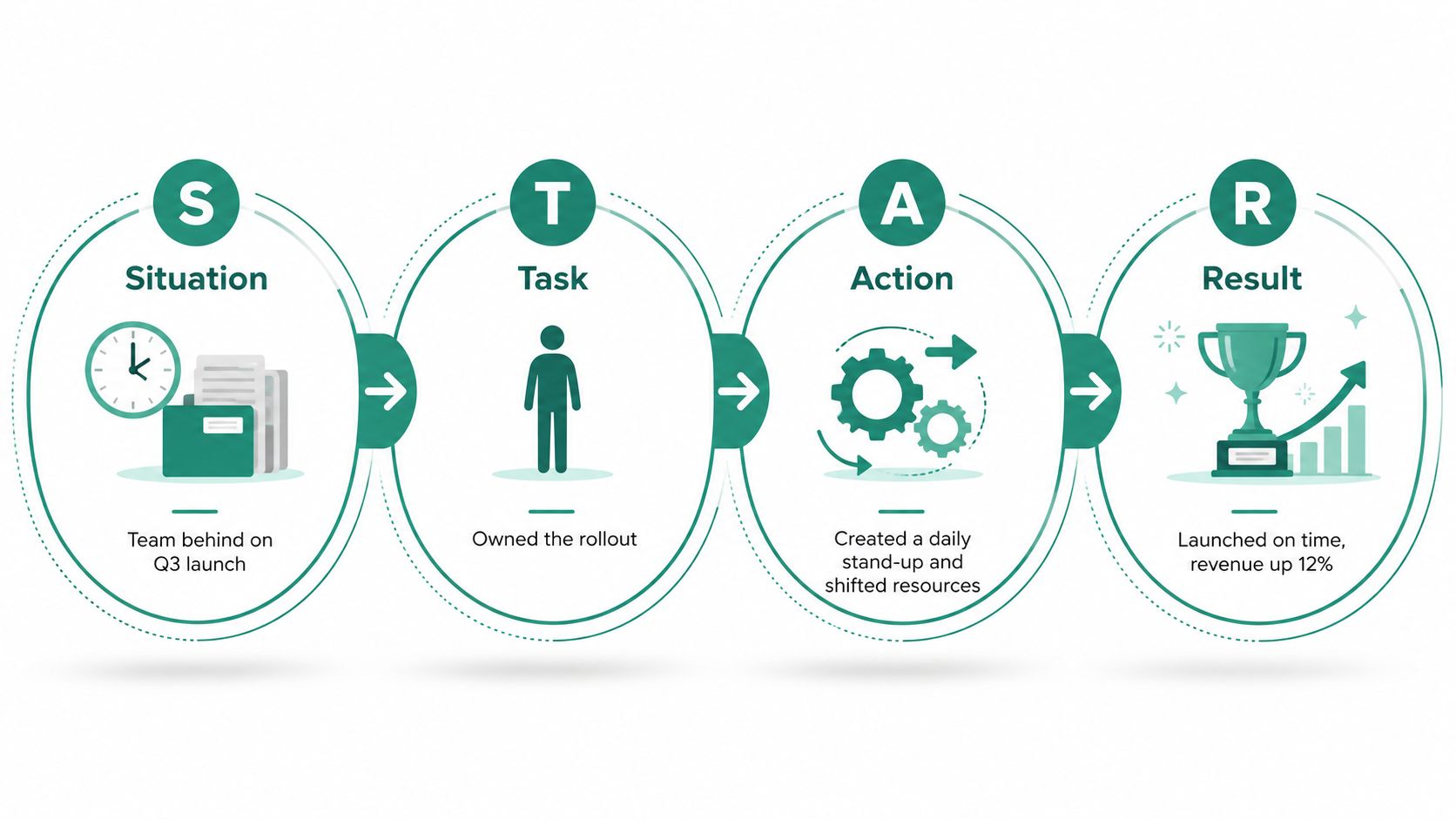
### Situation paints the scene
The **Situation** gives the interviewer the setting needed to understand why the example matters. It is the opening frame, not your full work history. A weak version sounds like, “I've always worked in busy environments,” while a stronger version sounds like, “Our team was two days from a product launch, and the customer support queue was already growing.”
> **Paint the scene, not the resume.**
That first part should give enough context for the rest of the answer to make sense. University College Dublin describes Situation as the background, which is a useful way to keep your opening focused on the moment that mattered ([University College Dublin](https://www.ucd.ie/professionalacademy/resources/career-advice/star-interview-technique/)).
### Task names your responsibility
The **Task** is where a lot of candidates blur their own role into team language. Strong answers make the responsibility clear and personal. A vague line like “We needed to fix the issue” does not tell the interviewer what was on your plate. A better version is, “I owned the customer response plan and had to decide how to prioritize complaints.”
> **The answer is about you, not the team.**
That distinction matters because interviewers are grading your judgment and ownership, not the existence of a group effort. In AI-assisted screening and structured scorecards, this part often gets treated like a label for responsibility, so if you hide behind “we,” the system and the reviewer both have less to score.
### Action carries the story
The **Action** is the part that proves how you work. It should be the longest section because it shows your choices, your trade-offs, and your execution under pressure. MIT's practical weighting gives **60%** to Action, while Northwestern uses **50%**, and both point to the same principle, the answer should spend the most time on what you personally did ([MIT Career Advising & Professional Development](https://capd.mit.edu/resources/the-star-method-for-behavioral-interviews/)).
A weak line says, “I handled it.” A stronger line says, “I reviewed the backlog, reassigned tickets, drafted the message to customers, and checked each update before it went out.” The second version gives the interviewer evidence they can score. It also helps AI-assisted interview tools detect specific behaviors instead of vague confidence.
### Result closes with evidence
The **Result** is where the story lands. It should show what changed because of your actions, and whenever possible, it should be quantified. That does not mean every answer needs a dramatic metric, but it does mean you should avoid endings like “and everything worked out.” The best closing line tells the interviewer what improved, what was learned, or what carried forward.
> **If you can count it, count it. If you can't, show the downstream effect clearly.**
That is why the STAR method works so well in structured hiring. It gives you a repeatable way to move from context to responsibility to action to outcome without slipping into vague storytelling, and it gives interviewers a cleaner path to score what they heard.
## How Long Each Letter Should Be in a Real Answer
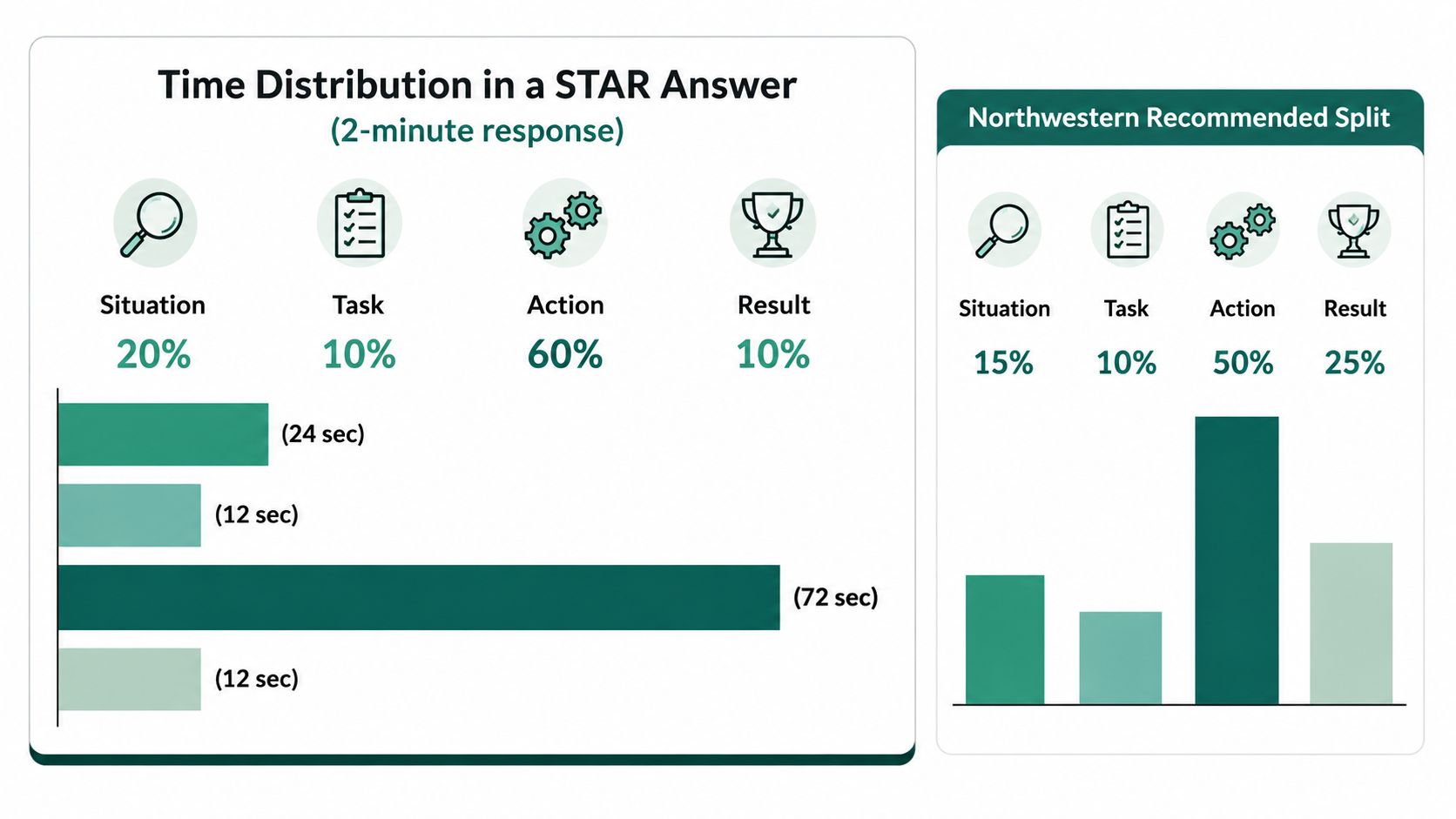
A strong STAR answer can still lose points if the timing is off. The problem is usually not the story itself. Candidates spend too long on the setup because it feels safer to explain the background first, but interview scoring systems are looking for evidence of judgment, ownership, and impact, not a long warm-up.
The simplest way to keep the answer on track is to let **Action** carry the most weight, then make **Result** clear enough to be judged. That is the part interviewers and AI-assisted scoring tools can score most directly, because it shows what you did and what changed afterward. A practical target is a response that lasts about **90 seconds to 2 minutes**.
A rehearsal split that works well looks like this:
- **Situation, 15 to 20 seconds.** Give only the context needed to understand the problem.
- **Task, 10 to 15 seconds.** State your responsibility in plain language.
- **Action, 45 to 70 seconds.** Describe your choices, trade-offs, and execution.
- **Result, 15 to 25 seconds.** Close with the outcome and the proof behind it.
That distribution matches how structured interviews usually separate signal from filler. The setup gives the interviewer the scene, the task shows your role, the action shows your judgment, and the result proves the story mattered. If any one piece gets too large, the answer starts to feel unbalanced, like a report that spends five minutes on the introduction and leaves the conclusion thin.
Candidates usually stumble in a few predictable ways. Some spend so much time on Situation that they sound like they are defending the background instead of answering the question. Others turn Action into a team recap, so the interviewer cannot tell what the candidate personally did. A third pattern is to stop at the final step without clearly stating what changed, which leaves the result hard to score.
A shorter answer can still work well if the structure stays intact. If the interviewer asks for a tighter version, trim the setup first and keep the decisions, the trade-offs, and the outcome. That is the safest place to cut because interviewers can fill in context faster than they can infer judgment.
> **Time budget check:** if the answer feels like a meeting recap, too much time went into context. If Action is thin, the response will sound polished but score poorly.
## A Step-by-Step Workflow for Drafting Your STAR Stories
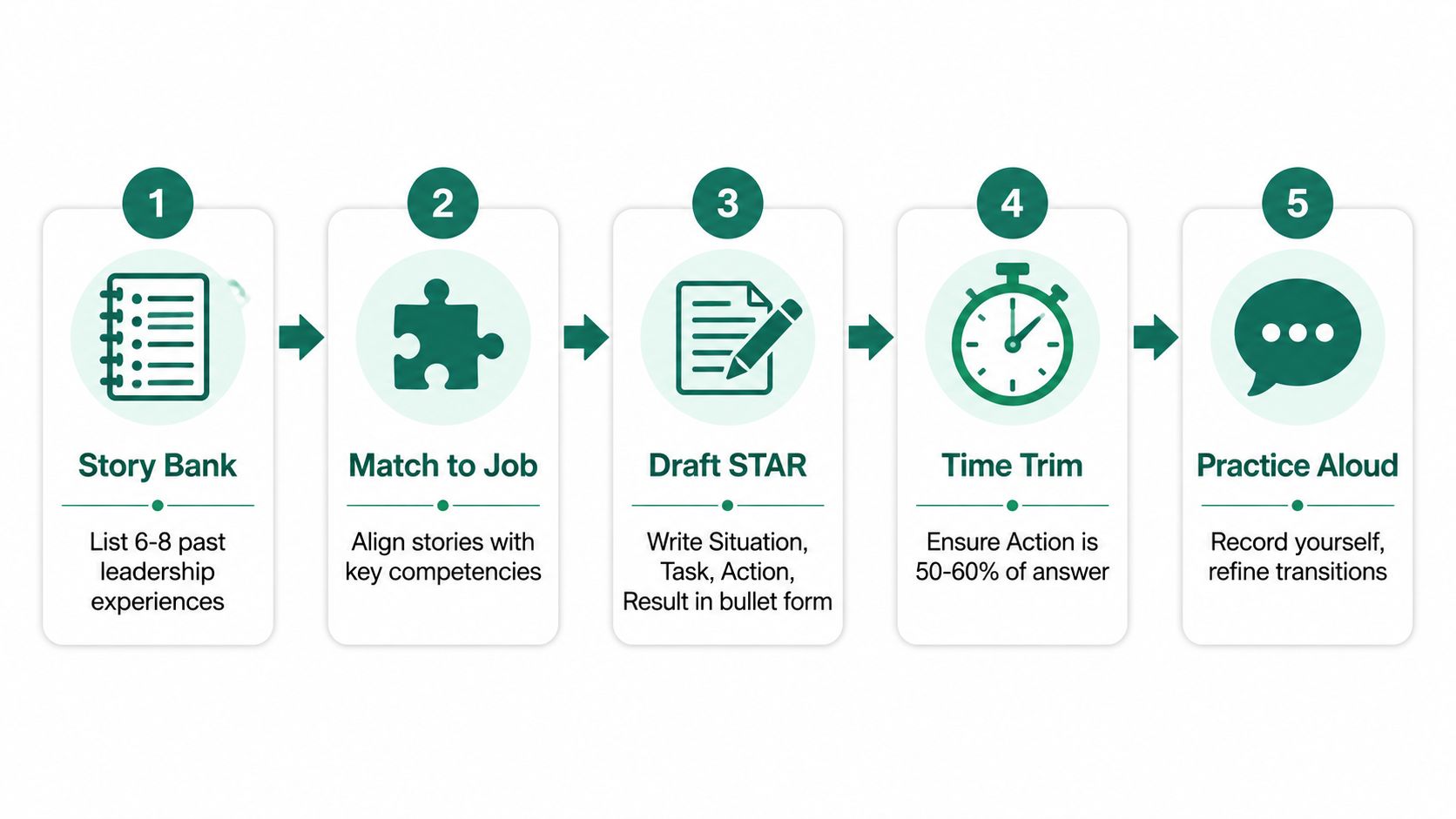
A strong STAR answer doesn't come from memory alone. It comes from sorting your experience before the interview so you're not trying to invent structure under pressure. The easiest way to do that is to build a story bank.
Start with six to eight experiences that show different strengths, leadership, problem-solving, conflict, failure, collaboration, delivery, and adaptability. For each one, write one line for the Situation, one line for the Task, and three to five bullets for the Action. The goal is to capture enough detail to speak naturally later without needing to reconstruct the whole event from scratch.
Then turn the notes into a draft answer and time it out loud. If the answer runs long, trim setup first and keep the personal decisions intact. If the result sounds vague, add the concrete effect, a number, a timeline, a process change, or a clear downstream outcome. When no obvious metric exists, describe the scale or significance carefully instead of forcing a fake statistic.
A messy set of notes might look like this:
- Team was behind on launch
- I had to help
- Talked to support and product
- Set up daily check-ins
- Fixed the issue
- Launch went better
A tighter STAR version sounds more like this:
“I joined a project where the launch was slipping because support tickets and product fixes were getting handled in separate threads. I was responsible for coordinating the response. I set up a daily check-in, grouped the open issues by priority, assigned owners for each item, and made sure the team had one shared update before the end of each day. The launch moved forward on schedule, and the team stopped losing time to duplicate work.”
Before you use a story in an interview, run it through a simple checklist:
- **Specificity.** Does the story describe one real event?
- **Ownership.** Is your role clearly stated?
- **Action verbs.** Can the interviewer hear what you did?
- **Outcome.** Does the result land cleanly?
- **Retell test.** Could a stranger summarize the answer from your version?
That last question is the one many candidates miss. If your answer is clear enough that someone else can repeat it accurately, it's probably clear enough for an interviewer to score well.
## Three STAR Answer Examples Across Different Roles
| Role | Weak Pattern | Strong Fix | Quantified Result |
|---|---|---|---|
| Customer service | Talks around the upset customer and says “we handled it” | Shows calm de-escalation, personal ownership, and a direct resolution path | Customer issue resolved with a clear satisfaction outcome |
| Software engineering | Describes the outage but not the debugging choices | Names the checks, the escalation path, and the communication cadence | Reliability or latency improvement described clearly |
| Healthcare operations | Stays on policy and avoids the actual decision made | Shows compliance judgment, patient focus, and follow-through | Training or process outcome stated concretely |
A customer service answer works best when the candidate stays calm and owns the interaction. A weak version sounds like a general story about a difficult caller and a team response. A stronger version sounds like this, “A customer was upset because an order arrived late and they had already called twice. I owned the call, checked the order history, confirmed the delay with logistics, apologized without sounding defensive, and offered the fastest corrective option I could support. The customer agreed to the replacement plan, and the follow-up note showed the issue was closed without escalation.”
The engineering version needs a different kind of clarity. Interviewers want to hear the debugging path, the communication decisions, and the part the candidate personally handled. A weak answer says, “The system went down and I fixed it.” A stronger one says, “A production incident caused a spike in errors, and I was responsible for isolating the failure. I reviewed logs, narrowed the issue to a recent deployment, coordinated with the on-call teammate, and updated stakeholders while we rolled back the change. Service stabilized, and we had a clear path for the postmortem.”
Healthcare operations often demands judgment under policy pressure, so the answer should show care and compliance together. A weak version sounds like a generic process description. A stronger version sounds like this, “A documentation issue threatened a patient handoff, and I had to make sure the record was accurate before the next shift began. I reviewed the intake notes, corrected the missing items, notified the right team members, and updated the handoff process so the same gap wouldn't repeat. The team adopted the new step, and the handoff was completed without another omission.”
These examples work because they stay close to the weighting split discussed earlier. The setup is quick, the personal action is detailed, and the result is clear enough to feel real.
## How Interviewers Score STAR Responses on a Structured Scorecard
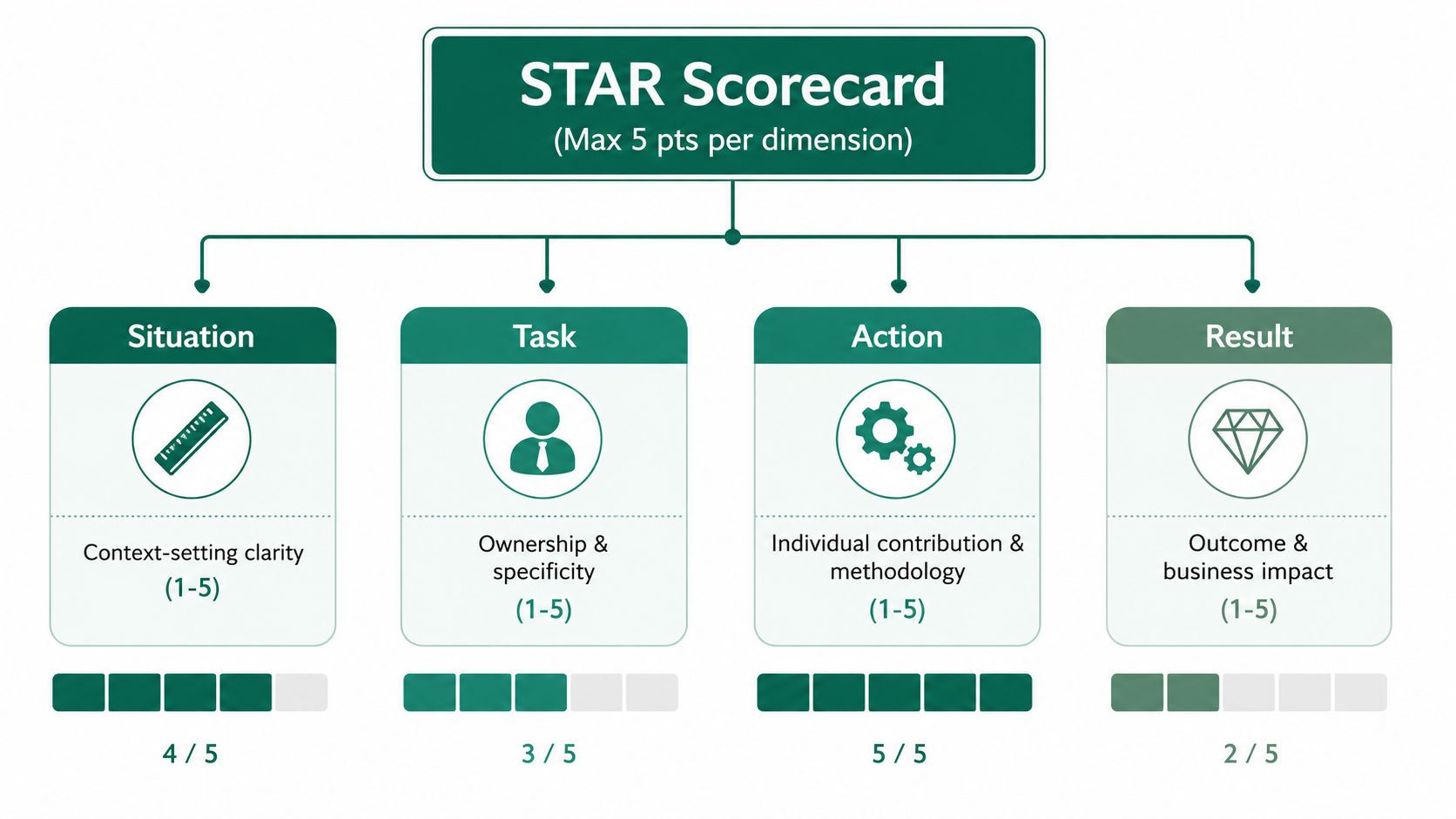
Interviewers don't just listen for a nice story. In structured hiring, they score what they hear against criteria. That's why STAR fits rubric-based interviews so well, because each letter maps cleanly to a different judgment area.
### What the scorecard is really checking
A practical scorecard usually breaks the answer into four dimensions. **Situation** gets scored for context-setting clarity, **Task** for ownership and specificity, **Action** for individual contribution and method, and **Result** for outcome and business impact. The rubric may use a simple point scale, and the interviewer uses the same question and the same criteria across candidates so the comparison is fairer and easier to defend.
That consistency matters in panels, where different people may ask the questions but still need to evaluate the same underlying skills. It also matters in AI-assisted screening systems that generate structured scorecards from candidate conversations. Those tools depend on completeness signals, clear role ownership, and evidence of impact, which is exactly why a clean STAR answer helps.
> A candidate who names the role, the decision, and the result makes the interviewer's job easier.
### How to make the scorecard work for you
The trick is to mirror the structure without sounding mechanical. Start with a direct context line, name your responsibility explicitly, spend the most time on the decision-making, and close with a result that can be evaluated. If a result has a number, use it. If it doesn't, state the operational change, the risk reduced, or the customer effect clearly.
If you're preparing interview questions for a panel or hiring process, it helps to think like the scorer. [This guide on writing interview questions](https://www.talentpronto.ai/blog-posts/how-to-write-interview-questions) is a useful companion because it shows how structured prompts are built in the first place. When you understand the prompt, you can answer it with less friction.
The broader point is that STAR isn't just a candidate trick. It matches the way modern interview systems are organized, especially when consistency, comparability, and evidence matter more than charisma alone.
## Common STAR Mistakes That Tank Strong Candidates
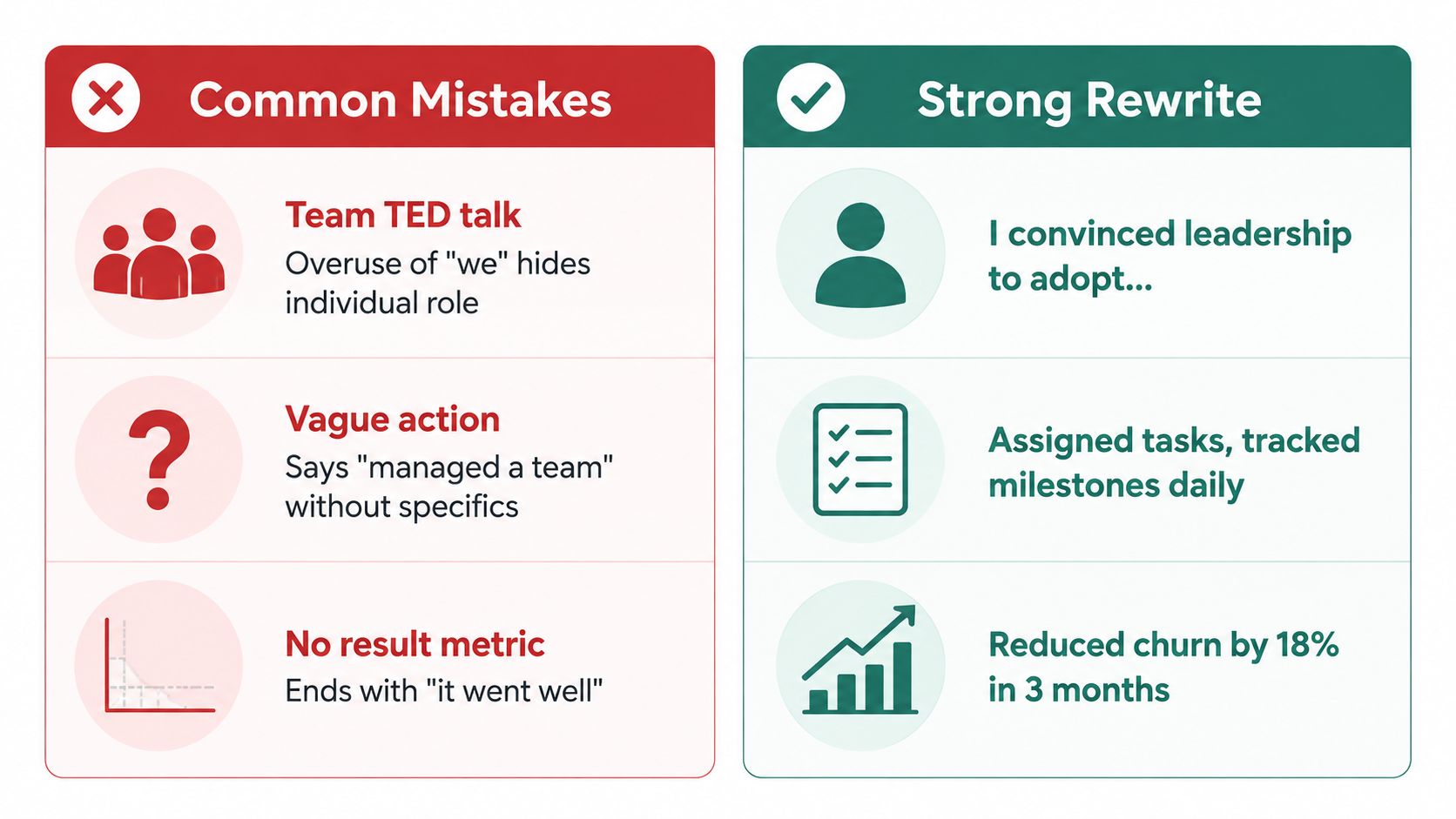
A lot of candidates do not fail STAR because they forgot the acronym. They stumble because the answer sounds safe, vague, or too team-centered for an interviewer to score with confidence. In a structured interview, that matters. AI-assisted screening tools and rubric-based panels both look for the same thing: clear ownership, enough context to understand the problem, the actions that show judgment, and a result that can be evaluated.
**Team TED talk.**
Weak: “We decided to improve the process, and we all worked hard to get it done.”
Strong: “I organized the process review, assigned owners, and changed the handoff steps so the work stopped stalling.”
That first version spreads credit so widely that no one can tell what you did. The stronger version gives the scorer something to mark, because it shows role ownership and a decision you personally drove.
**Too much setup.**
Weak: “The company had several departments, and the project involved lots of moving parts, and there was a long history behind it...”
Strong: “The project was behind schedule, and I was responsible for getting the launch back on track.”
Some candidates think more background makes them sound thorough. In practice, extra setup can hide the point of the story. Interviewers often score for clarity first, then completeness, so the context should work like a signpost, not a full map.
**Describing duties instead of decisions.**
Weak: “I managed the team and handled the issue.”
Strong: “I chose which tickets to escalate, when to loop in leadership, and how to sequence the fixes.”
Many strong candidates lose points here. Duties show that you had a title. Decisions show that you had judgment. If your answer never crosses that line, it can sound like a job description instead of evidence of performance.
**Ending without a real result.**
Weak: “It went well.”
Strong: “We cut the backlog, delivered the update on time, and avoided another delay in the next cycle.”
A result has to feel like a result to the person scoring it. That can be a number, but it does not have to be. It can also be a process change, a risk removed, a customer effect, or a deadline met. The key is that the interviewer can tell what changed because of your action.
**Reusing one story for everything.**
Weak: “I always use my strongest project story.”
Strong: “I keep several stories ready so I can match the example to the skill being asked about.”
A single story can be flexible, but it should not do all the work. Rubric-based systems reward fit, because the best answer matches the competency the interviewer is testing. If you only recycle one example, you may miss the skill behind the question even if the story itself sounds polished. For interviewers who want to train on scoring consistency, [this interviewer training resource](https://www.talentpronto.ai/blog-posts/training-for-interviewers) is a useful companion because it shows the rubric mindset from the other side of the table.
**Avoiding failure entirely.**
Weak: “I've never really made a mistake.”
Strong: “I missed an early warning sign, adjusted my process, and now I use a checklist before I escalate.”
Perfect answers can sound rehearsed, and rehearsed answers can sound less believable than a careful mistake that led to a clear change in behavior. A strong STAR response does not hide the setback. It shows what you learned, what you changed, and how that change improved later work.
Those rewrites matter because they change what the interviewer hears. The first version sounds vague and protected. The second version sounds like someone who can own a decision and explain its effect. That difference is rarely about grammar. It is about evidence.
A useful way to practice is to compare your answer to [A comparison chart showing common resume mistakes versus strong, results-oriented rewrite examples for better professional impact.](https://cdnimg.co/1e7ffc08-457d-4e19-b1a8-0bcf43179384/a8d890e8-5987-4ece-bc3c-590d400a1bca/star-method-for-interviewing-resume-tips.jpg) The same habit helps in interviews. Strong answers do not sound like a summary of participation. They sound like proof.
## Practice Plan and Quick Answers to STAR Method Questions
Start a 14-day practice plan with one goal, make your best stories easy to retrieve under pressure. Spend the first few days building your story bank, then draft three answers, record yourself, trim the length, and run two mock interviews. If a story feels weak, don't abandon it immediately, tighten the Situation, sharpen the Action, and make the Result specific.
A good companion while you rehearse is [master your opening scene](https://story.cv/blog/articles/tell-me-about-yourself), because the first minute of an interview often works the same way. You want control, clarity, and enough structure to keep the listener engaged without sounding scripted. That mindset also helps when you're preparing for different prompt styles, including [situational interview questions](https://www.talentpronto.ai/blog-posts/situational-interview-questions), which often end up in the same behavioral family.
**How many STAR stories should you prepare?**
Prepare enough to cover your most likely competencies, then add a few flexible stories you can adapt.
**Can one story answer different questions?**
Yes, if the story has enough detail to emphasize different skills. One example can show leadership, conflict handling, or problem-solving depending on what you highlight.
**What if the interviewer cuts me off?**
Answer the current part cleanly and stop. A shorter, structured response usually helps more than trying to recover with extra detail.
**What if the question doesn't fit STAR?**
Use a lighter version of the same structure. Give the context, your role, what you did, and the outcome.
**How does STAR work in short-form video interviews?**
Lead with the point faster, keep the setup compact, and make the Action and Result easy to follow without pauses or filler.
The original panic moment still shows up for most candidates. The difference is that now you've got a structure for the answer, a process for preparing it, and a practice plan that makes it usable when the interviewer asks a question you didn't expect.
---
Talent Pronto helps hiring teams run structured, conversational screening so candidates are evaluated against clear criteria instead of guesswork. If you're refining how interviews are designed or preparing for a process that uses scorecards, visit [Talent Pronto](https://talentpronto.ai) to see how structured screening can support better hiring conversations.