# Training the Interviewer: A Playbook for Hiring Teams
*Published 2026-08-12*
> Master training the interviewer with this playbook covering rubrics, calibration, AI screening, and compliance documentation.
Source: https://www.talentpronto.ai/blog-posts/training-the-interviewer
---
Most advice on interviewer training starts in the wrong place. It treats a workshop as if it were a fix, when the issue is whether interviewers can **collect evidence, apply a rubric, and defend a score the same way every time**. If training doesn't change those behaviors, it's just calendar filler.
That distinction matters more now that many hiring teams are reviewing **AI-generated scorecards** alongside human interviews. The job isn't to make interviewers sound more confident, it's to make them more consistent, more skeptical of weak evidence, and more disciplined about how they weigh what they see.
## Table of Contents
- [Why Most Interviewer Training Programs Fail](#why-most-interviewer-training-programs-fail)
- [Conducting a Needs Assessment Before Designing Training](#conducting-a-needs-assessment-before-designing-training)
- [Separate people problems from process problems](#separate-people-problems-from-process-problems)
- [Build a short diagnostic before the workshop](#build-a-short-diagnostic-before-the-workshop)
- [Building Structured Scoring Rubrics and Calibration Workshops](#building-structured-scoring-rubrics-and-calibration-workshops)
- [Make the rubric judge evidence, not personality](#make-the-rubric-judge-evidence-not-personality)
- [Run calibration as a disagreement exercise](#run-calibration-as-a-disagreement-exercise)
- [Training Interviewers to Work with AI-Assisted Screening](#training-interviewers-to-work-with-ai-assisted-screening)
- [Teach managers when to trust the output and when to challenge it](#teach-managers-when-to-trust-the-output-and-when-to-challenge-it)
- [The Operational Training Sequence That Actually Works](#the-operational-training-sequence-that-actually-works)
- [Start with observation before performance](#start-with-observation-before-performance)
- [Certify against a visible standard](#certify-against-a-visible-standard)
- [Training for Accessibility and Multilingual Candidate Contexts](#training-for-accessibility-and-multilingual-candidate-contexts)
- [Train for the edge cases before they become escalations](#train-for-the-edge-cases-before-they-become-escalations)
- [Measuring Training Impact with Analytics and Funnel Metrics](#measuring-training-impact-with-analytics-and-funnel-metrics)
- [Use the dashboard to catch drift early](#use-the-dashboard-to-catch-drift-early)
## Why Most Interviewer Training Programs Fail
More training hours don't automatically make better interviewers. In one survey-methodology study, basic interviewer training averaged **6.6 hours**, with **4 hours** the most common duration, yet programs ranged from **30 minutes to 30 hours** and only about one-third of centers trained basics for more than **6 hours** ([Tarnai and Moore study](https://opinion.wsu.edu/tarnai/paper/TarnaiMooreTSM%20II%20Draft%205-31-06.pdf)). That spread tells you everything about the market problem. A lot of teams are teaching the topic, but not standardizing the behavior.
The bigger mistake is confusing onboarding with training that changes rater behavior. The point isn't that interviewers know the policy. The point is that they can probe for evidence, use the same standards, and record the same facts in a way another reviewer can evaluate later. A meta-analysis found that specialized refusal-aversion training improved response rates by **7 percentage points** on average, while advanced training improved data quality by **4 to 30 percentage points** ([meta-analysis on interviewer training](https://digitalcommons.unl.edu/cgi/viewcontent.cgi?article=1001&context=sociw)). That's the difference between a lecture and a program that moves outcomes.
> **Practical rule:** if an interviewer can't explain why a candidate received a score with specific evidence, the training didn't stick.
Generic bias awareness workshops often fail because they don't touch the mechanics of scoring. Interviewers leave with good intentions and unchanged habits. They still improvise probes, drift from the rubric, and justify ratings with vague impressions. The result is inconsistent scorecards, weak comparability across interviewers, and more risk for the hiring team.
The more useful model is calibration, not classroom content. Practitioner guidance recommends structured interview frameworks, shared question sets, and calibrated rubrics reinforced with mock practice and feedback loops using recorded interviews ([structured interview guide](https://www.read.ai/articles/interviewer-training-a-proven-step-by-step-guide)). That lines up with what teams need. If the training doesn't change how a manager asks, listens, notes, and scores, it won't change the quality of the decision.
The same point shows up in [unconscious bias training for hiring teams](https://www.talentpronto.ai/blog-posts/unconscious-bias-training). Good intent is not enough. The workshop has to change the scorecard, the probes, and the way the interviewer defends the result.
## Conducting a Needs Assessment Before Designing Training
Start by auditing the interview process before writing a single slide. If you skip this, you end up training the wrong problem. Sometimes the issue is interviewer skill. Sometimes the rubric is muddy. Sometimes the question set doesn't match the job. Those are different failures and they need different fixes.
### Separate people problems from process problems
Review recent scorecards for rating spread across interviewers in the same role. If one interviewer consistently scores candidates much higher or lower than everyone else, that's a calibration issue. If every interviewer is scoring differently because the rubric is vague, that's a process issue. The training content should reflect that distinction.
Then look at candidate feedback. Complaints about unclear instructions, inconsistent interview lengths, or interviewers asking unrelated questions often point to process drift, not just weak interviewer skill. You can also map the role's core competencies to the questions being used. If the interview guide isn't aligned to what success looks like in the job, no amount of training will clean that up.
### Build a short diagnostic before the workshop
A practical needs assessment can be simple:
- **Review scorecard variance:** compare how often interviewers use the full scale versus clustering at the middle.
- **Audit question alignment:** check whether each question maps to a specific competency.
- **Scan candidate comments:** identify repeated confusion, awkward handoffs, or fairness concerns.
- **Interview hiring managers:** ask which behaviors they expect to see and which ones the current guide fails to surface.
- **Check compliance risks:** look for questions or note-taking habits that create exposure.
The goal isn't to produce a giant report. It's to figure out whether training should focus on evidence collection, rubric use, probing, documentation, or decision discipline.
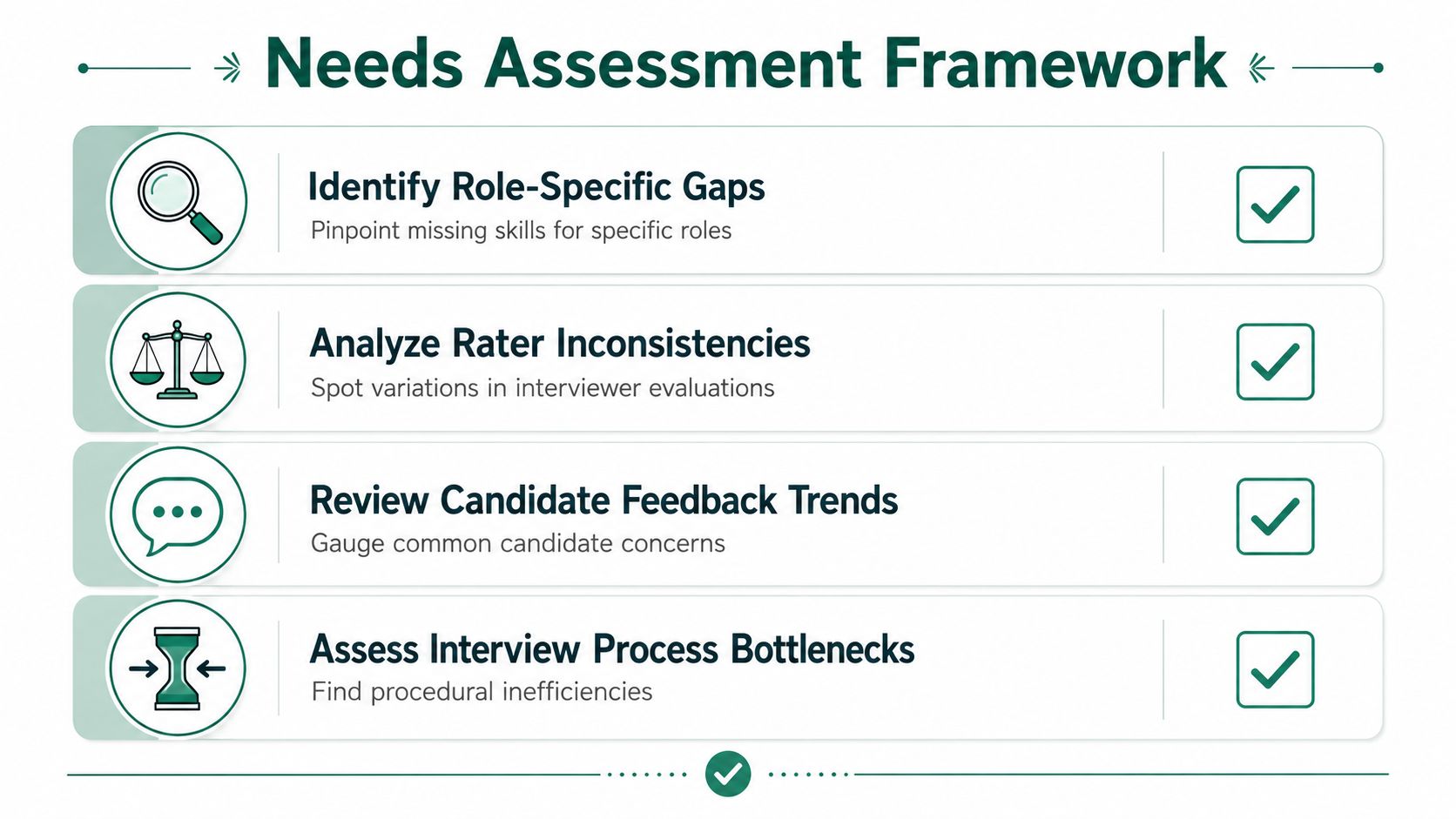
A strong diagnostics process also helps you prioritize where to spend time. High-volume roles with repetitive interviews usually need tighter standardization. Senior or niche roles may need deeper calibration around judgment and evidence quality. If you need a practical content anchor for building the question side of that process, [how to write interview questions](https://www.talentpronto.ai/blog-posts/how-to-write-interview-questions) is a useful reference point.
## Building Structured Scoring Rubrics and Calibration Workshops
Structured rubrics are only useful if interviewers apply them the same way. That's where many teams lose the plot. They create a scale, send it to managers, and assume alignment will happen by osmosis. It won't.
A strong rubric starts with a **defined competency**, then adds **behavioral anchors** that show what weak, acceptable, and strong evidence looks like. Without anchors, the scoring scale becomes a vibe check. Interviewers start rating based on confidence, polish, or similarity instead of observable job evidence.
### Make the rubric judge evidence, not personality
The easiest way to improve consistency is to anchor each score to behaviors the interviewer can hear, see, or verify. That means using the interview to collect details that are testable, not summaries. CREST's guidance is blunt about this. Interviewers should ask for specific, checkable detail, including facts tied to named people, CCTV, witnesses, or electronic records such as debit cards, phones, and computers ([CREST interview guidance](https://crestresearch.ac.uk/download/2237/16-001-01.pdf)). The logic transfers cleanly to hiring. If the answer can't be tested against evidence, the score shouldn't be strong just because it sounded polished.
Calibration workshops make that logic real. Each interviewer scores the same mock interview independently, then defends the rating with specific evidence. The facilitator keeps bringing the group back to the anchor language. Not “I felt good about them,” but “what did they demonstrate?”
> The fastest way to expose rating drift is to ask three interviewers to justify one score out loud. The weak assumptions show up immediately.
### Run calibration as a disagreement exercise
Don't design calibration to create instant consensus. Design it to surface where people interpret the rubric differently. That's where the learning lives. Use recorded interviews when possible, because replaying a transcript or clip makes it easier to compare notes against the same evidence.
A simple workshop sequence works well:
1. **Independent scoring first.** No discussion until everyone has committed a rating.
2. **Evidence review second.** Each interviewer points to the exact answer or note that drove the score.
3. **Anchor check third.** Compare the evidence against the rubric language.
4. **Rater reset last.** Decide whether the issue was interpretation, probing, or the rubric itself.
Many teams need to tighten their interview question design too. [How to write interview questions](https://www.talentpronto.ai/blog-posts/how-to-write-interview-questions) matters because a weak question creates weak evidence, and weak evidence makes calibration harder.
The point of the workshop is not to make everyone identical in style. It's to make them identical in standards.
## Training Interviewers to Work with AI-Assisted Screening
A lot of interviewer training content still assumes a human recruiter is doing every step manually. That's outdated. In many hiring flows, AI now handles early screening, generates scorecards, and ranks candidates before a manager ever opens a file. Talent Pronto is one example of a platform that conducts conversational screening, asks structured questions, and prepares scorecards for review. The training problem has shifted from “how do we interview?” to “how do we read machine-generated evidence without over-trusting it?”
The biggest risk is **automation bias**. Managers can start treating the AI summary as if it's an objective verdict instead of one input. That's especially dangerous when the scorecard is polished and concise, because clean formatting can feel more authoritative than it is. Human reviewers need to be trained to ask one question repeatedly, what evidence supports this score?
### Teach managers when to trust the output and when to challenge it
AI is useful when it standardizes early screening and captures consistent signals. It's less reliable when a candidate's context is unusual, the answer is nuanced, or the role requires judgment that the model may not fully understand. That's why interviewer training should include override logic, not just platform navigation. Managers should know when to probe deeper, when to request the transcript, and when to rely on their own follow-up interview to test a claim.
A practical rule works here.
> If the AI scorecard is based on thin evidence, the human reviewer should slow down, not speed up.
That means training people to validate the underlying transcript, not merely accept the summary. It also means teaching them to spot edge cases, like candidates whose experience is nontraditional but relevant, or responses that the machine may interpret too narrowly. The final decision should stay human, but the human has to be disciplined about how the AI output enters the process.
The most useful calibration exercise is simple. Give managers a real or sample scorecard, ask them to annotate where the AI evidence is strong, where it's incomplete, and where the final judgment should remain open. Then compare those annotations across raters. That's how you surface automation bias before it becomes a hiring pattern. If you're evaluating tools that generate structured screening outputs, the workflow described in [AI resume screening tool](https://www.talentpronto.ai/blog-posts/ai-resume-screening-tool) shows why the reviewer still needs training on interpretation, not just acceptance.
## The Operational Training Sequence That Actually Works
The best interviewer training sequence is operational, not theatrical. People learn the job by seeing it, doing it under watch, and proving they can repeat it. That sequence is shadowing, reverse-shadowing, then certification. Skip any step and rating variance usually creeps back in.
### Start with observation before performance
Shadowing comes first. A trainee watches an experienced interviewer conduct live interviews, taking notes on pacing, question order, probing, and how the interviewer records evidence. This stage matters because it shows the rhythm of a good interview, not just the content.
Then comes reverse-shadowing. The trainee runs the interview while an experienced interviewer observes. The observer should watch for the things that affect score quality, including whether the interviewer stays on the structured question path, asks for specific examples, and avoids leading prompts. During this stage, feedback has to be concrete. “You were too soft” doesn't help. “You accepted the first summary answer without asking for a specific example” does.
### Certify against a visible standard
Certification should mean something specific. It's not a rubber stamp and it's not a feeling. The interviewer should demonstrate that they can follow the guide, document evidence, and score in line with the rubric consistently enough to interview alone. If the person can't do that, they need more observed practice.
The reason this matters is simple. The core pitfall is skipping calibration. When that happens, scorecards become harder to compare across interviewers, especially in behavioral interviews that depend on STAR-style evidence collection and structured note-taking. The operational sequence protects comparability by making every interviewer prove the same habits before they work independently.
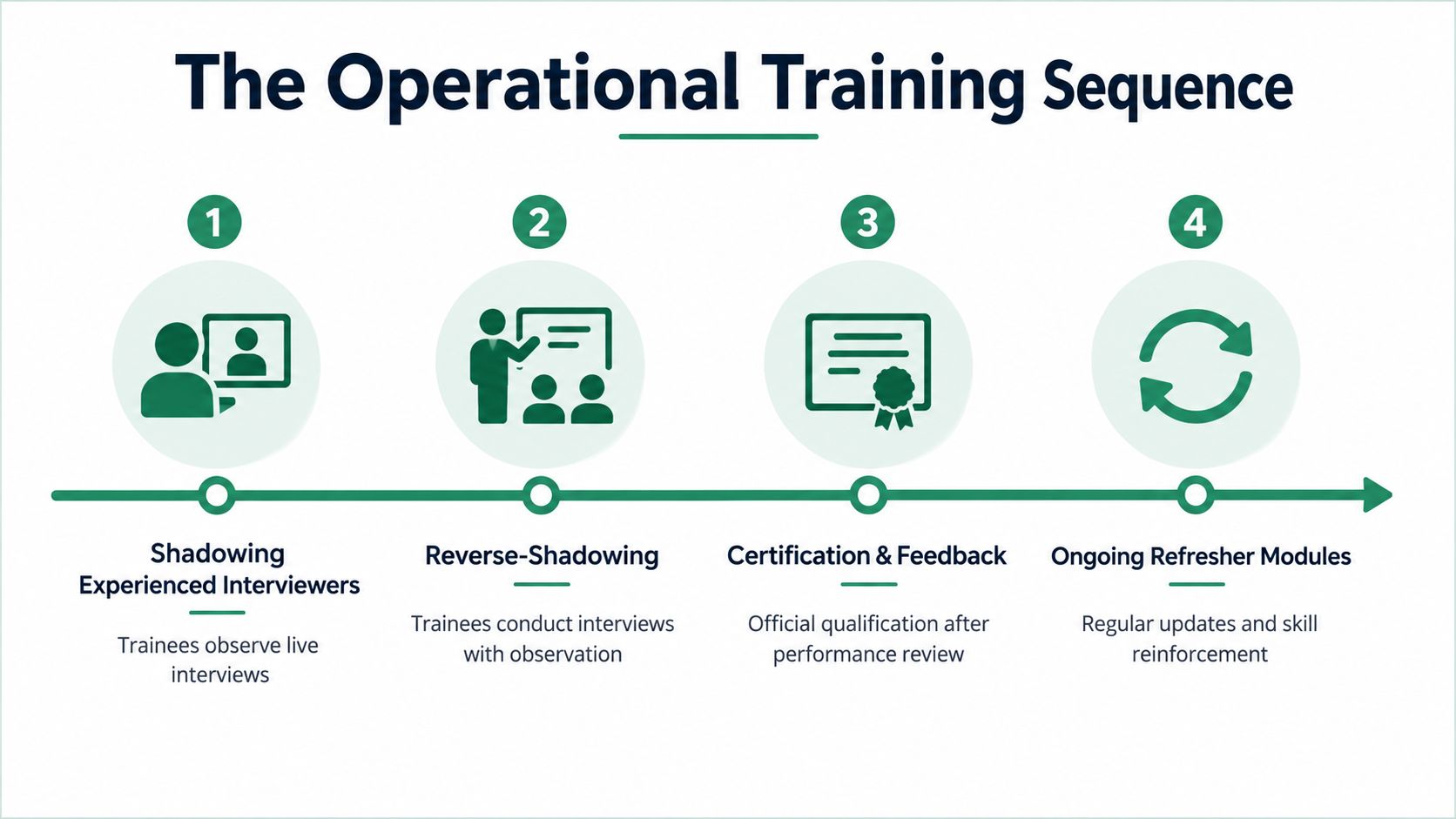
A few teams also build refresher modules into the cycle so interviewers get periodic reset points instead of waiting for a problem to surface. That doesn't replace certification. It keeps the standard from drifting once people get busy.
## Training for Accessibility and Multilingual Candidate Contexts
Modern interviewer training has to assume candidates won't all show up in the same conditions. Some are mobile-only. Some need disability accommodations. Some are interviewing across time zones. Some are doing the process in a second language. If the interviewer isn't trained for those realities, the company can still create an unfair process even when the questions themselves are standardized.
The fix starts with language. Interviewers need to use plain, direct phrasing and avoid jargon that makes the process harder to follow. They also need to know how to adjust voice, tone, and pacing without changing the underlying standard. That's a subtle but important difference. Accommodation is not the same as lowering the bar.
### Train for the edge cases before they become escalations
A practical accessibility module should cover:
- **Flexible formats:** know when phone, video, or text-based touchpoints are appropriate.
- **Translated materials:** make sure core instructions are understandable before the interview starts.
- **Cultural nuance:** train interviewers to recognize different communication styles without over-interpreting them.
- **Rescheduling and time zones:** give managers a clear escalation path when standard scheduling doesn't work.
- **Accommodations:** teach interviewers how to route requests quickly and respectfully.
The bigger problem is that many programs leave this to the coordinator or recruiter, which means the interviewer still enters the conversation unprepared. That creates friction for the candidate and inconsistency for the team. Training should cover contact strategy, tone, equipment handling, and how to keep the process stable when the situation is not standard.
The interview itself should still produce comparable evidence. The difference is that the interviewer knows how to get there without forcing the candidate into a rigid format that blocks performance. That's the standard that matters in healthcare, retail, logistics, and public service, where scale and access often collide.
## Measuring Training Impact with Analytics and Funnel Metrics
Training only matters if it changes the funnel. If the program produces better workshops but the hiring process stays inconsistent, the work didn't land. The simplest way to prove value is to measure whether interviewer behavior and hiring outcomes improve after calibration.
Start with the metrics that connect directly to training. Track **inter-rater consistency**, candidate completion, interviewer-specific score patterns, and whether candidate feedback becomes more positive about process clarity. If the team uses a platform that reports funnel data, those dashboards should show whether trained interviewers are using the rubric more consistently than untrained ones.
### Use the dashboard to catch drift early
One useful practice is to compare rating variance before and after calibration workshops. If variance stays high, the issue may be the rubric, the question design, or the facilitator. If variance drops but candidate completion falls, the process may have become too rigid or too long. The point is not to celebrate a dashboard. The point is to spot where training changed behavior and where it didn't.
A second level of analysis is interviewer cohort review. Some managers absorb the material quickly and keep applying it. Others revert to old habits after a few live conversations. That's where targeted refresher training pays off. You can also look at offer acceptance patterns, time-to-hire, and procedural feedback by interviewer group, then connect those trends back to the quality of the early interview.
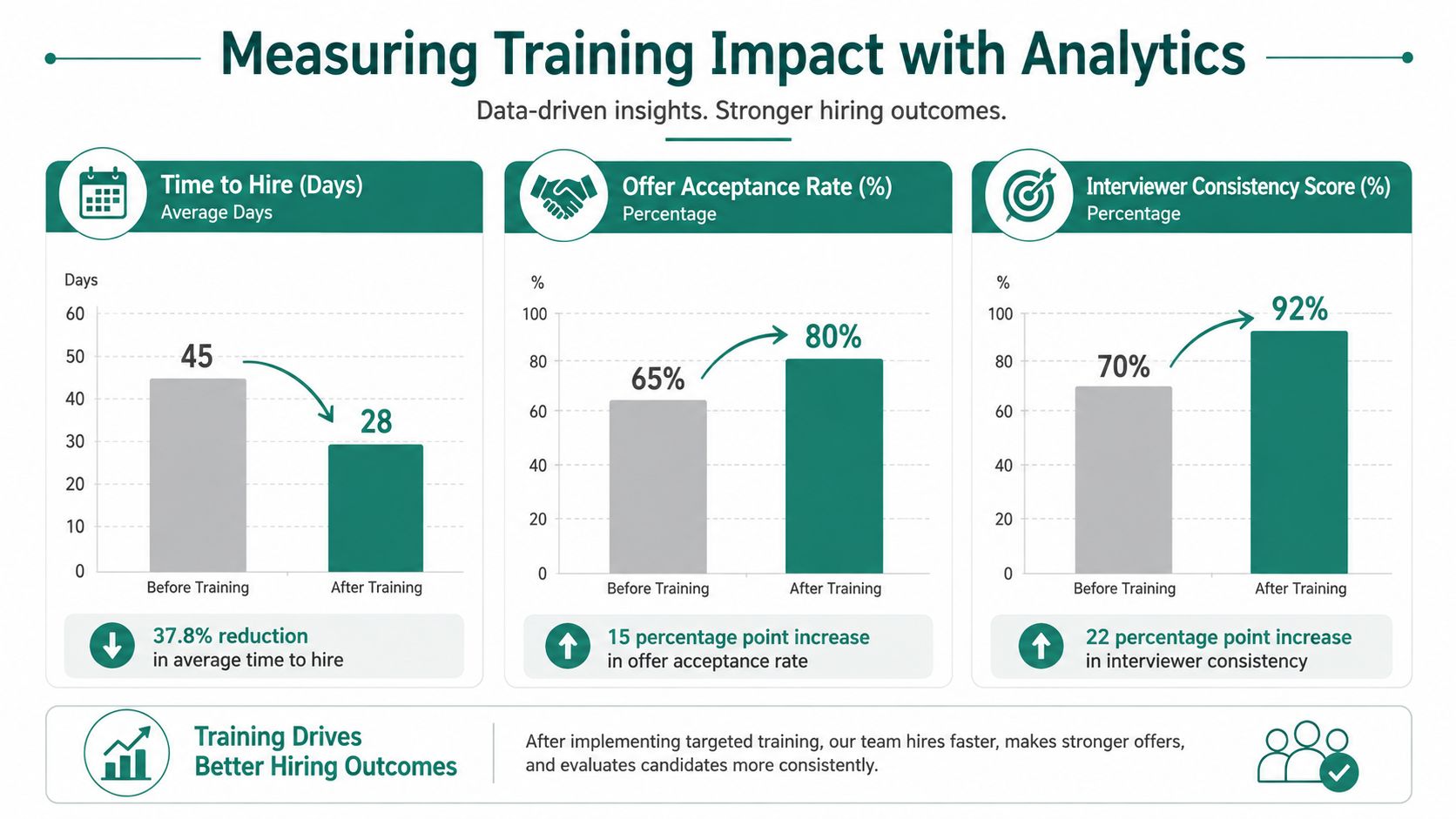
The last step is governance. Review the metrics on a regular cadence, identify interviewers who need recalibration, and update the rubric when the job changes. Training should be a loop, not a one-time event. That's how you turn interviewer development into a measurable hiring system instead of a slide deck.
---
If your hiring team needs structured screening, candidate scorecards, and a more consistent way to prepare interviewers for human review, take a look at [Talent Pronto](https://talentpronto.ai). It's built to generate standardized early-stage interview outputs that hiring teams can review and calibrate against. For teams that want less guesswork in the middle of the funnel, that's a practical place to start.