# What Is Candidate Screening and Why It Matters
*Published 2026-08-31*
> Learn what is candidate screening, how structured methods work, and the best practices that help employers hire faster and fairer in 2026.
Source: https://www.talentpronto.ai/blog-posts/what-is-candidate-screening
---
Candidate screening is the structured evaluation step employers use between application and interview, with the purpose of producing a comparable, evidence-based ranking of applicants against role criteria. Structured interviews predict job performance at about **0.44**, compared with about **0.33** for unstructured interviews, while later work reported corrected validity around **0.51**.
That distinction matters on the Monday when a requisition attracts a crowded application pool, the hiring manager has only a few interview openings, and everyone wants a shortlist immediately. Screening isn't just the act of moving names out of an inbox. Done properly, it's a **compliance-grade decision system** that turns role requirements into consistent evidence, then gives a human reviewer enough context to make a defensible choice.
## Table of Contents
- [The Moment Every Hiring Manager Recognizes](#the-moment-every-hiring-manager-recognizes)
- [A working definition](#a-working-definition)
- [What Candidate Screening Means](#what-candidate-screening-means)
- [Inputs](#inputs)
- [Criteria](#criteria)
- [Decision](#decision)
- [Output](#output)
- [Core Screening Methods Side by Side](#core-screening-methods-side-by-side)
- [Objectives a Good Screening Program Delivers](#objectives-a-good-screening-program-delivers)
- [Time to interview](#time-to-interview)
- [Quality of hire](#quality-of-hire)
- [Fairness](#fairness)
- [Candidate experience](#candidate-experience)
- [Best Practices That Hold Up Under Audit](#best-practices-that-hold-up-under-audit)
- [Build the rubric from the job](#build-the-rubric-from-the-job)
- [Calibrate the people using it](#calibrate-the-people-using-it)
- [Preserve the record](#preserve-the-record)
- [When Automated Screening Tools Earn Their Keep](#when-automated-screening-tools-earn-their-keep)
- [What automation improves](#what-automation-improves)
- [What automation doesn't prove](#what-automation-doesnt-prove)
- [Compliance Considerations You Cannot Skip](#compliance-considerations-you-cannot-skip)
- [Putting It All Together This Quarter](#putting-it-all-together-this-quarter)
## The Moment Every Hiring Manager Recognizes
Two hundred and forty applications arrived over the weekend for one open requisition. Two interview slots are blocked on the calendar, and the hiring manager wants a shortlist by Wednesday. The recruiter has a full schedule, the manager is already asking which applicants “look strongest,” and the easiest response is to skim résumés until a few familiar patterns feel convincing.
That approach creates three problems quickly. **Gut-feel triage doesn't scale**, especially once the pool becomes large enough that reviewers can no longer remember how earlier applicants were judged. Informal filters also produce inconsistent results. One reviewer may prioritize tenure, another may favor a particular employer, and a third may reward polished résumé language even when those signals aren't tied to the work.
The third problem appears later. A rushed screen can pass candidates who don't meet essential requirements, reject candidates whose evidence was presented differently, and leave no clear record of why either decision happened. The cost isn't limited to another interview. The team may lose productive time, damage candidate trust, and make a selection that nobody can explain months later.
### A working definition
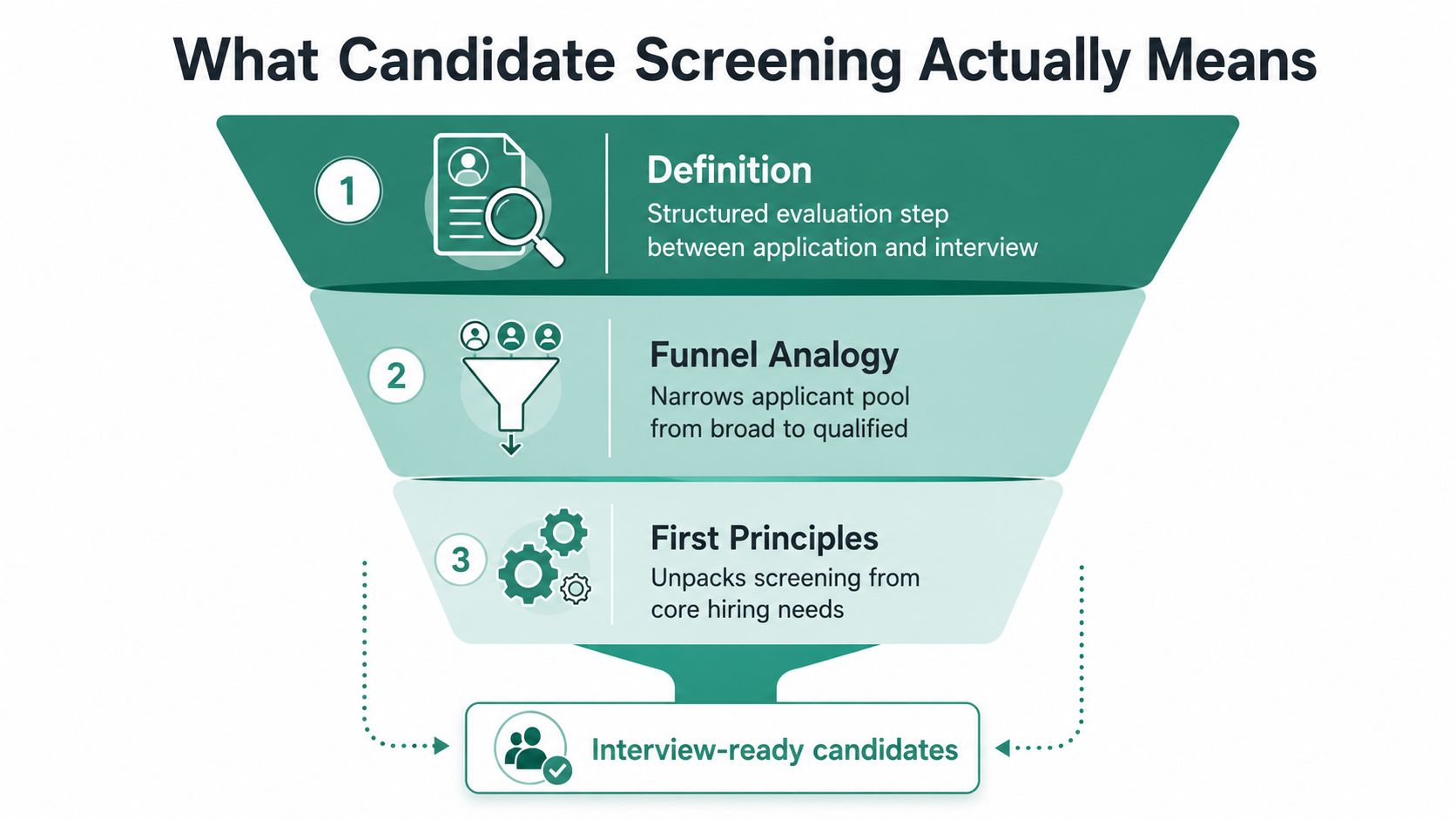
Candidate screening is the **structured evaluation step between application and interview**. It takes the information available at the top of the funnel, tests it against criteria derived from the role, and identifies which applicants deserve deeper human assessment.
A useful screening process answers four questions:
- **What evidence do we have?** Résumés, applications, answers, work samples, or assessments.
- **What does the job require?** Must-have capabilities, relevant experience, and observable behaviors.
- **How will we decide?** A rubric, a gate, or a combination of both.
- **What will we preserve?** Scores, reasons, and evidence for the shortlist and the decisions that didn't advance.
Teams that connect screening decisions to downstream outcomes can also use [quality-of-hire metrics](https://www.talentpronto.ai/blog-posts/quality-of-hire-metrics) to check whether an apparently efficient funnel is producing people who perform well after joining.
## What Candidate Screening Means
Candidate screening is the **structured evaluation step employers run between application and interview**. It narrows a broad applicant pool with relevant, comparable evidence before the organization invests more interview time. The goal is a defensible decision system, not a prediction of everything a future employee will do.
A screening funnel has four connected parts.
### Inputs
The process begins with what applicants provide: an application form, résumé, answers to knockout questions, or an optional assessment. Each source offers a different kind of evidence. A résumé records a person's claims and presentation, while a work sample lets the organization observe performance on a task related to the role.
### Criteria
Translate the job into **must-haves and useful differentiators**. A must-have may involve performing a required task, holding a necessary credential, or meeting a stated scheduling condition. A nice-to-have can separate qualified applicants, but it should not become an undisclosed requirement.
Criteria should come from the work itself. The U.S. Office of Personnel Management explains that structured interviews are more valid and reliable when questions connect to competencies identified through job analysis and every candidate is scored against the same criteria. Its [structured interview guidance](https://www.opm.gov/policy-data-oversight/assessment-and-selection/other-assessment-methods/structured-interviews/) offers a reference for building that connection. The same principle applies earlier in the funnel: define the evidence before reviewing people.
### Decision
Apply the same method to each applicant. A team might use pass-or-fail gates for required conditions, then a rubric for comparative strengths. Another approach scores every criterion and sends borderline cases to a second reviewer. Either model can work when the standard is set before the applicant is assessed, rather than improvised around an appealing résumé.
### Output
The output is a **ranked shortlist with documented evidence**. Sourcing builds the applicant pool, screening evaluates it, and interviewing examines fit and capability in greater depth. Screening creates the record connecting those stages, so the hiring manager, legal team, and candidate can understand how the decision was reached.
Conversational tools can standardize early questions and capture responses, while an [AI resume screening tool](https://www.talentpronto.ai/blog-posts/ai-resume-screening-tool) can help organize résumé evidence. Neither replaces the hiring team's responsibility to set job-related criteria and review the resulting decisions.
## Core Screening Methods Side by Side
Each screening method measures something different. The mistake is treating them as interchangeable or assuming the fastest method provides the strongest evidence.
**Résumé review** is useful for establishing whether an applicant appears to meet stated requirements. It can reveal relevant experience, career movement, tenure patterns, and credentials. It can't reliably show how someone performs a task, explains a decision, or handles an unfamiliar problem. Its failure mode is **overvaluing presentation and keyword match**.
**A structured phone screen** adds a human conversation. The recruiter can probe motivation, communication, availability, and baseline role knowledge using consistent questions. The method produces richer evidence, but it consumes interviewer time and can drift if different recruiters ask different follow-ups. Its central weakness is **inconsistent delivery and scoring**.
**Work samples and assessments** ask candidates to demonstrate job-related capability. They can provide stronger evidence than résumé claims, especially when the task resembles real work and the scoring rules are clear. They also lengthen the funnel and can create accessibility or candidate-experience issues if the exercise is excessive. Their failure mode is **measuring test-taking or unpaid labor instead of the job**.
**Conversational AI screening** automates a structured early conversation. It can ask the same role-specific questions, collect responses at scale, and return organized summaries for human review. It doesn't remove the need for a valid rubric, human oversight, or legal review. Its biggest failure mode is **giving an automated score more authority than the evidence deserves**.
| Method | What It Measures | Time per Candidate | Funnel Position | Biggest Failure Mode |
|---|---|---|---|---|
| Résumé review | Claimed experience, credentials, and career history | Short manual review | Initial application review | Keyword and pedigree bias |
| Structured phone screen | Motivation, communication, logistics, and baseline knowledge | Recruiter time for each conversation | Early qualification | Interviewer drift |
| Work sample or assessment | Job-related applied capability | Candidate and reviewer effort | Qualification or pre-interview stage | Poorly designed task |
| Conversational AI screen | Standardized responses to behavioral or technical prompts | Automated collection, human review still required | High-volume early stage | False confidence in automation |
Background checks belong in a separate compliance-controlled part of the process, not as a substitute for capability screening. Teams working with volunteers can use a [volunteer background check](https://www.volunteerbadge.com/volunteer-criminal-background-check) resource to understand that distinction and plan the appropriate verification step.
For organizations deciding whether a task should be part of the funnel, guidance on [pre-employment assessments](https://www.talentpronto.ai/blog-posts/pre-employment-assessments) can help keep the exercise connected to the actual role rather than general curiosity.
## Objectives a Good Screening Program Delivers
A sound screening program balances four outcomes. Speed matters, but speed alone can reward shallow filtering. A process that produces a shortlist quickly while excluding qualified people isn't efficient. It's merely fast at making an expensive mistake.
### Time to interview
Structured screening batches evidence collection before the hiring manager's calendar becomes involved. A common rubric lets recruiters compare applicants without reopening the same questions for every person. Automation can reduce manual handling, but the organization still needs a review step for exceptions and borderline results.
### Quality of hire
No early screen sees everything that happens after onboarding. That means quality of hire should be treated as a **proxy**, using downstream signals such as early performance, manager satisfaction, and whether the person demonstrates the capabilities the role required. If the shortlist looks excellent but new hires struggle with core work, the screening criteria may be measuring résumé similarity rather than job success.
### Fairness
Fairness needs operational measures. Reviewers can examine adverse-impact patterns across demographic groups, check whether screeners agree when evaluating the same evidence, and audit whether people followed the rubric. The EEOC explains that selection procedures can create legal risk when they intentionally discriminate or disproportionately exclude protected groups without adequate legal justification, under statutes including Title VII, the ADA, and the ADEA. Its guidance on [employment tests and selection procedures](https://www.eeoc.gov/laws/guidance/employment-tests-and-selection-procedures) belongs in the design conversation, not only after a complaint.
### Candidate experience
Applicants notice delay, repetition, and unexplained rejection. Track where candidates abandon the process, how they rate the application experience, and how quickly a person contacts those who advance. A conversational step can make access more flexible, but it should explain what happens next and provide a reasonable alternative where appropriate.
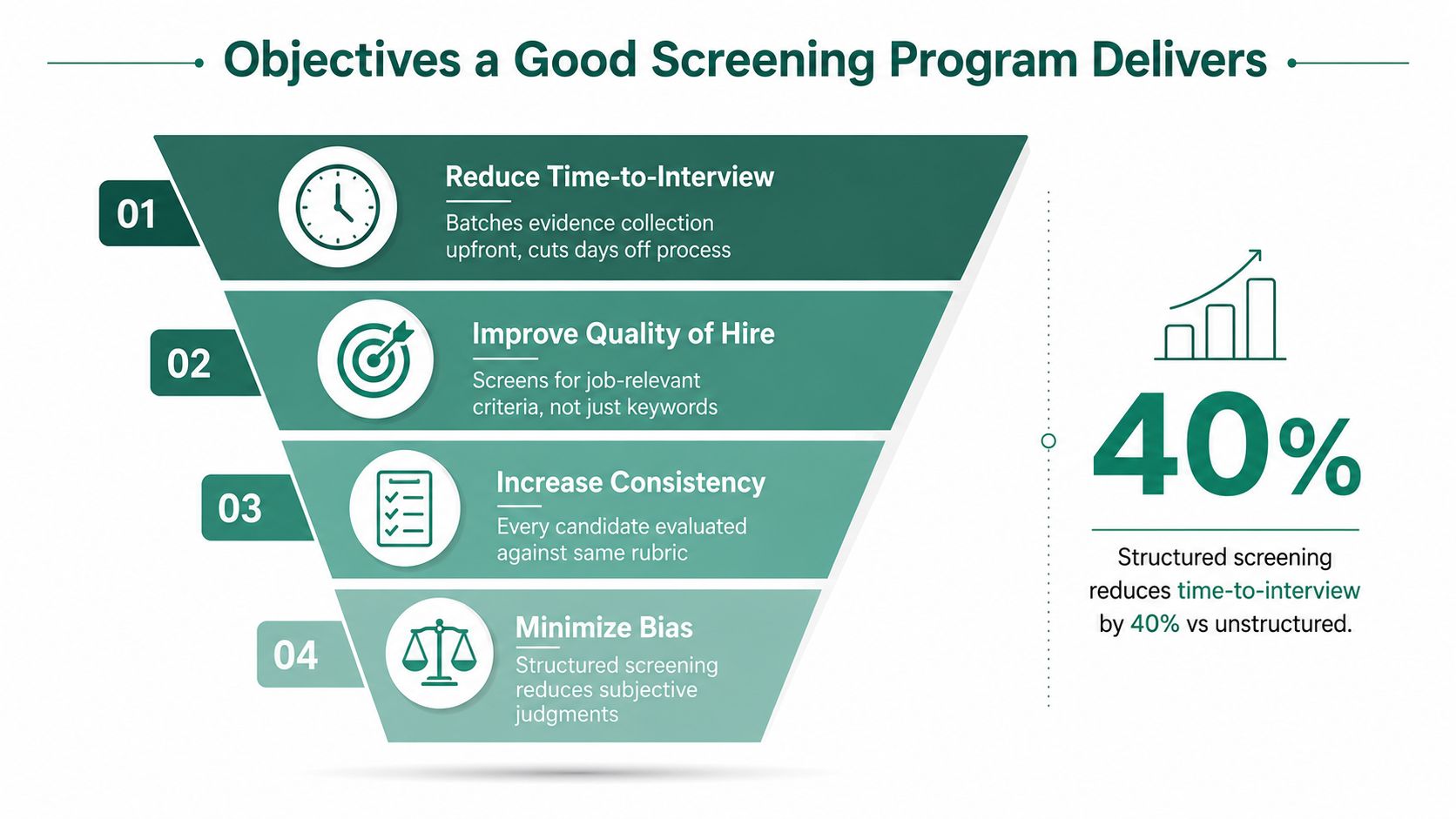
The trade-off is the point. A rubric change that reduces screening time by two days but worsens adverse impact isn't an improvement. The program's objective function must weigh **speed, downstream quality, fairness, and candidate experience** together.
## Best Practices That Hold Up Under Audit
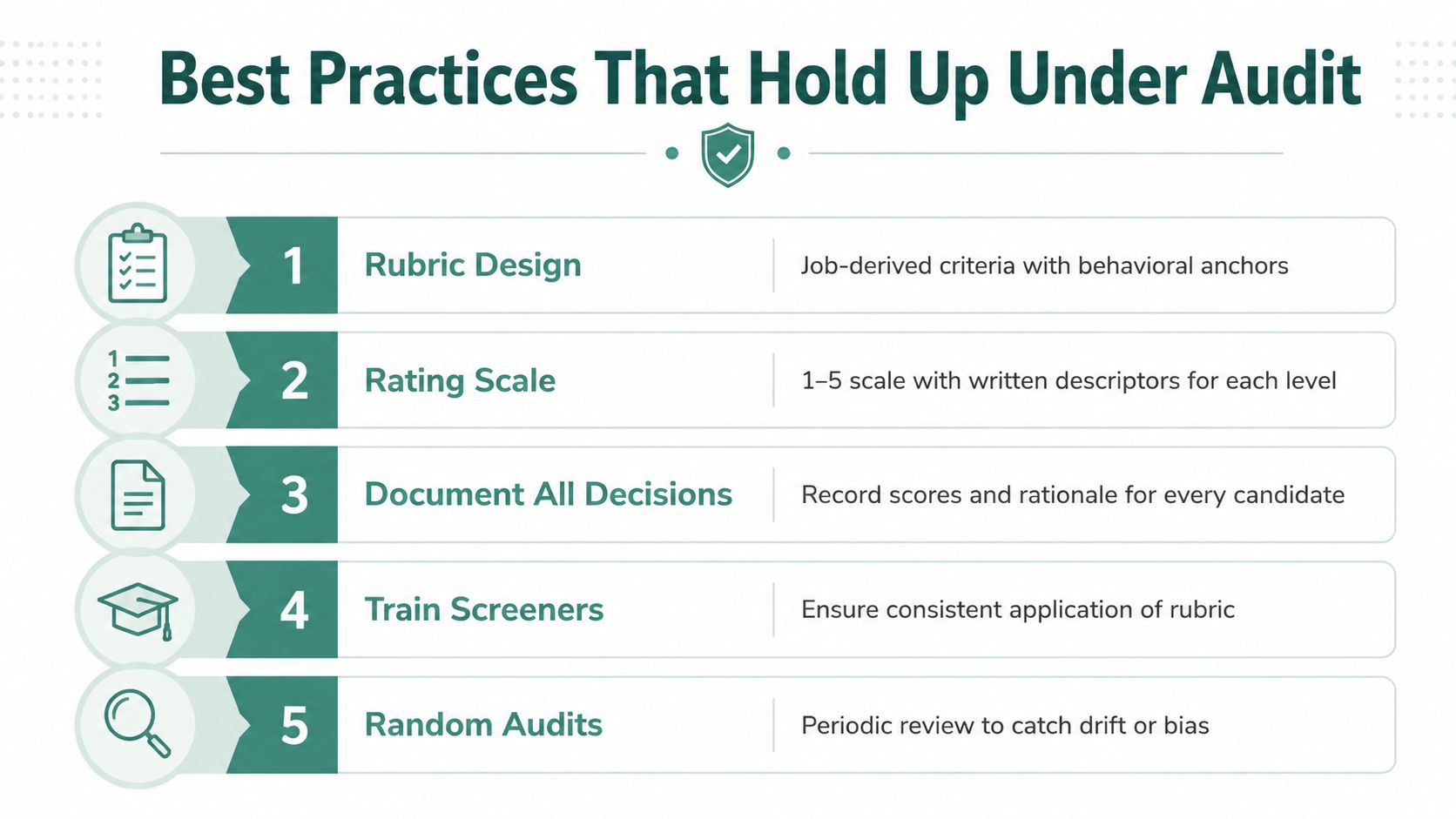
Auditable screening starts before the first résumé arrives. Write the criteria while the role is still being defined, not after a recruiter notices which backgrounds appear in the applicant pool.
### Build the rubric from the job
Identify the behaviors and capabilities that distinguish successful performance. Then create behavioral anchors so reviewers know what a low, middle, and high rating means. A **1 to 5 scale** can work when each level has a written definition, but the number itself doesn't create rigor. “Strong communicator” is vague. “Explains a complex customer issue clearly, identifies the decision made, and describes the result” gives reviewers something observable to score.
Weight must-haves separately from nice-to-haves. If a requirement is essential, make it a documented gate. If it merely improves fit, score it as a differentiator instead of allowing it to become an invisible rejection rule.
### Calibrate the people using it
Calibration is where recruiters and hiring managers score the same sample applicants, compare their reasoning, and resolve differences before live screening begins. Meet again when outlier scores appear. Without calibration, two people can follow the same rubric text while applying entirely different standards.
### Preserve the record
Lock the rubric when sourcing begins. Store the scoring rationale, the evidence considered, and the date of each decision. If the team changes a criterion, record who approved the change and which applicants it affects. Editing a requirement after seeing the pool is one of the clearest signs of a post-hoc process.
> **Audit question:** Could another reviewer reconstruct why this applicant advanced or was rejected without relying on anyone's memory?
Auditors typically look for the link between the requirement, the evidence, the score, and the decision. They also look for drift, such as reviewers rewarding personal familiarity, changing standards midstream, or recording conclusions without the underlying rationale.
## When Automated Screening Tools Earn Their Keep
Automation earns its place when the problem is repetitive volume, not when the organization wants to outsource accountability. A system can apply the same question set to every applicant, collect responses outside business hours, and return structured information for a human reviewer. It can also improve coverage by preventing the team from reviewing only the first group of applicants who appear in the queue.
The efficiency case is concrete in large enterprises. A **2026 analysis reported that 97.4% of Fortune 500 companies had a detectable applicant tracking system**, which shows how automated infrastructure is embedded in large-company hiring ([Jobscan's Fortune 500 ATS analysis](https://www.jobscan.co/blog/fortune-500-use-applicant-tracking-systems/)). An ATS, however, is infrastructure. It isn't automatically a valid assessment method.
### What automation improves
- **Consistency:** The system can present the same role-specific prompts and capture comparable responses.
- **Speed:** Candidates can complete an early conversation when recruiters aren't available.
- **Coverage:** The organization can engage more applicants instead of relying on a small manually reviewed subset.
- **Organization:** Structured summaries can help reviewers find evidence without replaying every interaction immediately.
### What automation doesn't prove
An algorithm can't eliminate bias because it produces a score. Research on AI résumé screening found that systems can inherit historical bias, and an experiment reported that people favored AI-preferred candidates up to **90% of the time**, demonstrating how strongly automated recommendations can influence human judgment (Iowa State research record). The practical safeguard is to audit inputs, test outcomes for disparate impact, and require reviewers to examine evidence rather than accept rankings automatically.
Conversational tools such as Anna from Talent Pronto can conduct role-specific screening conversations, ask behavioral and technical questions, and prepare structured scorecards, while the employer retains advancement and rejection decisions. Teams can also improve the applicant side of the funnel by giving candidates a clear [Markdown resume workflow](https://resumey.pro/blog/free-ats-friendly-resume-template/) that supports readable, ATS-compatible applications.
Use automation for **repeatable evidence collection**, not for replacing rubric design, calibration, or human responsibility.
## Compliance Considerations You Cannot Skip
Compliance becomes practical when you translate legal principles into screening decisions. The EEOC's Uniform Guidelines apply to selection procedures including interviews, application reviews, work samples, and performance evaluations. A résumé screen is therefore not an informal administrative act because it happens early.
The basic rule is straightforward. Criteria must relate to the job, apply consistently, and avoid unnecessary barriers tied to protected characteristics. The EEOC states that required tests must be necessary and job-related, and employers can't exclude people because of race, color, religion, sex, national origin, or disability. The same discipline should guide automated prompts, résumé filters, work samples, and human review.
| Law or Guideline | Screening Design Requirement |
|---|---|
| Title VII | Use job-related criteria and monitor whether the process disproportionately excludes protected groups. |
| ADA | Assess essential job capabilities without making disability-related inquiries or using unnecessary medical information. |
| ADEA | Avoid age proxies such as age-related preferences, unnecessary graduation-year filters, or assumptions about career stage. |
| EEOC Uniform Guidelines | Treat applications, interviews, work samples, and assessments as formal selection procedures that require consistent governance. |
| General documentation practice | Tie each rejection to a prewritten criterion and preserve the evidence and rationale at decision time. |
Voluntary self-identification data should remain separated from selection scoring and should be handled for lawful monitoring rather than informal reviewer judgment. Screening questions should also avoid personal topics that don't establish job capability.
For teams hiring across jurisdictions, employment checks need their own workflow. A practical [UK right to work checks guide](https://www.hrmanagement365.com/2026/08/25/right-to-work-checks-for-employers/) can help distinguish work authorization verification from capability assessment, especially when the same hiring process operates across countries.
## Putting It All Together This Quarter
Choose one role and redesign one early screening step rather than attempting a company-wide overhaul. Before posting, write the role-specific rubric, define the rating scale, separate essential gates from preferences, and decide what evidence each criterion requires.
Then run a controlled pilot alongside the existing résumé review. Have screeners use the same applicant pool where possible, record every rejection against a prewritten criterion, and review borderline cases without changing the rubric. Keep the pilot long enough to reveal normal operating variation, rather than judging it from a single hiring cycle.
Before approving any process change, ask three questions:
1. **Does it measure the job?** The evidence should connect to a real responsibility or capability.
2. **Can two screeners agree?** Calibration should produce comparable judgments from the same information.
3. **Can we defend the rejection in writing?** The decision should trace back to a criterion recorded before review.
The clearest diagnostic metric is the **agreement rate between screeners evaluating the same applicant pool**. If agreement remains weak, adding more automation won't solve the underlying problem. Fix the rubric and calibration first.
---
Talent Pronto helps employers run conversational screening with every applicant, evaluate responses against role-specific criteria, and prepare structured scorecards for human review. Visit [Talent Pronto](https://talentpronto.ai) to see how Anna can support consistent early-stage screening while your team keeps control of the criteria and final hiring decisions.