# What Is Employer Branding and Why It Matters in 2026
*Published 2026-08-18*
> Learn what is employer branding, why it shapes hiring and retention, the core components that make it work, and how HR teams can measure and improve it in 2026.
Source: https://www.talentpronto.ai/blog-posts/what-is-employer-branding
---
Employer branding is the gap between how a company promises to treat people and how it treats them. When that gap is wide, strong candidates withdraw, employees lose trust, and hiring costs can rise.
You may recognize the scene. A hiring manager says the role is attractive, the salary is competitive, and the team has meaningful work. Yet qualified candidates stop replying after the first interview. Meanwhile, a competitor seems to attract applicants with less recruiter outreach and fewer open roles.
The difference often isn't a clever careers page. It's whether candidates can find a credible, consistent answer to a simple question: **“What will my working life be like here?”**
Employer branding connects that answer to the full employment experience. It shapes how candidates discover a company, how recruiters communicate, how managers interview, how new hires are onboarded, how employees experience the culture, and how former employees describe the organization after leaving. In **2026**, it also includes how search engines and AI tools summarize the company to people who may never visit its careers site.
## Table of Contents
- [The Core Idea Behind Employer Branding](#the-core-idea-behind-employer-branding)
- [Start with the promise](#start-with-the-promise)
- [Why Employer Branding Matters Now](#why-employer-branding-matters-now)
- [From reputation to discoverability](#from-reputation-to-discoverability)
- [The Four Components of a Strong Employer Brand](#the-four-components-of-a-strong-employer-brand)
- [Employee value proposition](#employee-value-proposition)
- [Candidate experience](#candidate-experience)
- [Internal culture](#internal-culture)
- [Communication channels](#communication-channels)
- [The Promise Versus Reality Problem](#the-promise-versus-reality-problem)
- [Read the warning signs](#read-the-warning-signs)
- [Pressure-test the first week](#pressure-test-the-first-week)
- [Metrics That Prove the Brand Is Working](#metrics-that-prove-the-brand-is-working)
- [Measure the funnel in stages](#measure-the-funnel-in-stages)
- [Build a leadership view](#build-a-leadership-view)
- [What Strong and Weak Brands Do Differently](#what-strong-and-weak-brands-do-differently)
- [The operational version of a strong brand](#the-operational-version-of-a-strong-brand)
- [Practical Strategies and Quick Wins for HR Teams](#practical-strategies-and-quick-wins-for-hr-teams)
- [The first 30 days](#the-first-30-days)
- [Days 31 through 60](#days-31-through-60)
- [Days 61 through 90](#days-61-through-90)
## The Core Idea Behind Employer Branding
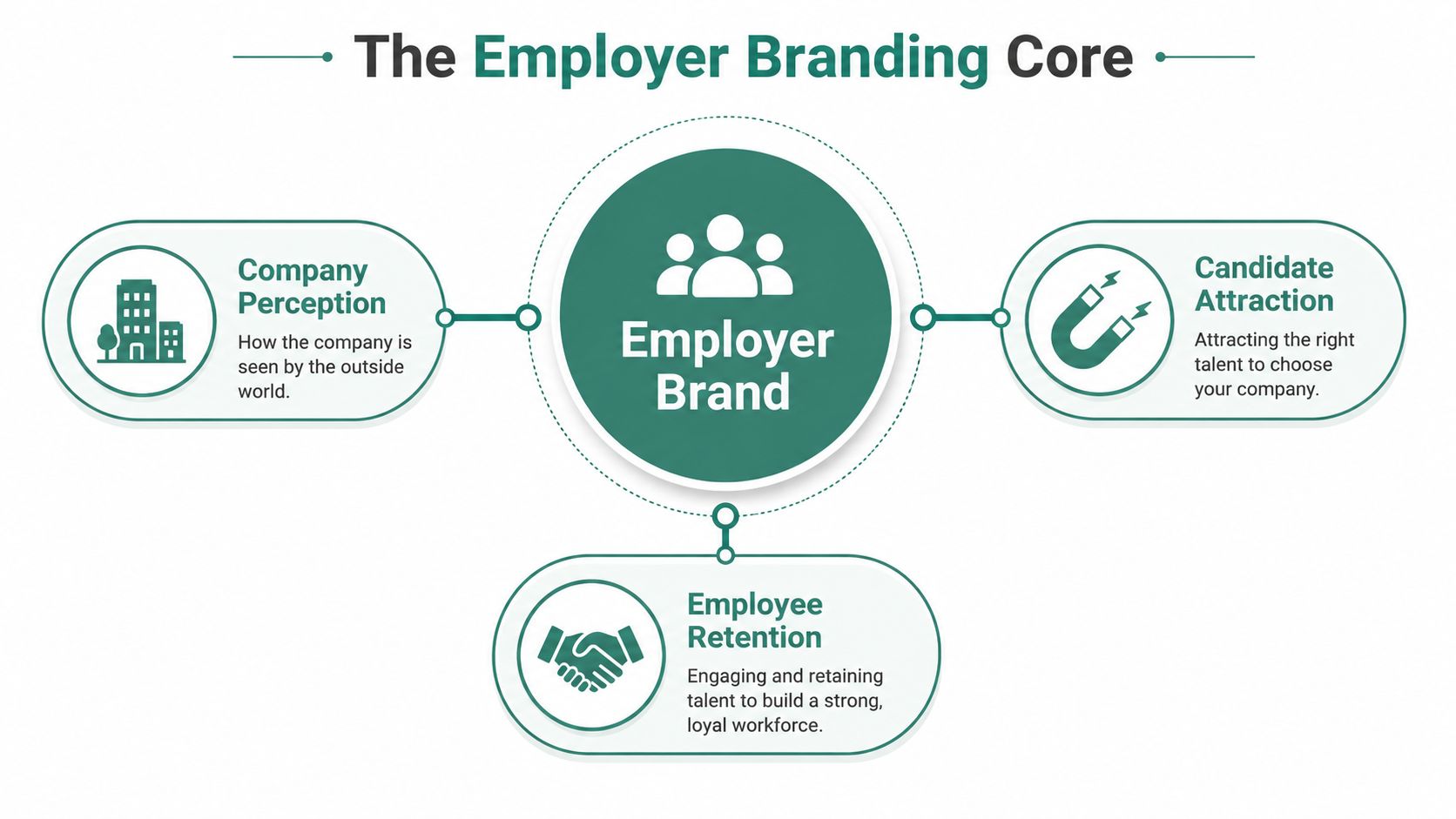
A useful definition of employer branding is **the system a company uses to shape and deliver its reputation as a place to work**. It connects the promise made to candidates with the experience employees receive and the stories people share after leaving.
A careers-page rewrite, office poster, or recruitment campaign can express that system. Those outputs are symptoms of the program, not the program itself. The brand becomes real through recruiting messages, interview behavior, onboarding, development, management practices, and the employee exit experience. It also affects whether search engines and AI tools can find and summarize a credible account of the company in **2026**.
### Start with the promise
Every employer makes promises, formally or accidentally. A job post may promise flexible scheduling. A recruiter may describe a supportive manager. A careers page may highlight growth, inclusion, or purpose. Together, these messages form an **employee value proposition**, or EVP, the practical answer to why someone would join and stay.
Delivery determines whether the promise earns trust. If schedules change without warning, managers act inconsistently, or development opportunities remain difficult to access, employees create their own version of the brand. That account can spread through reviews, professional networks, social posts, and conversations with candidates.
> **Practical rule:** Treat every employer-brand claim as an operating commitment. If the business cannot deliver it repeatedly, revise the claim or fix the experience.
Four connected elements help a TA leader explain the system to a hiring manager or CFO:
- **EVP:** What the organization offers and why the work is worth choosing.
- **Candidate experience:** What applicants encounter from job discovery through rejection or offer.
- **Internal culture:** How managers act, how work gets done, and whether employees receive the support described externally.
- **Communication channels:** Where people encounter the brand, including career pages, social platforms, review sites, employee advocacy, and AI-generated search summaries.
The operating model is straightforward. External storytelling attracts attention, candidate experience shapes confidence, and internal delivery determines whether employees and applicants believe the message. Measurement then links those experiences to outcomes such as attraction, progression through the funnel, retention, and employee advocacy.
## Why Employer Branding Matters Now
A candidate sees a company's reputation before a recruiter enters the conversation. That reputation influences whether the person notices the role, trusts its description, applies, and remains engaged through the hiring process. Employer branding therefore connects the candidate funnel with the employment experience rather than sitting apart as a communications project.
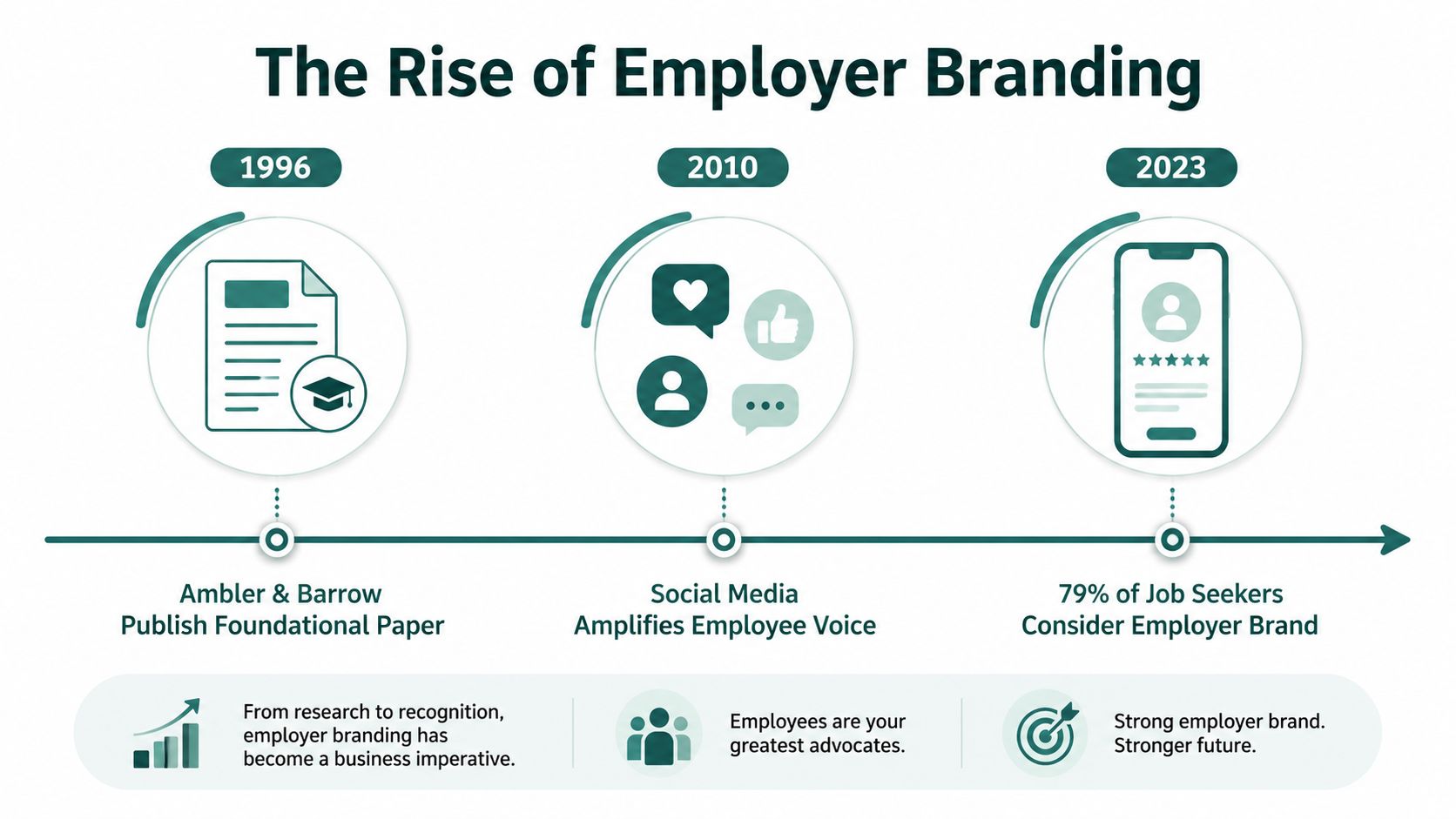
The concept became a formal management topic in the **1990s**, when **Tim Ambler and Simon Barrow introduced the term in a 1996 paper in the Journal of Brand Management**. Their idea applied brand-management principles to the employment relationship, not only to customers. Recruiting consequently moved toward a structured promise about what working for the organization would feel like. [JobScore's overview of employer branding history and impact](https://www.jobscore.com/articles/employer-branding-statistics/) provides context for that development.
The financial case is also visible in hiring results. Companies with positive employer brands receive **twice as many applications** as companies with negative brands, and a strong employer brand can reduce cost per hire by **as much as 50%**. A negative reputation can add **about 10% to hiring costs**, according to the industry figures summarized by [SearchLab's employer branding statistics](https://searchlab.nl/en/statistics/employer-branding-statistics-2026).
Candidate research shows why these effects begin before application. **84% of job seekers say an employer's reputation is important when deciding where to apply, and 83% research company reviews and ratings before applying**. Reputation shapes who enters consideration, how much confidence candidates place in the job description, and how much explanation recruiters must provide later.
### From reputation to discoverability
Candidates increasingly meet an employer through AI-generated search summaries as well as company websites, review platforms, and social channels. AI tools may present outdated benefits, repeat an employee complaint without context, or confuse one business unit with another. The candidate still experiences that output as part of the employer brand.
The practical question is simple: **Can your organization be found and understood accurately across the sources AI systems use?** Visibility now requires consistent facts, current policies, clear role information, and credible third-party discussion, not just ranking for a branded search. In 2026, being visible means making the organization legible to both people and the systems that help people discover employers.
TA leaders can connect these brand signals with workforce data to identify effects on applications, funnel progression, and retention. Teams examining that connection can use this guide to [understand people analytics](https://www.talentpronto.ai/blog-posts/what-is-people-analytics). For employees facing unhealthy work conditions, resources such as [workplace burnout help in Phoenix](https://revibementalhealth.com/how-to-deal-with-burnout-at-work/) reinforce why lived experience must support the public message.
Organizations increasingly treat employer branding as strategic. **90% of HR professionals and 80% of executives consider it strategic**, while **77% of organizations say it matters to their HR strategy and 49% have increased budgets for it in the past two years**, as summarized by [Passive Secrets' employer branding data](https://passivesecrets.com/employer-branding-statistics/). The operating priority is to keep public information accurate, connect it to measurable funnel outcomes, and ensure employees experience what candidates were promised.
## The Four Components of a Strong Employer Brand
A strong employer brand operates as a connected system. The **EVP**, internal culture, external reputation, and candidate experience reinforce one another, linking what the organization promises with what people discover, experience, and share.
### Employee value proposition
The **EVP** answers two practical questions: why should a qualified person work here, and why should that person stay? It can cover compensation, benefits, flexibility, career development, manager quality, purpose, recognition, and the everyday conditions of the role. A useful EVP gives candidates enough detail to judge whether the work suits them.
It also describes trade-offs. A manufacturing employer may provide stable schedules and technical development while requiring on-site work. A healthcare organization may offer mission-driven work and strong team relationships while asking employees to manage demanding shifts. Specificity makes the proposition believable. “Great culture” gives candidates little to evaluate.
Leadership statements alone cannot make an EVP credible. Employees must be able to recognize the promise in their working conditions. For a clearer view of the financial and nonfinancial elements that shape the offer, review [what total compensation includes](https://www.talentpronto.ai/blog-posts/what-is-total-compensation).
### Candidate experience
Candidate experience covers every interaction from job discovery through application, interviews, the hiring decision, and follow-up. It includes job-description clarity, application effort, response speed, interview structure, scheduling, accessibility, and the respect shown to people who are not selected.
A recruiting process supplies evidence about the employer before anyone joins. A company may describe care and collaboration, then leave applicants waiting without updates. Candidates can reasonably read that delay as information about how the organization communicates and manages commitments.
### Internal culture
Culture appears in operating choices. Managers allocate work, handle conflict, make decisions, recognize contributions, and support development. Employees encounter those choices through meeting habits, workload expectations, schedule flexibility, and the quality of management.
A culture that conflicts with the EVP turns public messaging into a sharper source of disappointment. Employees and former employees can describe what happens after the offer is accepted, making their accounts influential in how candidates interpret the company.
### Communication channels
Candidates build an employer impression across several sources. They may visit a careers site, read employee posts, scan job-board language, compare review sites, speak with a former colleague, or ask an AI tool to summarize the company.
Each channel should express the same underlying truth in a format suited to its audience. A social post can show an employee story, while a job page explains schedule expectations and compensation philosophy. Clear, consistent information also helps AI-mediated discovery in 2026. Being visible increasingly means being easy for both candidates and AI systems to interpret accurately, with role details, policies, and employee experience aligned across the sources those systems examine.
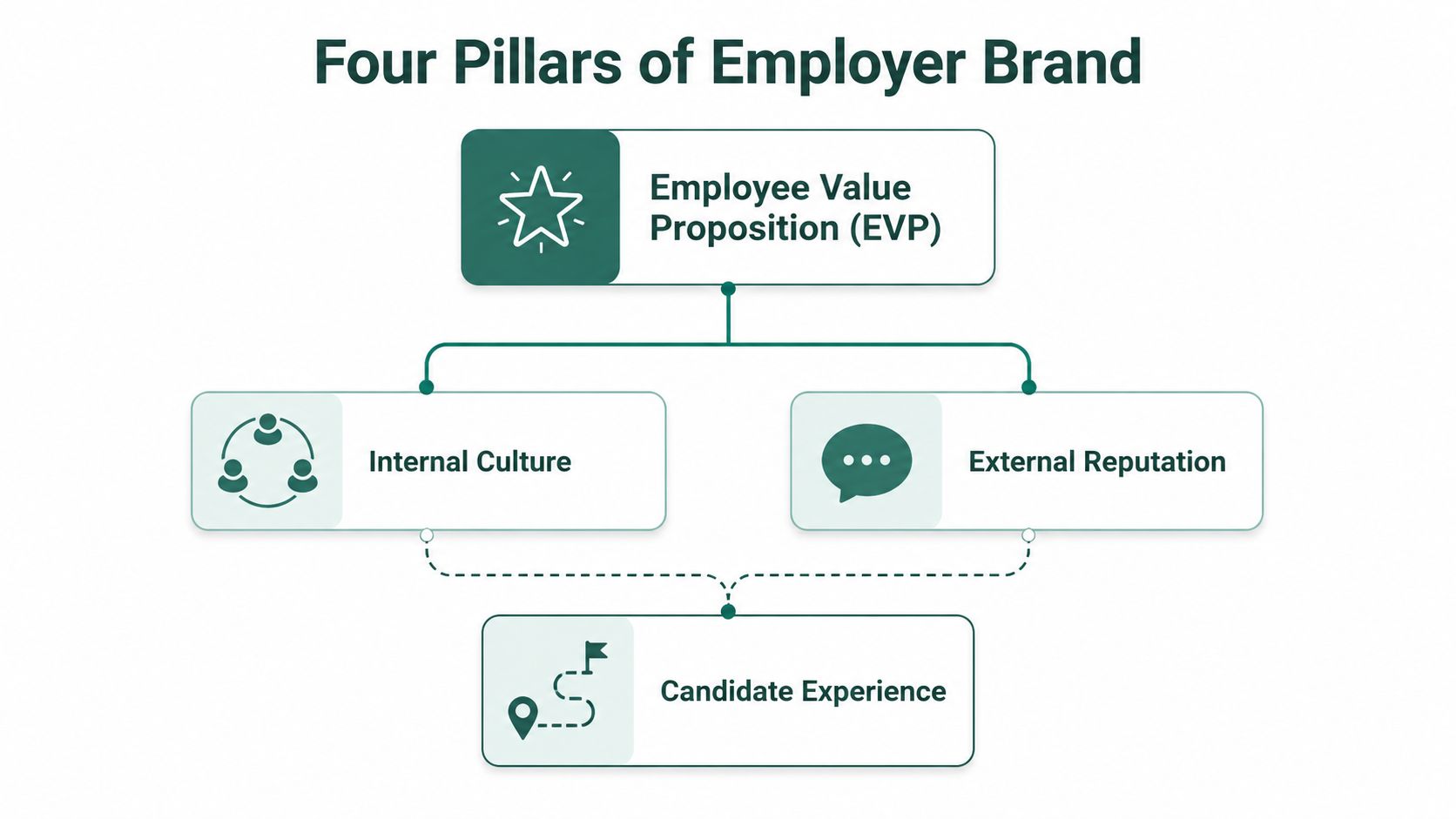
A short explanation of these relationships helps hiring managers connect the concepts to everyday recruiting decisions.
## The Promise Versus Reality Problem
Most employer-branding programs are better at describing the desired experience than delivering it. Marketing teams create polished stories, recruiters repeat the EVP, and leaders approve attractive language. Candidates then compare those claims with practical conditions such as schedule flexibility, manager quality, compensation transparency, and the consistency of the work environment.
The brand belongs to more than the company's communications team. Current employees, former employees, candidates, and managers all shape it across the employment lifecycle. That makes the difficult question unavoidable: **Does the brand still match reality after hire?**
### Read the warning signs
A promise-reality gap often appears through patterns rather than one isolated complaint. HR teams should investigate the underlying experience instead of immediately producing more content.
- **Review volatility:** If public reviews swing sharply between praise and criticism, ask whether experiences vary by manager, location, shift, or business unit.
- **Offer-to-acceptance decline:** If candidates accept interviews but reject offers, ask whether compensation, role scope, schedule, or manager expectations changed during the process.
- **Early attrition:** If new hires leave soon after joining, ask what they discovered in their first weeks that recruiters didn't explain.
- **Candidate withdrawal:** If applicants disappear after interviews, ask whether the process was slow, generic, or inconsistent with the company's stated values.
A polished promise can make the problem worse when it raises expectations that operations can't sustain. For example, “flexible work” may mean employee-controlled scheduling in one department and occasional manager approval in another. Candidates don't need every role to offer the same experience, but they do need an accurate description of the experience attached to the role.
### Pressure-test the first week
Take the EVP claim and translate it into observable behavior. If the company promises development, can a new hire identify a manager, process, or resource that supports development? If it promises belonging, do onboarding, team meetings, and feedback practices reinforce that message? If it promises transparency, does the candidate receive clear information about pay, schedule, decision criteria, and timing?
> The fastest way to improve an employer brand is often to remove a contradiction, not publish another campaign.
The strongest programs treat employer branding as a trust and delivery problem. They use stories to explain what the organization does well, then invest in the managers, policies, systems, and communication habits that make those stories credible.
## Metrics That Prove the Brand Is Working
Employer branding becomes manageable when leaders connect each metric to a funnel question. Awareness asks whether candidates can find and recognize the company. Consideration asks whether they want to learn more. Application asks whether they complete the process. Hiring asks whether the promise produces accepted offers and durable employment outcomes.
### Measure the funnel in stages
At the awareness stage, track branded search activity, share of voice in relevant discussions, engagement from target talent groups, and how AI tools describe the organization. AI visibility deserves its own audit. Ask the same role-specific questions across major generative search tools, record the answers, and check whether the responses accurately reflect current policies, roles, culture, and employee experience.
At consideration, examine careers-site behavior, job-page engagement, review-site sentiment, and the percentage of visitors who begin an application. A strong signal isn't merely high traffic. It's evidence that the right candidates understand the proposition and take the next step.
At application, monitor completion rate, time to apply, candidate questions, and drop-off at each stage. The [candidate experience metrics guide](https://www.talentpronto.ai/blog-posts/candidate-experience-metrics) can help teams turn process friction into a defined measurement plan.
At hire, connect employer-brand work to offer acceptance, qualified application rate, quality-of-hire proxies, early attrition, and retention by cohort. Don't treat these as proof that branding alone caused an outcome. Use them to identify relationships, then investigate the operating conditions behind the movement.
| Funnel stage | What to measure | Healthy signal | Red flag |
|---|---|---|---|
| Awareness | Branded search, employer mentions, AI-generated summaries | Candidates find accurate, consistent information | AI summaries are outdated, incomplete, or contradictory |
| Consideration | Careers-site conversion, review patterns, application starts | Target candidates continue after learning about the role | Visitors engage but avoid the application |
| Application | Completion rate, time to apply, drop-off by step | Candidates move through a clear, respectful process | Abandonment clusters around confusing or repetitive steps |
| Hire | Qualified applications, offer acceptance, early attrition | The hiring promise matches the accepted role | Offers are declined or new hires leave after discovering mismatches |
### Build a leadership view
Give leadership a compact dashboard that pairs perception with behavior. For example, show a review trend beside offer acceptance, or AI-summary accuracy beside qualified application volume. This prevents the team from celebrating reach while candidates struggle with the application process.
The 2025 HR.com finding that only **28% of organizations had a consistently applied, detailed employer branding strategy**, while **44% expected data analytics and predictive technologies to shape branding next**, highlights the execution gap described by [Employer Branding News](https://employerbranding.news/resources/what-is-employer-branding/). Measurement should therefore identify not just whether people noticed the brand, but whether the organization delivered it consistently.
## What Strong and Weak Brands Do Differently
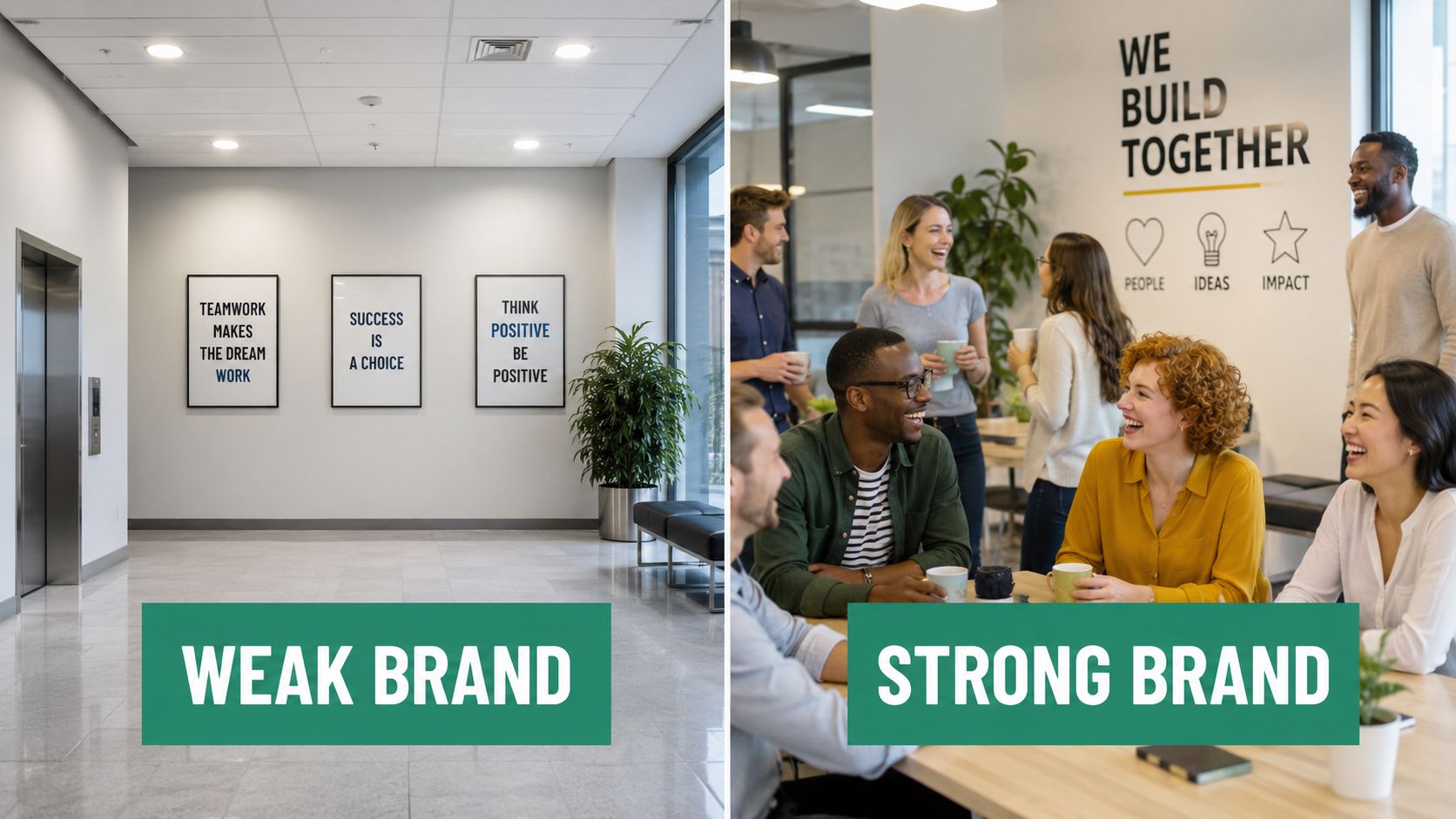
Consider a regional healthcare employer with open roles across clinical and administrative teams. Its careers site features bright photography and broad statements about teamwork, but recruiters respond inconsistently, interview panels ask unrelated questions, and candidates can't tell how schedules or pay are determined. Public reviews describe supportive colleagues in one location and poor management in another.
The company's problem isn't a lack of visibility. Candidates see the brand, then encounter a process that fails to confirm it. Qualified applicants leave during the process, hiring managers receive fewer relevant finalists, and recruiters spend more time repairing confidence than evaluating fit.
A manufacturing employer can create the same problem in a different form. Its job posts emphasize advancement, but interviews never explain the training path. A retail employer may promote flexibility while scheduling practices remain unpredictable. A technology company may celebrate autonomy while every decision requires multiple layers of approval.
### The operational version of a strong brand
Now compare an employer that makes its promise visible in the process. Candidates receive prompt updates, interviews follow a structured rubric calibrated to the role, compensation ranges are explained clearly, and hiring managers understand the experience the company has advertised.
That employer doesn't need every candidate to accept an offer. It needs candidates to make an informed decision and leave with a consistent understanding of the work. Employees and former employees then have concrete experiences to discuss, rather than vague slogans to repeat or dispute.
Four differences stand out:
- **Response speed:** Candidates know who owns the process and when they'll hear back.
- **Interview consistency:** Interviewers assess relevant criteria instead of improvising different standards.
- **Evidence behind claims:** Job posts and careers pages explain what flexibility, growth, support, or purpose looks like in the role.
- **Former-employee credibility:** Departing employees receive a respectful experience, so their later comments don't expose a sharp contradiction.
The strong brand isn't necessarily louder. It's more coherent. Candidates receive similar answers from the job post, recruiter, manager, interview panel, and employee community.
## Practical Strategies and Quick Wins for HR Teams
Start with the places where candidates already interact with your organization. Don't launch a broad campaign until the basic experience supports the promise.
### The first 30 days
Audit and rewrite the top three job posts by hiring volume or business urgency. Replace generic language with concrete information about responsibilities, manager expectations, schedule, location, development, and compensation practices. Then set a **24-hour candidate response SLA** for initial questions and status updates, with an owner responsible for exceptions.
Ask recent hires what surprised them during recruitment and their first week. Compare those answers with the EVP. The gaps will usually point to a better first set of improvements than a branding brainstorm.
### Days 31 through 60
Create a structured interview rubric for priority roles and train hiring managers to use it. The rubric should define the evidence interviewers need, the questions they'll ask, and how they'll record observations. Publish a clear compensation philosophy so recruiters and managers can explain how pay decisions work without improvising.
Activate employee advocacy on one channel rather than scattering effort across every platform. Invite employees to share specific experiences voluntarily, and never script praise that employees can't support.
### Days 61 through 90
Review funnel data by role, location, source, and hiring manager. Look for where candidates disengage, then fix that stage before increasing traffic. Audit AI-generated descriptions of the organization and correct outdated public information that may influence those summaries.
For early-funnel work, **Talent Pronto** offers conversational screening across web and mobile, role- and industry-aware questions, structured candidate scorecards, candidate Q&A based on employer-provided information, and scheduling options. Those capabilities can support a brand promise about responsiveness and consistent evaluation while recruiters focus on later relationship-heavy conversations.
Automation still needs boundaries. Humans should make final hiring decisions, and candidates should have a clear way to opt out of automated flows and use a traditional application path. A fast process isn't a trustworthy process unless candidates understand how it works.
---
Talent Pronto helps employers screen applicants through structured, conversational interactions, organize role-specific scorecards, answer candidate questions with approved information, and coordinate early-stage hiring workflows. Visit [Talent Pronto](https://talentpronto.ai) to see how a more consistent, responsive funnel can make your employer brand easier to trust.