# What Is Total Compensation and How to Calculate It
*Published 2026-08-10*
> Learn what is total compensation, how it differs from base salary, and how to calculate, compare, and negotiate job offers using real benefit values.
Source: https://www.talentpronto.ai/blog-posts/what-is-total-compensation
---
Total compensation is the complete package of **direct pay** and **indirect rewards**. In practice, that means **salary, bonuses, and commissions** plus the employer-cost value of **health insurance, retirement contributions, paid time off, equity, and perks**, and benefits usually make up about **30%** of the full package.
You just got two offers with the same base salary, and one of them feels better without looking better on paper. That's the moment total compensation matters, because the offer with richer benefits, stronger retirement support, or equity can be worth far more in real life than the one with a bigger headline number.
## Table of Contents
- [Why Base Salary Tells Only Part of the Story](#why-base-salary-tells-only-part-of-the-story)
- [What the headline number hides](#what-the-headline-number-hides)
- [The Components That Make Up Total Compensation](#the-components-that-make-up-total-compensation)
- [Direct compensation](#direct-compensation)
- [Indirect compensation](#indirect-compensation)
- [How to Calculate Total Compensation Step by Step](#how-to-calculate-total-compensation-step-by-step)
- [Step 1, add direct pay first](#step-1-add-direct-pay-first)
- [Step 2, assign a value to benefits](#step-2-assign-a-value-to-benefits)
- [Step 3, convert time off into dollars](#step-3-convert-time-off-into-dollars)
- [Step 4, treat equity carefully](#step-4-treat-equity-carefully)
- [Step 5, total it up and label what's uncertain](#step-5-total-it-up-and-label-whats-uncertain)
- [Comparing Two Job Offers Using Real Numbers](#comparing-two-job-offers-using-real-numbers)
- [Why the better-looking salary can still lose](#why-the-better-looking-salary-can-still-lose)
- [What to copy into your own spreadsheet](#what-to-copy-into-your-own-spreadsheet)
- [When a Higher Total Compensation Number Is Actually Worse](#when-a-higher-total-compensation-number-is-actually-worse)
- [The gap between promised value and usable value](#the-gap-between-promised-value-and-usable-value)
- [Risk changes the math](#risk-changes-the-math)
- [What to ask before you trust the number](#what-to-ask-before-you-trust-the-number)
- [Why Employers Must Communicate Total Compensation Clearly](#why-employers-must-communicate-total-compensation-clearly)
- [Why clarity protects trust](#why-clarity-protects-trust)
- [How consistent answers improve the candidate experience](#how-consistent-answers-improve-the-candidate-experience)
- [Practical Tips for Evaluating and Negotiating Offers](#practical-tips-for-evaluating-and-negotiating-offers)
- [What to ask for](#what-to-ask-for)
- [How to negotiate without getting stuck on salary](#how-to-negotiate-without-getting-stuck-on-salary)
- [How to decide what matters most](#how-to-decide-what-matters-most)
- [Making Total Compensation Your Decision Framework](#making-total-compensation-your-decision-framework)
## Why Base Salary Tells Only Part of the Story
Two job offers can list the same base salary and still leave you with very different take-home value. One role may include stronger retirement matching, broader health coverage, and equity. The other may look straightforward on paper, then cost more out of pocket and offer less value over time.
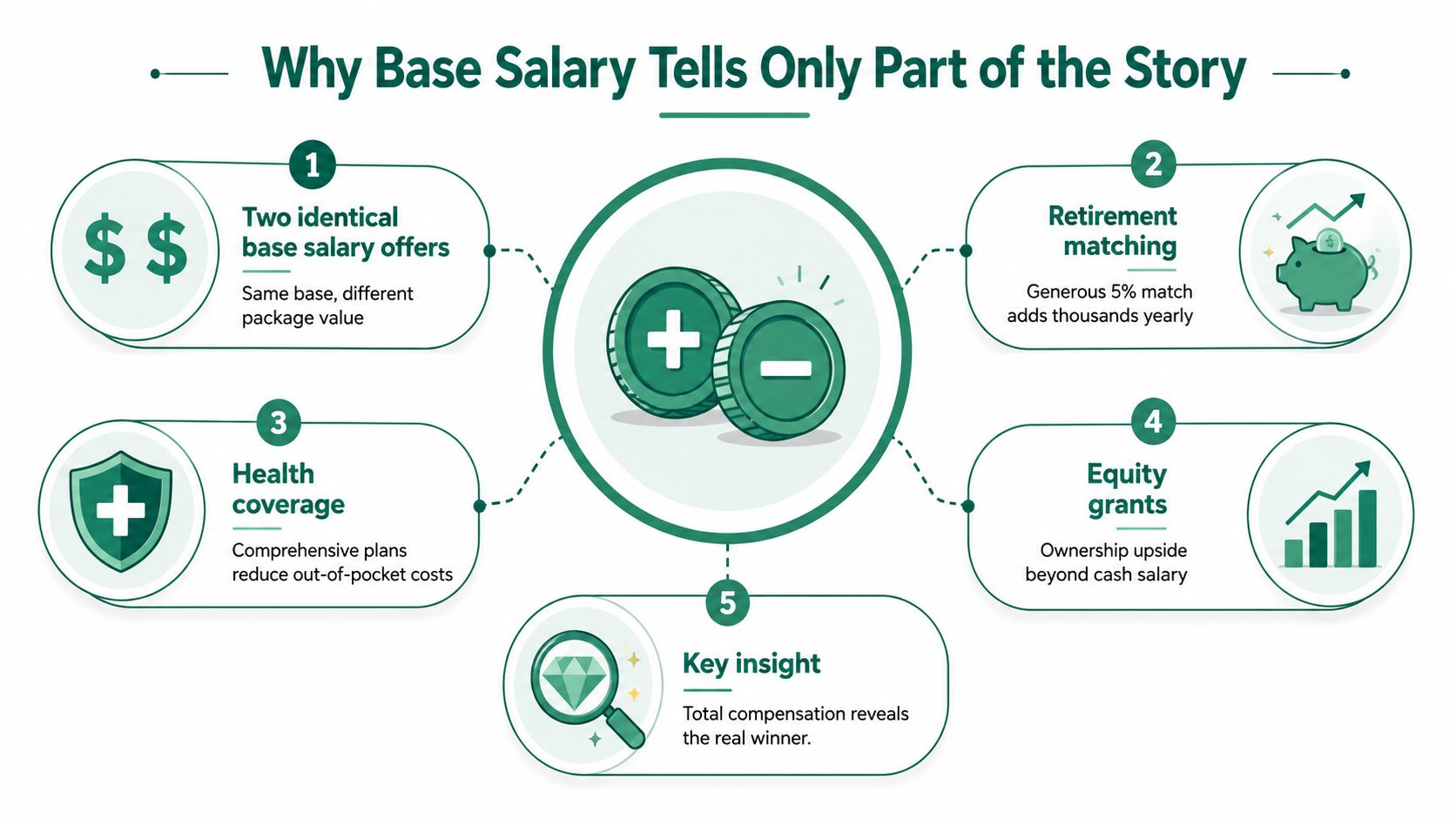
**Total compensation** captures the full economic value of a job, not just the cash amount you see first. The U.S. Bureau of Labor Statistics defines compensation as employer costs for **wages, salaries, and employee benefits**, which is why salary-only comparisons miss part of the picture ([BLS glossary](https://www.bls.gov/bls/glossary.htm)).
### What the headline number hides
A salary figure tells you how much cash the employer will pay directly. It does not tell you whether the company pays part of your health coverage, contributes to your retirement account, or gives you paid time off that still has value even though it does not show up as cash. It also does not show how those pieces fit together in real life, which matters when you are comparing offers that look similar at first glance.
The gap is easiest to see when you compare offers on an apples-to-apples basis. One package may have a higher salary but weaker benefits, while another may have a lower salary and stronger employer-paid value. That is why the headline number can be misleading if you treat it like the whole answer instead of one piece of the offer.
A useful way to compare packages is to convert each part into the value you can realize. Salary is simple because it is cash. Benefits require more care, since their value depends on whether you use them, how much the employer pays, and what you would otherwise spend yourself. For a practical payroll and accounting lens on how employers track these costs, see [UAE payroll accounting for SMEs](https://escrowconsultinggroup.com/blog/payroll-accounting-uae/).
> **Practical rule:** Two offers with the same salary are not equal unless you know what sits behind the number.
A better mental model is this, salary is the front door, while total compensation is the full house. If you stop at the front door, you may miss the rooms that matter most to your budget and long-term value. Once you compare the pieces side by side, the better offer often becomes easier to spot, even when the salary alone points the other way.
## The Components That Make Up Total Compensation
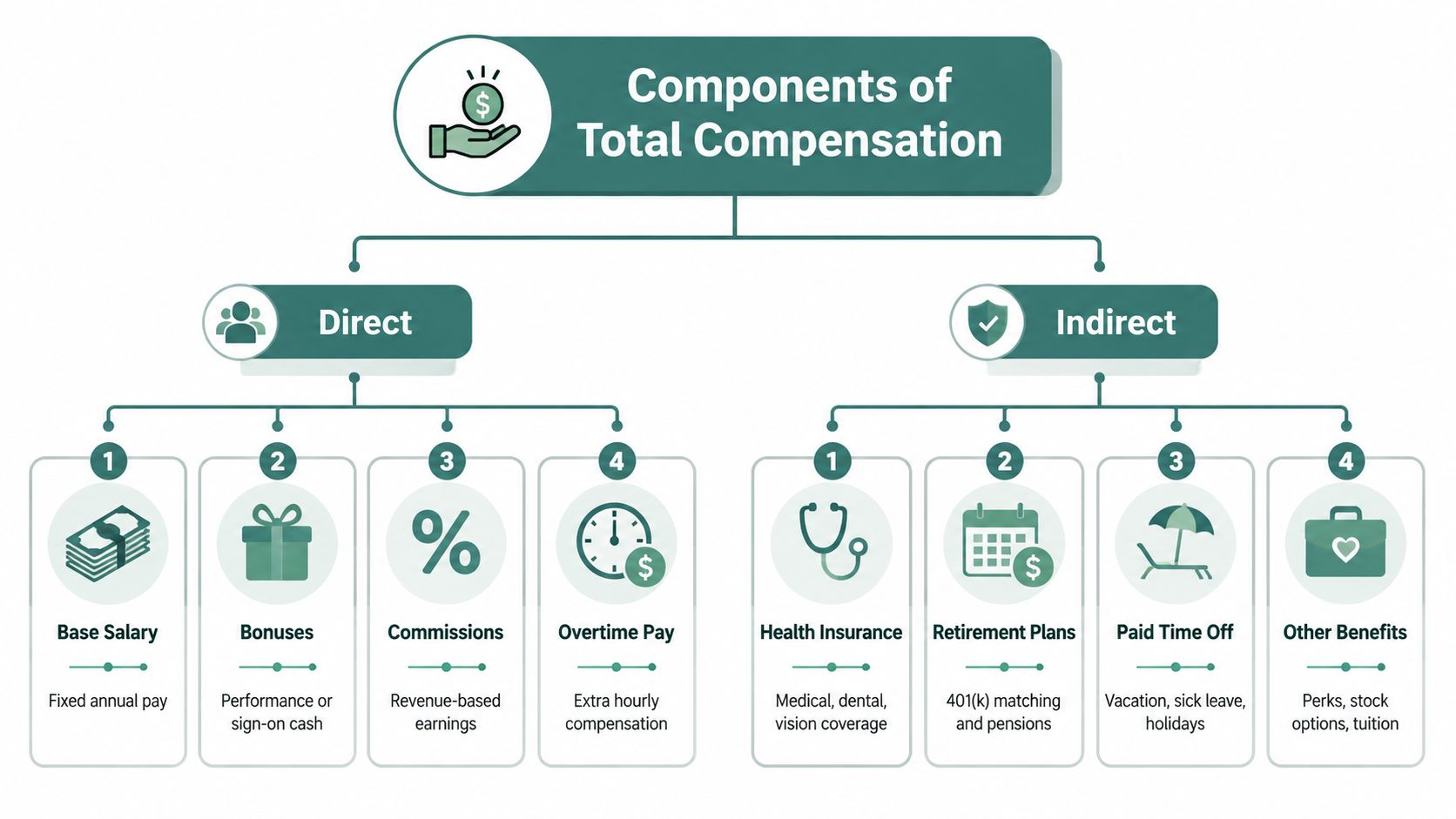
A full compensation package usually starts with **direct pay** and then layers in **indirect compensation**. Direct pay is the cash side, base salary, bonuses, commissions, and overtime. Indirect compensation is the employer-funded value that doesn't always show up in your bank account, but still affects what the job is worth to you.
### Direct compensation
**Base salary** is the fixed cash amount tied to the role. **Bonuses** are often tied to performance or sign-on incentives. **Commissions** depend on results, usually sales or revenue outcomes. **Overtime pay** applies when hourly roles require extra hours and the employer compensates those hours separately.
These are the easiest items to compare because they're explicit and usually stated in writing. If you want a broader compensation framework used in HR calculations, Paychex explains that total compensation is the sum of direct pay plus the dollar value of benefits and other employer costs ([Paychex total compensation calculator](https://www.paychex.com/articles/human-resources/total-compensation-calculator)).
### Indirect compensation
**Health insurance** can include employer-paid premiums for medical, dental, and vision coverage. **Retirement contributions** can include employer matches, profit sharing, or pension funding. **Paid time off** has value because you're paid while not working. **Equity** and stock options create ownership upside, though the value depends on vesting and company performance.
Other items can include life and disability insurance, education stipends, wellness benefits, and lifestyle perks. Some employers also include PTO, equity, or stipends in their broader total-rewards language, while others count only the items they can value directly. That inconsistency is one reason candidates get confused, and why offer comparisons should always begin with a full itemized list.
If you want to see how employers explain these pieces in another market, the discussion of [UAE payroll accounting for SMEs](https://escrowconsultinggroup.com/blog/payroll-accounting-uae/) is a useful reference point for how compensation and payroll items get tracked in practice.
## How to Calculate Total Compensation Step by Step
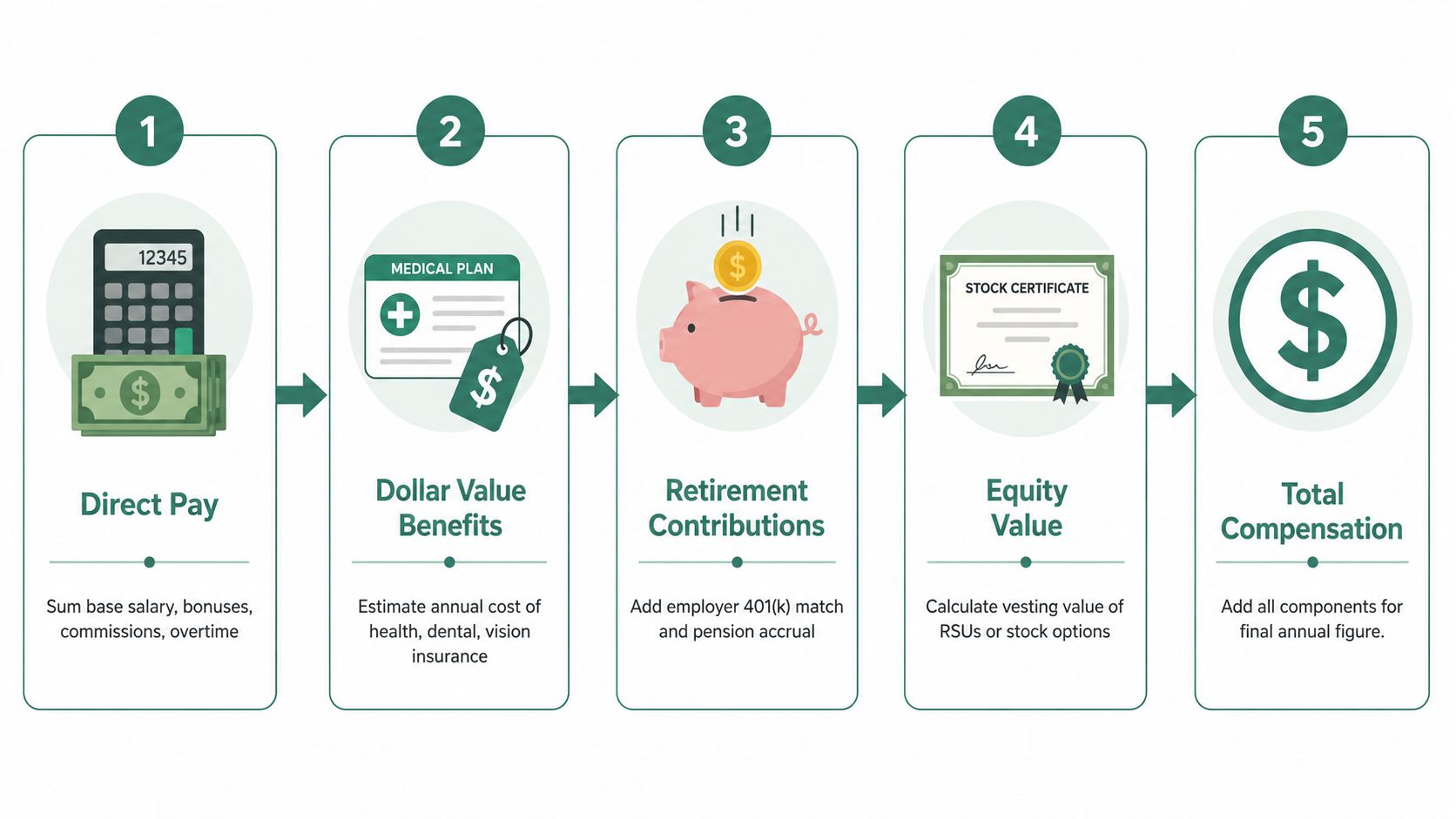
The cleanest way to calculate total compensation is to start with cash, then assign a dollar value to each benefit. That sounds technical, but the process is manageable if you treat it like a spreadsheet, not a vague HR concept.
### Step 1, add direct pay first
Start with the cash pieces you can see right away, salary, bonuses, commissions, and overtime. These items are the most straightforward because they're already in annual or hourly terms. If a bonus is discretionary, use the target amount, then mark it as variable so you don't confuse it with guaranteed pay.
### Step 2, assign a value to benefits
Health insurance is usually valued by the **employer-paid premium amount**, not by the coverage itself. If your employer pays the full premium, that's a direct addition to the package value. If you contribute part of the premium, you can still count the employer portion as compensation, because that's the employer cost.
Retirement contributions are easier to value when the plan match is stated clearly. For a matching plan, multiply your eligible pay by the employer match rate, then adjust for any cap or vesting rule. If you're comparing offers across countries or considering voluntary contributions, a resource like [salary sacrifice super calculator](https://wealthcollective.co/salary-sacrifice-super-calculator/) can help frame how employer and employee contributions affect the outcome in practical terms.
### Step 3, convert time off into dollars
Paid time off has real economic value because you're still paid while not working. A simple method is to divide annual salary by the number of workdays in a year, then multiply by the paid days off you receive. That gives you a rough annual dollar value for vacation, holidays, and sick time.
> **Use a consistent method.** If you count PTO in one offer, count it in every offer the same way, or your comparison will tilt unfairly.
### Step 4, treat equity carefully
Equity is where many people overestimate value. Options, restricted stock units, and similar grants can be meaningful, but vesting schedules matter. Use the employer's current valuation method if one is provided, and if not, keep the number conservative. A grant that looks large on paper can be worth much less if it vests slowly or never reaches the assumed value.
### Step 5, total it up and label what's uncertain
Add direct pay and the dollar value of each benefit to get the full package value. Then separate **guaranteed**, **likely**, and **speculative** components so you can see the risk profile clearly. That distinction matters because two offers with similar totals can feel very different once you know which parts are fixed and which parts depend on future events.
## Comparing Two Job Offers Using Real Numbers
A side-by-side comparison is the easiest way to see how total compensation changes the answer. One offer can have the bigger salary and still lose once you include retirement match, benefits, PTO, and equity value.
| Component | Offer A | Offer B |
|---|---:|---:|
| Base salary | $90,000 | $85,000 |
| Bonus | $0 | $5,000 target |
| Employer retirement contribution | $0 | $4,250 |
| Employer health coverage value | $3,000 | $8,000 |
| Paid time off value | $4,500 | $6,000 |
| Equity value | $0 | $4,000 |
| Estimated total compensation | $97,500 | $112,250 |
Offer A wins on base salary alone. Offer B wins on the full package because the employer is contributing more to retirement, health coverage, paid time off, and equity. The exact numbers in a real offer will vary, but the structure of the comparison is what matters.
### Why the better-looking salary can still lose
People often anchor on the first cash number they see. That's understandable, because base pay is easy to compare and easy to remember. But once you put the rest of the package into the same annual frame, the richer offer often emerges as the more valuable one.
This is also where life stage matters. A candidate with high medical expenses may care more about coverage quality than equity. Someone earlier in their career may prefer cash now over delayed upside. The math gives you the full picture, but your situation still decides which parts of that picture matter most.
### What to copy into your own spreadsheet
- **Base pay:** Put the annual salary in one row for each offer.
- **Employer benefits:** Add the employer's contribution to health, retirement, and any other named plan.
- **Time off:** Convert PTO into a dollar value using the same method for every offer.
- **Variable pay:** Separate guaranteed cash from target bonus or commission.
- **Equity:** Use a conservative annualized value if the grant vests over time.
The result isn't just a number. It's a comparison you can defend when you're deciding whether to accept, negotiate, or keep looking.
## When a Higher Total Compensation Number Is Actually Worse
A bigger total compensation number doesn't always mean a better offer. Sometimes it means more of the package is tied to variables you can't control, and that changes the value of the role.
### The gap between promised value and usable value
A total compensation statement can look impressive when it includes bonuses, commissions, and equity at their target or projected value. The problem is that those items may not arrive on schedule, may not be paid in full, or may not be worth what the employer implied. That's the realizable value gap, the difference between the headline number and what you can reasonably expect to receive.
### Risk changes the math
A cash-heavy offer is more predictable. You know what you're getting and when you're getting it. A higher total-comp number built on annual bonuses, unpredictable commissions, or speculative equity carries more risk, even if the top-line figure looks stronger.
That's why a lower total-comp offer can still be the better choice if it gives you stable pay, clear benefits, and less uncertainty. Candidates in volatile industries should pay extra attention to this mix, because variability changes whether the package supports your real financial plans or just looks strong in a presentation.
> If a component can disappear, shrink, or vest slowly, treat it as uncertain value, not as cash in hand.
### What to ask before you trust the number
Ask whether bonuses are guaranteed or discretionary. Ask how commissions are calculated and whether there are caps, clawbacks, or delayed payouts. Ask how equity vests, what happens if you leave, and whether the company provides any current valuation guidance.
Once you separate fixed value from contingent value, the decision gets clearer. The better total compensation package is the one that fits your risk tolerance, not the one with the biggest marketing number.
## Why Employers Must Communicate Total Compensation Clearly
Employers that only advertise base salary create avoidable confusion. They also make it harder for candidates to compare offers fairly, because two jobs with identical pay can differ sharply in total reward value.
A clear annualized compensation view helps recruiters explain the economics of a role. It also makes it easier to compare one offer against another in a way that's consistent, honest, and easier to evaluate early in the process. For teams that want a tighter job-ad structure, [how to write job advertisements](https://www.talentpronto.ai/blog-posts/how-to-write-job-advertisements) is a helpful companion piece because it shows how compensation details fit into a stronger posting.
### Why clarity protects trust
When compensation messaging shifts between recruiter, hiring manager, and offer letter, candidates notice. That inconsistency can make a strong company look disorganized, or worse, misleading. Clear language about salary, benefits, and the value of non-cash rewards reduces that risk.
It also helps employers stay aligned internally. If the hiring team understands the package as a whole, they can answer questions faster and present the role more accurately. That matters because benefit changes can alter total reward value without changing headline pay at all.
### How consistent answers improve the candidate experience
AI-enabled screening tools can help employers surface the same compensation information every time a candidate asks. That consistency matters when applicants are comparing pay, benefits, and total rewards before they've even spoken to a recruiter. Systems that use employer-provided data in conversational Q&A can answer those questions without guessing or improvising, which supports fairer, more transparent screening.
Teams that care about early-stage consistency often pair that with clearer hiring workflows. For a practical view of that side of the process, see [how to improve candidate experience](https://www.talentpronto.ai/blog-posts/how-to-improve-candidate-experience). The goal is simple, give candidates accurate compensation information early enough that they can make informed decisions, not late enough that trust is already shaky.
## Practical Tips for Evaluating and Negotiating Offers
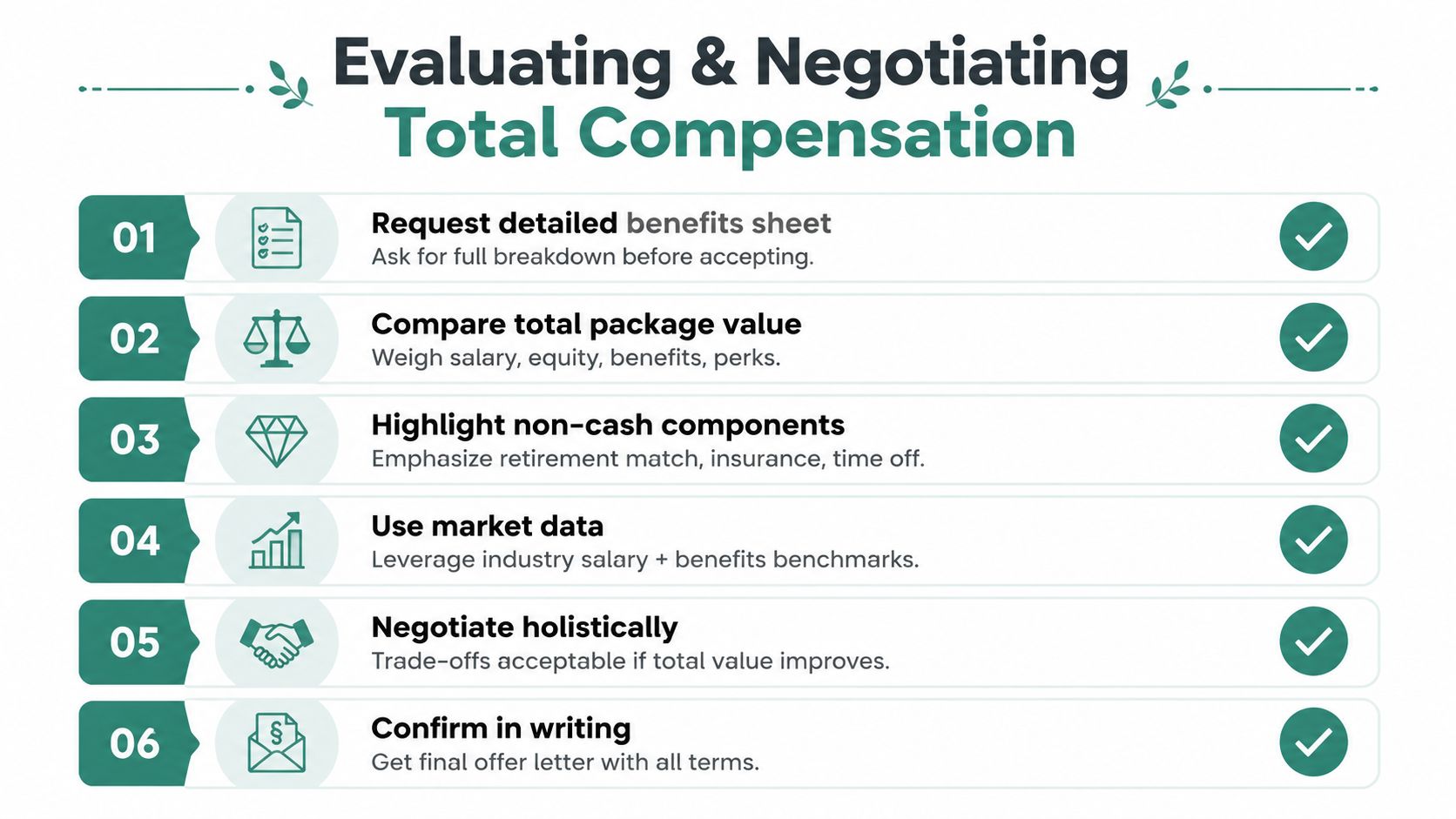
A good offer review starts with a full breakdown, not a quick glance at salary. If the employer can't or won't share the details, ask for them before you say yes.
### What to ask for
- **Detailed benefits sheet:** Request the employer's full breakdown so you can see health coverage, retirement, and paid leave in one place.
- **Employer contribution details:** Ask who pays what, especially for insurance premiums and retirement matching.
- **Vesting schedule:** Find out when equity becomes yours and what happens if you leave early.
- **Bonus rules:** Ask whether the bonus is target-based, discretionary, or guaranteed.
- **Written confirmation:** Make sure the final letter reflects every material term you discussed.
### How to negotiate without getting stuck on salary
If the base salary is fixed, move to the parts that might be flexible. A stronger retirement match, a signing bonus, extra PTO, a home-office stipend, or a higher equity grant can improve the total package even if the salary number stays put. Framing your request around **total value** makes the conversation more productive than repeating only one number.
### How to decide what matters most
Your priorities change with your life stage. A candidate paying for frequent care may put health coverage first. Someone managing a mortgage may care more about stable cash. A career changer may value education support and training more than a larger bonus.
The best habit is simple. Build a comparison sheet for every offer, include the same categories every time, and decide from the full picture instead of the loudest line on the page.
## Making Total Compensation Your Decision Framework
Total compensation gives you the full economic story, but it doesn't make the decision for you. Role fit, growth, culture, commute, flexibility, and manager quality still matter, and they can outweigh a small gap in pay.
The shift is mental. Once you start comparing packages by **direct pay**, **benefits**, **retirement value**, **paid time off**, and **equity**, you stop undercounting what a job is worth. That makes it much harder for a weak offer to win just because the base salary sounds good.
For a broader analytical lens on workforce decisions, [what is people analytics](https://www.talentpronto.ai/blog-posts/what-is-people-analytics) connects the same kind of disciplined thinking to hiring and workforce data. The same logic applies here. Use a consistent method, compare like with like, and pay attention to realizable value, not just projected value.
If you're reviewing offers this week, build the spreadsheet, ask for the missing details, and compare the whole package before you commit. When you're ready to make the process easier for your hiring team and clearer for candidates, visit [Talent Pronto](https://talentpronto.ai) to see how conversational screening and consistent compensation Q&A can support better hiring decisions.