The companies winning the engineering talent war aren't hiring more recruiters. They're using AI-augmented hiring to move faster while delivering a higher quality candidate shortlist that your hiring managers can trust.

Engineering leaders face a paradox: the demand for technical talent has never been higher, yet the process of finding and hiring that talent remains stubbornly manual, slow, and inconsistent. For most companies, hiring an engineer still looks roughly the same as it did a decade ago: post a job, get buried in resumes, and hope your team can find the right people before they accept another offer.
The numbers tell the story. A single engineering job posting can attract hundreds of applications. Your hiring managers and recruiters can only realistically screen a fraction of that pool, which means qualified candidates get overlooked simply because no one had time to review their resume. Meanwhile, the candidates who do make it through are often selected based on keyword matches and surface-level credentials rather than actual ability.
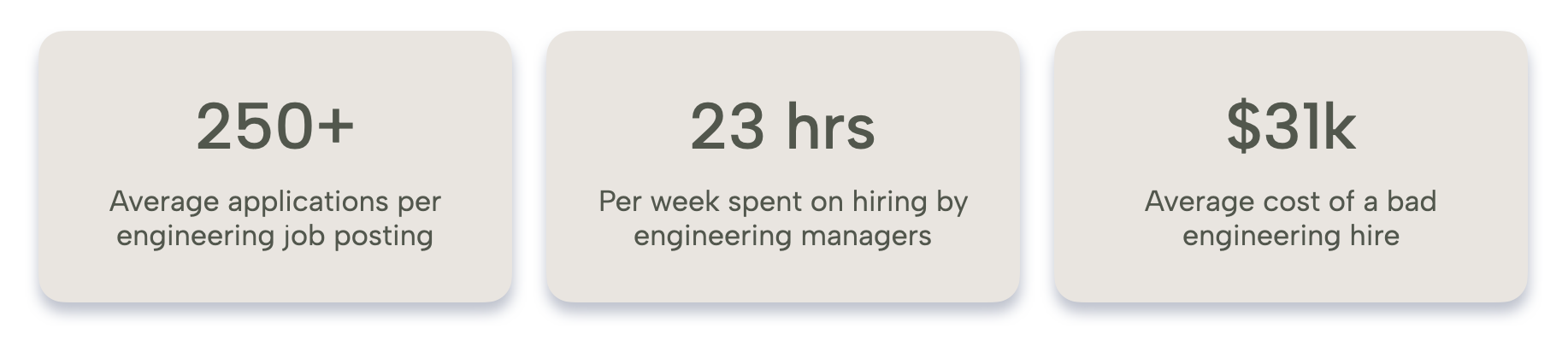
The real cost goes beyond dollars. Every hour your engineering managers spend conducting first-round phone screens is an hour they are not spending building product. And because they are inundated with applicants, they are forced to make snap judgments based on resumes alone, turning hiring into a guessing game rather than a deliberate, data-driven process.
When a bad hire does make it through, the downstream impact is significant: onboarding time, ramp-up costs, team disruption, and eventually the cost of backfilling the role. The Society for Human Resource Management estimates that the total cost of a bad hire can reach 50 to 60 percent of that employee's annual salary.
Most hiring processes were designed for a world with fewer applicants and more time. They rely on a combination of resume reviews, recruiter phone screens, and hiring manager interviews to whittle down the candidate pool. For engineering roles, this approach breaks down in several critical ways
A resume tells you where someone has worked, what tools they list, and how well they can format a document. It does not tell you whether they can architect a scalable system, debug a production issue under pressure, or collaborate effectively with a cross-functional team. Yet resumes remain the primary filter in most engineering hiring pipelines.
Even talented recruiters struggle to evaluate engineering candidates with precision. Without deep technical backgrounds themselves, they often rely on keyword matching and credential checking, which means candidates with non-traditional backgrounds or adjacent experience get filtered out, even if they would be excellent hires.
When your engineering managers do conduct phone screens, the experience varies wildly depending on who is asking the questions, what mood they are in, and how much time they have. One interviewer might ask deep systems design questions while another sticks to surface-level behavioral prompts. Without a standardized process, you have no consistent baseline for comparing candidates.
Top engineering talent moves fast. If your hiring process takes three to four weeks from application to offer, you are losing candidates to companies that move in days. The bottleneck is almost always the screening stage, where candidates sit in a queue waiting for someone to have time to talk to them.
The companies winning the talent war are the ones who figured out that speed and quality are not opposing forces.
With the right process, you get both.
AI-augmented hiring is not about replacing human judgment. It is about giving your hiring team better information, faster. Instead of relying on resumes and keyword filters to decide who deserves a conversation, an AI interviewer conducts structured, conversational interviews with every single applicant, so no one slips through the cracks.
The foundation of effective AI interviewing is structure. Every candidate receives the same set of carefully designed questions rooted in the STAR framework (Situation, Task, Action, Result). These behavioral questions go far beyond what a resume can reveal, probing how candidates have handled real-world challenges, how they think through problems, and how they communicate their reasoning.
A strong engineer is more than a collection of technical competencies. The best hires bring soft skills like clear communication, collaborative instincts, and the ability to navigate ambiguity. They also align with your team's culture and values. AI interviews evaluate all three dimensions: technical skills, soft skills, and culture fit, giving you a complete picture of each candidate in a single step.
This is the fundamental shift. In a traditional process, most applicants never get a real conversation. They submit a resume, and if the right keywords are not there, they disappear. With AI interviewing, every candidate who applies gets a structured interview. Your team is no longer limited by how many phone screens they can fit into a week. The AI runs 24/7, and candidates can complete their interview on their own schedule, which means you are also providing a better candidate experience.
Human interviewers, no matter how well-intentioned, bring unconscious biases and inconsistencies to the process. An AI interviewer asks the same questions the same way every time. It evaluates responses against the same criteria. The result is a level playing field where candidates are judged on their answers, not on rapport, appearance, or interviewer fatigue.
Not all AI hiring tools are created equal. If you are evaluating solutions for your engineering team, here are the capabilities that matter most.
There is a meaningful difference between a conversational AI interviewer and a simple chatbot or assessment quiz. Look for a system that can conduct a natural, adaptive conversation, asking follow-up questions based on candidate responses and probing deeper when answers are vague or incomplete. Candidates should feel like they are having a real interview, not filling out a form.
Your interview questions should reflect your actual needs: the technologies you use, the problems your team solves, and the values that define your engineering culture. A good AI interviewing platform lets you customize questions and evaluation criteria so that the interviews are tailored to your specific roles, not generic templates.
The output of an AI interview should be actionable. Look for a platform that provides structured scoring across multiple dimensions (technical ability, communication, culture alignment) and ranks candidates so your hiring managers receive a clear, prioritized shortlist rather than another stack of unstructured notes to sift through.
The whole point of AI-augmented hiring is to move faster while making better decisions. Evaluate platforms on their ability to deliver both: rapid candidate throughput with interview depth that gives you genuine confidence in the shortlist. If the tool only gives you speed or only gives you quality, keep looking.
• Conversational, adaptive AI interviews (not chatbots or quizzes)
• STAR-style behavioral questions with structured scoring
• Customizable to your technology stack, roles, and culture
• Evaluation of technical skills, soft skills, and culture fit
• Clear candidate rankings with actionable shortlists
• 24/7 availability for candidates across time zones
• Fast time-to-value with minimal setup overhead
The engineering hiring landscape has changed. Application volumes are up, competition for talent is fierce, and your team's time is more valuable than ever. Continuing to rely on manual resume reviews and ad hoc phone screens means you are leaving qualified candidates on the table while burning out your engineering managers on work that does not ship product.
AI-augmented hiring solves this by ensuring every candidate gets a structured, consistent interview that evaluates the skills, behaviors, and cultural alignment that actually predict success on your team. The result is a faster pipeline, a lower cost per hire, and a higher quality shortlist that your hiring managers can trust.
Faster time-to-fill: Interview every applicant without adding headcount to your recruiting team.
Lower cost-per hire: Eliminate wasted hours on unqualified candidates and reduce reliance on expensive agency recruiters.
Better candidate quality: Structured STAR interviews surface the candidates who can actually do the job, not just the ones with polished resumes.
Engineering time recovered: Give your managers back the hours they currently spend on first-round screens so they can focus on building.
Scalable hiring: Whether you are filling one role or twenty, the process stays consistent and the quality stays high.
The best engineering organizations are not hiring more recruiters. They are building smarter hiring processes. AI-augmented interviewing is how you get there.
Ready to see AI-augmented hiring in action? Schedule your demo now.

Talent Pronto is an AI-powered hiring platform built around Anna, our intelligent AI that conducts 24/7 conversational screening, evaluates candidates against specific job requirements and compliance needs, and schedules interviews. Run everything on the Talent Pronto ATS, our all-in-one applicant tracking system with a branded careers site and Anna built in, or keep your existing ATS and let Anna integrate with Greenhouse, Ashby, iCIMS, Jobvite, Lever, Oracle, and more. Either way, we help organizations reduce time-to-hire and build stronger teams.