Traditional applicant tracking systems weren't built to evaluate specialized skills and nuanced qualifications. Complex roles require smarter screening tech that goes beyond keyword matching to identify candidates who are truly qualified.
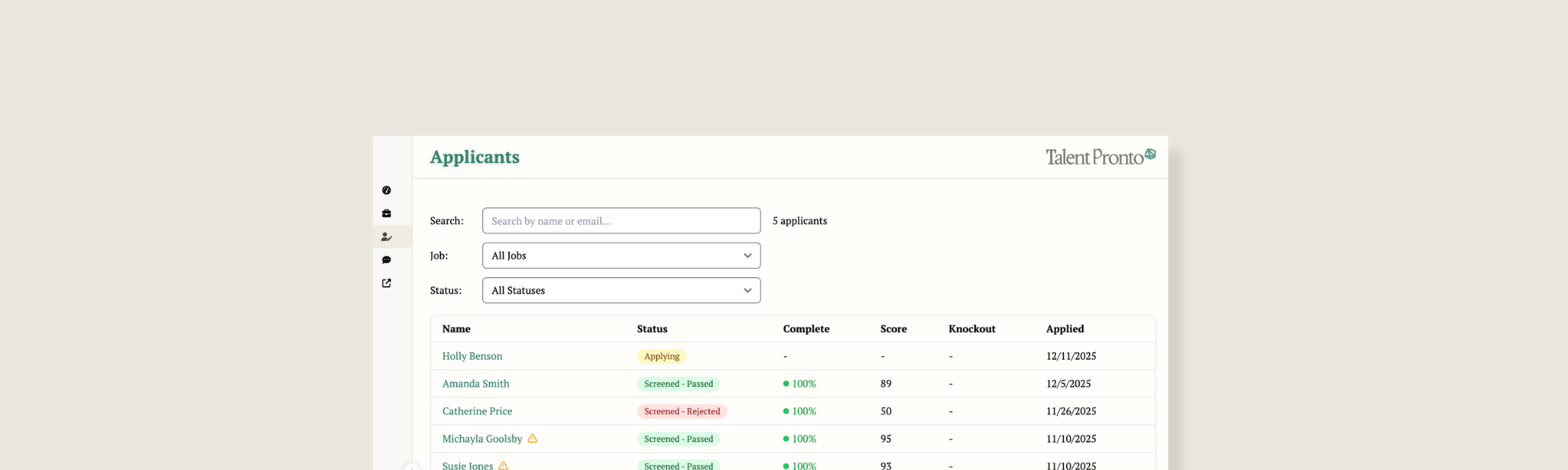
You posted a software engineering role last week. You've already received 847 applications. By the time the posting closes, you'll have over 1,500.
Somewhere in that pile are 5-10 truly qualified candidates. The rest range from underqualified to completely unrelated. Your challenge isn't attracting applicants. It's finding the qualified candidates buried in hundreds of applications.
Most hiring tools fall into two camps: generic ATS platforms that parse resumes without understanding them, or basic chatbots that collect information without evaluating depth. Neither works when you're drowning in applications for specialized roles where context and expertise matter more than keywords.
Complex roles require screening tools built to understand what makes candidates qualified and probe for depth, not just match keywords or gather data.
When you're facing 1,500 applications for a technical role or 200 for a nursing position, both traditional ATS and basic chatbots create the same fundamental problem: they organize information without evaluating it.
Generic ATS platforms use keyword matching that misses context entirely. The system treats "10 years of Java experience" and "10 Java projects completed in bootcamp" as equivalent if both resumes contain the right keywords. Any technical hiring manager knows these represent fundamentally different levels of expertise. Strong candidates get filtered out because they describe their experience differently than your job posting language. Career changers with relevant transferable skills disappear before anyone reviews them.
Many newer "AI screening" tools aren't much better. They're just glorified form-fillers asking predetermined questions without understanding the answers. If a candidate says "I have EMR experience," a basic chatbot moves to the next question. It doesn't ask which EMR systems, in what capacity, or for how long. It doesn't follow up when someone mentions Epic implementation to understand their specific role in the project.
Information gathering does not equal qualification assessment. You can collect perfectly structured data about 1,500 candidates and still have no idea which 10 are actually qualified. The result is the same either way: hiring managers end up reviewing hundreds of applicants manually because the screening adds no real evaluation value.
Roles requiring specialized training, certifications, or technical expertise need fundamentally different evaluation. These positions share characteristics that generic screening can't handle: specific certifications or licenses that must be verified (RN licenses, CPAs, AWS certifications, bar admission), technical skills that can't be verified from a resume alone, and experience that needs context to evaluate properly. "Managing a team" could mean supervising 3 entry-level employees or leading cross-functional initiatives with 50+ stakeholders. "EMR experience" could mean data entry or implementing Epic across a hospital network.
Real qualification assessment for these roles requires structured evaluation with intelligent follow-ups. Every candidate gets asked the same core questions about baseline qualifications: certifications, years of experience, specific technical skills. But the screening probes deeper based on their answers. If someone mentions Epic implementation, it asks about their role in the project. If another mentions basic Epic charting, that follow-up isn't relevant. Fairness comes from everyone being evaluated on the same criteria. Intelligence comes from adaptive questioning that reveals depth.
It also requires understanding credential hierarchies (a BSN represents different training than an ADN, a CPA requires passing a rigorous exam beyond an accounting degree), depth assessment rather than surface-level data collection, and defensible documentation showing candidates were evaluated on job-related criteria.
At Talent Pronto, we built Anna around a principle: when you're drowning in applications for complex roles, you need screening that actually evaluates qualifications.
Anna delivers:
From 1,500 applications to 15 qualified candidates worth interviewing.
Hiring managers review genuinely qualified candidates, not hundreds of applications. When screening actually evaluates depth, the candidates who reach human review are worth your team's time. You're making decisions based on real qualification assessment, not starting from scratch with every applicant pool. You're evaluating not just what candidates claim, but the depth behind those claims: who can actually do the job. And you have complete records showing candidates were evaluated fairly on job-related criteria with appropriate depth.
Generic ATS platforms work for high-volume, low-complexity hiring. Basic chatbots collect data without evaluating depth.
But when you're facing 1,500 applications for a specialized role requiring certifications, technical depth, or regulatory compliance knowledge, you need screening that actually assesses qualifications: understanding what distinguishes strong candidates from weak ones, probing for depth when it matters, and adapting conversations based on what candidates reveal.
Schedule a 15-minute demo to see intelligent screening in action: how Anna evaluates depth, adapts based on responses, and delivers the qualified candidates your hiring managers actually need to interview.

Talent Pronto is an AI-powered hiring platform built around Anna, our intelligent AI that conducts 24/7 conversational screening, evaluates candidates against specific job requirements and compliance needs, and schedules interviews. Run everything on the Talent Pronto ATS, our all-in-one applicant tracking system with a branded careers site and Anna built in, or keep your existing ATS and let Anna integrate with Greenhouse, Ashby, iCIMS, Jobvite, Lever, Oracle, and more. Either way, we help organizations reduce time-to-hire and build stronger teams.