Discover top healthcare recruiting software for 2026. Our guide covers compliance, credentialing, AI, and an evaluation checklist to optimize your hiring.
You're probably living some version of this right now. A nurse requisition opens at 7:00 a.m., applications start stacking up before lunch, a hiring manager wants interviews on the calendar by tomorrow, and someone on the compliance side flags a license that expires next week. Meanwhile, another candidate looks great on paper but no one has a reliable way to assess bedside manner before the first live interview.
That's why healthcare recruiting software matters more than a generic ATS upgrade. In healthcare, recruiting sits directly on top of credentialing, patient safety, audit readiness, shift coverage, and candidate responsiveness. If the system can't handle those realities, it doesn't matter how polished the dashboard looks.
Round-the-clock response closes a major healthcare hiring gap
A recruiter in healthcare doesn't just fill jobs. They manage urgency, documentation, licensure risk, manager availability, candidate communication, and staffing pressure all at once. When a med-surg role, respiratory therapist opening, or physician requisition sits open, the consequences hit operations fast.
That's why healthcare recruiting software has shifted from optional tooling to operating infrastructure. The market itself reflects that change. The global medical recruitment market is projected to grow from USD 68,235.2 million in 2026 to USD 127,072.4 million by 2033, with a 9.3% CAGR, driven by adoption of AI-enabled recruitment platforms, according to Coherent Market Insights' medical recruitment market projection.
The pressure isn't only about volume. It's about whether your team can move fast without lowering standards. In healthcare, a delayed hire can mean coverage gaps. A rushed hire can mean compliance problems. A poor fit can create turnover in roles where continuity and patient trust matter.
The workflow often breaks in several places at once:
That's the environment specialized platforms are built for. A healthcare-specific system isn't just a database with a healthcare label. It should support the challenges providers and health systems face every week, from clinical matching to compliance workflows to scheduling constraints. Teams evaluating healthcare recruiting workflows and tools should start there, not with generic feature checklists.
Practical rule: If your recruiting platform treats healthcare hiring like office hiring with extra fields, it will create workarounds, not control.
The fastest way to spot weak healthcare recruiting software is to look at what happens after a candidate says, “I'm interested.” In other industries, the next step might be screening and interviews. In healthcare, the next step is usually a chain of verification tasks that can stall placement, trigger audit problems, or expose the organization to risk if they're handled loosely.
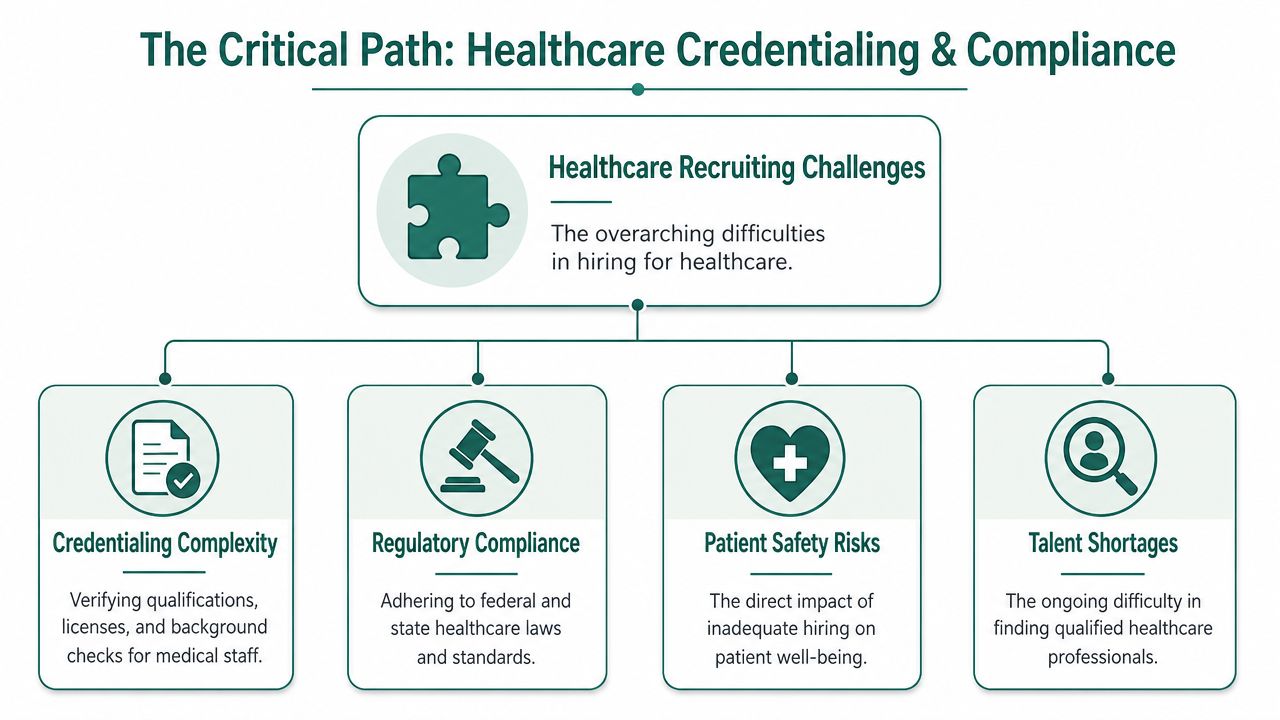
A basic ATS can store resumes and track stages. That's not enough for healthcare. You need a system that can support primary source verification, credential status tracking, expiration alerts, and documentation that stands up during review.
Purpose-built platforms must integrate automated PSV for licenses, generate real-time expiration alerts, and maintain audit-ready documentation to avoid placement delays that can cost agencies $1,200 to $3,500 per unfilled clinical role, as outlined in Althire's guide to healthcare recruitment software features.
The operational difference is huge. A general platform might let a recruiter attach a license document. A healthcare-ready platform should help confirm whether the credential is current, whether it's been verified from an approved source, and whether the team has proof on file when someone asks for it.
The most effective setups usually include these controls:
A lot of teams underestimate how closely recruiting and compliance are tied together. Recruiters feel this first when a strong candidate sits in limbo because no one can confirm a required document fast enough. Hiring managers feel it next when coverage remains open. Compliance feels it last, but usually with the biggest downside.
If a recruiter has to maintain a shadow spreadsheet to feel safe about licenses, the software has already failed.
There's also a regional compliance reality. Multi-site and cross-border organizations often need guidance beyond recruiting software itself. Teams operating in or with Canadian entities should understand broader requirements around privacy, security, and regulated healthcare systems. A useful primer is this overview of Canadian healthcare IT compliance, especially for leaders aligning recruiting systems with larger health IT controls.
One more point matters here. Healthcare recruiting software can't stop at credential collection. It has to reduce the chance that a candidate gets deep into the process before someone notices a missing verification, an expired credential, or a mismatch between role requirements and the actual license held. The best systems prevent late-stage surprises. Weak systems only document them after the damage is done.
Once compliance basics are clear, the next question is simpler. What should every credible healthcare recruiting platform do before you even evaluate the advanced AI layer?
The answer starts with workflow discipline. If the system forces recruiters to re-enter data, bounce between scheduling tools, and patch together reports manually, adoption falls off fast.
A strong platform should connect to the systems healthcare HR teams already use, including ATS, HRIS, payroll, and onboarding tools. Workday and ADP are common examples, but the principle matters more than the vendor list. Candidate status, interview progress, and hiring records should move cleanly across systems.
That's especially important when scheduling enters the picture. Healthcare interview coordination often breaks because recruiting calendars don't match the realities of rotating clinical schedules. Teams trying to reduce this friction should look closely at automated interview scheduling for complex hiring workflows, where the gains usually come from fewer handoffs, not just faster calendar invites.
Here's the baseline I'd expect before considering any purchase:
| Capability | Why it matters in healthcare |
|---|---|
| Centralized candidate records | Recruiters need one profile that includes clinical skills, certifications, preferences, and history |
| Searchable specialty data | Teams must filter by role fit, not just keyword matches |
| Workflow automation | Repetitive follow-up and status movement shouldn't depend on memory |
| Reporting dashboards | Leaders need visibility into bottlenecks and recruiter workload |
| Mobile-friendly experience | Candidates and managers often respond away from a desk |
A mature platform should also reflect the operational overlap between hiring and staffing. Candidate preferences for nights, weekends, per diem work, or facility location influence whether a submission turns into a workable placement. If the software can't store and surface those details clearly, the recruiter ends up doing the hard part outside the system.
The platform should reduce decisions that recruiters have to make from memory and increase decisions they can make from evidence.
These features aren't flashy. They're the layer that keeps the process coherent when volume rises.
At 9:30 p.m., a qualified RN finishes a shift, opens a phone, and applies to three jobs in ten minutes. By morning, the employer that responded, screened, and offered interview times is still in the running. The other two are already behind.
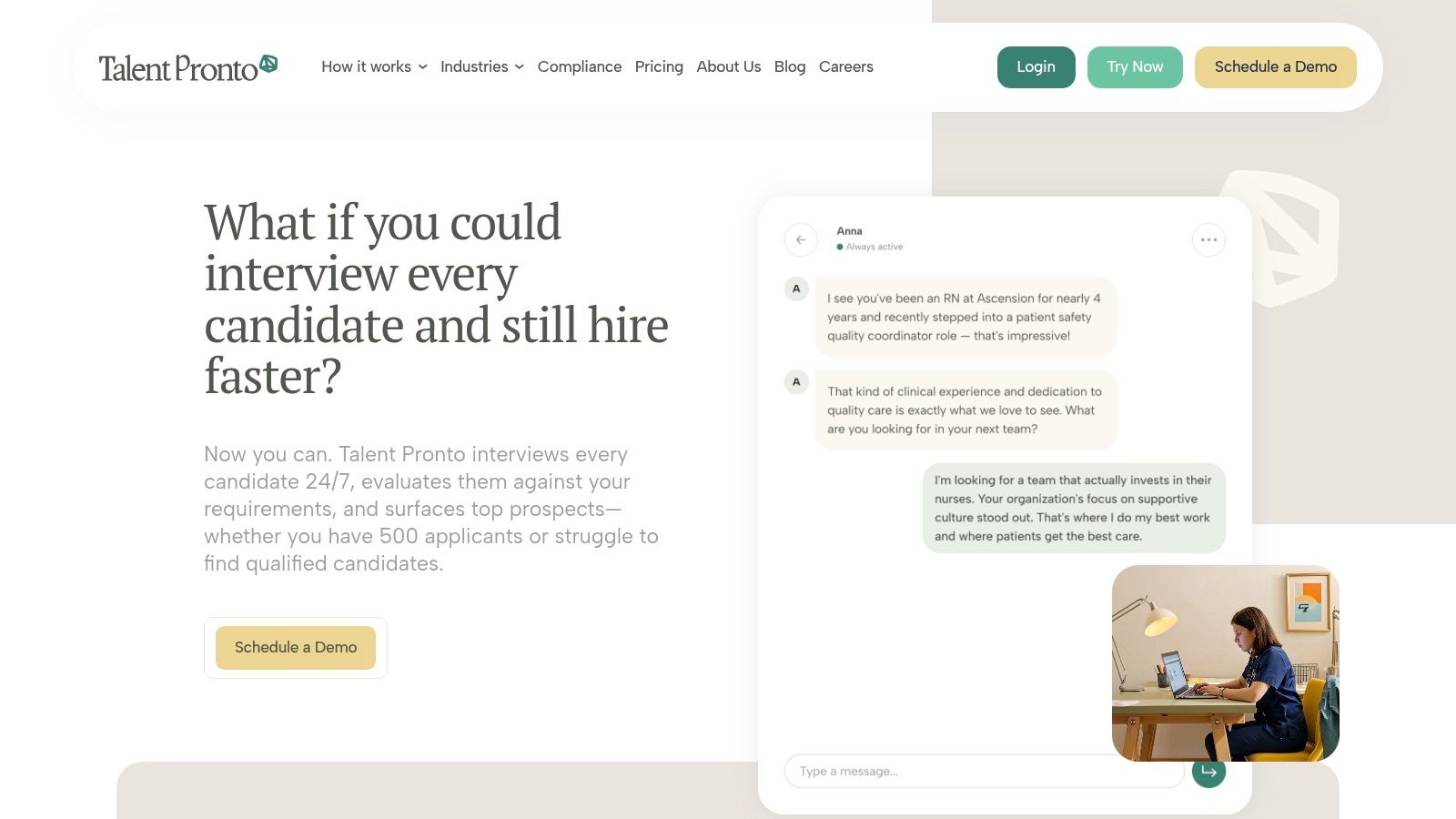
That is where AI earns its place in healthcare recruiting. The value is not generic automation. It is the ability to keep hiring moving during off-hours, apply the same screening standard across hundreds of applicants, and document early-stage decisions in a way recruiters and compliance teams can review later.
Bullhorn reports that healthcare staffing firms using AI can save recruiters significant weekly time, and firms that automate candidate search are more likely to place candidates faster, in its healthcare staffing software analysis. In practice, those hours matter because healthcare recruiting has too many exceptions for recruiters to spend their day on basic follow-up. The time should go to escalation calls, offer alignment, credential issues, and manager calibration.
High-volume healthcare hiring breaks down at the top of the funnel. Applicants come in after shifts, on weekends, and between patient loads. Recruiters work business hours. Hiring managers are often tied up on the floor. If nobody responds quickly, candidate interest drops before the first screening even starts.
Phenom reports that many healthcare applicants never hear back after applying, and points to AI screening plus shift-aware scheduling as a way to reduce that leakage across multi-site, rotating-shift environments, in its discussion of tools and resources for healthcare recruiters.
Conversational AI helps because it does more than send an acknowledgment email. It can answer basic questions about shifts, location, and next steps. It can ask knockout questions right away. It can offer interview slots while the candidate is still engaged. For frontline roles, that speed often matters more than adding another source of applicants.
Workday makes a similar point in its overview of a conversational applicant tracking system, describing how conversational ATS workflows can automate large portions of frontline hiring, including screening, candidate Q&A, and scheduling. That model fits healthcare well because the demand pattern is uneven and the candidate pool is mobile-first.
Speed is the obvious benefit. Structure is the more important one.
Healthcare teams do not hire on credentials alone. They hire for bedside manner, communication under stress, judgment with families, and the ability to stay calm when a patient interaction turns difficult. Those qualities are often discussed late and scored inconsistently. One recruiter calls a candidate warm. Another says polished. A manager says not the right fit. None of that creates a fair, comparable record.
A stronger conversational system brings discipline to that stage. It asks the same role-specific questions, follows a scoring rubric, captures examples, and gives reviewers something more useful than memory. That matters for empathy in particular. If a platform can guide a candidate through scenarios involving patient anxiety, conflict de-escalation, or difficult family communication, the team gets a more structured view of soft skills before the interview panel ever meets.
In healthcare, empathy should be assessed with the same consistency used for licenses, availability, and specialty fit.
That does not mean AI should judge character on its own. It means AI can make the first assessment more consistent. Recruiters and managers still decide what good looks like, which answers require follow-up, and where nuance outweighs a score.
Here is the practical test I use. Ask the vendor whether the system only records answers, or whether it conducts a guided screening tied to competencies for the role. There is a real difference between collecting availability and assessing whether a candidate can explain how they reassured an anxious patient while keeping the visit on track.
Cadient also notes that conversational screening paired with configurable eligibility questions can reduce abandonment in early-stage screening, in its overview of automated candidate screening and AI screening practices. For teams hiring at scale, that matters because every extra click in the process costs completions.
For a closer look at the operating model behind fast response and consistent throughput, review these high-volume hiring strategies.
Here's what that looks like in practice:
AI works well in healthcare recruiting when it handles repeatable front-end work and leaves judgment with the hiring team. It is useful for:
It still needs clear controls. Teams have to define the rubric, validate knockout criteria, audit for consistency, and train managers on how to use AI-generated summaries. A healthcare recruiting system should reduce administrative drag and improve early assessment quality. It should not make hiring decisions without oversight.
A polished demo can hide a messy operating model. I learned that the hard way. The questions that matter in healthcare are the ones that expose whether the system can hold up once recruiters, hiring managers, compliance staff, and candidates are all using it at the same time.
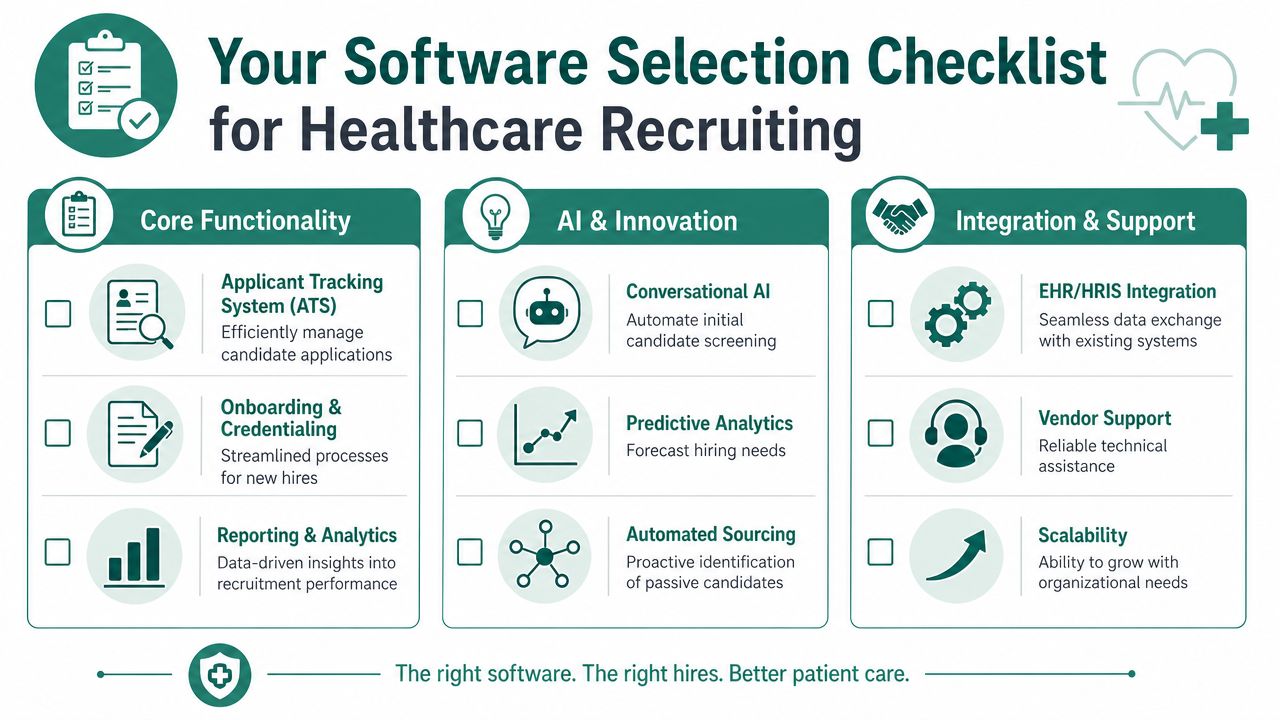
Start with risk control.
A vendor that knows healthcare should be able to explain how a nurse, therapist, or aide moves from application to cleared hire without manual side lists. They should also be clear about what their software does not handle well. That honesty usually tells you more than the feature sheet.
At this point, projects either get adopted or get sidelined.
Ask what your team has to do during implementation. Who maps current workflows. Who cleans up disposition reasons and user permissions. How do candidate statuses sync across the ATS, HRIS, credentialing tools, scheduling platforms, and onboarding systems. What happens when one candidate applies to three locations or shows up twice with different contact information.
Those details matter because healthcare recruiting breaks down in the gaps between systems. If recruiters have to re-enter notes, check a separate spreadsheet for license expirations, or email managers to confirm the latest status, the platform is adding another layer instead of removing work.
Ask about training, too. A stronger process usually requires behavior change. Recruiters may need to stop managing requisitions from their inbox. Managers may need to approve interviews inside the system instead of by text. If the vendor cannot explain how they drive adoption, expect old habits to win.
What to listen for: Strong vendors answer with workflow detail, role permissions, exception paths, and ownership. Weak vendors answer with product labels.
Healthcare hiring happens on phones, between shifts, and outside office hours. The software has to respect that.
Use questions like these:
Good software shortens delays between steps. It also makes those delays visible, which is just as important.
AI claims get fuzzy fast, so keep the evaluation concrete. In healthcare, the best use case is not generic matching. It is structured screening that captures information your team utilizes, including communication style, empathy, listening, and judgment under pressure.
Here's the short list I use:
| Question | Strong answer | Weak answer |
|---|---|---|
| How does your AI assess soft skills? | Uses role-based rubrics, standardized prompts, and scoring criteria recruiters can review | “It uses smart matching” |
| Does it support behavioral probing? | Follows up on candidate responses to gather comparable evidence | “It asks screening questions” |
| How are evaluations made consistent? | Produces scorecards tied to defined criteria and preserves the response record | “Recruiters can review transcripts” |
| Who makes final decisions? | Employer reviews results and makes the decision | “The system ranks the best people automatically” |
One gap I see in many platforms is the inability to assess bedside manner in a disciplined way. Resumes do not tell you much about empathy. Unstructured phone screens usually depend on recruiter memory and manager preference. Conversational AI can help if it runs the same role-specific interview framework for every applicant, captures how candidates respond, and turns those responses into comparable evidence instead of vague impressions.
That matters in healthcare because soft skills affect patient trust, family communication, and team fit. If your software cannot standardize how those traits are evaluated, faster workflow alone will not fix inconsistent hiring decisions.
Monday at 7:15 a.m., a nurse manager is texting about an open shift, compliance is chasing a missing license renewal, and three qualified applicants are waiting for a response from last week. That is not a recruiting problem alone. It is an operating model problem, and healthcare teams feel it first in time-to-fill, overtime, and candidate drop-off.
Strategic talent acquisition starts when recruiting, credentialing, interview scheduling, and candidate communication run in one connected workflow. If those steps live in separate tools, staff spend the day reconciling status updates instead of moving candidates forward. Good software fixes that by giving recruiters a live view of where each person stands, giving compliance teams the documentation trail they need, and giving hiring managers a shorter path to a decision they can defend.
I have seen the difference firsthand. The biggest gain is not speed by itself. It is consistency under pressure.
A modern healthcare recruiting platform keeps work moving after hours, routes candidates based on role requirements, and records the steps that matter for audits and handoffs. It also brings more discipline to a part of hiring that healthcare organizations often leave unstructured. Soft-skill assessment. Resumes do not show empathy, and rushed phone screens rarely capture it in a consistent way. Conversational AI can help if it uses the same role-based prompts for every applicant, follows up on responses, and produces scorecards recruiters and managers can review together. That gives teams a better way to compare bedside manner, communication, and judgment without relying on memory or gut feel.
Technology still needs operating discipline around it. Teams need clear knockout criteria, calibrated interview standards, recruiter training, and managers who close feedback loops on time. Software supports that work. It does not replace it.
If your current hiring process depends on inboxes, spreadsheets, and side conversations, recruiters are spending their energy compensating for system gaps. Better healthcare recruiting software changes that. It turns fragmented hiring activity into a process your team can run, measure, and improve.
Talent Pronto helps healthcare teams bring structure to early-stage hiring with conversational screening, role-specific scorecards, and interview coordination that keeps candidates moving without adding manual recruiter work. If you want to see how an AI-powered workflow can support faster, more consistent healthcare hiring, explore Talent Pronto.

Talent Pronto is an AI-powered hiring platform built around Anna, our intelligent AI that conducts 24/7 conversational screening, evaluates candidates against specific job requirements and compliance needs, and schedules interviews. Run everything on the Talent Pronto ATS, our all-in-one applicant tracking system with a branded careers site and Anna built in, or keep your existing ATS and let Anna integrate with Greenhouse, Ashby, iCIMS, Jobvite, Lever, Oracle, and more. Either way, we help organizations reduce time-to-hire and build stronger teams.