Learn what equal opportunity hiring means in 2026. This guide covers laws, benefits, best practices, and how AI tools build fair and compliant processes.
Native White applicants in Western countries receive about 50% more callbacks than similarly qualified non-White applicants, and that gap hasn't meaningfully narrowed despite decades of anti-discrimination law and equal opportunity policies, according to field experiments summarized here. That single fact changes the conversation. Equal opportunity hiring isn't a slogan, and it isn't solved by posting a policy on the careers page.
Leadership teams need a more practical view. Fair hiring means building a process that gives qualified people a real chance to advance, uses job-related criteria consistently, and produces outcomes you can examine and defend. It also means looking beyond the most obvious forms of bias. Resume gaps, inconsistent phone screens, informal scheduling, and unstructured interview notes can all distort decisions long before a final offer is made.
Equal opportunity hiring is a business discipline before it's a legal defense. It means every candidate is assessed on requirements that matter for the role, with as little irrelevant bias as possible. The standard isn't that every applicant gets the same outcome. The standard is that every applicant gets the same fair shot.
A simple way to explain it to managers is to think of hiring as a race. Fairness doesn't mean everyone finishes at the same time. It means everyone starts at the same line, runs the same course, and isn't forced over extra hurdles because of identity, background, or resume formatting.
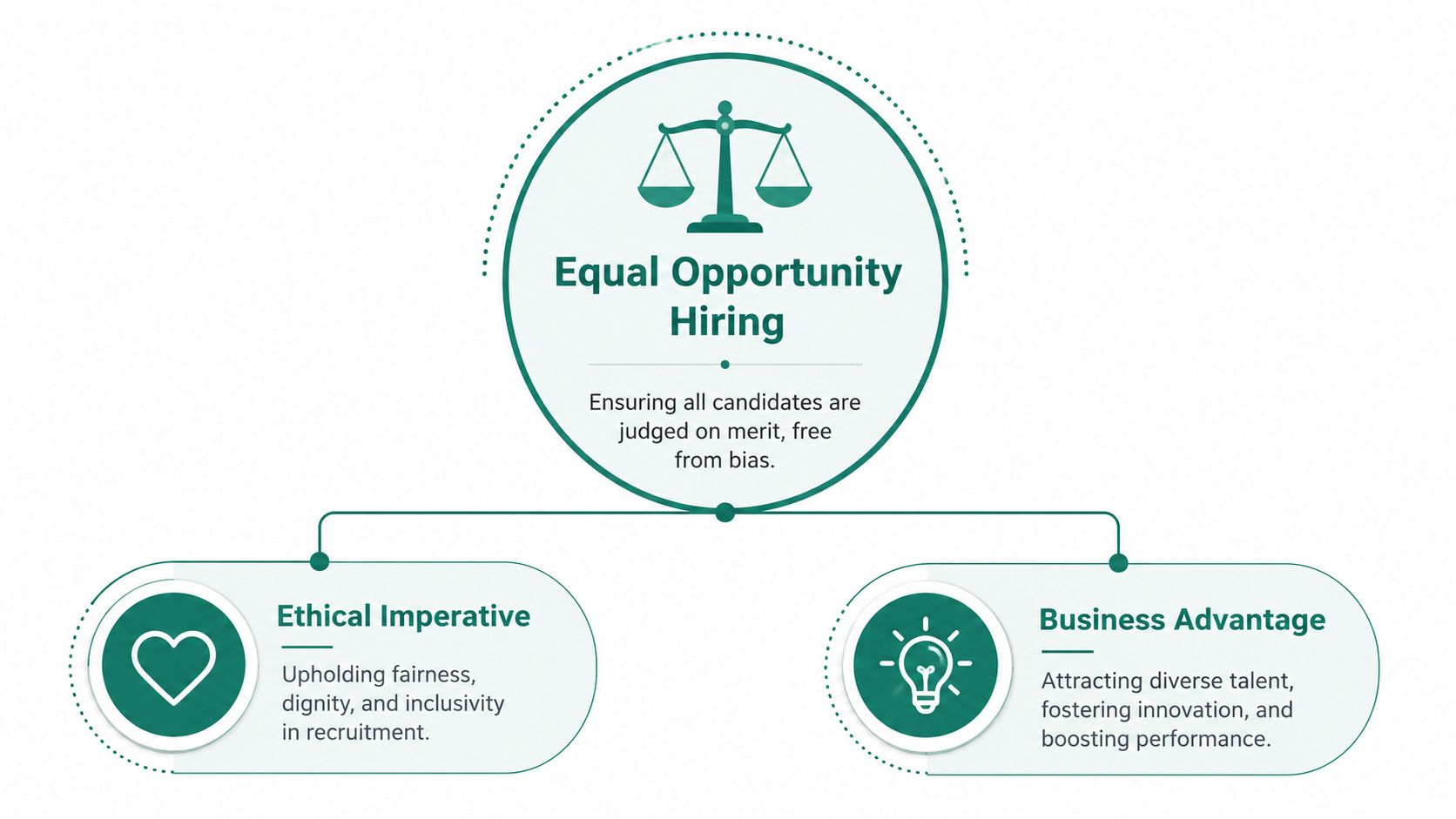
Many hiring teams say they hire on merit. In practice, merit only works when the process is structured enough to reveal it. If one recruiter asks detailed behavioral questions, another improvises, and a third decides based on “gut feel,” the organization isn't measuring merit consistently.
That's why equal opportunity hiring usually includes:
Practical rule: If a hiring team can't explain a decision using role-specific evidence, bias has room to enter.
The concept of equal opportunity hiring often tangles leadership discussions. Equal opportunity hiring doesn't mean lowering standards, guaranteeing outcomes, or preferring one group over another. It means removing irrelevant barriers so standards are applied consistently.
That matters because discrimination remains widespread in work settings. Globally, about 25% of employees experience discrimination in the workplace, and 61% of U.S. workers report witnessing or experiencing discrimination based on age, race, gender, or sexual orientation, according to these workplace discrimination statistics. The point isn't the mere existence of bias. It's that informal judgment leaves too much room for it.
Protected characteristics are the traits the law treats as off-limits in employment decisions. In practical terms, managers should understand this as a boundary: if a factor isn't job-related and touches identity or protected status, it shouldn't influence screening, interviewing, or selection.
Leaders often ask whether fairness and performance compete with each other. They don't. A fair process is how you identify the best talent more reliably. When standards are clear and evidence is consistent, the hiring team makes stronger decisions and can defend them.
The legal side of equal opportunity hiring starts with a basic principle. Employers can't make hiring decisions based on protected characteristics, and they also can't rely on processes that appear neutral but screen out protected groups without sufficient job-related justification.
That distinction matters because the law looks at two different problems. One is intentional unequal treatment. The other is a process that produces an unjustified pattern of exclusion even when nobody says the quiet part out loud.

Disparate treatment is the easier concept. A manager rejects someone because of race, sex, age, disability, or another protected trait. That's direct discrimination.
Disparate impact is more operational. A company uses one screening test, one degree filter, one scheduling practice, or one interview method for everyone, but the results disproportionately disadvantage a protected group. The process may look uniform on paper, yet still create legal risk.
Here's a plain example:
| Scenario | What happened | Why it matters |
|---|---|---|
| Manager skips candidates with foreign-sounding names | Directly unequal treatment | Likely intentional discrimination |
| Screening tool advances one group at much lower rates | Same tool for all, uneven outcome | Potential disparate impact |
| Interviewers all use different questions | No common standard | Hard to defend, easy for bias to shape outcomes |
A lawful hiring process isn't just one with good intentions. It's one that can withstand scrutiny when someone asks how candidates were screened and why certain groups advanced at lower rates.
The most cited benchmark here is the 80% rule, also called the four-fifths rule. The regulatory benchmark for equal opportunity is that a protected group's selection rate must be at least 80% of the highest-performing group's rate to avoid evidence of disparate impact, as explained in this EEOC-focused legal overview. If the ratio falls below 0.80, the employer faces a compliance risk and may need to prove the criteria are job-related.
For leaders, the lesson is simple. Don't wait for a charge or complaint. Monitor the funnel.
A practical review should ask:
If one group falls off sharply at one stage, that stage needs examination. The issue may be the questions, the timing, the technology, the scoring, or the qualification standard.
For teams that want a grounded explanation of employee rights and employer obligations around workplace discrimination, legal resources like this can help frame the issue beyond policy language alone.
The strongest compliance posture is boring in the best sense. Standard questions. Standard scoring. Standard documentation. Ongoing review. That kind of process reduces legal exposure because it gives the organization evidence that decisions are tied to business needs rather than preference or inconsistency.
Hiring mistakes are expensive. The larger cost often hides in plain sight. A company can follow the law on paper and still lose strong candidates because its process rewards familiarity, speed, or polish instead of job-relevant ability.
That is why fair hiring deserves board-level attention. It is a decision-quality issue.
Leadership teams should view hiring like any other high-stakes operating system. If the inputs are inconsistent, the output will be inconsistent too. An unstructured process works like a measuring tape with shifting markings. People still make decisions, but the tool itself introduces error.
Bias in hiring is often discussed as a legal or moral problem. It is also a productivity problem. When qualified applicants are screened out for reasons unrelated to performance, the organization spends more time searching, more money replacing failed hires, and more energy explaining decisions that should have been clear from the start.
The waste shows up in familiar places:
Employment gaps are a good example. Many teams still treat a gap as a warning sign even when it has little connection to current ability. Caregiving, military service, layoffs, health issues, and reskilling can all create pauses in a resume. If a process filters those candidates out automatically, the company is not reducing risk. It is shrinking access to capable people for a weak reason.
A fair hiring system gives leaders a more accurate view of who can do the work. That happens when the process asks the same questions, evaluates the same competencies, and records the same evidence for every candidate competing for the same role.
The practical benefit is straightforward. Teams can separate signal from noise.
For many organizations, that starts with clearer job criteria and skills-based hiring frameworks that focus on demonstrated ability instead of proxies such as pedigree, uninterrupted tenure, or interviewer chemistry. Once the criteria are clear, structured scorecards make those standards usable in real decisions. Conversational AI can support the process by asking consistent screening questions at scale, capturing candidate responses in the same format, and reducing the chance that one applicant gets a very different first screen than another.
This does not remove human judgment. It improves where judgment is used.
Executives already accept this logic in other business systems. Finance uses controls so reporting is reliable. Sales operations uses defined stages so pipeline data can be trusted. Hiring needs the same discipline if the company wants better outcomes across departments and locations.
That is also why the technology choice matters. Tools should help the team document decisions, apply common criteria, and review outcomes over time. Leaders evaluating governance tools in other functions often use the same principles when they compare CLM compliance platforms. The lesson carries over to hiring. Standardization, audit trails, and policy alignment improve consistency because they reduce improvisation.
Candidates form an opinion about the company before an offer is made. Repeated questions, vague feedback, long delays, and unexplained decisions signal disorder. A structured and fair process signals competence.
That matters for acceptance rates, referrals, and employer reputation. It also matters internally. Managers are more likely to trust hiring decisions when they can see how a candidate was evaluated and why one person advanced over another.
Fair hiring is not a side project for compliance teams. It is a practical way to improve talent access, decision quality, and hiring efficiency at the same time.
Most hiring bias doesn't arrive with a warning label. It shows up in small decisions that feel normal. A degree requirement copied from an old posting. A recruiter phone screen with no script. A hiring manager who values “polish” without defining what that means. Equal opportunity hiring improves when each of those moments becomes more structured.
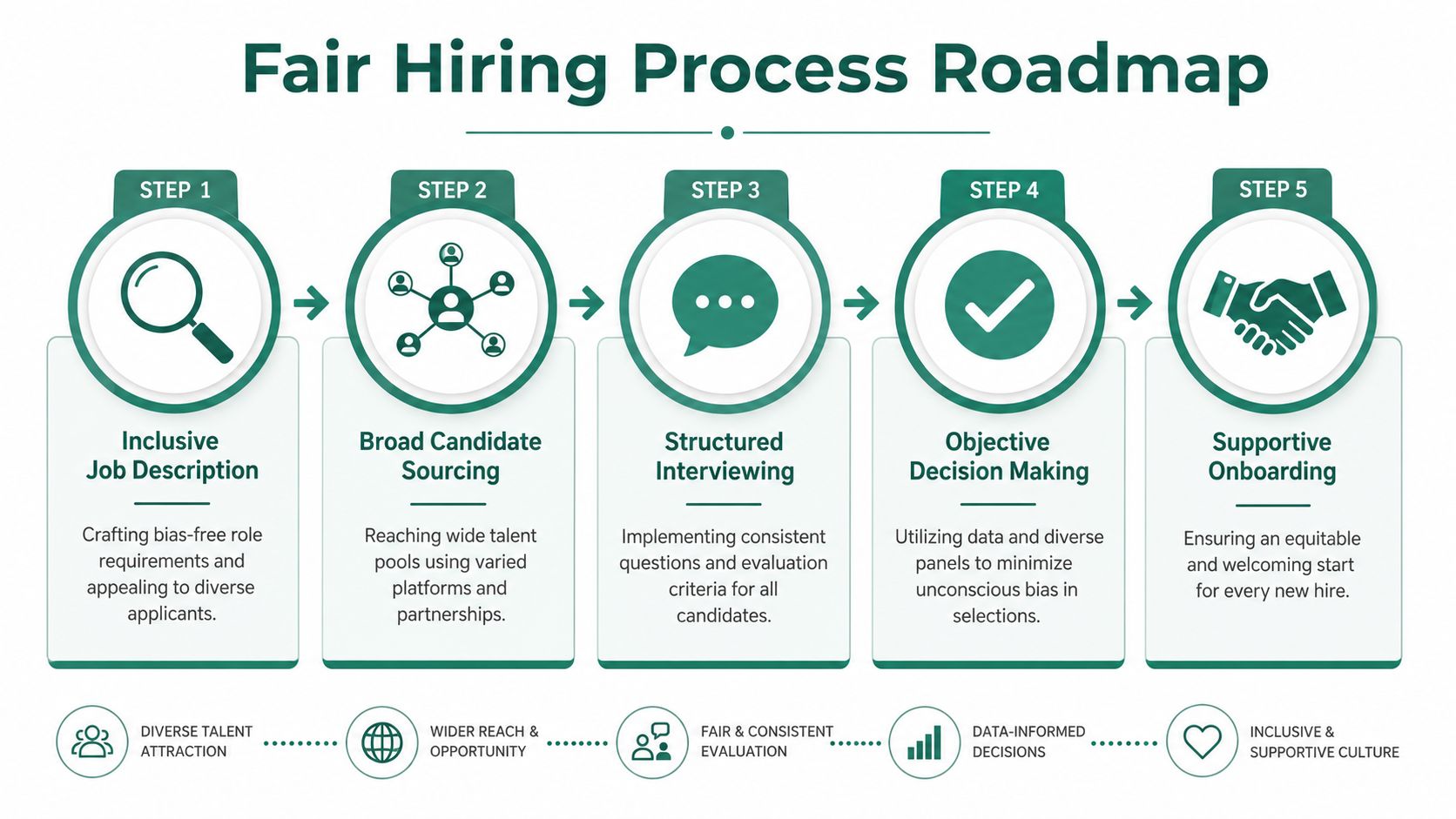
Before you post anything, check whether the role requirements reflect actual work or inherited habits.
Use this quick test:
This is also where skills-based design helps. Teams exploring skills-based hiring approaches often find that clearer competency definitions improve both fairness and screening efficiency.
The largest upgrade most companies can make is to stop improvising. Every candidate for the same role should face the same core questions, evaluated against the same rubric.
A structured process usually includes:
This isn't bureaucracy. It's quality control.
Structured evaluation tools can also improve speed. Implementing one-way video interviews and AI-assisted analysis can reduce recruiter screening time from 30 to 45 minutes per candidate down to 5 to 15 minutes, allowing one recruiter to screen 5 times more candidates with greater consistency, according to this overview of candidate screening tools.
The goal isn't to make every interview robotic. It's to make every decision comparable.
Fair hiring breaks down when only one stage is standardized. The job ad may be clean, while scheduling, screening, and panel review still vary widely.
A stronger operating model looks like this:
| Hiring stage | Common failure | Better practice |
|---|---|---|
| Job posting | Overbroad requirements | Role-specific criteria |
| Screening | Free-form recruiter calls | Structured questions |
| Interviewing | Different questions by interviewer | Core interview set for all |
| Selection | Vague discussion of “fit” | Scorecard-based review |
| Handoff | New hire starts with little context | Documented rationale and onboarding support |
Teams working on data-driven recruitment equity often focus on this exact issue. Not just attracting diverse applicants, but making each funnel step measurable and consistent.
Diverse interview panels can help, but only if the panel uses a common rubric. A varied group with no structure can still reproduce bias. Panelists should know what they're assessing, what evidence counts, and what topics are off-limits.
The practical standard is simple. If two interviewers assess the same answer very differently, the issue may not be the candidate. It may be the rubric.
Manual hiring tends to drift. One recruiter asks follow-up questions. Another rushes through a phone screen. A third forgets to document why someone advanced. Automation can reduce that variability when it's designed to support consistent, criteria-based evaluation rather than replace employer judgment.
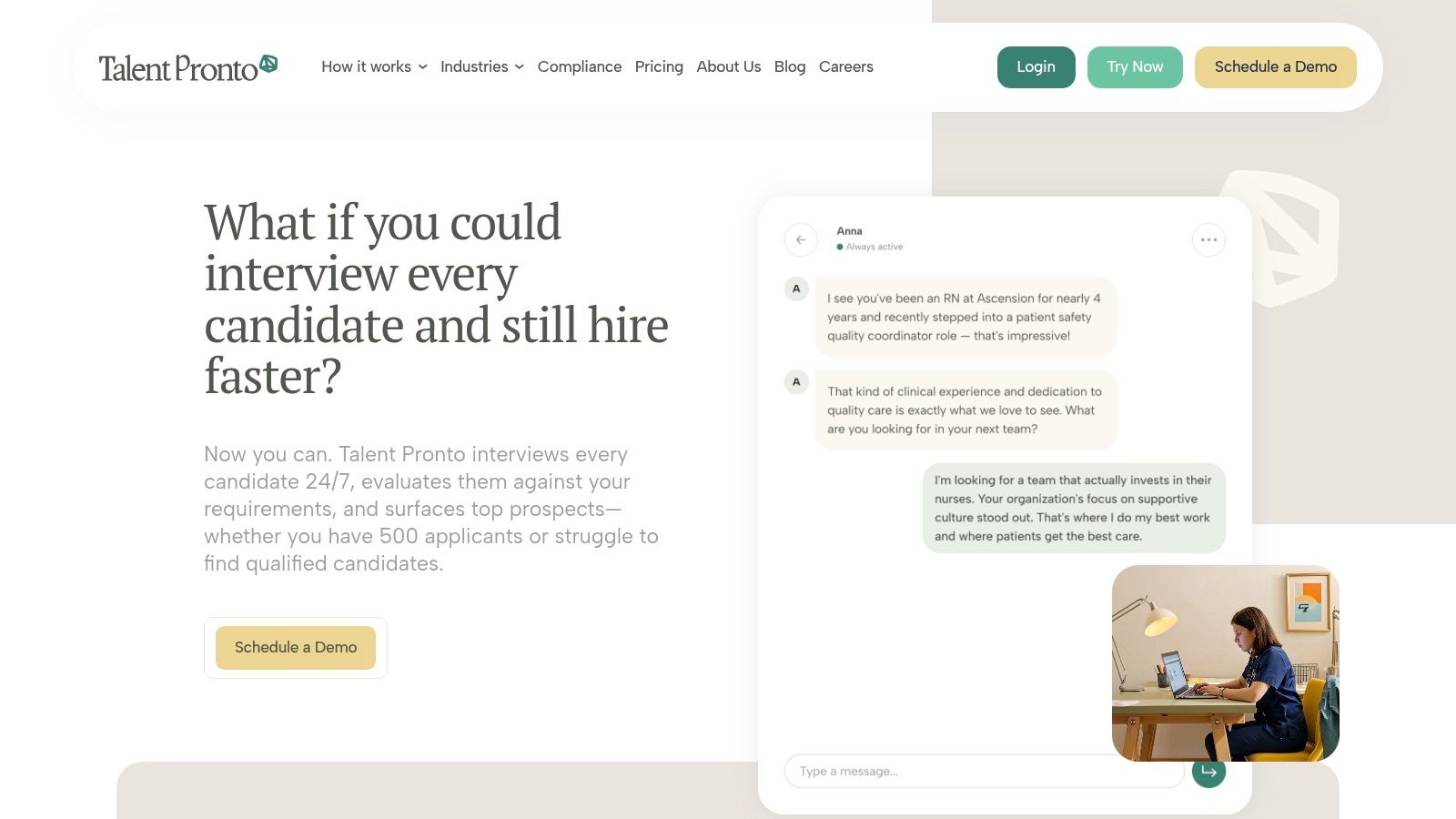
A good automated screening system gives every applicant the same role-specific questions, records the same categories of evidence, and produces a structured scorecard that recruiters can review. That matters because consistency is one of the few reliable ways to reduce avoidable subjectivity at scale.
Conversational AI is especially useful in high-volume or hard-to-fill hiring because it creates immediate, standardized engagement. Automated conversational screening raises candidate response rates from a baseline of 15% to an average of 45%, according to this discussion of conversational AI in recruiting. Separate research also reports a 93% screen completion rate, a 79% reduction in time-to-interview, and that 90% of automated interview scheduling processes save time by removing back-and-forth coordination, as summarized by Aptitude Research.
Those numbers matter for fairness as much as efficiency. Delays, missed calls, and scheduling friction don't affect every applicant equally. The more the process depends on availability, persistence, or insider familiarity with hiring norms, the more likely it is to exclude qualified people for reasons unrelated to job performance.
There's also an accessibility question leaders shouldn't ignore. Civil rights policy priorities for 2025–2026 state that AI systems should allow workers to opt out of automated assessments without punishment, according to the U.S. Civil Rights Task Force priorities. A fair system needs a human alternative for candidates who can't or prefer not to use automated tools.
AI doesn't become fair just because it's consistent. It needs a measurable fairness standard. In AI hiring, Equality of Opportunity means the model's true positive rate should be equal across demographic groups, as explained in this guide to AI fairness metrics. In plain language, if candidates are qualified, the system should be equally effective at identifying them regardless of group.
That standard helps leadership teams ask better questions:
For a practical look at this issue, the discussion of how AI screening reduces bias in hiring is useful because it focuses on process design rather than hype.
Here's a short demo that helps visualize how automated interviewing and structured screening work in practice.
AI should support employer decisions, not hide them. The strongest use case is early-stage consistency: same questions, same evidence categories, same scoring rubric, auditable outcomes, and human review before final decisions.
Automated hiring works best when it removes randomness, documents reasoning, and gives employers better evidence to review.
Many hiring teams watch for overt discrimination but miss the quieter filters. Affinity bias in interviews is one. Resume timelines are another. Career gaps often trigger assumptions about reliability or ambition even when the candidate's underlying capability hasn't changed.
That bias is measurable. A Harvard-led field experiment found that rewriting resumes to list years of experience instead of specific employment dates increased callback rates by approximately 15%, according to the Harvard Kennedy School summary of the study. The practical lesson is sharp: format alone can change outcomes.
The most common trouble spots include:
If your team wants a clearer vocabulary for identifying these patterns, this explanation of what interview bias is is a practical starting point.
Equal opportunity hiring improves when leaders track pass-through rates at each hiring stage, compare advancement patterns across groups, and review where drop-off becomes uneven. This doesn't require treating hiring like a math exercise. It requires paying attention to where the process stops being fair in practice.
A useful operating rhythm is to review the funnel regularly, examine scorecard consistency, and test whether your criteria still map to actual job success. If the process creates unexplained drop-offs, the process needs repair.
Many organizations still frame equal opportunity hiring as a legal obligation with documentation attached. That framing is too limited. The stronger view is that fair hiring is an operating system for better judgment.
A weak process leaves room for inconsistency, hidden barriers, and unnecessary risk. A strong one uses clear criteria, structured evaluation, measurable outcomes, and technology that supports consistency without removing human accountability. That's how organizations move from policy language to actual practice.
The harder challenge isn't spotting blatant discrimination. It's finding the routine habits that narrow the funnel. Resume gaps. Informal recruiter screens. Inconsistent follow-up. Tools without opt-out paths. Those are the places where equal opportunity hiring succeeds or fails.
Leaders who treat hiring as a strategic asset usually make the same choice in the end. They build systems that are fair because fair systems are more reliable, more defensible, and better at identifying real talent.
Talent Pronto helps employers put these principles into practice with AI-powered conversational screening, structured scorecards, and consistent early-stage evaluations that support fairer, more auditable hiring. If you're reworking your hiring process for speed, compliance, and better candidate quality, explore Talent Pronto.

Talent Pronto is an AI-powered hiring platform built around Anna, our intelligent AI that conducts 24/7 conversational screening, evaluates candidates against specific job requirements and compliance needs, and schedules interviews. Run everything on the Talent Pronto ATS, our all-in-one applicant tracking system with a branded careers site and Anna built in, or keep your existing ATS and let Anna integrate with Greenhouse, Ashby, iCIMS, Jobvite, Lever, Oracle, and more. Either way, we help organizations reduce time-to-hire and build stronger teams.