Explore the top video interviewing platforms in 2026. This guide covers features, benefits, ROI, and a practical checklist for choosing the right solution.
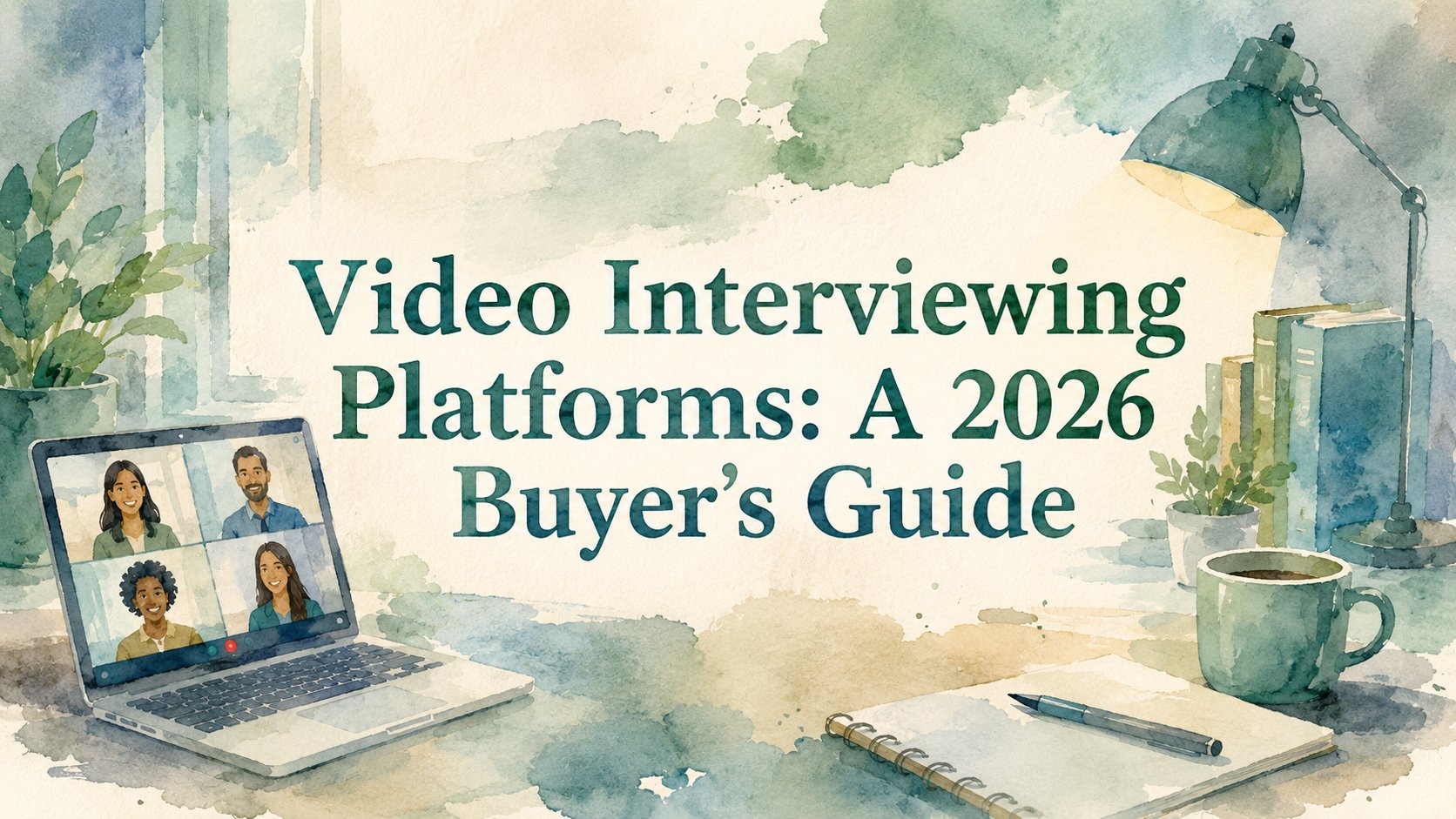
The market for video interviewing platforms isn't a niche software category anymore. It reached USD 2.76 billion in 2025 and is projected to grow to USD 6.29 billion by 2031, with a 14.98% CAGR during the 2026 to 2031 forecast period, according to Research and Markets' video interviewing platform market analysis. That number matters because it reflects a change in hiring behavior, not just software budgets.
Most buying guides stop at speed. They talk about faster screening, easier scheduling, and cleaner workflows. Those benefits are real, but they're not the whole decision. In 2026, smart buyers also need to evaluate two issues that are often treated like footnotes: accessibility compliance and AI-driven interview fraud. If your platform handles volume but exposes your team to ADA risk or weak fraud controls, you didn't buy efficiency. You bought a future problem.
Nearly every hiring team can run an interview on video. Far fewer can run one in a way that is structured, defensible, accessible, and hard to game. That gap is why video interviewing platforms have become a separate software category.
Video interviewing platforms are hiring systems built to manage interview workflows from invitation through evaluation. They standardize questions, collect recordings, store scorecards, track decisions, and connect interview activity to the rest of the recruiting process. If you're already conducting virtual interviews, the value is not video itself. The value is control over process quality.
That distinction affects risk as much as efficiency. A generic meeting tool can host a conversation, but it does not give TA leaders much help with interviewer consistency, audit trails, candidate accommodations, or fraud controls. In 2026, those gaps are no longer side issues. Buyers need to ask whether a platform supports captioning, keyboard accessibility, device flexibility, identity checks, and review workflows that do not invite bias or overreliance on AI scoring.
Most platforms support two interview formats, and each serves a different stage of the funnel:
Live interviews fit roles where probing matters early, such as leadership hiring or specialized positions with complex stakeholder requirements. Asynchronous interviews fit high-volume screening, distributed hiring, and any process where scheduling delays are hurting speed-to-submit.
I usually advise clients to reserve live interviews for stages where real conversation changes the decision. Using recruiter time for every first-round screen often creates cost without adding much signal.
The strongest platforms create repeatability. Candidates receive the same prompts. Reviewers score against the same criteria. Notes, recordings, and decisions stay tied to the requisition instead of getting scattered across calendars, inboxes, and spreadsheets.
They also give teams a better way to manage candidate experience at scale. A platform can present instructions clearly on mobile, support captions and transcripts, and preserve documentation if a candidate requests an accommodation or questions a hiring decision later. That is a practical protection, not just an administrative convenience.
Another difference is workflow depth. Purpose-built systems route interviews to the right reviewers, trigger reminders, log completion status, and pass outcomes back into the ATS. Teams comparing broader screening automation should also review how interview workflows connect to earlier-stage qualification tools in Talent Pronto's hiring workflow overview.
The short version is simple. Video interviewing platforms are not just software for talking to candidates on camera. They are systems for making interview decisions more consistent, more scalable, and less exposed to compliance and fraud problems that many buyers still underestimate.
The features that change hiring outcomes are not always the ones that look best in a demo. In 2026, smart buyers pay close attention to two areas many vendors still gloss over: accessibility compliance and AI-driven fraud controls. Efficiency matters, but avoidable legal exposure and weak interview integrity can erase that value fast.
One-way video works best at the top of the funnel, where teams need consistent answers to the same screening questions without tying up recruiter calendars. Candidates record on their own time. Reviewers assess responses against the same rubric, which makes side-by-side comparison easier and reduces the variation that creeps in when every screen is handled live.
That trade-off is practical, not universal. Async interviews speed up volume hiring and multi-region recruiting, but they can feel impersonal if used too late in the process or without clear instructions. Strong platforms offset that risk with candidate-friendly workflows, mobile recording, practice questions, captions, transcripts, and accommodation options that can be configured before launch instead of handled ad hoc after complaints come in.
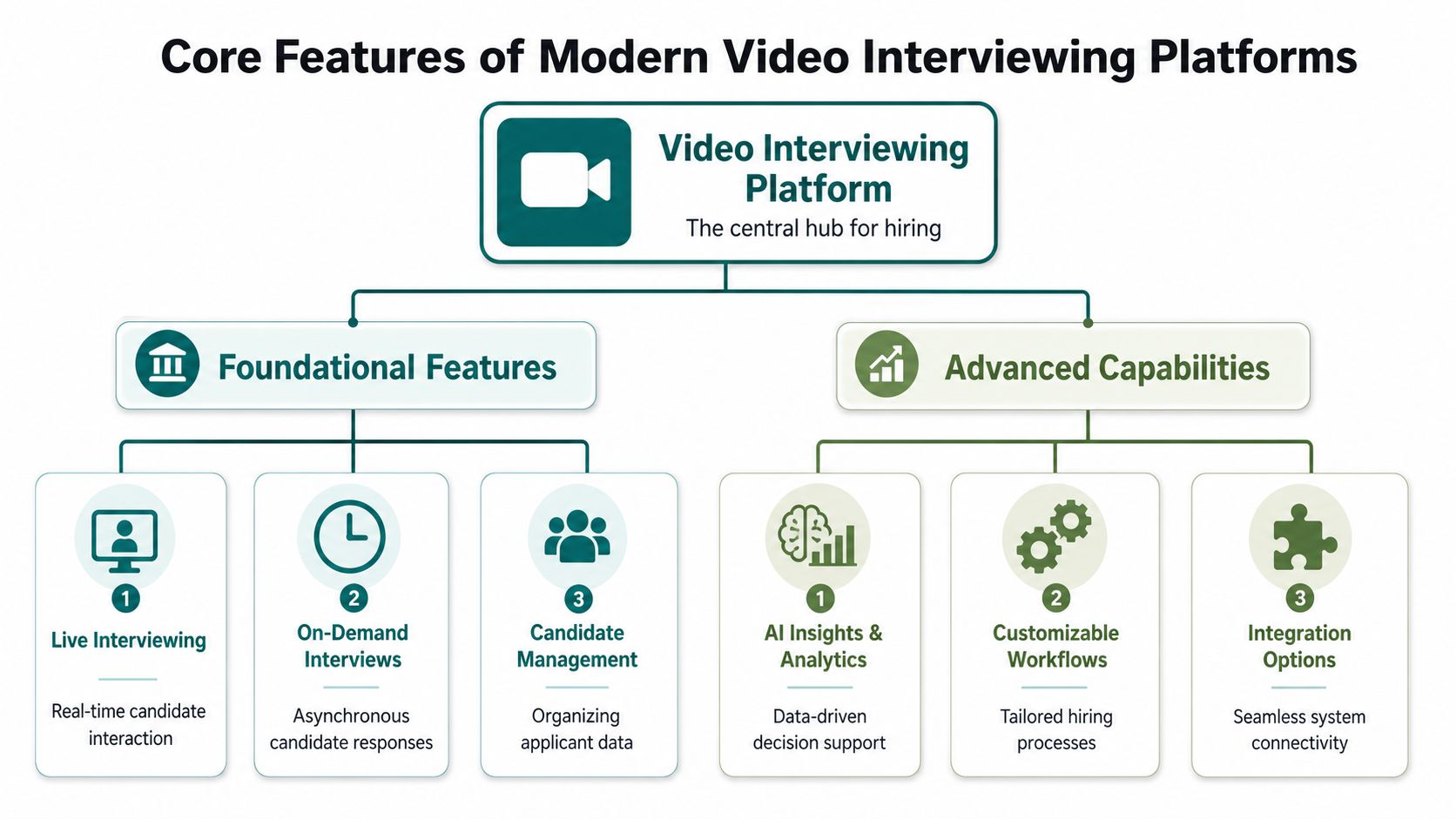
The most reliable AI features are the ones that help recruiters work faster without making hiring judgments for them. Transcript search, summaries, highlights, and interviewer note capture all fit that standard. Harver's review of video interviewing in recruitment points to faster hiring when teams use AI-driven transcript analysis and automate screening workflows, which matches what many implementation teams see in practice. The gain comes from faster review and better consistency, not from turning the interview over to a scoring model.
Buyers should be far more cautious with facial analysis, emotion detection, and any claim that a platform can infer fit or honesty from visual cues alone. Those features raise defensibility questions, create accessibility concerns, and can trigger internal pushback from legal, HR, and DEI stakeholders. If a vendor cannot explain how its AI supports human review, documents bias controls, and handles accommodation requests, that is a procurement risk.
Fraud controls now belong in the same conversation. Candidates have easy access to real-time coaching tools, synthetic media, and edited recordings. Platforms should give hiring teams practical safeguards such as retake limits, device and browser checks, response timing controls, audit logs, and reviewer flags for suspicious patterns. For teams trying to reduce preventable setup issues while still giving candidates clear recording guidance, this guide for authentic video footage is a useful reference.
These are the platform capabilities that tend to matter most after implementation starts:
The best feature set depends on the hiring model. A high-volume employer may value queue-based review and fraud controls more than advanced live interview features. An enterprise hiring for regulated or customer-facing roles may put accessibility documentation, audit trails, and structured scoring at the top of the list. That is the right way to evaluate these tools. Start with operating risk, then match the platform to the workflow.
A bad first-stage hiring process is expensive. The cost rarely shows up as one large line item. It shows up in recruiter hours spent on repetitive screens, manager time lost to weak handoffs, candidate drop-off, and compliance exposure that only becomes visible after a complaint or audit.
Video interviewing platforms make sense when they improve throughput without weakening control. That distinction matters in 2026. Plenty of teams can move interviews online. Fewer build a process that holds up under accessibility review, gives hiring managers usable evidence, and helps recruiters spot AI-assisted misrepresentation before it reaches the final round.
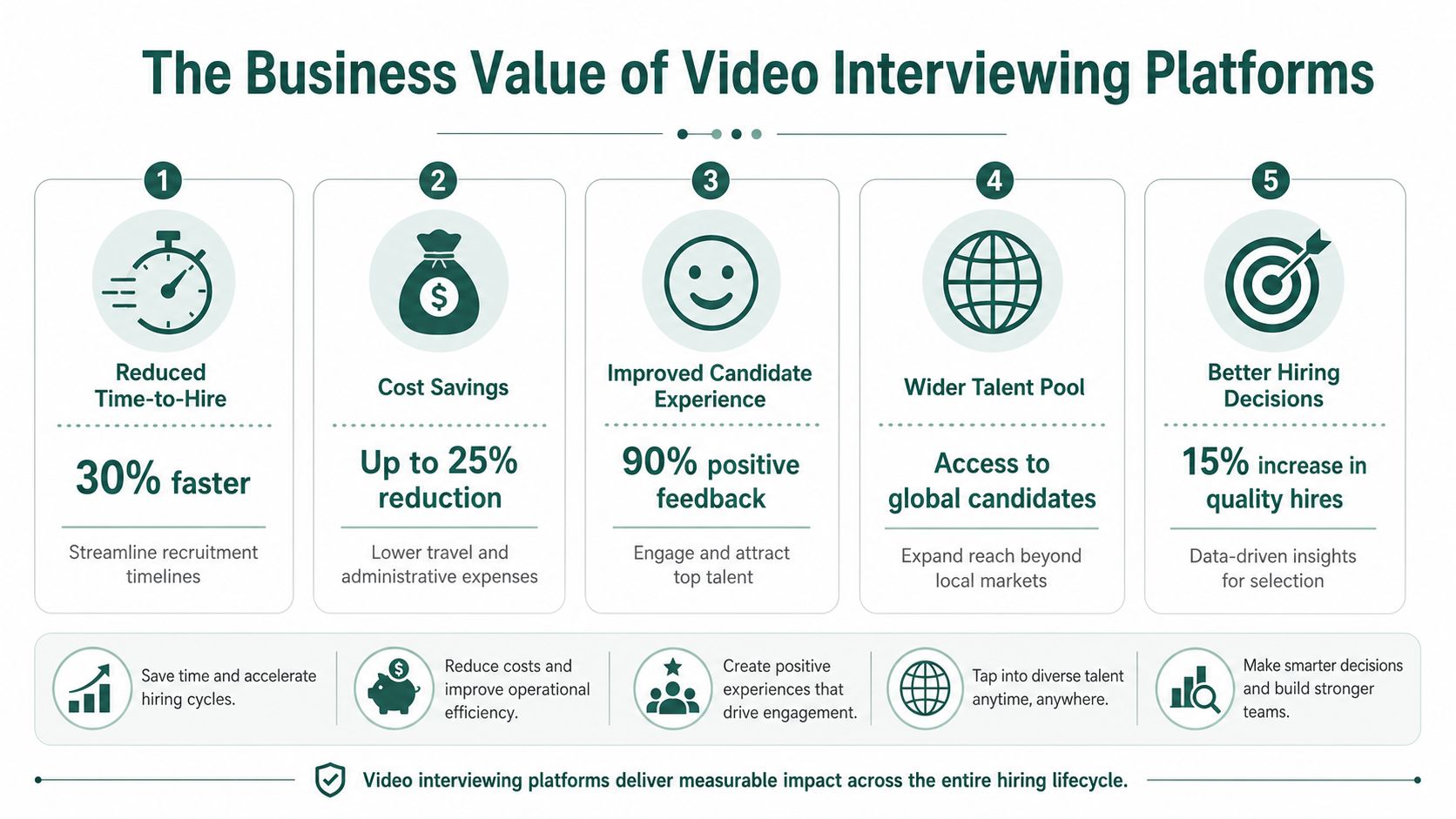
The first return usually comes from labor efficiency. Recruiters spend less time scheduling, repeating the same screening questions, and summarizing candidate responses for hiring managers. Hiring managers get a tighter shortlist and can review candidates on their own schedule instead of joining every early conversation live.
That gain is real, but speed alone is not the full business case.
A strong platform also improves decision quality. Structured prompts and standardized review workflows make it easier to compare candidates consistently across locations, recruiters, and business units. That reduces the rework that happens when teams realize halfway through a req that each interviewer has been using a different bar.
Risk reduction belongs in the ROI calculation too. If your organization hires at volume, serves the public, or operates in a regulated environment, accessible workflows and defensible documentation are not side issues. They protect the company from avoidable process failures. Teams hiring into care settings, for example, usually need speed and documentation at the same time. That is one reason many organizations evaluating video interviewing for healthcare hiring teams put auditability high on the shortlist.
The wrong rollout can create a faster broken process. I see this when companies adopt one-way interviews to save time, then fail to define accommodation steps, reviewer standards, or escalation rules for suspicious submissions. The platform appears efficient at first. Then candidate complaints increase, hiring managers stop trusting the output, and recruiters start building manual workarounds outside the system.
AI-driven fraud has changed the evaluation standard. Buyers should now ask how the platform handles identity checks, retake controls, browser restrictions, copy-paste behavior, audit logs, and reviewer flags for unnatural responses. Those controls will not eliminate fraud, but they make investigations possible and reduce the chance that a polished fake candidate moves deep into the funnel.
A platform only produces value if candidates complete the process. Short, well-scoped interview steps usually perform better than long prompts that feel like unpaid work. Clear instructions, mobile usability, captions, and reasonable deadlines all affect completion rates and applicant quality.
There is a practical trade-off here. More screening questions can give recruiters better signal, but they also increase abandonment. The best implementations protect interviewer time while keeping the candidate task proportional to the role. For frontline hiring, that often means a brief asynchronous screen. For higher-stakes roles, it may mean fewer prompts plus stronger live evaluation.
The business case is strongest when a platform does three things at once: reduces manual screening effort, creates a more defensible hiring record, and lowers the risk that accessibility failures or AI-assisted fraud undermine the process. That is the standard smart buyers should use.
Industry use cases separate smart implementations from expensive mistakes. The same platform can cut screening time in one environment and create candidate drop-off, compliance exposure, or weak signal in another.
Near the top of the funnel, the practical question is simple. Where does recorded or live video produce better hiring evidence than a phone screen, and where does it just add friction?
Healthcare hiring teams often need speed, auditability, and scheduling discipline at the same time. A short one-way interview can help confirm communication basics, shift availability, licensure context, and role interest before nurse managers or department leaders spend time on live interviews.
The risk is overusing async video for roles where accommodations, language access, or urgent hiring timelines require alternatives. Healthcare employers should treat video as a screening tool, not as a default gate for every candidate. For teams evaluating broader process design, this healthcare hiring automation approach for clinical recruiting shows how pre-interview screening can support interview workflows without making them heavier.
Healthcare also has a higher documentation burden than many sectors. If a candidate later challenges the process, structured questions, consistent scoring, and clear records matter more than polished branding.
Manufacturing teams usually want evidence of reliability, comprehension, and fit for the work environment. They rarely need a polished performance. A brief async interview can confirm whether candidates understand shift expectations, attendance standards, safety culture, and the physical or technical realities of the job.
Shorter is better here. Three to five focused prompts usually outperform a long interview that feels disconnected from the role.
There is also a fraud angle that buyers sometimes miss. Skilled hourly employers are seeing more applications assisted by AI tools, especially in high-volume recruiting markets. If the platform cannot flag suspicious retakes, identity mismatches, or copied responses, recruiters may move weak or misrepresented candidates into plant interviews and waste supervisor time.
Retail employers care about speed, consistency, and manager usability. Store leaders want to hear how candidates communicate, but they do not have hours available for first-round phone screens. Recorded interviews give district and store managers a way to review candidates between operational tasks and still apply the same opening standard across locations.
That consistency has direct value. One store should not hire on instinct while another applies a far stricter bar to the same role.
The best retail workflows keep the first step narrow. Customer interaction prompts, schedule availability, and scenario judgment are useful. Long interviews are not. Mobile completion also matters more in retail than many buying teams expect, because a large share of applicants will complete the step on a phone and abandon if the process becomes awkward.
After the first review layer, a live conversation can confirm warmth, responsiveness, and schedule fit.
Tech companies often get the weakest results when they push video into every stage. Candidates, especially engineers and product talent, tend to resist anything that feels like unpaid performance work. Video works better when it solves a specific evaluation problem, such as high application volume, cross-time-zone scheduling, or inconsistent early screening across hiring teams.
A narrower setup usually performs better:
Tech buyers should also weigh fraud controls more heavily than they did a year ago. AI-assisted applications, generated talking points, and identity substitution are no longer edge cases for remote hiring. For distributed teams, a platform that preserves audit logs and supports review escalation can prevent expensive mistakes that a basic scheduling tool will never catch.
Nearly every platform demo looks polished. The expensive mistakes show up later, during rollout, accommodation requests, disputed hiring decisions, and suspected AI-assisted fraud.
A stronger buying process tests the platform under real operating conditions, not demo conditions. In practice, that means checking three areas at the same time: fit for your hiring workflow, support for accessible candidate experiences, and controls that reduce impersonation and synthetic media risk. Buyers who skip one of those areas often end up replacing the system early or adding manual workarounds that erase the expected ROI.
Start with the hiring motion you run. High-volume hourly hiring, professional recruiting, and distributed technical hiring need different interview setups. Some teams need async screening to reduce scheduling load. Others need live interviews with structured scorecards and tight reviewer controls. Many need both, but only if both formats sit in one system and pass data into the ATS without manual cleanup.
Ask the vendor to show the workflow on screen. A verbal “yes, we integrate” is not enough. Confirm what syncs, how fast it syncs, and what breaks if a recruiter changes a stage in the ATS first. Scorecards, transcripts, candidate status, and completion data should land in the right records automatically. If they do not, recruiters end up managing exceptions by hand.
Accessibility needs equal weight in the buying process. This is one of the most overlooked risks in video interviewing because vendors often reduce the discussion to a generic compliance claim. Buyers should verify how candidates request an alternative to async video, whether the interface works with screen readers and keyboard navigation, and what support exists if a candidate hits a technical barrier during the interview. Documentation matters too. If a complaint or audit happens, your team should be able to show what options were offered and when.
Fraud controls now deserve the same scrutiny as workflow and accessibility. Remote hiring created a wider attack surface, and AI tools made it easier to coach candidates in real time, alter video submissions, or substitute identities. A platform should be able to explain how it handles suspicious activity, preserves audit records, and routes edge cases for human review. As PIN's analysis of video interview platform buying concerns notes, buyers are asking harder questions about deepfake fraud in one-way interviews, while many platform comparisons still stay at the feature-list level.
A simple test helps here. Ask each vendor to explain what happens when a recruiter suspects the person on screen is not the applicant who applied. Weak vendors return to generic security language. Strong vendors can walk through identity checks, evidence retention, escalation paths, and admin controls.
| Criteria | What to Look For |
|---|---|
| Interview format | Support for live, async, or both based on your hiring model |
| ATS and HRIS sync | Real write-back of candidate records, scores, and status changes |
| Structured evaluation | Scorecards, rubrics, and reviewer workflows that enforce consistency |
| Mobile experience | A candidate flow that works cleanly on smartphones |
| Accessibility compliance | Clear accommodation process, accessible interface, and documented support options |
| Candidate support | Instructions before the interview and real-time help when issues occur |
| AI design | Transcript analysis, summaries, and highlights rather than opaque facial scoring |
| Fraud controls | Specific explanation of identity verification or synthetic media detection measures |
| Auditability | Retained interview records, reviewer notes, and evaluation history |
| Global readiness | Language support, timezone flexibility, and region-specific compliance considerations |
The strongest buying teams run a short pilot before signing a long contract. They test completion rates, reviewer adoption, candidate support tickets, accommodation handling, and exception cases. That work takes longer than a polished demo. It also prevents buying a platform that looks efficient on paper and creates risk in production.
A failed integration can wipe out the efficiency gains that justified the purchase in the first place. I see this pattern often. A company buys a capable platform, then loses value because recruiters still copy data by hand, hiring managers skip scorecards, and exception handling for accommodations or suspected impersonation never gets defined.
The integration work starts before any API call. Map the hiring process as it runs today, including where candidates request accommodations, where identity concerns get escalated, and who owns final disposition in the ATS. If those decisions are vague, the software will expose the gap rather than fix it.
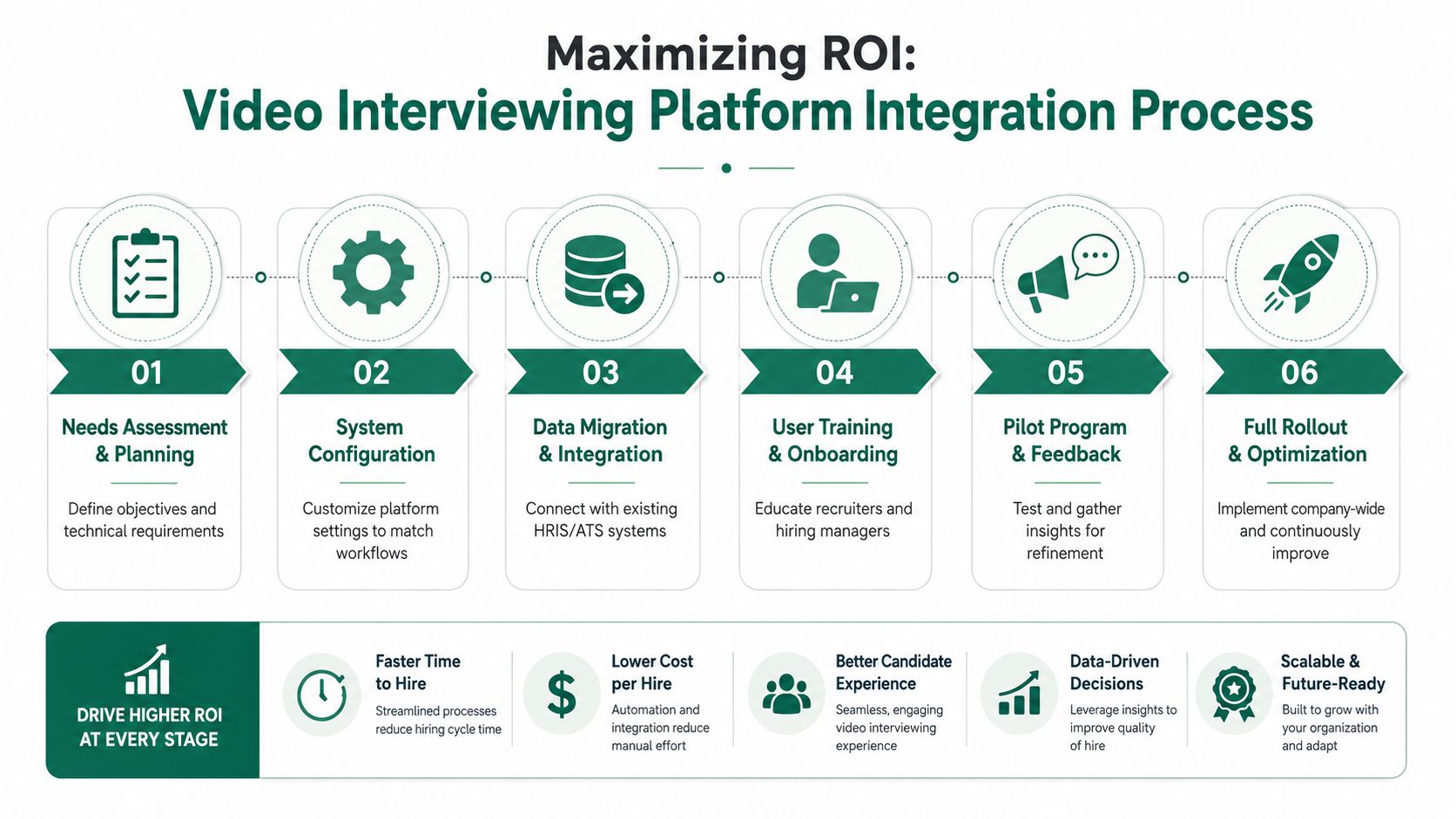
A sound implementation usually follows this sequence:
The highest-return integrations also set rules for what should not automate. For example, transcript summaries can save reviewer time, but candidate rejection decisions should not be triggered by AI-generated highlights alone. Fraud controls need similar care. If the platform flags possible synthetic media, the process should route the case to a trained reviewer with documented steps, not block the candidate without transparency and create legal exposure.
Training matters as much as system setup. Recruiters need a clear operating model, not a login and a short demo.
A practical model looks like this:
Hiring managers need separate training. The common failure point is not the integration itself. It is inconsistent review behavior. Managers may overvalue presentation style, penalize candidates for camera quality, or rely on AI summaries without watching the underlying response. Those habits reduce decision quality and increase bias risk.
The teams that get full ROI treat implementation as process design. They connect systems, define reviewer behavior, and set controls for accessibility and fraud from day one. That takes more work than a basic rollout, but it is what turns video interviewing software into a measurable hiring improvement instead of another tool recruiters work around.
A faster hiring process only pays off if it produces better decisions and fewer avoidable risks. That is the standard leadership will use after go-live.
The strongest ROI reviews look at three outcomes at once: speed, decision quality, and risk control. If you only report time saved, you miss the costs that show up later through poor-fit hires, inconsistent evaluations, accommodation failures, or candidates using AI tools to fake fluency and job readiness.
Start with the metrics your team can compare before and after rollout:
Then measure the controls that protect the value of those gains.
As noted earlier, accessibility gaps can erase the upside of a faster process. ROI should include process quality checks such as:
Fraud needs its own scorecard in 2026. Teams are seeing more candidates use AI-generated answers, off-camera coaching, and identity workarounds during remote interviews. A platform that speeds up screening but lets low-integrity applications pass through is not producing real return.
Track practical indicators:
Those numbers show whether the platform is improving signal quality or just increasing throughput.
A credible ROI report ties operational metrics to financial and compliance outcomes. Show where recruiter hours were reduced, where manager review became more consistent, and where process controls lowered exposure. If your team hires at volume, even modest reductions in manual screening time can free capacity for higher-value work such as calibration, stakeholder follow-up, and candidate closing.
Quality evidence matters just as much. Compare scorecard completion rates, interviewer agreement, and the percentage of candidates advanced with documented reasons. In my experience, this comparison often highlights whether many deployments either prove their value or stall. A platform can be fully implemented and still underperform because reviewers skip scorecards, rely on summaries, or make decisions based on presentation style instead of evidence.
Keep the narrative simple:
That is the ROI case discerning buyers should expect. Video interviewing platforms are not just efficiency tools. Used well, they improve hiring economics while reducing two risks that basic buying guides still understate: accessibility compliance failures and AI-assisted candidate fraud.
If your team wants to improve screening before the interview stage, Talent Pronto gives employers an AI-powered way to engage every applicant, ask structured behavioral and technical questions, rank candidates against role criteria, and coordinate next steps without adding manual screening load. It's a practical fit for organizations that need faster early-funnel decisions, stronger consistency, and better visibility across high-volume hiring.

Talent Pronto is an AI-powered hiring platform built around Anna, our intelligent AI that conducts 24/7 conversational screening, evaluates candidates against specific job requirements and compliance needs, and schedules interviews. Run everything on the Talent Pronto ATS, our all-in-one applicant tracking system with a branded careers site and Anna built in, or keep your existing ATS and let Anna integrate with Greenhouse, Ashby, iCIMS, Jobvite, Lever, Oracle, and more. Either way, we help organizations reduce time-to-hire and build stronger teams.