Master hiring with 9 key interview question communication skills. Assess candidates effectively using examples, rubrics, and 2026 tips.
You're staring at a stack of resumes that all say the same thing. “Excellent communication skills.” “Strong collaborator.” “Works well with cross-functional teams.” Then the interviews start, and the polished phrasing falls apart. One candidate rambles. Another gives tidy but shallow answers. A third sounds persuasive until you realize they never listened to the question.
That gap matters. In 2023, UK job platforms listed approximately 197,325 active vacancies that explicitly required communication skills, including 58,120 asking for “excellent communication skills” and another 30,000 asking for “good communication skills,” according to Acuity Training's communication skills statistics. Hiring teams clearly aren't treating communication as a vague bonus. They're using it as a filter.
That pressure has only increased as more interviews and collaboration move through digital channels. Candidates now need to show they can explain, listen, adapt, and recover in conversations that may happen by video, email, chat, or live meetings. If you also want candidates to gain executive presence in senior interviews, you need better prompts than “Are you a good communicator?”
This guide gives you nine role-aware interview question communication skills prompts that go beyond surface charm. Each one is built to expose how a candidate communicates in real working conditions, not how well they describe themselves. You'll also get follow-up prompts, what strong answers sound like, and scoring guidance you can standardize across healthcare, tech, manufacturing, government, and other team environments.
This question exposes whether the candidate can translate, not just talk. Strong communicators don't dump detail on people and hope it lands. They read the audience, simplify without distorting, and confirm the other person understood.
In healthcare, that may look like a healthcare IT specialist walking a physician through new EHR functionality. In biotech, it might be a sales rep explaining clinical trial data to hospital administrators. In manufacturing, it could be an engineer describing process changes to non-technical leadership.
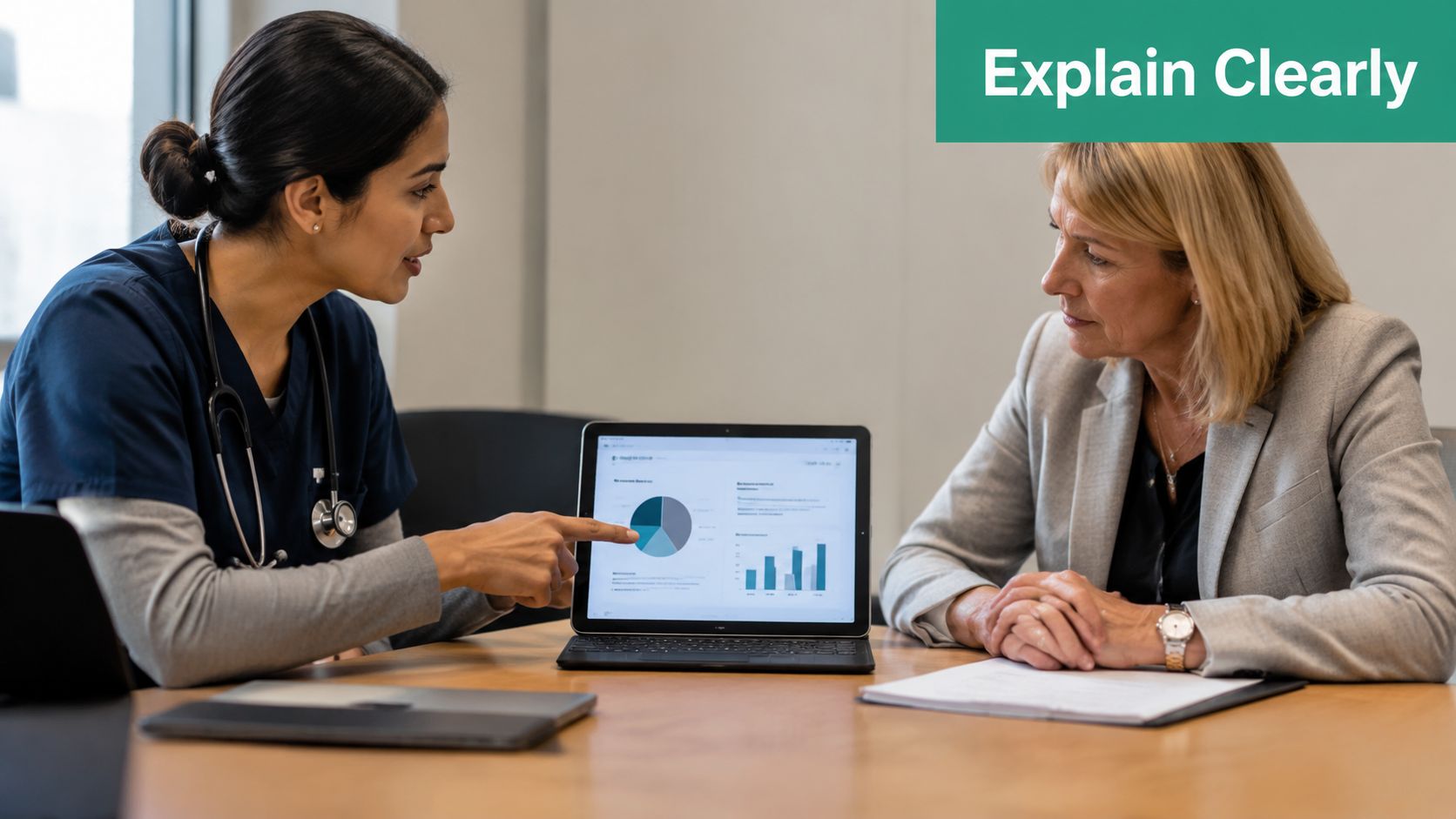
Ask two follow-ups that most interviewers skip.
A weak answer centers on the candidate's knowledge. A strong answer centers on the listener's needs. You want to hear methods like analogies, visuals, step-by-step framing, short summaries, and deliberate pauses for questions.
Practical rule: If the candidate spends more time proving they were the expert than showing how they helped someone understand, score that answer lower.
This is one of the easiest places to standardize early screening. Structured interviews predict job performance better than unstructured ones, with approximately 0.51 correlation coefficients compared with 0.31 for unstructured formats, according to Talent Pronto's structured interview guidance. That gap matters when multiple interviewers define “good communicator” differently.
If you're screening at scale, conversational prompts can probe beneath polished resumes. Talent teams using conversational screening to reveal what documents can't can ask for the original explanation, then immediately ask how the candidate confirmed understanding. That second answer often tells you more than the first.
A manager proposes a shortcut that saves time but creates risk. The candidate has to respond in real time, often to someone with more authority, without turning the disagreement into a power struggle. That is the situation this question tests.
The strongest answers show controlled disagreement. You are not looking for someone who avoids conflict or someone who treats every difference of opinion like a battle to win. You are evaluating whether the candidate can state a concern clearly, understand the other person's position, and work toward a decision the team can act on.
This matters across roles. A nurse may need to question a dosage decision and escalate safely. A manufacturing employee may need to push back on a supervisor's process choice that could affect quality. A government IT specialist may need to challenge a compliance interpretation from senior leadership. Different settings, same evaluation standard.
Good answers usually contain four parts:
Listen for restraint. Candidates who say “they just didn't get it” or “I made them see my point” often reveal more than they intend. Those phrases suggest blame, poor listening, or a need to win.
Stronger candidates sound different. They describe asking questions before arguing. They explain the risk, constraint, or customer impact. They show judgment about when to hold their ground and when to accept a decision they would not have made themselves.
A high-signal example might come from a hospitality manager who disagreed with a cost-cutting measure that would hurt guest experience. A strong response would cover the business pressure, the manager's rationale, the candidate's alternative, and the follow-through after the decision. That final part matters because communication skill is not just about making a point. It is also about preserving trust after tension.
Strong candidates usually show curiosity before advocacy.
Use follow-ups to separate polished storytellers from people who handle disagreement well:
For scoring, I would rate this answer high only if the candidate shows both backbone and control. A candidate who avoids the hard conversation may keep the peace in the moment but miss risks. A candidate who pushes every point aggressively may be right on facts and still damage team execution. The trade-off is real, and this question exposes it.
The broader hiring pattern supports using structured questions like this. The National Association of Colleges and Employers consistently identifies communication as one of the attributes employers seek in new hires, as reflected in its career readiness guidance at NACE. That is why this question works best inside a consistent evaluation system, with the same follow-ups, score definitions, and role-specific benchmarks for every candidate.
If you use Talent Pronto for structured screening, add one follow-up for every interviewer to ask: “How did they respond to your approach?” That answer often tells you whether the candidate resolved the disagreement, accepted a reasonable compromise, or outlasted the conversation.
A manager sits down with a strong employee and explains that their work is slipping. A nurse tells a family that the treatment plan has changed. A project lead informs leadership that a release date will be missed. In each case, the message matters, but the method matters just as much.
This question tests whether a candidate can protect trust while still being direct. Hiring teams often over-reward warmth here. That is a mistake. A better indicator is whether the candidate can prepare, state the issue clearly, handle the reaction, and leave the other person with a usable next step.

Strong answers are specific. The candidate explains what triggered the conversation, why they handled it personally, how they chose the setting, and the exact language they used. General claims like “I was honest and empathetic” are not enough. Good communicators remember the structure of a hard conversation because they planned it.
Role context changes what good looks like. In healthcare, you may want to hear how the candidate balanced empathy with policy, patient safety, or documentation requirements. In tech, listen for whether they separated the person from the problem and gave concrete examples instead of vague criticism. In operations or manufacturing, speed and clarity may matter more than a long discussion, especially if the issue involved safety or quality.
Use follow-ups that expose judgment, not just polish:
Two weak patterns show up often. One candidate is so careful that the message never becomes clear. Another candidate treats bluntness as honesty and ignores the impact on the relationship. Both create problems on the job. One delays correction. The other gets compliance for a day and resistance for the next six months.
A short video can help interview panels calibrate what empathetic directness sounds like in practice.
For scoring, use three dimensions and define them before interviews start.
Honesty. Did the candidate communicate the issue directly, with clear facts and no hedging?
Empathy. Did they show awareness of how the message would land and allow room for response?
Next-step clarity. Did the conversation end with expectations, support, or a concrete plan?
This question works best inside a standardized evaluation system, not as a one-off prompt. If your team uses a structured process through a tool like Talent Pronto, give every interviewer the same follow-ups and the same score definitions. That is how you compare a healthcare supervisor, a software manager, and a frontline lead fairly, even when their examples differ.
A lot of candidates know how to perform coachability. They say, “I'm always open to feedback,” then describe a comment they already agreed with. That tells you almost nothing.
The better version of this interview question communication skills test asks for disagreement. That forces the candidate to show whether they can separate emotional reaction from useful evaluation. In healthcare, that may be peer feedback on communication style. In tech, it may be code review comments they felt were unfair. In government or pharma, it may be a correction on compliance interpretation.
Don't reward instant agreement. Real professionals often need time to process difficult input. What matters is whether they listened, evaluated, and acted with judgment.
Use questions like these:
A strong answer might come from a nurse who felt a supervisor misunderstood their bedside style, then realized the concern was less about warmth and more about clarity during handoff. A weaker answer would stay stuck on whether the supervisor was fair.
Good candidates can extract value even from badly delivered feedback.
Automated video interview systems have also made communication evaluation more structured. In behavioral-based automated video interview formats, communication skill prediction models achieved 82.4% accuracy with an F1-score of 0.79 when measured against human-rated benchmarks from 1,240 candidate interviews, according to SpringerOpen research on automated interview assessment. You don't need to automate every interview to learn from that. The practical lesson is to score observable behaviors, not impressions.
That means rating whether the candidate listened, paraphrased, reflected, and changed course. “Seems mature” isn't a rubric. Observable evidence is.
This is one of the most revealing questions in the whole set because it tests repair. Every candidate has had a message land badly, arrive incomplete, or get interpreted in a way they didn't intend. The difference is in what they did next.
A healthcare provider may describe an incomplete shift handoff. A biotech project manager may explain a timeline email that created rework. A hospitality manager may have announced a policy change that confused the team. Good answers don't pretend the misunderstanding was minor. They explain what broke, who was affected, and how the candidate fixed both the immediate issue and the process behind it.
Listen for ownership first. If the answer starts with “They misunderstood me,” keep pressing. Maybe they did. But the candidate still needs to explain what they could have communicated more clearly.
Use these prompts to make the answer concrete:
Strong answers usually include a fast correction, transparent acknowledgment, and a prevention step such as updated documentation, a new check-in point, a clearer handoff, or moving sensitive communication from email to live conversation.
Bias can distort how interviewers interpret accountability. Some candidates are naturally polished storytellers and can make weak ownership sound thoughtful. That's why it helps to understand what interview bias looks like in practice and keep your scoring anchored to evidence instead of delivery style.
Organizations using automated, always-on conversational screening for every applicant reduce manual phone-screen time by more than 50%, according to Talent Business Partners' overview of Talent Pronto. That's useful here because misunderstanding-repair questions are hard to ask consistently at volume unless the follow-ups are standardized.
Generic “good communicator” claims collapse here. Cross-functional communication isn't one skill. It's a set of adjustments.
A healthcare clinician talking to non-clinical administrators shouldn't use the same framing they'd use with another clinician. A manufacturing quality manager won't persuade production leadership with compliance language alone. A tech product manager has to speak differently to engineering, sales, and executives while staying accurate with each group.
Most weak answers in this category describe coordination, not communication. The candidate says they “kept everyone updated” or “made sure stakeholders were aligned.” That isn't enough. Ask how the message changed from one audience to another.
Use follow-ups that force audience detail:
This question has become more important because many hirers now value audience-specific adaptation over generic clarity. In 2024 and 2025, 74% of healthcare and manufacturing hirers prioritized “audience-fluid” communication, while many interview articles still recommend one-size-fits-all responses, according to Clevry's communication competency resource. That's the exact gap your interview process should close.
A strong answer might involve a pharma regulatory specialist aligning legal, clinical, and commercialization teams around a submission timeline. What you want to hear is translation, not simplification. The candidate understood each group's concerns and framed the same core issue in ways each audience could act on.
A production line stops. A patient's condition changes. A core service goes down during peak traffic. In those moments, communication quality shows up in sequence, not polish. Strong candidates know what to say first, what action to assign, and what can wait for the next update.
A healthcare provider explaining critical lab results during an emergency, a manufacturing supervisor escalating a safety incident, or a tech incident commander communicating during an outage all face the same test. They need to deliver the minimum information required for safe action, then fill in context as time allows.

Ask the candidate to replay the message in order. That usually reveals more than a polished summary after the fact.
Good answers sound triaged. The candidate identifies the issue, states the immediate impact, assigns ownership, and sets a next checkpoint. In healthcare, that may mean patient status, intervention needed, and escalation path. In tech, it may mean customer impact, containment step, and next update in 15 minutes. For distributed support teams, including Bilingual Virtual Assistants, this question also helps you assess whether the candidate can keep instructions clear across language, time, and urgency constraints.
Under pressure, the standard is usable clarity.
Score this question on three dimensions: prioritization, composure, and actionability. That gives hiring managers a fairer frame than “strong communicator” or “good presence,” which often rewards confidence over judgment. A calm candidate who buries the lead should not outscore a concise candidate who gives others a clear next step.
This is also where a structured rubric helps. A candidate may sound impressive while still making poor trade-offs about timing, audience needs, or what to withhold until facts are confirmed. Teams that use a defined soft skills assessment framework tend to catch those differences earlier and score them more consistently across interviewers.
This question tests whether a candidate can adapt without patronizing, flatten difference without erasing it, and stay curious when someone works in a way that feels unfamiliar.
The examples vary widely. A young clinician may learn from a senior nurse with a very different style. A remote engineer may need to collaborate with an on-site colleague who communicates more directly. A pharmacist may serve a patient population whose health beliefs and expectations differ sharply from their own.
You're not looking for a generic diversity statement. You're looking for behavioral evidence that the difference changed how the candidate communicated.
Ask questions like these:
Strong answers describe real adaptation. Maybe they slowed the pace, reduced jargon, switched from meetings to written follow-ups, asked more clarifying questions, or changed how they framed disagreement. Weak answers use “we're all the same” language and avoid the actual challenge.
Soft skills assessment matters here because inclusion is often overclaimed and under-tested. Teams that want a more consistent screen can use soft skills assessment methods that go beyond resumes to evaluate listening, flexibility, and respect with actual prompts instead of assumptions.
For distributed and multilingual teams, support roles may also involve communication across language and cultural norms. Companies hiring Bilingual Virtual Assistants often see quickly that fluency alone isn't enough. The better differentiator is whether the person can adapt tone, pace, and context to the other party.
A project slips because the person who owns the decision never bought into the plan. The candidate had no formal authority, so the result depended on how well they read incentives, framed the issue, and built agreement.
This question works well because it tests communication in a setting where title cannot do the work. In healthcare, a nurse may need to persuade a physician to revisit a concern. In manufacturing, a quality lead may need operators to adopt a tighter safety process. In tech, an engineer may need a product manager to make room for technical debt. The common thread is judgment. Can the candidate influence by understanding the other side, or do they default to repeating their point until someone gives in?
Strong answers usually start with diagnosis, not persuasion. The candidate identified what the other person cared about, what constraints shaped the decision, and what risk or benefit would matter in that context. Then they adjusted their message. That is the behavior you want to score.
Use follow-ups like these to get past polished storytelling:
Good answers are specific. The candidate explains how they built credibility, chose timing, and tied the ask to shared goals such as patient safety, delivery speed, customer impact, cost, or risk reduction. Weak answers stay self-centered. They focus on being persistent, persuasive, or passionate, but never explain why the other person changed position.
For hiring teams, this is more than a good interview prompt. It is a useful scoring category in a repeatable evaluation system. Score for four things: clarity of stakeholder understanding, fit between message and audience, evidence of tact rather than pressure, and result. Talent Pronto or any structured interview workflow becomes more useful here because interviewers can log the same probes and score the same behaviors across candidates instead of rewarding whoever tells the smoothest story.
One trade-off matters. Some roles require visible persuasion in meetings. Others require quiet coalition-building over time. A strong candidate for a clinical lead role may describe escalating a safety concern with careful diplomacy. A strong candidate for a product role may describe earning support through documentation, data, and pre-meetings. Do not force one style into every job. Standardize the rubric, not the personality.
A weak answer focuses on winning. A strong one shows how the candidate made agreement easier without formal authority.
A side by side view helps hiring teams choose the right prompt for the role instead of defaulting to the same generic communication question in every interview. The point is not to ask all nine every time. The point is to cover the communication risks that matter for the job, then score answers against the same standard.
| Question | Implementation complexity | Resource requirements | Expected outcomes | Ideal use cases | Key advantages / Quick tip |
|---|---|---|---|---|---|
| Tell Me About a Time You Had to Communicate Complex Information to Someone with Limited Technical Knowledge | Medium. Requires careful scenario selection and probing | Low. Standard interview time, with optional follow-ups or a screening tool | Clear evidence of simplification skill and audience awareness | Healthcare, pharma, tech, manufacturing | Strong for testing translation ability. Quick tip: Ask, “How did you check understanding?” |
| Describe a Situation Where You Disagreed with a Colleague or Manager. How Did You Handle It? | Medium. Needs behavioral detail and tone evaluation | Low to medium. Some candidates need deeper probing for authenticity | Insight into emotional intelligence and conflict handling | Healthcare teams, manufacturing, government, hospitality | Useful for spotting respectful disagreement. Quick tip: Probe for ownership versus blame |
| Tell Me About a Time You Had to Deliver Bad News or Provide Negative Feedback | Medium. Sensitive topic, so scoring needs consistency | Low to medium. Contextual follow-ups often help | Measures empathy, honesty, and trust-preserving judgment | Leadership, healthcare, management, customer-facing roles | Strong signal for integrity in difficult conversations. Quick tip: Ask about preparation and follow-up |
| Give an Example of When You Had to Listen to Feedback You Disagreed With. How Did You Handle It? | Medium. Assesses reflection and actual behavior change | Low. Focused questions usually work | Shows coachability, self-control, and whether feedback changed behavior | Healthcare, tech, manufacturing, R&D | Good for testing adaptability. Quick tip: Ask, “What specifically changed after that?” |
| Tell Me About a Time When Your Communication Led to a Misunderstanding. How Did You Resolve It? | Medium. Requires attention to accountability | Low. Standard interview time, with probes on impact if needed | Reveals ownership, repair strategy, and prevention steps | Healthcare, manufacturing, compliance-heavy roles | Good measure of accountability. Quick tip: Listen for clear ownership and process fixes |
| Describe a Situation Where You Had to Communicate Across Different Departments, Teams, or Organizational Levels. What Was Your Approach | High. Multiple stakeholders make scoring more nuanced | Medium. Often needs examples, follow-ups, and outcome checks | Demonstrates stakeholder awareness and alignment skill | Matrixed organizations, regulatory environments, project management | Strong for evaluating cross-functional communication. Quick tip: Ask how they identified each group's priorities |
| Tell Me About a Time You Had to Communicate Under Pressure or With Limited Time. How Did You Prioritize Your Message | Medium. Evaluates prioritization and composure | Low to medium. Scenario-based follow-ups help clarify stakes | Shows crisis judgment, message prioritization, and calm under pressure | Emergency response, operations, incident management, healthcare | Useful for pressure testing communication. Quick tip: Ask what they said first, and what they left for later |
| Describe a Time You Collaborated With Someone Very Different From You Different Background, Style, Expertise, or Perspective. How Did You Ensure Effective Communication | Medium. Requires evidence of adaptation, not just goodwill | Low. Qualitative responses are enough if probes are sharp | Indicates inclusivity, flexibility, and learning across differences | Diverse teams, global or remote work, patient-facing and customer-facing roles | Strong for assessing adaptability across styles. Quick tip: Listen for curiosity, not just tolerance |
| Tell Me About a Time When You Had to Influence Someone Without Direct Authority. How Did You Approach It | High. Needs evidence of strategy and relationship impact | Medium. Follow-ups usually matter here | Reveals persuasion methods, ethical influence, and consensus-building | Product, clinical leadership, compliance, project roles | Strong predictor of cross-functional leadership. Quick tip: Probe for why the other person agreed, not just the outcome |
Used well, this table becomes more than a summary. It gives interviewers a shared decision tool. A hiring team filling a bedside nursing role may weight pressure communication, bad-news delivery, and cross-functional coordination more heavily. A team hiring a product manager may put more weight on simplification, disagreement handling, and influence without authority.
That role-specific weighting is what turns a list of questions into an evaluation system. Tools such as Talent Pronto are useful here because they let teams assign the same prompts, store the same probes, and score the same behaviors across interviewers. That is how communication assessment gets more consistent and more fair.
Asking good questions helps. Asking them the same way, scoring them the same way, and using role-aware follow-ups is what improves hiring quality.
That's the part many teams miss. They collect a strong set of interview question communication skills prompts, then let every interviewer define “good” on their own. One manager rewards confidence. Another rewards brevity. A third rewards warmth. By the end of the process, the candidate hasn't been evaluated on communication. They've been evaluated on interviewer preference.
A stronger system starts with a simple rubric. For each of the nine questions, score observable behaviors. Did the candidate adapt to the audience? Did they check for understanding? Did they listen before responding? Did they own misunderstandings? Did they stay clear under pressure? Did they preserve the relationship while handling conflict? Those are concrete behaviors. “I liked them” is not.
This matters because structured interviewing consistently outperforms loose conversation. It also matters because communication is now being assessed earlier and more consistently across hiring funnels. As noted earlier, projected enterprise adoption trends point toward broader use of AI-supported communication assessment in structured screening. Used well, that doesn't replace hiring managers. It gives them cleaner evidence.
Talent Pronto fits well in that model because it supports role- and industry-aware screening, structured scorecards, and conversational follow-ups instead of basic form collection. That's especially useful when you hire across healthcare, pharma, biotech, manufacturing, government, hospitality, and tech, where “good communication” means different things in practice. A nurse candidate may need to demonstrate patient-safety clarity. A product manager may need to show audience switching across engineering and executives. A manufacturing supervisor may need to communicate clearly during a safety incident. One rubric won't fit every role, but one scoring discipline can.
It also helps with consistency at scale. Organizations that implement automated conversational screening reduce manual phone-screen time by more than half, as noted earlier in the article, while keeping every applicant in the same structured process. That gives your team more time to review meaningful evidence instead of chasing calendars and conducting repetitive first screens.
If you want better communication hires, don't ask one vague question and trust instinct. Build a sequence. Use follow-ups. Define what strong, mixed, and weak evidence looks like before the interviews begin. Then apply the same framework to every candidate.
That's how you move from subjective impressions to better decisions, fairer comparisons, and stronger teams. And if you want broader hiring advice for HR managers, the same principle applies across every competency you assess. Standardize what matters. Score what you can observe. Hire on evidence.
If you want to turn these communication questions into a repeatable screening system, Talent Pronto gives your team a practical way to do it. Its AI-powered assistant conducts conversational screening around the clock, asks role-specific behavioral questions, and produces structured scorecards your hiring team can compare consistently. That makes it easier to evaluate communication fairly, reduce manual screening effort, and move strong candidates forward faster.

Talent Pronto is an AI-powered hiring platform built around Anna, our intelligent AI that conducts 24/7 conversational screening, evaluates candidates against specific job requirements and compliance needs, and schedules interviews. Run everything on the Talent Pronto ATS, our all-in-one applicant tracking system with a branded careers site and Anna built in, or keep your existing ATS and let Anna integrate with Greenhouse, Ashby, iCIMS, Jobvite, Lever, Oracle, and more. Either way, we help organizations reduce time-to-hire and build stronger teams.