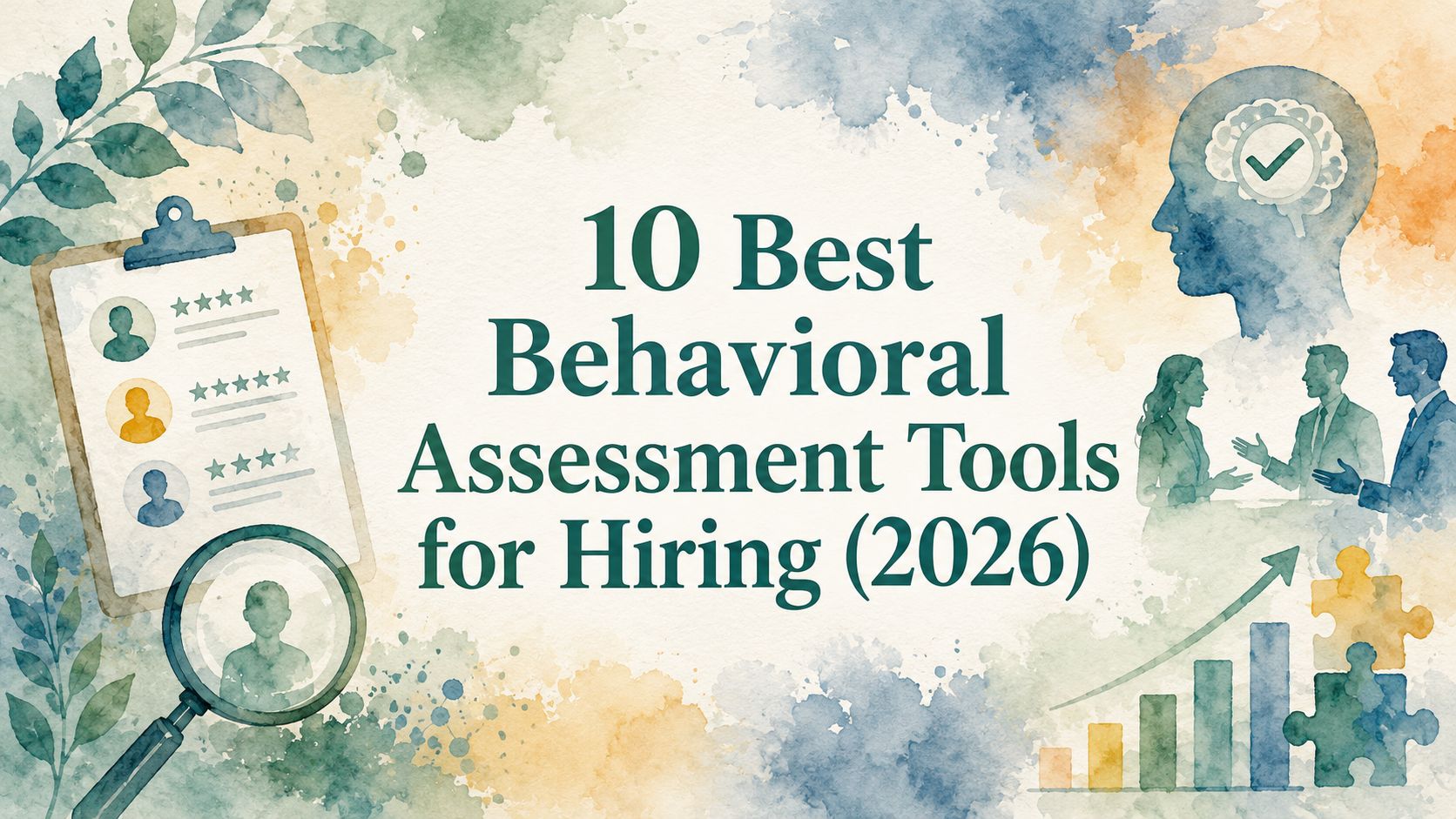
Explore the 10 best behavioral assessment tools for 2026. Our expert guide reviews top platforms for consistent, bias-free hiring and talent management.
A hiring manager has three finalists. All look qualified on paper. Six months later, one is steady under pressure, one struggles with feedback, and one creates friction across the team. The resume never showed that difference.
Behavioral assessment tools help hiring teams test for the patterns that shape day-to-day performance: judgment, collaboration, coachability, pace, and response to stress. Used well, they add consistency to hiring decisions that often drift toward gut feel. Used poorly, they slow the process, frustrate candidates, and create compliance exposure that procurement and legal then have to clean up.
That is why this guide focuses on more than feature lists. The key buying decision is about fit. Does the tool match the role family, hiring volume, validation standard, reporting needs, and manager skill level in your organization? Can your team defend its use if a candidate challenges fairness? Will recruiters use the results, or will the platform become an expensive side report nobody trusts?
I have seen strong assessment programs improve selection quality and manager confidence. I have also seen teams buy a platform because the demo looked polished, then struggle with low completion rates, weak stakeholder adoption, and vague score reports that never changed a hiring decision. The difference usually comes down to implementation discipline, job relevance, and whether the vendor gives enough evidence to support the use case.
If your broader goal includes hiring for interpersonal capability, this guide pairs well with our practical overview of soft skills assessment methods.
The sections that follow evaluate 10 behavioral assessment tools through a practical rubric: assessment depth, candidate experience, usability for managers, integration options, validation and documentation, bias mitigation support, and the trade-offs that matter once the contract is signed.
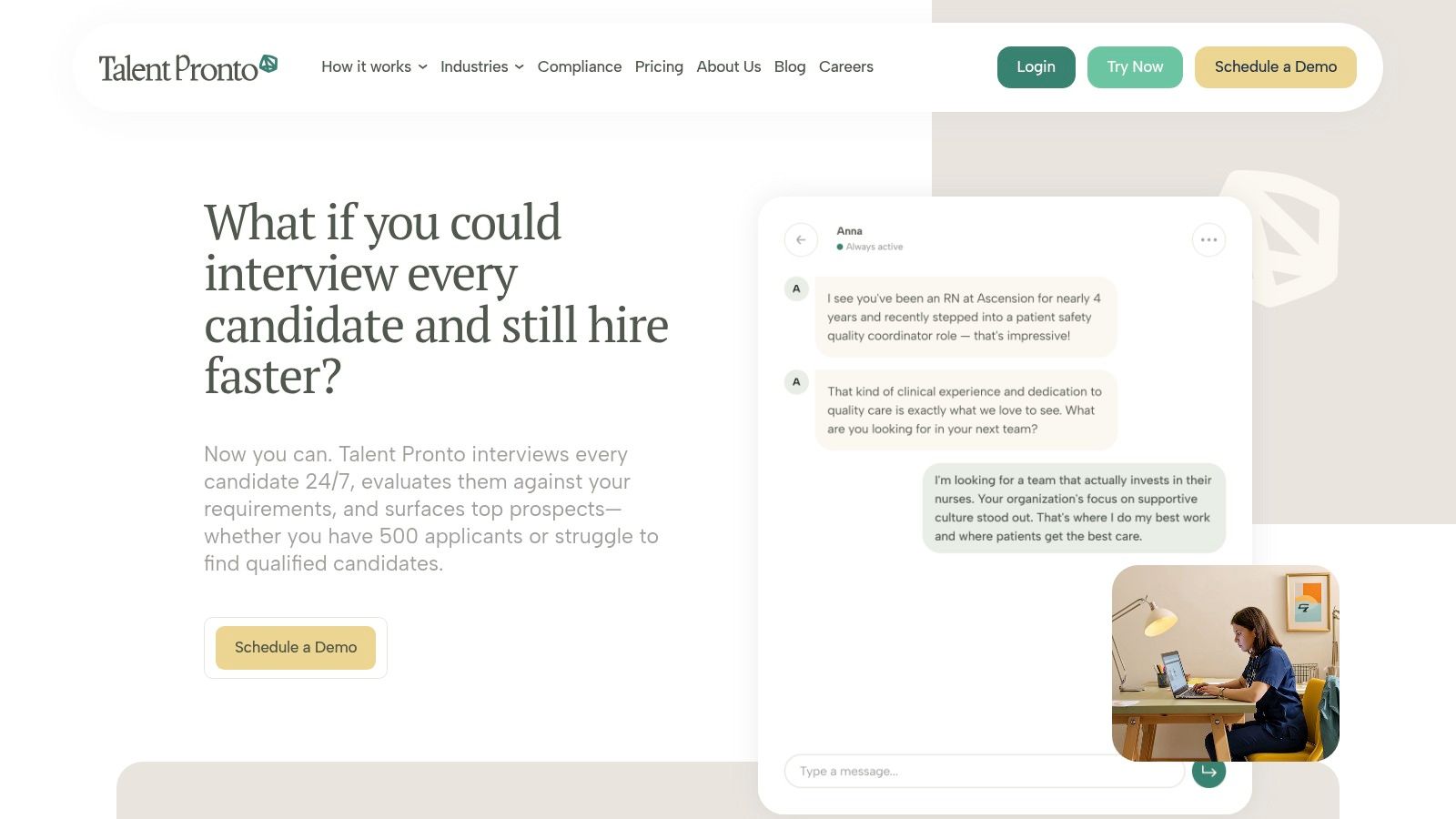
Talent Pronto is the most operationally useful option on this list if your real problem is early-funnel overload. Instead of sending candidates into a static questionnaire, its virtual assistant Anna runs 24/7 conversational screening across web and mobile, asks behavioral and technical questions, and produces structured scorecards against role-specific criteria.
That matters more than feature lists usually suggest. A lot of teams don't need another personality report. They need a way to engage every applicant, ask the same questions consistently, and stop relying on recruiters to manually triage the first wave of applications.
Talent Pronto feels different from legacy chatbot workflows because it's built around evaluation, not form capture. Anna probes into candidate experience, work style, technical fit, and job-relevant behaviors, then organizes the answers into comparable scorecards that hiring teams can review.
It also fits the reality of modern recruiting operations. The platform integrates with Greenhouse, iCIMS, Paylocity, ADP, and Workday, and typical implementation is described as one to three weeks. This can be the difference between a pilot getting approved and a project dying in procurement.
Practical rule: If your recruiters are spending most of their time scheduling, chasing, and manually screening, start with workflow relief first. Deeper psychometrics won't help if your team never gets to qualified candidates fast enough.
A few strengths stand out:
For teams that care about soft skills but struggle to measure them consistently, Talent Pronto's guide to soft skills assessment in hiring is a useful extension of the same philosophy.
Talent Pronto is best for organizations that need scale, consistency, and speed more than they need a standalone psychometric brand name. I'd put it at the top of the shortlist for high-volume recruiting, hard-to-staff operations, and distributed hiring teams where candidates apply outside business hours.
The main trade-off is straightforward. Pricing isn't public, and AI screening still needs human review for nuanced judgment calls. But as a front-end hiring engine, it solves a problem many legacy behavioral assessment tools don't even address well.
SHL remains one of the safest enterprise choices if your buyers want a mature vendor, established occupational personality science, and broad deployment options. OPQ32 has been around long enough that most global HR leaders, I/O psychologists, and procurement teams already know what they're buying.
That familiarity is a real advantage. When organizations need a tool that can support volume hiring, professional hiring, and internal talent processes inside one ecosystem, SHL usually enters the conversation early.
OPQ32 is strongest when your hiring process is already disciplined. It works well for organizations that have competency models, formal hiring stages, and stakeholders who want specific reports for recruiters, hiring managers, and talent leaders.
Where SHL tends to win:
Where it can frustrate teams is candidate experience. Compared with shorter or more conversational tools, OPQ32 can feel heavier. That doesn't make it weak. It just means it's usually a better fit for employers that value rigor and standardization over a lighter-touch experience.
If your process is loose, SHL won't fix that. It performs best when the organization already knows how to interpret assessment data and use it consistently.
Hogan Assessment Systems is where I'd look for leadership hiring, executive assessment, and high-stakes professional roles where derailers matter as much as strengths. The core suite combines HPI for everyday personality, HDS for derailment risks, and MVPI for motives and values.
That three-part view is why Hogan keeps its reputation. It doesn't just tell you how someone tends to show up when things are going well. It helps you think about how they may behave under pressure, what drives them, and where leadership risk can surface.
Hogan is not the tool I'd start with for frontline hiring at scale. It's too deep, too interpretation-heavy, and often too expensive for that use case. But for director-level and above, or for succession planning, it can be extremely useful.
The biggest mistake with Hogan is treating it like a simple pass-fail screen. It works better as a decision support tool for trained users who can interpret nuance.
The practical trade-offs are clear:
For organizations that want quick recruiter usability, Hogan can feel heavy. For organizations that want a more layered view of leadership behavior, that same depth is exactly the point.
A common buying scenario goes like this. HR wants better hiring consistency, recruiters need something candidates find easy to complete, and hiring managers will only use results if the report is easy to read. The Predictive Index is often on the shortlist because it solves that adoption problem better than many heavier assessment platforms.
The Behavioral Assessment is short, untimed, and built around four drives: dominance, extraversion, patience, and formality. It also maps people into 17 Reference Profiles. As noted in RecruitBPM's summary of validated behavioral assessment platforms, PI is available in multiple languages and has been used at large scale over a long period, which helps explain its market traction.
PI tends to work best in organizations that need a behavioral tool managers will readily use in hiring conversations, team discussions, and onboarding. That is a practical advantage, not a minor one. A platform can be psychometrically sound and still fail if the line manager ignores the report.
What stands out in real implementation:
The trade-off is depth. PI gives a usable view of work style and behavioral tendencies, but it is not the tool I would choose if the brief calls for nuanced personality interpretation, executive risk analysis, or a more forensic read on derailers.
That matters for selection governance too. PI is strongest when employers define role requirements up front, train managers on what the profiles can and cannot say, and use the assessment as one input alongside structured interviews and job-relevant evidence. For compliance and bias mitigation, that discipline matters more than the profile label itself. The safest buying decision is the one your team can implement consistently, explain clearly, and defend if a hiring decision is challenged.
Criteria Corp is often the practical choice for teams that don't want to manage separate vendors for personality, cognitive, skills, and emotional intelligence assessment. The platform is broad, recruiter-friendly, and easier to fit into general hiring operations than some specialist psychometric providers.
That breadth matters because behavioral data is usually strongest when it isn't used alone. Behavioral assessments become more useful when employers combine them with cognitive or technical tools and use the results to align candidate behavior patterns, preferences, and tendencies with role needs, as explained in the IJCRT paper on behavioral assessments in recruitment.
Criteria's strength is convenience with enough rigor for many commercial hiring teams. Recruiters can administer a range of assessments from one place, which reduces process complexity and makes rollout easier.
What usually works well:
The trade-off is that specialist buyers may want more depth in a single area than a broad platform can provide. Still, for many midsize and enterprise teams, Criteria gets adopted because it solves an operations problem first.
A retailer opens seasonal hiring for thousands of frontline roles. Applications spike in the first 72 hours, nearly all from phones, and the primary bottleneck is no longer sourcing. It is keeping candidates engaged long enough to finish screening. That is the context where Harver tends to make sense.
Harver stands out when behavioral assessment is part of a high-volume workflow, not a standalone psychometric exercise. Its game-based approach can reduce the friction that comes with long, repetitive questionnaires, especially for hourly, early-career, and distributed candidate pools. In practice, that matters because candidate drop-off is often the hidden cost in volume hiring stacks.
Harver is a strong fit for teams screening for potential in roles where resumes tell you very little. I have seen that matter most in customer service, operations, fulfillment, and other environments where hiring speed and completion rate can affect staffing levels within days.
What buyers should evaluate closely:
The trade-off is implementation discipline. Harver can improve candidate experience, but the technology does not solve weak job design. Teams still need role-specific success criteria, adverse impact monitoring, and documentation that connects the assessment to job-relevant behaviors. Without that, a polished assessment flow can create legal and decision-quality risk.
This is also where the buying decision gets more strategic. If the priority is psychometric depth for professional or leadership hiring, other tools in this category may offer stronger interpretability. If the priority is high applicant throughput, mobile usability, and a screening process candidates will complete, Harver deserves serious consideration.
A practical rule: ask vendors to show completion rates, validation approach, retest policy, accessibility support, and bias mitigation steps before rollout. For enterprise buyers, those details matter more than the novelty of the format.
Thomas International PPA stays popular because it's simple to explain. If your managers understand DISC language and want quick, usable insight for hiring and coaching, Thomas tends to land well.
That ease of use is real. In many organizations, the best assessment isn't the one with the deepest theory. It's the one managers will consistently use without needing a psychometrics background.
Thomas PPA works well for role fit conversations, interview preparation, and post-hire coaching. It's especially attractive when talent acquisition and L&D want to use the same language across the employee lifecycle.
A few practical points matter here:
The limitation is that DISC-style profiles are descriptive. They become more useful when you do proper job profiling and keep structured hiring discipline. Used casually, they can drift into oversimplified labels. Used well, they create a shared language managers can act on.
A common buying scenario looks like this. TA wants a hiring assessment, L&D wants something for development, and internal mobility teams want to stop asking employees to complete new tests every time they apply for a role. Plum is one of the few vendors built around that problem.
Its Discovery Survey is designed as a single assessment that can support selection, internal movement, and development planning. That can reduce duplicate testing and make the candidate and employee experience more coherent, especially in organizations with frequent role changes or strong internal talent marketplaces.
Plum is usually strongest in enterprises that need more than a point solution. I would shortlist it when the buying group includes HR, TA, legal, and talent management, and each group wants clear answers on fairness, documentation, and downstream use.
That is the key differentiator here. Plum is less about giving managers a simple personality label and more about creating an assessment layer the business can use across multiple talent decisions.
A practical evaluation rubric for Plum looks like this:
The trade-off is straightforward. Plum can be a strong strategic platform if your organization is serious about skills visibility, internal movement, and bias mitigation. If you only need a quick behavioral screen for frontline hiring, the setup effort may outweigh the value.
Implementation also matters more than buyers expect. Teams get the best results when they define decision rules early, validate how assessment outputs will be used at each hiring stage, and train managers to treat the results as structured input rather than an automatic verdict. That helps with both compliance and adoption.
A common buying scenario looks like this. The TA team wants better screening, HR wants something defensible for development, and business leaders do not want to buy two separate platforms six months apart.
Talogy is often a fit for that situation. Caliper has a long track record, and the platform is built for organizations that want personality and cognitive assessment under one vendor, with reporting options that can extend beyond hiring into onboarding, coaching, and succession discussions.
That breadth is useful, but it changes the buying decision. Caliper is rarely the best choice for teams that only need a fast behavioral screen for high-volume roles. It makes more sense for companies that want a structured assessment program with role benchmarking, multiple stakeholder views, and clearer links between selection and later talent decisions.
Talogy stands out when buyers want more than a personality profile. The value is in combining trait data with ability measures, then mapping those results to job requirements in a way hiring managers, HR, and talent development teams can each use differently.
A practical evaluation rubric for Talogy looks like this:
The trade-off is straightforward. Caliper can support better decisions when the organization is prepared to define success profiles carefully and use the outputs consistently. If that discipline is missing, the extra data can create noise instead of clarity.
Bias mitigation and governance matter here. Teams get more value from Talogy when they validate role criteria before launch, limit who can view sensitive outputs, and train managers to use results as one input alongside interviews, work samples, and experience. That approach improves adoption and puts the company in a stronger position if candidate fairness or documentation questions come up later.
A familiar buying scenario: the TA lead wants behavioral and cognitive signal in one platform, Finance wants pricing clarity before a demo, and the hiring team does not have six months for setup. Bryq is one of the few vendors on this list that addresses those three constraints at the same time.
Its appeal is practical. Bryq combines behavioral, cognitive, and skills assessment in a single workflow, and it is usually easier to size commercially than older enterprise platforms. For SMB and midsize teams, that shortens the vendor evaluation process and reduces the risk of buying a system that is too heavy for the hiring volume.
Bryq fits teams that need a hiring tool they can stand up quickly and use without extensive assessor training. ATS integrations, interview guides, and a unified candidate profile make it a sensible option for lean TA functions that want structure without a large implementation program.
A useful evaluation rubric for Bryq looks like this:
The trade-off is credibility versus convenience. Bryq is easier to buy and easier to launch than some legacy vendors. In larger organizations, though, procurement, legal, or executive stakeholders may ask harder questions about validation depth, global norming, and brand track record than they would with SHL, Hogan, or PI.
That does not make Bryq a weak choice. It means the buying team should be disciplined. Review the technical documentation, confirm how the platform supports fair-use decisions, and define where assessment scores sit in the process. The safest implementation is to use Bryq as one structured input alongside interviews, work samples, and job-relevant experience, not as a stand-alone filter.
| Product | Core capability | Candidate experience & quality (★) | Pricing / value (💰) | Best for (👥) | Unique selling point (✨) |
|---|---|---|---|---|---|
| 🏆 Talent Pronto | 24/7 AI conversational screening + role-aware scorecards | ★★★★☆ Anna interviews via web/mobile; standardized, audit-ready scorecards | 💰 Quote-based plans; strong value at scale (integrations & account mgmt) | 👥 High-volume hiring: healthcare, retail, manufacturing, tech | ✨ Agentic AI probing behavioral/technical traits; deep ATS/HRIS sync |
| SHL, OPQ32 | Validated occupational personality model & manager/candidate reports | ★★★★★ Longstanding validation; rich reporting suites | 💰 Quote/subscription; enterprise-focused | 👥 Global enterprises & professional hiring | ✨ Mature psychometric model; multi-language support |
| Hogan Assessments (HPI / HDS / MVPI) | Bright-side, derailers, motives, leadership & development focus | ★★★★★ Research-backed insights for high-stakes roles | 💰 Premium custom pricing; certification often required | 👥 Leadership selection, executive development | ✨ Derailer (risk) profiling + formal practitioner certification |
| The Predictive Index, PI BA | Very brief behavioral measure + talent optimization platform | ★★★★☆ ~6‑minute experience; practical manager reports | 💰 Subscription-based platform; quote | 👥 High-volume operations & hiring teams | ✨ Speed + job-profile linked interview guides |
| Criteria Corp, Personality & Behavioral Suite | Broad library: cognitive, skills, personality, EI | ★★★☆☆ Wide test options; experience varies by test | 💰 Quote-based; cost scales by volume & modules | 👥 Volume hiring teams wanting multiple assessment types | ✨ Single vendor for multi-test hiring programs |
| Harver (with pymetrics) | Gamified neuroscience-based exercises within hiring workflow | ★★★★☆ Engaging, mobile-first; high completion rates (~25 min) | 💰 Enterprise packaging; custom pricing | 👥 Volume roles: retail, contact centers, service | ✨ Game-based measures that boost engagement and inclusivity |
| Thomas International, PPA | DISC-style ipsative behavioral profile for hiring & coaching | ★★★☆☆ Short (8–12 min); manager-friendly outputs | 💰 Regional/partner pricing; quote | 👥 Hiring + post-hire development, team coaching | ✨ Quick DISC profiling with role-fit & coaching reports |
| Plum, Discovery Survey | Measures personality, problem-solving, social intelligence | ★★★★☆ Candidate-friendly; one assessment for multiple uses | 💰 Enterprise contracts; quote | 👥 Mobility, development, DEI-conscious organizations | ✨ Public bias audits & blended construct approach |
| Talogy, Caliper Assessment | Combined personality + cognitive with 70+ validated job models | ★★★★☆ Strong predictive focus; selection + development reports | 💰 Subscription/licensing; quote | 👥 Enterprise selection & development programs | ✨ Extensive job models + integrated workflows |
| Bryq, Talent Assessment Platform | Integrated cognitive, behavioral, skills profile with analytics | ★★★★☆ Unified candidate profile; quick implementation | 💰 Public pricing; SMB-friendly plans (some unlimited invites) | 👥 SMBs & mid-market seeking fast, data-driven hiring | ✨ Transparent pricing, quick ATS integrations and role builder |
A hiring team is six weeks into a rollout. Recruiters are sending the assessment. Candidates are completing it. Managers are looking at the reports and making different calls from the same score pattern. Legal has late questions about data retention. That is how a decent tool turns into a messy process.
Choose the platform that fits the decision you need to improve, the level of structure your managers can handle, and the compliance standards your organization has to meet. In practice, a simpler tool with clean workflows often produces better hiring decisions than a more advanced one that nobody uses consistently.
Use a scoring rubric before vendor demos start to blur together. I recommend weighting each area based on business risk, not vendor polish. For example, a high-volume frontline employer may weight candidate completion and ATS workflow more heavily, while an executive hiring team may put more weight on interpretive depth and validation evidence.
Score each vendor on these criteria:
Use a simple 1 to 5 scale for each category, then add written notes on trade-offs. A tool can score high on psychometrics and still fail your process because it takes too long, creates manager confusion, or lacks usable documentation.
The gap I see most often is practical usability. Research summarized in the PMC review of standardized assessment tools points to a familiar concern. Standardized tools do not automatically outperform informed human judgment unless they are used in a disciplined, role-relevant way. In hiring, that means setup and interpretation matter as much as the assessment design.
Buying advice: Do not evaluate these platforms in isolation. Evaluate the full operating model around them.
Compliance work starts before the first candidate invite goes out. Legal, talent acquisition, HRIS, and hiring leaders should review job relevance, notice and consent language, accessibility options, privacy terms, data storage, and retention rules before launch. This matters more if you hire across states or countries, or if the platform uses algorithmic scoring that needs additional review.
Bias mitigation needs a process, not a marketing claim. Ask the vendor how they test for adverse impact, what thresholds trigger review, whether clients can access subgroup reporting, and how often the model or benchmarks are refreshed. Then decide internally how results will be used. Assessment data should inform the decision, not act as an automatic pass-fail screen unless the legal and validation case is very strong.
Manager training is where many implementations succeed or fail. Give managers a short interpretation guide, example score reports, approved interview follow-up questions, and clear guardrails on what the assessment does not measure. Without that structure, managers tend to overread personality language or treat a score as fixed truth.
There is another judgment issue to address. Some traditional scoring frameworks still frame behavior too narrowly, especially under stress or in unfamiliar situations. End Seclusion's review of outdated behavioral assessment practices raises a useful caution here. Teams should interpret results in context and stay careful about deficit-based assumptions, particularly when evaluating neurodivergent candidates or applicants with nontraditional work histories.
Candidate communication also affects outcomes. Tell applicants why you use the assessment, how long it takes, whether accommodations are available, and how the results factor into the hiring process. Clear instructions reduce drop-off and build trust, especially in competitive labor markets where candidates have options.
Start with a narrow business problem. If screening quality is inconsistent at the top of the funnel, shortlist tools built for speed and structure, such as Talent Pronto, Harver, or The Predictive Index. If you need deeper insight for leadership hiring or succession planning, Hogan and Talogy usually deserve stronger consideration. If your team cares most about fairness documentation and broader talent use cases beyond hiring, Plum is worth close review.
Then run a controlled pilot. Pick one or two role families. Define success before launch. Measure completion rates, recruiter time saved, hiring manager confidence, interview consistency, and whether the tool changes decision quality in a way you can defend.
Do not scale based on a strong demo.
For teams buried in early-stage screening, an AI-driven conversational platform like Talent Pronto can produce visible operational gains quickly. It gives each applicant a structured screen, collects comparable behavioral and technical responses, and reduces the volume of resumes recruiters need to review manually.
If your hiring team is buried in early-stage screening, Talent Pronto is worth a close look. It gives every applicant a structured conversational screen, keeps candidate engagement moving around the clock, and helps recruiters spend time on the right people instead of sorting through the entire pile manually.

Talent Pronto is an AI-powered hiring platform built around Anna, our intelligent AI that conducts 24/7 conversational screening, evaluates candidates against specific job requirements and compliance needs, and schedules interviews. Run everything on the Talent Pronto ATS, our all-in-one applicant tracking system with a branded careers site and Anna built in, or keep your existing ATS and let Anna integrate with Greenhouse, Ashby, iCIMS, Jobvite, Lever, Oracle, and more. Either way, we help organizations reduce time-to-hire and build stronger teams.