Learn how a job fit assessment can reduce turnover and improve hire quality. This guide covers methodologies, implementation, and modern AI tools for 2026.
A hiring manager finally fills a hard role after weeks of interviews. The candidate has the right degree, polished answers, and a resume that checks every box. Three months later, the team is frustrated. Deadlines slip. Collaboration feels strained. The new hire isn't failing because they lack talent. They're failing because the role, the pace, and the team environment don't match how they work.
That scene plays out in companies of every size. The problem usually isn't effort. It's that most hiring processes still lean too heavily on resumes, gut feel, and unstructured interviews. Those methods can spot experience, but they often miss whether someone will thrive in the job.
A strong job fit assessment gives hiring teams a better way to decide. It adds structure where interviews drift, consistency where managers improvise, and evidence where bias often creeps in. It helps employers look beyond “Can this person do the work?” and ask “Will this person succeed in this specific role, in this specific environment, for this specific reason?”
Melissa, an HR leader at a growing care network, thought she'd made a safe choice. The finalist for a team supervisor role had years of experience, strong references, and an interview style that made everyone comfortable. Within weeks, small problems started piling up. The supervisor struggled with the pace, clashed with peers over communication, and seemed uneasy coaching newer staff.
The cost wasn't limited to salary. Senior employees spent extra time correcting mistakes. Team morale dipped because high performers had to absorb work they thought was already covered. Recruiters reopened the search while managers tried to stabilize the department.
That's the part many hiring teams underestimate. A bad hire doesn't only create a vacancy in disguise. It pulls time, trust, and energy away from people who were already carrying full workloads. If you've seen this happen, you've also seen how weak interview discipline can be the hidden cause.
A more structured process helps employers catch those risks before an offer goes out. That's one reason many teams now examine the broader cost of a bad hire and look for ways to replace guesswork with evidence.
Unstructured interviews often reward confidence, similarity, and storytelling skill. They don't always identify the person who will perform best once the real work begins.
The shift starts when hiring teams stop treating interviews as the whole evaluation and start treating them as one input among several. That's where job fit assessment becomes useful. It creates a repeatable way to compare candidates against the role itself, instead of comparing each candidate against a manager's personal instincts.
A job fit assessment is a structured method for testing whether a candidate matches the work, not just the job description. It helps hiring teams compare a person's likely day-to-day performance against the demands of the role, the manager's expectations, and the team environment.
A simple way to frame it is this: qualifications tell you whether someone can do the job. Fit helps you judge how they are likely to do the job once they are in it.
Hiring teams often stop at credentials. They confirm years of experience, certifications, industry background, or technical skill, then assume the rest will sort itself out in interviews. That shortcut is one reason interviews can feel inconsistent. Two candidates may look equally strong on paper, yet one thrives in the role while the other struggles with pace, ambiguity, collaboration, or feedback.
Job fit assessment adds another layer. It examines patterns that resumes rarely show clearly, such as how a person tends to make decisions, respond to structure, handle pressure, stay motivated, and work with others. In that sense, it works like a flight checklist. A pilot's training matters, but crews still use a checklist because important variables should be reviewed in a consistent way every time.
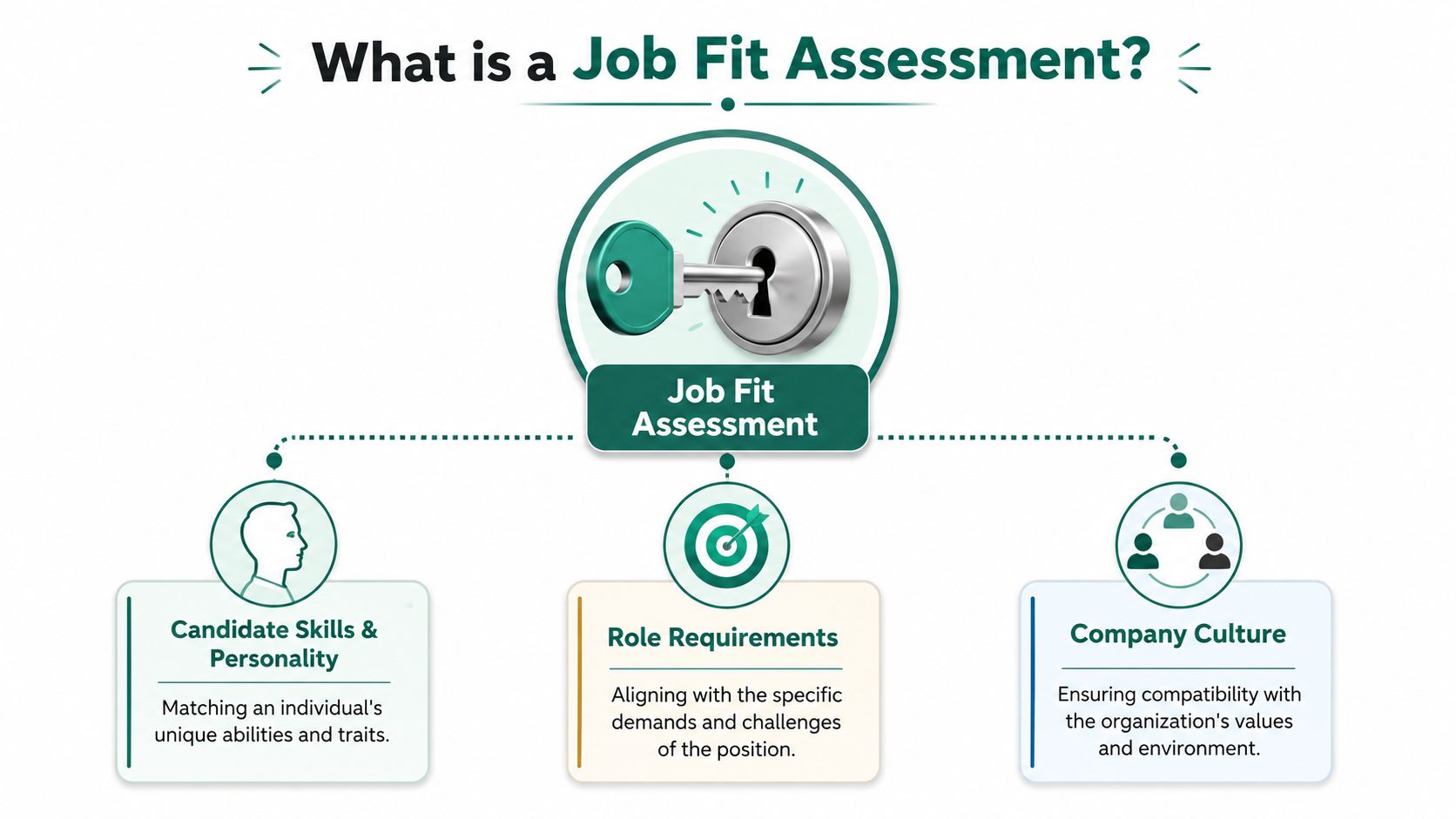
That broader view also helps with a problem many employers miss. A mismatch is not always about underqualification. A candidate can be strong enough for the work and still be a poor fit because the role is too narrow, too repetitive, too slow-moving, or too limited for their expectations. That is part of job fit too. Over-qualification fit matters because someone who feels constrained may disengage or leave quickly, even if they were impressive in the interview.
A well-designed assessment usually looks at several dimensions at once:
These tools often draw on psychometric principles, which can sound more technical than they are. Psychometrics is the practice of measuring traits and tendencies in a consistent, research-based way. Instead of asking interviewers to rely on gut feel, it gives them a common yardstick.
Here is a practical comparison:
| Hiring input | What it shows | What it often misses |
|---|---|---|
| Resume | Past roles, credentials, stated accomplishments | How the person works day to day |
| Interview | Communication style, examples, interpersonal presence | Consistency across interviewers, hidden bias, comparability |
| Job fit assessment | Measurable patterns tied to role success | Context that still requires human review |
That last point matters.
A job fit assessment is not a final verdict. It is a decision aid. Modern teams increasingly combine traditional assessments with AI-based tools, including conversational screening, to gather the same type of structured evidence earlier and more consistently. The goal is not to hand hiring over to software. The goal is to replace scattered impressions with a clearer, repeatable picture of fit.
A sales manager hires a candidate with a strong resume, sharp interview answers, and the exact industry background the team wanted. Three months later, performance is uneven, the manager is frustrated, and the new hire is already looking elsewhere. The problem was not skill alone. The problem was fit.
That is why job fit belongs in business planning, not just interview training. It affects retention, ramp time, manager workload, team stability, and the quality of future hiring decisions. If a company treats fit as a vague feeling, hiring stays inconsistent. If it defines fit in measurable terms, hiring becomes easier to repeat and easier to improve.
Strong candidates assess employers the same way employers assess candidates. They look for work that matches their preferred pace, level of structure, leadership style, and growth path. A role may look attractive on paper and still feel wrong once the person pictures the day-to-day reality.
This matters even more in organizations that are shifting toward skills-based hiring practices. Skills tell you whether someone can perform tasks. Fit helps you judge whether they are likely to stay engaged while doing them, under your conditions, with your team.
There is another reason leaders should pay attention. Poor fit does not only show up with underqualified hires. It also appears with over-qualification fit.
An overqualified candidate can succeed for a short period and still become a mismatch if the role offers too little challenge, too little autonomy, or too narrow a scope. In that case, the hiring risk is not capability. It is boredom, low commitment, and early turnover. Teams that ignore this point often misread overqualification as a safe choice, when it can create a different kind of instability.
A strong fit process works like a calibration tool. It helps every interviewer use the same reference points instead of relying on personal instinct. That changes hiring from a collection of opinions into a more disciplined evaluation.
The business benefits are practical:
This is also where traditional psychometrics and newer AI tools connect. Psychometric principles give hiring teams a stable blueprint for what to measure. AI-based conversational screening can gather the same kind of structured evidence earlier in the process and at a larger scale. The value comes from consistency, not automation for its own sake.
Leaders often say they hire for attitude, potential, or culture. Those ideas only help when they are translated into observable patterns. What does "handles ambiguity well" mean in this role? What behaviors show coachability? What signs suggest a highly capable candidate may outgrow the position in six months?
Once those questions are defined, hiring gets clearer.
A strategic job fit process does not replace judgment. It gives judgment a frame. That frame is what allows organizations to move from scattered interviews and confident guesses to a system that can be measured, audited, and improved.
There isn't one perfect method for measuring fit. The strongest hiring systems combine several. Each one uncovers something different, and together they form a fuller picture than any single tool can provide.
Psychometric tools help employers evaluate traits that don't appear clearly on a resume. According to Rasmussen University's overview of job fit assessments, psychometric tests such as the Big Five Personality Test and structured behavioral interviews are critical for assessing cognitive abilities, behavioral style, and personality traits, and when combined with skills assessments and job simulations, they create a complete evaluation framework.
That matters because people don't always describe themselves accurately in interviews. Some undersell themselves. Others perform confidence. Psychometric assessments give employers a more standardized read on likely work patterns.
For example, a role that requires steady follow-through, patience, and routine might not suit someone who needs constant novelty and freedom. Neither profile is better. They fit different jobs.
A structured behavioral interview asks all candidates the same job-relevant questions and scores answers against defined criteria. That's different from a free-flowing conversation where one interviewer asks about conflict, another asks about goals, and a third just talks chemistry.
A simple shift makes a big difference:
The second version is harder to fake and easier to compare across candidates.
If your team is moving toward skills-based hiring practices, structured interviewing is one of the fastest upgrades you can make. It forces the hiring team to define what evidence of success looks like.
Job simulations are often the closest thing to observing performance before a hire. Instead of asking candidates to describe what they would do, you give them a task that mirrors the role.
That might include:
These methods work because they reduce abstraction. You see how a person thinks, what they prioritize, and where they struggle.
The best assessment mix works like triangulation. One method shows tendencies, another shows evidence from the past, and a third shows how the person handles realistic work in the present.
Used together, these methodologies turn hiring from a personality contest into a clearer evaluation of role match.
A hiring manager fills the same role three times in 18 months. Each candidate looked strong in interviews. Each one struggled for a different reason. One could not handle the pace. One disliked the level of structure. One was capable of more than the job offered and left as soon as a better option appeared.
That pattern usually points to a process problem, not a people problem.
A useful job fit assessment program works like a hiring map. It helps your team define the route before candidates enter the process, so interviewers are not improvising at every turn. The goal is consistency, better evidence, and fewer expensive surprises after the offer is signed.
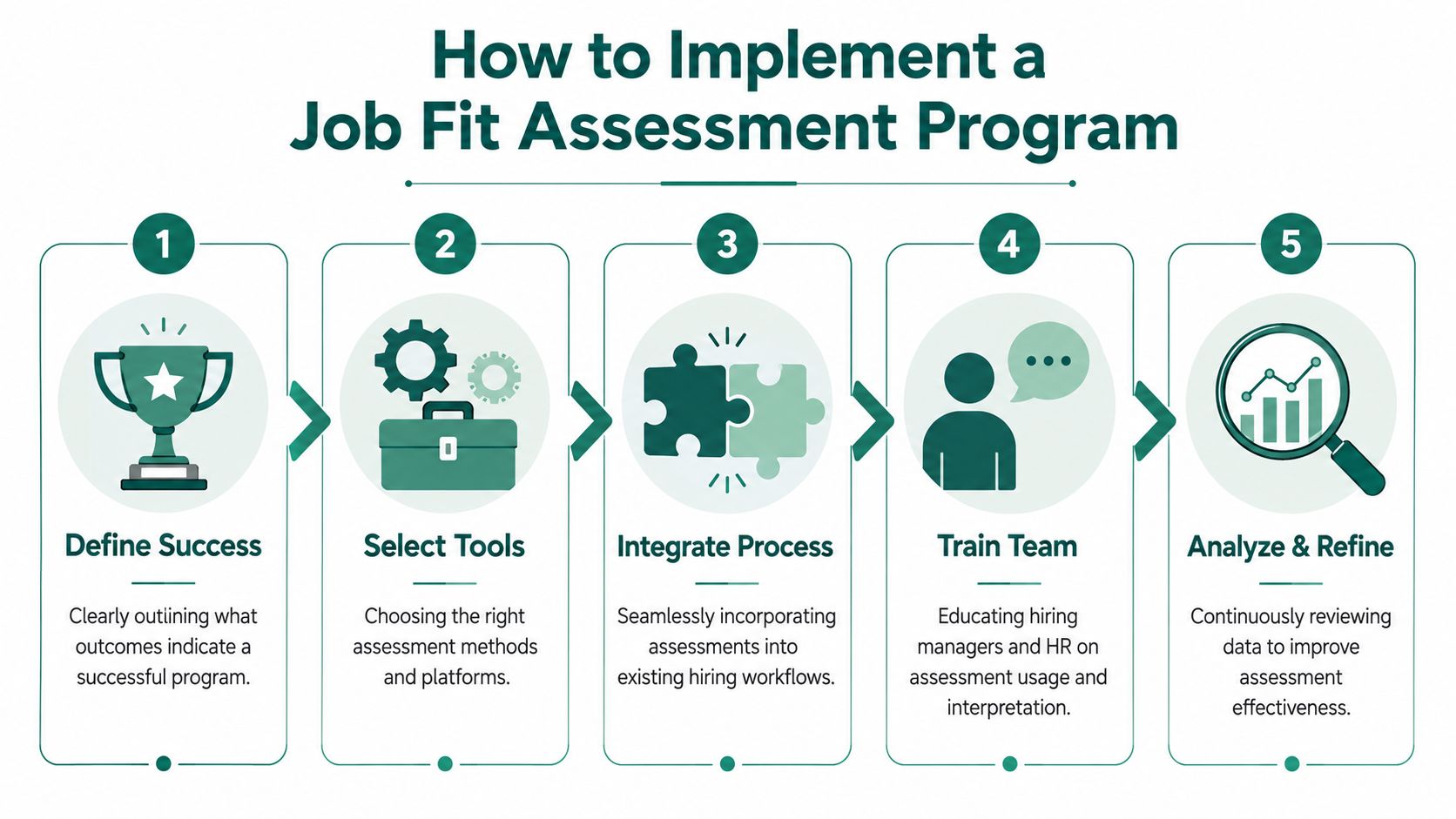
Assessment programs fail when teams shop for software before they agree on what the job demands. Start with the role itself.
Write down what success should look like in the first six to twelve months. Focus on observable outcomes, repeated behaviors, and the conditions under which the work gets done. Does the role reward precision or persuasion? Independent judgment or tight process discipline? Steady service or rapid problem-solving under pressure? Those choices shape the benchmark.
Psychometrics fit into this process like a measuring instrument. They do not decide who gets hired on their own. They help you measure traits and work patterns that matter for a specific role. AI tools can then help collect and organize those signals at scale, but only after your team knows what it is measuring.
A practical roadmap looks like this:
Hiring systems break down when they ask managers to do too much, too loosely, or too differently from one another. Simplicity matters.
| Implementation choice | Better option | Risk if ignored |
|---|---|---|
| Vague success profile | Role-specific benchmark | Interviewers judge by personal preference |
| One assessment for all roles | Different mix by job family | Signals become too generic |
| Informal score notes | Standard scorecard | Candidates are hard to compare |
| No manager training | Guided calibration | Results get misread or overused |
If your HR team is still selecting systems and workflows, it helps to find HR software on the Supatool blog and compare what different tools support around screening, evaluation, and process integration.
It also helps to decide where modern screening fits. Many teams now pair traditional job fit methods with early conversational screening so they can collect structured evidence before the first live interview. This approach is explained in why conversational screening reveals what documents can't, especially for high-volume roles where resume review alone misses too much context.
Underqualification is easy to spot. Over-qualification fit is easier to miss.
A candidate may have the ability to do the work and still be a poor match for the role's scope, pace, or level of challenge. The problem is not competence. The problem is staying power. If the job does not use enough of that person's range, motivation often fades, and turnover risk rises.
Researchers have documented this pattern. A study published in the Journal of Vocational Behavior found that perceived overqualification is associated with lower job satisfaction and stronger turnover intentions (ScienceDirect). That is why job fit should include challenge fit, not just capability fit.
Many hiring teams confuse "can do the job" with "likely to stay engaged in the job." Those are different questions.
Ask:
The strongest resume on paper can still be a weak long-term match if the role cannot keep that person interested.
A sound job fit assessment program protects against both forms of mismatch. It helps you avoid the candidate who cannot perform the work, and the candidate who can perform it but is unlikely to remain committed.
Early-stage screening has been one of the weakest links in hiring for years. Most application forms collect history, not insight. They ask candidates to upload a resume, retype the same data, and wait. That process filters for patience more than fit.
A static form can tell you where someone worked. It usually can't tell you how they think, how they communicate, or how they handle job-specific situations. It also creates friction at the very moment candidate interest is freshest.
That's why conversational screening has gained attention. According to Ringtime's overview of conversational screening, AI-driven dialogue over phone and WhatsApp reaches an 80% engagement rate compared with 30% for static forms, and these screening conversations typically last 3–5 minutes per candidate.
The difference is easy to understand. A form feels like paperwork. A conversation feels responsive.
Teams also report operational gains with chatbot-style recruiting tools. RecruitBPM's write-up on recruitment chatbots says organizations that implement them report a 30–40% reduction in time-to-hire compared with traditional screening methods. Cadient Talent's discussion of conversational AI in recruiting adds that recruiters using conversational AI cut routine outreach by up to 60%, and companies using recruitment chatbots see a 2.5× increase in qualified candidate flow.
Used well, conversational AI applies classic job fit principles at the top of the funnel. Instead of waiting for a recruiter to call each applicant, the system can ask every candidate a consistent set of role-aware questions.
That creates several practical benefits:
If you've ever felt that resumes flatten candidates into bullet points, this is the problem modern screening tries to solve. A useful primer on that shift is why conversational screening reveals what documents can't.
Here's where it gets interesting. Traditional psychometrics and modern conversational AI aren't competing ideas. They can reinforce each other. Psychometrics help define the traits and tendencies linked to success. Conversational AI helps collect structured evidence at scale, much earlier in the process.
A short product demo helps make that workflow more concrete:
Some HR teams worry that AI means handing hiring decisions to a machine. That isn't how a sound process should work.
AI can help with the repetitive part of screening. It can ask consistent questions, capture answers, summarize patterns, and surface candidates who meet defined criteria. Human decision-makers should still review evidence, conduct interviews, weigh context, and make the final call.
That division of labor makes sense. Screening is where consistency matters most and human bandwidth is often thinnest. Final selection is where judgment, nuance, and accountability matter most.
A good rule is simple. Let technology standardize the collection of evidence. Let people decide what that evidence means in context.
When employers use conversational screening this way, they aren't replacing hiring discipline. They're extending it to every applicant instead of reserving it for the handful who made it past a form.
Many employers assume assessments create legal risk. In reality, unstructured hiring often creates more risk because it leaves too much room for inconsistency, undocumented judgment, and bias.

A validated and role-relevant process gives every candidate the same opportunity to be assessed against the same criteria. That's one reason well-designed job fit assessment programs can help reduce hiring bias. They shift decisions away from vague impressions and toward documented evidence.
Structured interviews, consistent scoring rubrics, and role-specific benchmarks also make decisions easier to explain. If someone asks why one candidate advanced and another didn't, the team can point to defined criteria rather than memory or personal preference.
Keep these principles in place:
A fair hiring process doesn't happen because a company has good intentions. It happens because the company designed a process that makes fairness easier to practice and easier to defend.
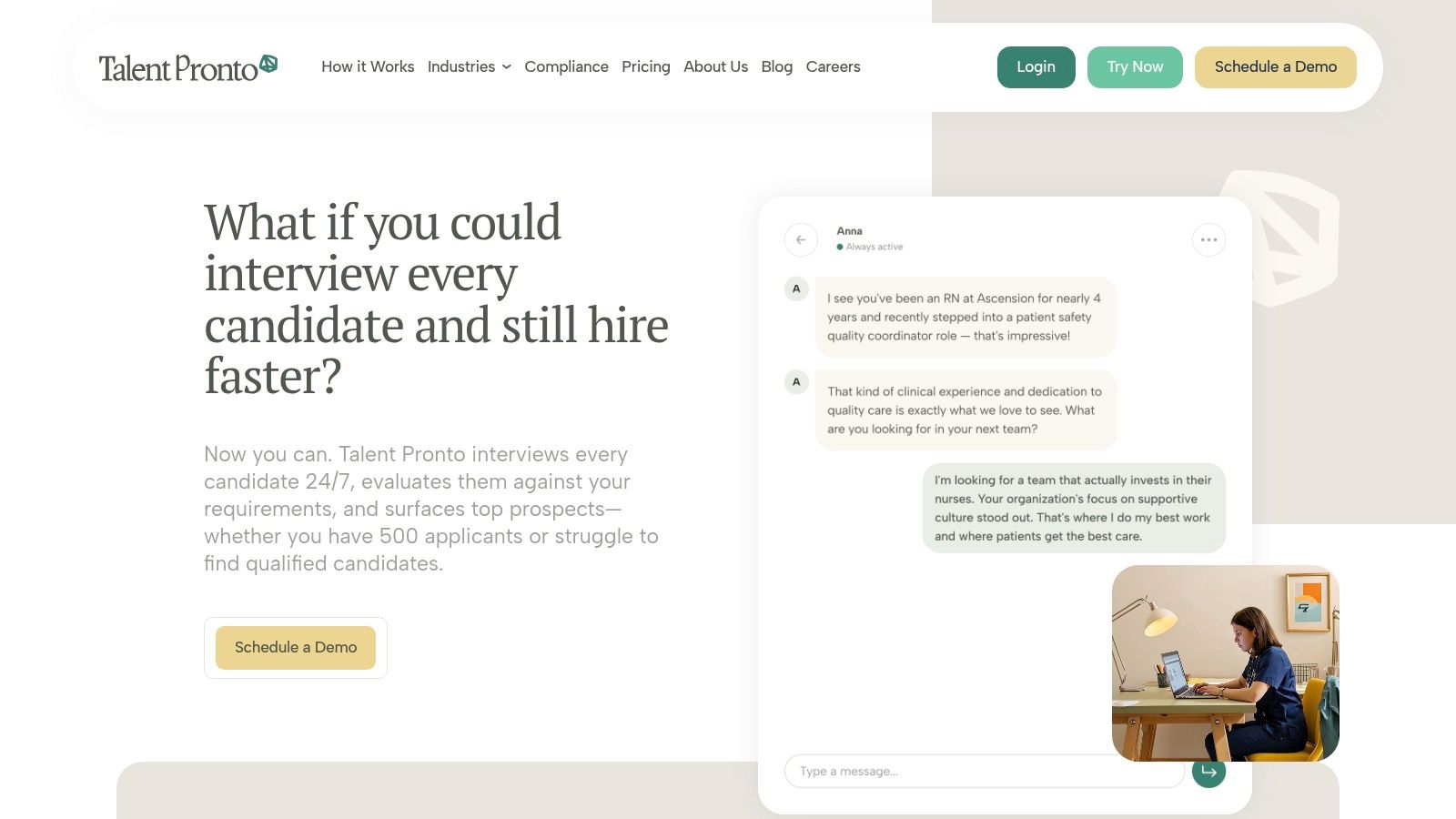
If your team wants a more structured way to screen every applicant, Talent Pronto offers AI-powered conversational screening that asks role-specific questions, creates structured scorecards, and helps employers compare candidates consistently without handing over the final hiring decision to the system.

Talent Pronto is an AI-powered hiring platform built around Anna, our intelligent AI that conducts 24/7 conversational screening, evaluates candidates against specific job requirements and compliance needs, and schedules interviews. Run everything on the Talent Pronto ATS, our all-in-one applicant tracking system with a branded careers site and Anna built in, or keep your existing ATS and let Anna integrate with Greenhouse, Ashby, iCIMS, Jobvite, Lever, Oracle, and more. Either way, we help organizations reduce time-to-hire and build stronger teams.