Automate screening, cut hiring time, and enhance candidate experience with a chatbot for recruitment. Explore benefits, use cases, and choosing the right AI.
You probably know the pattern already. A role goes live on Monday morning. By Tuesday afternoon, the ATS has a few hundred applicants. By Wednesday, hiring managers want a shortlist, candidates want updates, and recruiters are stuck doing triage instead of recruiting.
That's where the idea of a chatbot for recruitment usually enters the conversation. The problem is that many teams buy the wrong kind. They add a thin chatbot layer to the careers page, collect a few extra fields, and call it automation. Nothing important changes. Recruiters still read too many resumes, candidates still wait too long, and hiring managers still complain that the process feels slow.
A modern recruitment chatbot can change that, but only if it behaves like a real screening assistant instead of a prettier form.
Most hiring teams aren't short on applicants. They're short on usable signal.
A resume tells you where someone worked, how they describe themselves, and sometimes whether they used the right keywords. It usually doesn't tell you whether they can work the shift, hold the required license, relocate, start on time, handle a difficult patient interaction, or pass the essential screening points that matter for the role. So recruiters compensate with manual outreach, phone screens, follow-up emails, and a lot of spreadsheet logic that should have been automated years ago.
That's why the early funnel breaks first. Not because recruiters don't work hard enough, but because the process asks humans to do repetitive filtering at scale.
As of mid-2023, 54% of global recruitment agencies had adopted AI chatbots for initial candidate screening, and organizations using them reduced candidate response times from an average of 7 days to under 24 hours, according to Gitnux recruitment chatbot statistics.
In a manual workflow, the steps look familiar:
A strong chatbot for recruitment changes the order of operations.
Instead of asking recruiters to find signal inside the pile, it creates signal immediately. The candidate applies, answers structured questions, gets instant acknowledgment, and moves through a consistent screening flow. Recruiters review a scored, standardized profile instead of a blank resume and a hunch.
Practical rule: If your chatbot only captures contact details and dumps them back into the ATS, you haven't automated screening. You've automated data entry.
That's the fundamental distinction. A legacy bot helps you collect more applications. A modern one helps you understand them faster.
The simplest way to explain the difference is this. An old chatbot is a digital clipboard. A modern one is a junior screener.
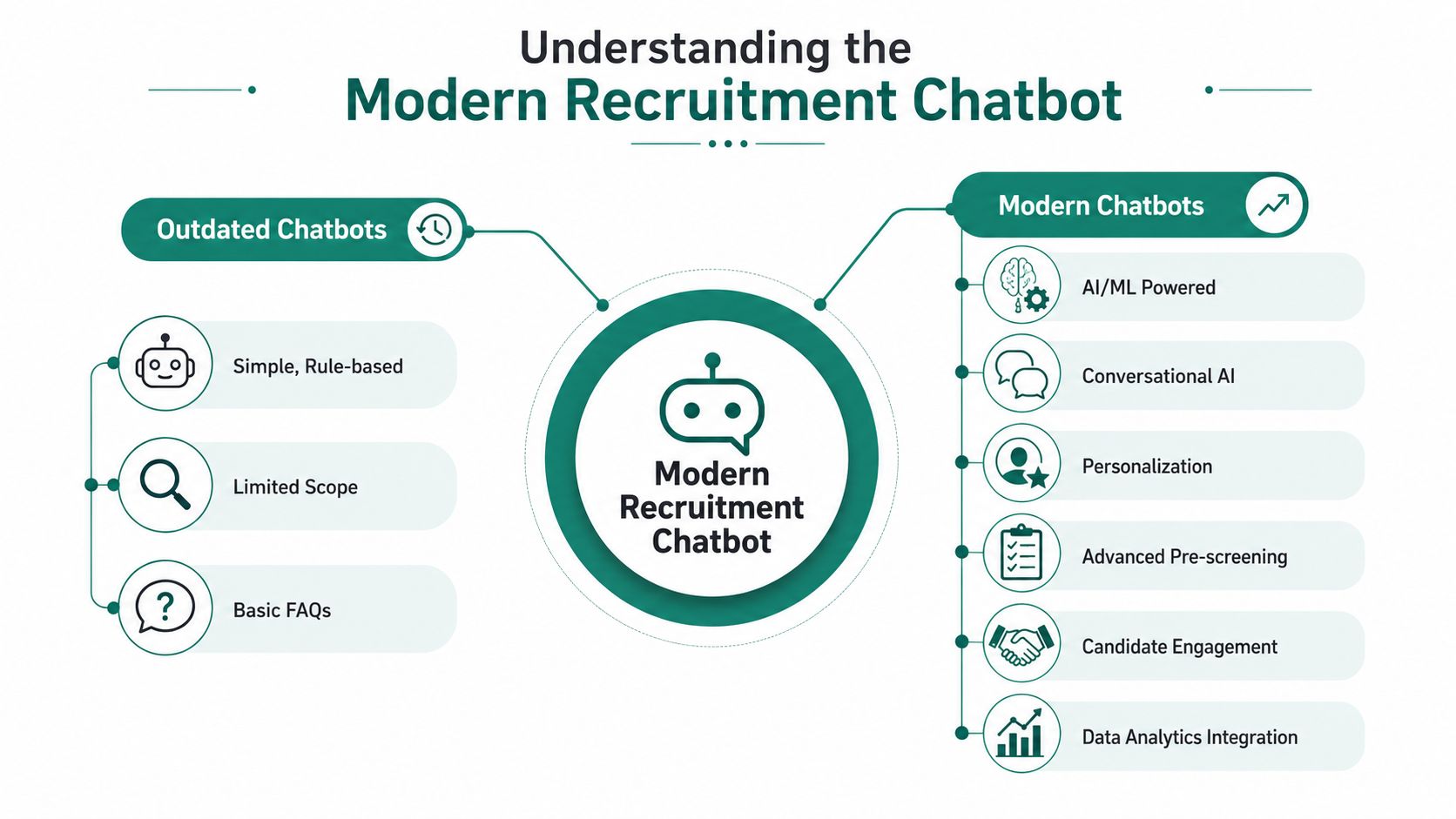
A basic ATS add-on usually does three things. It answers simple FAQs, asks a fixed set of questions, and pushes responses into fields. That can help with volume, but it doesn't improve judgment. It's still a static intake experience.
A better chatbot for recruitment runs a structured conversation. It asks follow-up questions based on what the candidate says, captures context, and organizes answers into comparable data. That's what people mean when they talk about conversational AI and agentic AI in hiring. In practical terms, it means the system doesn't just wait for an answer. It moves the screening forward.
Advanced conversational AI recruitment chatbots automate approximately 70% of initial candidate communication, enable HR teams to handle three times more applications without expanding staff, and convert conversations into 100% structured candidate data, according to SendPulse on AI chatbot candidate screening.
A real screening assistant does more than ask “Are you authorized to work here?” and “Can you start next week?”
It can probe for:
That matters because documents miss too much. This is exactly why conversational screening can reveal things resumes can't, which is explored well in this breakdown of what documents can't capture.
The best chatbot for recruitment doesn't try to replace recruiter judgment. It structures the conversation so recruiter judgment starts from better evidence.
Candidates increasingly expect speed, mobile access, and straightforward communication. A long application plus silence feels broken. A conversational flow feels closer to a real process.
That's especially useful for candidates who aren't polished resume writers. Resources like AI tools for no-degree job seekers show how much support applicants now seek just to get through hiring systems. If your front-end hiring experience still assumes everyone can optimize a resume and wait patiently for email replies, you'll miss strong people.
One note of caution. “Modern” doesn't automatically mean “better.” Many vendors now market scripted bots as AI. The test is simple: can it ask meaningful, criteria-based follow-ups and return structured screening output that a recruiter can use?
The business case for a recruitment chatbot gets stronger when you stop measuring it as a novelty and start measuring it as labor reallocation.
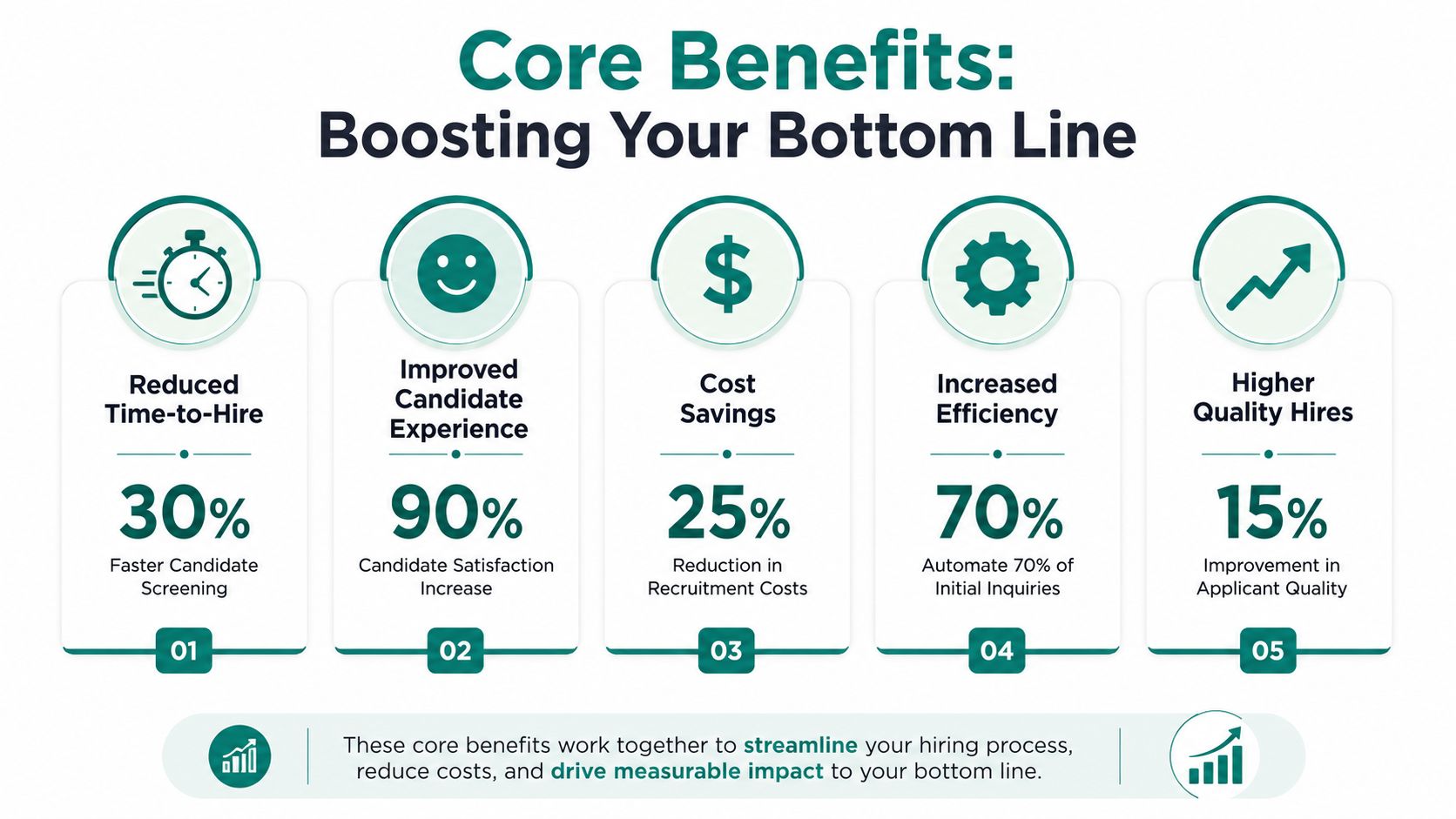
The first win is usually operational. Recruiters spend less time repeating the same first-touch tasks: answering routine questions, chasing availability, checking baseline qualifications, and logging notes back into the system.
Enterprises implementing integrated AI recruitment platforms report average annual cost savings of $2.3 million for organizations with 1,000+ employees, HR teams report a 40% reduction in administrative task time, and Deloitte reported that quality of hire increased by 24% when using AI, according to Second Talent recruitment AI statistics.
That doesn't mean every company will see the same financial outcome. It does mean the economic mechanism is clear. When the system handles repetitive screening and documentation, recruiters can spend more time on calibration, manager alignment, and candidate closing.
Faster hiring isn't just about scheduling interviews sooner. It starts earlier.
A strong chatbot for recruitment removes dead time between application, acknowledgment, qualification, and next-step routing. That matters because the early funnel is where process friction imperceptibly kills hiring momentum. By the time a recruiter opens the applicant queue manually, the strongest candidates may already be talking to another employer.
Here's a quick view of where the gains show up:
| Area | Manual workflow | Chatbot-supported workflow |
|---|---|---|
| Initial response | Recruiter inbox backlog | Immediate candidate engagement |
| Qualification | Resume read plus phone screen | Structured screening conversation |
| Data capture | Notes entered later | Standardized responses captured instantly |
| Recruiter effort | Repetitive first-touch work | Review and decision support |
A useful explainer on how automation supports the top of funnel is below.
Hiring leaders often worry that automation increases speed but lowers quality. In practice, poor design lowers quality. Good design improves it.
Why? Because the chatbot applies the same screening logic to every applicant, asks the same role-specific questions, and creates comparable scorecards. That reduces the random variation you get when different recruiters ask different first-round questions or document notes unevenly.
Slow communication is expensive. It leads to drop-off, duplicate outreach, rework, and brand damage.
A chatbot that can answer compensation, benefits, scheduling, and process questions around the clock reduces that friction. The best systems don't make the process feel robotic. They make it feel responsive.
If your recruiters are still spending prime hours answering the same basic candidate questions, you're using expensive human time for low-value work.
Theory is useful. Hiring teams usually decide based on whether the workflow fits their operating reality.
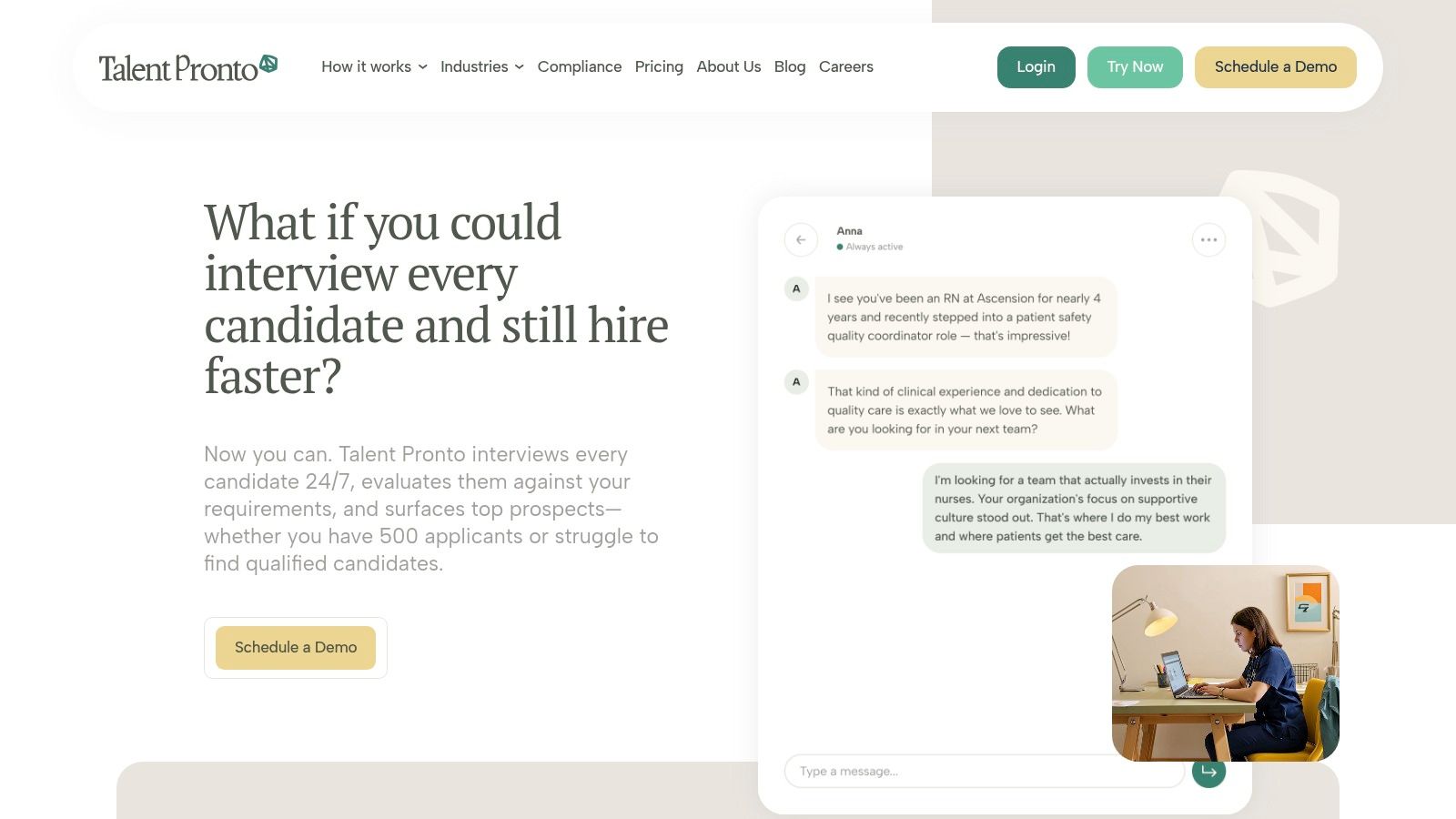
AI-powered recruitment chatbots that conduct 24/7 conversational screening can reduce time-to-screen by up to 80% compared to traditional manual resume reviews, according to Talent Pronto on conversational screening.
Healthcare hiring exposes the weakness of generic bots quickly. A basic form can collect license type and years of experience. It usually can't run a meaningful conversation around specialty area, patient population, shift flexibility, credential status, or unit-specific requirements.
A stronger screening assistant can ask practical follow-ups such as:
That's where Anna by Talent Pronto fits well. It conducts conversational screening, asks role-specific behavioral and technical questions, prepares structured scorecards, and syncs with systems such as Workday, Greenhouse, ADP, and iCIMS based on the platform details provided by Talent Pronto's hiring platform overview.
Manufacturing teams often face a different problem. They don't just need volume. They need fast, clean filtering for roles where attendance, schedule fit, physical requirements, and safety expectations matter immediately.
A good chatbot for recruitment in manufacturing asks the questions a floor supervisor cares about before the first interview:
This reduces wasted interviews. It also gives hiring managers more confidence in the shortlist because the screening output reflects actual plant requirements, not generic resume language.
Hospitality and retail hiring moves on a shorter clock. Candidates often apply from a phone, outside business hours, and to multiple employers at once. If the process takes too long, they disappear.
That's why chatbots work especially well here when they do three things well:
For these environments, the chatbot isn't just a convenience layer. It's the front door of the hiring process.
The chatbot should meet the urgency of the role. High-volume hiring needs immediate movement, not elegant delays.
The implementation mistake I see most often is treating chatbot deployment like a branding project instead of an operations project.
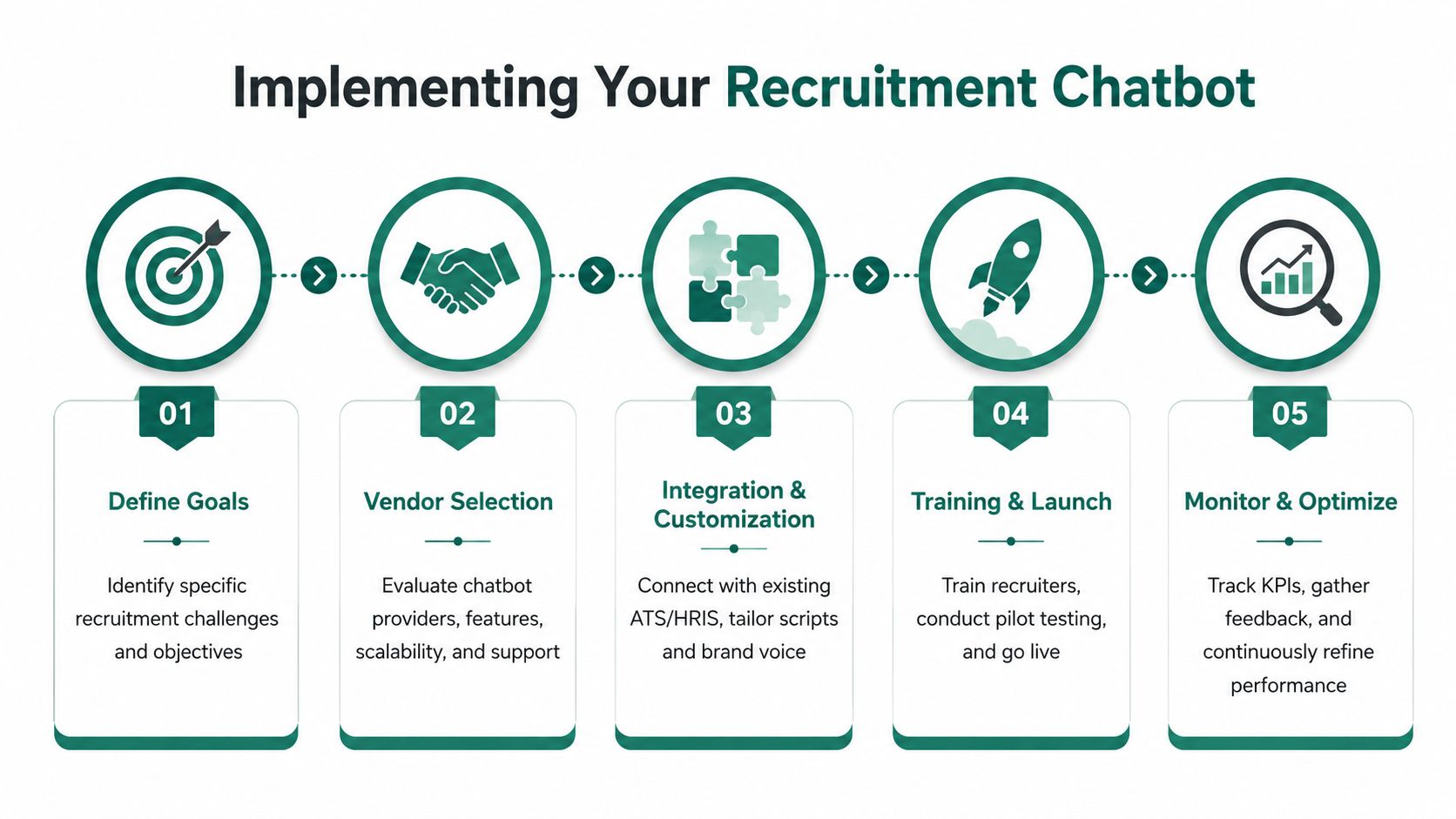
Don't begin with “we want AI in recruiting.” Begin with a failure point.
Examples: - Nurse hiring stalls because recruiters can't screen applicants fast enough. - Manufacturing roles stay open because too many applicants fail schedule or requirement checks late in the process. - Retail recruiters burn hours on repetitive candidate communication and scheduling.
That gives you a practical use case and a measurable implementation target.
A slick demo means very little if the tool can't write back to your ATS cleanly.
In regulated industries like healthcare and government, 71% of enterprises report failed or delayed AI deployments due to non-standard data schemas and compliance bottlenecks, which is why vendor integration depth matters so much for systems like Workday or Greenhouse.
Ask vendors direct questions:
Most disappointing chatbot launches have one thing in common. The team bought software before defining what “qualified” means.
Write the screening logic before launch:
| Step | What to define |
|---|---|
| Knockout criteria | Non-negotiables like certifications, work authorization, shift fit |
| Role evidence | What experience or behaviors indicate likely success |
| Escalation rules | When the chatbot should hand off to a recruiter |
| Candidate messaging | How the process is explained clearly and respectfully |
Recruiters don't need to memorize the bot flow. They need to know how to interpret the output, review scorecards, and step in when context matters.
That usually means training on: - Scorecard review - Candidate handoff - Manager calibration - Edge cases and overrides
A good implementation feels lighter than expected because the chatbot takes repetitive work away. A bad one creates a parallel process and doubles admin.
A chatbot for recruitment should earn its place in the stack. That means tracking the right outcomes and being honest about failure modes.
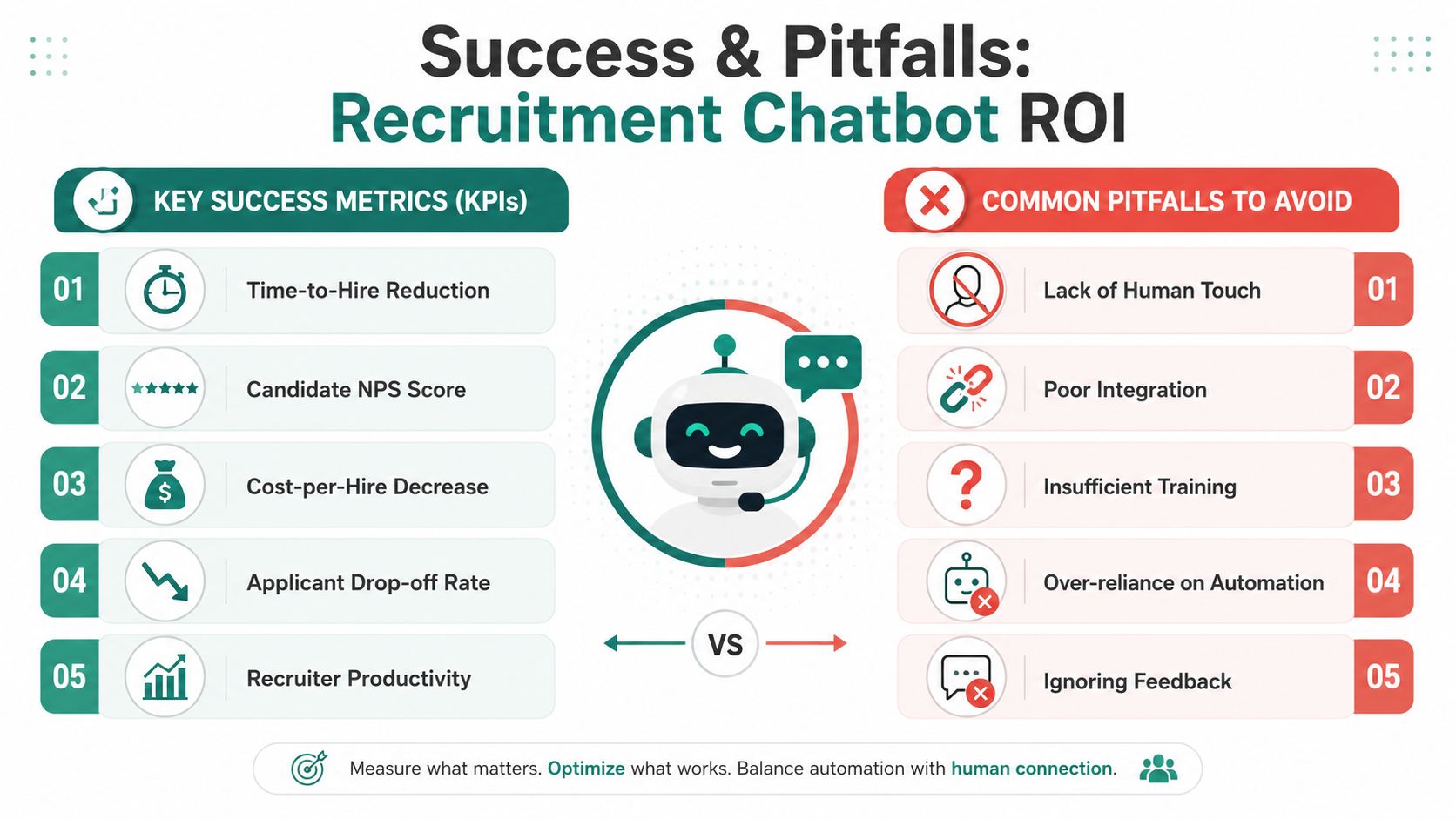
Skip vanity metrics like total bot conversations unless they connect to hiring outcomes.
Focus on measures such as:
This is the objection hiring teams underestimate. Candidates don't just want speed. They want fairness and clarity.
A significant pitfall is ignoring candidate perception. 68% of job seekers express concern that AI screening lacks human nuance, and only 22% of HR leaders have documented protocols for explaining AI-driven scorecard logic to candidates.
That trust issue matters more than is widely acknowledged. If the chatbot asks deep behavioral questions without explaining why, some candidates will disengage or second-guess the process. Fairness communication should be designed in, not added later. Teams that are serious about structured screening should also understand how bias shows up in interviews, which is why this piece on interview bias and how to reduce it is useful context.
Tell candidates what the chatbot is doing, what it isn't doing, and when a human reviews the process. Silence creates suspicion.
Some tools are just scripted forms with chat styling. They can be useful for FAQ deflection, but they won't improve screening quality.
A practical test: - Does it ask adaptive follow-ups? - Can recruiters review structured evidence, not just transcripts? - Does it fit your role families without heavy manual rebuilding?
The chatbot shouldn't make final hiring decisions. It should create consistency at the top of funnel and route the process intelligently.
When teams over-automate, they usually cut out the recruiter at the exact moment judgment is required. The better model is simple. Let the system handle repetitive screening and data capture. Let recruiters handle nuance, advocacy, exceptions, and final progression decisions.
When you compare vendors, ignore the polished demo for a moment and use a harder checklist.
A recruitment chatbot is worth adopting when it reduces noise, speeds up early screening, and gives your team a more defensible process. If it only adds another interface, skip it.
If you want to see how a conversational screening platform works in practice, Talent Pronto is worth a look. Its approach focuses on role-specific candidate conversations, structured scorecards, ATS syncing, and always-on early-stage screening so recruiters can spend less time triaging and more time making hiring decisions.

Talent Pronto is an AI-powered hiring platform built around Anna, our intelligent AI that conducts 24/7 conversational screening, evaluates candidates against specific job requirements and compliance needs, and schedules interviews. Run everything on the Talent Pronto ATS, our all-in-one applicant tracking system with a branded careers site and Anna built in, or keep your existing ATS and let Anna integrate with Greenhouse, Ashby, iCIMS, Jobvite, Lever, Oracle, and more. Either way, we help organizations reduce time-to-hire and build stronger teams.