Discover what is interview bias, its types, and impact on hiring. Get strategies & tools for a fairer, more effective process in 2026.
A hiring manager can believe they're being fair and still make biased decisions. That's the uncomfortable truth at the center of modern recruiting. The evidence is hard to ignore: applicants with male names have a 40% higher chance of being called in for an interview than identically qualified female counterparts, and nearly 90% of all people hold some bias against women according to the cited summary of a UN report in this overview of unconscious bias statistics and solutions.
That's why the question isn't just what is interview bias. It's what hiring teams will do about it when awareness alone clearly doesn't fix the problem. Fair hiring comes from process design, disciplined evaluation, and systems that reduce subjectivity before it can distort a decision.
Interview bias is the gap between how we think we evaluate candidates and how we do so. In practice, it shows up as quick judgments that feel reasonable in the moment but have little to do with job performance. A résumé feels stronger because the school is familiar. A candidate seems “polished” because their style matches the interviewer's. Another gets marked down for being “unclear” when the underlying issue is accent bias or discomfort with difference.
That's what makes interview bias so dangerous. It usually doesn't look like overt discrimination. It looks like confidence, instinct, chemistry, culture fit, or a manager saying, “I just wasn't convinced.”
Practical rule: If two candidates are judged by different questions, different standards, or different levels of interviewer patience, the process is already biased.
New hiring managers often assume bias starts in the final interview. It usually starts earlier. It can appear in résumé screening, in the first phone conversation, in how follow-up questions are asked, and in how much evidence each interviewer needs before deciding someone is strong or weak.
A useful working definition is simple: interview bias is any subjective distortion that causes a candidate to be judged on something other than relevant evidence for the role.
The practical consequence is bigger than fairness alone. Biased hiring weakens selection quality. Teams miss capable people, overvalue superficial signals, and create inconsistent records that are hard to defend later. The fix isn't to ask interviewers to “be less biased.” The fix is to build a hiring process where bias has fewer opportunities to enter the decision at all.
Most hiring bias isn't loud. It's quiet, fast, and easy to rationalize afterward. That's why new managers need a clear distinction before they can fix it.
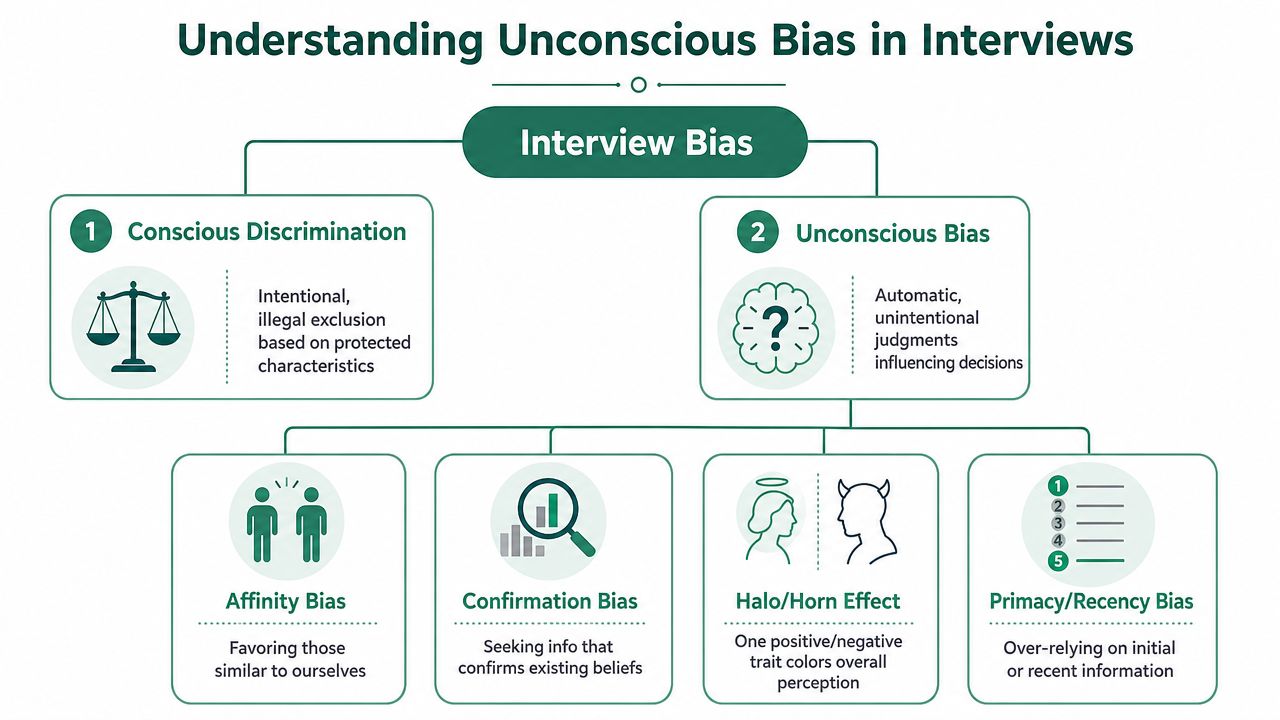
Conscious discrimination is intentional. Someone knowingly excludes or penalizes a candidate based on a protected characteristic. That's a compliance and legal issue, and it's direct.
Unconscious bias is different. It's unintentional, but it still changes outcomes. An interviewer may believe they're evaluating skill while reacting to communication style, shared background, age cues, or assumptions tied to a name.
Hiring managers often struggle with this because unconscious bias doesn't feel like bias. It feels like judgment. That's exactly why it survives in otherwise well-meaning teams.
A practical way to think about unconscious bias is as the brain's autopilot mode. Autopilot helps people make fast decisions, but it also fills in gaps with assumptions. In hiring, that's risky because speed and confidence can disguise poor evaluation.
Common shortcuts sound familiar:
The important point isn't that interviewers are bad people. It's that human judgment is uneven under pressure. When managers are busy, reviewing many applicants, or conducting several interviews in a row, they tend to rely even more on shorthand impressions.
A strong hiring process assumes this will happen and compensates for it. That's why mature organizations don't rely on interviewer self-confidence as a control mechanism.
Saying “I'm not biased” doesn't solve much. The more useful standard is building a process that doesn't depend on perfect self-awareness in the first place.
Once managers understand that, the discussion gets more practical. The goal stops being moral self-certainty and becomes operational discipline.
Bias becomes easier to manage when hiring teams can name it in real time. Most interviewers don't say, “I'm using affinity bias right now.” They say, “I clicked with them,” or “I'm not sure they'd work well with the team.” The language sounds harmless. The effect often isn't.
Affinity bias appears when an interviewer favors someone who feels familiar. Maybe the candidate attended the same university, worked at a similar company, or communicates in a way the interviewer relates to easily. The danger is obvious: similarity gets rewarded even when another candidate gives stronger evidence.
Halo effect happens when one positive trait colors the whole evaluation. A prestigious employer, polished delivery, or one excellent answer can inflate unrelated scores.
Horn effect is the reverse. One weak moment, an awkward opening answer, or an unusual communication style can drag down the rest of the interview.
Confirmation bias shows up when interviewers form an early opinion and then spend the rest of the conversation collecting proof that they were right. They ask one candidate generous follow-ups and press another candidate harder because they've already decided who seems stronger.
Stereotyping enters when assumptions get attached to identity markers, career path, age, name, or speech. The evidence on ethnic and linguistic cues is especially instructive. Research shows that applicants with ethnic names speaking with an accent were viewed less positively by interviewers than those without an accent, and that this bias directly impaired hiring decisions in this employment interview bias study on ethnic names and accents.
That last point matters because it removes the usual excuse. This isn't just about perception. It changes who gets hired.
| Bias Type | Definition | Example in an Interview |
|---|---|---|
| Affinity Bias | Favoring candidates who feel similar to the interviewer | A manager rates one candidate higher because they share a school, city, or work style |
| Halo Effect | Letting one strong trait influence all other judgments | A well-known employer on the résumé leads the panel to overestimate every competency |
| Horn Effect | Letting one negative trait overshadow the full interview | A shaky first answer causes the interviewer to score later answers more harshly |
| Confirmation Bias | Looking for evidence that supports an early impression | An interviewer decides a candidate lacks leadership, then notices only weak examples |
| Stereotyping | Applying assumptions based on identity or background cues | A candidate is judged as less capable because of accent, name, age cues, or communication style |
| Primacy Bias | Giving too much weight to first impressions | The first few minutes determine the score before the core questions are even complete |
| Recency Bias | Remembering the latest interview more vividly than earlier ones | The last candidate of the day seems strongest because their answers are freshest in memory |
A hiring manager doesn't need to diagnose every bias perfectly. They need to spot the warning signs early enough to slow down, return to the rubric, and ask whether the score is based on evidence or comfort.
Biased hiring affects business results long before anyone files a complaint. It changes which candidates make it through the process, weakens the quality of selection decisions, and leaves hiring teams with patterns they cannot defend well later.
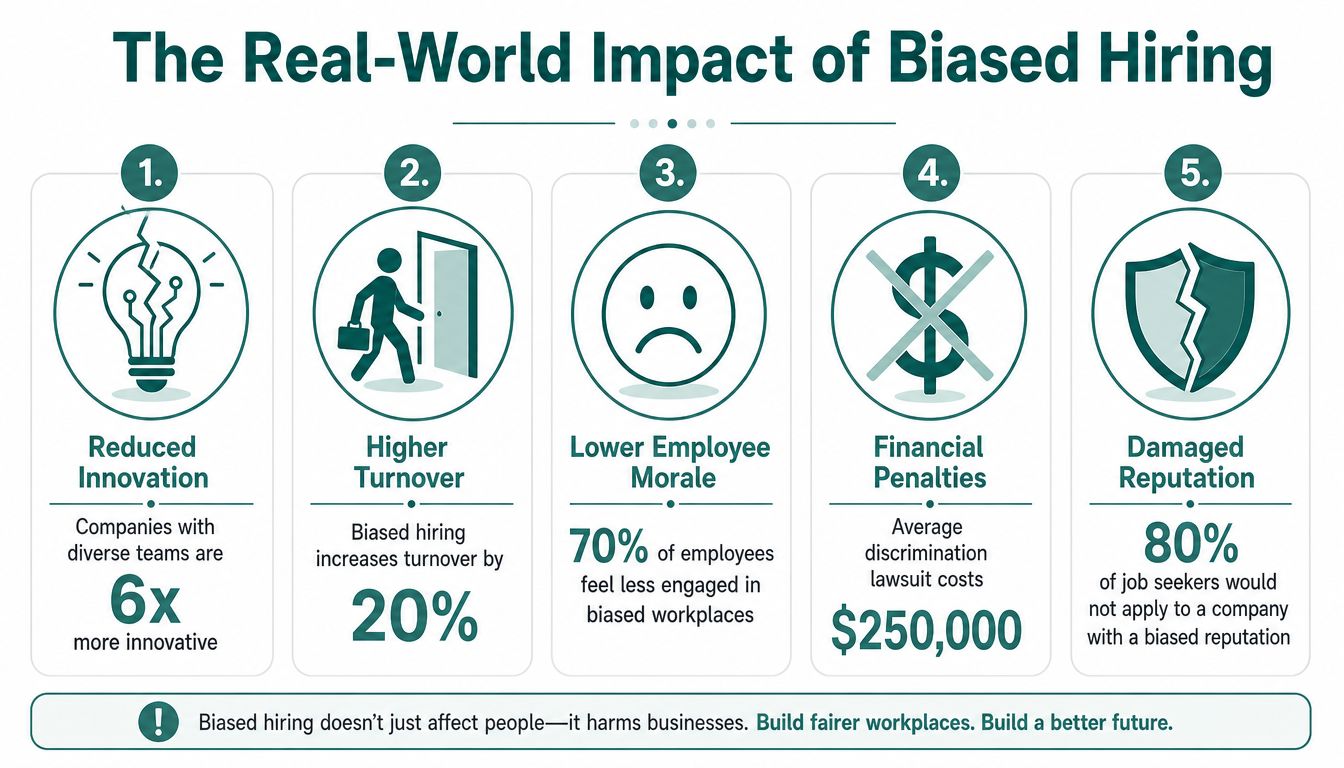
A biased process does more than create an unfair moment in one interview. It changes who advances, who gets rejected, and who stops applying after a poor experience. Once that pattern repeats across recruiters, hiring managers, and interview panels, the company is no longer dealing with isolated judgment errors. It is running a system that produces uneven outcomes.
That has a direct cost. Teams miss strong candidates, over-select for familiarity, and confuse polish with job readiness. Hiring managers often believe they are protecting quality when they rely on instinct. In practice, they can screen out people with the right skills because those candidates communicate differently, come from less familiar backgrounds, or do not match an unspoken idea of “fit.”
The fix is not trying harder to be fair. The fix is building fair hiring practices that standardize evaluation criteria and reduce subjectivity before bias has a chance to shape the shortlist.
Biased hiring lowers access for candidates and lowers decision quality for the employer.
Subjective hiring processes also create risk that HR has to clean up later. If candidates are asked different questions, scored against shifting standards, or rejected with vague notes, the organization has little evidence that decisions were consistent. That becomes a problem during internal audits, candidate complaints, and external scrutiny.
Good intentions alone often fall short. A manager may believe they evaluated everyone fairly, but belief is not documentation. Fair outcomes come from repeatable process controls, clear scoring criteria, trained interviewers, and records that show why one candidate was selected over another.
The legal exposure is straightforward. Employers should understand how inconsistent interview practices can support discrimination claims, especially when patterns appear across roles or locations. For a practical legal overview, this guide for California employers on discrimination is a useful starting point.
The reputational issue is also significant. Candidates notice when interviews feel improvised, dismissive, or uneven. Employees notice too. Once people see favoritism or “fit” being used as a loose justification, trust drops, referrals slow down, and hiring becomes harder to scale well.
Most hiring teams start with awareness training because it feels responsible and manageable. The problem is that awareness by itself doesn't create consistency. A fair process needs controls.
One of the most overlooked points in this area is that intending to be fair isn't enough. Research summarized by Washington State University found that saying “I am not biased” can reverse bias-reduction effects, while the framing “I intend to evaluate fairly and accurately” better engages the right cognitive filters in this Washington State University summary on countering bias in the interview.
Even then, intention is still not a substitute for structure. Interviewers can mean well and still overvalue shared backgrounds, communication style, or first impressions.
A lot of bad hiring process design hides behind good motives:
Here's the stronger standard. Don't build a process that depends on every interviewer being perfectly self-correcting.
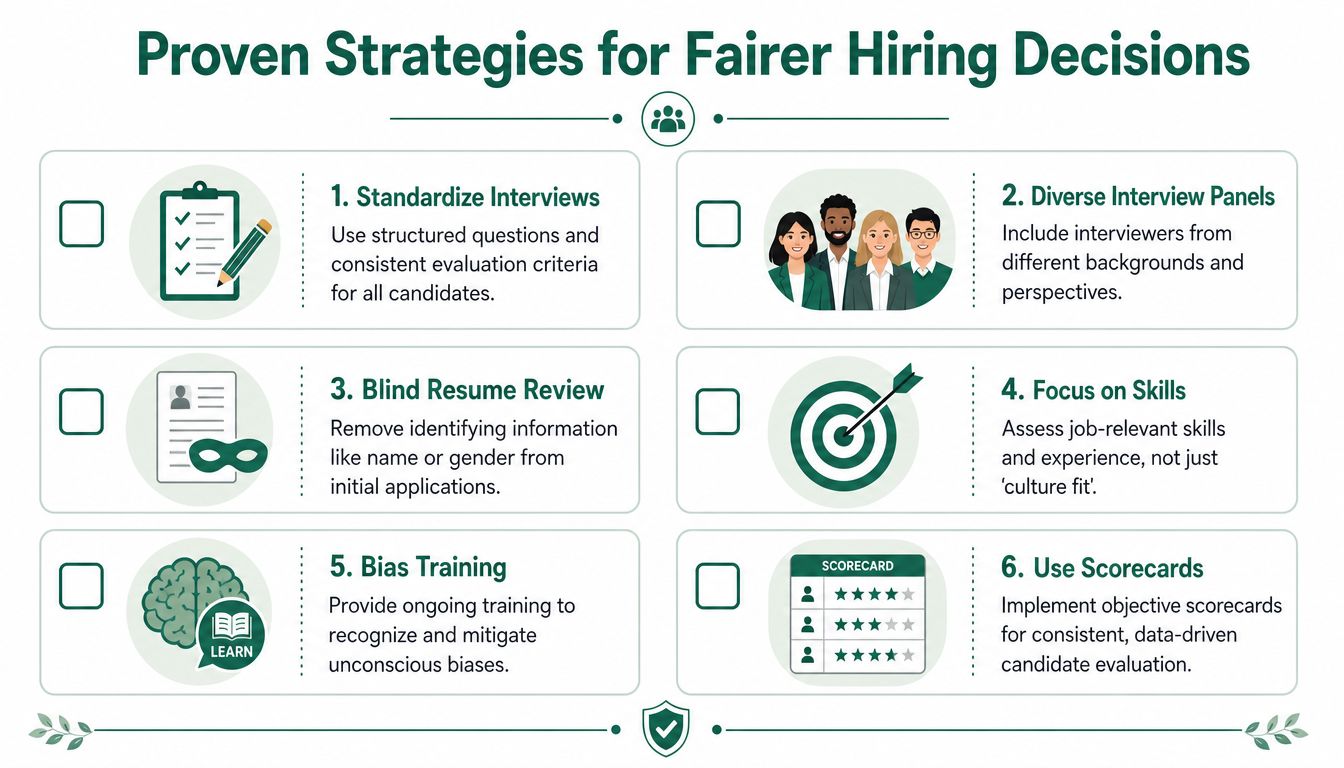
The most reliable intervention is the structured interview. Research shows that structured interviews with pre-defined, behaviorally anchored scoring rubrics are twice as effective as unstructured interviews at predicting job performance and significantly reduce halo, horn, and affinity bias according to this summary of structured interview evidence.
That finding has practical implications. A structured process should include:
This is also where blind review methods help. Removing names and other identifying cues from early screening reduces unnecessary triggers for bias. If you're redesigning the process more broadly, this resource on fair hiring practices is worth reviewing alongside your scorecard and interview design.
Use this short video as a practical reset for interview discipline:
The trade-off is real. Structured interviews can feel less spontaneous. Some managers worry they'll lose rapport or miss intangible signals. In practice, they lose less than they think and gain far more. Better comparability, cleaner notes, stronger auditability, and a process that selects on evidence rather than intuition.
Manual discipline helps, but scale exposes its limits. Once hiring volume increases, consistency usually drops. Reviewers get tired. Questions drift. Notes get thinner. Standards shift by day, interviewer, and workload.
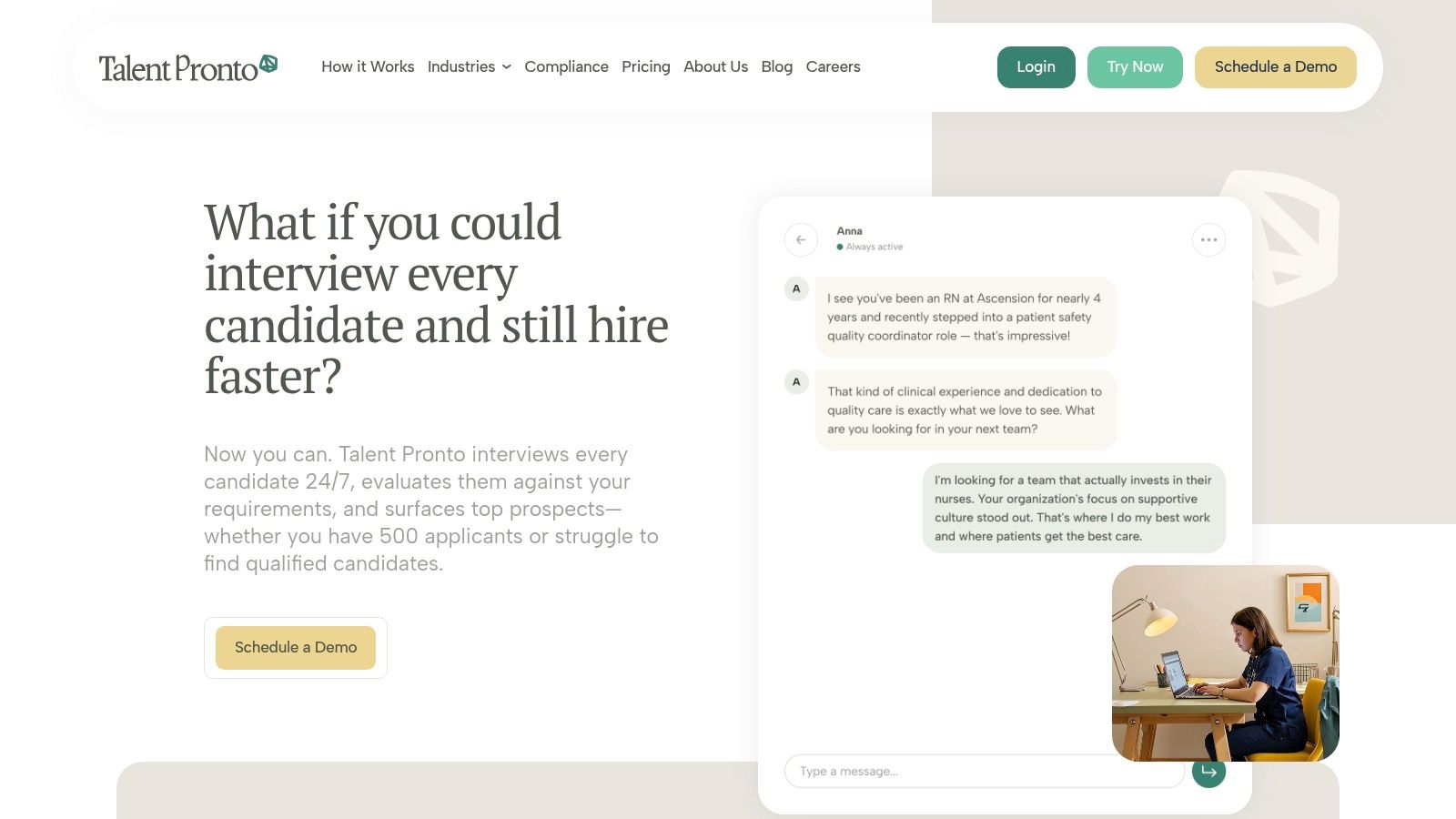
Technology is useful when it operationalizes the same fairness principles HR already knows work. The strongest systems standardize early-stage screening, ask the same role-specific questions in the same order, and produce documented scorecards against preset criteria.
That matters because structured, criteria-based screening using AI agents has been reported to reduce pipeline bias by 50% or more compared to unstructured interviews in this overview of AI-driven structured screening. The value isn't magic. It's repeatability.
A well-configured platform can remove a lot of the noise that human screening introduces:
Technology should handle consistency, documentation, and early evidence gathering. Humans should still define criteria, review context, and make final hiring decisions. That's the right split.
One example is Talent Pronto, which conducts conversational screening, asks behavioral and technical questions, and prepares structured scorecards tied to role-specific criteria. For teams evaluating this category, this explanation of how AI screening reduces bias in hiring outlines where automated consistency can improve fairness in the early funnel.
The caution is straightforward. Technology only helps if employers set clear competencies, audit question design, and avoid treating any ranking as automatic truth. A weak rubric at scale is still a weak rubric. But a strong rubric, applied consistently, is one of the few ways to make fairness repeatable under hiring pressure.
If you want the practical answer to what is interview bias, it's this: bias is the distortion that enters when hiring teams substitute impression for evidence. It's common, often unintentional, and entirely capable of undermining good hiring judgment.
The solution isn't perfection from individual interviewers. It's a process that expects human inconsistency and controls for it. Structured interviews, pre-defined rubrics, blind review where appropriate, disciplined debriefs, and carefully chosen technology all move hiring in that direction.
Trust in hiring comes from consistency. Candidates trust a process when they can see it's deliberate. Managers trust it when scores are comparable. HR trusts it when decisions are documented and defensible.
If your team wants to go further, shifting toward skills-based hiring is often the next logical step. It keeps the focus where it belongs, on what the person can do.
Talent Pronto helps employers turn fair-hiring principles into a repeatable process with conversational screening, structured scorecards, and role-specific evaluation criteria. If you want a more consistent early-stage hiring workflow, explore Talent Pronto.

Talent Pronto is an AI-powered hiring platform built around Anna, our intelligent AI that conducts 24/7 conversational screening, evaluates candidates against specific job requirements and compliance needs, and schedules interviews. Run everything on the Talent Pronto ATS, our all-in-one applicant tracking system with a branded careers site and Anna built in, or keep your existing ATS and let Anna integrate with Greenhouse, Ashby, iCIMS, Jobvite, Lever, Oracle, and more. Either way, we help organizations reduce time-to-hire and build stronger teams.