Ditch degrees & find better talent. Our 2026 guide to skills based hiring shows you how to define, measure, & scale a fairer, more effective hiring process.
85% of companies are using skills-based hiring in 2025, yet 82% of decision-makers lack a reliable, standardized method to evaluate and compare skills at scale according to TestGorilla's hiring data and University of Phoenix's analysis of the visibility gap. This highlights a significant challenge.
The market hasn't stalled because leaders doubt the idea. It stalls because many teams still can't see skills clearly enough to hire on them with confidence. Removing a degree requirement is easy. Building a repeatable process that lets recruiters, hiring managers, and compliance teams evaluate capability the same way is much harder.
That gap shows up every day in hiring rooms. Teams say they want practical talent, but they still lean on resumes when requisitions get urgent. They ask for potential, then shortlist pedigree. They open the funnel, then narrow it again because they don't trust their own evaluation methods. Skills based hiring only works when assessment becomes visible, structured, and operational.
Resumes still help. They show chronology, scope, and the environments where someone has worked. What they do poorly is answer the question hiring teams care about most. Can this person perform in this role, with this manager, under these conditions?
That gap is why so many skills-first efforts stall. The policy changes happen first. Degree screens get loosened, job descriptions get rewritten, and sourcing widens. Then the team reaches the selection stage and falls back on the same artifact it has always used: a document that describes work, but rarely proves capability.
The failure point in skills based hiring is usually not intent. It is visibility.
Many organizations say they hire for skills, but their process still relies on resumes, unstructured interviews, and manager intuition to infer who has those skills. That creates a visibility gap. Teams can name the capabilities they want, yet struggle to observe them consistently across a large candidate pool.
A simple test exposes the issue. If two interviewers review the same candidate evidence and score it very differently, the process is still driven by interpretation rather than shared standards.
The resume makes that problem worse because it rewards presentation quality alongside experience. Candidates who know how to frame outcomes, choose keywords, and mirror executive language often look stronger on paper. Candidates who built skill through military service, apprenticeships, certifications, internal mobility, contract work, or self-directed learning often need a human to connect the dots. Many teams never make that investment early enough in the funnel. In medicine, for example, presentation still matters, but format is not the same as capability. A resource on crafting a doctor's CV is useful because it shows how much hiring still depends on document conventions, even in highly skilled professions.
This is why more talent teams are introducing structured evidence earlier. A resume cannot probe judgment, test reasoning, or hold every candidate to the same prompts. Methods such as conversational screening that reveals what documents can't help teams capture signal before manager bias, pedigree bias, or formatting bias takes over.
Removing degree requirements can widen access, but it does not create a repeatable hiring system on its own.
A working skills-first model needs three things. Clear skill criteria for the role. A structured way to observe those skills. A scorecard that lets recruiters and hiring managers compare evidence with reasonable consistency. Without that infrastructure, teams tend to slide back to familiar shortcuts such as brand-name employers, referrals, polished interview style, or confidence mistaken for competence.
That is the point where the resume stops being the center of hiring. It becomes one input among several, useful for context but no longer trusted as the main proof of ability.
If you were hiring a chef, you wouldn't rely on a diploma alone. You'd want a tasting, a trial, or at least a clear demonstration of technique. Skills based hiring applies the same logic to every role.
It asks a simple question: Can this person show evidence that they can perform the work required? Not someday. Not in theory. In practice.
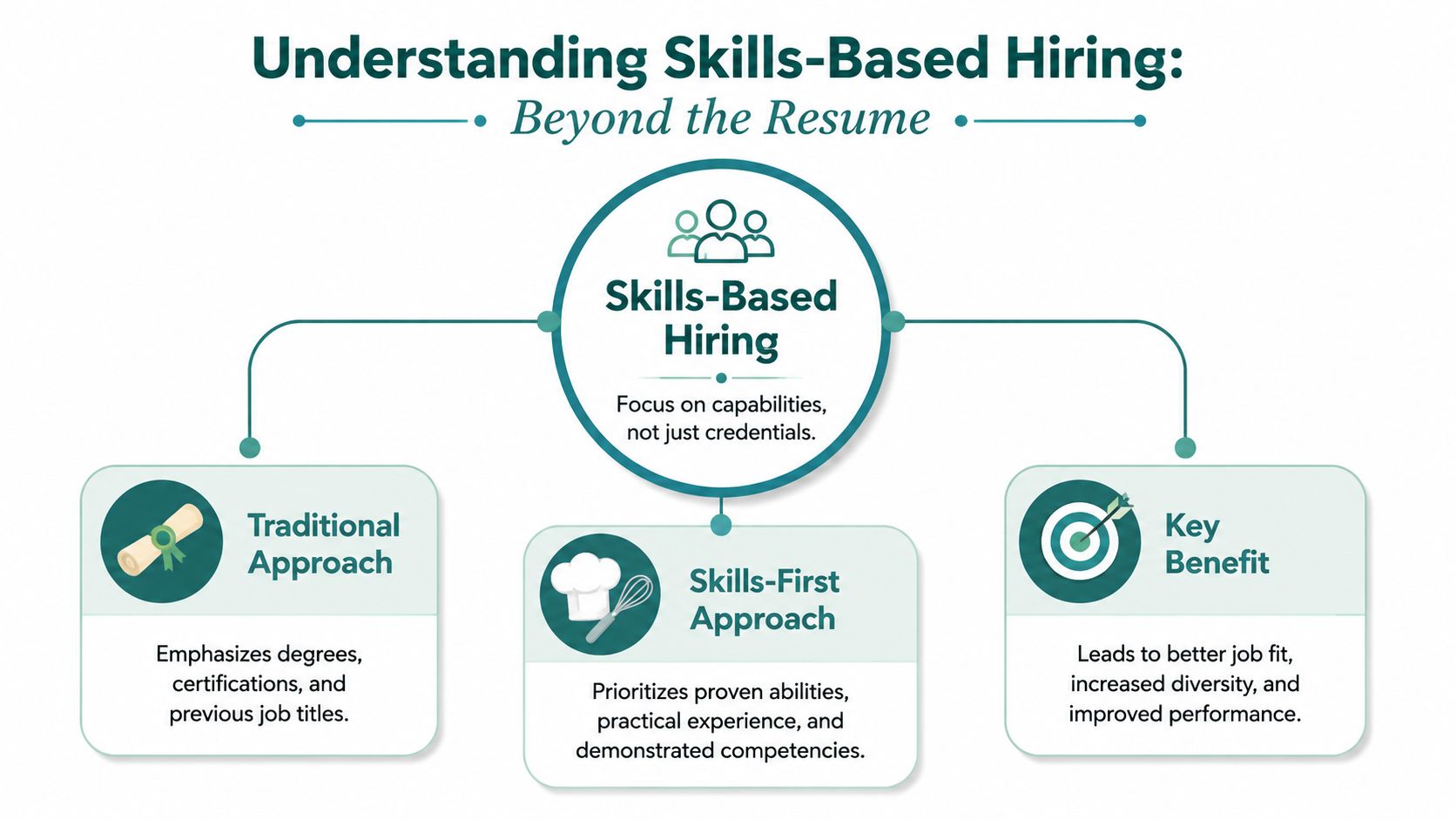
Skills-based hiring is not lowering standards. In strong systems, it raises them because every candidate has to produce observable evidence. A degree may still matter for licensed or regulated work. Previous experience still matters when context is critical. The difference is that neither one should substitute for proof of capability.
Traditional hiring often treats proxies as proof:
A skills-first model shifts the burden of proof:
A good skills-based process defines what success looks like before the first application is reviewed. That means separating essential capabilities from preferences and deciding what evidence counts.
Hiring for skills works when the bar becomes more explicit, not more flexible.
That distinction matters. Many teams say they're hiring for skills when they're really just being less rigid about background. That can widen the top of the funnel, but it doesn't fix evaluation quality. Real skills based hiring creates a line of sight between job requirements, candidate evidence, and selection decisions.
The old model is mostly elimination. Screen out the unconventional. Screen out the unfamiliar. Screen out the person whose resume doesn't read cleanly enough.
The better model is discovery. Find the people who can do the work, even if their path doesn't look conventional.
The shift to skills based hiring is happening for a practical reason. Many companies still cannot reliably see who can do the work. That visibility gap creates slow hiring, weak shortlists, and selection decisions that are hard to defend later.
Top employers are changing the model because resumes and pedigree filters break down in fast-changing roles. A degree can signal foundation. A brand-name employer can signal exposure. Neither gives enough evidence of present-day capability, especially when jobs now blend technical skill, judgment, communication, and tool fluency.
A key advantage is measurement.
Companies that hire well at scale define a smaller set of capabilities that matter in the role, then collect consistent evidence against them. That lets hiring teams compare candidates on the same terms instead of inferring competence from background alone. It also reduces a common failure mode in recruiting. Teams spend weeks generating applicants, then realize too late they still cannot tell who is ready.
Mis-hires usually start upstream. The problem is not effort. It is weak signal.
A resume is fast to scan, but it says very little about how someone prioritizes, handles ambiguity, writes, troubleshoots, or collaborates under pressure. Top companies switch because they want evidence that travels better into performance. Short work samples, job simulations, and structured interview scorecards do more than improve candidate comparison. They make trade-offs visible.
That matters in real hiring meetings. One candidate may be stronger technically. Another may be better with stakeholders and ramp faster. A skills-first process makes those differences explicit, which leads to cleaner decisions and better calibration across recruiters and hiring managers.
Teams using AI in this part of the funnel also need controls. Used well, AI screening can reduce bias in hiring by applying the same criteria consistently, but only if the criteria are job-relevant and audited.
Top companies are not widening the funnel by lowering standards. They are widening it by removing filters that were poor substitutes for skill in the first place.
That opens the door to people who built capability through internal mobility, contract work, military experience, apprenticeships, bootcamps, portfolio projects, or adjacent roles. In technical hiring, this is often the difference between a shallow pipeline and a workable one. Teams that get serious about evidence usually find qualified candidates they would have screened out before, especially when they get more disciplined about evaluating developer soft skills alongside technical ability.
The trade-off is real. Broader access creates more variation in applicant backgrounds, which can overwhelm an unstructured process. The fix is not to retreat to pedigree filters. The fix is to standardize evidence collection early.
Skills based hiring also gives organizations a stronger operating model for fairness, compliance, and hiring manager alignment.
If every candidate completes the same exercise, answers the same core prompts, and gets scored against defined criteria, the team has a record of why someone advanced or did not. That does not remove judgment. It makes judgment easier to review. It also exposes inconsistency faster, whether it comes from an interviewer who scores too loosely or a manager who keeps changing the profile mid-search.
The companies making the biggest gains are not just broadening access. They are building clearer ways to see skill before they make the hire.
That is why leading employers are making the switch. They want a hiring process that can identify capability at scale, not just reward the people who know how to package it on paper.
The move to skills based hiring changes the whole funnel, not just the interview. Sourcing targets shift. Screening becomes more structured. Interviews become more comparative. Final decisions rely less on pedigree and more on evidence.
For many teams, that sounds larger than it is. In practice, you're replacing weak proxies with stronger ones at each step.
Adopting skills-based hiring can expand talent pools globally by 6.1x on average, and up to 15.9x in the U.S. For critical AI roles, this approach increases the talent pipeline by 8.2x, which is 34% higher than the increase for non-AI jobs, according to LinkedIn's skills-based hiring report.
| Hiring Stage | Traditional Approach (Credential-Based) | Modern Approach (Skills-Based) |
|---|---|---|
| Sourcing | Target specific schools, employers, and linear backgrounds | Source from certification programs, skills communities, apprenticeships, returnship networks, and adjacent industries |
| Screening | Review resumes for titles, degrees, and years of experience | Use role-specific questions, work samples, and structured pre-screen criteria |
| Interviewing | Ask broad questions and rely on chemistry | Use consistent scenarios, scorecards, and evidence tied to job requirements |
| Selection | Choose the “best overall fit” based on discussion | Compare candidate evidence against defined must-have skills and proficiency expectations |
The earliest shift usually happens in screening. Once recruiters stop treating resumes as the primary gate, they need another way to identify viable candidates at scale. That's where structured questions, practical tasks, and consistent scorecards make the process manageable.
Soft skills need the same rigor. Teams often say they value communication, collaboration, and judgment, then assess them informally. That's unreliable. Frameworks for evaluating developer soft skills are a good reminder that interpersonal capability also needs observable criteria.
A second shift happens in interviewer behavior. Interviewers can't improvise their way through a fair comparison. They need defined prompts, anchored scoring, and a shared understanding of what good looks like. That's one reason many teams are rethinking how AI screening reduces bias in hiring when it's paired with structured criteria rather than vague automation.
Some habits actively undermine a skills-first model:
That's why process design matters more than policy language.
Most hiring teams don't fail because they reject the concept. They fail because they skip the operating model. A durable skills based hiring system usually comes down to three disciplines: define, assess, and validate.
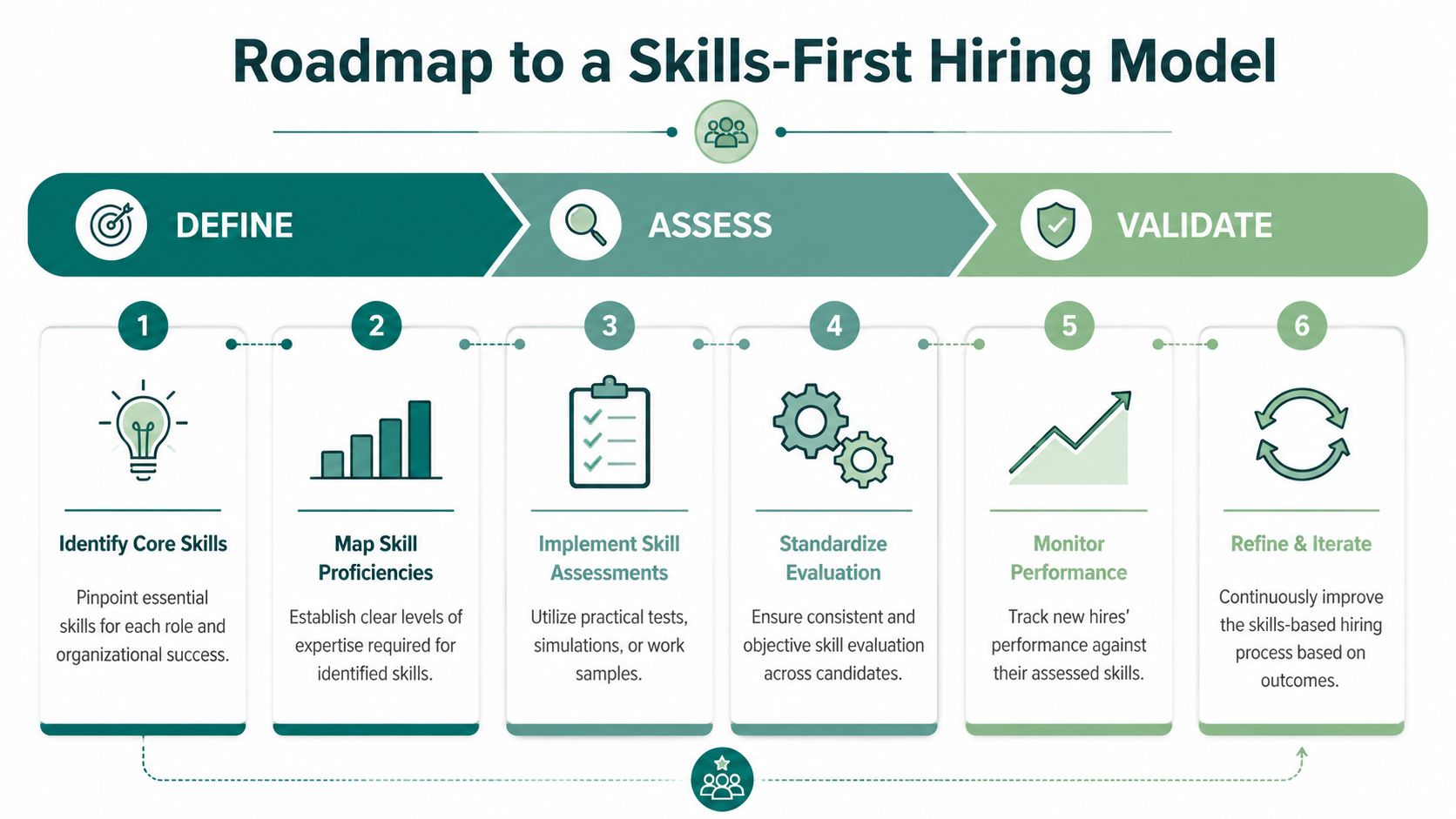
Start with the job, not the candidate profile. Ask the hiring manager what someone must be able to do in the first months of success. Push past generic phrases like “strong communicator” or “strategic thinker.” Those labels are too broad to score fairly.
Turn the role into a short list of essential capabilities. Then separate them from nice-to-have preferences. Many processes get cleaner immediately as a result. A manager may want industry experience, a certain degree, and experience with specific tools, but the role may require only a handful of essential competencies to perform well.
A useful definition stage usually includes:
Once the role is defined, assessment has to match the work. A customer-facing role may need role-play. An analyst may need a case exercise. A supervisor may need behavioral prompts tied to conflict handling, prioritization, and judgment.
The challenge is standardization. While skills-based hiring can raise standards, organizations must address the challenge of defining skills consistently without creating new barriers. Data shows non-degreed hires have a 10-percentage point higher two-year retention rate, but success depends on standardized skill frameworks and structured scorecards to ensure fair, comparable assessments, as noted in this discussion of the standardization paradox.
Don't replace one proxy with another. If your rubric becomes so rigid that it excludes capable people who demonstrate the skill differently, you've rebuilt credentialism in a new form.
Good assessment design stays close to the work and avoids unnecessary barriers. That means short, relevant exercises. It means scoring observable behavior rather than charisma. It means giving interviewers anchors for what strong, acceptable, and weak evidence looks like.
A hiring process isn't finished when the offer is accepted. It needs feedback from actual outcomes.
Look back at new hires after onboarding and once they've had time in role. Did the assessment predict performance? Did some criteria prove irrelevant? Were some exercises screening out people who later would have succeeded? Validation is what turns a one-time hiring redesign into an organizational capability.
Use a simple review cycle:
Teams that do this well treat rubrics as living tools. Stable enough to be fair. Flexible enough to improve.
General advice only gets you so far. Skills based hiring becomes real when you can see what assessment looks like in an actual role.
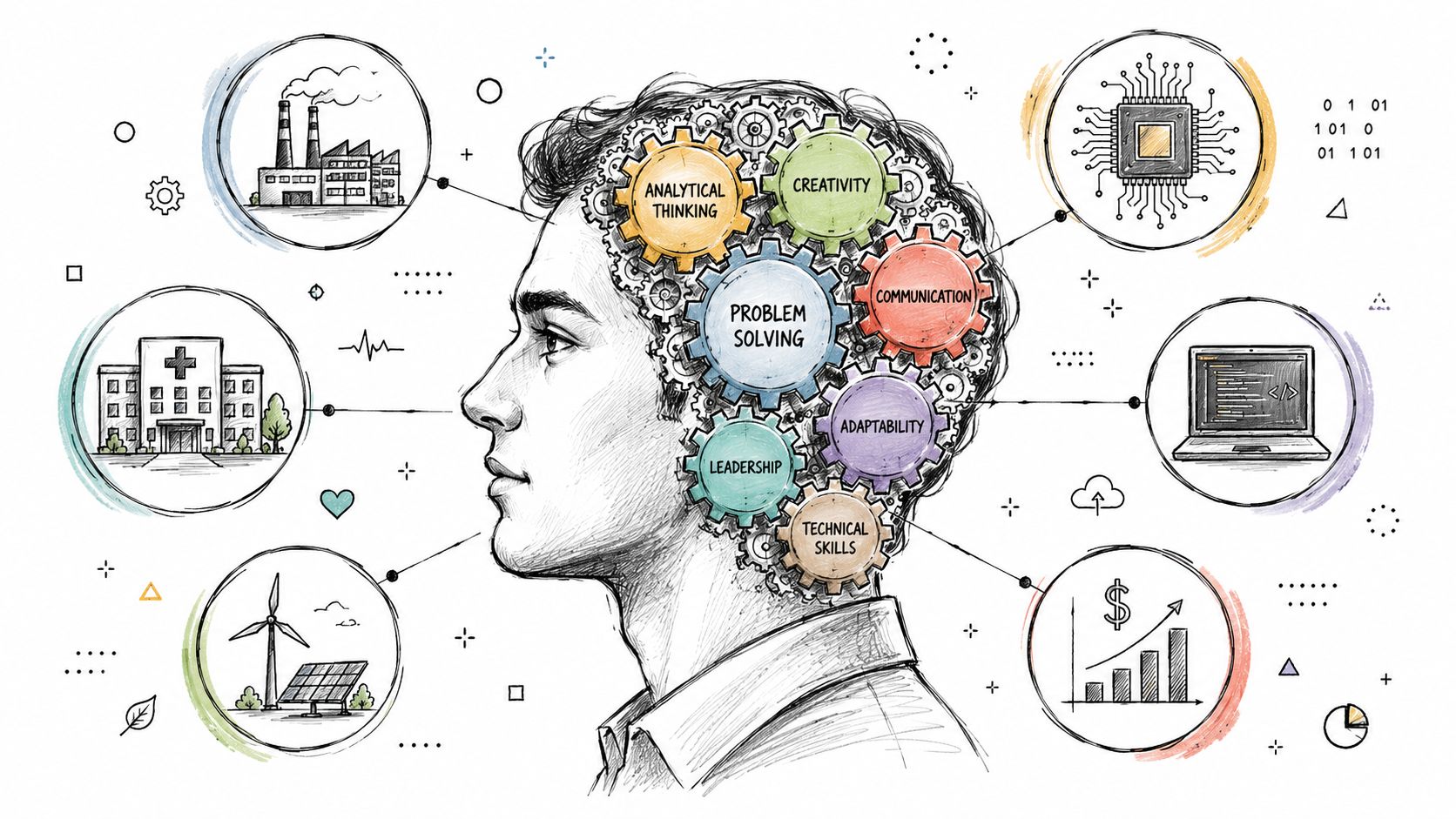
For maximum efficacy, organizations must define the minimum viable skill set for each role by separating 'must-have' competencies from 'nice-to-have' additions and explicitly assess both technical and soft skills, such as evaluating communication via role-play, according to this guide to skills-based hiring best practices.
A nurse manager role may require patient communication, prioritization, and escalation judgment. Instead of relying on tenure alone, the team can use a patient handoff scenario and score clarity, empathy, risk recognition, and next-step decisions. A candidate's explanation often reveals more than a resume line about years in acute care.
A welder or production technician assessment should look like work, not trivia. The strongest process uses a practical test, safety observation, and a few scenario questions about tolerances, defects, or equipment issues. That exposes precision, consistency, and rule adherence quickly.
For a front desk manager, the must-haves usually include service recovery, composure, and team coordination. A role-play involving an upset guest and a staffing shortfall lets interviewers watch tone, prioritization, and judgment in real time.
The best assessment for a role usually feels like a compressed version of the job itself.
A project coordinator in a public-sector environment often needs stakeholder communication, documentation discipline, and policy awareness. A situational exercise can ask the candidate to respond to shifting deadlines, conflicting inputs, and reporting requirements. The scoring should reward clarity, process discipline, and sound escalation choices.
A software engineer doesn't always need a long take-home project. Sometimes a scoped coding task, code review discussion, and structured questions about tradeoffs reveal enough. The same goes for product, support, and implementation roles. The task should mirror the job, not test for prestige.
Across industries, the pattern is the same. Define the critical skills, create evidence opportunities, and score what the candidate demonstrates.
The biggest obstacle in skills based hiring isn't knowing what good looks like. It's doing it consistently across volume, locations, and hiring teams.
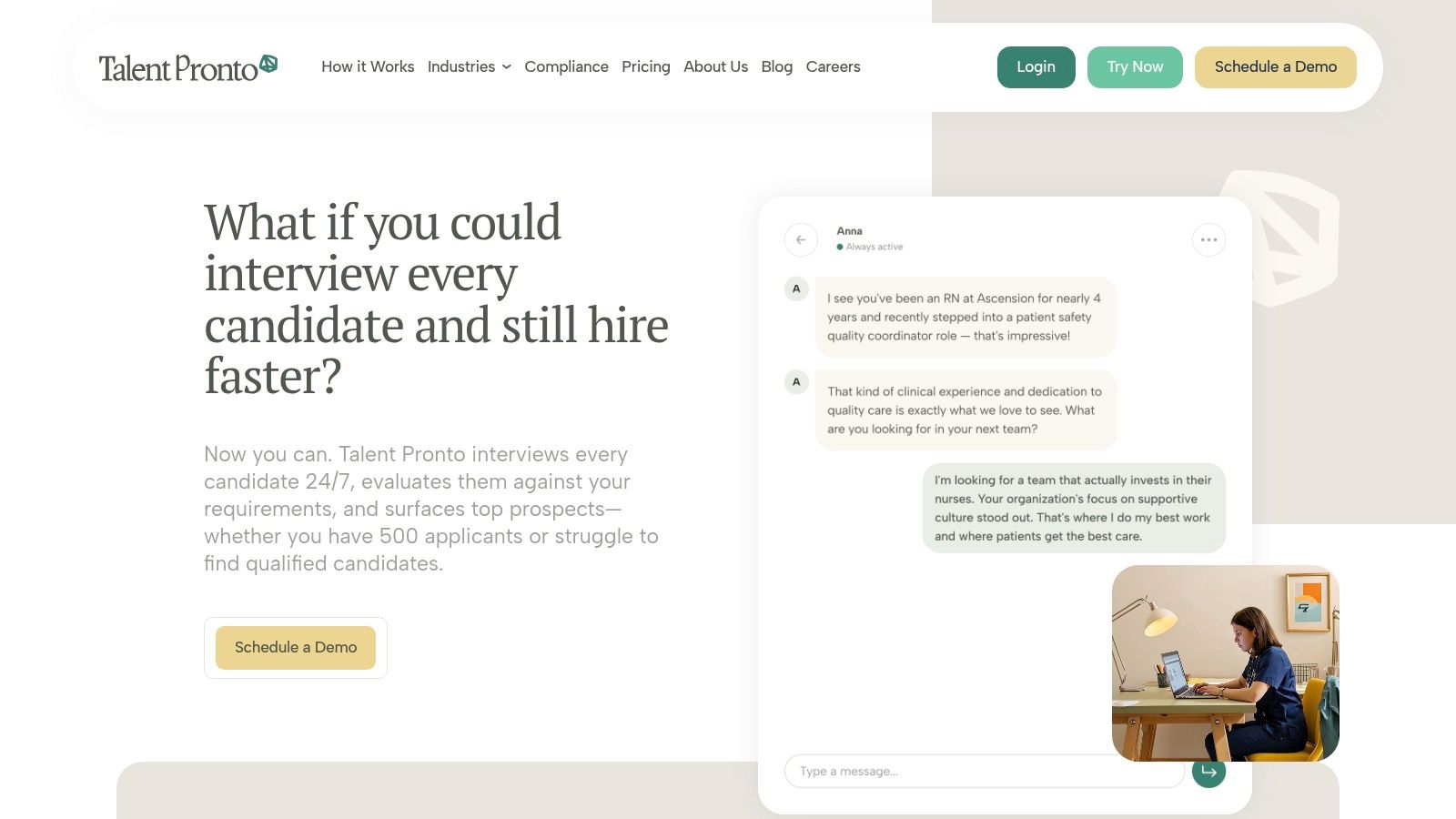
Technology helps when it solves two specific problems. First, it makes skill signals more visible earlier in the funnel. Second, it makes evaluation more consistent across candidates. That's why many teams are moving beyond form-fill bots toward conversational screening, structured scorecards, and role-specific workflows. Broader discussions of strategic recruitment AI solutions are useful here because the point isn't automation for its own sake. It's operational discipline.
Useful systems support recruiters instead of replacing judgment. They should ask relevant questions, collect comparable candidate evidence, and organize responses in a way that hiring teams can review quickly. They should also fit the rest of the stack instead of creating another manual process. For staffing and employer teams evaluating platforms, it helps to study how recruiting software for staffing firms handles workflow, coordination, and early-stage screening consistency.
A scalable setup usually includes:
Video can help teams visualize that operating model in practice:
The key point is simple. Skills based hiring only scales when the process can capture, compare, and document evidence without overloading recruiters or frustrating candidates.
Talent Pronto helps employers operationalize skills based hiring with conversational screening, role-specific questions, and structured scorecards that make candidate comparisons clearer and faster. If you want a practical way to evaluate every applicant more consistently, explore Talent Pronto.

Talent Pronto is an AI-powered hiring platform built around Anna, our intelligent AI that conducts 24/7 conversational screening, evaluates candidates against specific job requirements and compliance needs, and schedules interviews. Run everything on the Talent Pronto ATS, our all-in-one applicant tracking system with a branded careers site and Anna built in, or keep your existing ATS and let Anna integrate with Greenhouse, Ashby, iCIMS, Jobvite, Lever, Oracle, and more. Either way, we help organizations reduce time-to-hire and build stronger teams.