Learn how to master sourcing passive candidates. Our guide covers channels, advanced search, outreach, and automation to help you find and hire top talent.
About 70% of the global workforce is made up of passive candidates, people who aren't applying but would consider the right opportunity if someone reaches them well (Toggl). That single fact changes how a strong talent team should operate. If your hiring motion starts and ends with posting jobs, you're fishing in the smallest, noisiest part of the market.
The old playbook for sourcing passive candidates was simple. Search LinkedIn, send a batch of InMails, hope a few people reply, then manually chase follow-ups. It still works sometimes. It just doesn't scale well, and it breaks down the moment response timing, screening volume, or recruiter bandwidth becomes the bottleneck.
The better model is a system. You still need recruiter judgment. You still need sharp targeting and credible outreach. But once a passive candidate shows interest, the handoff into structured, fast, conversational screening matters just as much as the original message.
A large share of the workforce is not actively applying at any given time. That alone changes how strong hiring teams build their system. Passive sourcing is not a side channel for hard roles. It is a core route to quality hires.
The best people for many roles are already employed, performing well, and screening out weak recruiter outreach on instinct. They will still engage, but only if the message is specific, the opportunity is credible, and the process feels worth their time. That raises the bar in a useful way. It forces recruiting teams to get sharper on targeting, positioning, and speed.
Passive talent rewards relevance, speed, and credibility.
It also exposes process problems quickly. If outreach is generic, reply rates drop. If screening takes a week, interest fades. If the first call feels like a repeat of the job description, trust disappears. Passive candidates are less forgiving because they have less reason to stay in the funnel.
The teams that win here do not wait for a req to open and then start searching from scratch. They build market coverage early, keep warm talent communities, and use systems that can re-engage people without turning every touchpoint into manual work. If your team is rethinking how specialized talent gets identified and engaged, an AI talent placement agency can be a useful reference point for how modern sourcing models are changing beyond job boards.
That shift is operational, not just strategic. Recruiters need pipeline thinking. Hiring managers need to treat passive candidates like a relationship sale, not an application workflow. AI now plays a practical role here. Strong teams use it to enrich profiles, prioritize outreach, run conversational screening, and route interested people into the right next step faster. The goal is not to automate away judgment. The goal is to remove low-value delay so recruiters can spend time where human context still matters.
A disciplined passive sourcing engine creates three advantages:
This is why strong talent pipeline management matters so much. Teams with an active pipeline usually hire with less panic, fewer rushed decisions, and better candidate experience.
What fails is easy to spot. Recruiters send mass outbound, call it sourcing, and measure effort by send volume. That does not produce a durable passive funnel. A real passive strategy consistently identifies the right people, earns genuine replies, qualifies interest quickly, and moves candidates into a structured next step without losing momentum.
The fastest way to waste recruiter time is to open LinkedIn Recruiter before you've decided what you're hunting. Good sourcing starts with a map. Bad sourcing starts with filters.
A job description tells you what the business wants filled. A sourcing profile tells you where to find a likely hire.
Build the profile around five things: core skills, likely career path, target employers, workable locations, and essential requirements. The useful version is specific. “Backend engineer” is not a sourcing profile. “Backend engineer who has worked in API-heavy environments, has moved from mid-size SaaS into platform teams, and is likely sitting at a competitor or adjacent product company” is.
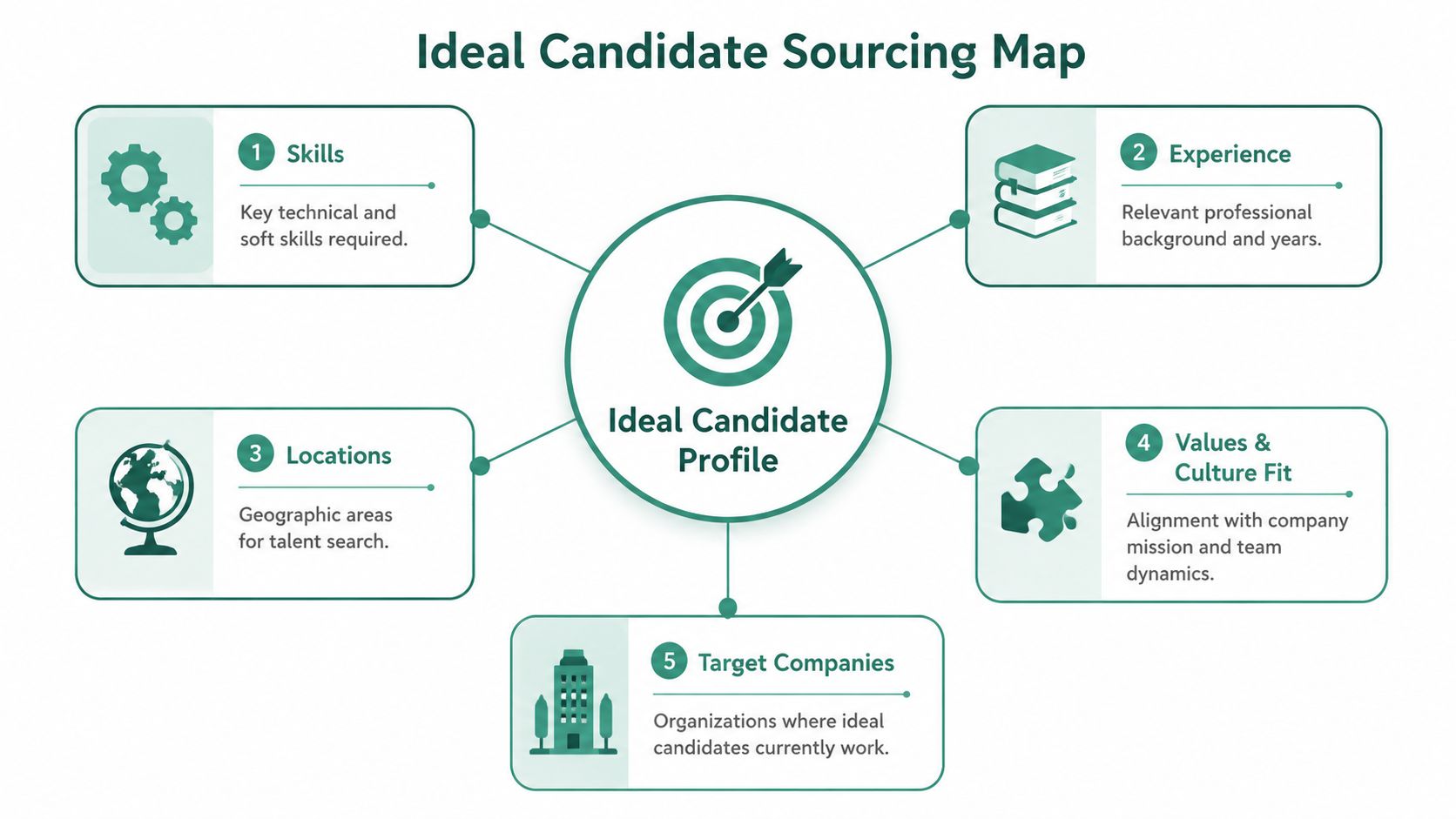
A strong profile also includes what to avoid. Too many recruiters build broad searches, then spend hours manually disqualifying people who were predictable misses from the start. If a role requires regulated-industry experience, customer-facing credibility, or night-shift flexibility, put that into the map before you search.
Not every market lives on LinkedIn in the same way. The channel should follow the talent, not the habit of the recruiter.
A simple mapping approach works well:
| Candidate signal | Best place to start | Why it matters |
|---|---|---|
| Clear corporate career path | LinkedIn Recruiter | Titles, employers, tenure, and movement are easier to inspect |
| Technical proof of work | GitHub or engineering communities | Code, contribution patterns, and specialization show up better than resumes |
| Creative output | Dribbble, Behance, portfolio sites | You can judge quality from real work, not bullet points |
| Local operational talent | Referrals and local networks | Community trust often beats cold outreach |
| Previously engaged talent | ATS and CRM | They already know your brand and process |
The most underused passive talent pool is the one you already paid to attract. Teams forget how much value sits in “almost” candidates, previous finalists, past applicants who were strong but mistimed, and people who engaged with your brand before the right role existed.
That matters because campaigns targeting past applicants, often called silver medalists, can yield 2–3x higher response rates than cold outreach to unknown passive candidates (AIHR). If you're serious about sourcing passive candidates, your ATS isn't just an archive. It's a reactivation engine.
Practical rule: Before any recruiter sources externally, require one pass through recent finalists, qualified declines, and high-signal past applicants.
A useful sourcing map usually includes:
The payoff is focus. Instead of generating a giant list and hoping relevance appears later, your team starts with a shortlist that has logic behind it.
Most recruiters don't need more results. They need better ones. The difference usually comes down to search logic.

Boolean search is still one of the most practical skills in sourcing because it forces precision. The goal isn't to pile up synonyms until you get thousands of profiles. It's to define the overlap that actually matters.
A few patterns that work:
("product manager" OR "senior product manager") AND (B2B OR SaaS) AND (platform OR APIs)
("maintenance supervisor" OR "plant supervisor") AND (manufacturing OR logistics) AND ("continuous improvement" OR lean)
("registered nurse" OR RN) AND ICU AND ("charge nurse" OR preceptor) NOT travel NOT recruiter
The best searches usually combine three layers: role identity, evidence of specialization, and one exclusion layer to strip out nearby but irrelevant profiles.
Platform search isn't always enough. X-Ray searching helps when you want public profile pages indexed by search engines, especially if you're working outside a paid tool or chasing niche footprints.
Try these formats in Google:
site:linkedin.com/in/ ("data engineer" OR "analytics engineer") "snowflake" "dbt" "healthcare"
site:github.com "machine learning engineer" "pytorch" "computer vision"
site:behance.net "brand designer" fintech
The logic matters more than the exact string. Start with the role, add the evidence you need, then add context like industry, tools, or geography.
A good walkthrough of search mechanics and candidate discovery is embedded below.
Many sourcing projects often drift off course. Keywords tell you what a person claims. Evidence tells you what they've likely done.
Look for things like:
Good sourcing profiles are built from proof. Bad ones are built from title matching.
I also like to save searches in layers. One wide search for market coverage, one narrower search for immediate outreach, and one stretch search for unconventional backgrounds. That gives recruiters options without mixing every candidate type into one messy bucket.
Passive candidates ignore vague recruiter messages because vague messages create work. They have to infer the role, guess the compensation, decide whether you're credible, and determine if the opportunity is even in the right range. Most won't bother.
The typical message has three problems. It's generic, it's self-centered, and it hides the one detail many passive candidates care about first.
Compensation transparency is the clearest example. Data shows that 71% of passive candidates prioritize salary information in their first recruiter interaction, and response rates increase by 45% when compensation is disclosed upfront (Reddit recruiting discussion). Recruiters often avoid that detail because they were taught to “sell the story” first. For passive talent, that usually backfires.
A strong outreach message earns a reply because it answers the candidate's unspoken filter questions fast.
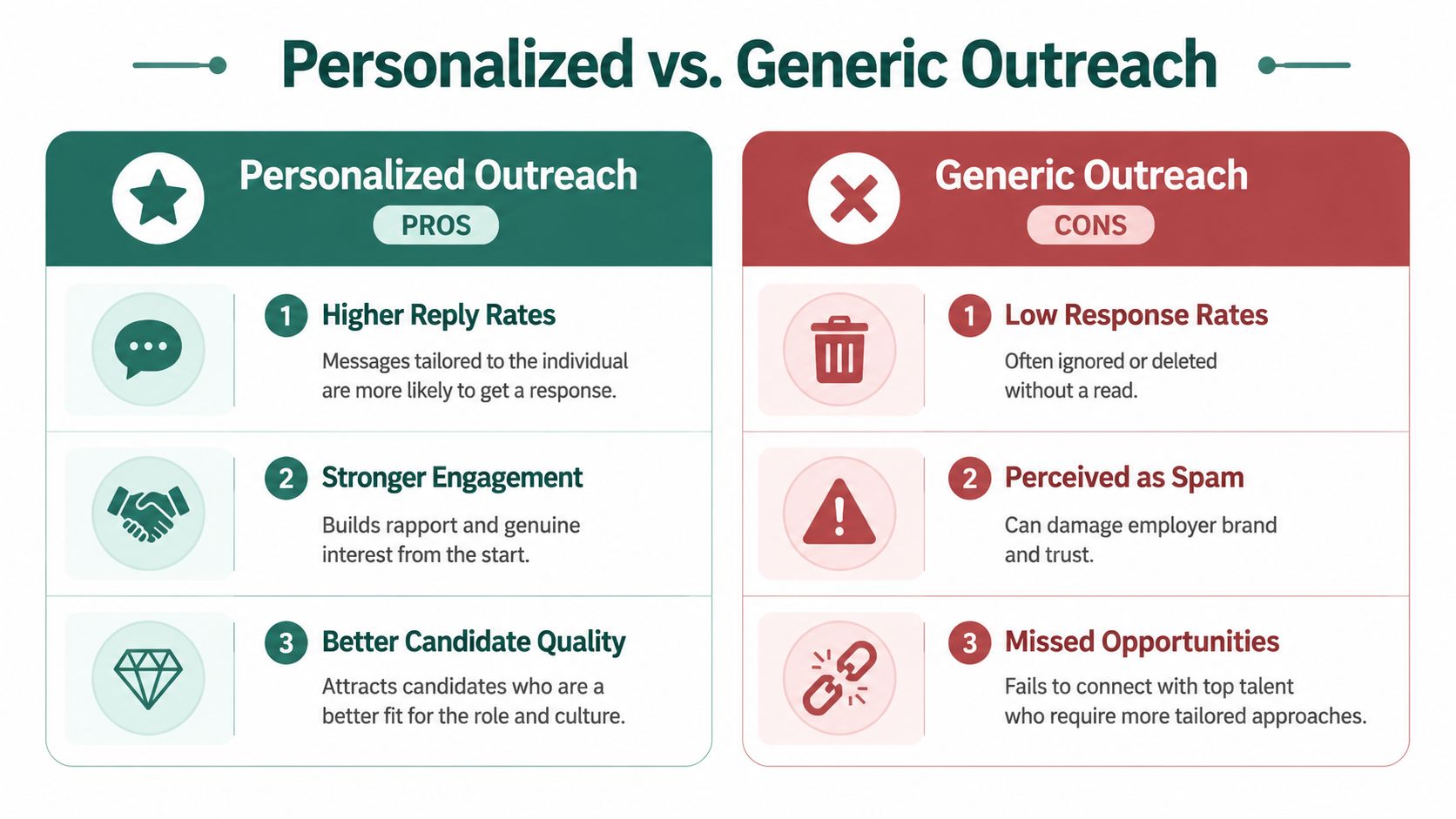
The best version is usually short and built from four parts:
If your team is tuning subject lines as part of outbound testing, this guide on email subject line capitalization is a helpful operational reference. Small details in recruiter email craft can affect whether a solid message even gets opened.
Here's the contrast in practical terms:
| Approach | What it sounds like | Likely outcome |
|---|---|---|
| Generic | “I have an exciting role at a fast-growing company. Would love to connect.” | Easy to ignore |
| Personalized | “Your move from plant operations into CI leadership stood out. I'm working on a role with direct influence over multi-site process improvement, and I can share the compensation range upfront if useful.” | Feels relevant and respectful |
If the candidate has to ask basic qualifying questions in reply one, your initial message wasn't finished.
A few outreach habits consistently help:
The biggest mistake is pretending personalization means adding a first name and one profile detail to a canned script. Real personalization means the message couldn't have been sent to ten other people unchanged.
Passive sourcing breaks down in the gap between interest and action. A strong candidate replies outside business hours, asks two reasonable questions, and then waits. If the next step depends on recruiter availability, momentum slips.
Automation works best in that gap. The goal is not to automate sourcing end to end. The goal is to remove delay after a candidate shows intent, while keeping recruiter judgment in the parts that affect fit, motivation, and close rate.
Conversational screening changes the operating model at that point. Instead of sending a form, trading emails, or forcing a recruiter callback, the candidate moves into a guided screening flow that captures required experience, deal-breakers, timing, and interest level in one sitting.
The performance difference is material. Conversational AI can lift candidate response rates from a baseline of 15% for traditional email to an average of 45%, a 3x increase, while cutting routine outreach tasks by up to 60% (Cadient Talent).
What it fixes is operational, not theoretical. Passive outreach usually slows down because recruiters cannot reply instantly at scale, candidates do not want to complete a full application yet, and basic qualification gets stretched across multiple messages. Conversational screening handles those moments well, especially in frontline, healthcare, field, manufacturing, and shift-based hiring where short windows of attention matter.
A good workflow should do four things fast. Respond immediately, ask only the questions that matter, answer common candidate questions consistently, and route qualified people to scheduling without recruiter back-and-forth.
| Stage | Manual process | Automated conversational process |
|---|---|---|
| Initial response | Wait for recruiter follow-up | Candidate gets immediate engagement |
| Qualification | Recruiter asks screening questions one by one | Structured role-specific questions appear instantly |
| Candidate FAQs | Recruiter repeats benefit and process info | Candidate gets consistent answers based on employer inputs |
| Scheduling | Email chain or calendar chase | Qualified candidates move into booking flow |
The trade-off is straightforward. Automation increases speed and consistency, but bad setup creates a colder experience than a well-run recruiter inbox. If the questions are generic, too long, or badly sequenced, completion drops and good candidates bail out. The fix is disciplined design, not more volume.
Use automation for repeatable work:
Keep recruiters in the moments that need judgment:
That split scales well because it reflects how strong recruiting teams already operate. Recruiters should spend time on persuasion, calibration, and closing. Software should handle speed, consistency, and admin.
For HR leaders setting this up across process, governance, and adoption, this practical framework for implementing AI tools in recruiting teams is a useful reference. The same operating principle shows up outside hiring too. This practical guide for sales teams is worth a look because prospecting and passive sourcing share the same core problem: fast follow-up, smart qualification, and enough automation to scale without making the interaction feel scripted.
A passive sourcing motion gets expensive when teams confuse activity with progress. Sent messages are not the metric. Search volume is not the metric. Even response rate alone can be misleading if the replies are unqualified or badly matched.
The most useful passive sourcing dashboard is small and operational. I would track:
Those metrics tell you where the engine breaks. If response is strong but qualification is weak, your targeting is off. If replies are decent but screen completion drops, your handoff is clunky. If qualified candidates aren't converting, the issue may sit with hiring manager calibration or interview speed.
Passive talent often converts on a slower clock than active applicants. Teams that only measure near-term fill speed miss that entirely.
Evidence shows that 68% of top-tier passive talent joined companies only after being nurtured in talent communities for 6–12 months without immediate openings (HootRecruit). That means your CRM, alumni lists, and silver-medalist pools need their own success measures. Not every strong passive candidate should be pushed into an immediate requisition. Some should be cultivated until the timing is right.
This is one reason talent leaders can learn from adjacent go-to-market disciplines. Sales teams have long treated nurture, routing, qualification, and timely follow-up as system design problems. This practical guide for sales teams is useful because the operating logic transfers well to candidate outreach, even though the context is different.
Passive hiring can become highly subjective if every recruiter screens differently and every manager improvises what “good” looks like. That's where structured process matters.
Use standardized screening questions, clear rubrics, and documented criteria for early-stage evaluation. That doesn't remove human judgment. It makes judgment comparable. It also creates a cleaner audit trail when someone asks why one candidate advanced and another didn't.
For teams formalizing that side of the process, these fair hiring practices are a solid reference point.
The simplest bias check is operational: ask whether every candidate for the same role gets the same core questions, the same evaluation framework, and the same threshold for moving forward. If the answer is no, your process is still relying too heavily on instinct.
Talent teams that want faster follow-up, structured conversational screening, and role-specific candidate ranking can explore Talent Pronto. It helps employers engage applicants at any hour, capture consistent scorecards, and keep early-stage hiring moving without adding recruiter admin.

Talent Pronto is an AI-powered hiring platform built around Anna, our intelligent AI that conducts 24/7 conversational screening, evaluates candidates against specific job requirements and compliance needs, and schedules interviews. Run everything on the Talent Pronto ATS, our all-in-one applicant tracking system with a branded careers site and Anna built in, or keep your existing ATS and let Anna integrate with Greenhouse, Ashby, iCIMS, Jobvite, Lever, Oracle, and more. Either way, we help organizations reduce time-to-hire and build stronger teams.