First-party data from a 60-day pilot shows candidates rated AI screening 4.7 out of 5 and most preferred it to a normal interview. Here is why, and what it means for hiring teams.
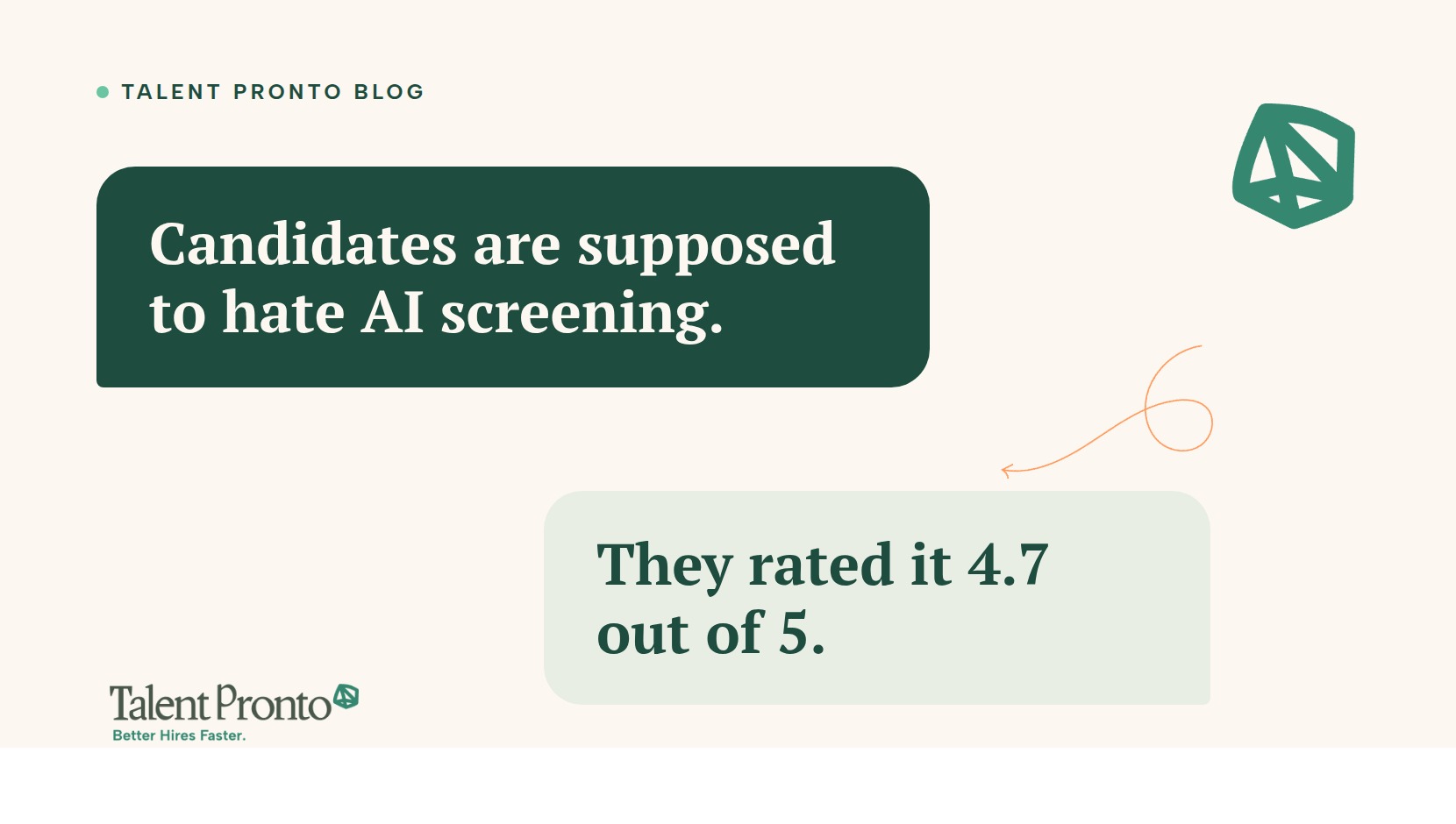
The received wisdom about AI in hiring is that candidates hate it. That every screening bot feels like a wall between a real person and a real job, and that anyone with options will resent being handed to a machine.
We had the chance to test that assumption against real data, not opinion. Over a recent 60-day pilot, a multi-role employer ran every applicant for four roles (frontline service, sales, technical, and managerial) through conversational AI screening with our assistant, Anna. At the end, we surveyed the candidates who went through it.
The result did not match the received wisdom. It contradicted it.
Across 328 candidates surveyed after their screen:
Those are not the numbers of a group tolerating an obstacle. They are the numbers of a group that preferred this to the alternative. And the alternative (a recruiter phone screen, a scheduling back-and-forth, a live first-round interview) is the thing the industry has spent decades treating as the candidate-friendly option.
So we looked harder at why. The open-ended feedback pointed to three things, and none of them were about the technology being clever.
The most common theme had nothing to do with AI at all. It was about pressure.
"I was able to fully think about my response before just saying the first thing that came to mind."
"I felt so at ease. I'm a terrible in-person interviewer."
A live interview measures two things at once: whether you can do the job, and whether you can perform under time pressure in front of a stranger. For most roles, only the first one matters. The second is noise, and it is noise that penalizes the nervous, the introverted, and the people who are simply better on reflection than on reflex.
An asynchronous, conversational screen removes that second test. Candidates answer in their own words, at their own pace, without a person watching the clock. What you lose is the theater of the live interview. What you gain is a cleaner read on whether someone can actually do the work.
This is the part worth sitting with: the format candidates found less stressful is also the format that arguably measures the job more fairly. Those are usually thought of as a trade-off. Here they moved in the same direction.
The second theme was access. The best candidates are usually already employed, which means the worst time to ask them to talk is during business hours.
"I received the email at 10:00pm and completed the screening before midnight."
A screen that is available whenever the candidate is free removes the single most tedious step in early hiring: finding a time. No phone tag, no calendar links, no "does Thursday work." The people most likely to benefit are exactly the ones you most want: employed, in demand, and unwilling to burn a lunch break on a first-round call for a job they are not yet sure about.
Candidates repeatedly described the experience as natural and low-pressure rather than mechanical. That distinction matters. A knockout questionnaire with a chat skin is still a form, and candidates can tell. A genuine back-and-forth, where the follow-up depends on what you just said, reads as someone paying attention.
The low-pressure, conversational framing is what let the first two benefits land. Time to think only helps if the questions feel worth thinking about. Availability only helps if the thing available is not a chore.
The clearest area for improvement came from the same surveys, and it is revealing.
"Overall a wonderful experience. I wish Anna was able to answer more of my questions."
Candidates did not want less of the assistant. They wanted more. Specifically, they wanted it to answer their questions about the role and the company, not just ask its own. That is the opposite of the "get me to a human" complaint the industry expects. When the screening experience is good, candidates start treating it as their first real conversation with the employer, and they expect it to be a two-way one.
That is a useful signal for anyone deploying AI in hiring. The bar is not "tolerable." Once the experience clears a certain quality line, candidates raise their expectations, and the next thing they want is information flowing back to them.
Three takeaways, in order of how much they should change your thinking:
"Candidates hate AI screening" is not supported by candidates. When the experience is asynchronous, conversational, and low-pressure, most candidates in this pilot preferred it to a normal interview. If your objection to AI screening is candidate experience, the burden of proof has shifted.
The benefit is fairness, not just speed. Vendors sell time saved. Candidates valued something else: the removal of live-interview pressure that has little to do with job performance. Async screening surfaces people who are good at the work and bad at the audition. That is a better funnel, not just a faster one.
A good experience raises expectations. Candidates who liked the screen immediately wanted it to tell them more about the job. Treat the screen as the start of a two-way relationship, not a gate.
None of this argues for removing humans from hiring. The pilot kept a person in the loop on every decision. It argues for being honest about what the traditional first round actually measures, and noticing that the candidates going through it have been quietly telling us they would prefer something better.
We built Anna to be that something better. The data, for once, is on the candidates' side.

Talent Pronto is an AI-powered hiring platform built around Anna, our intelligent AI that conducts 24/7 conversational screening, evaluates candidates against specific job requirements and compliance needs, and schedules interviews. Run everything on the Talent Pronto ATS, our all-in-one applicant tracking system with a branded careers site and Anna built in, or keep your existing ATS and let Anna integrate with Greenhouse, Ashby, iCIMS, Jobvite, Lever, Oracle, and more. Either way, we help organizations reduce time-to-hire and build stronger teams.