Learn the essentials of fair hiring practices, from legal compliance to actionable strategies. Build an equitable, high-performing workforce with our guide.
A hiring manager has a stack of resumes open, a department head asking why the role still isn't filled, and just enough self-awareness to know that “I'll know the right person when I see them” isn't a process. It's a risk.
That scene plays out every day. A recruiter screens quickly, a manager improvises interview questions, someone gets labeled “polished,” someone else gets labeled “not a fit,” and the team moves on without a clear record of why one candidate advanced and another didn't. When that happens, bias doesn't have to be intentional to shape the outcome. It only has to go unchecked.
That's why fair hiring practices matter now in a way they didn't a decade ago. They aren't just an HR policy topic or a legal footnote. They're an operating discipline. If you want a stronger pipeline, more defensible decisions, and a hiring process that scales beyond the instincts of a few busy managers, fairness has to be designed into the workflow.
The practical challenge is where most organizations get stuck. Leaders usually agree with the principle. They want structured interviews, consistent evaluations, and better documentation. Then real life intervenes. High applicant volume, fragmented systems, rushed interviews, and uneven manager training pull the process back toward habit and improvisation.
The fix isn't abstract. It's operational. Fair hiring works when job criteria are defined early, screening is standardized, decisions are documented, and the process is auditable. Technology can help enforce those rules, but only if the underlying hiring design is sound.
Gut-feeling hiring survives because it's fast, familiar, and easy to defend in the moment. A manager walks out of an interview and says, “I just don't think they'd work well with the team.” Everyone nods, and the process moves on. The problem is that this kind of reasoning is hard to test, hard to document, and almost impossible to scale fairly.
In practice, unstructured hiring creates three recurring problems. It produces inconsistent interviews, weak records, and decisions that depend too heavily on who happened to screen the candidate that day. That hurts candidate quality as much as it hurts fairness.
A strong hiring process doesn't remove judgment. It disciplines judgment. It asks hiring teams to define what success looks like before they meet applicants, then evaluate each person against that standard instead of against a mental image of the “ideal” hire.
Gut feel is often just pattern matching without documentation.
That distinction matters when hiring volume rises. In a low-volume environment, teams can sometimes hide process flaws behind close collaboration and manager attention. In a high-volume environment, those flaws become visible fast. Different recruiters ask different questions. Hiring managers weigh different criteria. Background checks appear at inconsistent points in the funnel. Candidates get advanced or rejected for reasons that no one records in a usable way.
Fair hiring practices solve that by replacing improvisation with repeatable rules. The best systems don't feel bureaucratic. They feel clear. Candidates know what's expected. Recruiters know what to ask. Managers know how to score answers. HR can show how decisions were made if anyone challenges the outcome.
That's the end of the gut-feeling hire. Not the end of human judgment, but the end of unmanaged judgment.
Fair hiring starts with a simple principle. Candidates should be assessed on job-relevant factors, through a process that applies consistent standards and avoids arbitrary exclusion.
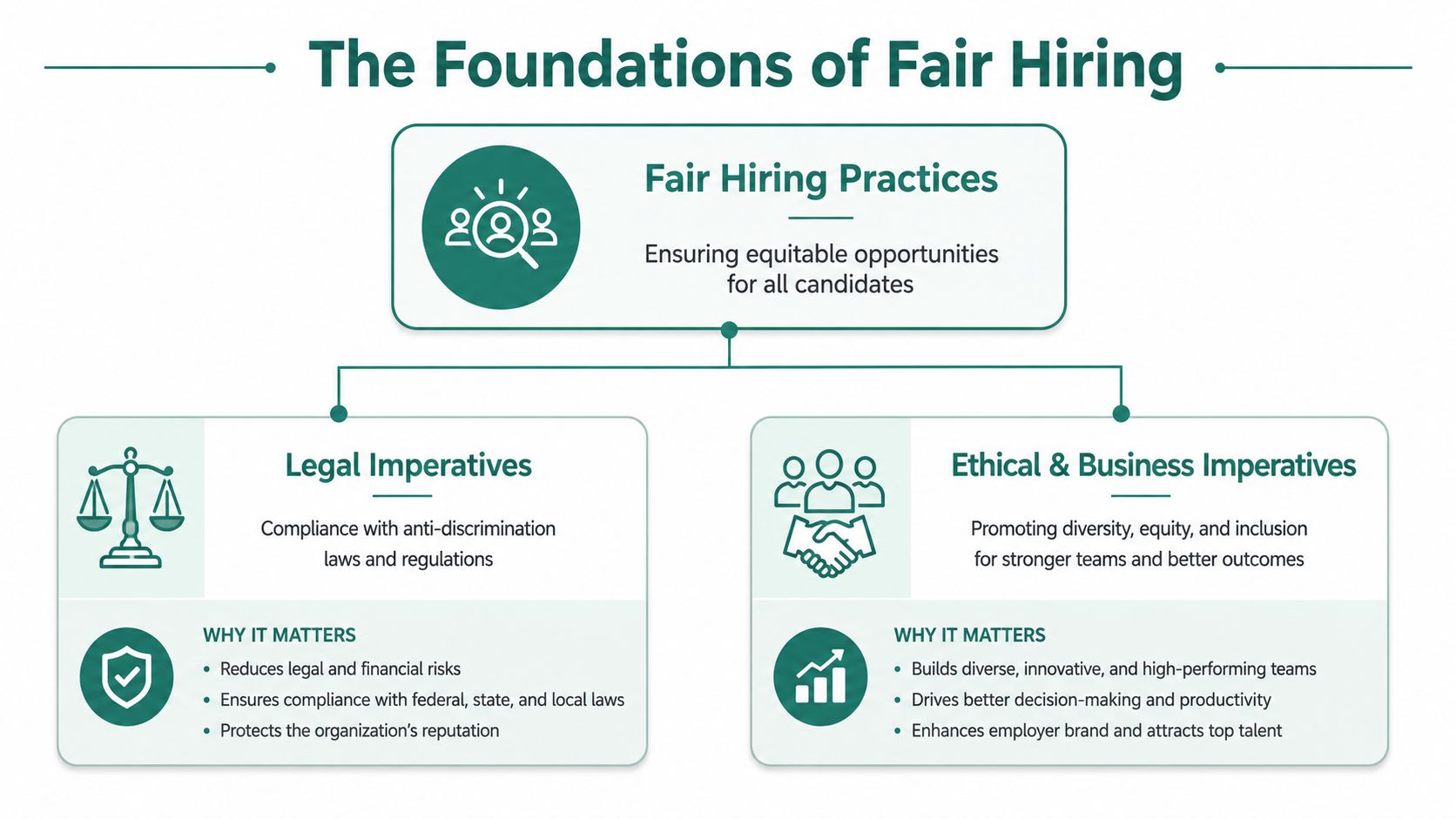
The first force is legal. Employers don't get to treat fairness as optional process hygiene. U.S. hiring decisions sit inside anti-discrimination law, including Title VII, and fair chance rules have changed how many employers must handle criminal history.
One fact puts the scale in perspective. Approximately 80 million people in the United States, roughly one in three U.S. adults, have an arrest or conviction record that can create barriers to employment. In response, the U.S. federal government passed the Fair Chance to Compete for Jobs Act in 2021, which prohibits most federal agencies and contractors from asking about criminal history on job applications or in initial interviews (National Employment Law Project on fair chance hiring for employers).
That change matters because it moves employers away from early blanket exclusions and toward later, more individualized review. It also reflects a broader shift in state and local fair chance laws. The old model of screening out applicants at the front door is harder to defend, and in many cases not allowed.
The second force is ethical and operational. Employers want a process that gives qualified people a real opportunity to compete. That sounds obvious, but it requires deliberate design.
A fair process usually includes a few baseline features:
Practical rule: If a hiring criterion isn't important enough to write down before interviews start, it usually shouldn't decide who gets hired.
Many organizations confuse intention with implementation. They say they value fairness, but their workflow still depends on résumé pedigree, improvisational interviews, and vague manager feedback. Fair hiring practices only work when process design closes that gap.
A legal standard without operational discipline won't protect the company or improve hiring quality. You need both.
Some employers still talk about fairness as if it were a trade-off against performance. In real hiring environments, that's usually the wrong frame. A well-built fair process expands the pool, improves consistency, and reduces the cost of bad decision-making.
The strongest business argument starts with access. If your process screens out people through broad assumptions, inconsistent interviews, or unnecessary pedigree filters, you're shrinking your own pipeline.
That's especially true in fair chance hiring. Studies show that individuals with criminal records who are hired often exhibit higher job loyalty and lower turnover than their peers without such histories, producing direct cost-savings for employers in reduced hiring and training expenses. This untapped talent pool represents significant value in a tight labor market (S2Verify on fair chance hiring practices).
This isn't just about opening the door wider. It's about opening it more intelligently. When employers stop using blunt exclusions and start using role-specific criteria, they often find capable applicants they were missing before.
There's also a risk-management angle. If your process creates patterns that disproportionately screen out certain groups, you can face disparate impact concerns even without discriminatory intent. For a useful legal explainer, Paradigm International discusses disparate impact in a way most HR teams can apply to real workflows.
The business case gets stronger when you look at what unfair hiring usually produces. It leads to avoidable turnover, longer time spent re-running searches, and weak early-stage filtering that wastes manager time. If your team advances the wrong people because the process is inconsistent, the downstream cost is substantial. This is one reason many HR leaders spend time quantifying the cost of a bad hire before redesigning the funnel.
A practical comparison helps:
Hiring approachWhat happens in practiceLikely business effectUnstructured screeningRecruiters and managers use personal judgment inconsistentlyMore noise in the funnelBlanket exclusionsApplicants are screened out without role-specific analysisSmaller talent poolStructured fair processCandidates are compared against the same criteriaBetter decision discipline
Reputation matters too. Candidates talk. So do recruiters, managers, and former employees. A hiring process that feels arbitrary can subtly damage your employer brand. A process that feels clear and respectful tends to attract stronger engagement, even from candidates you don't hire.
Fairness isn't separate from performance. In most organizations, fairness is what makes performance visible early enough to hire for it.
A fair process isn't one policy. It's a set of operating controls that work together. Most failures happen at predictable points: sloppy job definitions, résumé overreliance, unstructured interviews, and vague decision-making after the interview panel meets.
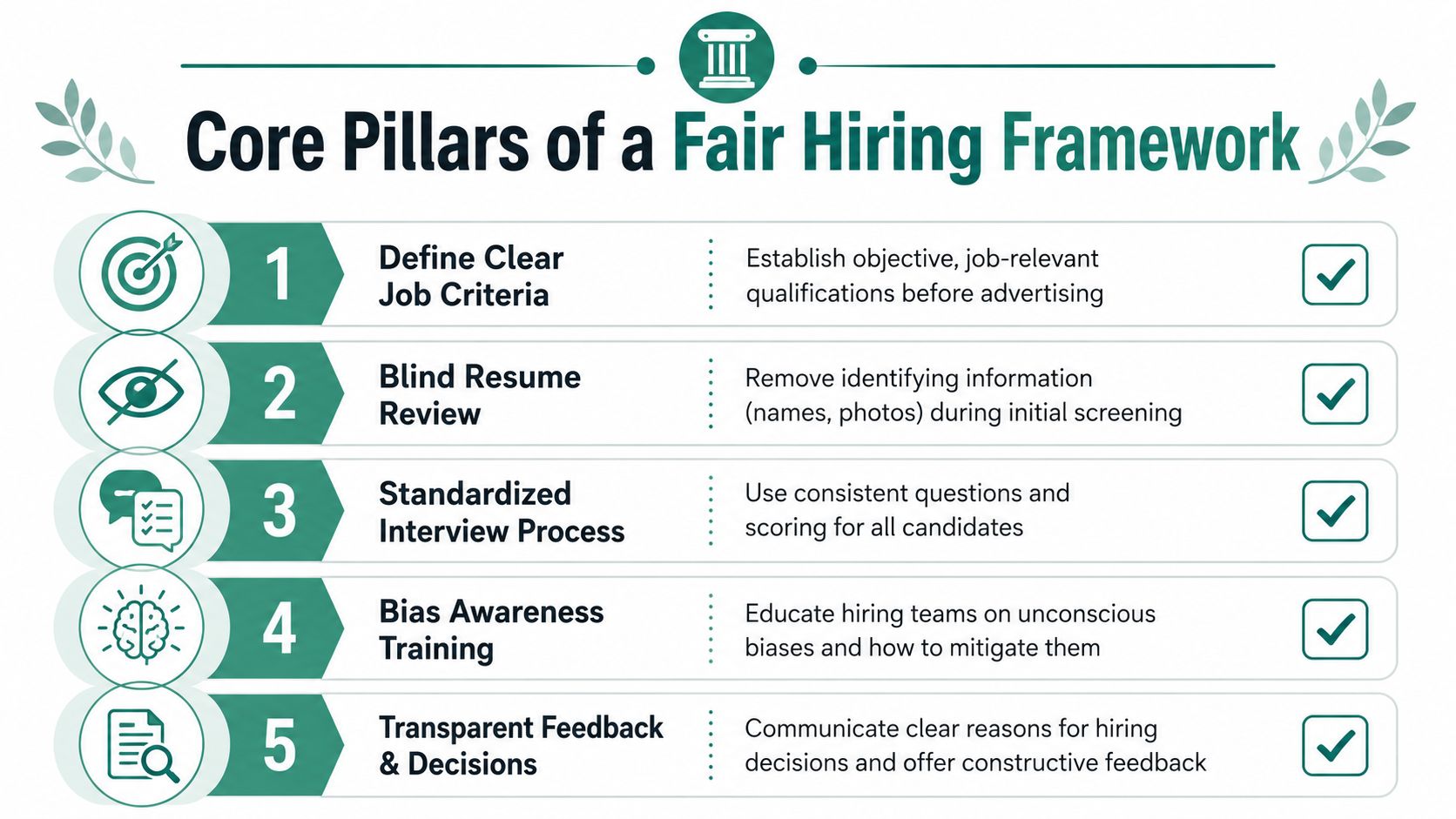
Many hiring teams begin with an implicit candidate image. They picture someone from a familiar employer, school, or career path, then build the process backward from that image. That's where fairness starts to erode.
A better method is to lock in role criteria first.
This is also where manager training matters. Interview teams need a common language for evaluating competency, not just a reminder to “avoid bias.” For that reason, Learniverse's guide for training managers is useful because it pushes teams toward observable skills and structured assessment.
The most common breakdown happens in the live interview. One manager asks technical questions. Another talks about career goals. A third spends half the meeting building rapport. Then the panel compares notes as if those were equivalent evaluations.
They aren't.
A fairer framework includes:
The scorecard should tell you why a candidate advanced without relying on anyone's memory.
This doesn't make interviews robotic. It makes them comparable. Managers still have room to probe, but the process anchors them to the same decision criteria.
Criminal record review is one area where employers often say the right things and then use inconsistent judgment. A fair process needs a rule that decision-makers can apply.
When considering criminal records, a “nature-time-nature” test improves fairness: employers should weigh the nature of the offense, how much time has passed since conviction, and the nature of the job being performed before making hiring or retention decisions. This replaces arbitrary blanket bans with individualized assessments (Checkr on fair chance hiring practices).
That standard works because it forces relevance. It asks whether the issue is connected to present job risk, not whether the record creates a general sense of discomfort.
In practice, employers should document three things when this comes up:
Without that discipline, the organization usually drifts back to blanket caution, which is hard to defend and often unnecessary.
The manual framework sounds straightforward until you try to run it across hundreds or thousands of applicants. That's where most employers lose consistency. Recruiters get overloaded, phone screens become uneven, and documentation slips.
Technology helps most when it enforces the same process every time.
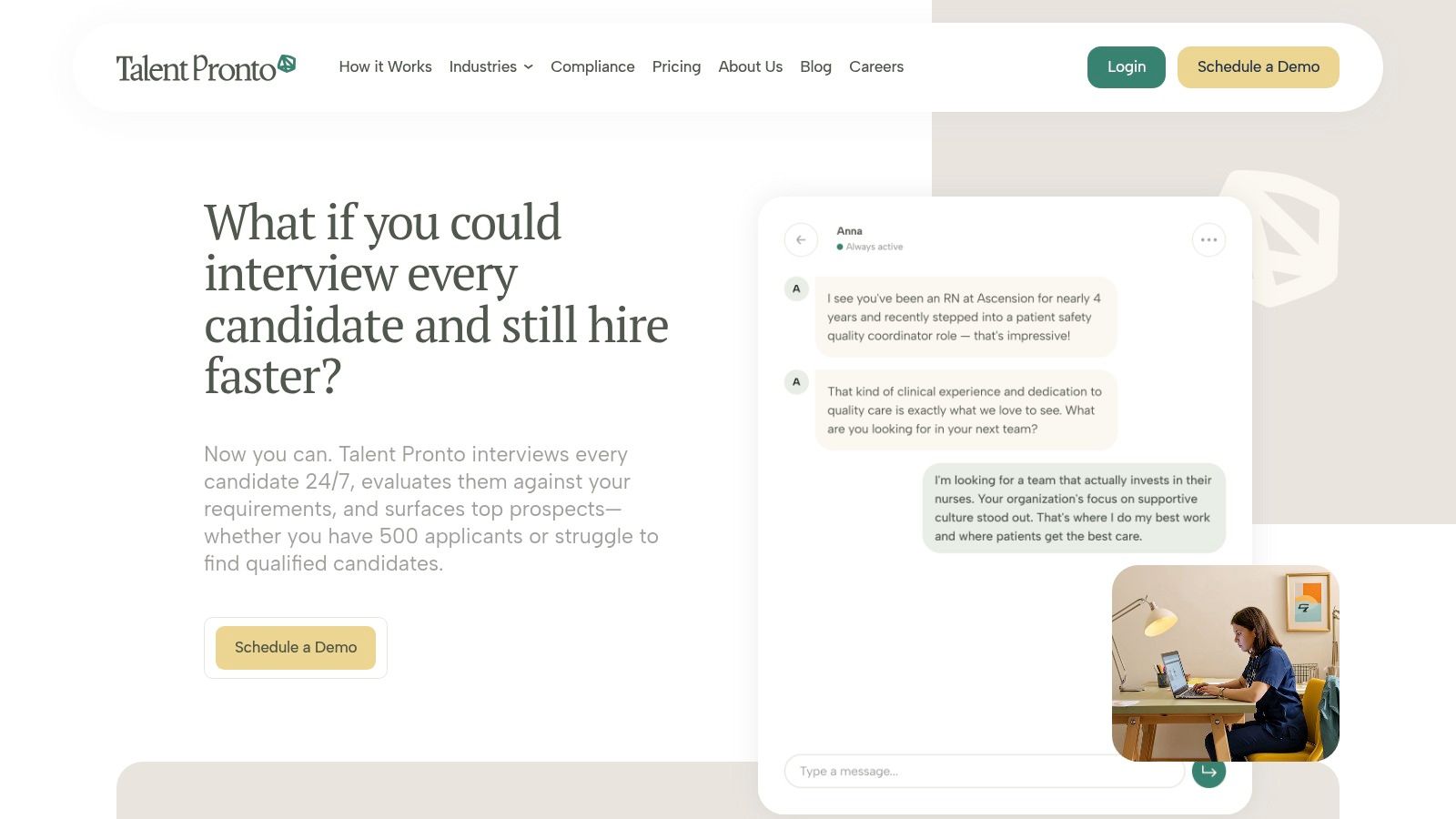
The best hiring automation doesn't replace judgment. It standardizes the inputs that feed judgment.
That means a system can ask every candidate the same role-aligned questions, capture responses in a consistent format, and score answers against the same rubric before a human reviewer steps in. In this context, conversational screening tools are often more useful than a basic ATS form or a rushed recruiter call. They create a structured first-pass evaluation instead of a patchwork of notes.
There's also evidence that algorithmic scoring can reduce bias when it is tied to job-related factors. A 2023 study found that when job-relevant personality traits were scored by an algorithm against performance drivers, the model showed non-adverse impact across gender groups. This is because the algorithm focuses on dimensions that correlate with job performance rather than demographic proxies, insulating the screen from implicit bias (2023 study on algorithmic personality assessment and non-adverse gender impact).
That finding supports a practical design rule. Don't automate vague notions of “fit.” Automate structured evaluation of job-relevant behaviors and competencies.
A useful system should do a few things well:
Many teams recognize the practical value of AI screening tools. A strong example of that design approach is explained in this overview of how AI screening reduces bias in hiring.
For a look at how automated interview flows can work in a live hiring environment, this short video is worth reviewing:
Automation isn't neutral just because it's consistent. Systems can still create unfair outcomes if the questions are poorly written, the rubric is weak, or the interface disadvantages certain candidates.
That matters even more with conversational AI. Candidates don't all process language, pacing, and digital interfaces the same way. If a screening tool assumes one communication style, one response speed, or one level of technical comfort, it can exclude people while appearing objective on the surface.
Good hiring technology should make evaluation more consistent. It should not make exclusion less visible.
So the standard should be high. Use automation for structured, role-aligned screening. Keep human oversight over advancement decisions. Review candidate experience regularly. And never assume that efficiency by itself equals fairness.
Most organizations don't need a complete rebuild on day one. They need a controlled implementation plan and a way to test whether the new process is producing fairer outcomes than the old one.
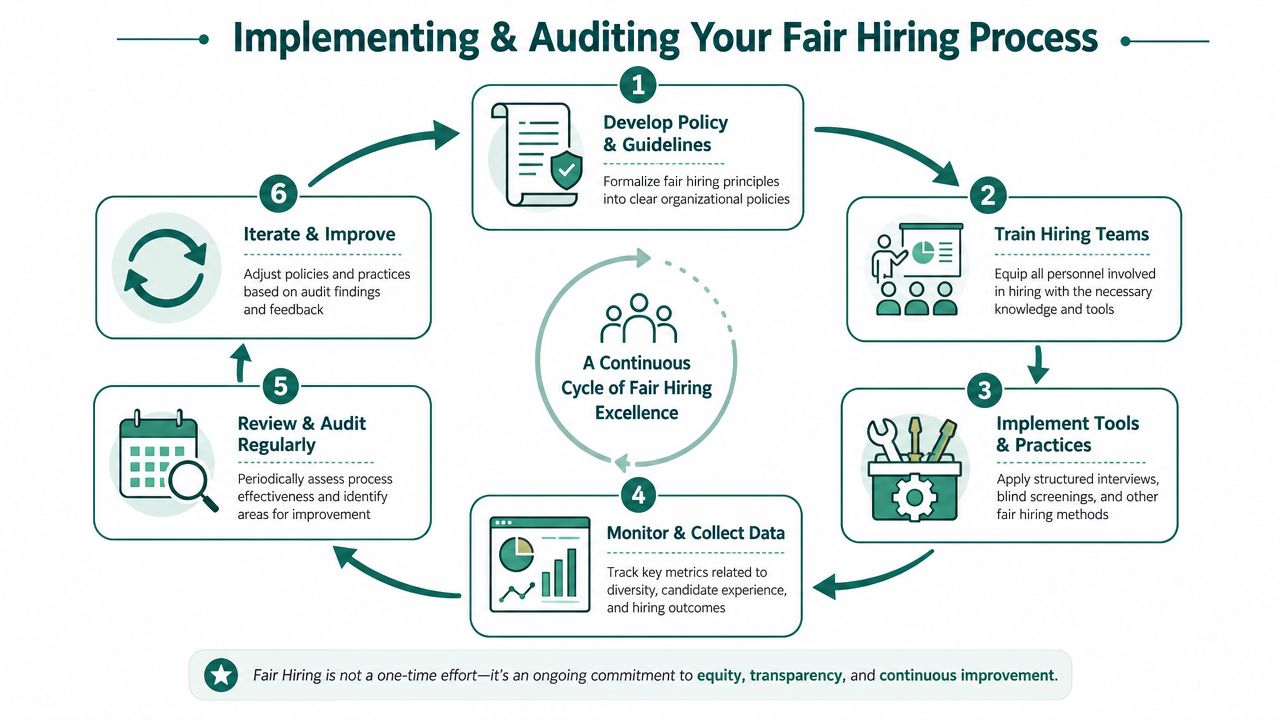
The cleanest way to implement fair hiring practices is to treat them as a recurring operating cycle.
The key is discipline. If each business unit is allowed to modify the process freely, standardization disappears before audits can tell you anything useful.
Fairness audits need records. Not intentions. Not manager recollections.
Empirical fairness analyses recommend that organizations routinely audit their selection workflows for disparate impact using statistical tests such as adverse impact ratios. Technology can support this by logging all assessment scores and decision touchpoints, enabling periodic audits to verify fair outcomes across demographic groups (University of Massachusetts Amherst guidance on using technology to increase fairness in hiring).
That means your audit should examine the actual movement of candidates through the funnel. Who passes the screen. Who gets interviews. Who receives offers. Where outcomes differ by group. Where managers override scores. Where feedback is vague or missing.
A simple audit checklist helps:
Audit questionWhat to inspectAre interviewers following the script?Interview records and scorecard completionAre decisions tied to job criteria?Written feedback and rejection reasonsAre outcomes balanced across groups?Pass-through rates and adverse impact reviewCan the process be reconstructed later?Logged scores, timestamps, and decision history
For teams evaluating systems and process controls, the security and compliance page on fair hiring is a useful reference point for what documented auditability should look like in practice.
If your team can't explain how a candidate moved through the funnel, your process isn't ready for a fairness audit.
Auditing shouldn't be framed as a legal fire drill. It's quality control for hiring. It tells you whether the process people think they're using is the process they are using in practice.
Fair hiring practices work best when they stop being treated as a set of good intentions and start operating like a system. The strongest employers don't rely on manager instinct to carry the process. They define job criteria early, standardize interviews, apply background review carefully, document decisions, and audit results over time.
That approach does two things at once. It reduces compliance risk, and it improves hiring quality. Those outcomes reinforce each other. A process built on clear standards is easier to defend and easier to scale. It also gives hiring teams a better shot at finding strong candidates who might otherwise get screened out by noise, habit, or inconsistency.
The practical lesson is simple. Fairness doesn't come from one training session or one policy update. It comes from repeated operational choices. Write better criteria. Ask better questions. Use better scorecards. Review the data. Fix what isn't working.
For organizations dealing with high applicant volume, distributed hiring teams, or recurring concerns about consistency, technology can make those choices easier to enforce. But the value comes from disciplined implementation, not from automation alone.
The employers that do this well don't just hire more equitably. They hire more clearly.
If you're ready to turn fair hiring practices into a repeatable workflow, Talent Pronto helps employers run structured conversational screening, create consistent scorecards, and document early-stage evaluations in a way that supports both efficiency and auditability.

Talent Pronto is an AI-powered hiring platform built around Anna, our intelligent AI that conducts 24/7 conversational screening, evaluates candidates against specific job requirements and compliance needs, and schedules interviews. Run everything on the Talent Pronto ATS, our all-in-one applicant tracking system with a branded careers site and Anna built in, or keep your existing ATS and let Anna integrate with Greenhouse, Ashby, iCIMS, Jobvite, Lever, Oracle, and more. Either way, we help organizations reduce time-to-hire and build stronger teams.