Master hiring! Find 10 decision making questions and answers, model answers, scoring rubrics & red flags for any role. Hire smarter in 2026.
You are down to two finalists. Both interview well. Both have relevant experience. The decision often comes down to one thing: who makes sound judgments when the facts are incomplete, the stakes are real, and the answer is not obvious.
That is the point where many interviews fail. Hiring managers ask broad, familiar questions. Candidates respond with polished stories they have used before. The conversation feels productive, but it does not always produce evidence you can trust. Strong presentation can mask weak judgment. Quiet candidates can still make excellent decisions.
Better hiring requires better decision making questions and answers. That means using the same prompts across candidates, listening for the same proof points, and scoring against the actual demands of the role instead of general impressions.
This article is built for that job. Each section gives you a structured question, a model answer framework, a practical scoring rubric, red flags to watch for, and role-specific variations you can use without rewriting your whole interview process. The goal is simple: turn subjective interviews into a repeatable assessment of judgment.
Structured interviews support that approach. Analysts have repeatedly found that a more consistent interview process improves hiring quality, interview consistency, and the experience for both candidates and hiring managers. Hiring should produce usable evidence, not just impressions.
There is also a scaling problem. A strong interview framework only helps if teams apply it consistently across roles, interviewers, and hiring volume. Tools such as Talent Pronto can standardize question sets, capture comparable responses, and help teams screen for decision quality earlier in the funnel, before interview noise starts to distort the picture.
A strong behavioral question for judgment starts with friction, not success. Ask: “Tell me about a time you disagreed with your manager about how to handle a problem. What did you do, what was the outcome, and what would you do differently now?” That prompt forces the candidate to reveal how they handle power, pressure, and accountability.
A solid answer has a clear sequence. The candidate explains the disagreement, names their own role without hiding behind “we,” shows how they raised the issue professionally, and describes what they learned. If they can only tell you why the manager was wrong, you've learned something useful, and it's probably not good.
Use a simple rubric with four scoring points: ownership, communication, judgment, and learning. In healthcare, that might help you distinguish a nurse who handled a patient complaint professionally from one who escalated tension. In manufacturing, it separates a supervisor who addressed a shift conflict directly from one who let resentment spread. In a startup, it shows whether an engineer can challenge a decision without becoming impossible to work with.
Follow-up questions matter more than most interviewers think. Ask, “What specifically did you say?” and “How did your manager respond?” Vague answers often collapse under that pressure.
Practical rule: Don't score the first story alone. Compare the candidate's behavior pattern across multiple scenarios before you conclude they're collaborative or difficult.
Document specific phrases from the response. That creates an audit trail and gives the panel something better than memory when it's time to compare finalists.
For technical roles, the best decision making questions and answers don't ask for a perfect solution. They ask for the candidate's approach when the solution isn't obvious. Try this: “A critical system is unavailable for 30 minutes. Walk me through your first steps, what you'd clarify, and how you'd decide what to do next.”
That works in healthcare IT, pharma quality, manufacturing, and logistics because it tests method, not performance theater. A healthcare IT lead should talk about impact, triage, escalation paths, downtime procedures, and communication. A manufacturing candidate should discuss isolating variables, checking error patterns, and ruling out safety risk before chasing efficiency.
Score the process in stages. First, does the candidate ask clarifying questions? Second, can they structure the problem? Third, do they show awareness of trade-offs, compliance, or customer impact? Fourth, do they know when to escalate?
A good answer usually sounds calm and ordered. It doesn't jump to a favorite fix before defining the problem. It also leaves room for alternative valid approaches, which is why your rubric should reward rigor, not one exact script. If you need more role-specific examples, this set of technical interview questions from Talent Pronto is a useful benchmark.
A candidate who asks smart clarifying questions is usually showing strength, not hesitation.
Culture fit gets abused in hiring. Too often it means “someone I'd like to work with.” That's not the standard. The better test is whether the person's decisions align with your operating values when the easy path conflicts with the right one.
Ask something ambiguous: “You discover a teammate cut a corner to hit a deadline, and the shortcut improves speed but could affect quality. What do you do?” In healthcare, the equivalent might involve a patient requesting something that isn't medically necessary. In hospitality, it might involve a guest complaint exposing a safety shortcut. In government, it may involve rule-bending to meet a deadline.
The best answers acknowledge the tension instead of pretending there isn't one. Candidates should explain what's at risk, who is affected, what immediate action they'd take, and how they'd communicate upward. If they rush to a righteous answer without showing the reasoning, that's weaker than it sounds.
A practical rubric scores values application, communication, courage, and consistency. You're not just checking whether they land on “follow the rules.” You're checking whether they can protect standards without creating unnecessary damage around them. For deeper role design, review culture fit hiring guidance from Talent Pronto.
The right decision made for the wrong reason is still a yellow flag.
A candidate who says, “I'd report it immediately because I don't want to be blamed,” is different from one who says, “I'd stop the risk, verify facts, and address it because quality and trust matter.” The action may look similar. The judgment behind it isn't.
Use follow-ups such as, “How would you explain that decision to your manager?” That's usually where real values show up.
In regulated environments, poor judgment can become legal exposure fast. You need a question that tests whether the candidate knows the rule, understands why it exists, and can apply it in a messy real-world situation.
Ask something specific to the role. For a nurse: “A patient asks to review their medical record. What would you do?” For healthcare IT: “An executive wants patient data for business analysis without the right agreement in place.” For manufacturing: “An employee reports equipment that doesn't meet safety standards.” For pharma quality: “You find discrepancies in batch records. What's your first step and why?”
A strong answer includes immediate action, documentation, escalation if needed, and the reason the rule matters. Candidates who know only the buzzwords usually falter when you ask, “What concerns would you raise?” Candidates with real depth can explain both the procedure and the operational consequence of getting it wrong.
Don't make the rubric all-or-nothing. Separate compliance knowledge from general capability. Some candidates can learn your exact framework quickly, while others show poor instincts that training won't fix.
If a candidate says, “I'd verify policy, limit access, and consult compliance before releasing data,” that's trainable even if the wording isn't perfect. If they say, “If it's for leadership, I'd probably send it,” that's a different category of risk.
Training quality matters after hire, too. Teams trying to maximize compliance training engagement usually get better results when they make scenarios concrete instead of abstract.
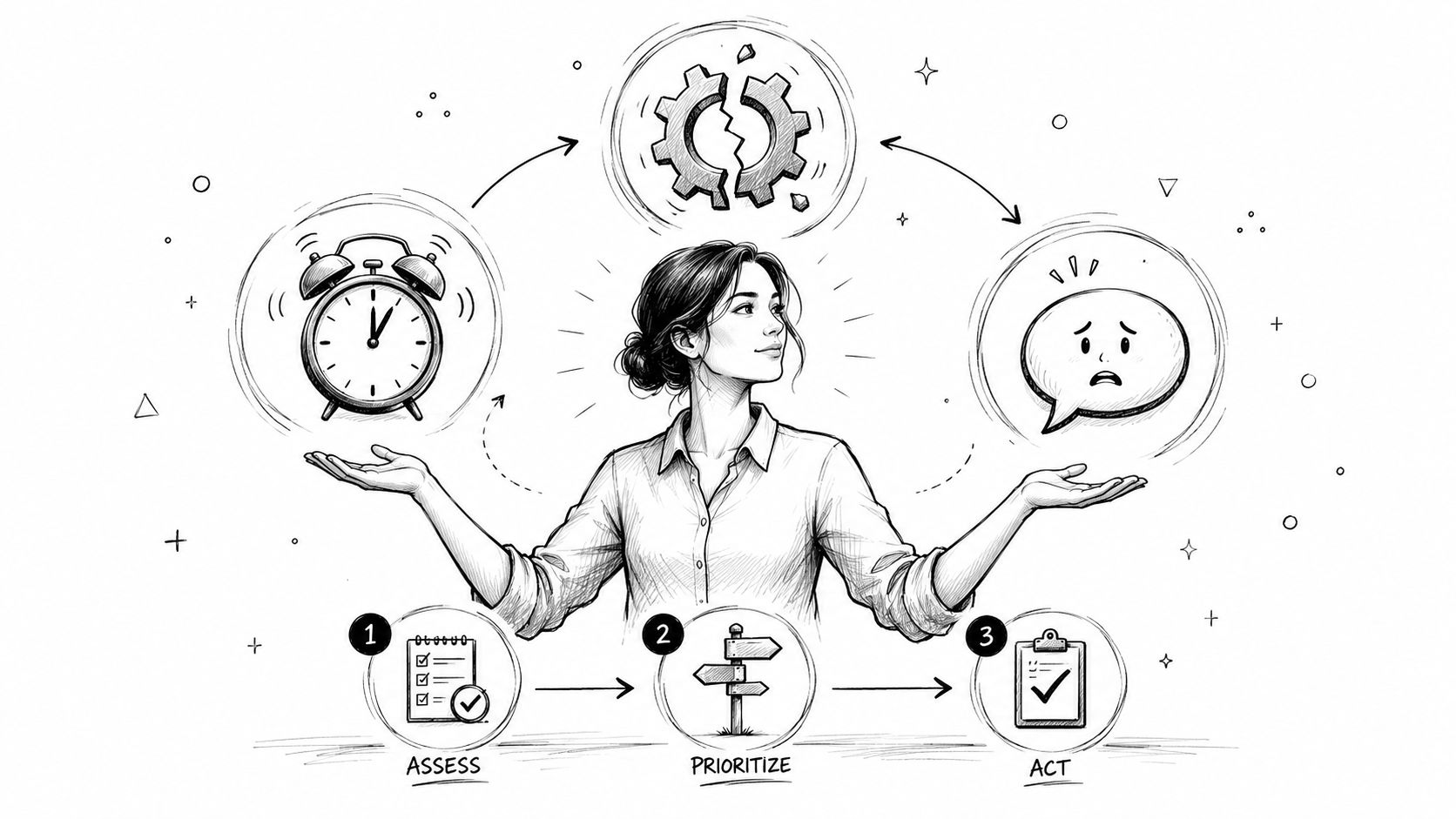
Pressure exposes decision quality fast. Ask candidates to walk through a high-consequence situation tied to the role. For an emergency nurse: “Three critical patients arrive at once and two nurses have called in sick.” For a plant manager: “A fire alarm activates during peak output. What are your first five actions?” For hospitality: “A major system outage hits during peak check-in with a full lobby.”
The best answers don't sound heroic. They sound organized. Strong candidates prioritize safety, stabilize the situation, communicate clearly, and pull in help early. Weak candidates often try to do everything themselves or skip over how they'd sequence action.
Score the response on prioritization, composure, resource use, and communication. Separate visible anxiety from decision quality. Some people sound intense while making excellent calls. Others sound smooth while missing the actual priorities.
Use follow-ups that get beneath the polished version. Ask, “Who would you call first?” “What would you defer?” and “What did you learn the last time something like this happened?” Those questions reveal whether the candidate recognizes limits.
In pressure interviews, calm sequencing matters more than confident storytelling.
There's also a long-term lens worth using here. One overlooked decision test is whether a candidate makes choices that still make sense later, not just in the moment. The American Management Association article on decision-making in uncertain times highlights this with the question, “What decision today will still make sense a year from now?” That's a useful probe for leadership roles, especially in healthcare and operations where quick fixes can create bigger downstream problems.

Ask every serious candidate some version of this: “Tell me about a significant mistake you made at work. What happened, how did you handle it, and what changed afterward?” It's one of the few questions that reliably exposes maturity.
The answer shouldn't be polished to the point of being bloodless. Good candidates usually show some discomfort because real mistakes cost something. They can name the consequence, explain their role clearly, describe how they addressed it, and point to a behavior they changed after the fact.
Your scoring rubric should cover candor, ownership, corrective action, and durable learning. In healthcare, that might involve missing an important detail in patient care and tightening the handoff process. In tech, it may involve a failed project and a different planning discipline. In manufacturing, it could involve a quality lapse or a missed safety issue.
Candidates who claim they can't think of a failure are rarely low-risk hires. More often, they lack reflection or they're protecting their image. The other warning signs are blame shifting, vague lessons, and no concrete change.
If you're using AI-assisted screening, this is one of the strongest places to standardize follow-up questions. In 2026, 87% of companies globally report using AI-driven tools in recruitment, and 63% of recruiters use AI to automate repetitive tasks like screening and initial communication, according to AI recruiting statistics compiled by Apollo Technical. The value isn't replacing judgment. It's making sure every applicant gets the same probe, not just the ones a recruiter had time to question thoroughly.

Teams often don't break because people lack technical skill. They break because conflict is mishandled, ignored, or personalized. Ask: “Tell me about a time you disagreed with a peer whose work affected yours. How did you handle it?”
Listen closely to how the candidate describes the other person. Do they show any attempt to understand the other person's priorities, constraints, or incentives? Candidates who frame every conflict as a story about someone else being difficult usually bring that pattern with them.
Good answers include a direct conversation, specific language they used, and an effort to resolve the issue without turning it into a turf war. In healthcare, this might involve observing a colleague cutting corners on patient safety. In tech, it could be a colleague dismissing ideas in meetings. In manufacturing, it may be missed deadlines from another function.
The strongest candidates can answer, “How might they describe this situation differently?” That question is excellent because it tests self-awareness without telling the candidate what you're measuring.
“What specifically did you say?” is often the most revealing follow-up in the entire interview.
If they can't answer that, the story often wasn't handled as well as they claim.
A lot of candidates say they're adaptable. Fewer can show how they learn when the job changes under them. Ask: “Describe a time you had to learn something completely new to succeed. What did you do first, how did you build competence, and how did you know you were ready?”
This works especially well for cross-functional hiring. A healthcare IT candidate may need to learn clinical terminology from scratch. A manufacturing leader may need to adapt to unfamiliar equipment or systems. A tech hire may need to work inside a methodology they hadn't used before.
You're listening for the learning process, not just the result. Did they seek documentation, ask strong operators for help, test understanding, and apply the skill in real work? Or did they passively “pick it up” and move on?
A useful scoring rubric covers initiative, learning strategy, application, and retention. The best answers often include a point where the candidate taught someone else, built a resource, or improved the process after learning it.
A red flag is when the candidate learned something once but can't explain how they approached it. Another is when they never used the skill again. Strong candidates can tell you what they did first, where they struggled, and what competence looked like in practice.
This is also one area where self-reported stories can be misleading if you stop too early. The Test Partnership discussion of decision-making interviews makes an important point: self-reported narratives don't always reflect observable decision behavior, and situational judgment tests can be more reliable because they test decisions in context. For high-stakes roles, that's worth combining with interviews instead of relying on storytelling alone.
Some of the hardest decisions in hiring involve roles where nobody reports cleanly to one person. Product managers, healthcare administrators, operations leads, and public-sector project owners all spend time aligning people they can't command.
Ask a scenario that forces trade-offs: “Engineering says a feature timeline is unrealistic. Sales says the customer won't wait. How do you handle the conversation and drive a decision?” In healthcare administration, swap in clinical leadership and finance. In manufacturing, use vendor quality and production capacity. In government, use conflicting agency requirements.
A good answer starts with information gathering. Strong candidates identify what each stakeholder needs, where the essential requirements are, and what facts can narrow the disagreement. Weak candidates jump to persuasion tactics before they've understood the problem.
Score for stakeholder mapping, communication quality, evidence use, and persistence. They should be able to explain how they would communicate a recommendation, how they'd handle pushback, and what they'd do if the first attempt failed. For more prompts in this category, these communication skills interview questions from Talent Pronto are useful for calibration.
Hiring note: “I convinced them” isn't enough. You need to hear how they built trust, framed trade-offs, and kept the relationship intact.
Look for candidates who can produce a workable decision without pretending every outcome is a win-win. Real influence is often about clarity, not charm.
A candidate can sound polished and still be a short-term hire.
The test is simple. Ask a scenario that forces the person to show how this role fits their next few years of work, and whether they understand the harder parts of the job: “What specifically about this role, in this organization, matches where you want to go next? Which parts of the job will stretch you, frustrate you, or slow you down in the first year?”
That framing does two jobs at once. It checks motivation, and it checks accuracy. Candidates who are serious about the role can usually describe the work with enough detail to name the trade-offs they are choosing. In healthcare, ask why this health system fits their goals, not healthcare in general. In manufacturing, ask how plant modernization, quality discipline, or shift realities fit the path they want. In government, ask what draws them to work shaped by process, scrutiny, and public accountability.
Strong answers connect ambition to the day-to-day job. The candidate should explain why this team, this operating pace, this reporting structure, and this problem set make sense for them now. They should also show they know what the role includes, what it does not include, and what they may need to learn fast.
At this point, many hiring managers get loose with standards. General enthusiasm should not score highly on its own.
Use a simple rubric:
Red flags are consistent across industries. The candidate spends most of the answer talking about leaving a bad manager or escaping their current company. They are surprised by core responsibilities. They focus almost entirely on title, compensation, or remote flexibility without showing interest in the work itself. Those answers often lead to fast regret on both sides.
The best responses balance ambition with realism. A strong candidate can say where they want to be in two to four years and why this role is the right next assignment, not just a recognizable brand or a safer move. They can also explain what they expect to be hard, which tells you they have pictured themselves doing the job rather than winning the offer.
For hiring teams, this section should not stay subjective. Give interviewers a model answer framework, define what a 1, 3, and 5 look like, and tailor the scenario by role family. AI screening tools such as Talent Pronto can help standardize that process at scale by asking the same structured motivation prompts, flagging weak alignment patterns, and routing stronger-fit candidates to live interviews.
Long-term fit does not stop at offer acceptance, either. The handoff into onboarding matters because expectations formed during hiring shape early retention and improving employee productivity.
| Assessment | 🔄 Implementation Complexity | 💡 Resource & Tips | ⚡ Speed / Efficiency | 📊 Expected Outcomes | ⭐ Key Advantages |
|---|---|---|---|---|---|
| The Behavioral Red Flag Assessment: Identifying Consistency in Past Performance | Moderate, needs trained interviewers and structured probes | Interviewer time, scorecards; train follow-up probes; document quotes | Low, conversational follow-ups lengthen screening | Strong prediction of teamwork, accountability, and conflict behavior | Reveals authentic behavior under pressure; fair scoring across candidates |
| The Technical Competency Validation: Problem-Solving Under Uncertainty | Moderate–High, requires role-specific scenarios and rubric design | SME input, tailored scenarios, rubrics accepting multiple approaches | Medium, faster than hands-on tests but needs probing | High for technical reasoning and foundations; flags knowledge gaps | Validates reasoning over rote answers; good for specialized roles |
| The Cultural Alignment Scenario: Values in Action | Moderate, careful scenario design to avoid bias | Time to customize values-based rubrics; subtle probes recommended | Medium, conversational but focused scenarios speed assessment | Predicts retention and team cohesion; reduces cultural mis-hires | Assesses values under pressure; strengthens employer brand fit |
| The Compliance and Regulatory Knowledge Question: Industry-Specific Requirements | High, requires up-to-date regulatory expertise and regular updates | Regulatory SMEs, updated content, separate compliance scoring tracks | Medium, targeted questions efficient if well-prepared | Critical for reducing regulatory risk; flags dangerous gaps early | Prevents hiring that could expose organization to penalties |
| The Stress Management and Resilience Scenario: Handling High-Pressure Situations | Moderate, scenario realism and nuanced scoring required | Simulated high-stress scenarios; score decision vs. stress response | Low–Medium, detailed answers take time to evaluate | Strong predictor for crisis performance and safety outcomes | Distinguishes decision quality under pressure from anxiety |
| The Accountability and Ownership Scenario: Learning from Failure | Low–Moderate, interview skill to detect authenticity needed | Interviewer training to spot polished narratives; document specifics | High, concise prompts elicit actionable responses quickly | Good predictor of growth mindset and team accountability | Hard-to-fake authenticity; predicts ownership behaviors |
| The Interpersonal Conflict and Collaboration Scenario: Team Dynamics | Moderate, requires follow-ups to assess perspective-taking | Time for probes about actions and framing; evaluate empathy | Medium, typical behavioral length | Predicts collaboration quality and potential team friction | Reveals EQ, communication style, and conflict resolution approach |
| The Diversity of Experience and Cross-Functional Capability Scenario: Adaptability | Moderate, scoring must separate agility from superficial claims | Examples across functions; probe learning process and transferability | Medium, narrative depth varies by candidate | Predicts learning agility and versatility in evolving roles | Identifies adaptable candidates beyond narrow experience fits |
| The Stakeholder Management and Communication Scenario: Influence Without Authority | Moderate–High, needs role-contextual political scenarios | SME-crafted scenarios; evaluate data use and consensus tactics | Medium, probing required for nuance | Predicts effectiveness in matrix and cross-functional roles | Assesses persuasion, diplomacy, and coalition-building skills |
| The Role-Specific Motivation and Career Alignment Scenario: Long-Term Fit | Low, straightforward but needs deeper probing for authenticity | Role-specific questions, follow-ups about trajectory and realism | High, direct questions are time-efficient | Predicts retention and realistic fit with role expectations | Filters candidates for commitment and realistic career alignment |
A hiring manager opens the ATS on Friday afternoon and sees 180 applicants for one role. By Monday, the strongest candidates may already be gone, not because the team made a bad decision, but because the process never created a fair, usable way to compare them.
That is the gap between asking decent interview questions and building a hiring system that produces reliable decisions.
The ten scenarios in this guide are useful only if they run inside a structured process. Each question needs the same core prompt, the same model answer framework, the same scoring rubric, and the same red-flag checks across candidates. That gives hiring managers something far more practical than interview notes. It gives them comparable evidence.
Consistency improves more than compliance. It improves hiring quality. Candidates also judge the company while they move through the process, and as noted earlier, candidate experience has a direct effect on offer acceptance. A slow, opaque interview flow signals disorganization. A structured one signals that your team knows what good looks like and can assess it fairly.
Automation helps when it handles repetition and preserves judgment. The point is not to let software decide who gets hired. The point is to use software to ask the right questions at scale, capture answers in a consistent format, apply the same rubric every time, and move qualified people to human review faster. An automation workflow example shared on Reddit shows how teams are reducing manual screening work and speeding up early-stage decisions when the process is tightly defined.
That same principle applies here. A tool such as Talent Pronto's G2 seller profile points to the operational upside hiring teams want from AI screening. Better coverage of qualified applicants, fewer missed prospects, and less recruiter time spent on repetitive first-pass review. In high-volume hiring, this is critical because strong applicants often disappear before a manager ever sees them.
Talent Pronto fits this process because it does more than ask generic screening questions. It can run behavioral, technical, cultural, and compliance prompts around the clock, score responses against role-specific criteria, and return structured scorecards to the hiring team. That supports a key advantage of this article's approach: each scenario becomes an operational tool, not just a conversation starter. You can standardize the question, define what a strong answer includes, flag weak patterns early, and adjust the variation by role without rebuilding the entire interview process every time.
The trade-off is straightforward. More structure reduces improvisation. Some interviewers dislike that because it feels less conversational. In practice, it produces cleaner comparisons and fewer hiring arguments based on gut feel. Managers still need discretion, especially for edge cases or unusual backgrounds, but discretion works better after a consistent screen than before one.
Organizations using AI-driven high-volume hiring automation report practical gains such as faster hiring cycles, lower manual workload, and better visibility into which candidates are worth deeper review, as described by Cadient Talent's guide to AI hiring automation. Those gains come from process design first, software second.
The practical takeaway is simple. Use decision making questions and answers inside a repeatable system. Score against evidence. Compare candidates on the same criteria. Let automation handle the first layer of consistency so hiring managers can spend their time where judgment adds value.
If you want to put this into practice fast, Talent Pronto gives hiring teams a way to run structured, conversational screening at scale. Anna, its virtual assistant, can ask role-specific behavioral and technical questions, capture responses around the clock, score candidates against your rubric, and deliver organized insights into your workflow so your team can focus on the final hiring decision.

Talent Pronto is an AI-powered hiring platform built around Anna, our intelligent AI that conducts 24/7 conversational screening, evaluates candidates against specific job requirements and compliance needs, and schedules interviews. Run everything on the Talent Pronto ATS, our all-in-one applicant tracking system with a branded careers site and Anna built in, or keep your existing ATS and let Anna integrate with Greenhouse, Ashby, iCIMS, Jobvite, Lever, Oracle, and more. Either way, we help organizations reduce time-to-hire and build stronger teams.