Learn how to write interview questions that surface real signal, with a step-by-step method for behavioral, technical, and structured prompts that score fairly.
You're staring at a question bank that looked fine in a doc and fell apart in real interviews. The prompts are broad, the answers are polished, and the hiring team still walks out disagreeing about who's qualified. That's usually the point where teams realize the problem isn't “finding better questions,” it's building a system that makes every question do a job.
A lot of hiring teams reuse old prompts because they feel safe. A manager pulls from a shared folder, an interviewer adds a few favorites, and suddenly the process is full of questions that sound smart but don't separate strong candidates from rehearsed ones. That's how template thinking takes over, and once that happens, the conversation starts rewarding confidence more than competence.
The fix is to treat every prompt as part of a system. Strong interview design ties each question to a competency, a probe, a rubric, and a compliance check, so the team knows what the question is trying to reveal and how to score the answer. That's the same logic behind decision-oriented interview practice, where the candidate has to explain assumptions, uncertainty, and what action they'd recommend, not just produce a number or a definition. Practical statistics interview guidance makes that shift explicit, and it matters because interpretation is often more revealing than computation.
Practical rule: if a question can be answered with polished theory alone, it's too easy to fake.
Five failure modes show up again and again. Some prompts test memory instead of judgment. Others invite rehearsed answers because they're too general. Some score inconsistently because different interviewers listen for different things. Some drift away from the actual role. And some create compliance risk because they touch areas that aren't job-related.
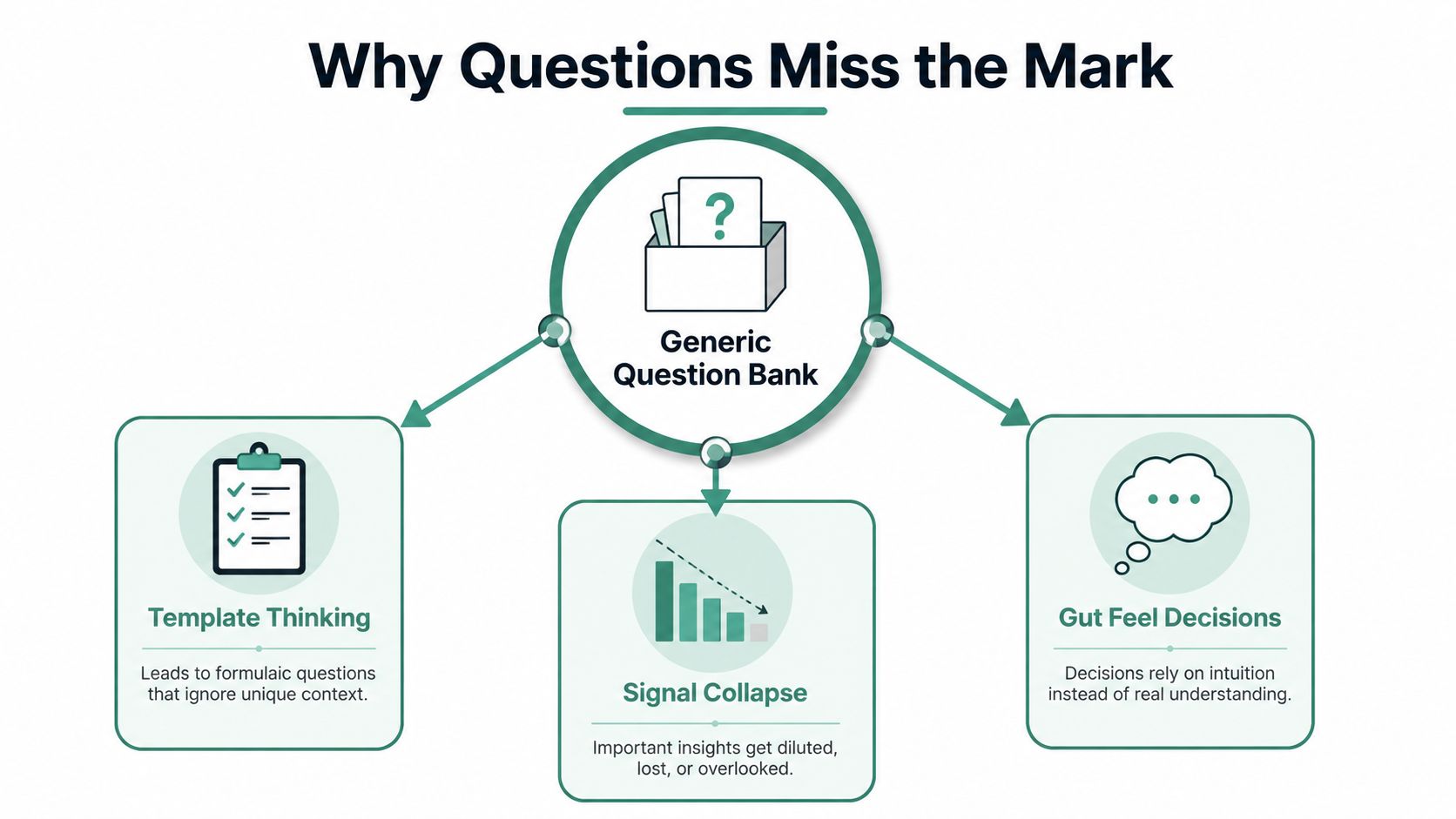
A good interview question doesn't just “sound better.” It changes the evidence you collect. If you're asking, “How would you test this?” you may get a neat answer. If you ask, “How would you choose the test, what assumptions must hold, and how would the result change the decision if the effect size is small?” you force the candidate to show judgment, not just vocabulary. That's the kind of question bank worth keeping.
How interview bias shows up in practice is worth revisiting while you audit your own prompts, because a weak question doesn't just miss signal, it also amplifies bias.
A question bank should start with the job itself. If the role is unclear, the prompts drift into clever phrasing, generic scenarios, or questions borrowed from the wrong level of seniority. Strong hiring teams begin with a short job analysis, then convert that into a competency map before writing a single prompt.
Take a mid-level operations role. The work may include process improvement, cross-functional coordination, documentation, escalation handling, and data review. Those are broad tasks, but they only become useful in an interview once they are rewritten as observable behaviors. “Can manage cross-functional work” is vague. “Can align stakeholders with conflicting priorities and keep a project moving” is measurable.
The next step is separating must-haves from nice-to-haves. If the role depends on process ownership, that competency should carry more weight than a secondary skill like presentation polish. For high-volume roles, keep the list tight and focus on the behaviors that matter every week. For senior roles, widen the map enough to include judgment, prioritization, and decision-making under ambiguity.
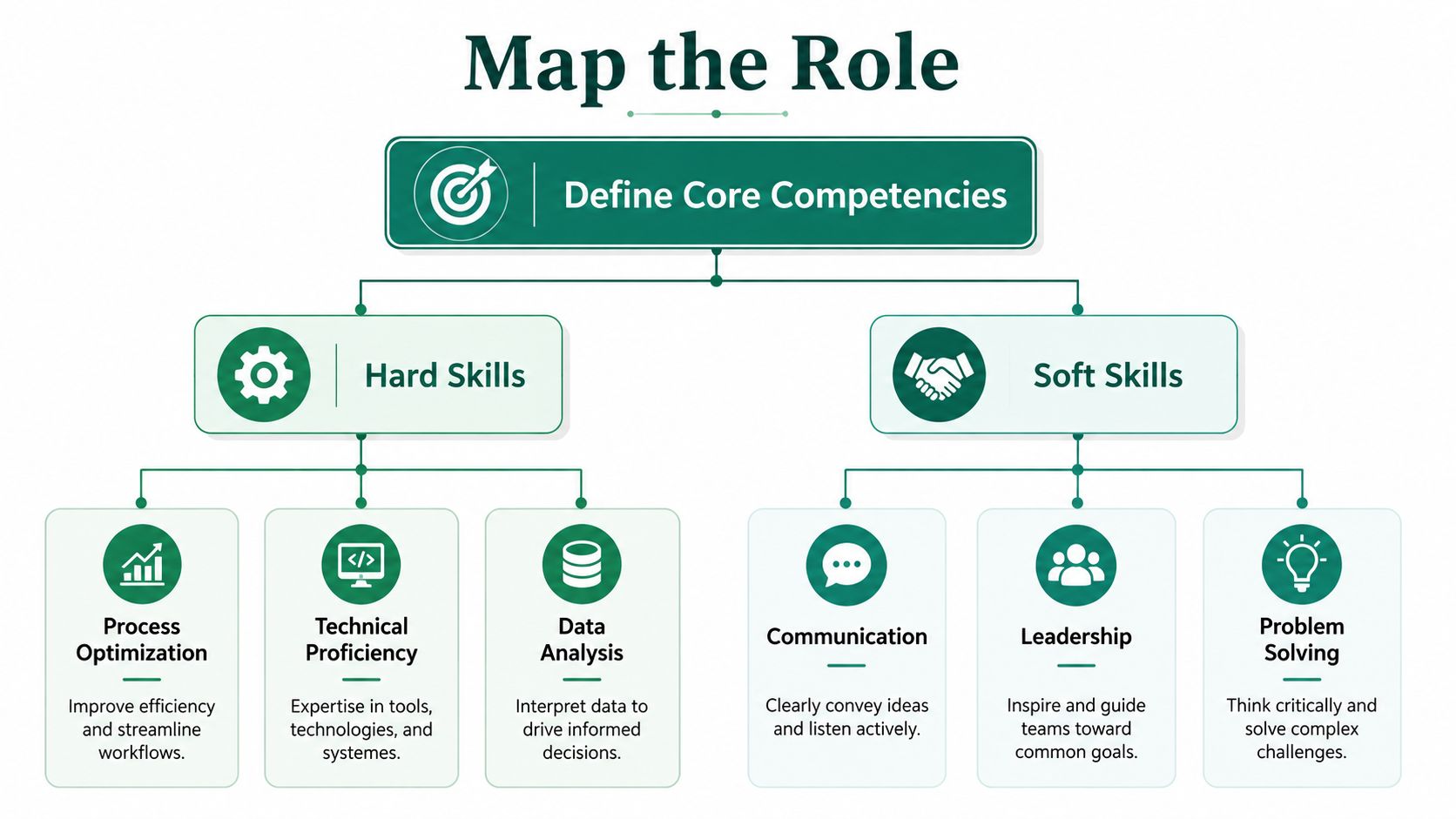
A practical competency map for that operations role might include:
That list becomes the skeleton of the interview. Each competency gets a slot, and each slot gets a purpose. If a competency does not deserve a question, it probably does not deserve attention in the interview loop either.
Map the role first, then write to the map. Anything else is just filling space.
Structured interviewing starts to pay off here. Harvard's structured interview guidance and OPM guidance on structured interviews both stress job-relevant, open-ended questions tied to competencies. That is not bureaucracy. It is the difference between collecting useful evidence and collecting opinions.
If you are building situational prompts for screening, situational interview questions can help you shape questions around judgment, response quality, and role realism.
A strong interview loop does not start with random questions. It starts with the competency, then picks the prompt type that can surface evidence for that competency. If the goal is past behavior, one prompt type fits. If the goal is applied skill, another does the work. If the goal is work style or judgment under pressure, a different prompt is needed, but it still has to stay tied to the job.
Behavioral prompts are the right tool when you need proof of what someone has already done. They usually ask for a Situation, Task, Action, Result response, which is why they show up so often in structured interviewing. OPM's structured interview guidance uses that STAR format for a reason. It gives interviewers a cleaner path to evidence when the competency is about judgment, collaboration, accountability, or follow-through.
Technical prompts belong where the job depends on demonstrated performance. A software engineer can be asked to walk through debugging a broken feature or explain the trade-offs behind an architecture decision. A customer-facing healthcare candidate can be asked how they would handle a difficult patient interaction while staying within process and policy. Those prompts are not there to corner the candidate. They show how the person thinks in conditions that mirror the work.
Cultural prompts should stay narrow and job-related. Ask about work style, communication habits, or response to feedback. Do not use them as a shortcut for vague liking or disliking. Once a cultural prompt turns into a personality test, the interviewer stops scoring evidence and starts scoring resemblance.
Situational interview questions help when you need to test judgment before a candidate has faced the exact scenario in the role. They work well for async screening too, because a clear hypothetical gives candidates enough context to answer without an interviewer steering the conversation in real time.
If the competency is about past behavior, ask for a behavioral example. If it is about execution, use a technical scenario. If it is about work norms, use a narrow cultural prompt. Do not assign two prompt types to the same competency unless you need extra validation. Redundant questions eat interview time and blur the signal, which makes strong candidates look better than they are and weaker candidates look worse.
A healthcare role might call for one behavioral question about patient communication, one technical question about handling a workflow or system issue, and one cultural question about collaborating across shifts. A software role usually tilts more toward applied technical prompts, with behavioral questions reserved for debugging discipline, teamwork, and how the candidate handles handoffs or production pressure. The mix should reflect the role, the risk, and the kind of evidence your hiring team can score consistently.
A strong question is short, single-purpose, and easy to score. Weak questions usually fail because they try to do three things at once, bury the actual ask, or reward a polished speech instead of a useful answer. If the candidate has to untangle the prompt before they can answer it, the wording is already too messy.
A bad version sounds like this, “Tell me about your communication style and how you manage conflict and what you'd do if a teammate disagreed.” That prompt is overloaded, vague, and easy to dodge. A better version is, “Tell me about a time you disagreed with a teammate. How did you handle it, and what happened?” It's cleaner, easier to score, and far more likely to surface real behavior.
The difference between how and why matters too. “How did you handle it?” usually produces process. “Why did you do that?” often invites a polished justification after the fact. In many interviews, how prompts are easier to evaluate because they produce actions and sequence, not abstract rationales.
Use plain language. Avoid jargon, avoid corporate sludge, and avoid anything that makes the candidate feel like they need to decode the wording before answering. Purdue OWL's interview question guidance recommends simple, clear, single-topic questions, and that's exactly right for hiring too. If the person can't parse the prompt quickly, you're measuring reading speed, not job skill.
Useful probe rule: the first answer is rarely the full answer.
Write the base question, then add follow-ups that go after specificity. Ask what the candidate did first, what changed, what evidence they used, and what they'd do differently next time. That's how you keep a polished story from floating away from the actual work.
The sequencing matters as much as the wording. Start with something non-threatening, move into the core competency, and leave the tougher questions near the end. Structured interview guidance from Purdue OWL and journalism-based question design guidance/09:_Sourcing_and_Verifying_Information/9.04:_Generating_Good_Interview_Questions) both support that sort of progression, and it works because candidates settle in before you ask for the details that matter.
A good question without a rubric is still a hunch. The minute you add a scoring anchor, the interview becomes easier to compare across people and easier to defend later. That's why structured scorecards matter more than clever prompts. They turn a conversational answer into evidence.
Take the behavioral question, “Tell me about a time you disagreed with a teammate. How did you handle it, and what happened?” A strong answer would name the situation clearly, explain the candidate's role, show specific actions, and finish with a concrete result. A weak answer would stay generic, blame someone else, or give a theory instead of a real example.
Between those two extremes, write the middle. That middle range matters because most candidates won't give perfect answers, and interviewers need a way to distinguish “partially demonstrated” from “not demonstrated.” Use observable signals, not vibes. Did the candidate describe the situation in enough detail? Did they show ownership? Did they explain outcome, not just intention?
A structured scorecard usually works best when each question maps to one competency and one rating scale. That makes it easier to calibrate after the interviews. It also keeps the interviewer from adding hidden criteria halfway through the conversation. If a question is meant to measure conflict handling, don't let it turn into a proxy for confidence, education, or similarity to the interviewer.
Training for interviewers matters here because rubrics only work if interviewers use them. A good scorecard doesn't rescue bad listening, but it does create a shared standard that makes bad listening easier to spot.
| Sample Rubric Anchors for a Behavioral Prompt | ||
|---|---|---|
| Score Level | Evidence to Listen For | Red Flags |
| Strong | Clear situation, specific actions, personal ownership, and a concrete result | None, or only minor gaps in detail |
| Moderate | Real example, but some steps are vague or the result is partly unclear | Some generalization, limited reflection |
| Weak | Example is thin, role is unclear, or action is mostly implied | Heavy abstraction, blame shifting, missing result |
| Poor | No real example, only advice or theory | Rehearsed language, evasive answers, obvious mismatch |
Build the scorecard around what the team will discuss later. If the rubric can't support a calibration conversation, it's not sharp enough yet.
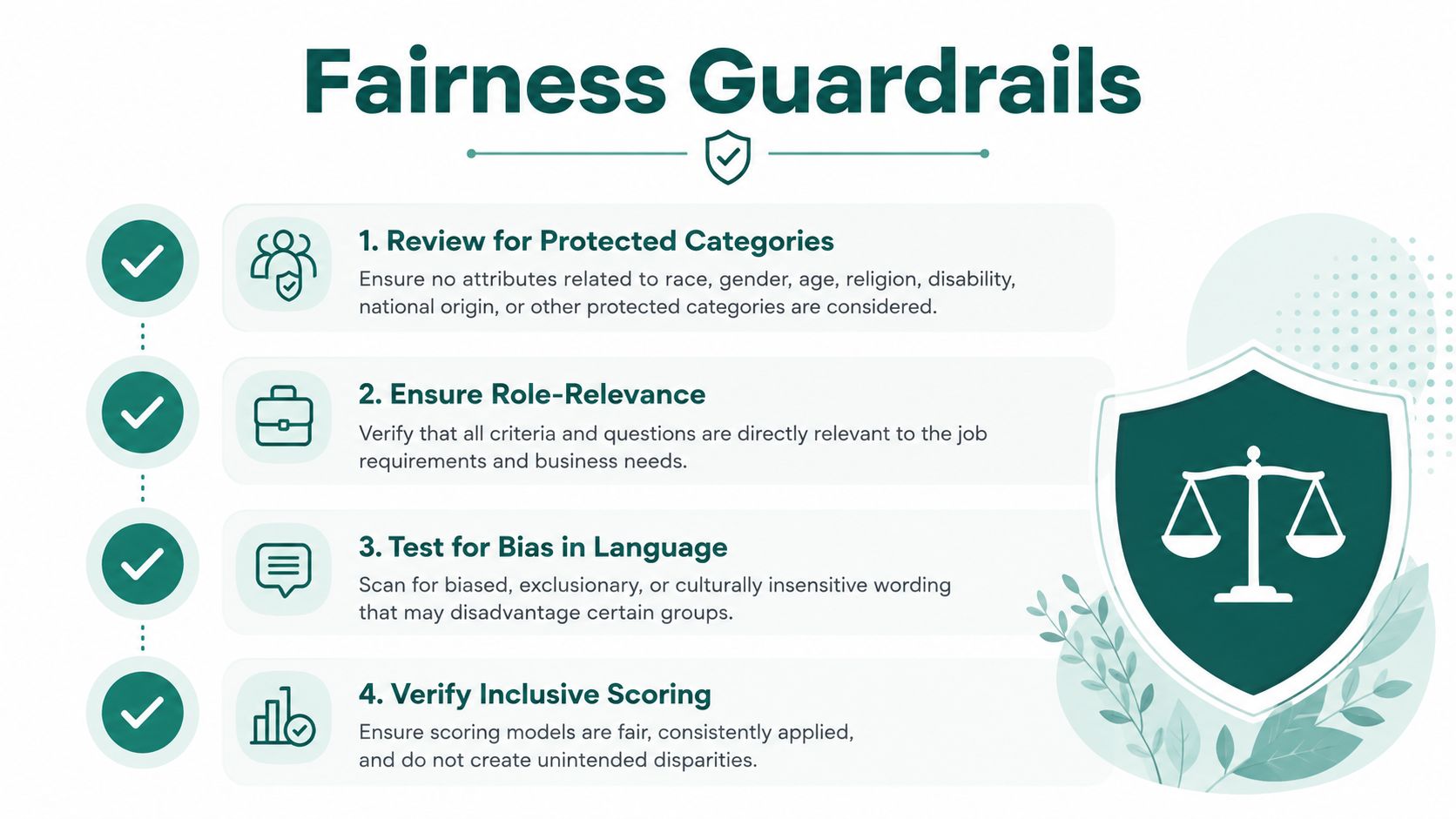
Compliance shouldn't be a cleanup step. It should shape the question from the first draft. If a prompt touches a protected category, or even sounds like it might, the burden is on the team to prove it's job-related and necessary. That's why the safest interview process is the one that removes risk before the question reaches the candidate.
Questions about family status, age, health, disability, religion, citizenship assumptions, caregiving, or tenure can wander into trouble fast, even when the interviewer thinks they're being conversational. “How long do you plan to stay?” sounds harmless, but it often signals a hidden concern about age, family plans, or stability. “Do you have any kids?” is even worse. It doesn't belong in the process.
Safer rewrites keep the focus on work. Instead of asking about family obligations, ask about schedule requirements for the role. Instead of asking about background assumptions, ask about job-relevant experience. If a question feels like a shortcut to avoid a proper work sample or structured prompt, it probably is.
If a prompt touches a sensitive area at all, write down the job-related reason before you use it. That doesn't just protect the company. It forces the team to decide whether the information is needed. If the answer is no, cut the question.
If a question can't survive a compliance review on paper, it won't survive a candidate challenge either.
Candidate-facing questions about compensation, benefits, and culture need consistency too. The answer shouldn't depend on which recruiter got there first or how well the candidate pushed. If you're using an automated or semi-automated system, make sure the information comes from employer-approved content so every applicant gets the same answer.
A short audit helps. Ask whether the question is role-relevant, whether it could be read as a proxy for a protected trait, whether the wording invites bias, and whether interviewers will score it the same way. If any answer is shaky, rewrite it before it ships.
A structured question bank travels cleanly into AI-assisted screening only when the design is already disciplined. If the prompts are tied to competencies, the scorecard is explicit, and the rubric is written before screening starts, then a conversational system can collect the same evidence a human interviewer would need later. If the design is sloppy, automation just scales the mess.
For teams looking at vendors, the useful checklist is practical. You want customizable rubrics, audit trails, ATS and HRIS integrations, candidate opt-outs, and a clear line between screening recommendations and final hiring decisions. You also want the tool to ask the same role-specific questions consistently, not just collect application fields and hand back a vague summary. Burnt screening platform is one example of a system in this space worth reviewing alongside others.
Talent Pronto fits this model because its conversational screening asks candidates role-specific behavioral and technical questions, then prepares structured scorecards for the hiring team. It also supports 24/7 screening, integrates with systems like Greenhouse, iCIMS, Paylocity, ADP, and Workday, and leaves final advancement decisions with the employer. That's the right architecture for a question bank that needs to work across human and automated loops.
The same bank can power asynchronous screening, top-of-funnel conversations, and later human interviews if the prompts are short, clear, and tied to the rubric. That's the advantage of treating interview questions as a system. The words stay useful because the structure around them does the heavy lifting.
Talent Pronto helps teams turn interview questions into a structured screening workflow, with role-specific prompts, scorecards, and conversational candidate engagement that can run across web and mobile. If you're rebuilding your question bank and want it to work in both human and AI-assisted hiring loops, visit Talent Pronto and see how the pieces fit together.

Talent Pronto is an AI-powered hiring platform built around Anna, our intelligent AI that conducts 24/7 conversational screening, evaluates candidates against specific job requirements and compliance needs, and schedules interviews. Run everything on the Talent Pronto ATS, our all-in-one applicant tracking system with a branded careers site and Anna built in, or keep your existing ATS and let Anna integrate with Greenhouse, Ashby, iCIMS, Jobvite, Lever, Oracle, and more. Either way, we help organizations reduce time-to-hire and build stronger teams.