Unlock top talent in 2026! Use our scenario based interview questions to boost hiring accuracy and find the best candidates. Get proven strategies now.
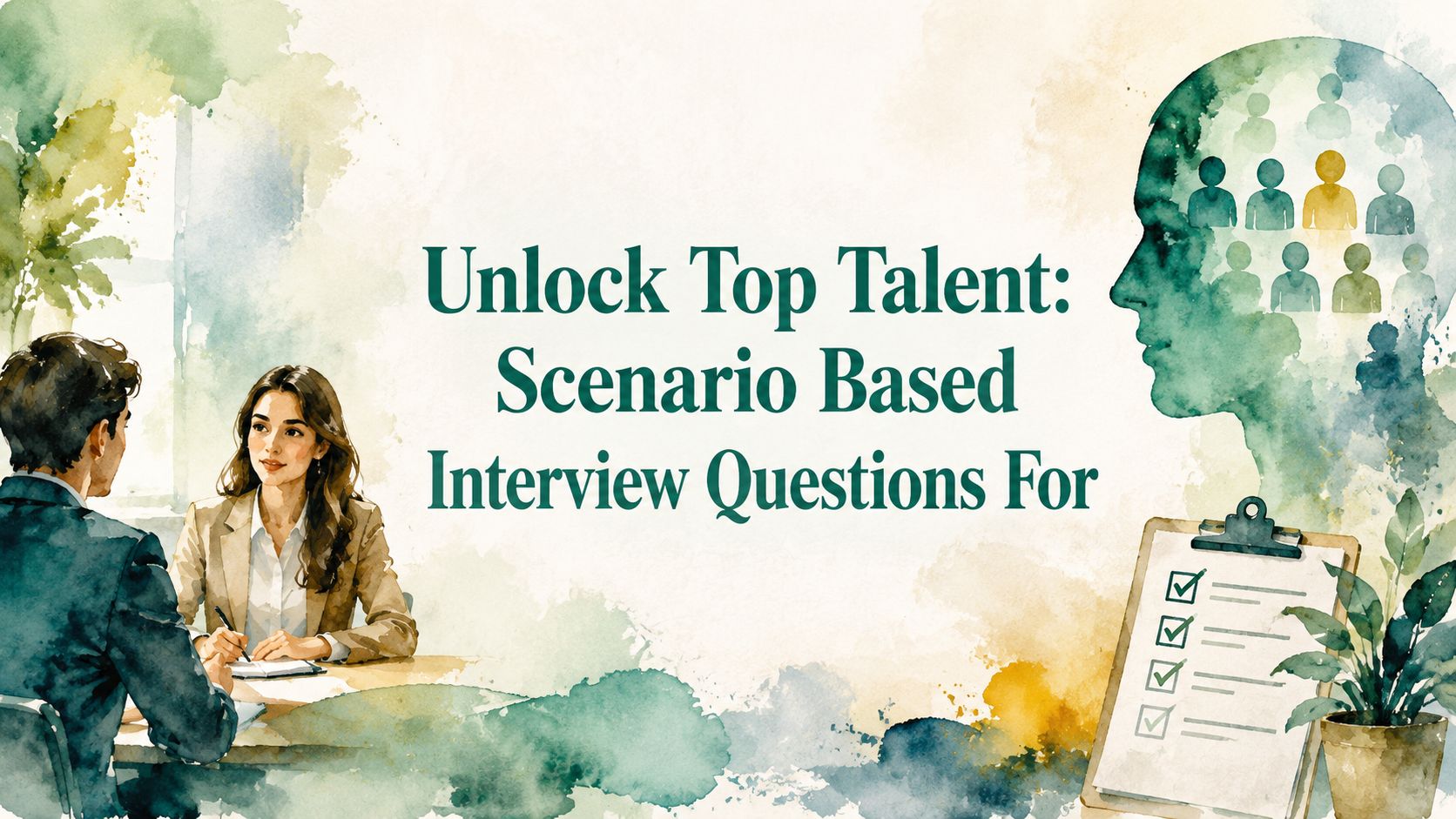
Why Scenario Based Questions Matter in 2026
Scenario based interview questions work because they measure judgment in motion, not just polish in conversation. Meta-analytic research puts the predictive validity of situational judgment tests at 0.37 for job performance, compared with 0.23 for unstructured interviews, which makes them materially better at forecasting hiring success when employers shift from casual conversations to structured, problem-focused formats across a dataset of more than 100,000 applicants meta-analytic findings on scenario based interviews.
That matters because hiring mistakes usually come from misreading how someone will solve problems, handle pressure, and work with other people once the job starts. Resumes don't show that. Traditional interviews often don't either.
Scenario based interview questions force candidates to reveal their decision path. They also create a cleaner comparison between applicants because everyone responds to the same challenge. Structured formats can reduce bias compared with unstructured interviews, especially when evaluators score against defined criteria rather than instinct alone, as reflected in research and industry analysis on standardized assessment approaches structured screening and bias reduction in hiring.
The practical payoff isn't just better signal. Structured scenario interviews have also been linked to faster hiring and stronger retention when organizations use them consistently instead of treating them as one-off prompts in otherwise unstructured interviews structured scenario interviewing outcomes.
The best way to use them isn't to ask random hypotheticals. It's to pair each scenario with a clear competency, a level-appropriate expectation, probing follow-ups, answer examples, and a simple rubric. That's where scenario based interview questions stop being a vague interviewing trend and become a repeatable hiring system.
A strong customer recovery scenario shows whether a candidate can balance empathy with action when emotions are high and facts are still incomplete. That's why it works so well in healthcare, hospitality, and retail. The candidate has to calm the person in front of them, protect trust, and move toward a fix without hiding behind policy.
Start with a specific prompt such as: a patient received the wrong appointment time and missed a critical procedure, a guest got cold food during a celebration, or a retail customer opened a damaged product and wants an immediate replacement. Give the tone and urgency. Then pause long enough for the candidate to think.
A realistic scene helps candidates stop reciting and start reasoning.

Ask: "A customer says your company wasted their time, wants to leave, and demands an immediate solution. What do you do first, and what happens next?"
Use it to score these competencies:
For entry-level roles, a solid answer centers on listening, clarifying the facts, and proposing a timely next step. For managers, the bar rises. They should also explain escalation, service recovery limits, and what process change would prevent repeats.
Practical rule: Don't score style alone. Score whether the answer protects the relationship and moves the issue toward resolution.
A strong answer sounds like this: "I'd start by acknowledging the impact and confirming the key facts. If it's a healthcare scheduling error, I'd check urgency immediately, involve the appropriate clinical contact if safety is affected, and give the patient a concrete next step before ending the conversation. After the immediate fix, I'd document the error and review how the scheduling handoff failed."
A weak answer sounds like this: "I'd apologize and explain the policy." That response isn't wrong. It's incomplete. It centers the company before the customer.
Use follow-ups that reveal reflection. Ask, "What would you do differently if the customer became more upset?" and "What would you change in the process afterward?" Candidates who can improve in real time tend to perform better in real customer environments.
Later in the process, you can compare how applicants communicate in live settings through tools that support remote interaction, including Skype web app features.
A short demonstration can help interviewers calibrate tone and pacing before scoring.
Conflict questions separate candidates who manage friction from those who avoid it, personalize it, or overpower it. Tight deadlines make this scenario especially revealing because time pressure often pushes people toward false certainty.
Use a prompt with legitimate disagreement. In manufacturing, a production team may want to keep a legacy process while a new hire pushes automation. In tech, frontend and backend developers may disagree on feasibility for a client request. In healthcare, clinical staff and administrative staff may have competing scheduling priorities that both make sense from their own vantage point.
Ask: "Two team members strongly disagree on how to finish an urgent project, and both have valid concerns. What do you do?"
The strongest candidates don't rush to impose a decision. They first surface the interests behind the positions. That's the difference between collaboration and mere mediation.
A useful scorecard can group signals into listening, diagnosis, facilitation, and decision quality. Teams that want a more standardized system often build this into broader behavioral assessment tools for hiring.
Good conflict answers don't erase disagreement. They convert disagreement into a decision process people can accept.
For individual contributors, look for three things:
For supervisors and managers, add a higher bar:
A strong answer might say, "I'd meet briefly with both parties, establish the critical parameters, and ask each person to define the trade-offs in their preferred approach. Then I'd choose or combine the path that best fits the timeline and risk profile, explain why, and close the loop after delivery."
A weak answer usually sounds cleaner than it is: "I'd tell them to put personal issues aside and follow the plan." That may end the conversation. It doesn't build a team.
Technical interviews often overvalue recall and undervalue reasoning. A pressure scenario corrects that by forcing the candidate to work through ambiguity with incomplete information, stakeholder impact, and operational risk.
The prompt should involve a live problem with consequences. An EHR sync failure during peak usage. A CNC machine producing dimensional errors with unclear root cause. A lab instrument showing calibration drift that could trace back to hardware, reagents, or procedure. The point isn't whether the candidate guesses right first. It's whether they triage well.
Don't present all the facts at once. Reveal the scenario in stages as the candidate asks questions. Research on scenario-driven interviews notes that strong organizations intentionally add new variables mid-response to test adaptability, while most interview guidance still treats scenario prompts as static scenario-driven interviews and dynamic complications.
That finding changes how technical interviewers should score. The quality of questions asked matters as much as the final recommendation.
A structured library of technical interview questions for role-specific screening can help teams build these staged prompts instead of defaulting to trivia.
A strong technical answer usually follows this order:
If the role is senior, add one more requirement. The candidate should show how they'd coordinate engineering judgment with stakeholder communication, especially when the data is still noisy.
A weak answer jumps to a favorite tool or pet theory. "I'd restart the service and see if it works" can be fine as one step. It isn't a complete operating model in a high-stakes environment.
Ethical scenarios expose whether a candidate has a decision framework or just a preference for sounding principled. That's especially important in healthcare, pharma, government, and regulated manufacturing, where the easiest short-term answer can create the biggest long-term risk.
Use realistic prompts. A supervisor asks for coding that increases reimbursement. A colleague wants to suppress negative side effect data to protect a trial timeline. A senior public-sector employee pressures the team to favor a connected applicant. A cost-cutting push suggests removing quality checks because they rarely catch issues.

Ask: "Your manager tells you to proceed even though the decision appears to conflict with policy or regulations. What do you do?"
Candidates who recognize the ethical problem immediately are easier to trust than candidates who first ask whether they'll get caught. In high-volume hiring, this category also has a structural problem. Industry analysis states that 70% of scenario questions in mass hiring lack standardized scoring rubrics, which leaves too much room for evaluator preference instead of role criteria scenario interview question standardization and evaluator bias.
That insight changes the evaluation method. Ethical scenarios shouldn't be scored on moral theater. They should be scored on issue recognition, reasoning, escalation path, and documentation.
Organizations building regulated hiring workflows often formalize this through compliance interview questions calibrated for audited environments.
Use a simple four-part scale:
Evaluator warning: A polished answer without a reporting path is weaker than a plain answer with clear reasoning and escalation steps.
A strong answer might say, "I'd verify the facts, decline to take the improper action, document the request, and escalate through the appropriate channel if the issue isn't corrected." A weak answer is softer: "I'd try to keep everyone happy while finding a middle ground." In ethical breaches, the middle ground is often the problem.
Scarcity reveals decision quality fast. When candidates have enough budget, staff, or time for everything, they don't need to rank trade-offs. Once resources tighten, their real operating logic shows up.
Give them a prompt with competing valid needs. A healthcare leader must choose between a patient safety upgrade, staff development, and operational efficiency. A product lead has engineering capacity for only three out of eight customer requests. A retail manager faces peak-season staffing gaps across multiple locations.
Ask: "You can't fund or complete everything. How do you decide what gets prioritized, and how do you explain the trade-offs?"
Then use one follow-up that changes the frame. "What if your loudest stakeholder disagrees?" or "What would you do differently with twice the budget?" The second question is underrated because it shows whether the candidate has a flexible framework or only a scarcity reflex.
For product, tech, and operations roles, scenario scoring gets sharper when candidates use explicit prioritization models. Domain guidance for tech and product management emphasizes data-driven frameworks such as investigating user acquisition data, analyzing conversion rates, using A/B testing, and even proposing scoring systems that balance feature complexity against long-term strategic benefit industry-calibrated scenario guidance for tech and healthcare roles.
A strong answer explains the framework before the choice. For example: protect safety or service continuity first, rank options by impact and reversibility, gather input from key stakeholders, then communicate what won't be done and why.
That explanation matters more than the exact choice, especially if multiple answers could work.
A weak answer starts with the favorite option and reverse-engineers justification afterward. In interviews, that often sounds decisive. On the job, it's often just bias in a confident voice.
Most interview prep still assumes static prompts. Real work isn't static. Projects change, requirements shift, and new information arrives after people have already committed effort.
That's why an ambiguity scenario should move. Start with one challenge, then add a complication halfway through. In healthcare, a merger changes systems and protocols. In tech, the product strategy pivots after market feedback. In manufacturing, a supply disruption forces sourcing redesign. In pharma, adverse event findings alter a trial plan.
Ask the candidate to respond, then interrupt with a new variable. Maybe the timeline shortens, a key stakeholder objects, or the original data turns out incomplete. Research on dynamic scenario-driven interviews argues that many candidates are underprepared for this because standard interview guides treat scenarios as one-path hypotheticals instead of evolving simulations dynamic scenario interview design and adaptability testing if earlier principles are applied to scoring mechanics, though the core dynamic design concern was noted earlier.
What matters isn't whether the candidate stays calm in performance terms. It's whether they can pause, reassess, and revise without becoming defensive or pretending nothing changed.
The best candidates don't protect their first answer. They update it.
For junior candidates, score openness to new information and ability to ask clarifying questions. For mid-level candidates, add communication. Can they explain the change to teammates or customers without creating confusion? For senior candidates, add transition leadership. Can they preserve momentum while resetting priorities?
A strong answer sounds like: "Given the new information, I'd revisit the assumptions behind my first plan. I'd explain what changes immediately, what stays stable, and what decision I'd delay until I have the missing input."
A weak answer usually falls into one of two traps. It either clings to the original plan as if nothing changed, or it overreacts and rebuilds everything from scratch. Adaptability sits between rigidity and chaos.
Some roles don't fail because of poor technical thinking. They fail because the candidate can't align people with different incentives, risk tolerances, and information needs.
A stakeholder scenario should include at least three parties with legitimate but conflicting priorities. In healthcare, that might be clinicians, patient safety advocates, and cost-conscious administrators. In pharma, it could involve R&D, commercial, and regulatory affairs. In manufacturing, it might be the production floor, quality team, and a waiting customer.
Ask: "You need agreement from multiple stakeholders who want different outcomes. How would you move this forward?"
Strong candidates map the audience before they propose the message. They recognize that executives, peers, regulators, and frontline staff don't need the same level of detail, the same cadence, or the same framing.
Broad communication skill translates directly into operational judgment. Candidates should know when to use a quick escalation, when to hold a cross-functional meeting, and when to separate decision-makers from informed parties.
A strong answer often includes a communication sequence: identify decision rights, gather concerns separately if needed, align on essential requirements, present options with trade-offs, then create a follow-up cadence by stakeholder group.
If the candidate can also describe how they'd preserve trust with the group that doesn't get its preferred outcome, that's a strong sign for senior roles.
A weak answer sounds procedural. "I'd send an update email and keep everyone informed." Communication isn't stakeholder management if it doesn't move alignment, reduce misunderstanding, or support a decision.
This scenario shows whether a leader can address poor performance without drifting into avoidance, aggression, or vague coaching. It's one of the clearest differentiators between someone who supervises tasks and someone who manages people.
Use prompts grounded in repeated behavior. A nurse arrives late and disrupts handoffs after an informal conversation already failed. An engineer's code quality causes delays and they're defensive when peers offer feedback. A hospitality employee keeps drawing complaints and there's observation but limited documentation.

Ask: "How would you prepare for the conversation, what would you say, and what happens if the employee becomes defensive?"
The preparation piece matters. Strong candidates mention examples, documentation, timing, privacy, and organizational process. In regulated environments, they should also know when HR or another function needs to be involved.
For healthcare-specific screening, scenario questions are especially useful because they force candidates to demonstrate patient-safety and compliance judgment instead of relying on polished self-description. Talent Pronto notes that poor early-stage screening drives a large share of turnover in healthcare, which is why role-specific scenario questioning matters so much in that setting healthcare screening challenges and scenario-based evaluation.
Score the response on four dimensions:
A strong answer sounds like, "I'd prepare documented examples, hold the conversation privately, state the pattern and impact clearly, listen to the employee's perspective, set expectations for change, and define follow-up." A weak answer either dodges the issue or jumps straight to punishment without trying to correct performance first.
Leaders who handle this well don't confuse kindness with vagueness. They make standards unmistakable.
This scenario reveals systems thinking. It shows whether a candidate can find the root cause of an operational problem that no single department owns.
Use prompts with shared pain and distributed responsibility. Patient wait times may involve scheduling, clinical flow, registration, and billing. A slower drug development cycle may require input from R&D, regulatory, manufacturing, and commercial teams. A defect problem may depend on production, maintenance, procurement, and quality assurance.
Start from the candidate's home function, then widen the lens. Ask: "Your department is being blamed for a recurring issue, but you suspect the root cause crosses multiple teams. How do you investigate and improve the process?"
That wording matters because it surfaces whether the candidate gets territorial or curious. The best candidates don't defend their silo first. They map the system first.
Scenario-based interviewing has become mainstream partly because organizations need more reliable, role-relevant views of this kind of judgment. Historical adoption data shows the method moved into mainstream use in the United States and Europe during the 1990s, with broad enterprise uptake over time as employers leaned into more structured, data-driven hiring historical adoption of structured scenario interviews.
Look for these signals in the answer:
A strong answer might describe gathering baseline process data, meeting affected functions separately to surface incentives and constraints, testing a smaller process adjustment, and defining who owns the new workflow. A weak answer usually starts and ends inside one department.
When candidates can explain how they'd handle a function that sees the fix as disadvantageous, you're no longer just hearing about collaboration. You're hearing about implementation.
In these scenarios, customer orientation gets tested against reality. The candidate has to balance customer need with policy, cost, timing, and authority limits. Anyone can say they're customer-centric when the answer is easy.
Use a prompt with friction built in. A patient is in pain but can't get an earlier covered slot. A tech support agent knows a workaround that solves a critical bug fast, but the standard process is much slower. A retail customer is outside the return window but clearly experienced a valid failure. A healthcare provider needs an expedited pharmaceutical shipment that strains normal cost and timeline assumptions.
Ask: "What decision would you make, how would you explain it to the customer, and what would you document or escalate internally?"
The strongest candidates don't default to policy language. They look for room to solve the underlying problem while respecting boundaries. That's where creativity shows up.
Candidates who use STAR tend to communicate this more convincingly. Guidance on scenario-based interviewing notes that responses structured around Situation, Task, Action, and Result are rated more favorably, especially when the result is quantified STAR-based scenario interviewing guidance. In an interview rubric, that doesn't mean every answer needs a number. It means the candidate should tie the decision back to a concrete outcome.
A strong answer sounds like this: "I'd clarify the urgency, review the flexibility I have, and explain transparently what I can do now versus what needs approval. If I can't grant the exact request, I'd still try to offer the best feasible alternative and document the exception or escalation."
A weak answer sounds like this: "I'd explain that's our policy." That protects the company in the narrowest sense while often damaging trust, retention, and future goodwill.
For roles that screen at scale, this scenario also benefits from structured scoring. Without it, interviewers often reward whichever answer matches their own personal instincts rather than the role's actual decision boundaries.
| Scenario | Implementation Complexity (🔄) | Resource Requirements (⚡) | Expected Outcomes (⭐ / 📊) | Ideal Use Cases | Key Advantages (💡) |
|---|---|---|---|---|---|
| The Customer Service Recovery Scenario | 🔄 Medium, scripted role-play; needs contextual detail | ⚡ ⚡, low to moderate time, trained evaluators | ⭐⭐⭐, predicts empathy & de-escalation; 📊 boosts retention metrics | Healthcare, Hospitality, Retail, Support reps | 💡 Reveals real-time EI; customizable; hard to pre-script |
| The Team Conflict and Collaboration Scenario | 🔄 Medium, multi-perspective setup, follow-ups required | ⚡ ⚡, moderate facilitation and scoring rubric | ⭐⭐⭐, predicts team fit & leadership potential; 📊 informs retention | Team leads, Project managers, Clinical supervisors | 💡 Surfaces conflict navigation style and consensus ability |
| The Technical Problem-Solving Under Pressure Scenario | 🔄 High, staged technical details, progressive reveals | ⚡ ⚡⚡, expert evaluators, realistic tooling/context | ⭐⭐⭐⭐, strong predictor for mission‑critical roles; 📊 reduces hiring risk | Software, IT ops, Biotech, Manufacturing techs | 💡 Assesses troubleshooting methodology and stakeholder comms |
| The Ethical Dilemma and Compliance Scenario | 🔄 Medium, carefully framed scenarios to avoid bias | ⚡ ⚡, interviewer skill and clear scoring criteria | ⭐⭐⭐⭐, predicts integrity & compliance behavior; 📊 prevents legal risk | Healthcare, Pharma, Regulated manufacturing, Government | 💡 Reveals values alignment and escalation willingness |
| The Resource Constraint and Priority-Setting Scenario | 🔄 Medium, realistic trade-offs, ambiguous 'right' answer | ⚡ ⚡, moderate prep, clear priority framework needed | ⭐⭐⭐, predicts strategic judgment; 📊 useful for leadership selection | Operations, Budget managers, Project leads | 💡 Shows trade-off analysis and stakeholder consideration |
| The Adapting to Change and Ambiguity Scenario | 🔄 Low–Medium, scenario can be concise but needs realism | ⚡ ⚡, moderate facilitation, contextual framing | ⭐⭐⭐, predicts resilience and learning agility; 📊 valuable in volatile contexts | Startups, Product managers, Operations, Research | 💡 Reveals mindset toward change and communication approach |
| The Stakeholder Management and Communication Scenario | 🔄 Medium, multiple perspectives, role complexity | ⚡ ⚡⚡, moderate to high prep for realistic stakeholder mix | ⭐⭐⭐⭐, predicts success in matrix orgs; 📊 improves cross‑functional outcomes | Program managers, Client-facing roles, Regulatory liaisons | 💡 Tests influence without authority and tailored communication |
| The Performance Management and Difficult Conversation Scenario | 🔄 Medium, requires behavioral anchors and follow-ups | ⚡ ⚡, moderate time, trained interviewers for nuance | ⭐⭐⭐, predicts supervisory effectiveness; 📊 impacts team retention | Team leads, Supervisors, Clinical leaders, Managers | 💡 Reveals balance of empathy and accountability; documents process |
| The Cross-Functional Collaboration and Process Improvement Scenario | 🔄 High, multi-department context, system-level detail | ⚡ ⚡⚡, significant prep, cross-functional knowledge | ⭐⭐⭐⭐, predicts ability to break silos; 📊 drives process gains | Process improvement, Quality, Ops, Project managers | 💡 Assesses systems thinking and collaborative solution design |
| The Customer-Facing Decision with Competing Constraints Scenario | 🔄 Medium, genuine constraints required to be fair | ⚡ ⚡, moderate realism and clarity on authority levels | ⭐⭐⭐, predicts customer-centric judgment; 📊 affects satisfaction metrics | Customer service, Patient coordinators, Support, Guest services | 💡 Tests judgment under policy limits and escalation sense |
The biggest mistake teams make with scenario based interview questions isn't asking the wrong scenario. It's asking a decent scenario with no scoring discipline behind it. When that happens, the interview feels structured to the candidate but remains subjective for the panel. That's where inconsistency creeps in.
A better operating model is simple. Match each scenario to one primary competency and one or two secondary competencies. Decide in advance what a strong, acceptable, and weak answer looks like for the level you're hiring. Then train interviewers to score evidence, not confidence.
That matters because the structural quality of evaluation affects fairness as much as the quality of the question itself. Emerging analysis indicates that organizations using structured, criteria-based scoring for scenario responses reduce bias exposure compared with unstructured gut-feel assessments criteria-based scoring and reduced bias exposure. The practical lesson is clear. Standardization isn't bureaucracy. It's signal protection.
The second mistake is treating scenarios as static scripts. The strongest interview loops use follow-ups that test reflection, adaptation, and boundaries. Ask what the candidate would do differently. Ask what they'd change if a stakeholder pushed back. Ask what new information would alter their choice. Those follow-ups reveal whether the person can think, not just rehearse.
For healthcare hiring, this becomes even more important because patient safety changes the scoring logic. Domain-specific scenario guidance in nursing emphasizes a prioritization hierarchy of assessment, action, communication, and documentation, and failure to prioritize patient safety in the action phase can be disqualifying healthcare scenario priorities and patient safety benchmarks. That principle is useful beyond nursing too. Every role has its equivalent essential requirements.
One practical way to roll this out is to build a small scenario bank instead of trying to overhaul the whole process at once. Choose five to eight recurring scenarios tied to your most common failure points. For each one, define the competency, seniority expectation, follow-up prompts, and a four-part rubric. That gives interviewers enough structure to compare candidates while leaving room for authentic answers.
Keep the scoring language concrete. Avoid labels like "executive presence" or "culture fit" unless you can define observable behaviors behind them. Better labels are things like clarifies assumptions, protects safety, prioritizes by impact, escalates appropriately, documents decisions, or adapts when conditions change. Those can be defended and audited. Vibes can't.
It's also worth separating interview quality from candidate polish. Scenario based interview questions often reward candidates who ask clarifying questions, revise their thinking when new information appears, and name trade-offs clearly. Those signals are more durable than charisma. They also map more closely to the work itself.
When teams use these scenarios consistently, the process becomes easier to improve. Hiring managers can compare score patterns, identify where interviewers disagree, and refine prompts that produce noisy results. That feedback loop is one reason structured scenario interviewing has spread so widely in modern hiring. By 2010, over 65% of Fortune 500 companies had integrated scenario-based questions into core interview processes, up from 28% in 2000 Fortune 500 adoption of scenario-based interviewing. The headline isn't just adoption. It's maturation. Employers learned that the question alone isn't the system. The rubric is.
If you want more signal from interviews next quarter, don't add more questions. Use fewer, better scenario based interview questions. Calibrate them by role. Attach follow-ups that test adaptation. Score on evidence. Then compare candidates against the same standard. That's how resumes stop dominating the process and real job judgment starts doing the work it should.
Talent Pronto helps employers turn scenario based interview questions into a repeatable screening system. Its AI-powered assistant conducts conversational screening around the clock, asks behavioral, technical, cultural, and compliance questions specific to the role, and produces structured scorecards against role-specific criteria. For teams hiring in healthcare, manufacturing, logistics, hospitality, retail, government, and tech, Talent Pronto offers a practical way to standardize early-stage evaluation, reduce manual review, and move qualified candidates forward faster while keeping final hiring decisions with the employer.

Talent Pronto is an AI-powered hiring platform built around Anna, our intelligent AI that conducts 24/7 conversational screening, evaluates candidates against specific job requirements and compliance needs, and schedules interviews. Run everything on the Talent Pronto ATS, our all-in-one applicant tracking system with a branded careers site and Anna built in, or keep your existing ATS and let Anna integrate with Greenhouse, Ashby, iCIMS, Jobvite, Lever, Oracle, and more. Either way, we help organizations reduce time-to-hire and build stronger teams.