Our training for interviewers provides a complete blueprint for better hiring in 2026. Learn key techniques to improve your interview process.
Most teams don't need another interview policy. They need a better operating system. The failure usually shows up in the same place, a debrief where two interviewers heard the same answers and somehow left with opposite conclusions, then the hiring manager is stuck reconciling gut feel, scorecard drift, and a candidate who's already comparing notes with another employer.
That's what weak training for interviewers really costs. It slows hiring, exposes bias, and turns every loop into an argument over memory instead of evidence. Strong programs don't just tell people to “ask better questions,” they define the questions, the scoring, the note-taking, the calibration, and the technology around the interview so the process behaves consistently when pressure is high.
The cost becomes obvious the minute a hiring team leaves the room with different stories about the same candidate. One interviewer remembers strong examples and clean delivery. Another remembers rambling, missed detail, or a score that feels low because the conversation never got anchored to a rubric. That kind of mismatch is not a personality issue, it's what happens when interviewers are asked to improvise a high-stakes evaluation without shared training.
A serious program gives people the same operating context. Statistics Netherlands (CBS) uses oral classroom instruction for interviewer basics across 8 training days over an elapsed 2 months, in groups of 12, and CBS says interviewer training improves response rates and the quality of information collected (CBS interviewer training model). That's a useful benchmark because it shows how a major statistical system treats interviewer preparation as infrastructure, not onboarding fluff.
The broader research points the same way. In one meta-analysis, the most common quality outcome measured was response rate, appearing in 22 studies, followed by correct recording of responses (14), item nonresponse (12), and reading questions exactly as worded (12) (systematic review of interviewer training). The practical lesson is simple, training works best when it improves standard execution, not when it tries to turn every interviewer into a performer.
Practical rule: if two interviewers can't defend their scores with the same evidence, the process is undertrained, not just “subjective.”
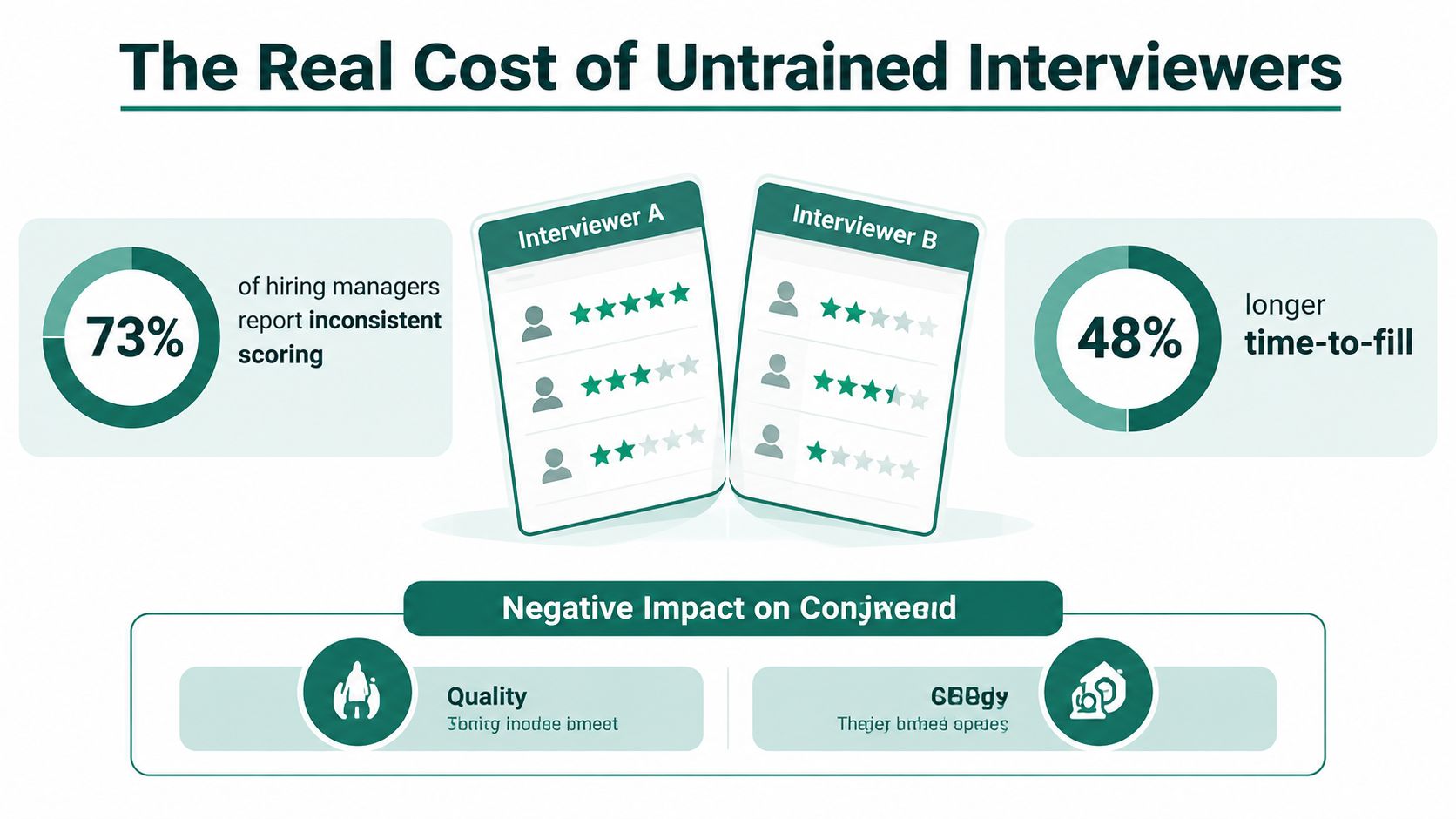
Untrained interviewers create hidden tax across the funnel. Recruiters spend more time repairing feedback. Hiring managers revisit decisions. Candidates hear inconsistency and lose trust. In regulated environments, that's more than inconvenience, because inconsistent scoring also weakens the paper trail that should show fairness and objectivity.
A mature program should move three things at once. It should make hiring conversations more comparable, reduce scoring noise, and make the interview itself easier to run under time pressure. That's the standard to aim for, whether the team is hiring nurses, machinists, or backend engineers. If the program doesn't make the loop more reliable for the people doing the work, it's not training, it's theater.
Generic curriculum is where interviewer programs go to die. A panel that hires emergency-room nurses, line supervisors, and software engineers should not use the same question bank or the same scoring language for every role. The starting point is a competency map, because that's what tells interviewers what they're looking for before they start asking questions.
A good map names the behaviors behind success. In healthcare, that often means clinical judgment, patient communication, and escalation discipline. In manufacturing, safety mindset and shift reliability matter more than polished storytelling. In retail, conflict handling and service recovery are usually more predictive than abstract leadership language.
From there, build the question bank. Behavioral questions belong where you need proof of past action. Technical or scenario questions belong where you need evidence of problem-solving under job-specific conditions. The cleanest way to avoid a bloated guide is to assign each question to one competency only, then write a short note explaining why it's there.
Keep the curriculum tight enough that an interviewer can use it live without translating it in their head.
The next layer is the rubric. If the scale is too vague, interviewers fill in the gaps with preference. If it's too detailed, they stop using it. The useful middle ground is a scorecard that defines what “strong,” “acceptable,” and “weak” look like for the role, then ties each description to observable evidence rather than personality language.
A one-page curriculum template works well in practice: - Role competencies. What success looks like in this job. - Core questions. The exact questions interviewers must use. - Probe guidance. What to ask when the first answer is thin. - Scoring anchors. What each rating means in behavior, not vibe. - Practice segment. Time reserved for mock use of the rubric.
That structure lets you calibrate by seniority too. Entry-level roles usually need more evidence of learning agility and coachability. Senior roles need stronger evidence of judgment, prioritization, and cross-functional influence. The point isn't to make every interview identical, it's to make every interview legible.
The conversation itself gets disciplined. Interviewers do not need to sound robotic. They need to know how to gather evidence without leading the candidate, losing focus, or drifting into a free-form chat that can't be scored later. The STAR method is still the cleanest foundation for behavioral interviewing because it pushes the interviewer to ask for Situation, Task, Action, and Result instead of accepting a polished summary.
A workable structure keeps the conversation from bloating. One practical format uses 5 minutes for introductions, 30 minutes for three behavior-based questions with probes, 5 minutes for candidate questions, and 5 minutes to close (step-by-step interviewer guide). That time budget matters because it forces discipline. If an interviewer spends ten minutes on small talk, they have already stolen evidence time from the scorecard.
| Segment | Duration | Purpose |
|---|---|---|
| Introductions | 5 minutes | Set context and reduce early anxiety |
| Behavior-based questions with probes | 30 minutes | Gather evidence against competencies |
| Candidate questions | 5 minutes | Clarify role and process |
| Close | 5 minutes | Explain next steps and end cleanly |
Technical interviewing needs the same kind of structure, just with different evidence. The best technical prompts test how a candidate reasons, not whether they can recite trivia. That's why a role-specific question set should be paired with a guide that keeps interviewers from over-indexing on puzzle culture. If you need a working set of prompts for that part of the loop, use technical interview questions as a reference point for building role-appropriate depth.
A flawed interview usually sounds friendly but gives away the answer. “You handled that conflict well, right?” is a leading question. “Tell me about a time you disagreed with a teammate, what happened next?” is neutral. The first invites agreement. The second gives the candidate room to show evidence.
Neutral questions, one at a time, beat clever wording every time.
The same is true for active listening. Feigned rapport sounds like the interviewer performing warmth while waiting for their turn. Real listening sounds quieter. The interviewer tracks the answer, asks a follow-up, and doesn't interrupt the first two sentences just to prove they're engaged. That difference matters because strong interviewing collects facts, it doesn't cosplay as empathy.
Most interview training gets this wrong by leading with legal fear instead of practical control. People remember a list of don'ts, then go back into interviews without a usable method. A fairer conversation starts with structure. Every candidate gets the same core questions, the same order, detailed rating scales, and structured notes, because those are the controls that reduce inconsistent scoring and bias leakage.
U.S. government guidance on structured interviews is blunt about the controls that matter. Ask every candidate the same questions, use detailed rating scales, take notes, and train interviewers as core safeguards for fairness and objectivity (structured interview guidance). That is the legal and operational baseline, not the finish line.
The harder part is making the interview feel human without letting it drift. GESIS recommends both a theoretical rules overview and practical mock interviews, which is the right combination because rule-reading alone doesn't change behavior (GESIS interviewer skills training guide). In practice, that means interviewers should learn the boundaries first, then rehearse them in conversation.
Keep the script in the rubric, not in the interviewer's mouth.
The best interviews sound structured, not stiff. That means the interviewer can keep the same core questions while still using natural transitions, a normal tone, and enough flexibility to let the candidate finish a thought. Rigid scripting often hurts rapport because candidates feel boxed in, but a flexible structure preserves fairness if the interviewer still captures comparable evidence.
A simple compliance checklist helps: - Use the same questions for each candidate in the same role. - Take structured notes tied to competencies, not impressions. - Rate against anchors instead of gut feel. - Avoid off-limits topics that can create bias or legal risk. - Keep room for follow-up only when it deepens evidence, not when it changes the standard.
For teams that need a practical bias refresher before training, this interview bias guide is a good companion reference. The key is not to make interviewers timid. It's to make them consistent enough that fairness is visible in the record.
Nothing replaces reps. Interviewers get better when they first watch strong interviewers, then run practice interviews under observation, then get specific debriefs, then compare scorecards in calibration. That sequence works because it moves from observation to execution, and then from individual judgment to shared standards.
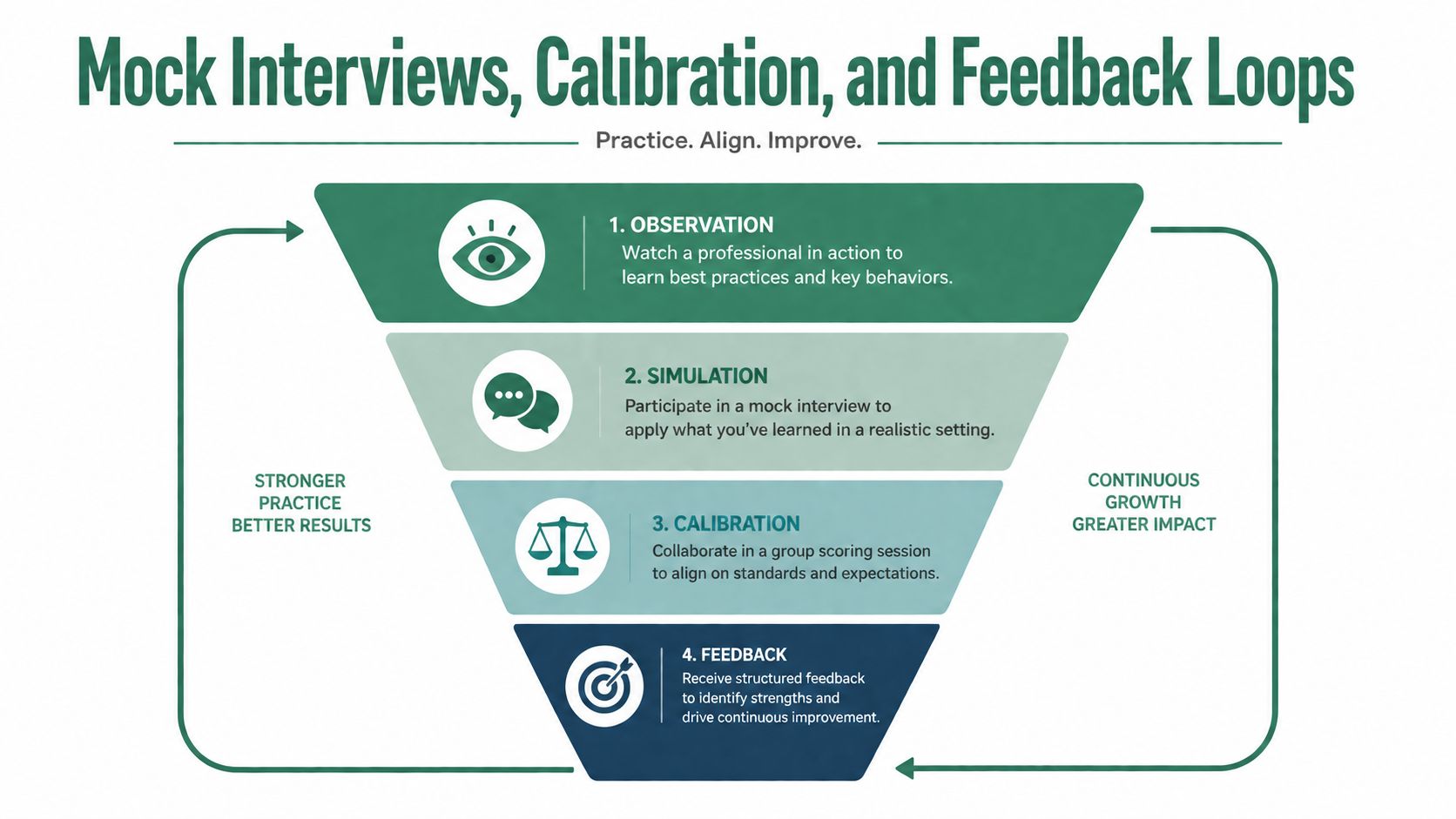
Start by pairing a trainee with an experienced interviewer. The trainee watches for how the pro opens the conversation, handles silence, asks probes, and writes notes. Then the trainee conducts a mock interview while someone else observes, tracks misses, and flags where evidence was thin or a question led the candidate.
The debrief should be behavioral, not vibes-based. “You seemed confident” is useless. “You interrupted the second answer before the candidate gave an example, so we lost evidence for ownership” is actionable. The goal is to connect a behavior to a scoring outcome, because that's how someone learns what to do differently next time.
Calibration is where teams stop pretending that score differences are self-explanatory. Put two or three scorecards side by side, read the notes, and compare the evidence behind each rating. If one interviewer scored a candidate higher because they liked the delivery, while another scored lower because the answer lacked specifics, the group should resolve that difference by returning to the rubric.
The best calibration sessions end with a written adjustment, if needed, or a note that the rubric is sound and the interviewer needs more practice using it. That avoids the worst failure mode, where every discussion becomes a fight over who “saw it right.” It also keeps the program honest when patterns emerge across roles.
The useful sequence is simple: - Observe first. Watch an experienced interviewer run a complete loop. - Simulate next. Run a mock interview with a live observer. - Debrief immediately. Capture what was said, what was missed, and what evidence was weak. - Calibrate in groups. Compare scorecards and align on rubric use.
A short video-based learning layer can help reinforce the live work, especially for distributed teams. The point is not to replace practice. It's to make the practice repeatable.
Modern interviewer training has to cover more than note-taking and behavioral questions. Teams are now using AI-assisted screening, structured scorecards, and ATS or HRIS integrations to move candidates through early hiring faster. The risk is obvious, if interviewers trust the machine blindly, they stop exercising judgment. If they distrust everything the system produces, they create inconsistency another way.
Talent Pronto is one example of a platform that runs 24/7 conversational screening, asks behavioral and technical questions, and prepares structured scorecards before the live interview, while syncing with ATS and HRIS systems such as Greenhouse, iCIMS, Paylocity, ADP, and Workday. That kind of setup can reduce manual screening load, but it still depends on interviewers who know how to interpret the output rather than rubber-stamp it. The interviewer remains the accountable decision-maker.
The new skill is AI literacy for interviewers. That means knowing when to trust a structured summary, when to challenge it with specific evidence, and how to explain the process to candidates without sounding evasive. It also means treating automated summaries as support, not truth, because summaries can flatten nuance that matters in hiring.
Teams need to train interviewers to inspect the scorecard, not just read it. Which evidence supported the rating. Which answer was paraphrased too aggressively. Which competency looks strong on paper but weak in the notes. Those are the questions that keep the human in control.
The broader market is moving toward more conversational interfaces and interview intelligence, but most public training material still centers on traditional preparation, note-taking, and behavioral questions. That gap is why a responsible program now needs a module on how to verify AI-generated outputs before using them in a decision. If the candidate-facing conversation feels too synthetic, it can also help to review tips for alive AI conversations as a reminder that conversational flow matters even when the system is automated.
The point of AI in interviewing is not to remove judgment. It's to make judgment better documented.
For teams evaluating different deployment paths, a virtual interview platform can sit between application intake and the live panel, but only if interviewers know how to read the output critically. AI-assisted screening should make the process more consistent, not more opaque.
A training program that never ships is just a deck in a folder. The rollout needs owners, deadlines, and evidence that the new behavior is sticking. A clean path is to start with a pilot group, expand to department coverage, then lock in measurement once interviewers have enough reps to show stable scoring.
Days 1 to 30, train a pilot group of hiring managers and high-volume interviewers, then ask them to run mock interviews and calibrate scorecards with TA support. Days 31 to 60, expand the same materials to each department, with HR or talent ops owning schedule discipline and rubric updates. Days 61 to 90, measure whether scoring is becoming more consistent and whether interviewers are using the guide in live loops.
The metrics that matter are the ones that show behavior and outcome. Track inter-rater agreement on scorecards, time-to-fill, quality-of-hire signals at 90 days, candidate NPS, and the percentage of interviewers who completed mock-and-calibrate cycles. Those numbers tell you whether the process is getting more reliable or just more documented.
Interviewer attrition mid-program usually means managers treated training like optional admin. Fix it by tying completion to hiring privileges, then giving managers a short version of the business case so they stop sending mixed signals.
Scorecard drift usually starts when people like the rubric in theory but default to old habits in live interviews. Fix it with side-by-side calibration, not another policy email. The interviewer should see exactly where the score diverged from the evidence.
Candidate experience complaints often come from interviews that sound stiff or repetitive. Fix it by teaching interviewers how to stay consistent without sounding scripted, and by tightening the 45-minute budget so the conversation doesn't sprawl.
Tool adoption stalls usually mean the software was introduced before the workflow was taught. Fix it by pairing the tool with a visible owner, a note-taking standard, and a weekly review of whether scorecards are being completed on time.
If you want a system that turns interviewer prep into a repeatable hiring capability, Talent Pronto can support the screening and scorecard side of that workflow while your team owns the standards, calibration, and final decision. Visit Talent Pronto to see how conversational screening can fit into a structured interviewer program and give your hiring team a cleaner evidence trail.

Talent Pronto is an AI-powered hiring platform built around Anna, our intelligent AI that conducts 24/7 conversational screening, evaluates candidates against specific job requirements and compliance needs, and schedules interviews. Run everything on the Talent Pronto ATS, our all-in-one applicant tracking system with a branded careers site and Anna built in, or keep your existing ATS and let Anna integrate with Greenhouse, Ashby, iCIMS, Jobvite, Lever, Oracle, and more. Either way, we help organizations reduce time-to-hire and build stronger teams.