Master talent pipeline management with proven strategies for sourcing, screening, and nurturing candidates. AI tools accelerate early-stage hiring.
A recruiting funnel can lose about 97% of applicants before they speak with a human, with roughly one hire for every 180 applicants according to a 2026 recruiting funnel benchmark summary. That reality changes the definition of talent pipeline management. The job isn't to collect more resumes. It's to protect qualified candidate intent, measure conversion at every stage, and fix the delays or screening decisions that remove strong people from consideration.
Across healthcare and technology hiring, the same operational pattern appears at scale. Teams invest heavily in sourcing, then let applications sit, use inconsistent screening criteria, or move candidates through interviews without reliable scorecards. A healthy pipeline behaves differently. It gives recruiters and hiring managers evidence about where candidates exit, why they exit, and which changes improve movement without lowering the hiring bar.
The brutal math is simple. Only about 6% of job views become applications, 3% of applicants reach interviews, and roughly one candidate is hired for every 180 applicants, according to the recruiting funnel metrics benchmark. In other words, about 97% of applicants are screened out before speaking with a human.
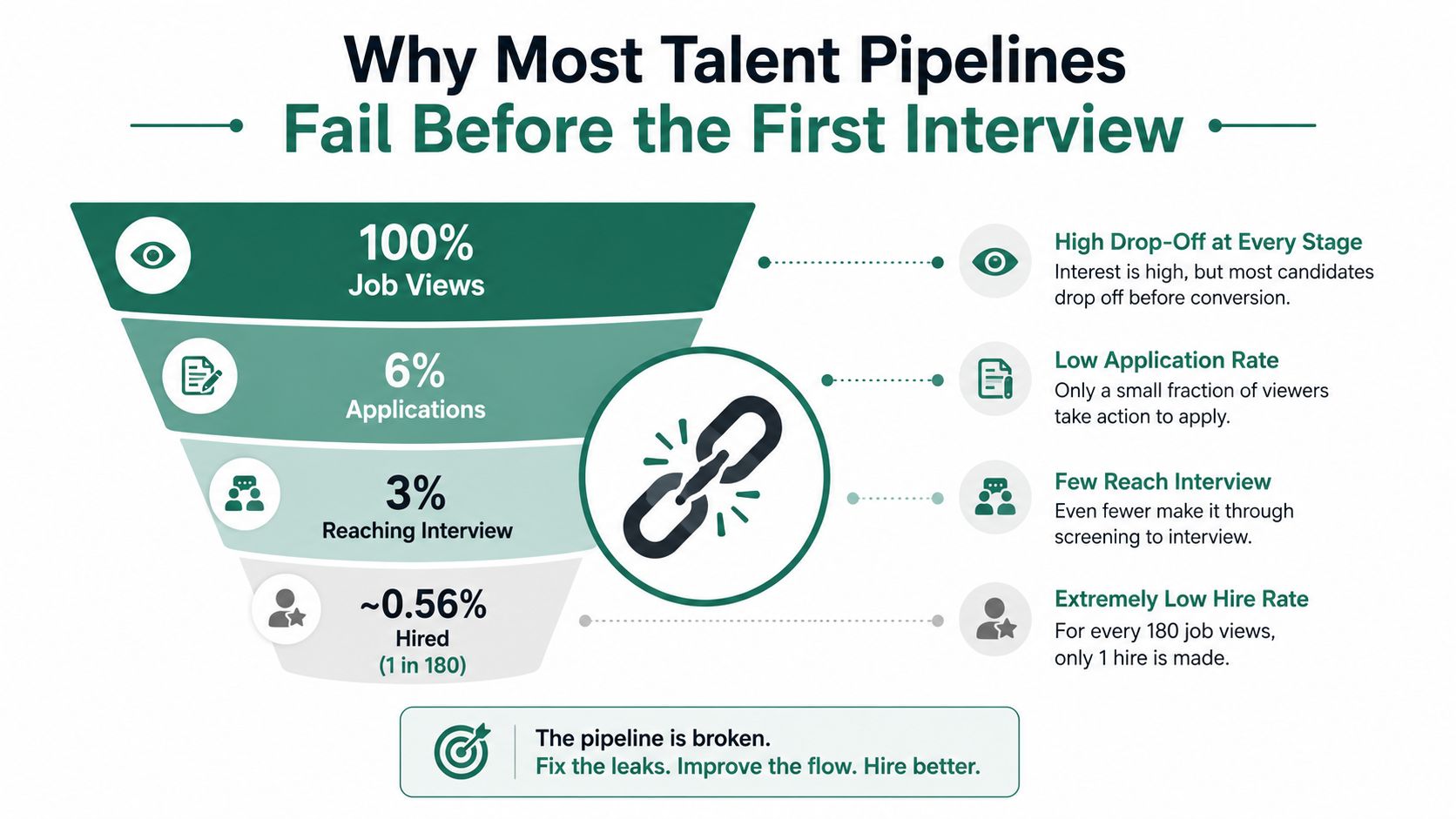
That drop-off doesn't automatically mean the funnel is broken. Hiring requires rejection, and many applicants won't meet the role's requirements. The problem starts when recruiting leaders can't distinguish intentional selection from avoidable abandonment. A qualified nurse may leave because the application takes too long. A software engineer may accept another offer because nobody responds. A strong applicant may be rejected because one recruiter interprets a competency differently from another.
Applicant totals are easy to report and difficult to act on. A large top-of-funnel number can conceal weak source quality, unclear job requirements, slow review, or a hiring team that disagrees about what “qualified” means. Talent pipeline management turns those hidden problems into stage-level questions.
Track the movement between apply-to-screen, screen-to-interview, interview-to-offer, and offer-to-accept. If applications are plentiful but recruiter screens remain scarce, inspect the sourcing mix and application criteria. If candidates pass recruiter screens but stall with hiring managers, examine scheduling, role alignment, and manager responsiveness rather than buying more advertising.
Practical rule: Treat every stalled stage as an operating problem to diagnose, not as a reason to pour more candidates into the top.
Candidate experience is part of this equation, not a separate brand initiative. Teams should review application completion, response latency, withdrawal reasons, and unanswered questions alongside funnel conversion. The candidate experience metrics guide provides a useful lens for connecting process behavior with applicant sentiment.
A pipeline review should therefore ask whether qualified people are being surfaced, contacted, assessed consistently, and moved forward quickly enough. Sourcing creates possibility. Conversion discipline creates hiring capacity.
A modern recruiting funnel usually contains 5 to 7 distinct stages, according to an overview of candidate pipeline conversion rates. The exact design varies by role, but the stages should reflect real decisions rather than administrative handoffs.
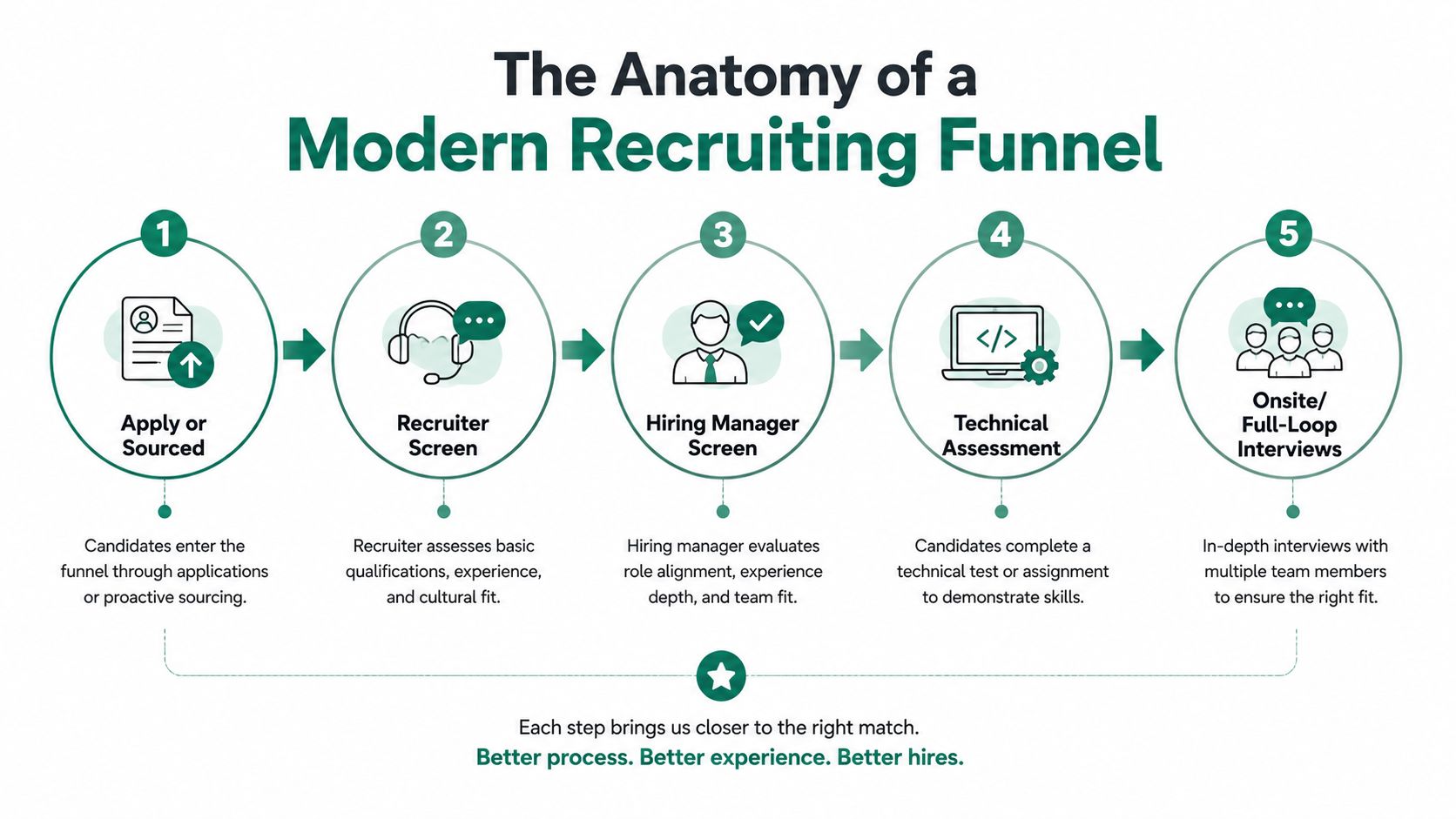
Apply or sourced is the entry point. Candidates may submit an application, respond to outreach, join a talent community, or come through an employee referral. The important question is whether the record contains enough information to determine the next action without forcing recruiters to reconstruct context from email threads.
Recruiter screen tests baseline requirements, motivation, availability, work authorization where relevant, and communication expectations. It shouldn't repeat every question in the application. Its purpose is to establish whether the candidate merits deeper evaluation.
Hiring manager screen connects the candidate's experience to the team's actual operating environment. Managers should assess scope, judgment, collaboration, and role-specific outcomes, not just confirm that a resume looks familiar.
Technical assessment may involve work samples, structured problem-solving, clinical scenarios, or another job-relevant exercise. The assessment should measure capabilities the job requires. A complicated test that doesn't resemble the work creates friction without improving selection.
Onsite or full-loop interviews gather evidence from multiple perspectives. Interviewers need distinct competencies and questions, otherwise several conversations produce the same shallow signal.
The useful data sits between stages. Apply-to-screen shows whether sourcing and initial criteria are aligned. Screen-to-interview can expose recruiter calibration problems or slow scheduling. Interview-to-offer helps identify assessment quality, hiring manager standards, or candidate fit. Offer-to-accept reflects the combined effect of compensation, role expectations, timing, and candidate trust.
A quarterly funnel review should segment these rates by source, role family, location, recruiter, and hiring manager. Global employers especially need comparable definitions across healthcare, retail, manufacturing, and technology. Otherwise, one region may appear productive because it counts stages differently.
A funnel is only useful when every stage has an owner, an entry definition, an exit definition, and a decision deadline.
Don't optimize every conversion rate blindly. A higher screen-to-interview rate may mean recruiters are advancing too many marginal candidates. A lower interview-to-offer rate may reflect a necessary correction after weak screening. The operational goal is not maximum movement. It's reliable movement of candidates who meet the role's requirements.
A legacy ATS chatbot usually handles administration. It asks applicants to confirm contact details, answer knockout questions, select availability, or locate a job description. That can reduce repetitive work, but it doesn't necessarily improve the quality of the screening decision.
An agentic AI screening system takes a different approach. It can conduct a conversation that probes experience, behavioral examples, technical understanding, cultural considerations, and compliance-related requirements. The output isn't merely a completed form. It's a structured record that helps an employer compare candidates against a defined rubric.
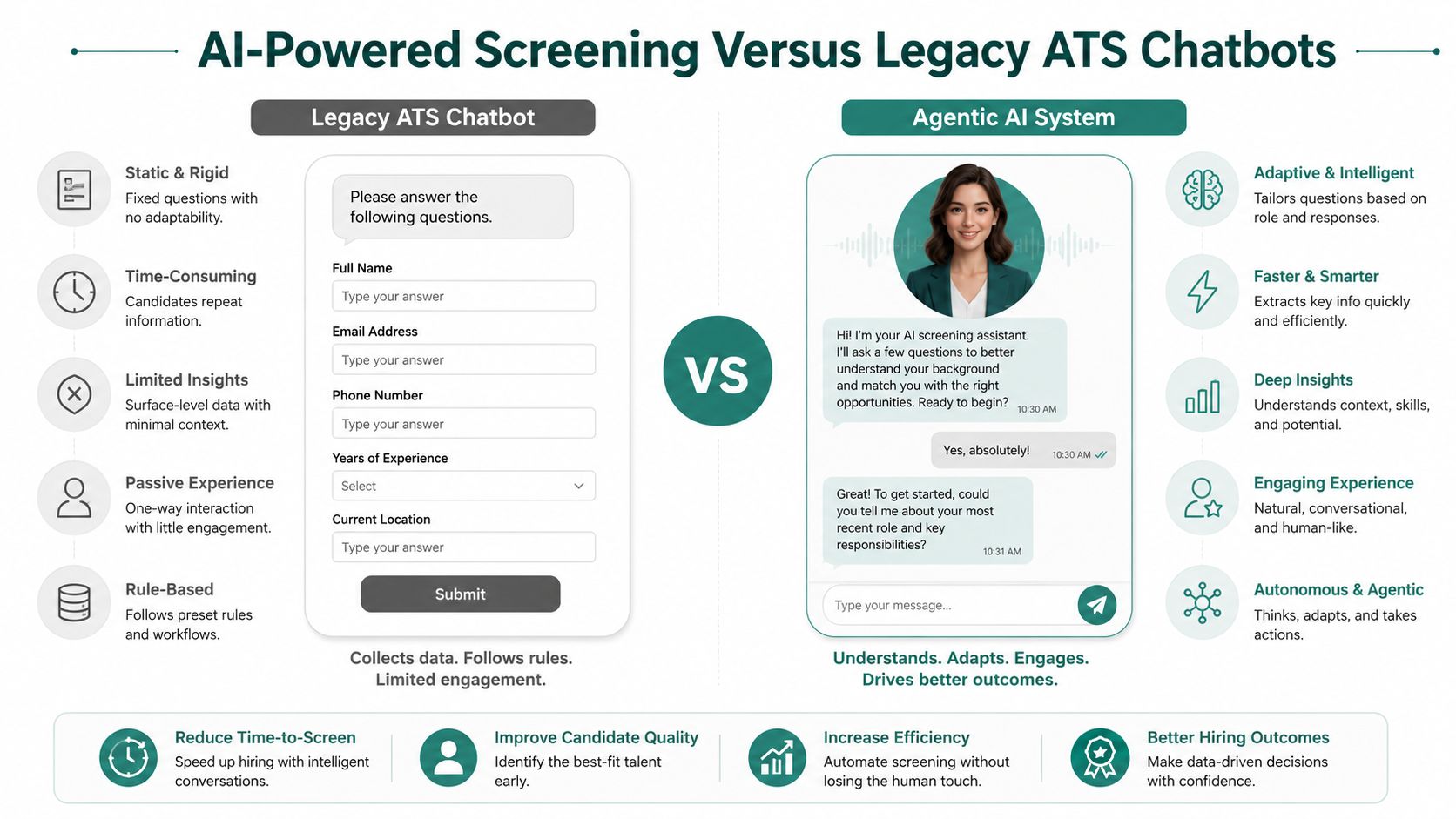
The distinction matters because speed can amplify a weak process. If an organization has unclear requirements, an automated tool may reject candidates faster without making the decision more defensible. Before deployment, recruiting and hiring managers should define:
Structured interviews have stronger predictive validity than unstructured interviews, and synthesis work identifies well-designed structured interviews as highly useful predictors of job performance, as summarized in this structured interview evidence review. That doesn't make automation automatically fair or accurate. It means a consistent structure gives AI and human reviewers a better foundation than improvised conversations.
Legacy chatbots still have a place for simple transactions. They can answer employer-provided questions, collect basic information, and route applicants. They become insufficient when teams need to understand how a candidate handled a technical problem, supported a patient population, managed a shift, or worked within a regulated environment.
Talent Pronto's virtual assistant Anna is one example of a conversational screening approach. Anna engages candidates around the clock, asks role-aware behavioral and technical questions, and prepares structured scorecards, while employers retain advancement and rejection authority. For a broader explanation of the underlying model, see how AI assistants work.
This video offers additional context on conversational hiring workflows:
The practical test is straightforward. If the tool only collects fields, it's an intake layer. If it produces consistent, job-relevant evidence that recruiters can audit, it can become part of talent pipeline management.
Candidate intent decays while applications wait in a queue. In a recruiting metrics benchmark, candidates who received an SMS immediately after applying showed an overall engagement rate of 58.92%, with an average first response time of 3 minutes 52 seconds and many replies arriving within 10 minutes of application completion, according to the PivotCX recruiting metrics benchmark.
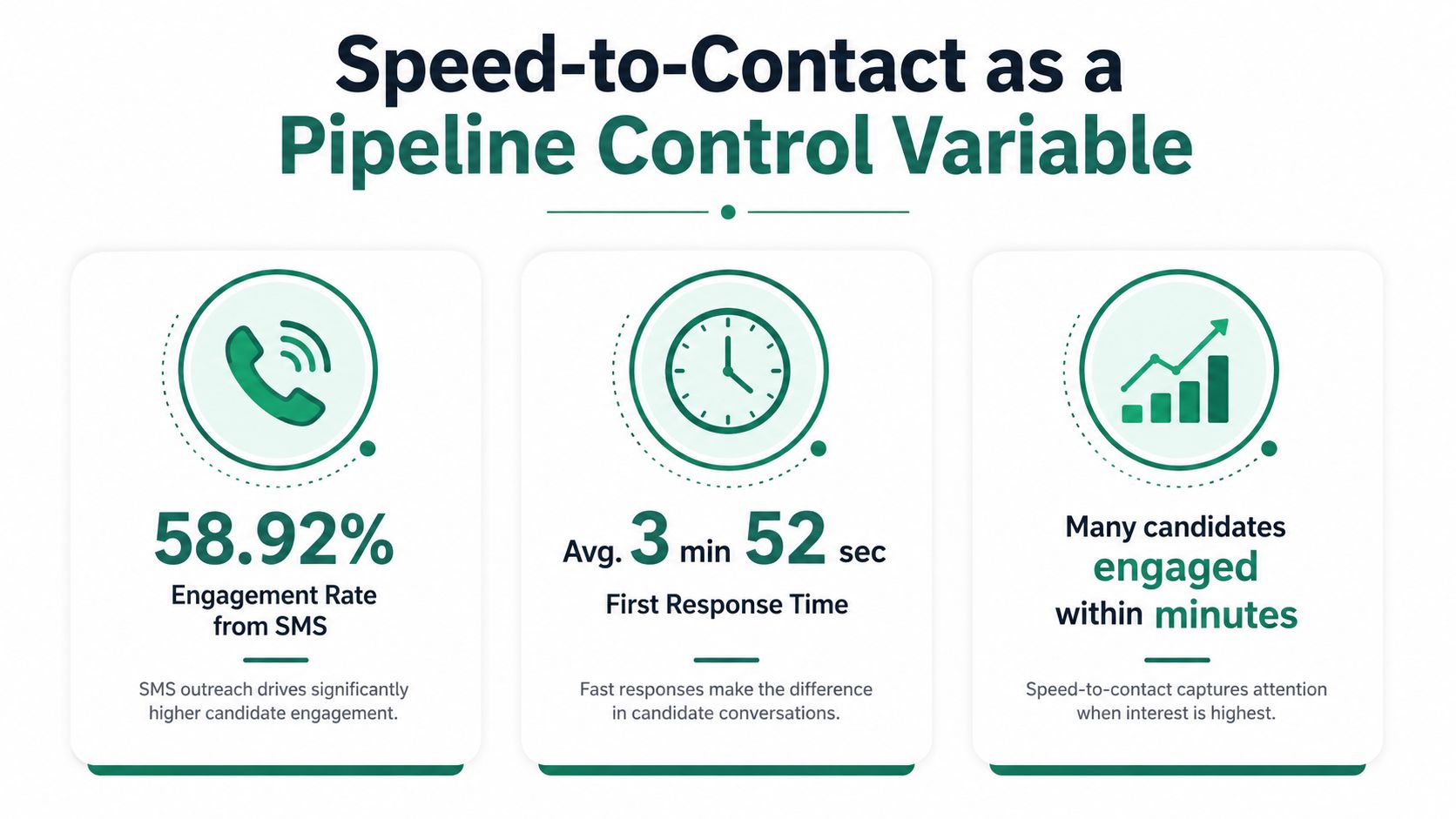
The mechanism is operationally clear. A prompt acknowledgment confirms that the application entered the process, gives the candidate a way to ask questions, and presents the next step while motivation is still fresh. Delayed contact creates room for competing employers, uncertainty, and process fatigue.
For high-volume and shift-based hiring, especially in healthcare, retail, manufacturing, and hospitality, response speed can't depend entirely on a recruiter being online. Automated acknowledgment and mobile-first outreach should operate continuously, with clear escalation rules for cases that require human judgment.
Monitor three measures together:
Segment each measure by source and role family. A healthcare pipeline may respond quickly to applicants for one shift but lose candidates for another. A technology team may see strong engagement from referrals and weak engagement from a job board. Those differences tell you where to adjust workflow, message content, or staffing.
The fastest message won't repair an irrelevant screening process. Speed preserves intent, then structured evaluation determines whether that intent becomes a qualified opportunity.
Recruiters should also set expectations clearly. An automated message shouldn't imply that a person has reviewed the application if that hasn't happened. It should explain what the candidate can expect, provide a clear opt-out where appropriate, and avoid making promises about advancement.
The best early-funnel design combines immediate acknowledgment, useful questions, transparent status, and a fast next step. Speed is not merely a candidate-experience metric. It controls how much of the qualified pipeline survives long enough to be evaluated.
A pipeline dashboard should help a recruiting leader decide what to change next. Counts alone rarely do that. The more useful approach combines flow metrics, decision quality, and post-hire outcomes.
Structured interviews support this diagnostic model because standardized rubrics, anchored behavioral questions, and consistent question order reduce measurement noise. Interviewers should score independently before discussion. Otherwise, the most senior voice in the room can overwrite evidence and make scorecards look aligned when they reflect consensus bias.
| KPI | What It Reveals | Red Flag Threshold | Intervention Strategy |
|---|---|---|---|
| Time-to-fill by source and role family | Whether specific channels or job families create delays | A sustained increase relative to the team's internal baseline | Review stage aging, approval delays, scheduling capacity, and source quality |
| Offer acceptance by interviewer or hiring team | Whether candidate expectations, assessment, or closing practices vary across teams | A recurring pattern of declined offers in one team or interview path | Audit role messaging, feedback speed, compensation communication, and interviewer calibration |
| 90-day retention correlated with screening scores | Whether early screening evidence connects with post-hire outcomes | Low retention concentrated among a score band or screening path | Revisit competencies, scoring anchors, and realistic job previews |
| Source quality tied to performance outcomes | Whether a channel supplies durable, capable hires rather than applicant volume | High applicant flow with weak progression or post-hire results | Reallocate effort toward sources that produce qualified, retained employees |
| Stage conversion rate | Where candidates leave or process owners lose momentum | A meaningful internal gap between comparable roles or regions | Inspect criteria, candidate communication, scheduling, and ownership at that stage |
| Time in stage | Whether candidates are waiting for a person, decision, or system action | Repeated aging in the same stage | Assign service-level ownership and automate reminders without automating judgment |
The red-flag column should use internal baselines rather than invented universal targets. A rate that looks healthy in one role can be poor in another because labor supply, credential requirements, shift design, and candidate expectations differ.
Formalize the rubric before screening begins. Define role-specific competencies, decide which evidence earns each score, and document which requirements are mandatory. Then ask interviewers to submit independent ratings before group discussion.
The goal isn't to remove judgment. It's to make judgment visible and comparable. When a candidate advances, the record should show which evidence supported that decision. When a candidate is rejected, the team should be able to distinguish a missing requirement from an inconsistent interpretation.
Review the dashboard quarterly, but don't wait for the quarterly meeting to address a stalled candidate. Funnel reviews identify systemic issues. Daily ownership protects individual candidates.
A full pipeline can still be a weak pipeline. SHRM reports that 69% of organizations struggled to fill full-time roles in 2025, while 28% required new skills and 47% updated roles to include those skills, according to SHRM's 2025 Talent Trends research. The implication is important: many organizations don't have an applicant shortage alone. They have a definition problem.
A role can attract plenty of candidates who match yesterday's description but lack the capabilities the team now needs. Healthcare employers may revise roles around new systems or compliance responsibilities. Technology employers may shift from a narrow tool requirement toward broader platform ownership. Manufacturing teams may need candidates who combine operational expertise with digital fluency.
Start with a skills audit for priority roles. Compare the capabilities listed in current job descriptions with the skills managers use to evaluate strong performance. Separate stable requirements from emerging competencies, then tag candidates against both categories.
A future-ready pipeline should answer questions such as:
Don't treat a keyword as proof. Ask for evidence of application, context, and results. A structured question about how someone learned a new system can reveal adaptability more effectively than a checkbox asking whether the person has used it.
Pipeline health extends beyond offer acceptance. Connect screening scores to 90-day retention and performance feedback, then examine where the relationship breaks. If candidates with strong early scores leave quickly, the issue may be unrealistic expectations, weak onboarding, poor manager fit, or a rubric that rewards the wrong behaviors.
This approach changes the recruiting conversation. The question isn't “How many candidates do we have?” It's “Can this pipeline supply people who meet current needs and remain useful as the role evolves?” That is the standard future-ready talent pipeline management should meet.
A workable rollout doesn't begin with a company-wide launch. It starts with a contained role family, clear evaluation criteria, and an integration plan that prevents recruiters from maintaining a second system.
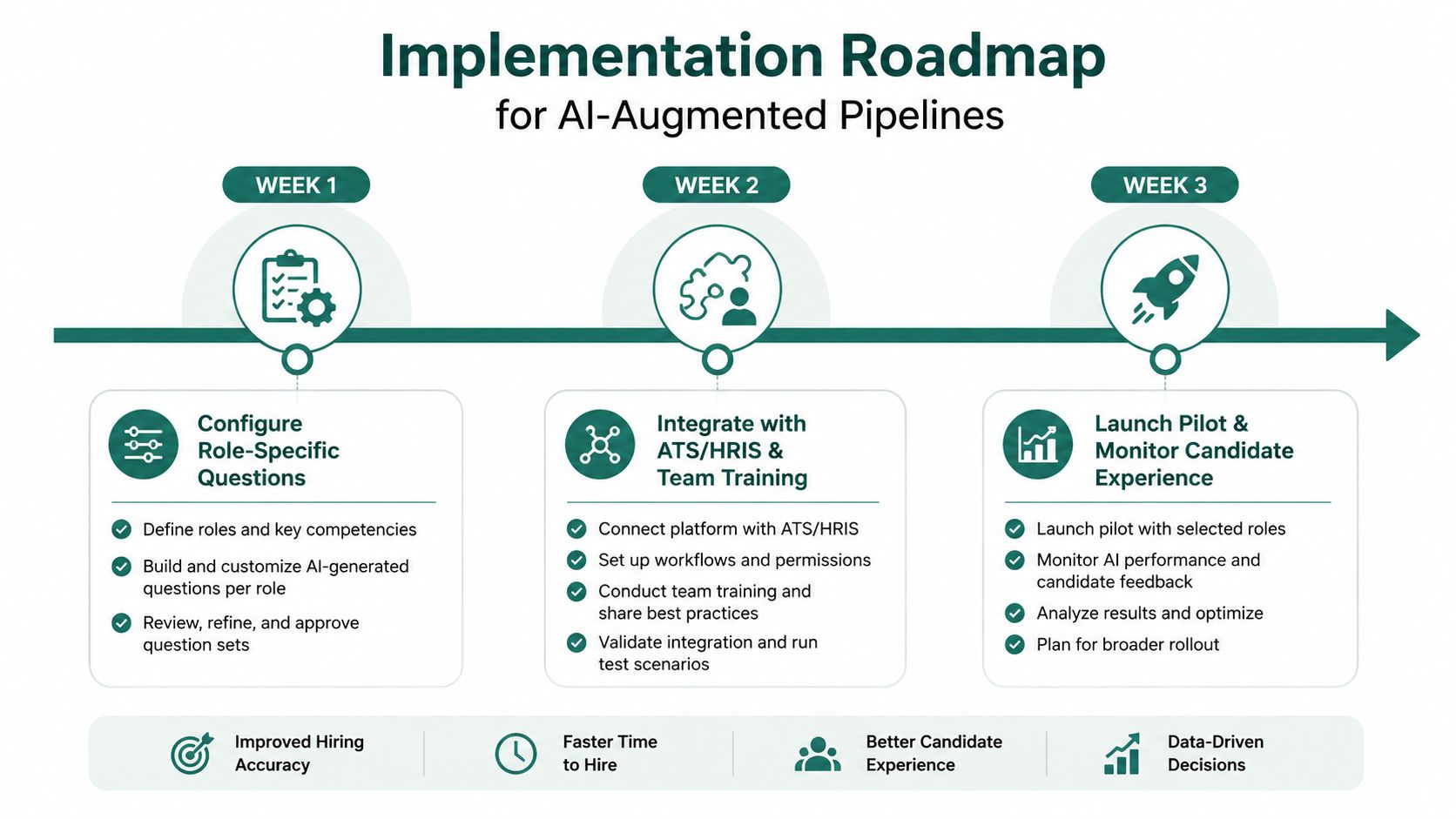
Select high-volume roles where manual screening creates the most delay. Configure role-specific questions covering behavioral, technical, cultural, and compliance requirements. Write the scoring rubric before candidates enter the workflow, and define which results trigger recruiter review rather than automatic progression.
Include hiring managers in calibration. They should review sample responses, identify misleading questions, and agree on what counts as evidence. A technically elegant workflow still fails if managers don't trust the scorecard.
Integrate the workflow with the existing ATS or HRIS, including platforms such as Greenhouse, iCIMS, Paylocity, ADP, and Workday. The objective is to synchronize candidate data and statuses so recruiters don't copy information between systems.
Use this week to train recruiters on interpreting AI-generated scorecards. Training should cover escalation, audit review, candidate questions, and the limits of automated recommendations. Teams planning their wider architecture can use this overview of the HR tech stack to identify adjacent systems and ownership gaps.
Pilot the workflow across a small group of job families, then monitor candidate opt-out rates, message response, completion, stage movement, and hiring manager feedback. Review false positives and false negatives manually. If qualified candidates are being filtered out, adjust the questions or rubric rather than lowering standards without evidence.
Before expanding, confirm that candidates can choose a traditional application path when needed. Review communications for employer-brand consistency, accessibility, privacy, and fair hiring practices. Employers should also explain how candidate information is used and preserve human authority over advancement and rejection.
A quarterly funnel review should begin with the pilot, not after full deployment. That cadence gives the team a repeatable way to revisit criteria as roles, skills, and business priorities change.
A talent pipeline becomes a business asset when the organization maintains it between requisitions. A 2026 benchmark summary reports that 36.9% of employers hired from their existing talent pipeline in 2025, showing that an engaged, qualified pipeline can contribute hires without restarting cold sourcing each time a role opens, as documented in the recruiting funnel benchmarks.
That requires more than storing old applicants. Teams need to maintain candidate relationships, update skill profiles, record preferences, and re-engage strong finalists when a suitable role appears. For practical guidance on building and maintaining these relationships, Underdog.io advice for talent pipelines offers a useful complementary perspective.
The strategic shift is from applicant inventory to reusable capacity. Organizations that manage conversion, response speed, structured evidence, and post-hire outcomes can fill roles with greater confidence while reducing the waste created by repeated sourcing and inconsistent screening. Talent pipeline management is workforce infrastructure, not an administrative list.
Talent Pronto provides 24/7 conversational screening, role-specific questions, structured scorecards, and ATS or HRIS integrations that help employers qualify applicants without removing human decision authority. Visit Talent Pronto to see how its workflow can support faster, more consistent pipeline management across healthcare, technology, manufacturing, retail, and other high-volume hiring environments.

Talent Pronto is an AI-powered hiring platform built around Anna, our intelligent AI that conducts 24/7 conversational screening, evaluates candidates against specific job requirements and compliance needs, and schedules interviews. Run everything on the Talent Pronto ATS, our all-in-one applicant tracking system with a branded careers site and Anna built in, or keep your existing ATS and let Anna integrate with Greenhouse, Ashby, iCIMS, Jobvite, Lever, Oracle, and more. Either way, we help organizations reduce time-to-hire and build stronger teams.