Upgrade your hiring with 10 technical interview questions for 2026. Get model answers, scoring rubrics, and tips to find the best tech talent for any role.
A backend hire ships code for six weeks, then the team discovers they can solve rehearsed interview puzzles but cannot reason through production trade-offs, debug under pressure, or explain design choices. Senior engineers stop building and start compensating. The hiring loop gets noisier because each interviewer starts substituting personal preference for a shared standard.
The fix is a structured interview system tied to real work.
Strong technical interview questions measure specific capabilities: code quality, systems judgment, communication under constraint, domain knowledge, and learning speed. They also need the right level of difficulty for the role. A junior data analyst should not get the same evaluation as a staff platform engineer, and a security hire should not be screened with a generic software loop that ignores risk, compliance, and incident response.
Preparation has also changed. Candidates now arrive with polished answers for common algorithm prompts, standard statistics topics, and familiar behavioral questions. That does not mean structured interviews are broken. It means interviewers need a better toolkit: clear prompts, defined scorecards, red flags worth documenting, and follow-up probes that test whether someone understands the work or has memorized a pattern.
That is the standard this guide uses. Each question type includes what to ask, why it works, how to score it, and what to probe next. The goal is consistency across interviewers, faster calibration, and better evidence at the hiring decision. It also fits a modern funnel where early screening, scheduling, and candidate routing can be automated through platforms such as Talent Pronto. Teams building that kind of process should also review this CTO's guide to AI-augmented hiring.
If you're refining your process, this guide pairs well with mastering tech interviews.
Two-pointer problems are still one of the cleanest early screens for software engineering roles. They reveal whether a candidate can reason about state, indices, and trade-offs without hiding behind heavy abstractions. Good prompts include removing duplicates from a sorted array, merging sorted arrays in place, or solving a container-style max-area problem.
The best candidates don't rush into code. They restate the problem, ask what can be mutated, confirm input assumptions, and describe why a two-pointer approach beats a more memory-heavy alternative for this case. That short setup often tells you more than the final implementation.
Ask the candidate to solve one problem, then vary the constraint. Sorted input becomes unsorted. In-place mutation becomes forbidden. Duplicates become allowed only up to a threshold. That's where shallow memorization breaks.
Practical rule: Score explanation and implementation separately. Some candidates can talk through the right approach but can't code safely. Others stumble verbally but write solid logic.
For complex roles, generic screening usually breaks down fast. A structured variant library tied to role depth works better, especially for specialized hiring pipelines such as specialized screening for complex roles.
Use a simple rubric with four dimensions:
Red flags show up quickly. They include jumping into syntax before defining pointer movement, changing the algorithm midstream without explanation, or failing to test the obvious edge cases.
A strong follow-up probe is: “Walk me through how your algorithm behaves on the smallest valid input and on an input with repeated boundary values.” That forces precision. It also gives your team a structured comparison point when several candidates solve the same base prompt.
System design questions should feel like architecture review, not theater. For senior engineers, staff engineers, and platform candidates, prompts like “design a rate-limiting service,” “design a real-time notification system,” or “design a photo feed” reveal how they think about scale, reliability, and operational trade-offs.
Use the prompt to assess judgment, not diagram polish.
A useful reminder from technical hiring guidance is that senior candidates shouldn't be assessed with the same basic question bank used for juniors. More open-ended problems are more appropriate when you need to measure higher-level reasoning Holloway on level-appropriate interview questions.
A visual prompt can help anchor the conversation:
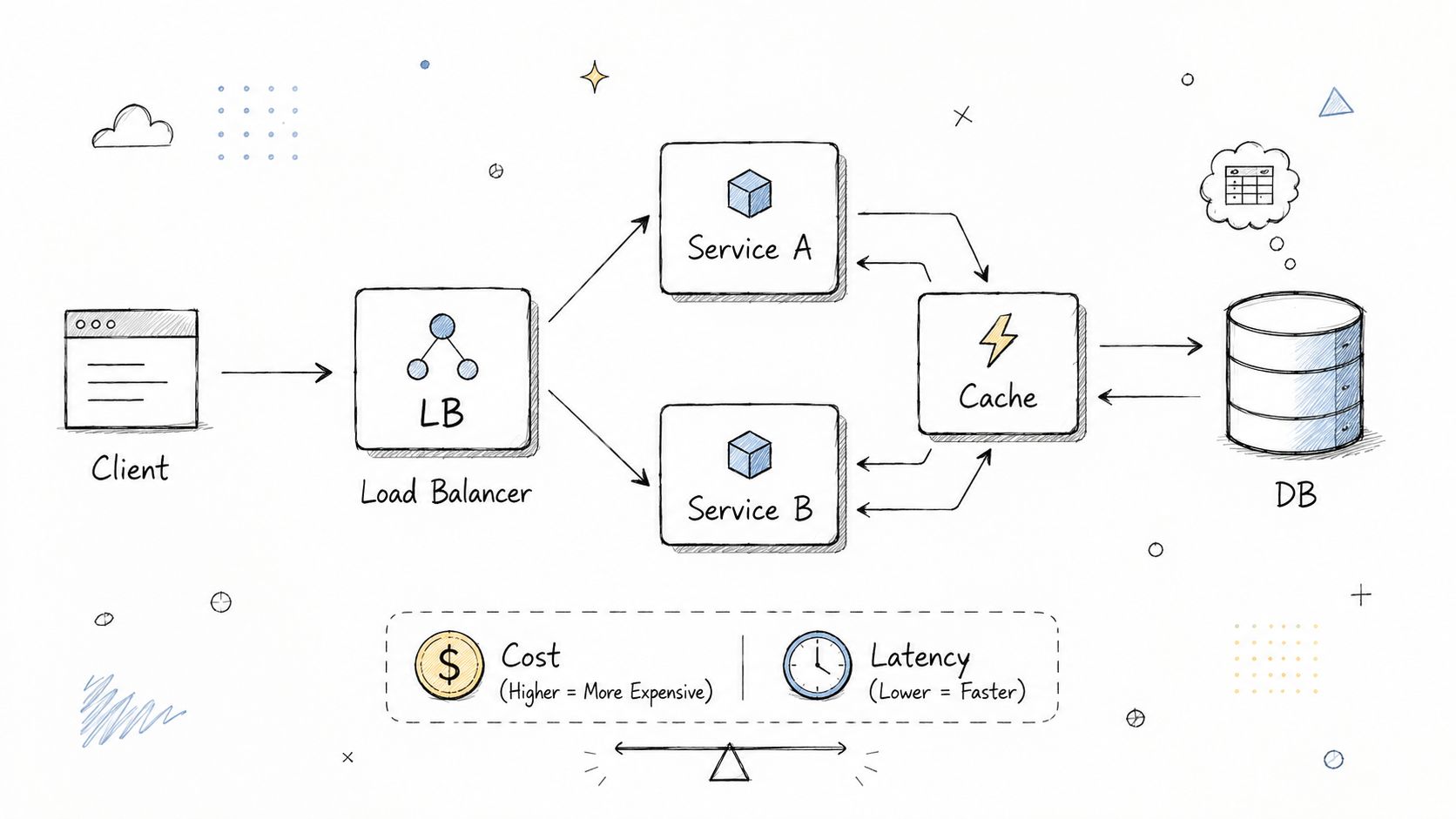
Strong candidates start with questions. What's the latency expectation? What traffic pattern matters more, reads or writes? What kind of failure is unacceptable? They define scope before they design components.
That's why role-specific rubrics matter. A startup CTO hiring a first platform lead will score differently than an enterprise team hiring a principal architect. Teams that want a more consistent process often pair these interviews with AI-augmented hiring workflows for technical leadership so the same trade-off categories are captured across interviewers.
Score on structure, trade-off awareness, and justification. Don't punish candidates for choosing a different stack if they can explain why it fits the constraints.
Useful probes include:
Later in the conversation, a short walkthrough helps you see whether the candidate can communicate under pressure. This overview video works well as interviewer calibration material before your team runs system design loops:
The biggest red flag isn't missing a component. It's refusing to acknowledge trade-offs.
Conflict questions are where many hiring teams get lazy. They ask for a story, hear something polished, and move on. That misses the point. You're not checking whether someone knows the STAR framework. You're checking how they behave when goals, timelines, and people collide.
Ask for a concrete example: disagreement with a manager, tension with a peer, or a cross-functional conflict that threatened delivery. Then keep the candidate in specifics.
A strong answer has four visible traits. The candidate names the stakes, owns their role, describes what they said or did, and shows what changed after the conversation. You want behavior, not summary.
Ask, “What specifically did you say next?” Summary language often hides weak judgment.
Candidates who handle conflict well usually show balanced accountability. They don't turn every disagreement into a story about someone else being unreasonable. They also don't flatten the story into “we aligned” without explaining how.
Write down red flags, not impressions.
This is a good category for conversational screening because natural follow-ups matter. A structured AI interviewer can probe for missing detail, ask role-specific variants, and keep every candidate on the same rubric without letting one interviewer go soft and another go hard. In healthcare, you can anchor the scenario in patient safety. In manufacturing, you can anchor it in safety compliance or shift handoff failures.
Through these questions, many of the best hires separate themselves. General intelligence matters, but day-one credibility often comes from domain depth. If you're hiring a data engineer, ask about SQL optimization or normalization versus denormalization. If you're hiring healthcare IT, ask about patient data handling. If you're hiring DevOps, ask how they'd design a CI/CD pipeline for microservices.
Role-specific depth is a better predictor than generic technical trivia.
Indeed's guidance on role-based interview evaluation highlights prompts such as distinguishing qualitative and quantitative data, explaining primary versus secondary research, demonstrating statistical proficiency, and naming the software used to organize findings or analysis workflows. In practice, that means candidates should connect methods, tools, and business decisions rather than reciting definitions Indeed on market research interview questions.
A good deep-dive question has three parts. First, a core concept. Second, a practical scenario. Third, a trade-off.
For example, don't ask “What is normalization?” Ask, “Explain normalization, then tell me when you'd denormalize a production schema and what risk you'd accept by doing it.” That phrasing turns a textbook answer into a hiring signal.
Score domain questions on:
A weak candidate gives dictionary answers. A stronger one ties the concept to a concrete operational choice. The strongest candidates also explain what they'd monitor after making that choice.
Standardized scorecards help a lot. If every interviewer asks different tool questions without a shared rubric, you'll confuse familiarity with competence.
Whiteboard-style algorithm questions still matter when the role requires live decomposition under pressure. The problem doesn't need to be exotic. Rotated binary search, connected components in an undirected graph, or merging multiple sorted lists can all work well if you score the process, not just the finish.
The interview should sound like collaborative debugging, not silent test-taking.
Candidates often reveal more in the first few minutes than in the final answer. Do they clarify the input and output? Do they propose a brute-force baseline before optimizing? Can they say why one approach is better than another?
Independent practice guidance often recommends asking candidates about the largest dataset they've handled and the variables and data types involved, because that exposes real scale and complexity exposure. The same principle applies here. Good interview questions surface how someone thinks with real constraints, not just whether they've seen a pattern before Workforce on practicing technical interview questions.
Good follow-ups are small but sharp:
The moment a candidate gets stuck is often the highest-signal part of the interview. Watch whether they freeze, narrate, or recover.
Red flags include total silence, defensive behavior when challenged, and inability to explain an algorithm they just wrote. If you use conversational screening earlier in the funnel, candidates are often more comfortable thinking aloud by the time they reach a live panel. That gives you better signal and less performance noise.
Take-homes work when they mirror real work and respect candidate time. They fail when teams assign mini-products, hide the rubric, or let reviewers grade based on personal style.
A useful assignment is small but rich: build a simple REST API, refactor brittle code, or implement a lightweight data-processing task with tests and documentation.
Good take-homes are explicit about scope, expected deliverables, and what matters in evaluation. Candidates should know whether you care most about correctness, test coverage, readability, documentation, or architectural choices.
Keep the problem narrow enough that a follow-up interview can cover the interesting decisions. The best version of this format isn't “submit and wait.” It's “submit, then discuss why you built it that way.”
Use the same review sheet for everyone.
A common mistake is over-rewarding polished formatting and underweighting reasoning. Some strong engineers submit plain repositories but defend every trade-off clearly in discussion. That's often better than a glossy submission with borrowed patterns and weak explanation.
For regulated roles, add scenario-specific criteria. If the assignment touches healthcare workflows, ask how they'd handle access controls, auditability, or sensitive data in a production version.
This question sounds soft. It isn't. Poor motivation answers often predict short tenure, weak engagement, or a bad match between the role and the candidate's expectations.
Ask why they want the role, what kind of work energizes them, and what success would look like in the position. Then push past the polished answer.
Strong answers are specific. The candidate can name the kind of problems they want, the environments where they've done their best work, and why this role fits that pattern. They don't just praise your mission statement. They connect their next move to actual responsibilities.
This is also a good place to test self-awareness. If someone says they want more ownership, ask what ownership looked like in their last role. If they say they want growth, ask what kind.
For teams that care about retention and team alignment, this often overlaps with a broader culture fit hiring approach, especially when you need to distinguish genuine pull toward the role from simple push away from a current employer.
Score motivation on evidence, not enthusiasm alone.
A red flag isn't ambition. It's vagueness. Another is when the candidate's timeline, scope expectations, or preferred work style clearly conflict with the job, but no one documents it because the answer “felt positive.”
A candidate says they are “advanced” in Kubernetes, Terraform, and AWS. Twenty minutes later, it is still unclear whether they have shipped production systems or followed someone else's runbook. Tool proficiency questions exist to close that gap.
The fix is simple. Assess tools inside a competency framework, not as a checklist. Ask where they used the tool, what constraints they faced, what failed under load or in production, and what judgment calls they had to make. That approach reveals depth, decision quality, and risk awareness.
For regulated teams, tool fluency also has to include governance. An engineer who can configure a platform but cannot explain access controls, auditability, or change management creates hiring risk. That matters in sectors working through Navigating NIS2 and DORA frameworks, where operational choices and compliance obligations often meet in the same workflow.
Ask for one substantial project tied to one tool. “Tell me about a service where you used Django REST Framework heavily.” Then keep narrowing the scope. What was the traffic profile? Where did performance break down? Which defaults caused problems? What would you change if the team rebuilt it today?
That same structure works across stacks. React, Tableau, Docker, Salesforce, SQL, Kubernetes. The pattern is consistent because the hiring signal is consistent. You are testing operational memory, trade-off judgment, and ownership.
I also recommend one counterfactual probe: “When would you avoid this tool?” Candidates with real fluency usually answer fast. They know the failure modes, the maintenance burden, and the point where another option becomes cheaper or safer.
Use proficiency levels based on observable behavior, then document evidence for each rating.
Interview teams often go wrong. They score confidence instead of evidence.
A stronger process uses follow-up probes and red flags for each level. If a candidate claims independent fluency in Kubernetes, ask how they handled noisy neighbor issues, secrets management, rollout failures, or cluster cost control. Red flags include vague ownership, overuse of buzzwords, and answers that stay at the feature level. “We used Helm and autoscaling” is not enough. “We changed resource requests after repeated throttling in one namespace, then adjusted the deployment strategy because restarts were cascading into downstream latency” is evidence.
For hiring teams using structured screening workflows, this section should feed directly into your scorecard. In Talent Pronto or any similar interview system, map each tool to required depth, define acceptable evidence in advance, and attach follow-up probes so every interviewer tests the same standard. That keeps one interviewer from rewarding name recognition while another looks for production judgment.
Case studies are one of the best formats for senior and cross-functional roles because they resemble real work. You give the candidate a realistic problem. A booking system is slow. An app crashes on certain devices. Data synchronization errors are appearing in a health record workflow. Then you ask them to investigate, prioritize, and propose next steps.
This format rewards reasoning, not recall.
A/B testing and experimentation have also become one of the most common interview question families because they force candidates to think through control groups, metrics, significance, and common pitfalls like running tests for too little time or with too small a sample. That shift reflects how technical interviews increasingly connect directly to business experimentation rather than pure theory data science interview materials on A/B testing questions.
Give enough information to start, but leave room for clarifying questions. You're looking for diagnostic discipline. What do they ask first? What hypotheses do they form? What data would they want before touching production?
A strong candidate sequences the problem. They don't leap from symptom to solution. They identify likely layers, rule out obvious causes, and explain how they'd reduce risk while investigating.
Focus on these dimensions:
This is also the best format for seeing how candidates handle uncertainty. Many interview guides underplay that skill, but practical advice increasingly emphasizes asking clarifying questions, reasoning out loud, and explaining how you'd investigate an unknown rather than bluffing Indeed on handling ambiguity in technical interviews.
For regulated industries, this category isn't optional. It doesn't matter how strong someone is technically if they can't operate safely within the rules of the environment. Healthcare teams may ask about HIPAA-related handling of patient data. Payment teams may ask about PCI-DSS considerations. Manufacturing teams may ask about OSHA-related protocols. Biotech and medical software roles may probe FDA-related development practices.
The best questions focus on applied judgment.
Don't ask for a textbook recital. Ask how the candidate would build or operate something safely. “How would you design access to patient records?” is much stronger than “What is HIPAA?” because it forces translation from policy to system behavior.
Then ask for a past example. If they've worked in a regulated setting, they should be able to describe a moment when compliance changed a design choice, a release plan, or an escalation decision.
For organizations managing security and operational risk in Europe, broader resilience and compliance expectations also shape the way teams think about technical responsibility. This overview of NIS2 and DORA frameworks is a useful business-side reference.
Use hard thresholds here.
A major red flag is treating compliance as someone else's department. In regulated environments, engineers, analysts, managers, and operators all carry part of the responsibility.
| Assessment | Implementation Complexity 🔄 | Resource Requirements ⚡ | Expected Outcomes ⭐ / 📊 | Ideal Use Cases | Key Advantages 💡 |
|---|---|---|---|---|---|
| Coding Problem: Two-Pointer Array Manipulation | Low–Medium, focused algorithmic pattern | Minimal, 5–10 min, simple IDE/whiteboard | ⭐⭐⭐ verifies fundamentals and space-efficient thinking · 📊 Clear pass/fail metrics | Junior to mid-level software/backend screens | Quick to grade, objective, exposes problem-solving steps |
| System Design: Scalability & Architecture Question | High, open-ended, trade-off heavy | High, 20–40 min, senior interviewer time + whiteboard | ⭐⭐⭐⭐ reveals architecture judgment and production experience · 📊 High predictive for senior roles | Principal engineers, architects, tech leads | Tests trade-offs, communication, and system-level thinking |
| Behavioral: STAR Method – Conflict Resolution Scenario | Medium, structured storytelling format | Moderate, 10–15 min, needs skilled probing | ⭐⭐⭐⭐ strong predictor of teamwork & EI · 📊 Good signal on cultural fit | Managers, team leads, clinical and customer-facing roles | Encourages evidence-based examples; comparable across candidates |
| Technical Knowledge: Domain-Specific Deep Dive | Medium–High, role-tuned technical depth | Moderate, subject-matter evaluator required | ⭐⭐⭐⭐ assesses practical, day-one competency · 📊 Useful for specialized hires | Data engineers, healthcare IT, DevOps, backend | Directly job-relevant; uncovers hands-on experience and trade-offs |
| Problem-Solving: Whiteboard Algorithm with Explanation | Medium, interactive, iterative | Moderate, live session, ~30–40 min | ⭐⭐⭐ exposes decomposition, debugging & communication · 📊 Good for reasoning assessment | Junior to mid-level developers, backend engineers | Offers real-time insight into thought process and adaptability |
| Technical Screening: Practical Coding Challenge (Take-Home) | Medium, scoped deliverable with artifacts | High, candidate 2–4 hrs + review time | ⭐⭐⭐⭐ strong signal on code quality, tests, docs · 📊 High fidelity to real work | Mid-to-senior engineers, full-stack, data engineers | Produces tangible artifacts for deeper evaluation; low interview pressure |
| Behavioral: Motivation & Career Growth Question | Low, open-ended conversational | Low, brief, interviewer-led | ⭐⭐⭐ indicates retention risk and alignment · 📊 Predictive for engagement | All roles; critical for high-turnover positions | Reveals genuine goals and company fit when probed properly |
| Technical Competency: Framework & Tool Proficiency Assessment | Low–Medium, targeted checks | Low, quick pass/fail style | ⭐⭐⭐ confirms tool readiness and ramp speed · 📊 Reduces onboarding time | Roles requiring specific stacks (React, Kubernetes, etc.) | Fast, objective screening for immediate-use skills |
| Case Study Analysis: Real-World Problem Solving | High, complex, multi-step diagnostics | High, 20–40 min, domain expert input | ⭐⭐⭐⭐ evaluates prioritization, root-cause analysis · 📊 Mirrors on-the-job decision making | Senior engineers, technical leads, managers | Simulates real responsibilities; assesses business and technical judgment |
| Compliance & Safety Knowledge: Industry Regulations | Medium, rule-based but context-dependent | Moderate, needs domain reviewer and up-to-date refs | ⭐⭐⭐⭐ critical for regulated roles, reduces legal risk · 📊 Verifiable competency for audits | Roles in healthcare, pharma, finance, manufacturing, govt | Ensures regulatory awareness and minimizes compliance exposure |
A strong bank of technical interview questions is only useful if your team applies it consistently. That's the part many companies still get wrong. They collect questions, but they don't standardize rubrics, define what a good answer looks like by level, or capture responses in a way that makes candidates comparable across interviewers.
The fix is process design. Decide which question types belong at which stage. Put lightweight but structured screens early in the funnel. Reserve the most time-intensive interviews for candidates who have already shown baseline fit. Match the format to the skill being measured. Coding questions for implementation. System design for trade-off judgment. Domain deep dives for day-one readiness. Behavioral questions for conflict, motivation, and accountability. Compliance questions wherever risk exposure is real.
Then make scoring explicit. Every interviewer should know what counts as strong, acceptable, weak, and disqualifying. That doesn't mean forcing everyone into rigid scripts. It means giving them a shared rubric so the same candidate doesn't look “excellent” to one interviewer and “unclear” to another just because each person was evaluating a different thing.
Automation helps most in the early and middle stages. Structured conversational screening can ask behavioral and technical questions in the same order, capture follow-up detail, and produce consistent scorecards before your engineers spend calendar time on live interviews. That's especially useful when you're hiring across multiple roles, locations, or seniority levels and need the same evidence standards for each applicant. It also helps with documentation. When hiring teams can review the same response evidence, disagreements become more useful. They're about interpretation, not memory.
AI-driven workflows are most valuable when they support interviewer discipline, not replace judgment. The employer should still decide who advances, who gets rejected, and what trade-offs matter for the role. The platform's job is to operationalize the structure: ask the right questions, apply the rubric consistently, surface comparable evidence, and reduce the amount of administrative work your team does between application and interview loop.
That's where a platform like Talent Pronto can fit naturally. Based on its product description, it conducts conversational screening, asks behavioral and technical questions, and prepares structured scorecards aligned to role-specific criteria. Used well, that kind of workflow can help employers standardize early-stage evaluation, reduce inconsistency, and free up technical interviewers for later-round conversations where live judgment matters most.
The broader point is simple. Better technical hiring doesn't come from adding more questions. It comes from asking fewer, better-targeted questions in a system your team can repeat. When your workflow is structured, candidates get a fairer process, interviewers spend their time on the right people, and hiring decisions become easier to defend.
If you want a structured way to screen every applicant with consistent behavioral and technical questions, Talent Pronto is one option to evaluate. It supports conversational screening, role-specific rubrics, structured scorecards, and interview coordination so your team can run a more repeatable early-stage hiring process.

Talent Pronto is an AI-powered hiring platform built around Anna, our intelligent AI that conducts 24/7 conversational screening, evaluates candidates against specific job requirements and compliance needs, and schedules interviews. Run everything on the Talent Pronto ATS, our all-in-one applicant tracking system with a branded careers site and Anna built in, or keep your existing ATS and let Anna integrate with Greenhouse, Ashby, iCIMS, Jobvite, Lever, Oracle, and more. Either way, we help organizations reduce time-to-hire and build stronger teams.