Learn how video interviews for jobs work in 2026, from live and async formats to AI screening, scoring, and compliance best practices.
A hiring manager has 240 applications open for a clinical coordinator role. The strongest candidates live across two states, and a holiday weekend is approaching. Instead of coordinating travel or spending days on introductory calls, the team sends a recorded first-round interview, then brings finalists into a live panel.
That workflow is efficient, but efficiency alone doesn't make it good. The format you choose affects who completes the process, what evidence recruiters collect, how consistently hiring managers score candidates, and whether your compliance team can defend the system later. Video interviews for jobs are a funnel-design decision, not just a software purchase.
A video interview for a job is an employment interview conducted through a live or recorded video channel. It can be a scheduled Zoom, Microsoft Teams, or Google Meet conversation, a one-way interview in which candidates record responses to employer prompts, or an AI-assisted assessment that reviews recorded answers before a recruiter examines the results.
The format changes the evidence collected and the friction candidates face. A live call supports follow-up questions and real-time context. An asynchronous interview gives applicants the same prompts and a defined completion window. An AI-assisted assessment can add transcripts, structured scores, or competency signals to the employer's ATS workflow.
Video interviews sit beside, rather than replace, other screening methods. A phone screen captures spoken content without visual context. Video also exposes camera position, lighting, facial presentation, eye contact, background, and connection quality. An in-person meeting gives the employer more control over the setting, while a written assessment measures text-based communication instead of spoken and on-camera behavior. Those differences affect funnel conversion and the fairness of the signal.
Video interviewing moved from a niche recruiting tool to a common early-stage practice during the pandemic era. One industry benchmark reports that 22% of employers used video interviews before the pandemic, compared with 79% conducting them regularly by January 2021, a 57-point increase in adoption. Gartner-referenced data in the same industry summary placed usage at 86% of organizations at some stage of hiring by 2022. The benchmark details the adoption shift and its role in modern recruitment.
The shift reached hourly, professional, healthcare, retail, technology, and distributed roles. Employers use video to reduce travel, widen geographic reach, and create a repeatable first interaction across locations. Tool choice also reveals a workflow decision: 90% of hiring professionals in one survey used general communication tools such as Zoom, Skype, or Teams for interviews, while 8% used specialized video-interview platforms. Teams choosing general tools may gain speed, but they still need a reliable ATS handoff, consistent scoring, and clear recording controls.
Once a team adds video to the funnel, four connected decisions determine the result:
Treating video interviews for jobs as a funnel component keeps these choices connected. A fast screen still fails if qualified candidates abandon it, if reviewers score camera comfort instead of job evidence, or if the ATS cannot pass usable results to the hiring team.
The live-versus-async decision should start with the funnel, not with a platform demo. Ask how many people need screening, how much judgment the role requires, how much recruiter time is available, and how much candidate friction the process can tolerate.
Live interviews are stronger when the employer needs dialogue. A recruiter can probe an unclear answer, test how a candidate responds to an unexpected question, and explain the role in context. That interaction can reveal communication style and rapport more naturally than a fixed recording. The cost is scheduling. Recruiters and candidates must find a shared time, and distributed teams can lose applicants when scheduling takes too long.
Asynchronous interviews remove much of that coordination. Candidates answer the same questions within a stated window, which makes the process easier to repeat across a large applicant pool. The tradeoff is narrower signal. Short, recorded answers can reward polish, camera comfort, and familiarity with the format rather than the underlying capability.
A randomized study of more than 3,000 applicants found that asynchronous audio or video interviews reduced application continuation by about 53%, or 45 percentage points, while synchronous online interviews reduced continuation by 20%, or 17 percentage points, compared with no interview screening. The randomized study examines how interview format affects application continuation. The operational lesson is straightforward. Don't put the most demanding video step at the top of every funnel.
| Dimension | Live Video Interview | Asynchronous Video Interview |
|---|---|---|
| Scheduling | Requires a shared appointment and interviewer availability | Lets candidates respond within a defined window |
| Recruiter workload | Higher coordination and meeting load | Lower scheduling burden, though review still requires capacity |
| Candidate experience | More conversational and easier to clarify | More flexible, but often feels less personal |
| Signal quality | Supports probing, rapport, and contextual follow-up | Produces comparable responses to fixed prompts |
| Drop-off risk | Usually lower than an earlier high-friction async screen | Can create substantial abandonment when placed too early |
| Fairness risk | Interviewer behavior can vary across candidates | Standardization helps, but camera, accent, appearance, and prompt design can affect evaluation |
| Best fit | Senior roles, complex work, and culture or stakeholder screens | High-volume retail, hourly, and repeatable initial screens |
Typical asynchronous designs are tightly constrained. In a large archival dataset, employers usually asked 4 to 5 questions, gave candidates 30 seconds to prepare, and allowed 2 minutes to answer each question. Candidates produced an average of 259 seconds of footage across all questions, and when re-recording was allowed, candidates used it about 40% of the time. The archival study describes common asynchronous interview design and response behavior.
Decision rule: Use async when volume is high and the first signal is repeatable. Use live when the role requires probing, judgment, or relationship-building. Use a hybrid when you need scale early and human assessment later.
Video interviews work best when they solve a specific bottleneck in the hiring funnel. They shouldn't appear just because the ATS or recruiting platform makes them available.
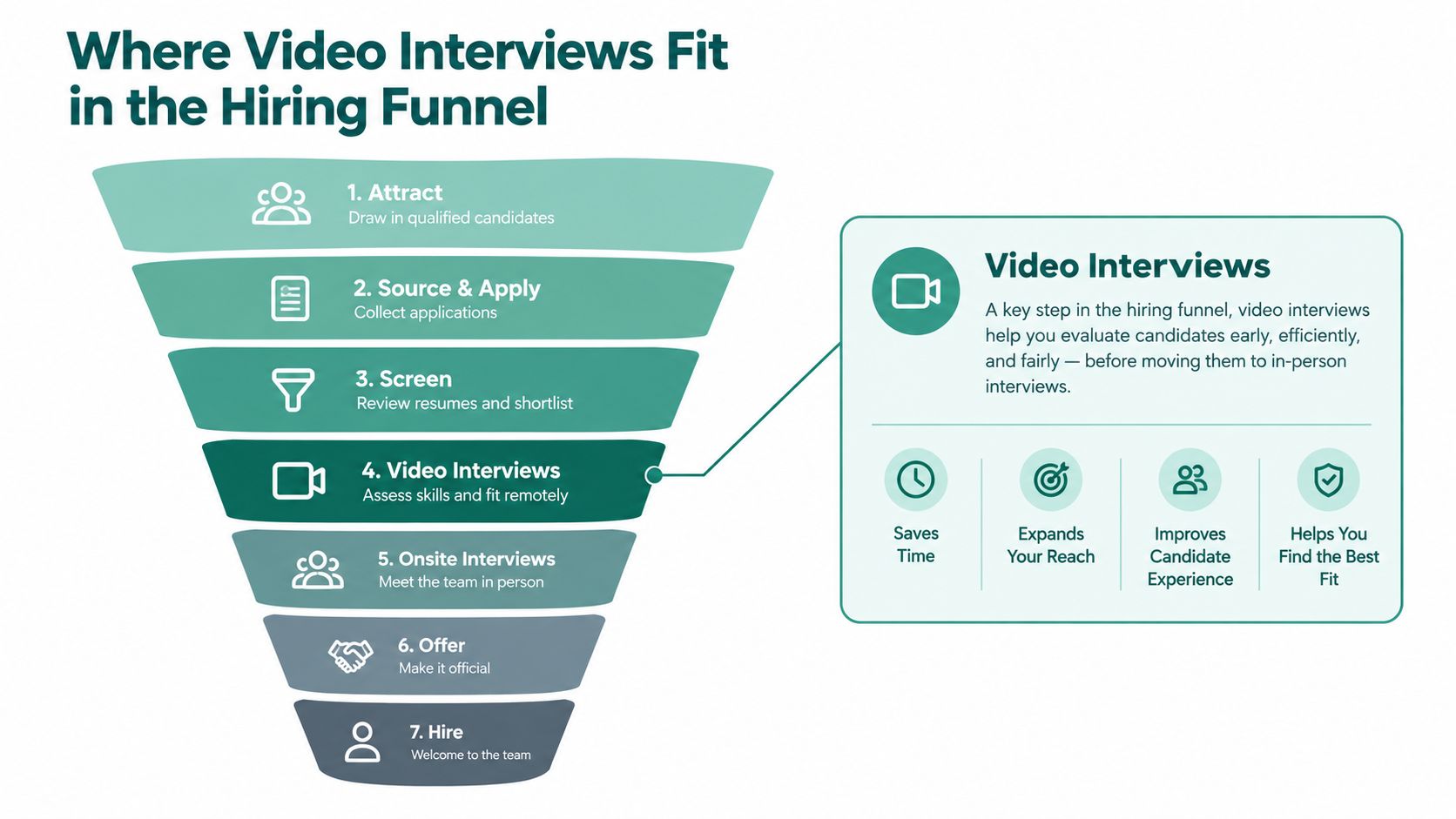
The funnel usually moves from sourcing and application, through application review and an initial screen, into skills or values assessment, hiring-manager discussion, panel interviews, references, and offer. Each stage has a different job. Sourcing creates reach. Application review establishes basic eligibility. The initial screen tests minimum role fit. Later conversations examine judgment, collaboration, technical depth, and motivation.
Video most often occupies two slots. The first is an early asynchronous screen that replaces a phone call. The second is a mid-funnel live interview that replaces an in-person round. Those placements can coexist, but they shouldn't ask candidates to repeat the same evidence several times.
An employer might ask candidates to record answers about relevant experience, availability, customer interaction, or a role-specific scenario. Recruiters can then review a consistent response set rather than making separate introductory calls. In a retail funnel, that can help a team handle volume. In healthcare, the prompts may focus on patient communication, documentation habits, or escalation judgment.
The ATS should receive more than a video link. It should store the candidate's stage, completion status, reviewer notes, rubric scores, and any required consent record. A recruiter should be able to route a candidate to the next stage without manually reconstructing what happened in the interview.
AI screening tools can parse recorded answers for keywords, speech patterns, and competency cues, then pass scores into the ATS as structured fields. Recruiters can use those fields to filter, shortlist, and route candidates without rewatching every recording. That can reduce repetitive review, but it doesn't turn a proxy into proof of capability.
The right model is AI-assisted triage with human accountability. The tool can identify responses for closer review, organize evidence, and surface missing criteria. The employer still needs to validate the rubric, check edge cases, review adverse-impact signals, and make advancement or rejection decisions under a documented process.
Talent Pronto is one example of an AI hiring platform that conducts conversational screening, asks role-specific behavioral and technical questions, prepares structured scorecards, and integrates candidate statuses with ATS and HRIS systems. That kind of workflow can fit an early screen, provided the employer defines the criteria and keeps human review in the decision loop.
A broken microphone isn't a minor inconvenience. It's a candidate who may never reach the evaluation stage. A recording setting left unconfigured isn't an administrative oversight. It's a compliance gap that can affect the entire interview population.
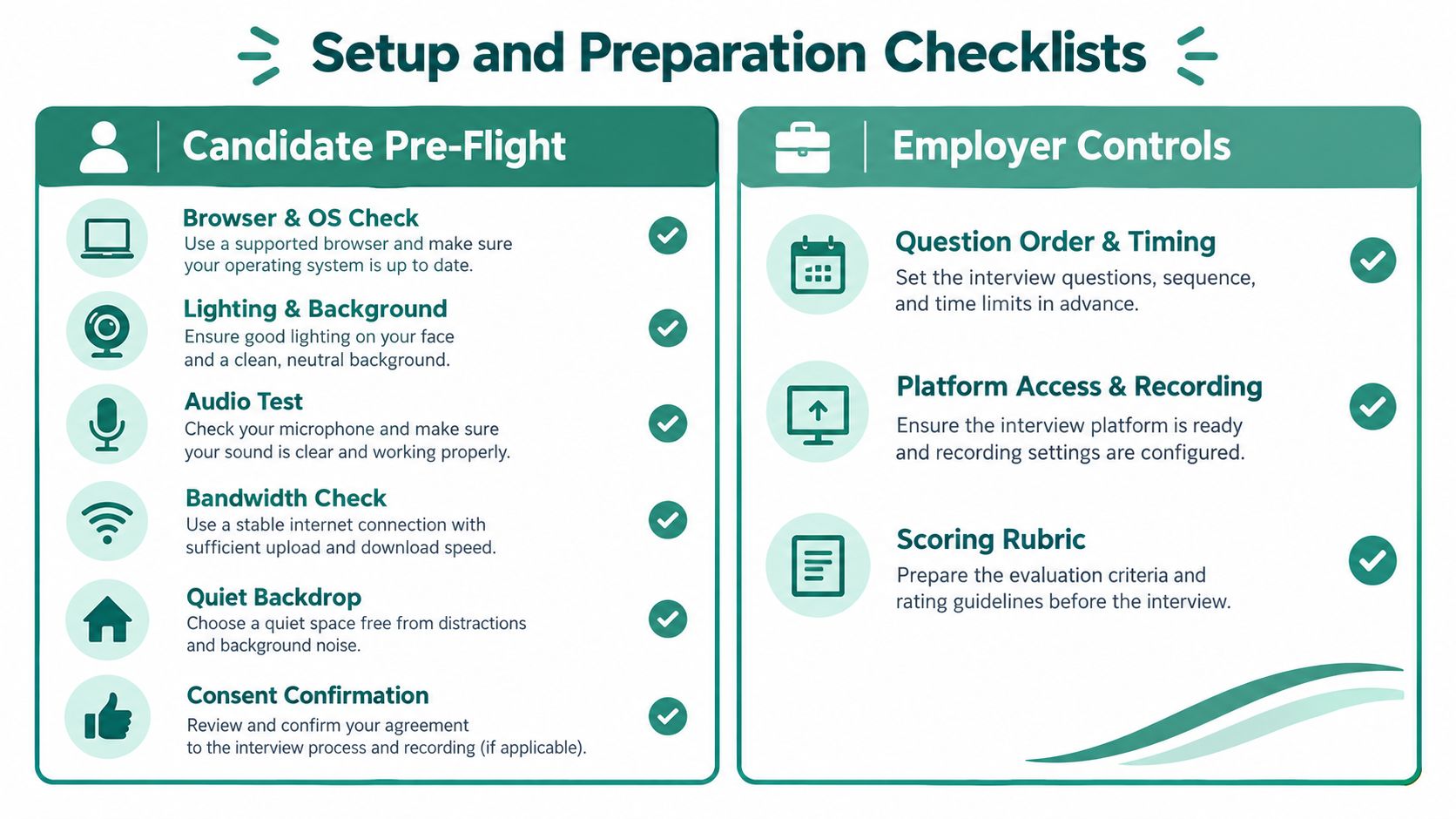
Employers and candidates need a coordinated pre-flight routine. Send a reminder 24 hours before the interview with the exact meeting or recording link, the deadline window, accessibility instructions, and a fallback contact. Don't make a candidate search through an ATS portal for the information needed to complete the next step.
Candidates should test the selected browser, operating system, webcam, microphone, and video platform before the interview. They should check framing, lighting, audio clarity, internet stability, and the background, then close unnecessary programs and silence notifications. A quiet setting helps, but employers should also recognize that not every candidate has a private office or high-end equipment.
For a recorded interview, candidates need to know whether they can pause, restart, or submit another take. For a live call, they need the meeting link, expected duration, interviewer names when available, and a direct way to report a connection failure.
Employers should configure question order, time limits, retry allowances, mobile access, recording permissions, and the scoring rubric before invitations go out. If a candidate has to create an account, download software, or complete a long setup process, explain that requirement in advance.
Scheduling also needs ownership. Teams that want to reduce coordination should define whether the candidate books directly or whether a coordinator schedules after review. A documented automated interview scheduling workflow can help connect the completed screen to the next available step, but automation shouldn't hide the deadline or remove a human fallback.
Candidate experience test: Ask a person outside the recruiting team to complete the process on a phone and a laptop. Watch where they hesitate, then remove every avoidable ambiguity.
If your team creates training clips or onboarding material around the process, you can also discover AI video creation techniques for producing clear visual guidance. Keep candidate instructions short, accessible, and specific. The goal isn't to make the process look polished. It's to prevent avoidable friction from changing who completes it.
Intuition is a poor scoring system. A structured rubric with behavioral anchors gives interviewers a common definition of strong evidence and makes disagreements visible.
For live interviews, recruiters should complete notes promptly while details remain clear, then have panelists score independently before discussing the candidate. For asynchronous submissions, assign multiple reviewers where possible and hide unnecessary identity information during the first evaluation. Neither approach eliminates bias, but both reduce the influence of an interviewer's memory, mood, or preference for a particular communication style.
A useful rubric separates the competency from the impression. “Professional presence” is vague and invites appearance bias. “Explains a difficult customer interaction, identifies the action taken, and describes the outcome” gives reviewers something observable to assess.
| Dimension | Score 1 (Below Bar) | Score 3 (Meets Bar) | Score 5 (Exceeds Bar) |
|---|---|---|---|
| Role knowledge | Gives generic answers and misses core requirements | Explains relevant knowledge with a workable example | Connects deep knowledge to the role's real operating context |
| Judgment | Doesn't identify risk, tradeoffs, or escalation needs | Identifies the main issue and chooses a reasonable response | Weighs competing risks and explains a clear, defensible decision |
| Communication | Response is difficult to follow or doesn't address the question | Answers directly with understandable structure | Communicates clearly, adapts detail to the audience, and handles follow-up |
| Collaboration | Blames others or gives no evidence of shared work | Describes a constructive contribution to a team outcome | Shows how they created alignment across competing priorities |
| Customer or patient focus | Doesn't address the other person's needs | Responds respectfully and resolves the stated problem | Anticipates needs while protecting safety, quality, or service standards |
Use a structured interview scoring rubric as a starting point, then tailor the anchors to the role. A clinical coordinator and a software engineer shouldn't be judged against identical evidence.
The fairness evidence isn't reassuring enough to justify blind trust in one-way video. A medical scoping review found the research mixed and often methodologically weak, with moderate or high risk of bias in most studies. It concluded that one-way video interviewing may work as an initial screen, but found no evidence that it should replace live, bidirectional interviewing. The review examines validity and fairness concerns in asynchronous video interviewing.
AI-assisted scoring adds speed, not immunity. It can inherit bias from question wording, rubric design, accent, appearance cues, training data, or the way a competency is represented in speech. Human reviewers must audit unusual scores, investigate inconsistent outcomes, and retain the authority to override a machine-generated recommendation.
Practical conclusion: Standardization is necessary, not sufficient. A consistent process can produce consistently poor judgments if the rubric measures the wrong thing.
Recorded interviews create obligations that many recruiting teams discover after implementation. Before recording, tell candidates what will happen, obtain the required consent, explain who can access the material, and define how long the employer will retain it. The same discipline applies when a vendor generates transcripts, analyzes speech, or produces an AI score.
Illinois' Artificial Intelligence Video Interview Act requires employer notice, prior consent, and an explanation of how the AI works and what characteristics it evaluates. Maryland requires written consent and a waiver for facial recognition during pre-employment interviews. This legal summary outlines the Illinois and Maryland requirements. Those rules aren't interchangeable, and employers need jurisdiction-specific advice before launching a recorded or AI-supported process.
GDPR may apply when EU candidates' personal data enters the workflow, which means the employer needs a lawful basis, transparent processing information, and appropriate data governance. Employers also need to consider accommodation duties under the ADA and Equality Act, depending on the jurisdiction and candidate circumstances.
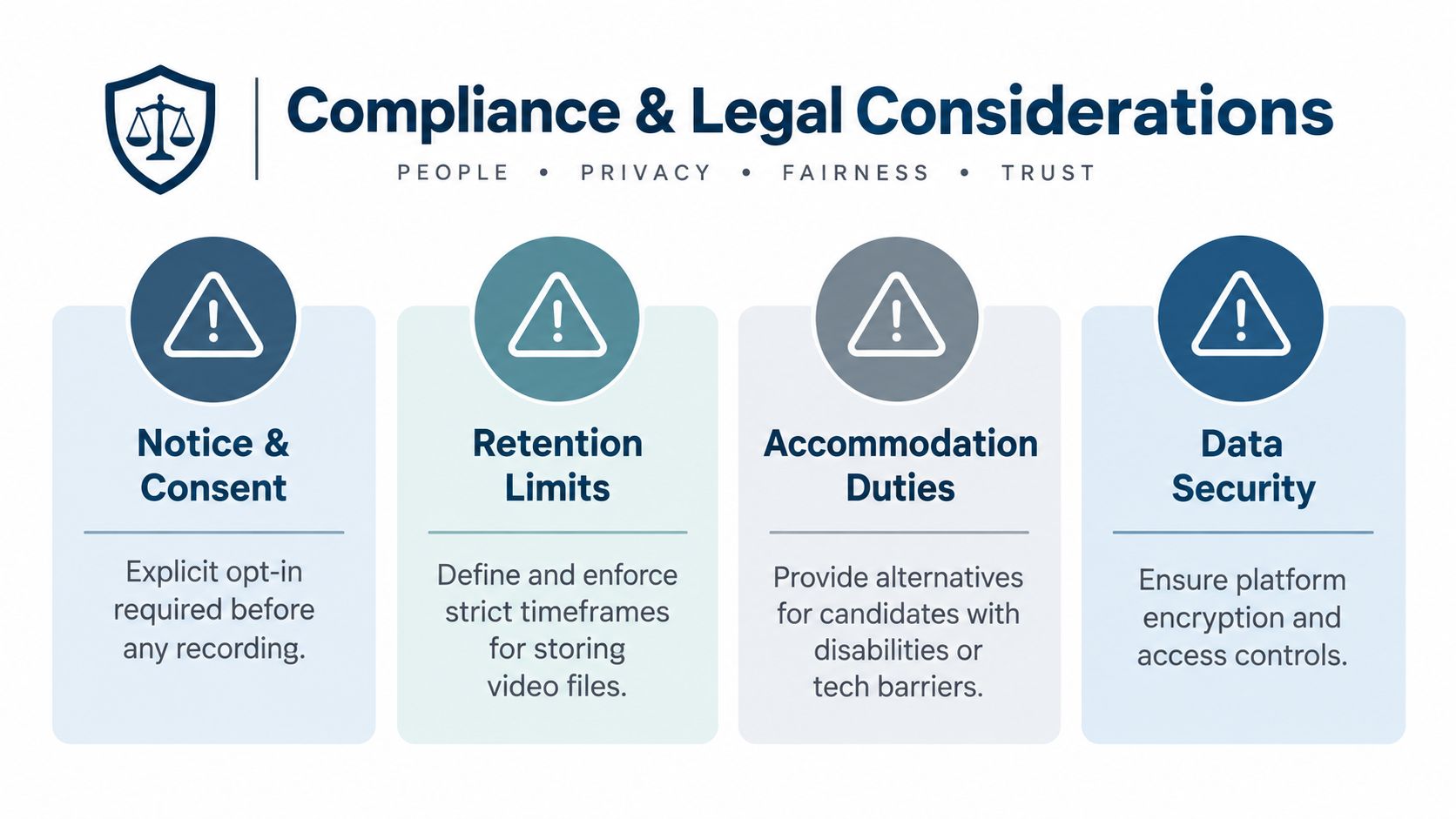
Recorded interviews may become discoverable in litigation. AI vendors often shift audit responsibility back to the employer, so a contract isn't a substitute for internal ownership. Maintain consent records, retention schedules, accommodation procedures, vendor assessments, and a recurring bias-audit cadence that can withstand regulator questions and plaintiff discovery.
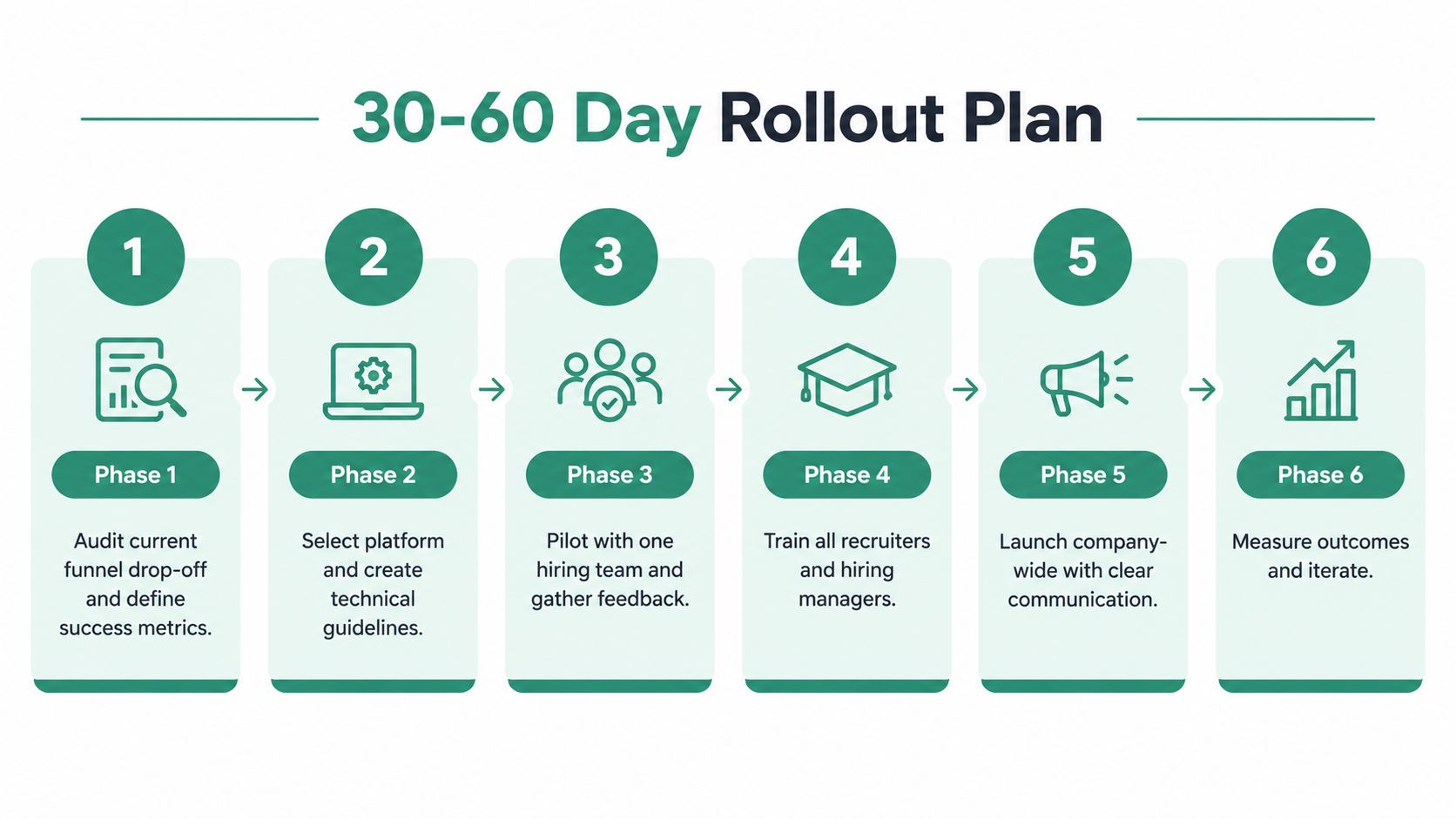
Roll out video interviews in phases. A team that buys a platform first and designs the funnel later usually creates a faster version of its existing problems.
Owner: Talent operations. Deliverable: A role-level funnel map showing completion, scheduling friction, reviewer workload, and candidate feedback. Go/no-go gate: Approve live, async, or hybrid only when the team can explain why the format matches role volume, seniority, and required signal.
Owner: Recruiting systems and IT. Deliverable: ATS integration, candidate notifications, status mappings, access permissions, and fallback instructions. Go/no-go gate: Send test candidates through the complete workflow and confirm that results, consent, and handoffs land in the right records.
Owner: Recruiting and the hiring manager. Deliverable: Role-specific questions, anchored scoring criteria, reviewer instructions, and an escalation path for edge cases. Go/no-go gate: Have reviewers score sample responses independently, then resolve disagreements before inviting real candidates.
Owner: One recruiting lead and one hiring team. Deliverable: A pilot report covering completion rate, time to hire, reviewer effort, and candidate sentiment. Go/no-go gate: Expand only when the process works for candidates on different devices and the team can explain every rejection or advancement decision.
Owner: Talent operations, legal, and the vendor. Deliverable: A validated AI configuration with human review, override rules, monitoring, and candidate disclosures. Go/no-go gate: Don't automate ranking until the underlying rubric has produced consistent human judgments and the employer has tested for disparate outcomes.
Owner: HR compliance and recruiting leadership. Deliverable: Documented consent, retention, accessibility, security, and audit procedures, plus a quarterly bias review. Go/no-go gate: Pause expansion when the team can't retrieve an interview record, explain a score, or honor an accommodation request.
This sequence also helps teams compare video interviewing platforms based on workflow fit rather than feature volume. If you need to create internal explainer content for candidates or hiring managers, tools that transform text into video can support that communication layer, but the guidance still needs human review for accuracy and accessibility.
Teams that treat video interviewing as a funnel-design problem can improve recruiter capacity and hiring quality within a quarter, but only when they measure the whole journey. Completion, candidate sentiment, reviewer consistency, compliance readiness, and downstream hiring outcomes matter more than the number of interviews a platform can process.
Talent Pronto helps employers screen applicants conversationally, apply role-specific questions and structured scorecards, and coordinate ATS-connected interview workflows across healthcare, retail, technology, and other teams. Visit Talent Pronto to see how a documented, human-controlled screening process can fit into your video interview funnel.

Talent Pronto is an AI-powered hiring platform built around Anna, our intelligent AI that conducts 24/7 conversational screening, evaluates candidates against specific job requirements and compliance needs, and schedules interviews. Run everything on the Talent Pronto ATS, our all-in-one applicant tracking system with a branded careers site and Anna built in, or keep your existing ATS and let Anna integrate with Greenhouse, Ashby, iCIMS, Jobvite, Lever, Oracle, and more. Either way, we help organizations reduce time-to-hire and build stronger teams.