Explore 10 proven diversity hiring strategies to build an inclusive team. Learn practical steps, measurement tips, and real-world examples to drive real change.
38% of job descriptions contain gender-coded words, and that same kind of language can reduce applications from women by 40% when the posting itself signals who belongs and who doesn't. That's why diversity hiring strategies have to start upstream, before interviews, before offers, and even before a recruiter opens a résumé. If the language in the posting, the screening rules, or the interview format is uneven, the funnel narrows long before a hiring manager notices.
Many companies still treat diversity as a branding statement or a final-stage hiring goal. The better approach is operational: write more inclusive job copy, standardize evaluation, widen sourcing, and measure each stage of the funnel so bias shows up where it happens. A recent survey found that 69% of organizations use structured interviewing, while only 8% publish diversity data, which tells you two things at once, structured practices are becoming normal, and visibility is still far behind execution Breezy HR's 2025 diversity hiring report.
The practical payoff is straightforward. Modern hiring teams can use structured workflows, automated screening, and consistent scorecards to make fairer decisions at scale, while HR leaders keep the human judgment where it matters most, in coaching, calibration, and final selection. Talent Pronto fits that model well because it supports conversational screening, role-specific questions, and structured scorecards for every applicant.
Resume bias appears before a hiring manager ever speaks with a candidate. Research summarized in Harvard's evidence-based hiring guide shows why first-pass screening needs to be designed around job evidence, not identity markers, and why subjective review can reproduce unequal outcomes even when qualifications look similar.
The implementation has to be deliberate. Remove names, photos, graduation dates, addresses, and other identifying details before the first review, then shift the process to a work sample or skills assessment that asks candidates to show how they would do the job. For a technical role, that may be a coding task. For operations, it may be a prioritization exercise. For client-facing work, it may be a written response or a simulated conversation.
Automation makes that process more consistent. Manual redaction is easy to do unevenly, especially when volume is high, so a system that standardizes what gets hidden and what gets scored reduces the chance that one recruiter sees more than another. Talent Pronto's skills-based hiring approach is relevant here because it can structure the first pass around the same criteria for every applicant before a recruiter reviews the file, which improves consistency and makes the process easier to defend.
A short skills test works when it resembles the actual work. A generic personality quiz does not. A practical sample gives hiring teams a better basis for comparison because the candidate is showing performance, not self-presentation, and that matters when you are trying to reduce bias in the early funnel.
The trade-off is candidate experience and accessibility. Long assessments can discourage strong applicants, and poorly designed tests can favor people who have more time rather than more ability. Keep the exercise focused on one or two job-critical tasks, give clear instructions, and set reasonable time expectations so the assessment measures skill instead of stamina.
Measurement should be built in from the start. Track pass rates by stage, compare completion and advancement across demographic groups where legally appropriate, and review whether the assessment predicts on-the-job performance after hire. If a work sample produces wide score gaps without a clear link to later success, the test is probably measuring the wrong thing.
Compliance matters as much as design. Retain the scoring criteria, candidate submissions, and reviewer notes so HR can show why decisions were made if there is a challenge later. Consistent documentation also helps managers calibrate scoring over time and spot which exercises create too much noise.

Resume bias shows up early and in subtle ways, which is exactly why blind screening still matters. A synthesis cited in the verified data reports that résumé screening by race can produce 50% fewer callbacks for Black candidates even when qualifications are identical, which is a stark reminder that “equal” review often isn't equal at all WorldMetrics diversity hiring statistics.
The implementation detail matters more than the concept. Strip names, photos, graduation dates, addresses, and other identifying markers before first-pass review, then move to a skills-based assessment that asks candidates to demonstrate how they'd do the job. In technical roles that can mean a coding exercise, in operations roles it might be a prioritization scenario, and in client-facing roles it can be a written response or simulated conversation.
Automation helps here because manual redaction is inconsistent. Talent Pronto's blind resume screening and skills-based initial assessment approach is useful when the applicant flow is large, since the system can standardize what gets hidden and what gets scored before a recruiter sees the file. That consistency is what makes the process defensible.
A short skills test works when it mirrors actual work. A generic personality quiz does not. A practical sample, on the other hand, lets you compare applicants on output, not pedigree, and that's especially valuable for candidates from nontraditional paths, bootcamps, military service, or career changes.
A diverse panel changes the questions people ask and the conclusions they reach. A practical panel design starts with role clarity, not just a calendar invite. Use a mix of interviewers who can test different dimensions of the job, and keep HR or EEO support involved so questions and ranking criteria stay tied to the role, not to personal preference.
The strongest panels are assembled with intent. Decide which perspectives need to be present, assign those roles before the interview starts, and make sure each interviewer knows what to evaluate. One person can probe technical depth, another can assess collaboration, and another can watch whether the rubric is being applied consistently. If everyone improvises their own questions, the interview quickly turns into a loose conversation with uneven coverage.
Independent scoring should happen before any group discussion. That reduces the chance that the most confident voice in the room sets the tone for everyone else. After the interview, compare scores against written evidence, not against memory, and record disagreements so the debrief can surface where the rubric needs tightening.
Diverse panels do not guarantee a fair decision, but homogenous panels make it much easier for bias to go unchallenged.
Talent Pronto's structured scorecards support this kind of panel work because each interviewer can evaluate candidates against the same criteria, even if they are joining from different locations or time zones. That matters in distributed hiring, where panel coordination often becomes the reason teams drift back to ad hoc conversations.
For firms that need a practical hiring reference, the hiring guide for advisory firms is a useful companion because it frames panel structure, candidate evaluation, and role alignment in a way that is easier to operationalize.

Inclusive job copy is one of the easiest places to lose candidates before you even know they were interested. The verified data notes that men may apply when they meet only 60% of qualifications, while women often apply when they meet 100%, which is why inflated requirement lists can shrink the pool before sourcing even starts Commerce diversity recruitment guidance.
The fix is concrete. Separate must-have qualifications from preferred ones, keep the required list short, and remove coded words like “aggressive” or “competitive” when they aren't job-critical. If the role includes flexibility, hybrid options, or accessibility accommodations, say so plainly in the posting instead of burying that information on a careers page.
Sourcing should follow the same logic as the job ad. If you only post in the usual places, you'll get the usual applicant mix. Build relationships with HBCUs, HSIs, disability networks, LGBTQ+ professional groups, and women-focused organizations, then track which partnerships produce qualified applicants over time.
The strongest sourcing programs aren't one-off campaigns, they're recurring relationships with communities that already know your industry.
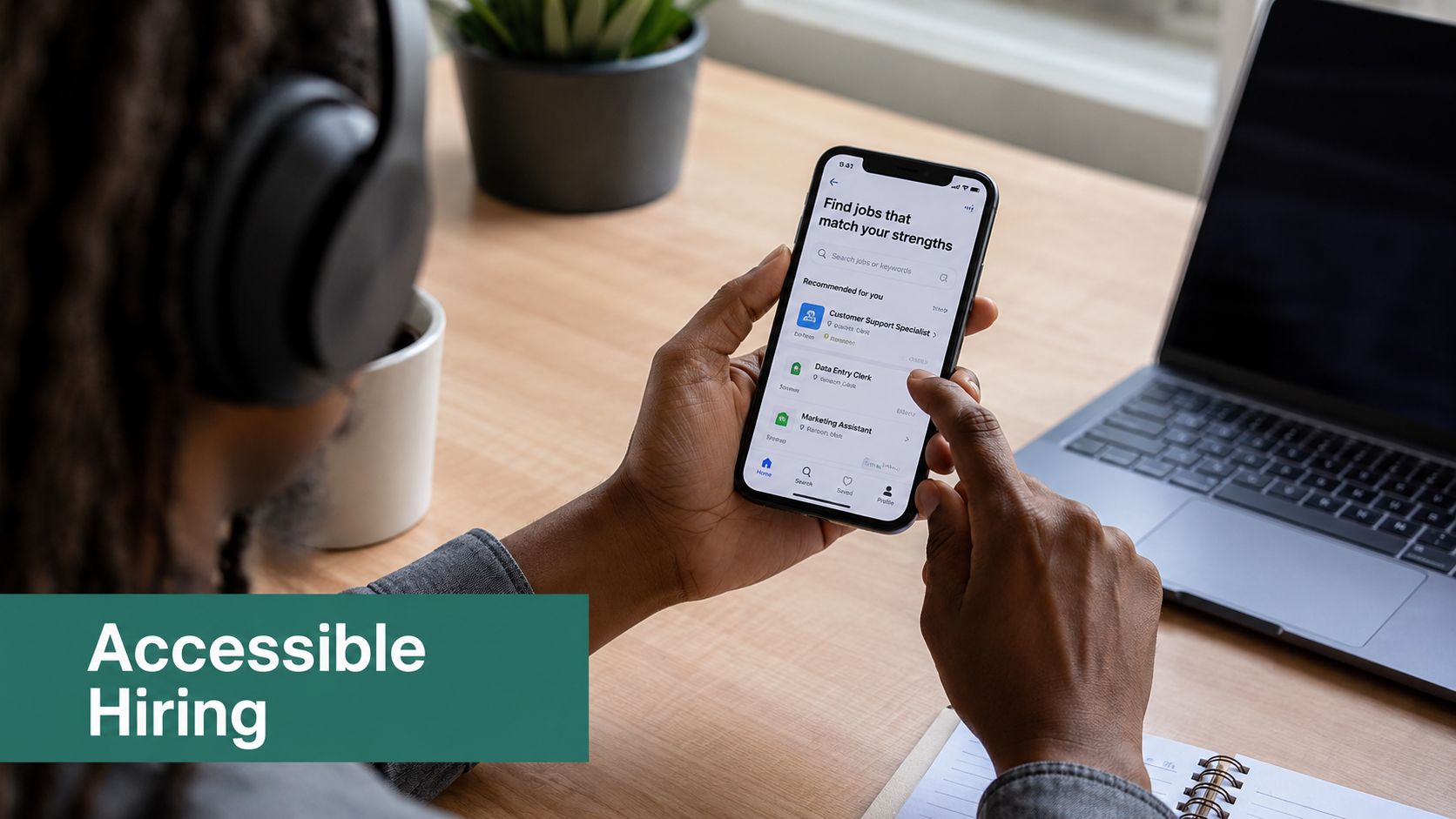
Talent Pronto's guidance on accessible application and screening processes fits here because inclusive hiring isn't only about copy, it's about whether the application flow itself is usable and welcoming. A clean posting, a clear application path, and consistent early-stage communication all matter.
The hiring guide for advisory firms is a useful reminder that role clarity matters across industries, especially where trust and client communication are core to the job. The same principle applies whether you're hiring in finance, healthcare, or manufacturing, candidates need to understand what success looks like.
A stronger diversity pipeline starts before full-time hiring does. Internship and rotational programs give early-career candidates access to entry points they may not get through standard recruiting channels, and they work best when the path to conversion is clear from the start.
Cohort design makes a real difference. When participants begin together, learn together, and progress through the organization with shared support, they are less likely to be isolated in one team or left to figure out expectations on their own. A senior mentor also matters, because early-career talent usually needs context, feedback, and sponsorship, not just assigned work.
Recruiting partnerships should match the communities you want to reach. Build relationships with HBCUs, HSIs, disability employment organizations, veteran networks, and community colleges that already serve the talent pools you want to include. The contiguous compliance approach discussed by Contigo is a useful reminder that program design and documentation matter when regulated workforces are involved.
These programs fail when they are treated like branding exercises. They work when they function as talent systems with clear selection, support, and conversion rules.
Training alone won't fix hiring, but poor training will absolutely undermine it. Harvard's evidence-based hiring guide identifies structured interviews, objective criteria, neutral language, blind evaluation, and a diverse set of evaluators as some of the most effective bias-reduction methods, which is a strong clue that training has to sit beside process design, not replace it Harvard evidence-based hiring guide.
The best programs are interactive and operational. Use role-play, realistic interview scenarios, and examples from your own hiring history so managers see where bias enters the room. Then pair the training with a manager toolkit, a calibrated scorecard, and a reminder of what evidence should look like in a debrief.
Training also needs reinforcement. One annual slide deck won't change behavior if the hiring team goes back to unstructured interviews the next week. Make the training mandatory for all interviewers, and revisit it when you change processes or expand into new jurisdictions.
For compliance, include the legal frameworks that apply to your workforce and tools. The verified data specifically names EEOC rules, NYC Local Law 144, Colorado SB 24-205, and the EU AI Act for employment data in the EU as frameworks that should be named in a measurable diversity hiring strategy pin.com diversity hiring strategy.
Referral programs can widen the funnel or shrink it, depending on how they're designed. If every referral is rewarded the same way, employees tend to refer people who look like their existing network, which means the program often mirrors the current workforce instead of expanding it.
A diversity-focused referral program changes the incentive structure. Create a separate bonus tier or recognition path for referrals that help broaden representation, and make sure employees understand that referred candidates still go through the same evaluation process as everyone else. The referral should open a door, not skip the line.
The practical challenge is keeping the program fair while still making it useful. Track the source mix of hires, not just referral volume, and monitor whether referred candidates from underrepresented groups are moving through the funnel at the same rate as other applicants. If they aren't, the issue may be the screening design, not the referral network.
Referral programs work best when employees are taught how to expand their networks, not just how to forward a résumé.
Encourage managers and recruiters to sponsor participation in professional groups, conferences, and alumni communities that reach beyond the existing employee base. That gives the referral program a more diverse upstream network, which is where the value really starts.
Third-party partners can fill gaps that internal recruiting teams often cannot cover on their own. That includes recruiting firms with access to diverse talent, professional associations, and community organizations that already support the populations you want to hire.
These partnerships work best when they are specific to the role and the market. A nursing opening may fit a relationship with minority nurse organizations, while a technical role may be better served through programs like Year Up or Pathways to Tech. The physician jobs resource shows why specialized roles often need specialized sourcing, especially in healthcare where skill supply and geography can constrain the search.
Set expectations early and make them measurable. Define the role family, target candidate profile, response times, and what your team considers a qualified slate. If a partner cannot explain how they reach candidates or how they measure quality, the relationship usually turns into resume forwarding without much strategic value.
Internal process still matters. Partner sourcing without structured evaluation only brings a wider funnel into the same biased decision-making. The strongest teams pair external partnerships with standardized screening, diverse panels, and manager training so the broader sourcing effort changes outcomes.
Continuity creates the most value. One-off vendor relationships rarely build trust in candidate communities. Ongoing partnerships do, especially when the employer stays present outside hiring cycles and treats the partner as a talent ally instead of a transaction.
Skills-based hiring widens the candidate pool beyond a traditional degree screen, which helps surface people whose capability is not captured by a diploma alone. Google, IBM, Amazon, Walmart, and Best Buy have all been associated in the research brief with skills-focused or alternative pathway hiring, and that shift reflects a practical change in how employers evaluate talent.
Start with role analysis. Break the job into the tasks that drive success, then separate the competencies that matter from legacy requirements that were copied forward from older job descriptions. If a certification, bootcamp, apprenticeship, military training, or portfolio project demonstrates the same capability, treat it as real evidence rather than a second-tier substitute.
Credentials do still matter in some roles. The point is to stop using them as a proxy for competence. Use work samples, simulations, and practical trials to test real performance, then compare those results with on-the-job outcomes so the process gets better over time.
Hiring teams often resist skills-based hiring because they worry the process will become inconsistent. The fix is tighter structure, not looser standards. Standardize the assessment, document what strong performance looks like, and use role-specific scorecards so candidates from different backgrounds are measured against the same criteria. Talent Pronto is relevant here because role-specific criteria and structured scorecards make it easier to compare candidates from very different backgrounds without turning the review into a guessing game.
The operating question for HR is simple, what evidence predicts success in this role, and how will you verify it before the hire? That answer should guide the assessment design, the hiring manager briefing, and the final decision rules. It also gives recruiting teams a clearer way to explain why an alternative credential counts, which reduces debate during calibration and protects the process from drift.
Measurement matters as much as design. Track pass-through rates by credential type, compare assessment scores with later job performance, and review whether diverse candidates are advancing at the same rate as candidates with traditional degrees. If the data shows strong performers are still getting screened out, the issue is usually the filter, not the talent pool. Modern hiring tools can help by scoring work samples consistently, storing calibration notes, and showing where a requirement is excluding qualified applicants.
Hiring more diverse candidates won't matter if they leave or stall. Transparent salary ranges, regular equity audits, and structured mentorship or sponsorship programs help close the gap between who gets hired and who gets promoted.
The verified data makes the case for measuring the whole funnel, including offer-acceptance rate by group and 12-month retention as part of the broader diversity strategy pin.com diversity hiring strategy. That's the right lens, because pay decisions and advancement pathways affect whether people stay.
A pay equity audit should compare compensation by gender, race or ethnicity, and other relevant demographics while controlling for legitimate factors like role level, experience, and performance. If the audit finds unexplained gaps, the organization needs a remediation plan, not a communications plan. Open salary ranges in postings reduce guesswork and help candidates self-select more confidently.
Mentorship and sponsorship are different, and both matter. Mentors help with development and navigation, while sponsors advocate for opportunities, visibility, and advancement. Formal matching criteria, senior leader involvement, and promotion tracking make the programs more than goodwill.
Retention is part of hiring. If your compensation and advancement systems are inconsistent, the hiring wins won't last.
The best organizations treat pay transparency and sponsorship as one system. Candidates see fairer compensation up front, employees see a path forward after hire, and HR can track whether advancement is improving over time.
| Strategy | Implementation Complexity 🔄 | Resource Requirements ⚡ | Expected Outcomes 📊 | Ideal Use Cases 💡 | Key Advantages ⭐ |
|---|---|---|---|---|---|
| Structured Behavioral Interviewing with Standardized Questions | Medium–High: design rubrics & train interviewers | Moderate: rubric dev, interviewer training, documentation | High: consistent scoring, reduced unconscious bias, auditable records | Large-volume hiring, compliance-sensitive roles, high-stakes selection | High predictive validity; defensible and consistent evaluations |
| Blind Resume Screening and Skills-Based Assessment | Medium: redaction tools + assessment design | Moderate–High: redaction software, assessment platforms, graders | High: reduces name/demographic bias; enlarges non-traditional pipeline | Early-stage screening, technical/skill-focused roles | Strong bias reduction; focuses selection on demonstrated skills |
| Diverse Recruiting Panel and Interview Teams | Medium: assemble & coordinate diverse panelists | Moderate: panel training, scheduling time from multiple stakeholders | High: broader perspectives, fewer biased decisions, better candidate signal | Mid-to-senior hires, roles needing cultural fit validation | Improves decision quality via multiple independent viewpoints |
| Inclusive Job Description Writing and Sourcing | Low–Medium: language audits and active sourcing | Low–Moderate: copy review tools, sourcing channels, partnerships | Moderate–High: increases diverse applicant volume and relevance | All open roles to boost applicant diversity at source | Expands talent pool; reduces unnecessary credential barriers |
| Internship & Early-Career Programs for Underrepresented Groups | High: program design, cohort support, conversion planning | High: staff, mentors, training, program management | High (long-term): reliable diverse pipeline, higher retention | Early-career hiring, sector pipeline building, talent development | Creates feeder pipeline and reduces hiring risk through evaluation |
| Bias Training & Inclusive Leadership Development | Medium: curriculum + reinforcement and accountability | Moderate: trainers, coaching, measurement systems | Moderate: awareness + behavior change when paired with structures | Organization-wide leader training; paired with hiring process changes | Builds skills & accountability; more effective with structural fixes |
| Employee Referral Programs with Diversity Incentives | Low–Medium: incentive design and monitoring | Low–Moderate: bonus budget, tracking and reporting systems | Moderate: can yield quality diverse hires if tracked correctly | Hard-to-fill roles, leveraging employee networks | Cost-effective sourcing and higher candidate engagement when guided |
| Partnerships with Diversity-Focused Recruiting Firms | Low–Medium: partner selection and coordination | Moderate–High: partner fees, integration, relationship management | High: access to specialized candidate pools and expertise | Senior/technical roles lacking internal reach or networks | Rapid access to underrepresented talent and cultural expertise |
| Skills-Based Hiring & Alternative Credential Recognition | Medium: role analysis and assessment development | Moderate: assessment tools, partnerships, onboarding support | High: expands candidate pool; better competency fit | Roles measurable by work samples (tech, trades, applied roles) | Reduces credential inflation; identifies capable non-traditional talent |
| Pay Transparency, Equity Auditing & Mentorship/Sponsorship | High: audits, policy changes, mentor/sponsor programs | High: HR analytics, remediation budgets, senior time commitment | High: improved attraction, retention, reduced pay gaps over time | Retention/advancement equity initiatives and leadership pipelines | Builds trust, corrects systemic inequities, accelerates advancement |
The strongest diversity hiring strategies don't work as isolated initiatives. They work as a system, where job copy, screening, interviewing, sourcing, and retention all reinforce the same standards. That's why structural changes like blind screening and standardized scorecards matter so much, they reduce variation at the point where bias is easiest to introduce, while leadership training and sponsorship keep the culture aligned with the process.
Measurement is what turns intent into operations. The verified guidance points to monitoring applicant-pool diversity, slate diversity, interview-pass-through rates, offer-acceptance rate by group, and 12-month retention, along with adverse-impact monitoring using the four-fifths guideline when selection rates begin to diverge Umbrex diversity hiring rate guide. If you don't know where the funnel breaks, you're guessing at the fix.
The most durable teams also name ownership clearly. Someone has to maintain the scorecards, someone has to review the sourcing mix, someone has to audit the job ads, and someone has to check whether managers are following the process. Without that ownership, even good tools drift back into inconsistent use.
Talent Pronto fits this operating model because it supports 24/7 conversational screening, role-specific question sets, structured scorecards, candidate Q&A, and reporting that helps employers monitor funnel health. Those capabilities don't replace hiring managers, they give them a more consistent starting point and better data to work with.
A practical rollout is simple. Start with one strategy that addresses your biggest funnel leak, measure it for a full hiring cycle, and then add the next layer. If your job ads are vague, fix the copy first. If the first interview is unstructured, standardize it first. If diverse candidates are entering but not advancing, audit the scorecards and panel process first.
If you want to turn these diversity hiring strategies into a repeatable workflow, visit Talent Pronto and see how conversational screening, structured scorecards, and role-specific questions can support fairer early-stage hiring. Use it to standardize first-pass evaluations, reduce manual bottlenecks, and give your HR team cleaner data to improve the funnel over time.

Talent Pronto is an AI-powered hiring platform built around Anna, our intelligent AI that conducts 24/7 conversational screening, evaluates candidates against specific job requirements and compliance needs, and schedules interviews. Run everything on the Talent Pronto ATS, our all-in-one applicant tracking system with a branded careers site and Anna built in, or keep your existing ATS and let Anna integrate with Greenhouse, Ashby, iCIMS, Jobvite, Lever, Oracle, and more. Either way, we help organizations reduce time-to-hire and build stronger teams.