Explore fair chance hiring, from Ban-the-Box laws to structured screening, plus best practices and compliance tools for equitable recruitment.
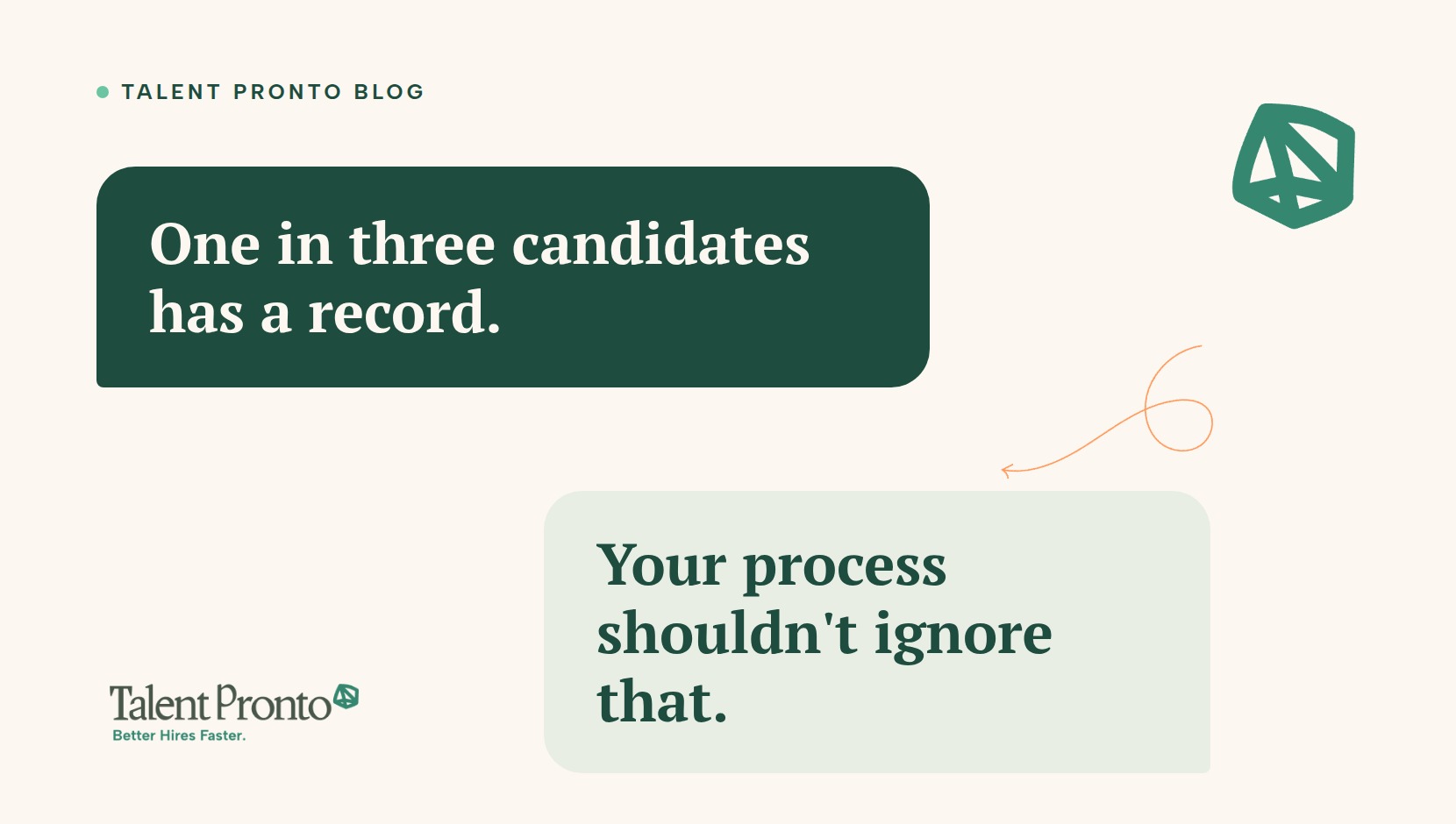
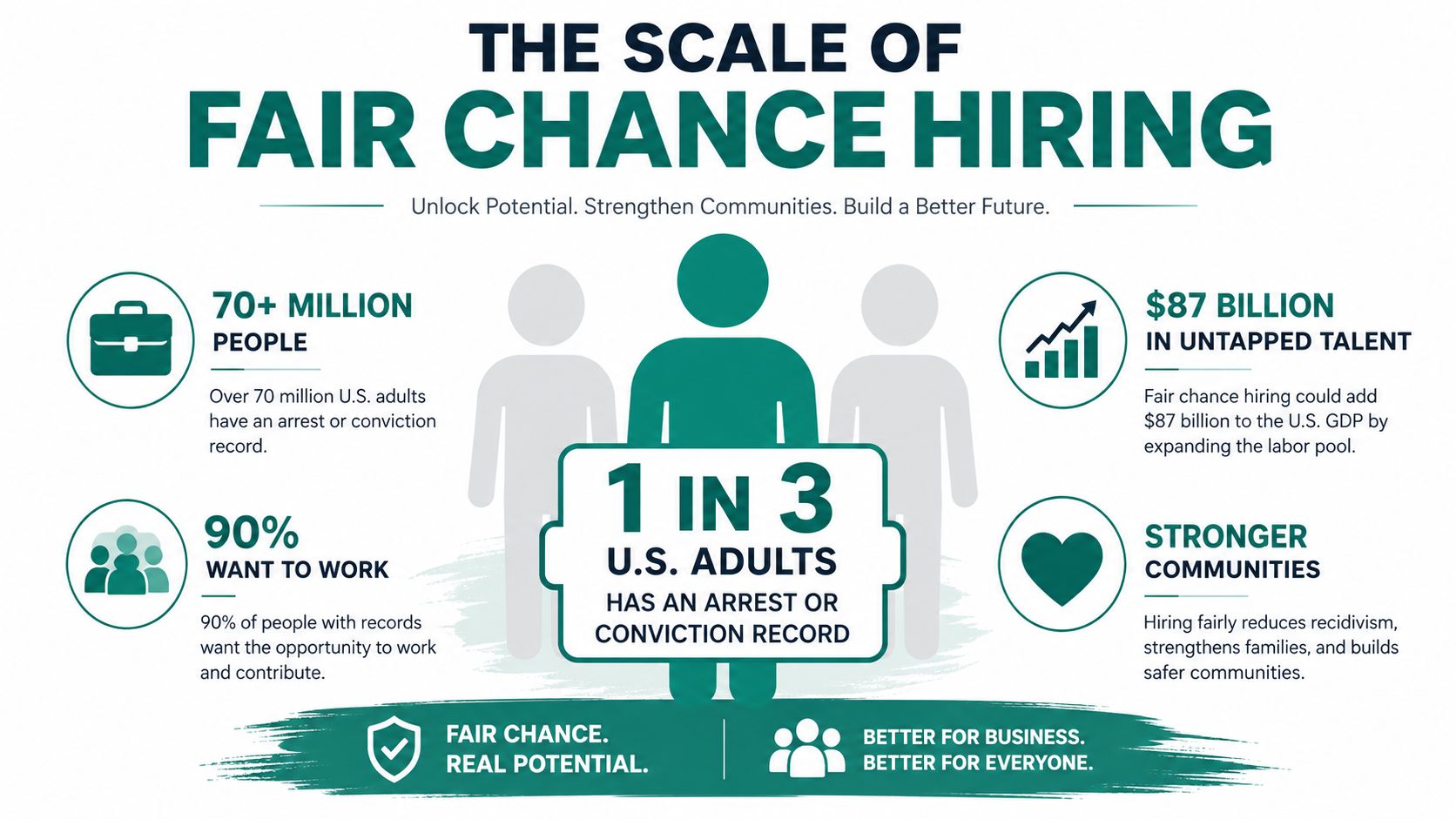
One in three U.S. workers may have an arrest or conviction record, which is why fair chance hiring isn't a side topic anymore. It's a core labor strategy, and in large hiring markets it can decide whether your requisitions stay open or move.
The mistake most employers make is treating fair chance hiring as a single application change. The stronger approach is operational, auditable, and built for regulated work, with a screening workflow that can hold up in healthcare, government, logistics, and other high-risk environments while still creating real advancement pathways for people who are hired.
The scale is the reason employers can't keep thinking about criminal-record screening as a narrow exception. An estimated 70 million to 80 million U.S. adults have an arrest or conviction record, which is roughly one in three workers (MIT Sloan / Checkr report). That means every hard cutoff in an application flow can remove a meaningful slice of the available labor pool.
A fair chance policy isn't charity, and it isn't a PR exercise. It's a response to a workforce reality that affects employers of every size, especially in markets where the cost of vacancy is already high and the candidate pool is thin. The same MIT Sloan and Checkr research notes that Checkr employed people with records at 4% of its workforce, which shows the model can be operational inside a growth-stage tech company rather than treated as a public-policy slogan (MIT Sloan / Checkr report).
That scale changes the hiring equation. If your process screens on the first page, you're not just filtering for risk, you're filtering out qualified people before they've had a chance to demonstrate fit.
Practical rule: if criminal history is relevant, evaluate it late and individually. If it isn't relevant, remove it from early-stage screening entirely.
Fair chance hiring also fits how modern employers think about pipeline resilience. Instead of waiting for perfect applicants, organizations widen access, then use structured evaluation to protect quality. That matters in large labor markets where a single policy can touch hundreds or thousands of candidates across roles.
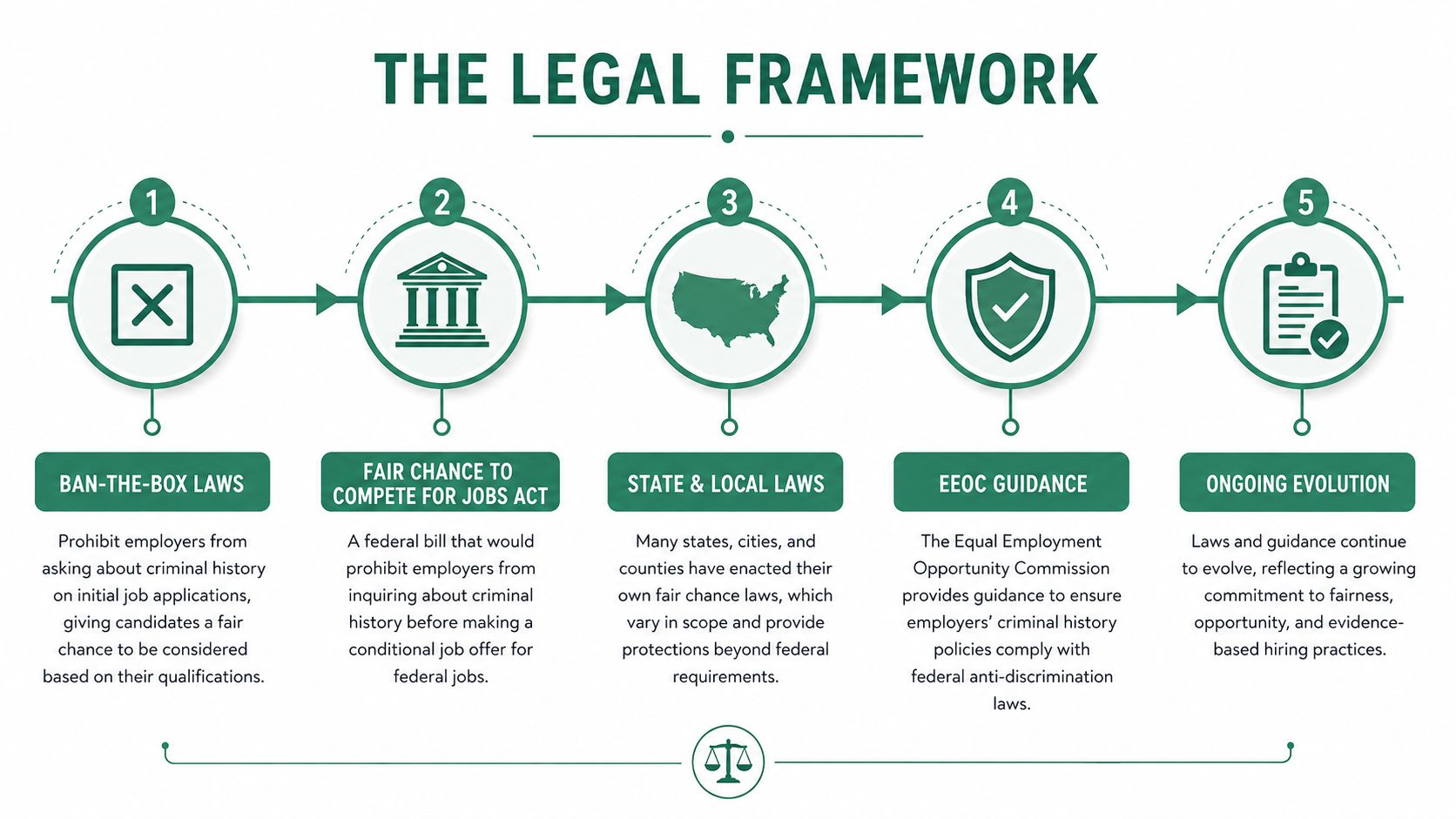
The legal structure starts with timing. The cleanest fair chance process removes criminal-history questions from the initial application and delays background-check review until after a conditional offer (Fair Chance Hiring summary). That sequencing matters because it forces the employer to evaluate qualifications before triggering a criminal-history review.
The federal Fair Chance to Compete for Jobs Act of 2019 generally bars U.S. federal agencies from asking about criminal history before a conditional offer of employment, with exceptions for roles that require inquiry by statute, access to classified information, sensitive national-security work, dual-status military technician jobs, and federal law-enforcement officer roles (HHS overview of the Act). That makes delayed inquiry the default in one of the country's largest hiring systems.
The review stage still needs structure. The EEOC-aligned approach uses individualized assessment, often described through the nature, time, nature factors, the nature and gravity of the offense, the time passed since the offense or sentence, and the nature of the job sought (LISC fair chance principles). New York City guidance adds a related standard, saying an employer may decline only if there's a direct relationship between the record and the job or an unreasonable risk to property or safety (LISC fair chance principles).
The worst compliance failures usually come from rushed, inconsistent processes. A blanket exclusion says less about risk than it does about weak workflow design. Employers in regulated industries need a documented decision path, not a manager improvising after a background report lands.
For employers trying to map those rules to a real policy stack, a practical jurisdiction-specific resource like crimes you cannot expunge in Illinois can help legal teams separate record-keeping questions from hiring rules, which aren't the same thing.
If you're building a policy from scratch, the most useful starting point is a workflow that pairs timing, notice, and individualized review with a written record of the decision. An overview of that approach sits well alongside a dedicated compliance page such as https://www.talentpronto.ai/security-compliance-fair-hiring-page, which is where many HR teams start when they need to align legal and operational controls.
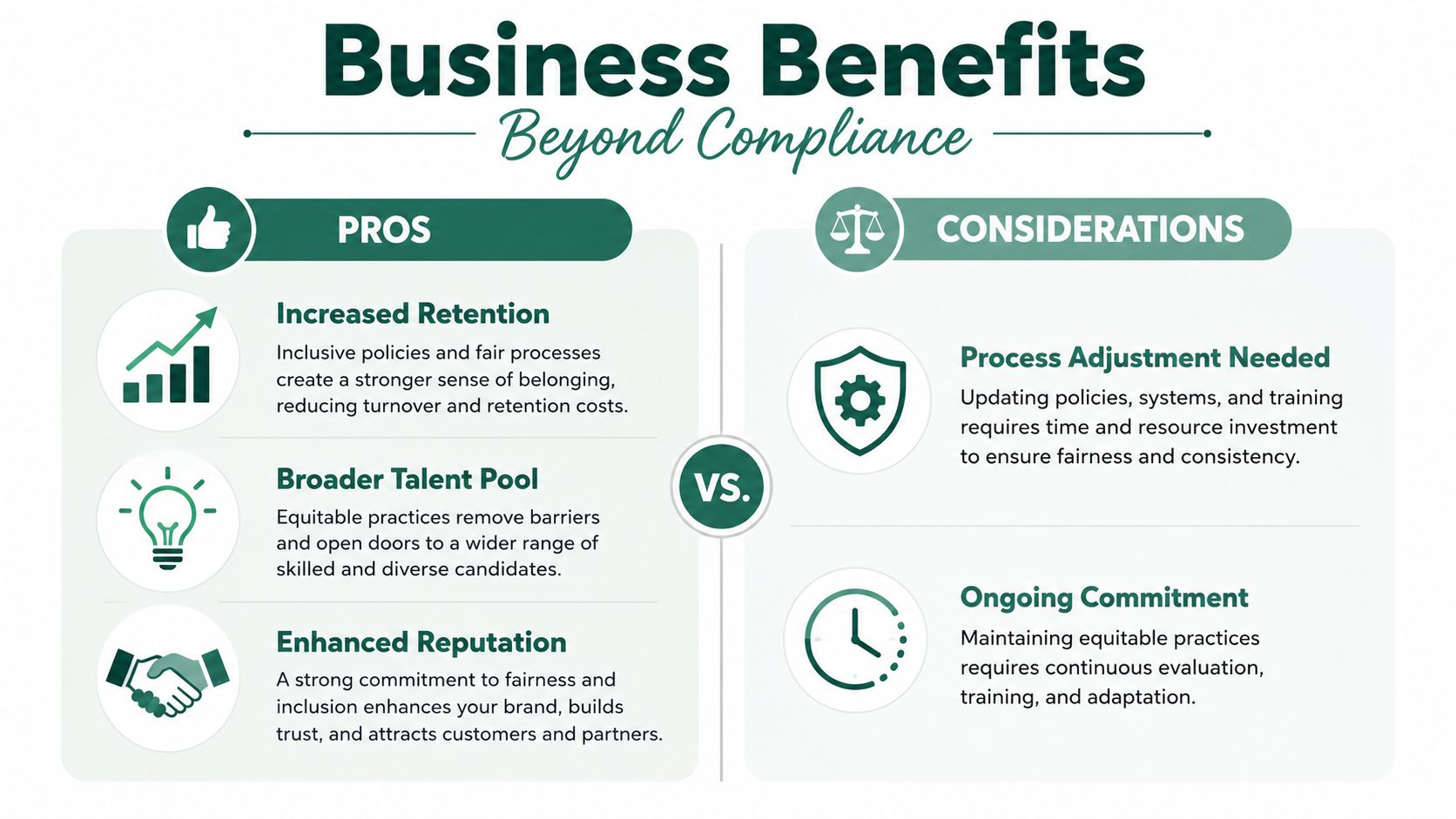
Fair chance hiring works best when leaders stop framing it as a legal burden and start treating it as a sourcing and process advantage. The strongest employer outcome comes from replacing reflexive exclusion with a structured review that lets more qualified people stay in the process long enough to be assessed fairly.
The callback penalty tied to disclosure is real. In a landmark study cited by NELP, callback rates fell from 34% to 17% for white applicants and from 14% to 5% for Black applicants when applicants disclosed a criminal record (NELP research summary). That is a screening problem, not just a social one, because early exclusion narrows the pool before skills can be evaluated.
San Francisco's fair-chance policy shows what happens when the process is structured well. NELP reports that only 2% of applicants with conviction histories were disqualified in 2013–2015, falling to 0.731% in 2022–2023 (NELP research summary). The point isn't that every employer should mimic the city's exact rules, it's that individualized assessment can sharply reduce unnecessary exclusion.
A fair chance process doesn't eliminate judgment. It forces judgment to happen on job-relevant facts instead of shortcuts.
Ad-hoc screening creates legal exposure because no one can later explain why one candidate was rejected and another was not. A documented workflow does the opposite. It gives legal, HR, and line managers a shared rule set, which is especially important in regulated roles where the employer still has to evaluate safety, licensing, or fiduciary concerns.
The business case is also cultural. Teams that use clear, job-related criteria tend to make fewer inconsistent calls, and that consistency matters to candidates who compare notes quickly in tight labor markets. Fair chance hiring, done properly, supports inclusion without asking managers to guess where the boundaries are.
A useful reference point for teams that need a lighter intro to the subject is equal opportunity hiring, which frames the same talent-pipeline logic from a broader workforce perspective.
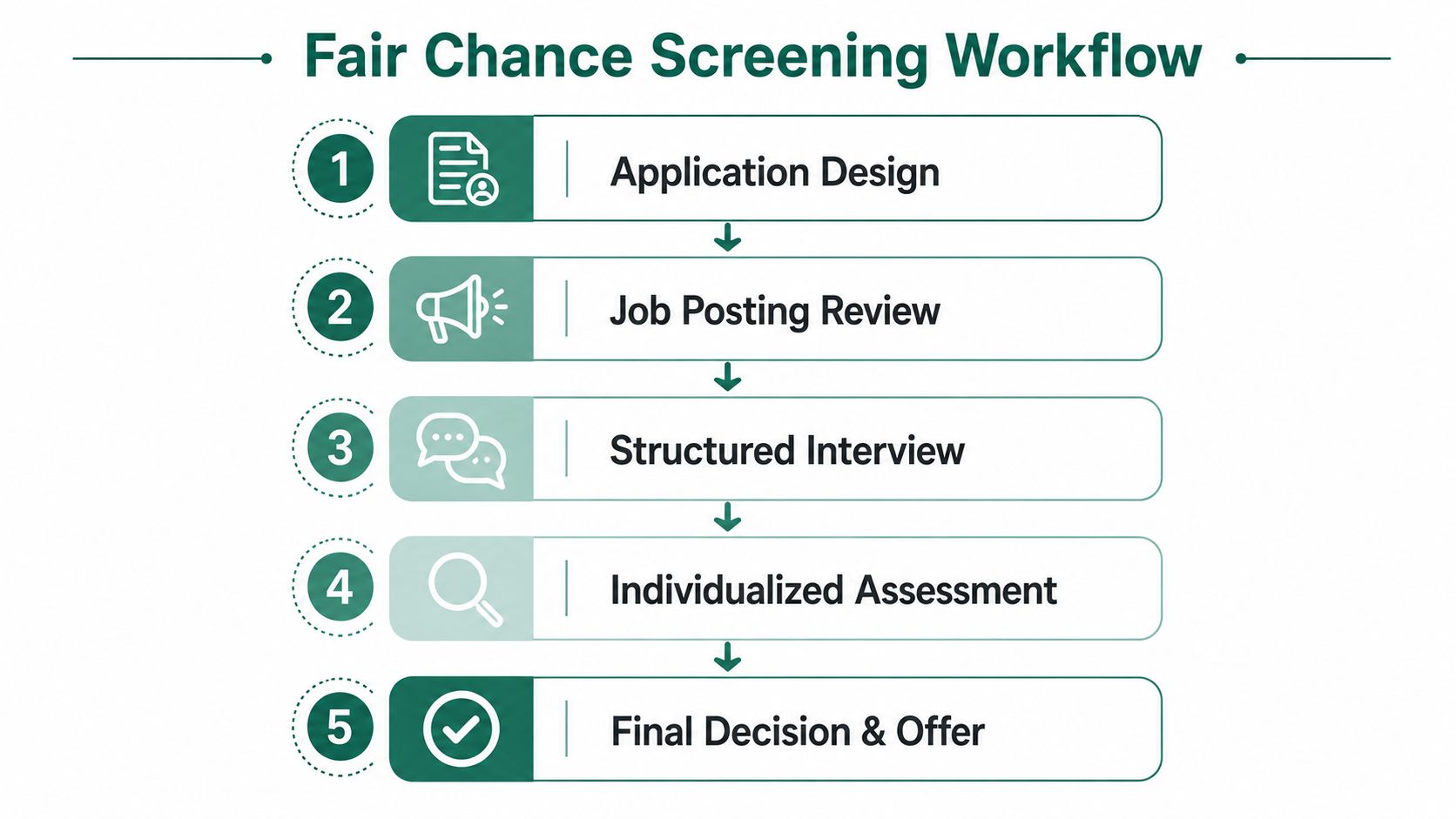
A defensible workflow starts before the background check, not after it. The application should remove criminal-history questions from the front door, then move candidates through role screening, interview, and conditional offer before any criminal-history review happens (Fair Chance Hiring summary).
The useful sequence looks like this:
Those steps sound simple, but the hard part is consistency. Healthcare, government, and logistics teams often have legacy policies that rely on blanket exclusions because they're easy to administer. Easy doesn't mean defensible.
BCG's guidance says employers should use the four-factor assessment, considering the relevance of the charge, the nature of the offense, the age of the record, and evidence of rehabilitation, and it also calls for risk-appropriate workarounds for restricted or regulated roles (BCG fair chance hiring guidance). That's the right mindset for sensitive roles, because a pharmacy technician, a public-sector procurement role, and a warehouse associate don't carry the same risk profile.
Documentation is where most programs get thin. If a candidate is rejected after a conditional offer, the file should show what was reviewed, what was considered job-related, and why the final decision was made. That's the difference between a real policy and a verbal preference.
For employers hiring household workers or caregivers, a practical background-screening resource like how to check a nanny's history can help translate general screening concepts into a tighter, role-specific review.
Manual fair chance review breaks down when managers apply different standards to similar candidates. Automation helps because it can force a common question set, a common scoring rubric, and a common audit trail, which is what compliance teams need when they review hiring decisions later.
The strongest systems hide demographic indicators from the people making early-stage decisions, use aggregate fairness metrics, and keep testing selection rules before and after deployment (UMass Employment Equity guidance). That matters because biased inputs or unvalidated scoring rules can reproduce discrimination even when the process looks standardized.
A platform like Talent Pronto, used here as one option among others, conducts conversational screening, ranks candidates against role-specific criteria, and records the question-and-answer trail needed for review. It can also mask demographic information during scoring and keep an audit log of each question, answer, and rationale, which is the kind of structure fair chance programs need when they're audited.
The value isn't that software replaces judgment. It's that software makes judgment traceable.
Integration matters as much as scoring. If a screening layer can sync status and candidate data into systems like Greenhouse, iCIMS, or Workday, HR doesn't have to rebuild the file by hand or chase hiring managers for updates. That reduces inconsistency, and it also reduces the chance that a candidate's response gets lost between stages.
Use automation for uniformity, not for final decisions. The final call still belongs to the employer, but the earlier process should be standardized enough that similar candidates are reviewed the same way.
A fair chance program that uses automation well should still allow candidate opt-out, manager review, and documented exceptions for restricted roles. The point is auditable fairness, not blind automation.
If teams need to think through adverse-impact measurement before deployment, the internal guide at https://www.talentpronto.ai/blog-posts/what-is-adverse-impact is a sensible companion reference because it keeps the focus on process quality rather than intuition.
For employers comparing candidate-screening tools, a consumer-facing comparison like evidence-based mouth swab tips is a reminder of why structured, job-relevant screening matters. Candidates will seek any advantage they can find when processes feel opaque, and that's another reason employers should keep screening rules clear, consistent, and legitimate.
Most fair chance content stops at getting someone hired. That's the easy part to describe and the hard part to sustain. JFF notes that the majority of people with records are hired into entry-level positions, while companies tend to make limited investments in their advancement (JFF).
That gap creates a predictable failure mode. Employers celebrate access at the front door, but the employees most affected by fair chance policies often don't get a real path upward. When that happens, fair chance hiring becomes a one-time intake strategy instead of a durable talent model.
The fix is practical, not philosophical. Employers can define which roles have advancement pathways, what skills count as readiness, and what documentation is needed before a promotion decision. That keeps the process from drifting back into informal bias, where manager preference masquerades as merit.
A few habits make the difference:
Advancement without structure just recreates old bias in a new form.
Employers in major labor markets should care because turnover and inclusion are connected. If the front door opens but the interior stays closed, the organization loses credibility with candidates and loses the benefit of the hiring investment. Fair chance hiring is strongest when it becomes part of the internal mobility system, not just the application screen.
A workable program doesn't need perfection, but it does need proof. The checklist below keeps compliance, screening design, and advancement in one place so HR, legal, and hiring managers can use the same playbook.
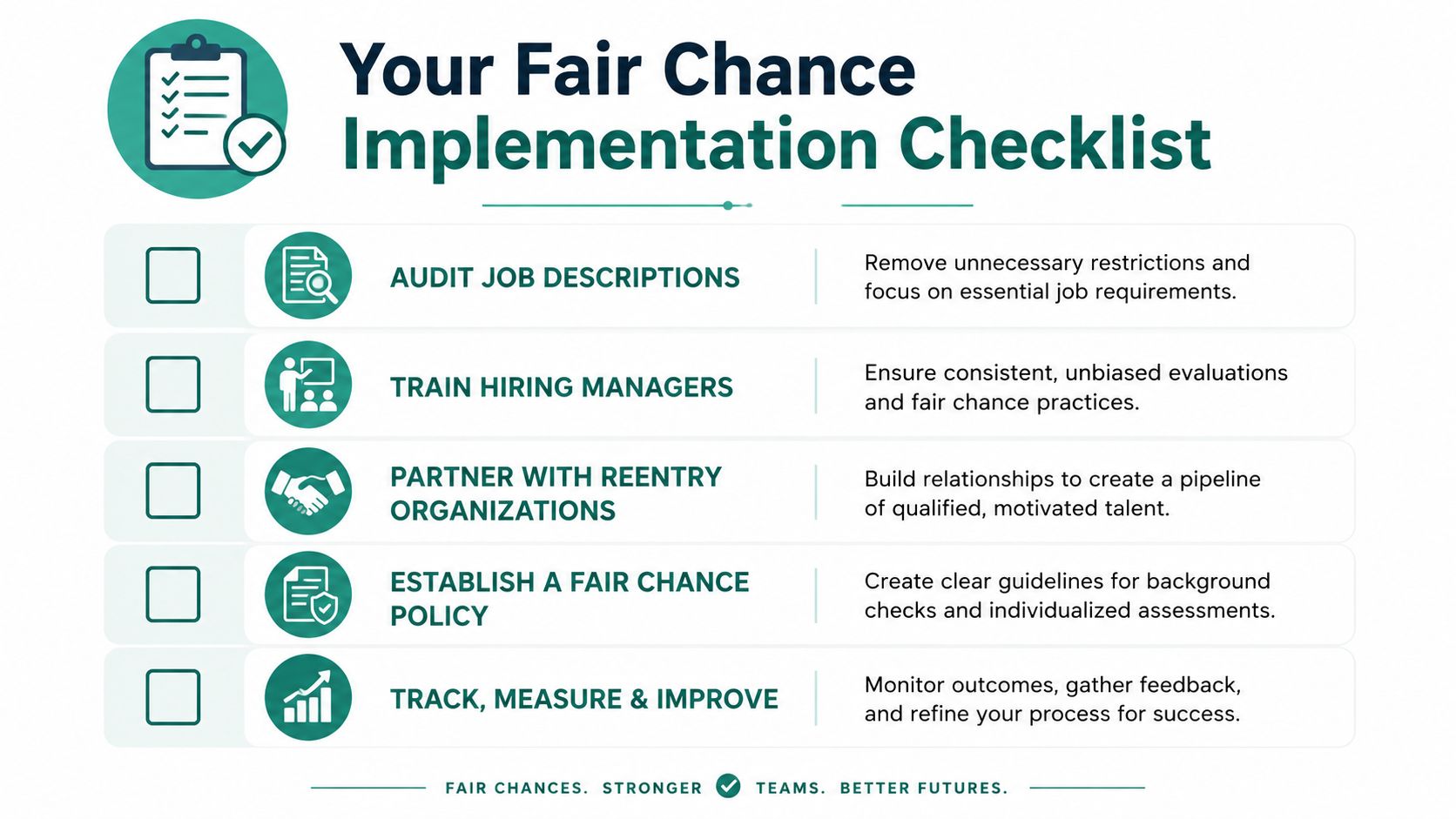
The biggest mistake to avoid is assuming a compliant background-check form equals a fair chance program. It doesn't. You need process discipline, manager training, and a record of how decisions are made, especially when the role is regulated or safety-sensitive.
If your team is ready to move from policy language to an auditable hiring workflow, Talent Pronto can help you structure conversational screening, apply role-based criteria, and keep a review trail that HR and legal teams can work from. Visit Talent Pronto to see how a fair chance workflow can be built into your hiring process without turning compliance into guesswork.

Talent Pronto is an AI-powered hiring platform built around Anna, our intelligent AI that conducts 24/7 conversational screening, evaluates candidates against specific job requirements and compliance needs, and schedules interviews. Run everything on the Talent Pronto ATS, our all-in-one applicant tracking system with a branded careers site and Anna built in, or keep your existing ATS and let Anna integrate with Greenhouse, Ashby, iCIMS, Jobvite, Lever, Oracle, and more. Either way, we help organizations reduce time-to-hire and build stronger teams.