Design & implement a structured culture fit assessment for fair, efficient hiring. Explore methods, questions, legal best practices, & metrics for 2026.
Your hiring team probably has a familiar problem right now. Candidates look good on paper, managers like the conversation, and everyone says the person seems like a “fit”, but no one can explain what that means in evidence you can defend later. That's where a culture fit assessment earns its place, because it turns a vague conversation into a structured check on values, behaviors, and working style.
Used well, it doesn't replace skills screening or interviews. It gives you a clearer early signal, helps reviewers compare applicants consistently, and makes it easier to separate real alignment from shared background or personal chemistry. For teams hiring at volume, that shift matters even more, because the process has to stay fair, repeatable, and fast.
A hiring team can hear three different versions of the same candidate and still not know why. One recruiter may like the conversation, a manager may say the person “felt right,” and a compliance reviewer may ask what evidence supported the decision.
A structured culture fit assessment replaces that guesswork with observable criteria. It starts by turning culture into something people can assess, such as how a candidate shares information, handles disagreement, or follows through on commitments. For recruitment teams using AI-powered platforms like Talent Pronto, that translation matters because the platform can only score what the team defines clearly. If the criteria stay vague, the process stays vague too.
Practical rule: if a value cannot be described in behavior, it cannot be scored fairly.
The wider point is simple. Culture should be measured through core values and visible behaviors, not through casual impressions or social similarity. That reduces similarity bias, makes interview notes easier to compare, and gives hiring managers a clearer basis for discussion. The London School of Economics analysis on hiring for culture makes this distinction explicit, recommending explicit questions and value-based indicators instead of judgments built on who feels familiar. LSE analysis on hiring for culture
For a recruitment team, the operational step is to define the behaviors before interviews begin. For example, if collaboration matters, the scorecard should describe what collaboration looks like in practice, such as sharing context early, asking for input before decisions close, and handing work off cleanly. If ownership matters, the scorecard should show how a candidate identifies risk, closes loops, and explains trade-offs without hiding problems. That is how a qualitative idea becomes a measurable criterion in a high-volume hiring flow.
Candidates benefit from the same structure. They are reviewed against evidence from answers, examples, and past actions, rather than against a recruiter's instinct. The business also gets a cleaner process, because the early funnel becomes easier to explain, easier to audit, and easier to improve.
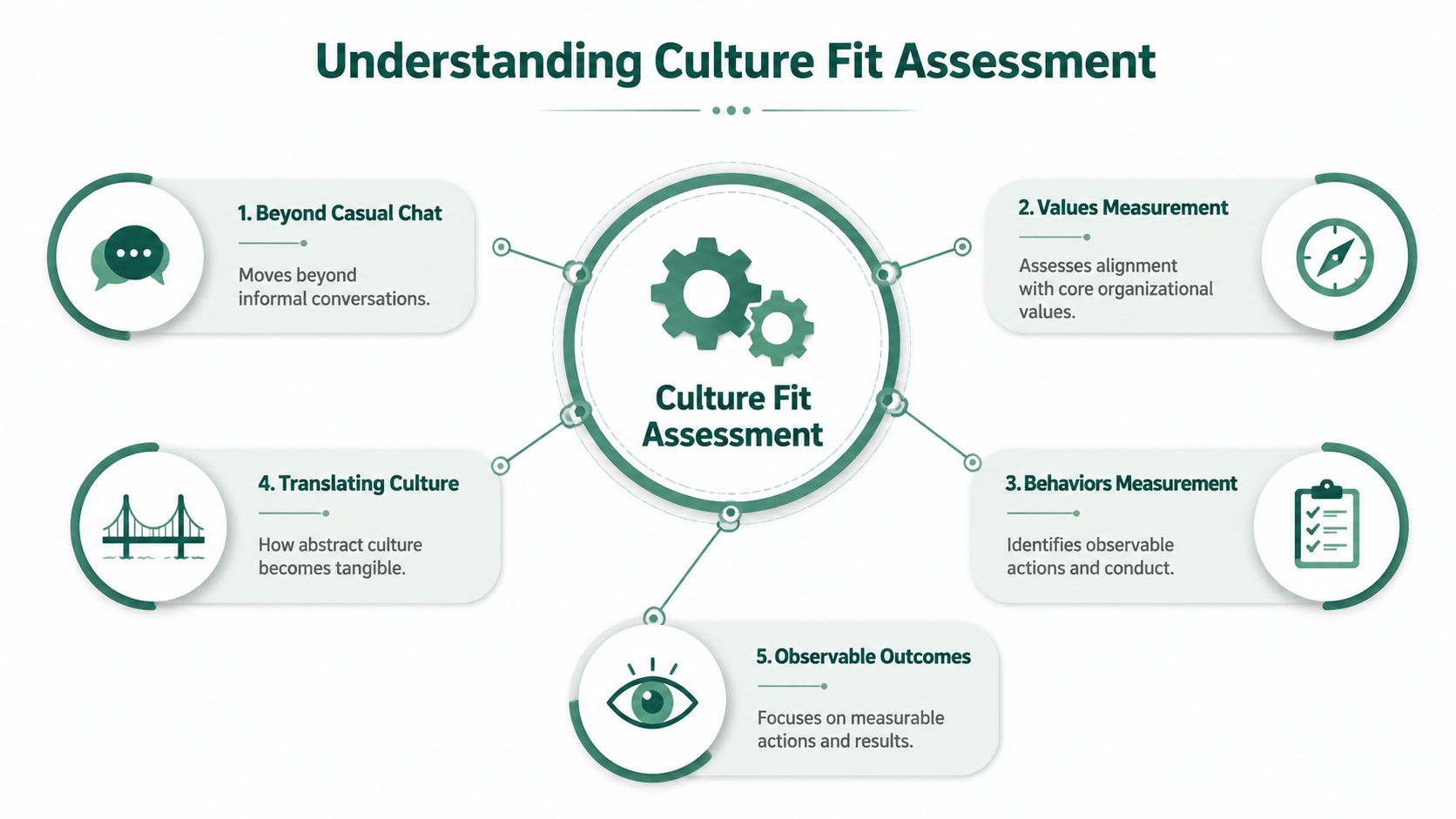
A useful way to understand culture fit assessment is as a values-and-behaviors measurement system. It is not a personality clone test, and it is not a casual chat about whether someone seems pleasant. Its primary aim is to check whether a candidate shows the behaviors your organization needs in everyday work, under ordinary pressure, and in the moments when priorities shift.
Culture becomes usable only after it is translated into anchors. “Collaboration” might mean sharing information early, asking for input before a decision is closed, and giving clean handoffs. “Ownership” might mean flagging risk early, closing loops, and explaining trade-offs without hiding problems. Once those ideas are written down, interviewers can score the same evidence instead of relying on vague impressions.
For a recruitment team, this is the point where a platform like Talent Pronto can help turn policy into process. If the hiring team defines the behaviors first, the system can prompt structured questions, capture notes in a consistent format, and keep reviewers focused on the same signals across a high-volume hiring flow. That matters because culture should be measured in the evidence a candidate gives, not in who feels familiar in the room.
A practical culture fit scorecard works like a checklist for day-to-day work. Each value gets a behavior, each behavior gets a rating scale, and each rating needs a short explanation tied to what the candidate said or did. That gives recruiters a common language for comparing candidates across sites, interview panels, and time.
Once the organization defines those behaviors, psychometric thinking becomes easier to apply because the process starts to resemble measurement instead of impression management. A related model compares the organization's working style with candidate preferences or behaviors across areas such as collaboration, autonomy, and risk tolerance. Psychometric culture match model
Teams also benefit when assessments support group decisions instead of relying on loose personality labels. Structured assessments can help managers discuss fit in a more disciplined way, especially when several interviewers need to compare notes and agree on what the candidate evidence actually shows. unlocking team potential with assessments
The practical lesson is straightforward. Culture becomes measurable only after the company defines the evidence it wants to see, then uses the same criteria every time.
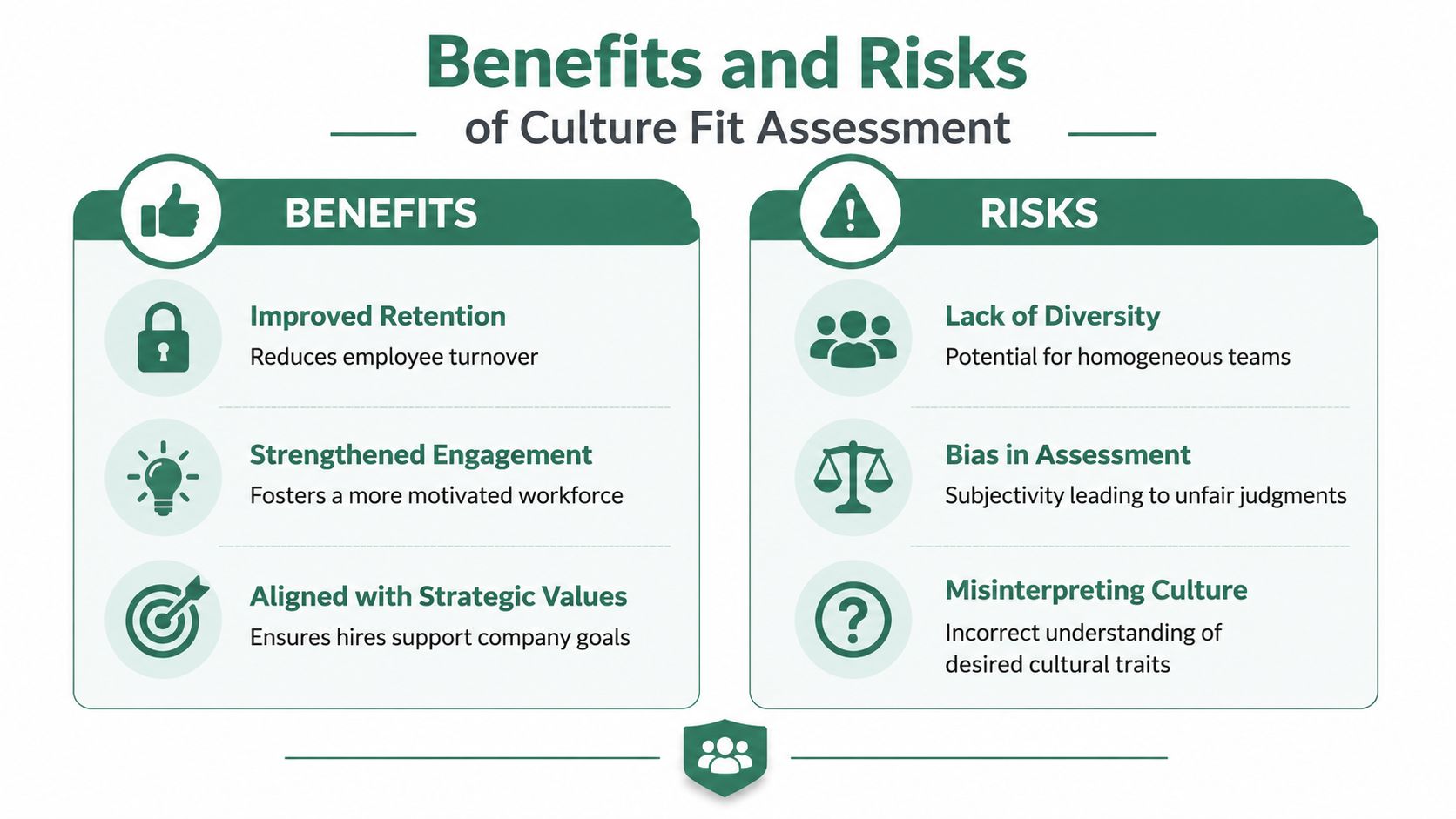
The appeal of a structured culture fit assessment is obvious once you've lived through inconsistent hiring. Managers stop arguing about whether someone was “good with people” and start scoring evidence. That makes hiring easier to compare across candidates, and it also creates a trail that other reviewers can inspect later.
The strongest case for culture assessment is alignment. When hiring teams define values clearly, they can screen for behaviors that support the way work is performed. That matters because structured methods make it easier to keep panels aligned, compare candidates across regions, and avoid one manager drifting toward personal preference.
A HireVue review notes that culture fit assessments have very low validity and, at best, only a slight impact on retention, placing them among the weakest pre-hire predictors of success. HireVue review on culture fit validity The practical reading is not “ignore culture.” It's “don't let culture substitute for stronger evidence.” Structured interviews and cognitive tests remain more reliable predictors, so culture assessment should sit beside them, not on top of them.
The main risk is similarity bias. Interviewers can mistake familiarity for fit, especially when a candidate shares a communication style, school background, or leadership style with the panel. That's why unstructured notes are dangerous. They capture the interviewer's impression, not necessarily the candidate's behavior.
A culture process gets risky when it starts rewarding sameness instead of evidence.
There's also a second risk, over-weighting fit and under-weighting skills. A team can end up selecting people who sound aligned but can't do the work. The fix is straightforward, use culture as one signal, define it behaviorally, and calibrate assessors so they score the same evidence the same way. The best systems don't abandon culture fit, they make it harder to misuse.
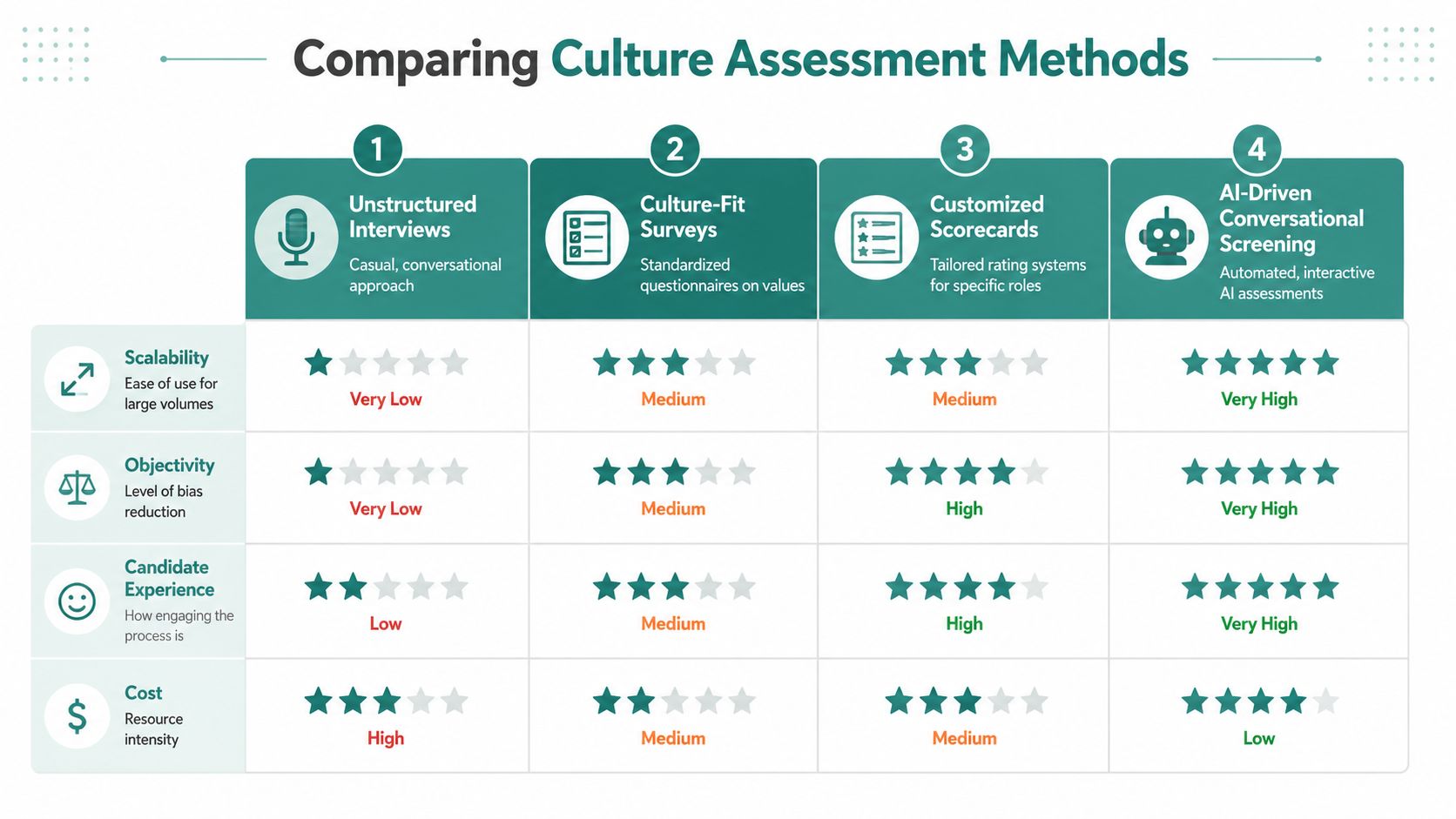
A team can choose the wrong method for the right reason. A founder may prefer an unstructured interview because it feels quick and conversational, while a high-volume employer needs a method that can be repeated, reviewed, and audited across many applicants without turning every decision into a new debate.
| Method | What it does well | Main weakness |
|---|---|---|
| Unstructured interviews | Feels natural and flexible | Hard to compare, easy to bias |
| Culture-fit surveys | Standardizes the question set | Can still become shallow if the rubric is weak |
| Customized scorecards | Improves consistency and auditability | Requires upfront design and manager calibration |
| AI-driven conversational screening | Scales early screening and keeps the same criteria in play | Needs strong governance and clear human handoff |
The strongest technical setups use a two-entity comparison model. First, map the organization's actual working style. Then compare each candidate's preferences or behaviors against that baseline across dimensions like collaboration, autonomy, and risk tolerance. The Culture-smart psychometric model gives a useful way to think about that comparison, because it frames fit as a structured match between two sets of traits rather than a loose feeling about a candidate. Some systems expand into many dimensions and use thresholds for review escalation, which helps when a pipeline needs clear routing rules instead of ad hoc rejection.
If your hiring volume is low, customized scorecards may be enough. They give interviewers a shared reference point without adding much process overhead. If your team reviews large applicant pools, automated screening can reduce manual work before a human ever enters the loop, especially when the same cultural criteria must be applied again and again.
A platform such as Talent Pronto can handle conversational screening, role-specific questions, and structured scorecards, which makes it practical for teams that want comparability without giving up speed. The same logic appears in the guide on cultural interview questions for structured hiring, where culture is translated into prompts that managers can score. For teams also exploring broader team diagnostics, the partner resource on unlocking team potential with assessments shows how assessment design can support a shared language across hiring and team development.
For teams building a stronger values framework, the guide for structured culture interviews is a useful reference for turning culture into reusable prompts. The decision comes down to fit between method and scale. Choose the method that matches your hiring flow, then score the evidence the same way every time.
A culture fit assessment works best when the questions pull out concrete behavior. The goal is not to ask, “Do you like our company?” The goal is to ask for examples that show how a person works, then judge those examples against a fixed rubric.
A simple way to keep that process fair is to use the same question set for every candidate in the role family. Keep it short enough for mobile completion, and keep the full prompt set under a normal interview window so candidates can finish it without friction. Sapia on cultural fit assessment design
Use the same question set for every candidate in the role family. The point is to compare answers, not to improvise a new standard each time. If you are using an AI-powered workflow in Talent Pronto, this is also where structured prompts help turn culture into something your team can measure consistently. For teams comparing question design with interviewer prompts, the internal Talent Pronto cultural fit interview questions resource gives practical examples of how values become usable questions.
| Question | Behavioral Anchor Low | Behavioral Anchor High | Score Range |
|---|---|---|---|
| Tell me about a time you made a mistake at work. | Avoids specifics, blames others, or gives a hypothetical answer | Names the mistake, explains impact, and shows what changed afterward | 1 to 5 |
| Describe a time you had to work across teams to solve a problem. | Mentions cooperation in general terms but no evidence of coordination | Gives a clear example of information sharing, alignment, and follow-through | 1 to 5 |
| When you disagree with a process, what do you do first? | Reacts emotionally or works around the process without raising it | Raises the issue directly, explains the risk, and stays constructive | 1 to 5 |
| How do you decide whether to move quickly or pause for more input? | Gives a vague preference with no decision logic | Shows a repeatable rule based on impact, risk, and stakeholder needs | 1 to 5 |
Start with 3 to 5 core behaviors and turn each one into observable anchors. Then use a fixed rubric such as 1 to 5 or 1 to 3, so different interviewers judge the same evidence against the same standard. Sapia on cultural fit assessment design The reason for that structure is straightforward. It reduces scorer variance and gives managers a cleaner path when two answers sit near the middle of the scale.
A clean question bank helps, but the rubric matters more than clever wording. A team can ask a good question and still score it poorly if the anchors are vague. The guide for structured culture interviews is a useful reference for turning values into reusable prompts that fit a hiring process. The main aim is consistency, not style.
Scoring rule: if two assessors can read the same answer and reach different conclusions without a clear reason, the rubric is not ready.
A culture assessment is only useful if it can survive scrutiny. That means the process has to be built around job-related evidence, clear notes, and repeatable scoring. It also means the team has to stop assuming that “culture” is a safe word for intuition.
Start with standardized rubrics and documented criteria. Then use a blind first pass so reviewers score evidence before they see names, schools, photos, or location. That structure matters because it pushes evaluators toward observable behaviors instead of surface similarity.
For teams hiring in regulated environments, the internal what is interview bias resource is a useful companion to a formal bias review. If you also need a legal reference for candidate screening and record handling, the essential guide for CT employers is worth reading alongside your internal policy review.
Managers need more than a scorecard. They need calibration sessions, examples of strong and weak answers, and a rule for when to escalate borderline cases. They also need to store the rationale behind the score, because a number without notes is hard to defend later.
Practical rule: if the rubric says “collaboration,” the notes should show collaboration, not just “seemed nice.”
A final safeguard is to keep the panel diverse and check for drift over time. If one interviewer routinely scores higher or lower than everyone else, the team should recalibrate. That doesn't just reduce bias, it also makes the process easier to explain to leaders who want to know why one candidate advanced and another did not.

A high-volume funnel needs more than good questions. It needs routing logic, fast candidate contact, and a way to keep the same standards in play without making recruiters chase every response manually. That's where AI-powered screening changes the operating model.
The basic sequence is straightforward. The system reaches out after application, asks a structured set of questions, scores the responses, and routes qualified candidates onward before a recruiter reviews anyone. That's the definition of automated candidate screening, and it's what makes the early funnel manageable at scale. Automated screening mechanism
Conversational AI can also stay active 24 hours a day, 7 days a week, which helps when applicants apply outside business hours. Conversational AI in recruitment AI-powered screening systems score applicants against structured, role-specific criteria and return rankings or next-step recommendations for recruiter review. AI-powered candidate screening
For large hiring programs, even small process gains matter because the manual workload is huge. One recruiting implementation guide says organizations using AI-powered screening report about 40% faster time-to-hire and up to 75% efficiency gains in recruitment administration. AI screening implementation guide That doesn't mean automation replaces judgment. It means recruiters spend less time on first-pass sorting and more time on actual decision-making.
Teams that want a practical operating model can use Talent Pronto to run role-specific question sets, auto-score responses, and hand qualified candidates to recruiters with structured scorecards. If you're running a high-volume process, the internal high-volume hiring strategies article is a useful companion for thinking about thresholds, handoffs, and workflow design.
The best automation doesn't decide who gets hired. It decides who gets reviewed first.
A significant advantage is consistency. When the same values prompts, scoring rules, and routing thresholds apply across roles and sites, the process becomes easier to monitor and easier to improve without creating a manual bottleneck.
A strong culture fit assessment is built on three things, clear values, structured rubrics, and evidence-based scoring. Once those are in place, automation can help you keep the process consistent at scale without turning it into a black box. The point isn't to hire people who feel familiar, it's to identify people whose behaviors match the way the role and team work.
Track the health of the process, not just the final hiring decision. The most useful metrics are completion rate, time-to-first-interview, stage conversion by fit band, assessor variance, and candidate sentiment. If those numbers drift, the process needs calibration, not more intuition.
A good rule of thumb is simple. If managers can't explain why a candidate scored the way they did, the culture assessment isn't ready yet. If they can, you've got a process that's more fair, more consistent, and easier to scale.
A CTA for Talent Pronto. If you want to turn culture fit assessment into a structured, auditable part of your hiring funnel, use Talent Pronto to ask role-specific questions, score responses with consistent rubrics, and route candidates through an early-stage process that stays manageable as volume grows.

Talent Pronto is an AI-powered hiring platform built around Anna, our intelligent AI that conducts 24/7 conversational screening, evaluates candidates against specific job requirements and compliance needs, and schedules interviews. Run everything on the Talent Pronto ATS, our all-in-one applicant tracking system with a branded careers site and Anna built in, or keep your existing ATS and let Anna integrate with Greenhouse, Ashby, iCIMS, Jobvite, Lever, Oracle, and more. Either way, we help organizations reduce time-to-hire and build stronger teams.