Discover how virtual job tryouts help employers assess candidates with simulation-based hiring. A complete guide for 2026.
Virtual job tryout programs are not soft screening tools. HireVue's benchmark claims point to 53% improvement in performance, 117% improvement in retention, and 175% improvement in gender diversity versus baseline hiring outcomes, which is why employers stopped treating these simulations like a novelty and started treating them like an assessment strategy (HireVue Virtual Job Tryout ABX). The practical lesson is simple, if you are hiring at scale, you need a way to see how people work before they enter the workforce.
That is the appeal of a virtual job tryout. It replaces résumé polish and interview performance with a job-relevant simulation that asks candidates to handle realistic tasks, decisions, and constraints. For employers running high-volume hiring, that shift matters because consistency is hard to achieve when dozens or thousands of applicants reach the same stage at once.
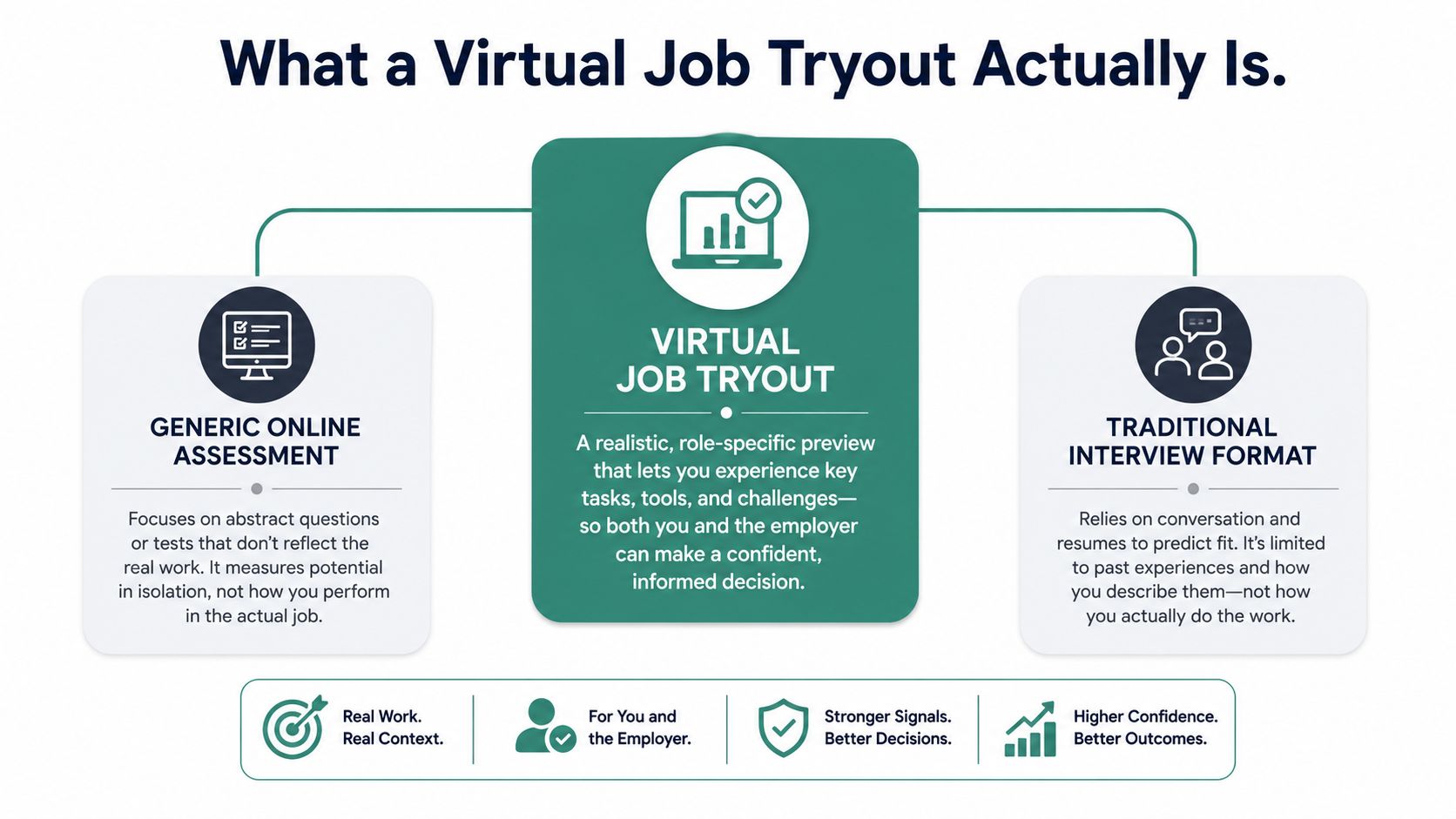
A virtual job tryout is a pre-hire simulation built around real work, not a generic online quiz. HireVue describes its Virtual Job Tryout® as an assessment that immerses candidates in job-related tasks and uses work-related simulations to show whether someone is a fit for the role (HireVue Virtual Job Tryout). That difference matters because a VJT is meant to show how a candidate thinks, prioritizes, and responds under conditions that resemble the job itself. It is less about what someone can recite and more about what they can do when the work is concrete and the rules are clear.
A useful comparison is a functional capacity evaluation in the physical world, which measures how well someone can handle task demands under defined conditions. The hiring version is similar in purpose, but it focuses on role-specific judgment, task flow, and decision quality rather than physical capacity. In both cases, the goal is not to impress anyone with abstract knowledge. The goal is to observe performance against a real standard.
The format gained traction because hiring had already shifted online, and employers wanted a more consistent way to compare applicants. Industry reporting notes that virtual interviews became mainstream after the pandemic, with one report showing 90% of organizations using virtual interviews for early-stage hiring, another showing 82%, and 93% planning to continue (B2B Reviews). That shift pushed employers toward digital assessment where the process needed to be repeatable, not just conversational.
VJTs fit that need well. They reduce reliance on résumé keywords and interview charm by asking candidates to handle realistic work scenarios. In high-volume roles, that makes it easier to compare people on the same task set instead of trying to infer capability from unrelated signals. It also forces a practical design decision, whether the simulation is measuring the behaviors that drive success, or just producing a polished candidate experience.
A strong VJT narrows the gap between what a candidate says they can do and what they do when the work gets messy. Talent teams often use these assessments alongside broader pre-employment assessments when they need a clearer read on job fit and operational readiness (Talent Pronto). The best programs feel less like a test and more like a preview of the job, while still being realistic about the trade-offs, such as accessibility friction, time burden, and how well the assessment connects to the rest of the hiring workflow.
A simulation only works when it is built around the work, not around the vendor demo. Start with the 3 to 5 highest-frequency, highest-consequence tasks in the role, then design the assessment around those tasks alone. If you try to cover everything, completion drops, scoring gets noisy, and you end up with a longer exercise that predicts less.
Practical rule: if a task doesn't happen often or doesn't matter when it goes wrong, it probably doesn't belong in the simulation.
The strongest simulations mirror the tools, constraints, and success measures the person will face on day one. The candidate should recognize the work context quickly. If the role requires prioritizing tickets, checking order accuracy, or resolving customer issues under time pressure, the assessment should surface those behaviors directly. That is also where design trade-offs show up. A simulation that feels too polished can hide weak performers, while one that is too clunky creates friction before you get any useful signal.
VJTs are usually multi-component assessments. Common elements include situational judgment, work-sample simulations, ranking and prioritization tasks, data analysis, and personality or biodata items (JobTestPrep). That structure matters because one task type rarely captures the full job. A logistics associate may need judgment, attention to detail, and speed. A healthcare coordinator may need prioritization, accuracy, and calm communication.
Runtime also needs to be designed with care. Longer assessments create more room to observe behavior, but they also increase drop-off and make accessibility issues harder to ignore. Some teams overfit the simulation to the assessment platform and forget the candidate journey. The result is a process that screens people out for endurance instead of performance, which is a bad trade in high-volume hiring. Use good resume keywords to use only where they fit the task design, not as a substitute for job-relevant simulation content.
The best design work happens before anything is written. Define the core tasks, write the simulation to reflect them, and use the same context every time the candidate sees a scenario. That keeps the assessment comparable and makes the results easier to defend with hiring managers. It also means the simulation should fit into the rest of the hiring stack without creating duplicate steps, broken handoffs, or a candidate experience that feels disconnected from the role. For deeper guidance on building simulations that predict performance, see our pre-employment assessments framework (pre-employment assessments).
A simulation is only as strong as its scoring model. If your reviewers are improvising, or if the platform only tells you who finished, you are not running an assessment. You are running a digital obstacle course.
The better approach is structured scoring with competency bands calibrated to role complexity. That lets hiring teams distinguish between a candidate who can complete the task and one who can complete it at the standard the role requires. In practice, this means deciding in advance what good, acceptable, and weak performance look like, then scoring each response against those definitions rather than against a vague gut feeling.
The most useful implementations choose one or two key outcomes to track, such as reducing time-to-hire or improving 90-day retention, and define success before the assessment goes live (Lathire). That keeps the team from collecting data that no one uses. It also helps leaders avoid the common trap of measuring the simulation itself instead of the hiring outcome it was supposed to influence.
A rubric that hiring managers can't explain is a rubric they won't use.
Calibration matters too. A junior role and a lead role should not be scored with the same expectations, even if the tasks look similar. The cut-off score or competency band needs to reflect role complexity and what past successful hires did, not just whether a person finished the assessment.
For practitioners who want a broader hiring-language lens, a resource like good resume keywords to use can help teams understand what candidates are likely to signal on paper before they reach the simulation. That does not replace the VJT. It just reminds you how different paper screening is from performance screening.
The strongest framework is one that hiring managers trust, candidates can understand at a high level, and HR can defend later. Anything less turns the VJT into a black box, and black boxes do not hold up well in real hiring operations.
Most employer content talks about simulation design and barely mentions the conditions candidates sit in when they take the assessment. That omission matters. Internet instability, device limitations, browser permissions, and noisy environments can distort results, especially for candidates in lower-connectivity regions or non-traditional work settings.
A candidate who has the right skills but the wrong setup can look weaker than they are. That is not a fair screen, and it is not a reliable one either. A practical guide for job seekers in LATAM explicitly advises checking internet stability, laptop and peripheral setup, and the assessment environment before starting, which is a clear signal that technical readiness affects outcomes (Latojobs).
The first fix is a readiness check. Tell candidates what devices, browsers, and permissions they need, then give them time to confirm setup before the assessment opens. If you can, build in a low-risk practice step so candidates know whether their camera, audio, or interface is working.
A second fix is to offer a route for people who prefer a traditional application process. That opt-out matters more than many teams admit, because not every strong candidate will be comfortable with a simulation on the first pass. A fair process gives people a way in without forcing every applicant through the same channel.
Mobile design also deserves attention. If your audience includes hourly, frontline, or field candidates, the experience has to work on the device they already use. If it only functions well on a laptop in a quiet room, you have designed for convenience on your side, not accessibility on theirs.
For teams focused on the broader candidate journey, the advice in how to improve candidate experience is worth revisiting because friction is often the difference between completion and drop-off. The goal is not to make the assessment easier. The goal is to make sure the assessment measures job-relevant skill instead of technical privilege.
When employers get this right, the VJT becomes a better screening tool and a fairer one.
A virtual job tryout should not land in your process as a standalone experiment. It needs a workflow, owner, and handoff rules, or it will create more confusion than clarity. The implementation work is usually less about the assessment itself and more about where it sits in the funnel.
Start with a pilot. Pick one role family, one business unit, or one geography where hiring demand is clear and the hiring managers are open to structured process changes. Then define what success looks like before the first candidate enters the flow.
Implementation fails when recruiters have to translate the assessment twice, once for managers and once for the ATS.
An integrated workflow matters even more if you use conversational screening alongside the VJT. Tools like Talent Pronto can screen applicants with structured questions and scorecards, which makes the early funnel easier to coordinate with a simulation layer when the process is designed well. The point is not to add tools. The point is to reduce handoffs that slow hiring down.
Guided onboarding is part of the rollout, not an afterthought. If hiring managers do not understand the scorecards, they will default to résumé pattern-matching or interview gut feel, and the whole exercise loses value. Keep the process simple enough that busy teams can use it without renegotiating the rules every week.
Vendor selection should start with operational fit, not feature count. The question is not, “What can the platform do?” It is, “Can this platform support the way we hire?” That distinction matters because a flashy interface with weak integration or thin assessment logic becomes a burden fast.
Here is the clearest comparison I use when reviewing platforms.
| Evaluation Dimension | Legacy Chatbot Approach | Modern Agentic AI Approach |
|---|---|---|
| Screening depth | Collects form fields and basic answers | Probes experience and behavioral traits beyond form collection |
| Candidate engagement | Scripted, static, often one-size-fits-all | Role-aware, conversational, and more responsive |
| Evaluation output | Limited notes or basic routing | Structured scorecards tied to role criteria |
| Scheduling support | Often separate from screening | Can coordinate next steps after review |
| ATS and HRIS fit | May require manual transfer | Designed to sync data and statuses |
| Candidate experience | Functional, but often rigid | More interactive and persistent across the funnel |
| Compliance support | Depends on add-ons | More likely to include fair hiring documentation |
The modern platform should also understand industry context. Healthcare, manufacturing, retail, government, and tech teams do not ask the same questions, and they should not get the same canned screening flow. A platform with role-aware questioning and structured scorecards will usually outperform a legacy chatbot that only moves people from one form to the next.
If you want a deeper vendor lens, the guidance in virtual interview platform is useful because the same integration and workflow questions apply whether the front end is conversational screening or a full simulation. Security and compliance also belong in the review. If the vendor cannot document how it supports fair hiring practices, the system may be convenient but still risky.
Can the platform support your current workflow without forcing recruiters to copy data, re-score candidates, or rebuild interview scheduling by hand? If the answer is no, the tool is not ready for high-volume operations.
Executive stakeholders usually want a clear read on return, and VJT programs create value in several places at once. Some of that shows up in quality of hire, some in recruiter efficiency, and some in auditability. The mistake is trying to prove the whole case with one metric.
The most useful measures are 90-day retention, downstream performance ratings, time-to-hire, and candidate completion rates. HireVue's benchmark figures around performance, retention, and diversity show why employers pay attention to the model, but each organization still needs to connect the assessment to its own hiring outcomes (HireVue Virtual Job Tryout ABX). That is where the business case becomes real.
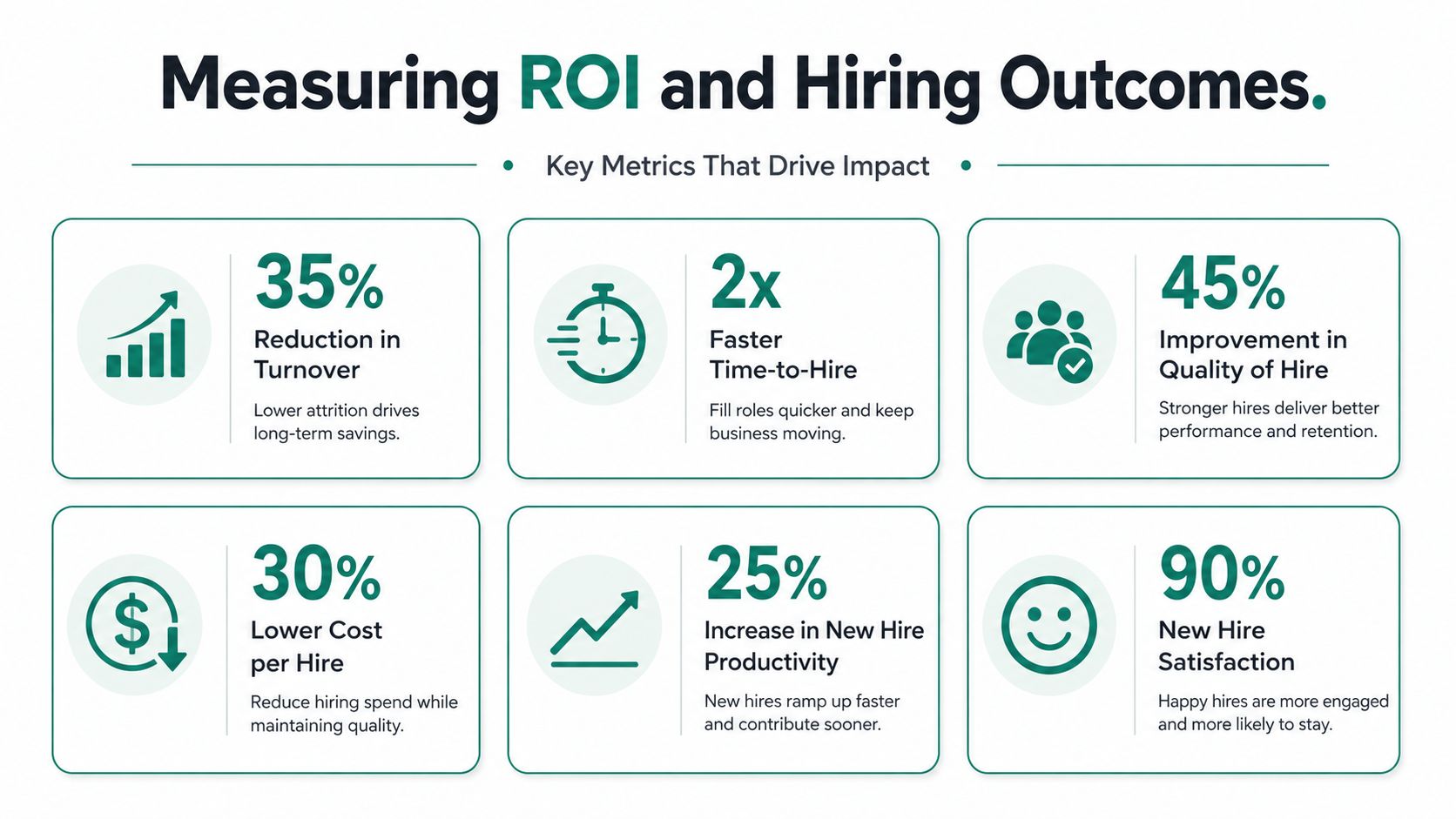
Track the simulation cohort against the non-simulation cohort if your process allows it. Look at whether completed assessments correlate with stronger downstream performance or better retention, then review whether certain roles need different cut-off rules. That kind of reporting gives you a continuous improvement loop instead of a one-time launch story.
Structured data also helps with compliance reviews and diversity goals because you can show that candidates were evaluated against the same criteria. That does not solve every hiring problem, but it does give you a cleaner record of how decisions were made. For executive review, that audit trail often matters as much as speed.
If the data only proves that candidates started the assessment, you still don't know whether it improved hiring.
A mature VJT program should make hiring more predictable, not just more digital. If the process surfaces better hires, shortens bottlenecks, and gives recruiters a clearer operating rhythm, the investment is doing real work.
If you want to build a virtual job tryout process that fits your hiring workflow, Talent Pronto can help you layer conversational screening, structured scorecards, and ATS-connected routing into one process. Visit Talent Pronto to see how it supports high-volume screening and compare it against your current early-funnel setup.

Talent Pronto is an AI-powered hiring platform built around Anna, our intelligent AI that conducts 24/7 conversational screening, evaluates candidates against specific job requirements and compliance needs, and schedules interviews. Run everything on the Talent Pronto ATS, our all-in-one applicant tracking system with a branded careers site and Anna built in, or keep your existing ATS and let Anna integrate with Greenhouse, Ashby, iCIMS, Jobvite, Lever, Oracle, and more. Either way, we help organizations reduce time-to-hire and build stronger teams.