AI video interviews reintroduce the anxiety, bias, and friction that structured screening is supposed to remove. Learn why text-based conversational AI produces cleaner signal, fairer scoring, and higher completion rates.
AI is reshaping how candidates get screened, and two very different approaches are competing for the first round of hiring. One asks candidates to sit in front of a webcam and talk to an algorithm. The other has a structured conversation with them in text. On the surface they look like variations on the same idea. In practice, they produce very different outcomes for candidates, for hiring teams, and for the quality of the decisions you make.
AI video interviewing takes the worst parts of the traditional interview and automates them. AI chat interviewing removes them.
If the goal of AI-assisted screening is a fairer, faster, more consistent first round, video works against that goal in almost every dimension that matters. Here is why text-based conversational screening is the better foundation.
Ask anyone who has done a one-way video interview how it felt. They will tell you it was uncomfortable. Talking to a camera with no human on the other end, watching a countdown timer, wondering whether they should look at the lens or the little preview of their own face, re-recording an answer three times because they stumbled on the first word: this is not how you get someone's best thinking.
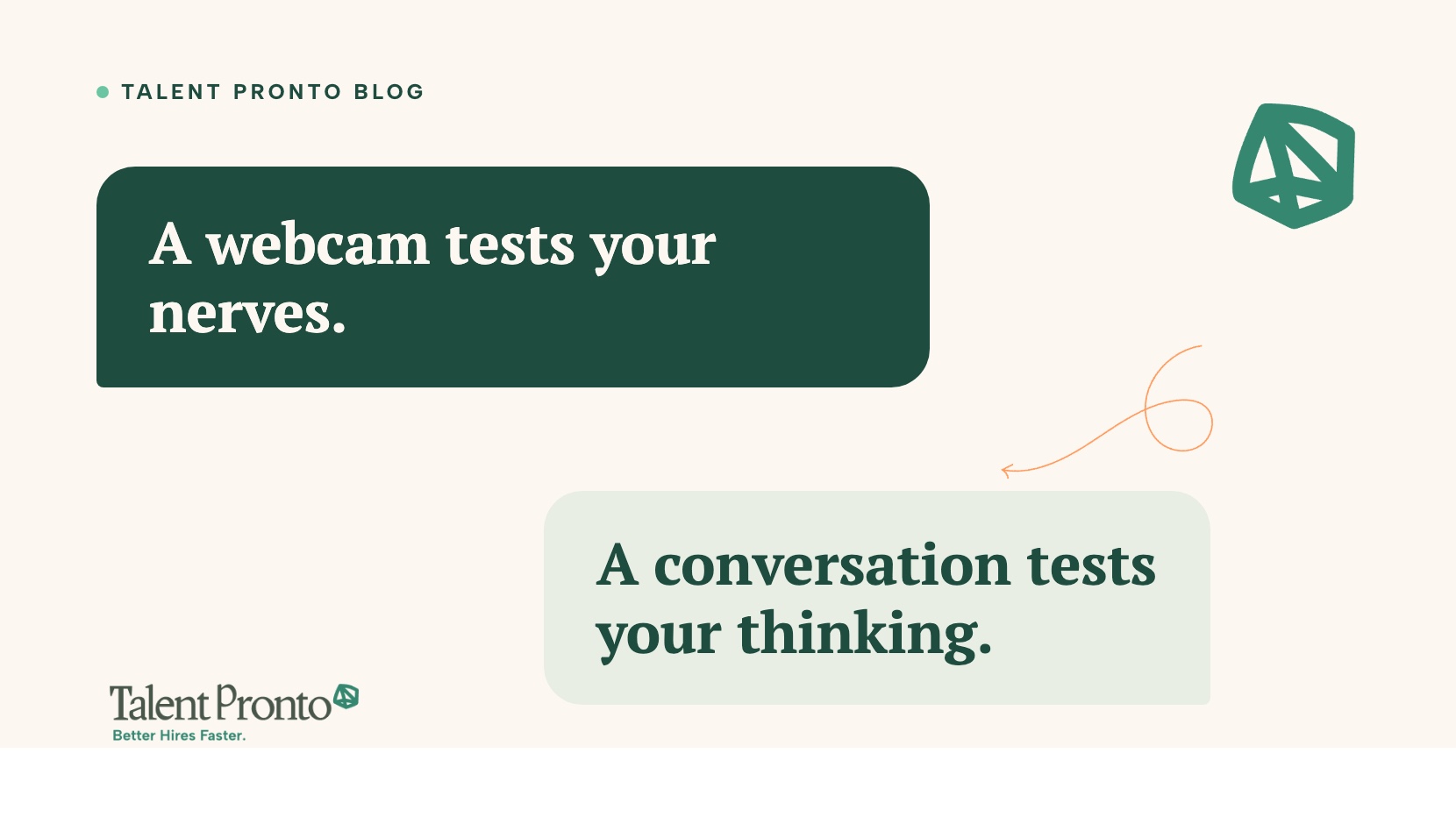
That discomfort isn't a minor UX complaint. It's noise in your data. A candidate who freezes on camera isn't telling you they can't do the job. They're telling you they don't perform well when a webcam is recording them for later judgment by software. For the vast majority of roles, on-camera composure has nothing to do with the work.
Text-based screening lowers the temperature. A candidate answers in their own words, at their own pace, in a medium that feels closer to messaging than to an audition. You get their reasoning instead of their stage fright.
The strongest argument for AI screening is bias reduction: evaluate what a candidate says about their qualifications, not what they look or sound like. Video quietly undoes this.
The moment you turn on a camera, you reintroduce every visual and auditory signal that structured screening is supposed to neutralize: race, age, perceived gender, weight, attractiveness, accent, physical ability, and the socioeconomic cues baked into someone's background, lighting, and home. Some video interview tools have historically gone further and scored facial expressions, tone, or "enthusiasm," a practice that has drawn regulatory scrutiny and, in at least one high-profile case, was pulled after researchers questioned whether it measured anything job-related at all.
Even when a video tool claims to ignore appearance, the signal is still captured, still stored, and still available to any human reviewer who watches the recording later. You cannot un-see a face. Text-based screening never collects those signals in the first place. Anna evaluates the substance of an answer against a rubric, with no face, no voice, and no demographic cues to pattern-match on.
A video-first process silently filters out people before they ever answer a question.
Text screening levels this. It works on a cheap phone over a weak connection, in a noisy break room, at midnight after a shift. It gives non-native speakers a moment to compose a clear answer. It doesn't ask someone to broadcast their living conditions to get considered for a job. That is what equity looks like in practice, not a policy statement, but a process everyone can actually complete.
Here's the part hiring teams underweight: for most roles, the thing you're trying to assess is how someone thinks and how clearly they can communicate. Text captures both better than video does.
Reasoning is legible in writing. When a candidate types out how they'd handle a short-staffed shift or a difficult customer, you see the structure of their thinking: what they clarify, what they prioritize, how they sequence their response. Spoken answers ramble, backtrack, and trail off. Written answers show the shape of the reasoning.
Written communication is the actual job skill. A huge share of modern work happens in writing, including email, tickets, documentation, chat, and customer messages. A chat interview is a direct work sample of that skill. A video interview measures how well someone talks to a camera, which most jobs never require.
Answers are consistent and comparable. Two candidates answering the same question in text produce responses you can put side by side and evaluate against the same criteria. Video answers vary by lighting, audio quality, nervousness, and delivery, forcing reviewers to mentally correct for all of it before they can compare substance.
The paradox of video is that it feels richer, but for evaluating job fit it's mostly richer in the wrong information.
Every extra step in an application is a place candidates drop out, and video is a big step. Booking time, finding a private spot, checking the camera and mic, dressing for it, and re-recording fumbled answers add up to a real barrier. Strong candidates with other options are the first to abandon a process that feels like too much work for a first round.
Text screening is asynchronous and low-effort. A candidate can start it the moment they apply, from the same phone they applied on, and finish in one sitting without staging anything. Lower friction means more people finish, and more finishers means a larger, more representative pool of qualified candidates for your team to choose from. You're not just being kinder to candidates; you're widening the top of your funnel with exactly the people a heavy process would have scared off.
Fair, defensible hiring depends on scoring every candidate the same way against the same criteria. Text makes that straightforward.
A written answer is already the artifact you score. There's no transcription step that mangles names and technical terms, no judgment call about whether a pause meant uncertainty or thoughtfulness, no reviewer subtly rewarding a warm on-camera presence over a stronger but more reserved answer. The rubric applies directly to the words on the page.
That also produces a cleaner audit trail. When a hiring decision is questioned, you can show the exact question asked, the exact answer given, and exactly how it scored against your criteria, all in text that's easy to store, search, and review. Video "evidence" is heavier to retain, harder to audit at a glance, and carries all the demographic information you'd rather keep out of the file.
Ironically, the medium that seems more "verifiable" is increasingly easy to fake. Real-time face-swapping and voice cloning have gotten good enough that a video interview no longer proves who's actually answering. A confident-looking talking head is now something software can generate. Meanwhile, a candidate can quietly read AI-generated answers off a second screen while the camera rolls, so the video adds a veneer of authenticity without the substance.
Text-based, adaptive conversational screening defends against this differently, not by trusting a face, but by probing reasoning. Anna asks follow-up questions that build on a candidate's specific prior answers, pressing for the concrete detail and lived specificity that a copy-pasted or generic response can't supply. The goal of the first round isn't biometric identity verification; it's a substantive conversation that's hard to fake your way through and easy to revisit in a later human interview.
There's a privacy dimension too. Video interviews collect and store biometric data, including faces and voices, which is exactly the category of sensitive information that a growing body of laws, from Illinois' BIPA to various state and international regulations, treats as high-risk. Collecting less of it is simply less liability. Text screening captures what candidates say about their qualifications and nothing more.
None of this means cameras have no place in hiring. Later stages, when you're down to a short list and a human is genuinely meeting the candidate, are exactly where a real conversation, face to face or over live video, adds value. Rapport, chemistry, and the nuanced back-and-forth of a final interview are human moments, and they belong to humans.
The mistake is putting a camera at the top of the funnel, where you're trying to evaluate hundreds of people fairly and consistently. That's the stage that demands structure, low friction, and clean signal, and that's exactly where text-based conversational AI is strongest.
AI video interviewing automates the traditional interview's worst tendencies: it makes candidates anxious, reintroduces appearance-based bias, filters out people without the right setup, and collects sensitive data you'd be better off never holding, all while capturing less of the reasoning that actually predicts performance.
AI chat interviewing does the opposite. It lowers anxiety, strips out visual bias, works for everyone, produces cleaner and more comparable signal, gets completed by more qualified candidates, scores consistently against a rubric, and keeps your first round focused on substance instead of surface.
For the first conversation with a candidate, the question isn't whether AI should be involved. It's what medium gives you a fairer, more accurate read. The answer is text.
Schedule a 15-minute demo to watch Anna run a structured conversation with candidates, score every answer against your criteria, and hand your team a ranked shortlist, no webcam required.

Talent Pronto is an AI-powered hiring platform built around Anna, our intelligent AI that conducts 24/7 conversational screening, evaluates candidates against specific job requirements and compliance needs, and schedules interviews. Run everything on the Talent Pronto ATS, our all-in-one applicant tracking system with a branded careers site and Anna built in, or keep your existing ATS and let Anna integrate with Greenhouse, Ashby, iCIMS, Jobvite, Lever, Oracle, and more. Either way, we help organizations reduce time-to-hire and build stronger teams.