Discover proven bias mitigation strategies for hiring, from structured rubrics to AI screening, and build a fairer, more consistent recruitment process.
You've probably seen this happen. Two candidates reach the final interview with comparable experience, relevant skills, and strong references. The hiring manager chooses the person from a familiar university, someone who shares a professional contact, or a candidate whose communication style feels more natural to the panel. Months later, the rejected candidate performs exceptionally well in another team, and everyone recognizes that the original decision relied on comfort more than evidence.
That outcome usually isn't caused by one openly prejudiced person. It comes from an evaluation process that leaves too much room for personal interpretation. Effective bias mitigation strategies reduce that room across the full hiring lifecycle, from job design and sourcing to screening, interviewing, selection, and post-hire review.
A marketing director opens the shortlist for a content strategist role. Candidate A has worked at a recognizable brand, attended the same university as the hiring manager, and speaks confidently about familiar campaigns. Candidate B has built a strong portfolio for smaller organizations, explains complex topics clearly, and has delivered results in environments that look less familiar to the panel.
Both candidates meet the stated requirements. During the debrief, the team describes Candidate A as a “natural fit” and Candidate B as “less polished.” Nobody can point to a job-related competency that separates them. The decision rests on impressions, shared connections, and communication style.
Later, Candidate B joins another company and becomes the person colleagues rely on for difficult projects. The original team realizes that its hiring process didn't identify capability consistently. It identified familiarity.
That distinction matters. Bias mitigation isn't a slogan added to a careers page. It's a set of controls that changes how people define the job, review evidence, ask questions, assign scores, and revisit outcomes. If one stage allows intuition to dominate, later stages may reinforce the first impression.
Practical rule: If an interviewer can't explain a decision using evidence tied to the role, the process is measuring preference as well as capability.
A useful way to diagnose the problem is to walk through the funnel. At each stage, ask what information the evaluator sees, what information gets ignored, and how the organization records the decision. Those questions reveal why structured interviews, role-aware scorecards, anonymized review, panel design, and audit trails work together rather than as isolated fixes.
Bias in hiring is a systematic deviation between how candidates are evaluated and how they perform. The gap can come from an explicit rule, such as preferring applicants from certain universities, or from implicit pattern-matching around names, accents, schools, hobbies, age, or communication style.
Explicit bias is easier to spot because someone states or applies a preference directly. Implicit bias is more difficult because the evaluator may sincerely believe the decision was objective. A hiring manager might call one candidate “credible” and another “rough around the edges” without realizing that both judgments reflect familiarity rather than job evidence.
The funnel gives bias several opportunities to enter:
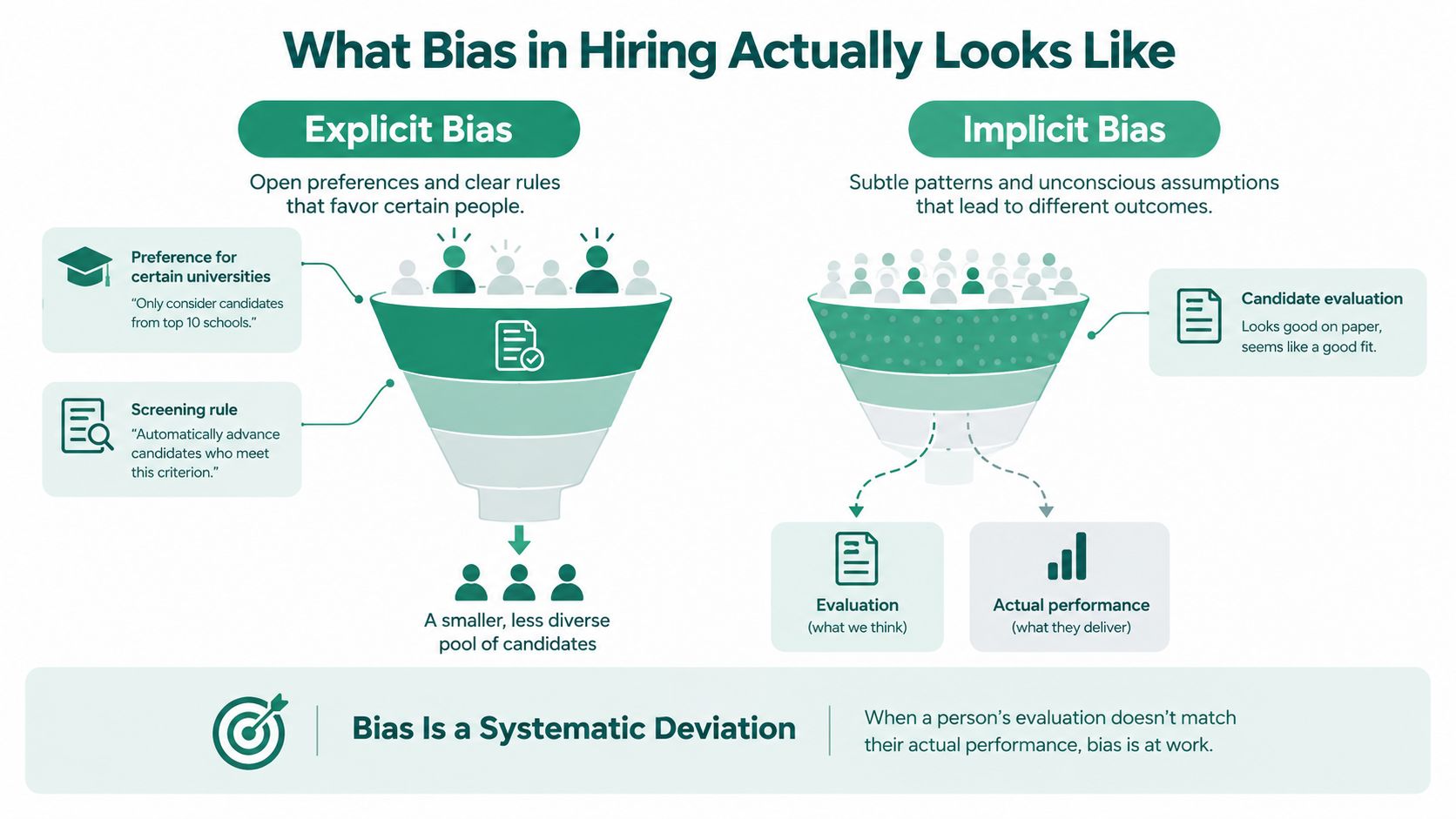
These problems can appear in a warehouse hiring funnel, a nursing recruitment process, a software engineering search, or an executive appointment. Employers that need a deeper legal and operational perspective can also consult this practical guide for securities professionals on employment discrimination defense.
The strongest controls change the conditions under which people evaluate candidates. They don't ask interviewers to become perfectly objective. They reduce avoidable variation, preserve job-related evidence, and make decisions easier to inspect later.
Structured rubrics translate impressions into anchored ratings. Instead of asking whether a candidate “seems strategic,” the panel scores observable evidence, such as how the candidate diagnosed a customer problem, chose priorities, and measured an outcome. A widely cited evidence summary reports validity coefficients of about .50 to .60 for structured interviews, compared with about .20 to .30 for unstructured interviews (Talent Systems). The same summary identifies reduced opportunities for irrelevant factors to influence scores as the core bias-reduction mechanism.
Standardized questions make candidate responses more comparable. Every applicant should receive the same job-related prompts, in the same order where practical, with consistent follow-up probes. The structured employment interview research links increased structure with narrower evaluator discretion and reduced racial similarity bias in quasi-experimental evidence.
Anonymized screening removes identifiers such as names, photos, and school details during early review when those details aren't needed to assess the relevant competency. It can reduce name-based assumptions and school prestige effects, though it may remove useful context for senior roles where career scope and institutional experience matter.
Diverse panels broaden the set of perspectives applied to the same evidence. A panel can notice that an evaluator is rewarding a familiar communication style or treating one career path as more legitimate. Guidance on fair and structured interviews recommends benchmark answers and clear scoring before interviews begin, while panel-based interviewing can reduce reliance on one person's judgment (UK government guidance).
Audit trails preserve who reviewed an application, which evidence they considered, what score they assigned, and why. That record supports calibration and retrospective review rather than leaving the organization with only a final outcome. For teams designing education programs outside corporate hiring, this same principle can inform efforts to find accredited bias training for nurses.
| Mechanism | Bias It Targets | Funnel Stage |
|---|---|---|
| Structured rubric | Halo, affinity, and impression bias | Screening and interviews |
| Standardized questions | Unequal probing and conversational bias | Phone screens and interviews |
| Anonymized review | Name, photo, and prestige bias | Early resume review |
| Diverse panel | Single-reviewer and group blind spots | Interview and debrief |
| Audit trail | Unexplained or inconsistent decisions | Every stage and post-hire review |
For a practical treatment of how training fits into the wider workflow, review unconscious bias training, then connect the learning to specific prompts, anchors, and review checkpoints.
Fairness starts before the first application arrives. Begin with the job's actual outcomes, not a generic list of preferred traits. For a customer support role, the outcomes might include resolving customer issues, documenting interactions accurately, and escalating risk appropriately. For a maintenance technician, they might include diagnosing equipment problems, following safety procedures, and communicating status clearly.
Turn each outcome into a competency. Then write a prompt that tests only that competency. A customer support question could ask how the candidate handled a frustrated customer while protecting the service standard. It shouldn't invite discussion of school prestige, family background, tenure gaps, or extracurricular affiliations unless those details directly affect the work.
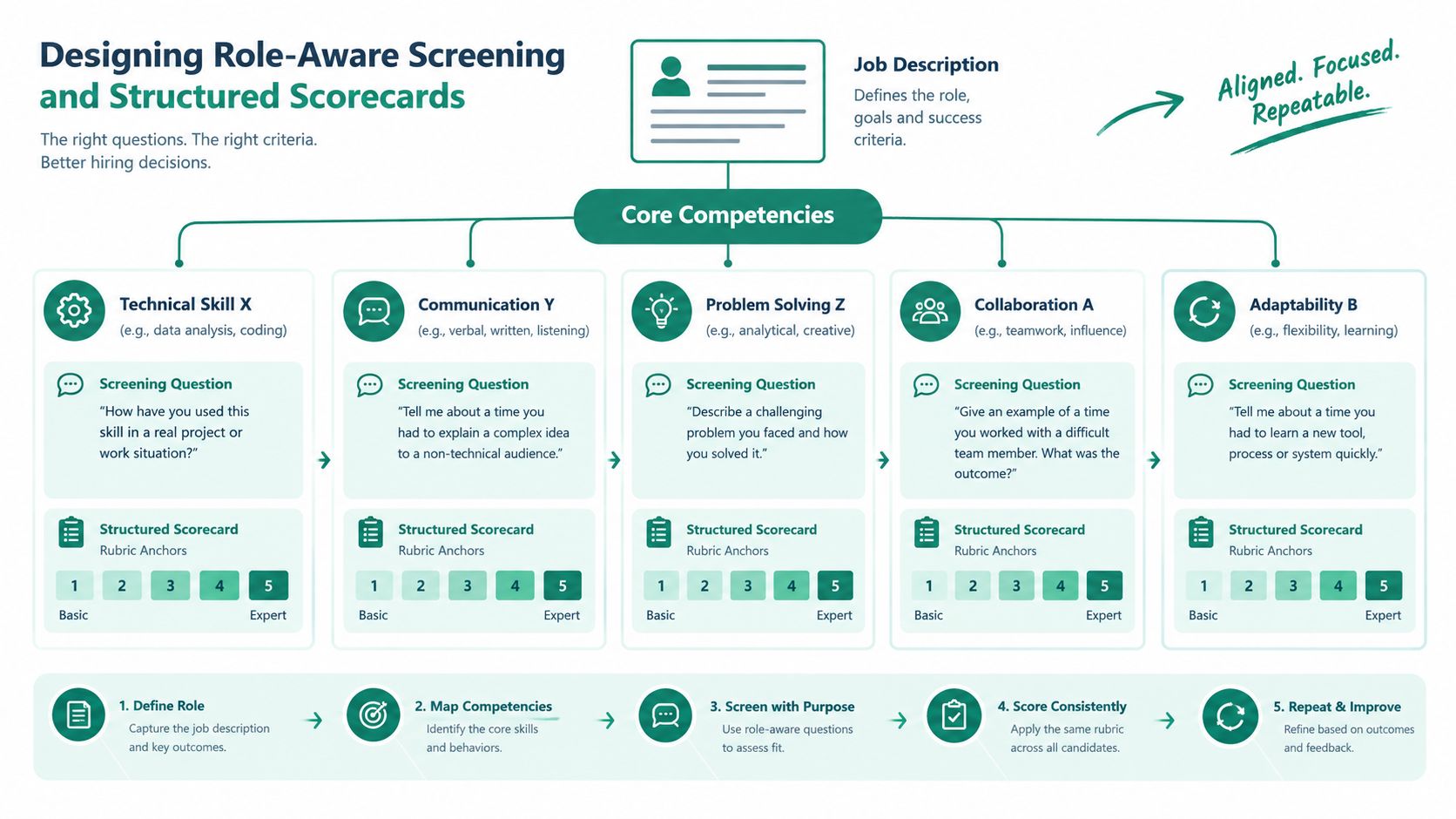
Pair every prompt with a scorecard. Each competency needs observable anchors, such as:
You can use four or five anchors per competency, provided the language remains specific. Interviewers should score what the candidate demonstrated, not how polished, enthusiastic, or familiar the response felt.
Keep weightings role-aware. Task execution may deserve more weight than general communication for a technical role, while communication may carry greater importance for a client-facing position. Treat seniority, culture contribution, and task capability as separate dimensions. “Culture add” shouldn't become a coded way to reward similarity.
During a pilot, ask reviewers:
For additional guidance on making ratings observable and comparable, use this interview scoring rubric.
An algorithmic hiring process needs controls before, during, and after model scoring. A single adjustment can reduce one form of disparity while leaving another untouched, so the defensible approach is a multi-stage fairness pipeline.
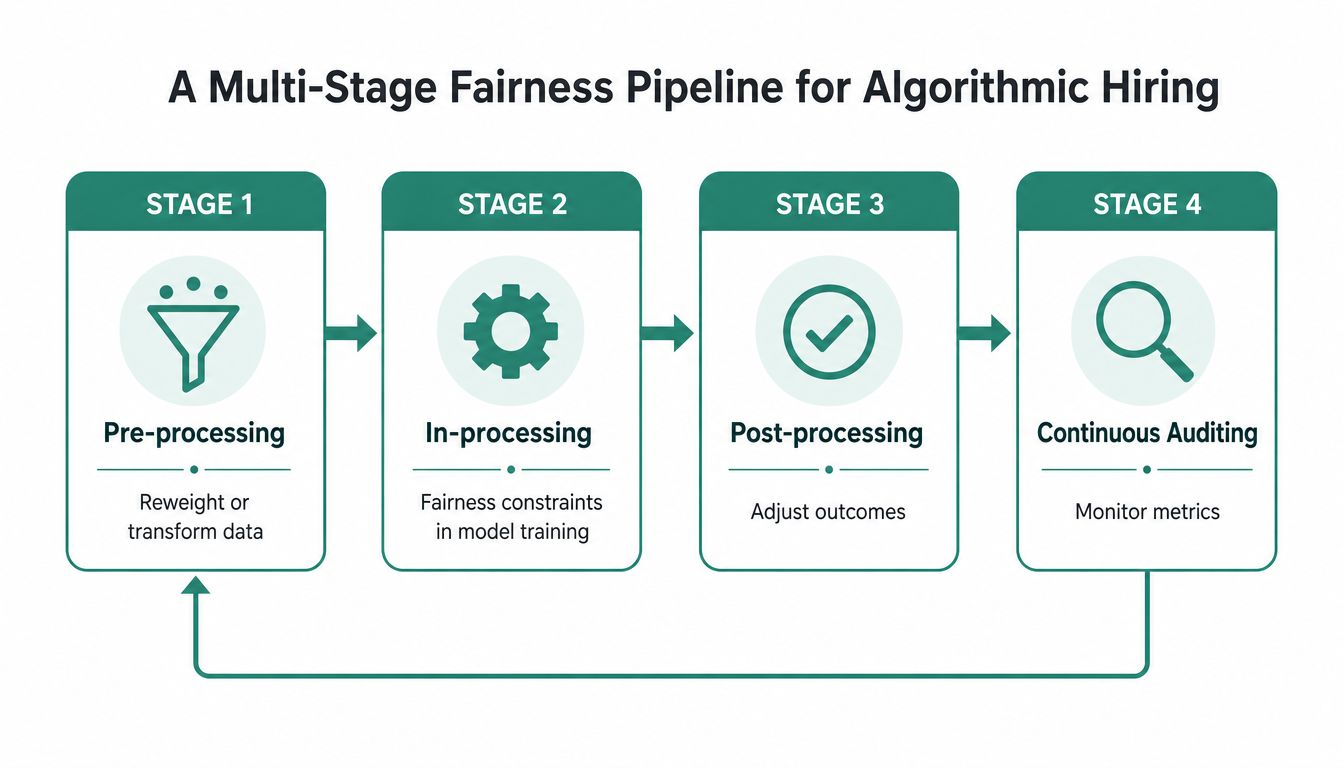
Before scoring, teams can remove features highly correlated with sensitive attributes, anonymize selected fields, and rebalance training data through balanced sampling. Dataset aggregation, data augmentation, synthetic data generation, and iterative retraining can broaden the examples available to the system. These controls address the possibility that the model learns historical inequities from the data itself.
During training, fairness constraints or regularizers can be added to the objective function so predictions depend less on protected attributes. The model may be optimized not only for predictive performance but also for a selected fairness condition. That choice matters because different fairness goals can conflict.
After the model produces scores, employers may adjust thresholds or rankings to meet the fairness definition they selected. This can change who advances and may affect precision or applicant volume for some groups. Post-processing therefore needs documented reasoning, human oversight, and validation against the role's requirements.
Auditing connects the stages. Teams should monitor outcomes, check calibration across demographic groups, document rejected candidates, and revisit the system when data or hiring conditions change. A major review of employment-assessment algorithms found that organizations often disclose limited validation detail, which makes vendor claims insufficient without documented audits and periodic reevaluation (arXiv review).
Watch this overview before designing a recorded candidate flow, then review practical guidance on setup for recording interviews. For terminology and compliance context, see what adverse impact means.
Start by naming the result you're trying to improve. A team focused on demographic parity may choose controls that affect who reaches the next stage. A team focused on equal opportunity may prioritize whether qualified candidates receive comparable consideration. Another team may prioritize predictive accuracy or a consistent candidate experience.
Those goals can point to different interventions. Anonymized review can reduce early-stage identity cues, but it may remove useful context for senior positions. Structured scorecards improve comparability and defensibility, but they require careful job analysis and interviewer calibration. Diverse panels can improve perceived fairness and expose blind spots, but they won't automatically change scores when the underlying rubric remains vague. Audit trails strengthen accountability without necessarily changing who advances.
| Strategy | Best For | Tradeoff | Watch Out For |
|---|---|---|---|
| Anonymized screening | Reducing identity cues early | Less context for complex careers | Reintroducing identifiers too early |
| Structured rubrics | Comparable, job-related ratings | Requires preparation and calibration | Anchors that describe personality |
| Diverse panels | Broader review and challenge | Coordination can take more effort | Treating representation as a substitute for structure |
| Audit trails | Defensibility and review | Documentation takes discipline | Recording scores without rationale |
| Algorithmic controls | Repeatable handling of large applicant pools | Fairness goals may conflict with accuracy or volume | Accepting model output without validation |
Role seniority, applicant volume, and regulatory exposure should shape the mix. High-volume entry roles may benefit from anonymized early review and consistent screening questions. Senior searches may need more contextual evidence, stronger panel governance, and deeper audit documentation. There isn't one universal bias fix. The right strategy depends on the metric, the role, and the consequences of error.
You don't need to rebuild your ATS to make the workflow more consistent. A phased rollout gives talent operations, recruiters, hiring managers, and legal or compliance partners a clear sequence of work.
Start with baseline diagnostics. Map every funnel stage, identify who makes each decision, and capture demographic pass rates where lawful and appropriate. Compare recorded decisions with rubric scores, if rubrics already exist, and document where reviewers deviate from the stated criteria.
Assign an owner for the baseline and create a simple decision log. The log should record the role, stage, decision, evidence considered, and reason for any exception. The first audit checkpoint asks whether the organization can explain how candidates move from application to offer.
Pilot structural controls on selected roles. Introduce anonymized resume review where practical, create standardized question banks, and calibrate scorecards with interviewers before live interviews begin. Have reviewers score sample answers independently, compare interpretations, and revise anchors that produce inconsistent ratings.
The second checkpoint examines consistency. Confirm that candidates received substantially the same core questions, that interviewers used comparable probes, and that every score includes a brief job-related rationale.
Add panel composition rules, audit trails, and scheduled fairness reviews. A panel can include at least two interviewers and a mix of perspectives, while the recruiting lead ensures that each person understands the scoring standard. Store rationale notes and deviations in the same system recruiters already use, rather than creating a separate compliance archive that nobody maintains.
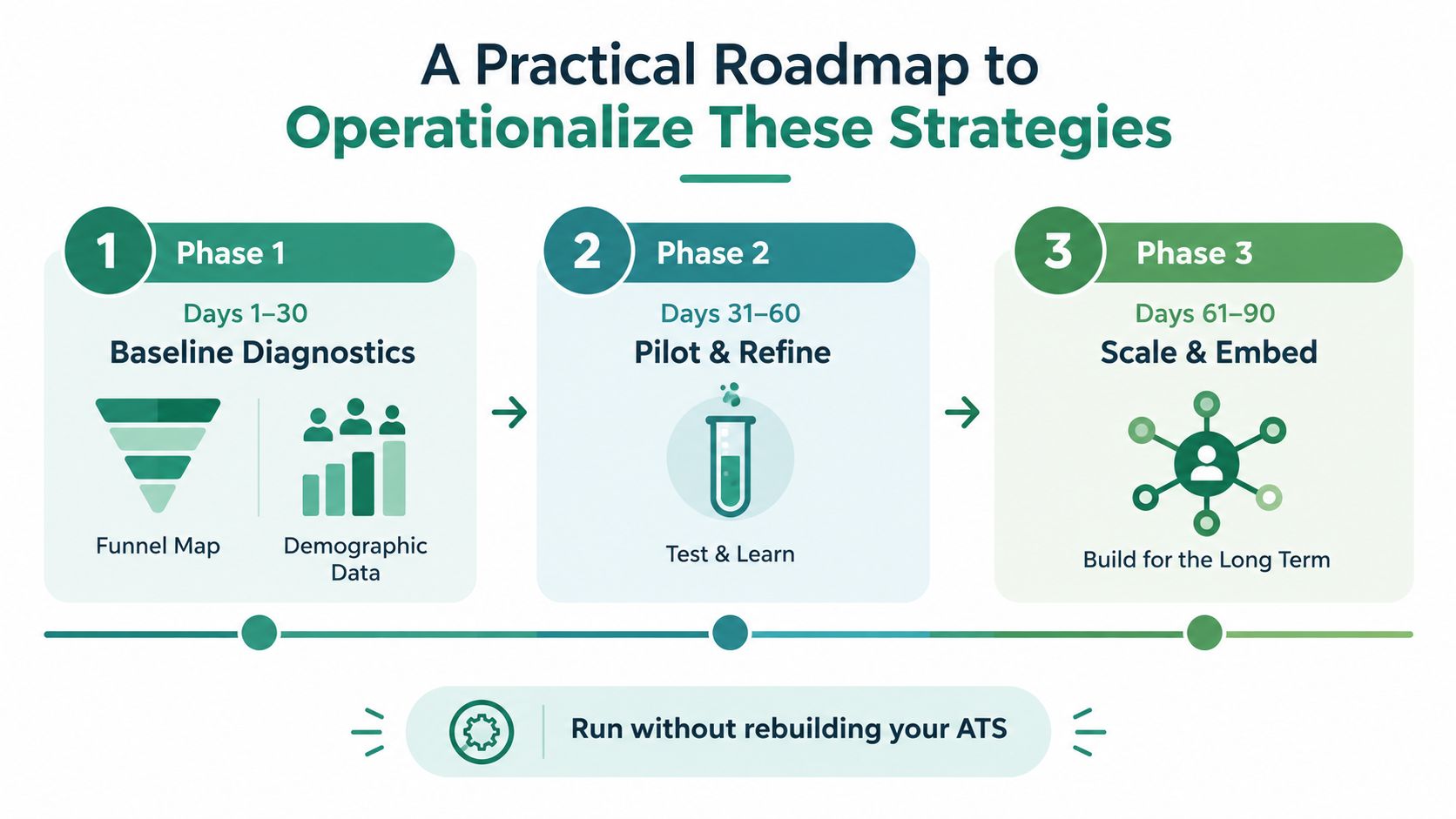
The final checkpoint turns the pilot into an operating rhythm. Review funnel data, unresolved exceptions, panel feedback, and scorecard changes. Give each action a named owner and a review date so fairness work remains part of recruiting operations rather than a project that ends after launch.
Bias mitigation is a recurring discipline. Job design can encode unnecessary requirements, sourcing can narrow who hears about an opportunity, screening can overvalue familiar signals, interviews can reward conversational similarity, selection can amplify group preference, and post-hire results can reveal whether the original assessment predicted performance.
The controls must match those risks. Use role-specific competencies at intake, consistent outreach and screening criteria, structured questions and anchored scorecards in interviews, documented rationales in selection, and post-hire comparisons that test whether the process identified the capabilities the role needed.
A 2025 lifecycle framework describes mitigation across understanding machine-learning requirements, managing diverse datasets, retraining models, and regular auditing (Taylor & Francis study). That lifecycle view applies to human-led hiring too. A rubric can drift when the role changes, a panel can normalize a narrow standard, and a model can require reevaluation after its inputs or operating environment change.
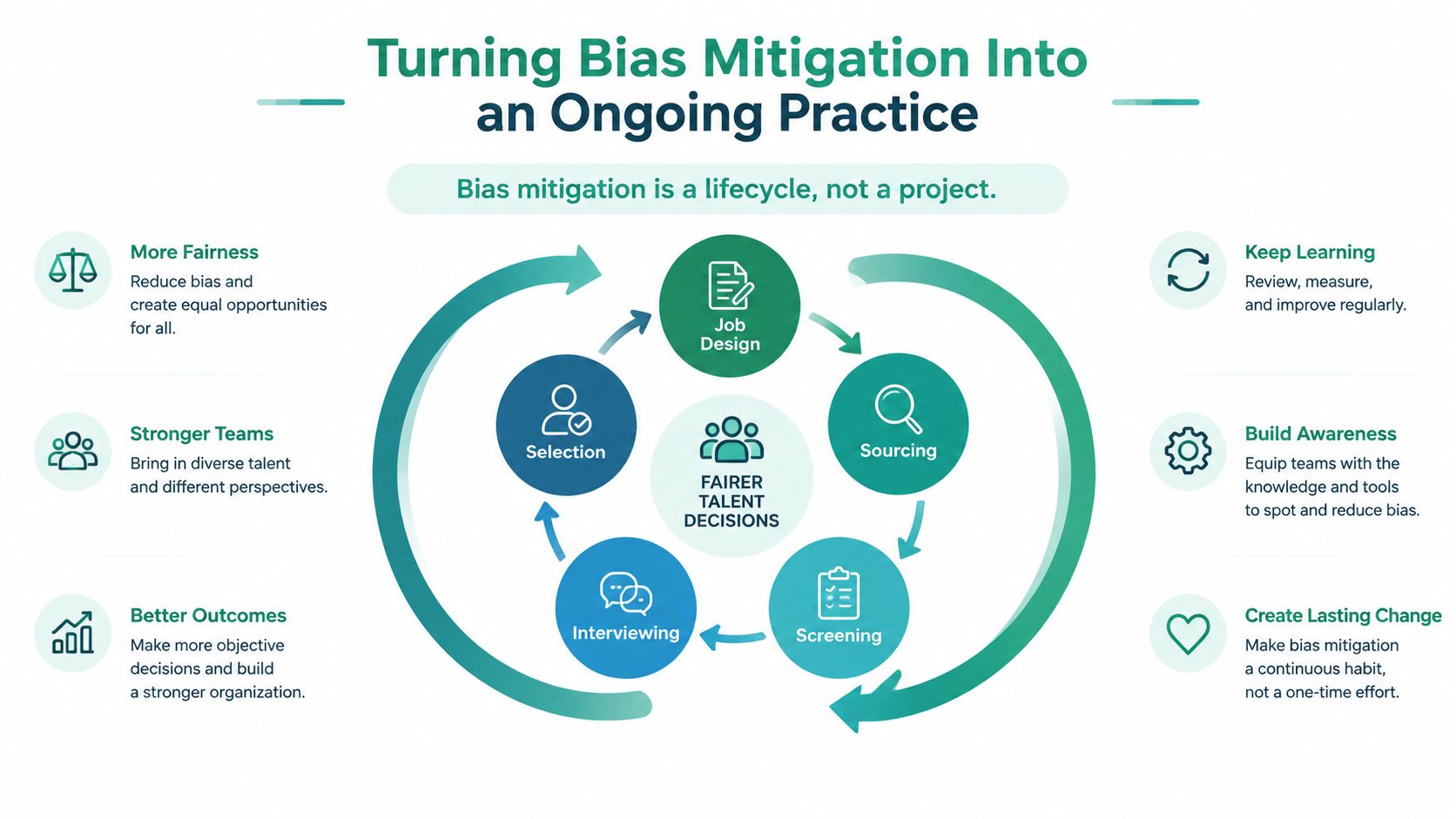
Assign a named owner for fairness metrics, add calibration to hiring retrospectives, and refresh rubrics when responsibilities, markets, or tools change. Treat the choice of fairness metric as an explicit operating decision, because research on different debiasing approaches shows that outcomes vary depending on whether the organization prioritizes applicant volume, diversity, or perceived fairness (SAGE study).
Instrument dashboards, run structured experiments, and review outcomes after people are hired. Talent Pronto can serve as one operational layer by conducting conversational screening with consistent questions and employer-defined, role-specific scorecards, while the employer retains advancement and rejection decisions within the broader fairness program.
Talent Pronto provides conversational screening, role-aware questions, structured candidate scorecards, automated outreach, scheduling, and ATS or HRIS integrations to help teams apply consistent early-stage criteria. Visit Talent Pronto to see how its screening and audit-friendly workflow can fit into your hiring controls.

Talent Pronto is an AI-powered hiring platform built around Anna, our intelligent AI that conducts 24/7 conversational screening, evaluates candidates against specific job requirements and compliance needs, and schedules interviews. Run everything on the Talent Pronto ATS, our all-in-one applicant tracking system with a branded careers site and Anna built in, or keep your existing ATS and let Anna integrate with Greenhouse, Ashby, iCIMS, Jobvite, Lever, Oracle, and more. Either way, we help organizations reduce time-to-hire and build stronger teams.