Use conversational ai interview questions to screen behavioral, technical, cultural, and compliance fit with follow-ups and consistent scoring rubrics.
Most advice about conversational AI interview questions starts with a list of clever prompts. That's the wrong starting point. The useful question isn't whether an applicant can produce a polished answer. It's whether the conversation creates comparable evidence about job-related capability, judgment, communication, and risk.
A stronger screening flow tests four dimensions: behavioral, technical, cultural, and compliance evidence. Each prompt below follows a repeatable pattern: a core question, a role-specific example, targeted follow-ups, scoring signals, and a fairness caution. That structure helps recruiters look past resume keywords without turning an automated conversation into an opaque decision.
Conversational screening has become relevant because employers increasingly need to engage large applicant pools, collect structured answers, and reduce manual bottlenecks. Aptitude Research reported conversational AI use or planned use rising from 7% of companies in 2019 to 38% in 2020, while its later update said 65% of companies had some high-volume recruitment needs. The Aptitude Research report helps explain why the strongest case is operational scale, not novelty.
Talent Pronto is one relevant example of this approach, combining conversational screening, structured scorecards, and employer-controlled advancement decisions. Candidates preparing for interviews can also use an AI interview prep tool, but preparation shouldn't replace evidence. The ten questions below are designed to reveal it.
Resume familiarity is easy to claim. Hands-on experience is harder to fake when the conversation asks what the candidate did, why they made particular choices, and what happened afterward.
Use a specific system rather than a broad category. For a healthcare role, ask: “Describe your experience implementing or managing electronic health record systems such as Epic or Cerner. What workflow customizations did you handle?” In manufacturing, ask about SAP or another ERP in a production environment. For retail or hospitality, ask the candidate to walk through point-of-sale work during a high-volume period.
A conversational screener should not stop after the first answer. Ask:
Strong answers contain concrete actions, constraints, and lessons. Weak answers repeat product names, describe what “the team” did, or rely on generic claims about optimization.
The scoring rubric should distinguish direct hands-on ownership, supported contribution, exposure only, and unsupported familiarity. Don't award higher scores because a candidate uses advanced terminology. Score the evidence that matches the role's competency definition.
Fairness safeguard: Ask every candidate the same core technology question and give equivalent opportunities to explain unfamiliar tools. A candidate who used a comparable system may demonstrate transferable capability without having used the exact brand.
Candidates should prepare two or three genuine examples, explain the reason behind technology choices, and connect technical work to business value. Employers can use guidance on writing interview questions to turn a broad technology requirement into observable criteria. For specialist roles, compare the rubric with expectations in a Senior AI Architect Conversational AI Twilio role, but don't confuse a job title with proof of competence.

Conflict screening should test judgment under pressure, not agreeable phrasing. Ask for one incident and score how the candidate identified the concern, set boundaries, chose an escalation path, and followed through.
Start with a role-specific prompt:
Listen for the candidate's own decisions. A strong response identifies the other person's need, explains what the candidate said or did, and connects the response to a measurable or observable outcome. The candidate may use the STAR method for interviewing, but the format matters less than specific evidence.
Use conversational follow-ups to test authenticity:
Score behaviors against an anchored rubric. Direct evidence of attentive listening, calm boundary-setting, proportionate escalation, and reliable follow-through should rank above polished delivery. Penalize blame, vague references to “we,” promises the candidate could not keep, or an outcome that depends only on appeasing the customer. A less polished speaker can still demonstrate strong conflict resolution.
Use the same core prompt and follow-ups for every candidate, while allowing equivalent explanations for different customer or stakeholder contexts. Behavioral interview tips by Interview Pilot can help interviewers build consistent probes, but the scoring criteria must reflect the role.

A short training video can help interviewers distinguish empathy, appeasement, and effective resolution.
A candidate's claim to be a “fast learner” has little screening value without evidence. Ask for one real transition and require a clear account of how the person moved from unfamiliarity to useful output.
The example should fit the role's likely learning curve. A technology candidate might describe learning a programming language, cloud platform, or unfamiliar software system. In healthcare IT, the example could involve a new clinical platform. Manufacturing candidates might discuss a production process, machine, or quality standard. A hospitality candidate can explain how they learned a new POS or payment platform.
Listen for the decisions behind the result: how they assessed the gap, chose learning resources, practiced, checked their understanding, and decided they were ready to work independently. Documentation, formal training, hands-on testing, mentoring, and peer collaboration can all be valid evidence. A credible answer also identifies where progress was slow or an early approach failed.
Score the evidence against five anchors:
Use the same core prompt for every candidate, then ask, “What accelerated your learning?” and “What would you change if you had to learn it again?” The first tests judgment about learning inputs. The second tests reflection and adjustment. Record the specific behavior and outcome, not the confidence of the delivery.
Do not require prior familiarity with the exact tool. Score the method used to become capable, including relevant adjacent experience. A rubric that rewards brand familiarity alone can exclude adaptable applicants.

Compliance questions reveal applied judgment when candidates explain how a requirement changed their work. Ask what they personally did to protect people, data, quality, or the organization, rather than asking them to recite acronyms.
Match the prompt to the role. Healthcare candidates might discuss HIPAA privacy and security requirements or patient data. Pharmaceutical and biotech candidates could address FDA requirements, clinical trial protocols, or Good Manufacturing Practices. Government roles may involve security clearance history where applicable and federal information security standards. Manufacturing and logistics roles can focus on OSHA safety standards or EPA compliance. Healthcare finance roles might cover billing compliance, coding accuracy, and audit protocols.
A useful screening sequence moves from the rule to the decision:
Listen for a concrete action, the reason behind it, and a clear boundary around the candidate's authority. Ask, “What made the situation difficult?” or “What did you do when the compliant option slowed the work?” These follow-ups distinguish lived experience from policy language.
Use anchored scoring so every candidate is judged on the same evidence:
Do not request sensitive personal information or confidential details from a former employer. Keep scoring tied to job-related knowledge and decisions. Candidates may disclose limited experience if they can explain how they would close the gap.
For roles involving AI tools, include responsible use, privacy awareness, and escalation judgment where those competencies apply. AI interview question guidance from DataCamp emphasizes ethics, limitations, and real-world trade-offs alongside technical knowledge.
Ask for a disagreement that required judgment, not a story designed to make the candidate look heroic. The answer should show what evidence shaped their view, how they raised the concern, and how they handled the decision afterward.
Adjust the prompt to the role. A leader might discuss a strategic direction, an operations candidate an inefficient process, and a cross-functional contributor competing priorities between departments. Ask for enough context to distinguish a genuine disagreement from a routine preference.
Use targeted follow-ups:
Listen for respectful challenge, accurate ownership, and practical judgment. A strong candidate can recognize why the other position seemed reasonable, explain the risk or trade-off they identified, and support the final decision once the discussion ends. They can also revise their view when new information appears.
Score the evidence rather than whether the recommendation won:
Do not score vague impressions such as “executive presence” or confidence unless the role defines observable behaviors that require them. Keep the rubric tied to job-related reasoning and conduct. A structured interview uses consistent questions and anchored grading criteria for each applicant, improving comparability and predictive value, as explained in peer-reviewed research on structured interviews.
A candidate may disagree without being insubordinate. The screening decision should rest on how they assessed evidence, communicated a concern, and accepted accountability for the next step.
Strong problem-solving answers show how a candidate creates reliable evidence under uncertainty. Ask for a technical issue, process breakdown, customer problem, or complex decision they had not handled before. Then use conversational follow-ups to separate a repeatable method from a polished story.
Start with the candidate's first move: “What did you need to clarify before acting?” In healthcare IT, the example might involve troubleshooting a technical failure. In operations, it could involve a process that stopped working as intended. A customer-facing employee might explain how they found an answer without immediate access to one.
Listen for a sequence you can verify:
Ask, “What changed your initial hypothesis?” and “How did you know the problem was solved?” These questions reveal whether the candidate examined causes or applied a familiar fix without checking the result.
Collaboration belongs in the evidence, too. Ask who they consulted, why that person had relevant knowledge, and what changed after the discussion. Reward accurate ownership, appropriate escalation, and clear use of expertise. A candidate who says, “I did not know yet, so I gathered this evidence,” may show stronger judgment than one who claims instant certainty.
Use an anchored rubric based on job-related behaviors. The competency-based interview questions guide can help translate problem solving into observable criteria, such as investigation quality, decision reasoning, verification, and learning. Score those behaviors consistently rather than confidence or storytelling skill.
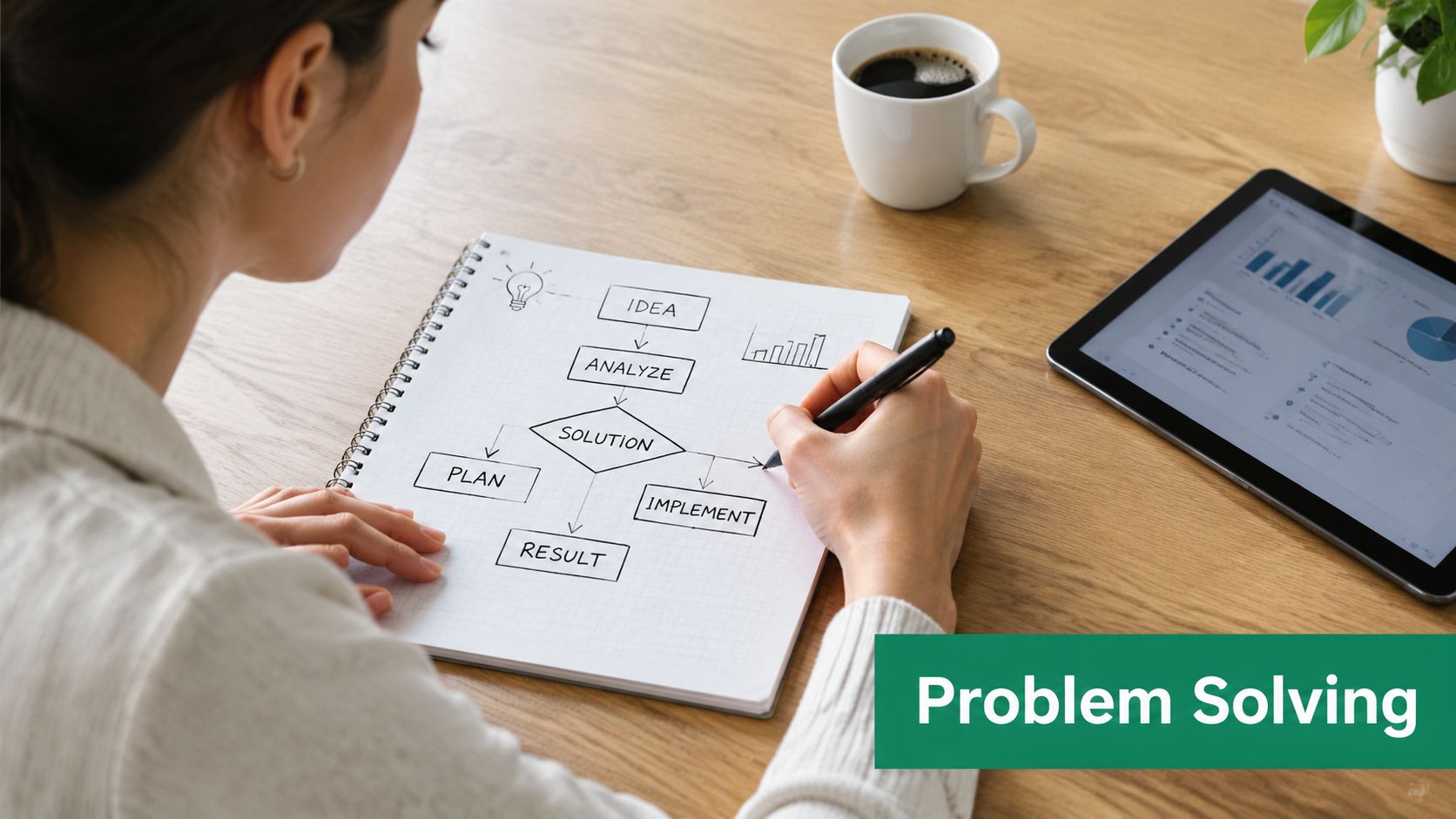
A polished project story can hide limited ownership. Ask for one initiative with a clear purpose, defined responsibilities, a change or obstacle, and an observable result. This keeps the conversation focused on evidence rather than a rehearsed summary of ongoing duties.
The answer should separate participation versus ownership. Someone may contribute valuable work without leading the project, and that is acceptable when the contribution is precise. “We launched it” offers little evidence. “I created the rollout plan, coordinated testing, and changed the sequence after a dependency slipped” shows decisions, responsibility, and adjustment.
Use the candidate's story to test execution in sequence:
Follow up on the weakest part of the account. Ask, “Which decision was yours?” “What did you change after the constraint appeared?” and “What evidence supported the outcome?” These prompts distinguish direct experience from group-level narration.
Score planning, ownership, adaptation, communication, and outcome awareness separately. Finishing on schedule does not prove success if quality, adoption, or customer needs declined. A change in direction can indicate sound execution when the candidate identifies a real constraint, explains the trade-off, and adjusts responsibly.
Request role-appropriate evidence, such as a quality measure, delivery milestone, adoption signal, or documented improvement. Do not require confidential employer data. The candidate can explain the result without revealing proprietary details. The project planning interview questions image illustrates the kind of planning context interviewers may explore.

“Culture fit” can reward similarity instead of collaboration. Ask for an example that shows how the candidate worked across differences in discipline, background, communication style, time zone, or professional priorities.
Listen for the candidate's own decisions. Did they adjust the communication method, clarify terminology, invite a quieter contributor, document an agreement, or resolve competing priorities? A statement such as “I value diversity” has limited value until it connects to observable conduct and an outcome.
A useful follow-up sequence is:
Use the weakest part of the account to guide the next question. A candidate describing a product, engineering, operations, and compliance project should explain how responsibilities were coordinated, not merely name the functions involved. Someone discussing remote or global work should describe the working practice that reduced confusion across locations.
Score the evidence rather than personality:
Friction is useful evidence when the candidate explains how they addressed it and what they learned. Do not ask about protected characteristics or use “fit” to reward resemblance to the current team. Apply the same anchored criteria to every candidate. The U.S. Department of the Interior identifies anchoring, cultural, and availability bias as issues structured interviews should help counter, as detailed in its interview-bias material.
Critical feedback reveals how a candidate converts input into changed behavior. Ask for a specific situation where the feedback affected work quality, communication, leadership, or technical decisions, then let the candidate explain what happened in their own sequence.
Listen for three points: whether they understood the concern, tested its accuracy, and changed a working method. A technical employee might describe revising a problem-solving approach. A manager might explain how feedback changed delegation or communication. The example need not involve a major failure, but it should include observable consequences.
Use conversational follow-ups based on gaps in the account:
Score the response with anchored levels. Rejection without consideration indicates limited receptiveness. Acknowledgment without action shows awareness but weak follow-through. Partial adjustment demonstrates developing coachability. Sustained improvement, supported by later behavior or results, provides stronger evidence.
Separate an initial emotional reaction from the eventual conduct. A candidate may feel defensive and still seek clarification, accept valid criticism, and make a durable change. Do not reward a disguised strength such as “I care too much.” Ask whether the feedback was relevant, what the candidate learned, and how the lesson now shapes similar work.
Conversational AI can deliver the same neutral probes to each candidate, improving early-screen consistency. It should not infer attitude from wording alone. Human reviewers need to examine ambiguous or unusually brief answers, including responses shaped by accessibility, language, or communication differences. Apply the same rubric and comparable follow-ups to every candidate.
A polished claim about organization proves little. Ask for a period when several demands competed, then reconstruct the decisions in sequence. The evidence should show how the candidate judged urgency, impact, dependencies, stakeholder expectations, and the cost of delay.
Use a concrete setting without forcing every candidate into the same scenario. A healthcare applicant might describe competing patient or administrative needs during a shift. A project candidate could explain overlapping deliverables, while an operations candidate might address several process failures appearing together.
Start with one prompt: What did you do first, and why? Continue with targeted questions about the work that was delayed, delegated, renegotiated, or communicated. Ask how the candidate tracked progress, protected quality, and responded when new information changed the order of work.
A credible account includes trade-offs, not a claim that everything was completed effortlessly. Look for these signals:
Anchor scores to observable evidence. A vague account of “handling everything” indicates limited decision evidence. A clear sequence with justified trade-offs shows developing judgment. Strong evidence includes timely communication, controlled execution, and a later adjustment that improves reliability.
Do not reward constant overwork or automatic escalation. The same core question can support fair comparison when role-specific examples and equivalent follow-ups are used. Conversational AI can deliver those prompts consistently, while human reviewers assess unusual gaps, brief answers, and context that wording alone cannot explain.
| Question | 🔄 Implementation complexity | ⚡ Resource requirements | 📊 Expected outcomes | Ideal use cases | ⭐ Key advantages |
|---|---|---|---|---|---|
| Tell Me About Your Experience With [Specific System/Technology] | Medium–High, needs technical follow-ups and role-specific probes | Moderate, technical interviewer time, scoring rubric | Confirms hands‑on competency; detects resume padding | Technical roles (DevOps, healthcare IT, ERP, conversational AI) | Validates technical fit and reduces under‑qualified hires (⭐⭐⭐) |
| Describe a Time When You Had to Manage a Difficult Customer or Stakeholder Interaction | Medium, STAR enforcement and probing for empathy | Low–Moderate, interviewer time for behavioral depth | Reveals emotional intelligence, conflict resolution, accountability | Customer‑facing roles (healthcare, retail, hospitality, services) | Predicts reduced escalations and better customer outcomes (⭐⭐⭐) |
| Walk Me Through Your Approach to Learning a New Skill or Technology | Low–Medium, standardized follow‑ups about resources/timeline | Low, few targeted prompts; minimal tooling | Assesses learning agility, resourcefulness, time‑to‑competency | Fast‑changing fields and junior hires (tech, IT, manufacturing) | Identifies upskilling potential and adaptability (⭐⭐) |
| Tell Me About Your Experience With [Compliance/Regulatory Requirement] | High, requires role‑specific legal/regulatory design | Moderate–High, SME/HR input and audit documentation | Verifies regulatory knowledge and risk awareness | Regulated industries (healthcare, pharma, government, finance) | Filters compliance risk and creates defensible hiring records (⭐⭐⭐) |
| Describe a Time When You Disagreed With a Decision From a Manager or Leadership | Low–Medium, probes communication and escalation choices | Low, behavioral interviewer prompts | Shows professional maturity, persuasion, and respect for hierarchy | Leadership, cross‑functional, and strategic roles | Identifies constructive challengers and collaborative leaders (⭐⭐) |
| Walk Me Through Your Problem‑Solving Process When Facing an Unfamiliar Challenge | Medium, requires assessment of method and authenticity | Low–Moderate, time to evaluate reasoning and evidence | Measures analytical approach, root‑cause thinking, verification | Tech, operations, customer support, leadership roles | Distinguishes systematic problem‑solvers from impulsive responders (⭐⭐⭐) |
| Tell Me About Your Experience Leading or Contributing to a Project From Start to Finish | Medium–High, needs scope, role, and outcome validation | Moderate, detailed follow‑ups to verify ownership and metrics | Evaluates execution, stakeholder management, measurable impact | Project managers, program leads, process improvement roles | Predicts delivery capability and promotion potential (⭐⭐⭐) |
| Describe Your Experience Working in a Diverse or Cross‑Functional Team Environment | Low–Medium, probes genuine inclusion vs. generic statements | Low, behavioral prompts tailored to DEI examples | Gauges inclusion mindset, collaboration across differences | Global, remote, cross‑functional teams; DEI‑focused orgs | Predicts team cohesion and innovation from diverse perspectives (⭐⭐) |
| Tell Me About a Time You Received Critical Feedback and How You Responded | Low, straightforward behavioral with reflection probes | Low, minimal interviewer effort | Assesses coachability, resilience, and growth mindset | High‑feedback cultures, leadership development tracks | Identifies candidates who learn from feedback and improve (⭐⭐) |
| Walk Me Through a Time When You Had to Balance Multiple Priorities or Competing Deadlines | Medium, examines prioritization criteria and communication | Low–Moderate, probing for tradeoffs and stakeholder updates | Measures time management, prioritization, stress resilience | High‑volume, deadline‑driven roles (healthcare, ops, CS) | Predicts sustained performance and effective stakeholder communication (⭐⭐⭐) |
Good conversational AI interview questions don't create fairness automatically. They create an opportunity for fairness when employers define the competency, ask comparable questions, record evidence, and keep advancement decisions under accountable human control.
Start by defining the job-related competencies before writing prompts. A healthcare role may require privacy judgment, patient communication, and workflow accuracy. A manufacturing role may prioritize safety, equipment experience, troubleshooting, and execution. A technology role may need technical authenticity, learning agility, collaboration, and responsible deployment judgment. Each competency should have observable indicators and clear boundaries.
Use the same core questions, in the same order, for every candidate in the screening stage. Structured interview guidance from Paycor describes standardization as the use of the same questions and rating criteria, which makes comparisons more defensible than informal conversations shaped by interviewer preference.
Build follow-ups in advance. A neutral probe such as “What did you personally do?” is more useful than a leading prompt that suggests the answer the screener wants. Follow-ups should clarify ownership, context, decisions, outcomes, and learning. They shouldn't invite protected information or unrelated personal details.
Anchor scores to evidence. A high score should mean the candidate described relevant actions, sound reasoning, and an outcome that fits the role. A low score should reflect missing or contradictory evidence, not accent, verbosity, personality similarity, or an evaluator's impression that someone “felt right.”
Document the rationale for each score. Short notes should identify the answer or behavior that supported the rating. Avoid labels such as “not a culture fit” unless the team can translate that judgment into a defined, job-related competency.
Review flagged responses manually. Human review matters when a response is ambiguous, incomplete, affected by an accommodation, or potentially relevant to a compliance or safety concern. AI should support screening, not replace employer judgment or make final hiring decisions.
Candidate trust deserves the same attention as scoring. One candidate survey compilation reports that only 26% of applicants trust AI to evaluate them fairly, while 52% believe their application information is already screened by AI. The survey summary also reports that 64% of job seekers are comfortable with AI conducting initial screening interviews and 72% report positive experiences with AI-powered application processes. Those findings point to a practical design requirement: disclose the AI interaction, explain its limited purpose, provide a human route where appropriate, and offer an opt-out when the workflow supports it.
Monitor completion, consistency, candidate experience, and downstream decisions. AI-assisted interviews remain concentrated in early-funnel screening. One industry compilation reported interview automation at 23% of AI-using employers in October 2024 and 34% by August 2025, with two-thirds of recruiters planning to expand AI pre-screening interviews in 2026, a projection reported by Cover Sentry's hiring AI statistics. Treat those figures as context, not a reason to automate without controls.
Talent Pronto is one option for putting this method into practice. Its workflow supports role- and industry-aware behavioral, technical, cultural, and compliance questions, customized scoring rubrics, structured scorecards, candidate Q&A, scheduling, and ATS or HRIS coordination. The employer remains responsible for advancement and rejection decisions, while the screening system organizes early evidence for review.
The strongest implementation is not the one with the most questions. It's the one that asks relevant questions consistently, follows up without bias, scores evidence against an anchored rubric, and gives qualified candidates a clear path to human consideration.
Talent Pronto offers conversational screening with role-specific questions, structured scorecards, candidate Q&A, scheduling, and ATS or HRIS coordination. Visit Talent Pronto to explore how a consistent early-stage screening workflow can support fairer, more evidence-based hiring decisions.

Talent Pronto is an AI-powered hiring platform built around Anna, our intelligent AI that conducts 24/7 conversational screening, evaluates candidates against specific job requirements and compliance needs, and schedules interviews. Run everything on the Talent Pronto ATS, our all-in-one applicant tracking system with a branded careers site and Anna built in, or keep your existing ATS and let Anna integrate with Greenhouse, Ashby, iCIMS, Jobvite, Lever, Oracle, and more. Either way, we help organizations reduce time-to-hire and build stronger teams.