Use 10 conversational interview questions to assess behavior, skills, culture, compliance, and candidate fit with structured scoring tips.
Most advice about conversational interview questions gets one important thing backward. A relaxed tone can improve the candidate experience, but an entirely improvised conversation often produces answers that are difficult to compare, score, or defend. The strongest screening conversations sound natural because the interviewer uses flexible prompts inside a fixed evaluation system, with predefined competencies, consistent follow-up rules, and an anchored scorecard.
The framework below moves from broad context to role capability, behavior, collaboration, adaptability, compliance, compensation, and candidate-led evaluation. Each question includes practical probes for healthcare, technology, manufacturing, pharma, retail, hospitality, government, and professional services. The aim isn't to turn interviews into rigid scripts. It's to make the conversation useful enough to uncover buyer needs effectively, while preserving comparable evidence for hiring decisions.
That distinction has a strong evidence base. A widely cited 1994 review analyzed 106 validity estimates from 12,847 job applicants and reported operational validity of about 0.44 for structured interviews versus 0.33 for unstructured interviews (the meta-analysis). Platforms such as Talent Pronto can support role-aware questioning and structured evaluation without making final hiring decisions.
“Tell me about yourself” is open-ended, but it shouldn't be unmanaged. Candidates need room to frame their experience in their own words, while recruiters need a clear lens for evaluating relevance, progression, communication, and motivation.
Set expectations before the answer begins. Asking for a concise professional overview, rather than a complete life story, keeps the prompt conversational while producing more comparable responses. A 60 to 90 second window is practical for an early screen, and that range can be communicated without making the exchange feel mechanical.
The evaluation should focus on evidence related to the role. A healthcare candidate might connect clinical experience, certifications, and patient-care priorities to the health system's values. An engineer might explain project ownership, technical progression, and the problems they enjoy solving. A retail or hospitality candidate might emphasize customer service, teamwork, and growth.
Practical rule: Score the relevance and substance of the story, not the candidate's ability to perform a polished monologue.
Follow-ups should respond to the candidate's evidence, not to personal impressions. If someone mentions leading a complex project, ask what they owned, what changed, and how success was judged. If a candidate makes a broad claim about expertise, request a specific example.
A role-aware AI rubric can look for competencies embedded in narrative, such as leadership indicators in a healthcare supervisory role or technical ownership in an engineering role. Pairing the response with resume evaluation can also help recruiters clarify discrepancies or confirm accomplishments, but the conversation shouldn't become an adversarial fact check.
For a screening platform, this question produces rich context without forcing candidates into form fields. Talent Pronto can use role-specific criteria and follow-up prompts while preserving a structured record for employer review. The important boundary remains clear: the system can organize evidence, but the employer decides what the evidence means for the role.
For candidates who want to shape this answer effectively, the StoryCV guide to telling your story offers a useful perspective on professional narrative.

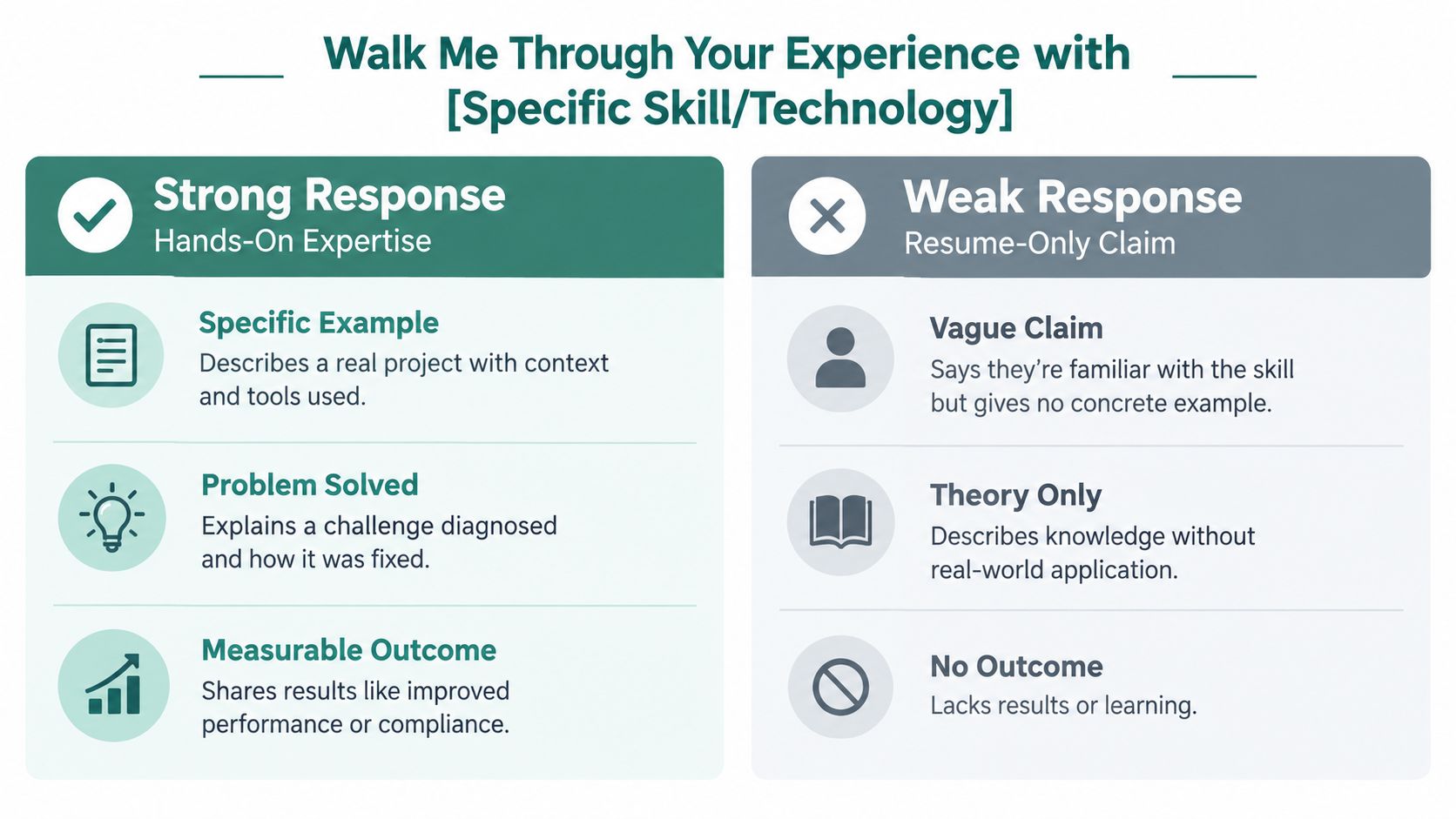
A candidate can claim familiarity with an application, framework, instrument, or process without demonstrating meaningful hands-on capability. “Walk me through your experience with [specific skill or technology]” changes the conversation from self-assessment to evidence.
The bracketed element should come directly from the job's requirements. For a healthcare role, ask about an electronic medical record system and a workflow problem the candidate resolved. In manufacturing, ask about CNC equipment, PLCs, or a quality-control tool, then request a diagnosis and corrective action. For technology roles, ask about a programming language or framework and a project involving performance, reliability, or a critical bug. In pharma or biotech, ask about a regulatory protocol, laboratory instrument, or data-management system.
A strong answer explains context, personal contribution, technical choices, and outcome. A weak answer lists tools without showing how the candidate used them. Senior candidates should usually discuss trade-offs, risks, mentoring, or system-level consequences. Junior candidates can demonstrate competence through clear process, sound troubleshooting, and willingness to verify their work.
Define what novice, intermediate, and expert answers look like for that particular role. The rubric might distinguish candidates by:
If the answer is vague, probe with “What did you personally do?” If it's highly detailed but lacks an outcome, ask what result followed. If the candidate names a required skill that hasn't been assessed elsewhere, flag it for mandatory review.
One trade-off matters here. Technical screening can save time compared with a live demonstration, but it can't validate every practical capability. Use this prompt to identify depth and decide whether a later work sample, technical interview, or credential check is necessary.
Place the question in the context of the job's actual skill inventory, not a generic technology list.

A later follow-up can ask the candidate to explain how they learned the tool, collaborated during implementation, or handled a failure. That connection helps recruiters distinguish memorized terminology from applied capability.
A challenge question is useful only when it reveals decisions. Candidates often prepare stories about difficult situations, but a polished account can hide whether they owned the work, learned from the problem, or observed someone else solve it.
Make the prompt role-specific. A healthcare candidate might describe a patient-care or documentation workflow breakdown. An engineer could discuss a technical setback that required a different approach. A manufacturing candidate might explain how they responded to a production or quality issue. In pharma, the relevant challenge may involve regulatory accuracy under deadline pressure. In retail or hospitality, it may involve a difficult customer or team situation.
The first follow-up should establish ownership: “What was your specific role?” The next should test judgment: “What would you do differently now?” Those questions separate responsibility from storytelling and learning from hindsight theater.
A strong answer includes the situation, the candidate's actions, the outcome, and what they applied later. The outcome doesn't need to be dramatic. It does need to show how the candidate judged options, involved the right people, managed risk, and learned.
Recruiters can use the STAR method for interviewing as a structure for probing answers, but shouldn't reward candidates merely for naming each STAR component. The scoring rubric should prioritize decision quality, accountability, role relevance, and learning transfer.
A memorable struggle isn't automatically evidence of resilience. The useful signal is how the candidate acted, what the action changed, and whether the lesson affected later work.
For high-risk roles, align the challenge with the organization's priorities. Patient safety should matter in clinical hiring. Product quality should matter in manufacturing. Data integrity should matter in pharma. For a low-risk customer-facing role, judgment, de-escalation, and service recovery may carry more weight than technical complexity.
Don't confuse persistence with effectiveness. Pair this question with a technical or compliance prompt when the role requires specialized judgment, so the score reflects relevant problem solving rather than general determination.
Motivation questions work poorly when recruiters accept generic praise. “I admire your culture” and “I want a new challenge” may be sincere, but they don't tell you whether the candidate understands the work or has a credible reason for choosing it.
Give candidates enough employer-provided context to answer fairly. The role's responsibilities, team priorities, product or service, and mission should be clear before you score research quality. Then ask what specifically attracts the candidate.
A healthcare candidate might connect the opportunity to patient care or a clinical specialization. A technology candidate should be able to discuss the product, technical problem, or company mission that interests them. A pharma or biotech candidate might connect the role to a research area. A manufacturing candidate can explain why the position and operating environment fit their next step. For government hiring, public service and the agency mission may be central.
A good response links the candidate's interests to actual work. It may also explain what they want to learn, contribute, or take ownership of. A weak response focuses only on location, title, or broad company reputation.
Useful follow-ups include:
Compensation can be a legitimate priority, so don't automatically treat it as a red flag. The practical issue is whether the candidate's expectations match the role's responsibilities and package. Score motivation as a secondary alignment signal, not as a proxy for personality or cultural similarity.
The same principle applies to AI-assisted screening. Employer-curated information can help a system answer candidate questions consistently, but an automated evaluation shouldn't infer commitment from writing style, enthusiasm markers, or cultural familiarity. Review whether the candidate gave role-related evidence.

Collaboration isn't the absence of disagreement. It is the ability to make progress when people communicate differently, prioritize different risks, or bring different professional perspectives.
Ask for a real example rather than a personality label. In healthcare, the candidate might describe coordination across nursing, physicians, administration, or another clinical discipline. In technology, ask about a teammate who approached a problem differently. In manufacturing, the example could involve another shift, department, or cultural background. In pharma, research, quality, and regulatory teams often carry legitimate but competing priorities.
The strongest answers show adaptation without pretending that differences don't create friction. Candidates should explain how they clarified expectations, adjusted communication, challenged an idea respectfully, or created a shared decision process. They should also acknowledge their own working style and how it affects others.
Ask:
Score for curiosity, respect, communication, conflict management, and self-awareness. Don't award points because a candidate says they enjoy teamwork. A candidate who avoids conflict may sound agreeable while leaving important risks unaddressed.
Remote and hybrid roles need different probes from on-site roles. Ask how the candidate documents decisions, handles asynchronous work, escalates blockers, and keeps distributed colleagues informed. A multidisciplinary healthcare role may require more attention to handoffs and shared accountability. A professional services role may require comfort with clients and strong personalities.
The conflict resolution course for healthcare professionals provides useful context for role-specific collaboration prompts, particularly where disagreement can affect patient care.
Use feedback questions later to complete the picture. Collaboration scores should reflect observed behaviors and relevant examples, not whether the candidate resembles the interviewer's preferred communication style.
For regulated work, compliance shouldn't be a generic values question. It should test whether the candidate recognizes relevant obligations, applies them under pressure, and speaks up when a process creates risk.
Name the framework or standard. In healthcare, ask about HIPAA, patient privacy, electronic health record security, or another requirement tied to the role. Manufacturing candidates might discuss safety protocols and quality-control procedures. Pharma and biotech candidates may need to explain FDA regulations, GxP procedures, documentation, IRB protocols, data integrity, or laboratory safety. Government and compliance roles should be assessed against the specific regulatory framework or audit process they will handle.
A candidate who can define a standard but can't describe applying it may need development. That isn't always disqualifying. The role's risk level should determine whether the gap requires training, a deeper interview, or removal from consideration.
Strong evidence includes identifying a concern, documenting it, escalating appropriately, correcting the process, and protecting accuracy or safety despite operational pressure. Weak evidence includes vague statements about “following the rules” without a scenario.
Follow-ups should test lived experience:
A proactive compliance mindset is more valuable than defensive compliance that appears only when a supervisor is watching. However, don't reward unnecessary escalation or rigid behavior that prevents reasonable problem solving. The rubric should define what appropriate judgment looks like in that workplace.
Document responses carefully. Consistent scorecards create an audit trail and help hiring teams review evidence if a decision is challenged. The compliance interview questions guide can help recruiters build prompts around job-specific obligations rather than relying on broad ethics language.
Compensation belongs in a fair screening conversation, but the question should be mutual and informative. Asking candidates to name a figure without explaining the employer's range, benefits, schedule, location, or work arrangement creates avoidable friction.
A better prompt is: “To make sure this opportunity is a good mutual fit, what compensation range did you have in mind, and which parts of the package matter most to you?” For healthcare, scheduling and benefits may matter alongside salary. A technology candidate may prioritize equity, remote work, or professional development. In retail and hospitality, hourly rate, scheduling, and benefits can be central. Manufacturing candidates may weigh shift, stability, and total package. Professional services candidates may care about level, work arrangement, and development.
Provide employer-approved compensation information before or during the exchange. Candidates can then self-select with better context, and recruiters can identify misalignment without turning the answer into an automatic rejection.
Useful follow-ups include:
Don't infer competence, loyalty, or cultural fit from a candidate's range. A narrow expectation may reflect a specific need, while a broad range may reflect uncertainty. Score only practical alignment and record the context behind the answer.
The total compensation guide can help recruiters explain salary, benefits, incentives, and other employer-provided elements consistently. Also ensure the process follows local rules. Some jurisdictions restrict salary history questions, so ask about expectations and priorities rather than previous pay.
Adaptability is easiest to evaluate through a recent example. Ask about a new clinical system, manufacturing process, regulatory requirement, programming language, customer tool, or operating procedure that the candidate had to learn.
A strong candidate explains how they learned. They may have used formal training, documentation, practice, mentoring, peer feedback, or deliberate experimentation. They can describe how they knew they had reached working proficiency and how they applied the skill in real conditions.
For a junior candidate, look for resourcefulness and a realistic learning process. For a senior candidate, look for how they lead adoption, reduce disruption, coach others, and make decisions when the new information is incomplete. In roles involving AI-augmented work, ask how the candidate evaluates AI tools, checks outputs, protects sensitive information, and decides when human review is required.
The most useful follow-ups are concrete:
Score initiative, accuracy, openness to feedback, and transfer into performance. Don't confuse enthusiasm for change with the ability to adopt change safely. In healthcare, pharma, and manufacturing, a candidate who moves quickly but skips verification may create more risk than a careful learner.
Scenario questions can complement the behavioral example. Ask what the candidate would do if a new system launched before they felt fully confident, then evaluate whether they seek support, protect quality, and communicate limitations.
Feedback questions reveal more than whether a candidate claims to be coachable. They show how the person processes discomfort, distinguishes useful criticism from disagreement, changes behavior, and maintains a working relationship.
Ask for a specific instance. A healthcare candidate might discuss feedback from a supervisor, peer, patient, or family member. An engineer could describe code review or criticism of a technical design. In manufacturing, quality or process-adherence feedback may be especially relevant. Pharma candidates can discuss documentation, data integrity, or compliance feedback.
Listen for the actual feedback, not a vague statement that the candidate “always welcomes input.” The candidate should explain what they heard, how they responded, what they changed, and whether the change lasted.
“I accepted the feedback” is not the outcome. The outcome is the behavior that changed afterward.
Useful probes include:
Score ownership, emotional regulation, learning transfer, and professional judgment. A candidate who admits an initial defensive reaction may provide more credible evidence than someone who presents perfect immediate acceptance. The key question is whether they processed the feedback constructively.
Adapt the standard to the organization's culture. A team that uses frequent direct reviews needs candidates comfortable with regular correction. A safety-critical environment may require especially strong responses to quality or compliance feedback. Avoid rewarding a single communication style. Evaluate whether the candidate can receive and use information necessary to perform the job.
Candidate-led questions turn the interview into a two-way evaluation. They give applicants a chance to test role clarity, manager support, team dynamics, growth, schedule, and expectations while showing how they think about career decisions.
Don't score candidates for asking questions that flatter the employer. Score the relevance and thoughtfulness of what they need to know. A candidate might ask how success is defined, what the team is currently trying to improve, how decisions are made, what training looks like, or how the role collaborates with other functions.
The question set should vary by seniority. An entry-level candidate may focus on onboarding, coaching, and day-to-day responsibilities. A senior candidate may ask about scope, decision rights, technical direction, performance expectations, and cross-functional dependencies. For healthcare, questions about staffing, patient-care priorities, and handoffs may matter. For manufacturing, candidates may need clarity on shift conditions, safety ownership, and quality processes.
A conversational screening system should provide a clear way for candidates to submit questions and receive accurate answers based on employer-approved information. It should also route unanswered or sensitive questions to a recruiter rather than improvising.
Evaluate curiosity carefully. A candidate who asks no questions may be constrained by time, accessibility, anxiety, or uncertainty about the process. A candidate who asks many questions isn't automatically a better fit. Review the content, context, and whether the candidate is trying to understand the work.
This final prompt also helps reveal mismatched expectations before later interviews. If the candidate's questions show a different understanding of schedule, responsibilities, or decision authority, the recruiter can clarify the role rather than allowing an avoidable surprise to reach the offer stage.
| Question | Implementation Complexity 🔄 | Resource Requirements ⚡ | Expected Outcomes ⭐ | Ideal Use Cases 📊 | Key Advantages 💡 |
|---|---|---|---|---|---|
| Tell Me About Yourself | Low–Medium, open-ended, minimal setup | Low, basic prompt and time limit | ⭐⭐⭐⭐, rich narrative on background & communication | Broad screening; all seniority levels | Builds rapport; reveals storytelling & alignment |
| Walk Me Through Your Experience with [Skill/Tech] | Medium–High, requires role-specific calibration | Medium–High, skill rubrics, domain expertise | ⭐⭐⭐⭐⭐, validates hands-on competency and examples | Technical, regulated, or specialist roles | Filters resume-only claims; evidence-based scoring |
| Describe a Challenge You Faced and How You Overcame It | Medium, needs behavioral rubric (e.g., STAR) | Medium, probes and scoring for outcomes | ⭐⭐⭐⭐, shows problem‑solving, resilience, ownership | Fast-paced, high‑stress, leadership roles | Reveals learning, accountability, and adaptability |
| Why Are You Interested in This Role and Our Organization? | Low, straightforward prompt, needs employer context | Low, employer content improves evaluation | ⭐⭐⭐⭐, assesses motivation and cultural fit | Mission-driven orgs; retention-focused hiring | Filters genuine interest; predicts offer acceptance |
| How Do You Approach Collaborating with Different Working Styles? | Medium, needs nuance to detect authenticity | Low–Medium, example prompts and follow-ups | ⭐⭐⭐⭐, evaluates EQ, conflict handling, teamwork | Cross-functional, remote, multidisciplinary teams | Identifies team-fit and potential collaboration risks |
| Tell Me About Your Experience with [Compliance/Safety/Quality] Standards | Medium–High, must map to specific regulations | High, domain experts, maintained question sets | ⭐⭐⭐⭐⭐, demonstrates compliance awareness; reduces risk | Healthcare, pharma, manufacturing, government | Mitigates audit/legal risk; documents due diligence |
| What Are Your Salary Expectations and Compensation Priorities? | Low, direct prompt but requires tactful framing | Low, compensation data for context improves outcomes | ⭐⭐⭐, clarifies alignment; reduces late-stage mismatch | High-volume, budgeted roles; regional pay bands | Saves time; lowers offer rejection and negotiation friction |
| Describe Your Approach to Learning New Skills or Adapting to Change | Low–Medium, seeks concrete examples of learning | Low, prompts for methods, timelines, outcomes | ⭐⭐⭐⭐, signals growth mindset and agility | Roles with rapid technology/regulatory change | Predicts long-term adaptability and development potential |
| Can You Share an Example of How You've Handled Feedback or Criticism? | Medium, needs probes to assess authenticity | Low, targeted prompts and rubric for ownership | ⭐⭐⭐⭐, assesses coachability, humility, emotional maturity | Feedback-rich cultures; managerial tracks | Identifies coachable candidates and team compatibility |
| What Questions Do You Have About the Role, Team, or Organization? | Low, placed at end of screening | Very Low, open field to capture candidate priorities | ⭐⭐⭐, signals candidate engagement and research | Closing of interviews or automated screens | Reveals concerns, priorities, and preparation level |
Conversational screening becomes reliable when the employer designs the evaluation before the conversation begins. Start by mapping each question to a job competency. “Tell me about yourself” might assess relevant communication and career alignment, while a technical walkthrough tests applied capability. A compliance question may carry greater weight for a clinical, pharma, government, or manufacturing role than for a low-risk administrative position.
Next, define observable anchors for weak, acceptable, and strong answers. A weak technical answer may name tools without describing personal work. An acceptable answer may explain a relevant task and sound troubleshooting process. A strong answer may add trade-offs, verification, outcomes, and collaboration. These anchors help reviewers score evidence rather than confidence, accent, fluency, charisma, or familiarity with interview conventions.
Use consistent core questions for every candidate applying to the same role. Follow-up prompts can remain flexible, but the rules should be predetermined. For example, recruiters might ask for ownership when a candidate makes a broad claim, ask for an outcome when the answer describes activity without impact, and ask for a specific scenario when the answer remains hypothetical.
The move toward structure has a long research history. Behavioral interview questions emerged in the 1980s in response to the limitations of casual interviewing, with industrial psychologist Dr. Tom Janz credited in industry histories with developing questions focused on past actions. Later reviews commonly report corrected validity estimates around 0.42 to 0.51 for structured formats versus about 0.19 to 0.38 for unstructured formats (behavioral interview history and research context). The practical lesson is simple: natural language works best when the underlying measurement stays disciplined.
Review scorecards for patterns, not isolated impressions. Look for repeated evidence across technical, behavioral, collaboration, adaptability, and compliance responses. A candidate may give a polished motivation answer but show weak ownership in challenge and feedback examples. Another may communicate briefly yet provide precise, role-relevant evidence. Structured review protects both candidates and employers from allowing one memorable moment to dominate the decision.
The approach also matters as AI-assisted screening becomes more common. AI-conducted interviews rose from 10% in June 2023 to 23% in October 2024 and 34% in August 2025, while the same source reports that two-thirds of recruiters plan to expand AI pre-screening interviews in 2026, a projection about planned activity rather than a current outcome (AI hiring statistics and 2026 projection). Employers should treat that adoption as a reason to improve governance, not as permission to automate judgment.
Talent Pronto is one example of a role-aware screening platform. Its virtual assistant, Anna, conducts conversational screening across web and mobile, asks behavioral, technical, cultural, and compliance questions, and prepares structured scorecards. The platform also supports resume evaluation, candidate outreach, scheduling, candidate questions based on employer-provided information, and ATS or HRIS coordination with systems such as Greenhouse, iCIMS, Paylocity, ADP, and Workday. Employers still make advancement and rejection decisions.
The best system leaves room for human review, candidate choice, documented criteria, and appropriate accommodation. A conversation should feel respectful and responsive, but every answer should still connect to a defined competency and a fair evaluation standard.
Visit Talent Pronto to explore 24/7 conversational screening, role-specific behavioral and technical questions, and structured candidate scorecards. Use it to turn natural screening conversations into consistent evidence, coordinate next steps, and keep employer judgment at the center of hiring.

Talent Pronto is an AI-powered hiring platform built around Anna, our intelligent AI that conducts 24/7 conversational screening, evaluates candidates against specific job requirements and compliance needs, and schedules interviews. Run everything on the Talent Pronto ATS, our all-in-one applicant tracking system with a branded careers site and Anna built in, or keep your existing ATS and let Anna integrate with Greenhouse, Ashby, iCIMS, Jobvite, Lever, Oracle, and more. Either way, we help organizations reduce time-to-hire and build stronger teams.