Use these screening interview questions to assess technical skills, behavior, culture, compliance, and fit with consistent scoring and automation tips.
The popular advice is to collect a long list of screening interview questions and ask every candidate as many as possible. That approach creates the appearance of rigor without producing reliable evidence. Effective screening does more than confirm resume keywords. It reveals behavior, capability, judgment, motivation, communication, and risk through answers that evaluators can compare.
A stronger process organizes questions by the kind of evidence each answer should produce. The ten categories below cover technical competency, behavioral events, motivation, compliance, problem-solving, communication, inclusion, track record, industry knowledge, and learning orientation. Each category includes role-specific examples, scoring signals, sample answer quality, red flags, and an automation workflow.
Structure matters because research has consistently found that standardized interviews predict job performance better than casual conversations. The 1994 meta-analysis by McDaniel and colleagues synthesized 106 studies involving 12,847 people and reported operational validity of .44 for structured interviews versus .33 for unstructured interviews in predicting performance (the original meta-analysis). A later review reported a mean validity of about .42, with an 80% credibility interval from .18 to .66, placing structured interviews among the strongest selection methods (the 2023 review).
Conversational automation can ask consistent questions, branch into neutral follow-ups, answer candidate questions, and prepare scorecards. It shouldn't make final advancement or rejection decisions. The employer still needs to review evidence, monitor fairness, and retain accountability. This article also excludes any autogenerated authorship footer.
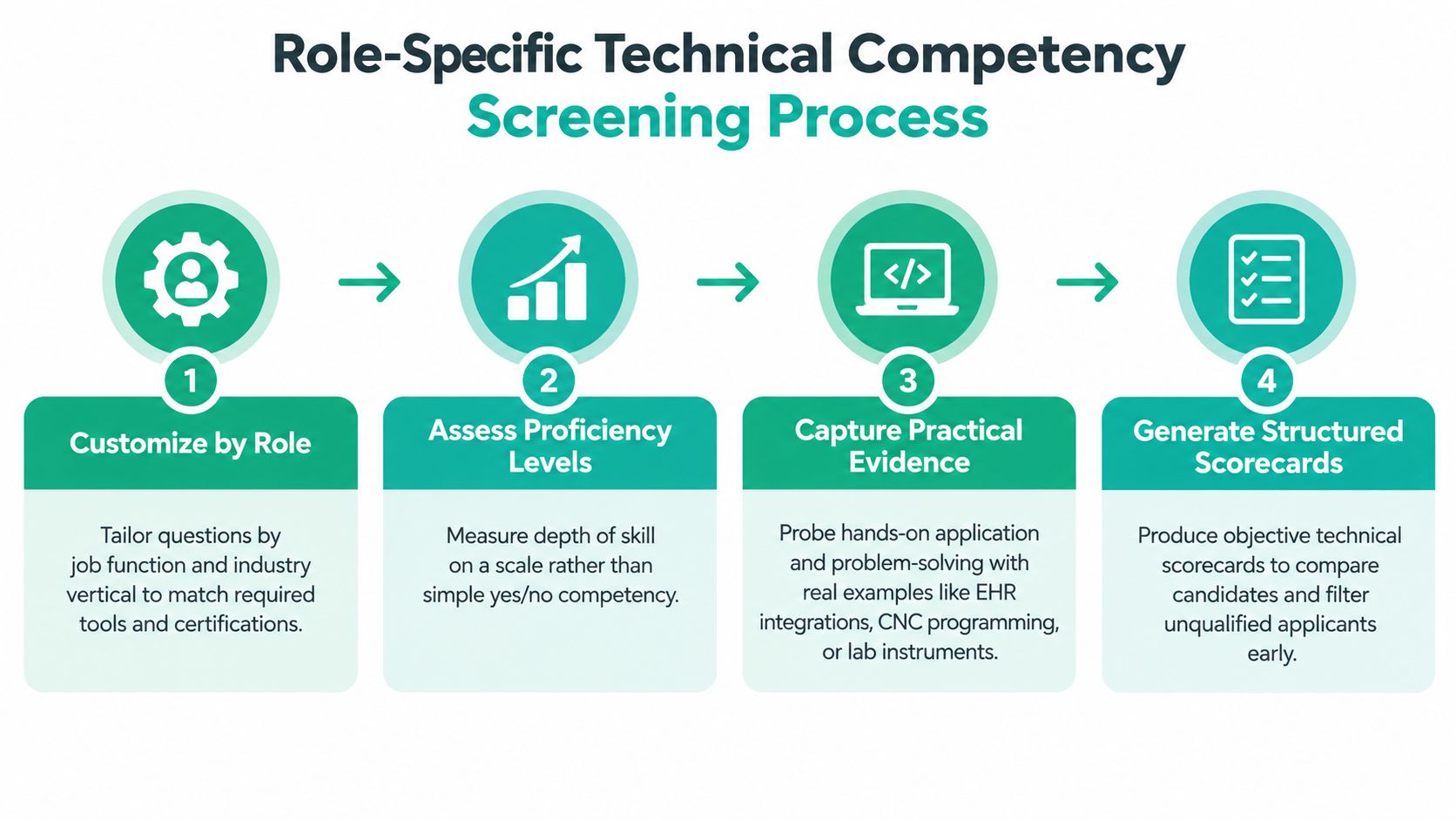
Technical screening should test evidence of hands-on work, not familiarity claimed in the abstract. Ask what system or method the candidate used, which task they owned, how independently they worked, and what result or constraint shaped the work. This produces clearer evidence than “Are you familiar with our systems?”
For healthcare IT, ask: “Describe your experience with EHR systems. Which ones have you used, and what integrations have you configured?” In manufacturing, ask: “Walk us through your experience with CNC programming. What materials and complexities have you worked with?” For pharma or biotech, ask: “Tell us about your laboratory experience. Which analytical instruments have you operated independently?”
The technical interview questions guide helps translate job requirements into targeted prompts. Match each question to work the role requires, rather than testing generic industry vocabulary.

A strong answer names the tool or method, defines the candidate's contribution, and explains how they handled complexity. A healthcare IT candidate might distinguish configuring an interface from testing it, documenting it, and supporting users after deployment. Product names without decisions, checks, or responsibility provide weak evidence.
Use separate scoring signals for different levels of contribution:
Apply the same rubric to every candidate, while allowing a reasonable route for candidates to clarify unfamiliar terminology or describe equivalent tools. This supports fair comparison without treating confidence or accent as evidence of technical ability. Calibrate reviewers with sample answers before using the screen at scale.
Automation should ask the core question first, then branch only when clarification is needed. If a candidate names an EHR, a follow-up can ask which integration they configured and how they tested data flow. Record the response against the rubric. Do not infer competence from keywords alone.
Review the question set when tools, regulations, or role expectations change. Keep foundational and advanced versions separate so seniority is judged through demonstrated responsibility, not conversational polish.
Behavioral screening should collect evidence from a real event, not invite a polished opinion. Replace “Are you good at handling conflict?” with “Tell us about a time you resolved a conflict with a colleague.” The second prompt gives reviewers something to examine: context, responsibility, decisions, and results.
Ask candidates to structure the response around Situation, Task, Action, and Result. Role-specific wording keeps the evidence relevant. In healthcare, ask: “Tell us about a time you identified a patient safety issue or process improvement. What was the situation, what action did you take, and what was the result?” Retail and hospitality screens can focus on a difficult customer. Manufacturing screens can ask for a specific equipment failure and the candidate's diagnostic process.
The STAR method for interviewing offers a foundation for writing these prompts. For executive roles, the STAR method for executives is useful when answers must show organizational scope and leadership judgment.
A strong response identifies the candidate's role, the constraint, the action they personally took, and the outcome. A dramatic story is unnecessary. A manufacturing technician who explains how they isolated a failure, involved maintenance, documented the fix, and prevented recurrence may provide better evidence than a polished but vague leadership anecdote.
Use targeted probes only when evidence is missing:
Score outcome impact, problem-solving quality, accountability, and relevance to the role. Reviewers should accept different storytelling styles when the same evidence is present. Calibration should focus on missing evidence, not accent, confidence, or a preferred communication style.
Practical rule: A memorable story is not automatically predictive. Score the decisions and actions the candidate describes.
Automation can ask one follow-up at a time, triggered by a missing evidence field. If the candidate explains the situation but not their contribution, request their specific role. If the result is unclear, ask how success was measured. Store the original response with each follow-up so reviewers can assess the complete context rather than a keyword match. Recheck prompts and scoring examples as role expectations change.
Motivation screening produces evidence about fit between the candidate's goals and the work the employer can offer. It should reveal why the role makes sense now, not reward candidates who flatter the company or perform enthusiasm. Ask: “What attracted you to this role, and what would you like to build or accomplish here?” Then use, “What else?” or “Tell me more about that.” These prompts invite detail without suggesting the answer you want.
Role context changes the evidence you should seek. In healthcare or pharma, ask: “What drew you to this role in healthcare? Tell us about your interest in this specific area of medicine or health technology.” For government, ask why public-sector service fits the candidate's goals. In manufacturing or logistics, ask: “Walk us through your career path. Why this next move, and what are you looking to build or accomplish?”
A strong answer connects the candidate's experience and interests to actual responsibilities. For example, a public-sector applicant may discuss service, accountability, and long-term contribution. A logistics candidate may explain an interest in operational scale, reliability, or process improvement. “Dynamic environment” and “great culture” are weak signals until the candidate explains what those terms mean for this position.
Alignment does not require the candidate to share the hiring manager's background, personality, or interests. Score these signals:
Compare the answer with the job posting. Someone seeking complex clinical work may be mismatched with a primarily administrative position. That indicates an expectation gap, not automatically poor motivation. Give candidates enough accurate information to make an informed choice, then tailor later communication to the gaps they identify.
Automation can present the same core question to every applicant and trigger role-specific follow-ups when an answer lacks a connection to the work, employer, or career path. It may answer questions using approved employer information about culture, benefits, and responsibilities, but a recruiter should review that content for accuracy before publication. Flag expectation gaps for human review. Do not reduce motivation to a good-or-bad label, and audit prompts and scoring examples for consistent treatment across candidates.

Compliance screening should produce evidence of both rule knowledge and conduct under pressure. Ask candidates to explain relevant training, certifications, or standards, then request an example of protecting sensitive information, stopping unsafe work, reporting a concern, or following a quality process when speed mattered.
Use role-specific prompts. In healthcare: “Tell us about your experience with patient data privacy and HIPAA compliance. Describe a situation where you handled sensitive patient information.” For pharma or manufacturing, ask about quality management systems, GMP, or the most rigorous quality environment the candidate has worked in. For government roles, ask whether the candidate holds a clearance or has worked with security protocols, and whether they can pursue clearance when the position requires it.
Score the evidence rather than the candidate's confidence:
A structured interview can still contain an inappropriate question. Employers generally should not ask pre-employment questions about sex, pregnancy, marital status, children, future childbearing, childcare, or a spouse's information, according to EEOC guidance on gender-related inquiries. They also should not ask about disability status or require medical questions or an examination before making a job offer, as explained in EEOC guidance on disability and medical questions.
Ask whether the candidate can perform the essential job function, with or without reasonable accommodation where applicable. Do not use a medical condition, family arrangement, or protected characteristic as a proxy for availability or reliability.
Automation should present questions approved by HR or legal teams, record the prompt and response, and route defined cases for human review. It must avoid inferences about protected traits. For regulated roles, an audit trail supports consistency only when the questions are defensible, the rubric is calibrated, and recruiters review exceptions.

Use hypothetical scenarios to examine how candidates handle uncertainty, gather information, test assumptions, and involve others. These questions produce evidence about reasoning, not personality, so scoring should focus on the decision process rather than a single preferred answer.
Start with the operating context. For a technology startup, describe a supply chain delay affecting a product launch and ask how the candidate would identify options and recommend a response. In healthcare, ask how they would join a department that uses unfamiliar systems. In manufacturing, ask what they would investigate after an unexpected drop in production efficiency.
The strongest responses often begin with clarification. A candidate might ask about the delay's size, customer commitments, inventory, quality constraints, contractual obligations, and alternative suppliers. That sequence shows whether they can separate missing information from assumptions before choosing an action.
Score the reasoning chain, using a role-specific rubric:
A high-quality answer connects the proposed action to constraints such as safety, customers, colleagues, or operations. A technically impressive response that ignores those effects should not receive the highest score. Follow up with “What else would you consider?”, “How would you validate that assumption?”, and “Who else would you involve?” These prompts distinguish independent thinking from isolated decision-making.
Automation can present the scenario, capture the initial response, and issue neutral probes when a required dimension is missing. Configure scoring around evidence in the answer, not specific wording, speed, or confidence. Human reviewers should assess borderline responses, particularly when a proposed action could affect safety, compliance, patient care, or customers.
Communication screening should produce evidence about how a candidate exchanges information, not merely how confidently they speak. Use a short role scenario, then examine the candidate's explanation, listening, clarification, and response to follow-up questions. The same evidence matters differently across roles: patients need understandable explanations, manufacturing teams need constructive coordination, and remote technology teams need reliable communication across distance.
Start with a role-specific prompt:
Ask for the recipient's response. “How did the other person react?” and “What did you learn?” reveal whether the candidate adjusted to the listener's knowledge, concern, or misunderstanding. A strong sample answer describes the audience, the adjustment made, the resulting response, and what the candidate would repeat or change. A weak answer focuses on delivering the message, claims the other person failed to understand, or presents persuasion as winning.
Use a behavior-based scorecard:
Define score levels with job-relevant evidence. A competent response may explain the issue clearly and resolve it. An excellent response also demonstrates active listening, appropriate adaptation, and a useful outcome. Do not score accent, extroversion, speaking speed, or conversational similarity as communication quality.
Automation can deliver consistent prompts, collect text or voice responses, and issue follow-ups when the candidate omits the listener's reaction or their own adjustment. Configure scoring for observable evidence, not sentiment, accent, enthusiasm, or confidence. Human reviewers should assess advancement decisions, especially where context or accessibility needs may affect the interaction.
DEI screening should produce evidence about behavior, reflection, and collaboration across different perspectives. It should not test identity or ask candidates to prove personal virtue. Use a prompt such as, “Tell us about a time you worked effectively with someone whose background, perspective, or experience differed from yours. What did you learn, and what changed in your approach?”
For leadership roles, ask for a specific inclusion effort, the candidate's decisions, and the resulting change in team participation or working relationships. For any role, ask, “What does belonging at work mean to you, and how have you helped create it?” Strong answers describe observable actions, acknowledge assumptions or barriers, and connect learning to later behavior. Familiar DEI terminology matters less than credible examples.
Protect the interview boundary. Do not ask about gender, race, age, religion, disability, family status, or other protected characteristics. Keep questions focused on conduct, decisions, and outcomes. A candidate does not need a perfect story. Reflection, listening, repair, and continued learning can provide useful evidence.
Use a shared rubric, and review it with HR or legal partners before deployment. The bias mitigation strategies guide can support consistent evaluation practices. Diverse panels can add perspective, while scorer training helps separate communication style, accent, or cultural familiarity from the behavior described.
Score the evidence rather than the candidate's vocabulary:
For a competent answer, look for one relevant action and a credible result. A stronger answer explains the context, the candidate's role, the adjustment made, and how the lesson influenced later work.
Automation can present the same behavior-based prompt, collect written or recorded responses, and offer an accessible alternative format. Configure scoring for observable evidence. Do not infer identity, protected status, cultural fit, sentiment, or confidence from language. Human reviewers should make advancement decisions where context or accessibility needs affect interpretation.
Resume claims become useful evidence when the interviewer traces how the work happened. Ask about the original business problem, the candidate's specific decisions, the result, and the evidence supporting it.
Start with the claim most relevant to the role. For a reported improvement, ask: “What problem were you solving, what did you personally own, and how did you measure the outcome?” For an employment gap, use a neutral prompt: “What were you doing during that time?” For a manager, ask about one team they led, including its operating challenges, their decisions, and how they developed individuals.
A useful follow-up sequence is: “What was your part?”, “What alternatives did you consider?”, “What changed afterward?” This creates a fuller record than challenging the resume directly and gives candidates room to explain shared work, constraints, and imperfect results.
Use a role-specific scorecard rather than rewarding polished storytelling. Look for:
A strong answer connects context, action, and outcome. A weaker answer repeats resume language or names tools without showing judgment. For a technical role, ask which systems the candidate independently operated and which they only encountered. For a leadership role, ask how team performance changed and what the manager did to influence it. This distinction separates breadth of exposure from depth of ownership.
Automation can extract resume claims and generate approved follow-ups, then present the same prompts to each candidate. Configure it to capture responses and map observable evidence to the scorecard. It should not treat an employment gap or career change as dishonesty. Recruiters must review explanations in context, while later reference checks can test material claims. Preserve the candidate's words and supporting details instead of assigning a conclusory label.
Industry knowledge should produce evidence of preparation, judgment, and role relevance. It should not become an unpaid research contest. Share enough information for candidates to understand the position, then set expectations according to seniority and sector.
Open with: “What do you know about us?” Ask the same core question before supplying hints. A healthcare candidate might explain what attracts them to the sector and how the organization's clinical or operational focus connects to the role. In technology, ask about the product space and market pressures the candidate sees. In manufacturing, ask what interests or concerns them about the industry.
Role-specific follow-ups reveal the quality of the connection. A healthcare applicant may discuss patient access or operational complexity. A startup applicant might relate product adoption, regulation, or supply constraints to the job. A candidate for a virtual medical assistant company could explain how technology affects administrative workload and patient communication, if those issues reflect the actual employer and position.
Define the required knowledge before interviewing. Basic organizational facts may be appropriate for every applicant. Detailed market analysis fits a senior commercial or strategy role, but may be excessive for entry-level hiring.
Use a compact scorecard:
A strong answer identifies a relevant fact, explains its effect on the role, and acknowledges uncertainty where the candidate lacks information. A weak answer lists corporate language without showing how the knowledge would influence decisions.
Automation can present employer-approved resources, ask the same opening question, and record the follow-up, “How do you see that affecting this role?” Configure scoring to capture observable evidence rather than keyword matches. Do not require confidential information or reward access to specialized preparation materials. Human reviewers should consider unequal access and avoid rejecting a candidate because of one missing fact. Calibration sessions can compare sample answers and align reviewers on what preparation means at each level.
A candidate's learning orientation appears in what changed after feedback, failure, uncertainty, or new evidence. “I love learning” offers little screening value. Ask: “Tell us about a time you received critical feedback or made a significant mistake at work. What did you do, what did you learn, and how did you apply that learning?”
Tailor the prompt to the role. For a technology position, ask about deliberately accepting work outside the candidate's expertise. In healthcare, ask how the candidate stays current and which practice or belief they changed after reviewing new information.
Use the follow-up answers to assess durable behavior:
A strong response names a genuine limitation, explains an action beyond accepting feedback, and shows that the new approach continued. Asking for examples, changing a workflow, seeking coaching, and checking results are useful signals. Flawless self-presentation is not the standard.
Score evidence, not the phrase “growth mindset.” “I'm bad at X” may indicate a fixed conclusion, while “I'm building skill in X, and here's how” can show an active process. Vocabulary alone remains weak evidence. Give more weight to the behavior, follow-through, and later application.
Automation can ask the opening question consistently, then branch to an example, a specific change, or a later application when the response is generic. Configure it to flag missing evidence for human review rather than issue a final judgment. Human scorers should calibrate examples by role level and distinguish limited experience from unwillingness to learn. For regulated roles, include whether the candidate updates practice when standards or evidence change. This improves consistency, though additional probing can lengthen the process and may feel intrusive if the purpose is not clear.
| Screening Type | 🔄 Implementation complexity | ⚡ Resource requirements | 📊 Expected outcomes | 💡 Ideal use cases | ⭐ Key advantages |
|---|---|---|---|---|---|
| Role-Specific Technical Competency Questions | Medium–High; needs SME design and periodic updates | High; subject-matter experts, assessment platform, calibration | Objective technical scorecards; filters unqualified candidates (reported 40–60% interview load reduction) | Specialized or hard-to-fill technical roles (engineering, healthcare IT, manufacturing) | Precise proficiency measures; surfaces non-traditional skilled candidates |
| Behavioral Event Questions (STAR Format) | Medium; requires standardized prompts and scorer training | Moderate; evaluator training and time for structured interviews | High predictive validity for job performance; consistent scorecards and audit trail | Customer-facing, leadership, and roles where past behavior predicts success | Focuses on documented behaviors; reduces bias and improves comparability |
| Motivation and Career Alignment Questions | Low–Medium; straightforward to design but needs careful phrasing | Low; interviewer time and attentive listening | Better retention; reduced first-year turnover by identifying misalignment | Roles where cultural/mission fit and retention matter (nonprofit, public sector, mission-driven firms) | Identifies motivated, mission-aligned candidates early |
| Compliance and Safety Screening Questions | Medium–High; must align with regulations and legal review | High; legal/compliance input, documentation, role-specific tailoring | Reduces regulatory risk and supports legal defensibility; documents due diligence | Highly regulated sectors (healthcare, pharma, government, manufacturing) | Protects organization from compliance violations and reputational risk |
| Problem-Solving and Adaptability Questions | Medium; needs realistic scenarios and evaluator calibration | Moderate; time for scenarios and trained evaluators | Identifies analytical, resilient candidates; predicts success in ambiguous roles | Fast-moving organizations, startups, consulting, roles with evolving scope | Assesses reasoning and learning agility beyond domain expertise |
| Communication and Interpersonal Skills Questions | Low–Medium; can be assessed during routine screening | Low; interviewer observation plus scoring rubric | Predicts team cohesion and client-facing effectiveness | Remote/distributed teams, client-facing, cross-functional roles | Evaluates real-time communication and listening during screening |
| Diversity, Equity, and Inclusion Awareness Questions | Medium; requires careful non-discriminatory design | Moderate; diverse panels and evaluator training recommended | Identifies culturally humble candidates; helps reduce team friction | Organizations prioritizing DEI, leadership and people-management roles | Strengthens inclusive culture and signals organizational commitment |
| Experience and Track Record Validation Questions | Low–Medium; focuses on resume references and probing | Moderate; time-consuming follow-ups and verification checks | Detects exaggerated claims, unexplained gaps; validates past impact | Senior hires, roles requiring verified credentials or measurable outcomes | Prevents mis-hires from false credentials; clarifies candidate history |
| Industry and Organizational Knowledge Questions | Low; simple to craft but must be role-calibrated | Low; interviewer prep and candidate research expectation | Filters generic applicants; identifies genuinely interested candidates | Mission-driven organizations, roles needing market or product familiarity | Surfaces targeted applicants and enables tailored engagement |
| Growth Mindset and Learning Orientation Questions | Low–Medium; needs probing and consistency in scoring | Low–Moderate; interviewer skill to elicit real examples | Predicts long-term adaptability and development potential | High-growth, rapidly evolving industries and development-focused roles | Highlights coachability and potential beyond current skills |
Good screening interview questions won't fix a process that has no defined decision criteria. Begin by identifying the capabilities that distinguish success in the specific role. Separate must-have requirements from trainable skills, then map each requirement to one or more evidence categories. A clinical role may need technical competency, privacy behavior, communication, and learning orientation. A manufacturing role may need equipment knowledge, safety judgment, troubleshooting, and cross-functional communication.
Choose a balanced set rather than asking every possible question. More prompts can create fatigue without improving evidence. A small, deliberate set of job-linked questions is easier to score, easier for candidates to complete, and easier for recruiters to audit. Keep knockout questions limited to genuine requirements, such as an essential certification, schedule condition, or legally necessary work authorization question.
Write anchored scoring levels before the first candidate answers. A low score should describe missing or contradictory evidence. A middle score should describe adequate, relevant evidence. A high score should require specific actions, sound judgment, meaningful outcomes, or role-level complexity. Anchors stop evaluators from awarding points for confidence, similarity, or a memorable story.
Structured interviews have a strong research foundation. One meta-analytic summary reported that increasing structure raised validity from about .20 to .57, a net gain of .37, across interview levels (the interview structure review). The same research base has also described structured interviews as producing validity coefficients roughly twice those of unstructured interviews. These findings support standardization, but structure must be applied to appropriate questions. A consistently scored question about family plans is still inappropriate.
Add neutral follow-up branches. The system can ask for the candidate's specific role, an outcome, a decision rationale, or a lesson learned when the initial response leaves a required evidence field blank. It shouldn't keep probing until a candidate gives the answer a recruiter prefers. The branch logic should be documented and tested across roles.
Test the screen for disparate impact before relying on it. Review whether questions introduce unnecessary barriers, whether response formats are accessible, and whether evaluators interpret answers consistently. Structured interviews can show lower racial subgroup differences than several other selection predictors, as described in the 2023 review of structured interviews (the review of validity and subgroup differences). That advantage depends on job-related content and disciplined scoring. It isn't a guarantee that every structured process is fair.
Review red flags with human oversight. A scorecard can surface a missing certification, contradictory employment detail, or safety concern, but a recruiter or hiring manager should examine the context before making a decision. A separate large-scale review cited in 2024 found that more structured scoring can increase the predictive validity of rater evaluations by more than 50% (the structured scoring review). The practical lesson is to improve rater discipline, not to outsource judgment.
Talent Pronto can support this workflow with 24/7 conversational screening, role- and industry-aware question sets, behavioral and technical prompts, structured scorecards, candidate Q&A, scheduling, analytics, and ATS or HRIS integrations. Its virtual assistant, Anna, can ask consistent follow-ups based on employer-provided criteria and prepare comparable candidate records. Supported integrations include Greenhouse, iCIMS, Paylocity, ADP, and Workday, with availability and configuration depending on the implementation.
The employer retains advancement and rejection decisions. That distinction matters. Automation can evaluate responses against a defined rubric, organize evidence, and flag areas for review, but it shouldn't make the final hiring decision or turn a protected characteristic into a hidden score. Give candidates an opt-out route for traditional application or screening methods, explain what the interaction involves, and provide accessible alternatives where needed.
Finally, review questions, rubrics, and workflows whenever the role changes, compliance requirements evolve, or score patterns become inconsistent. Monitor completion, follow-up usage, reviewer agreement, and candidate concerns as process signals. The strongest screening system isn't the one with the most advanced conversation. It's the one that asks defensible questions, captures relevant evidence, treats candidates consistently, and leaves accountable people in control of the decision.
Talent Pronto provides conversational screening that asks role-specific technical, behavioral, compliance, and knockout questions, then organizes responses into structured scorecards for recruiter review. Visit Talent Pronto to see how its screening workflows, candidate Q&A, scheduling, analytics, and ATS or HRIS integrations can support a more consistent early-stage hiring process.

Talent Pronto is an AI-powered hiring platform built around Anna, our intelligent AI that conducts 24/7 conversational screening, evaluates candidates against specific job requirements and compliance needs, and schedules interviews. Run everything on the Talent Pronto ATS, our all-in-one applicant tracking system with a branded careers site and Anna built in, or keep your existing ATS and let Anna integrate with Greenhouse, Ashby, iCIMS, Jobvite, Lever, Oracle, and more. Either way, we help organizations reduce time-to-hire and build stronger teams.