Use our interview scheduling template to cut coordination time, speed responses, and improve show rates with ready-to-copy email copy and ATS rules.
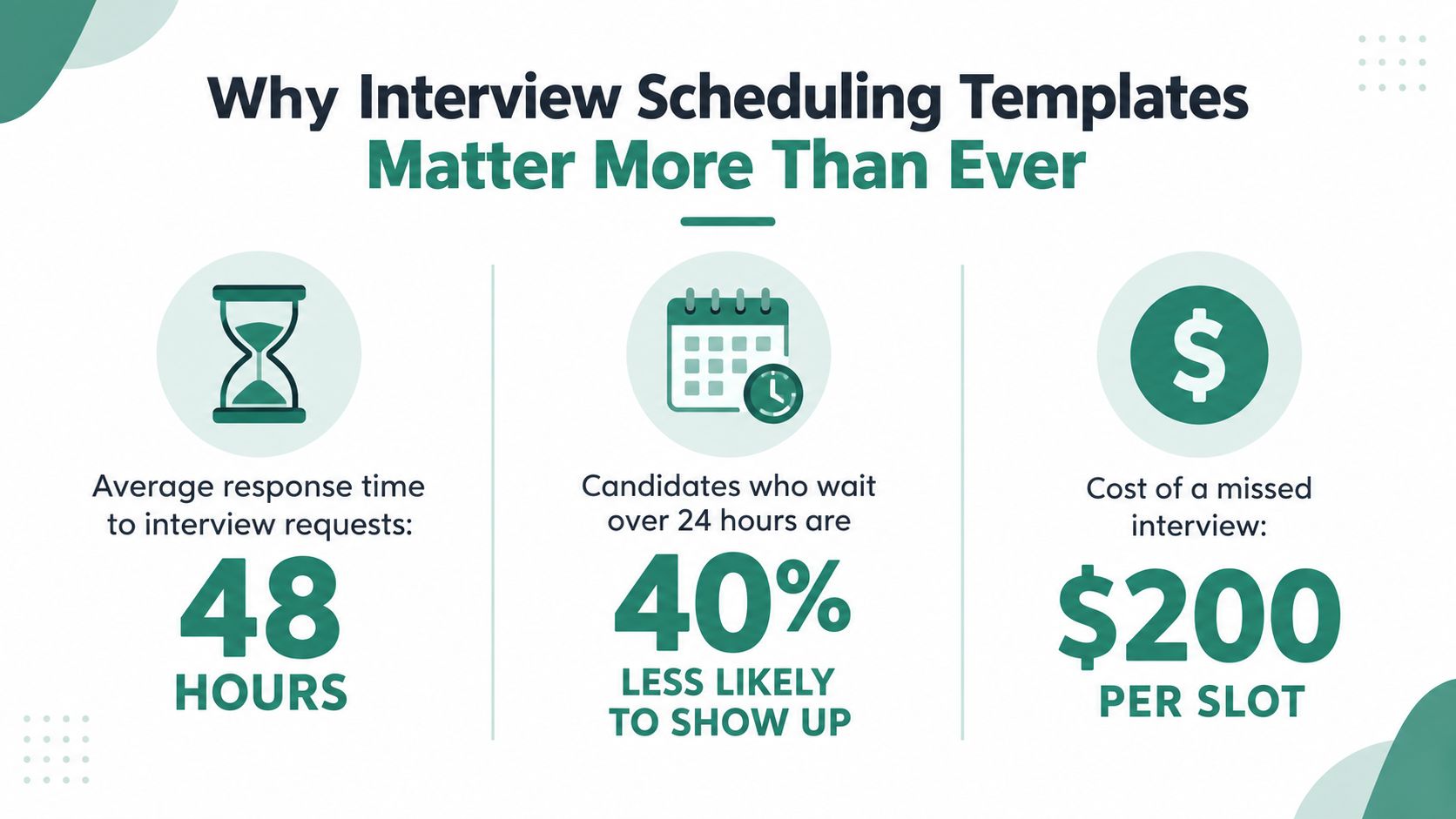
A candidate can leave a hiring process because scheduling takes too long. Cronofy's 2024 Candidate Expectations Report found that 21% of candidates expect an interview within 2–6 days, while 29% expect it within a week. At the one-month mark, 36% would disengage, an increase of 12 percentage points from the prior year. An interview scheduling template therefore isn't just polished email copy. It's a practical control for response speed, calendar coordination, reminders, and recovery when the first plan fails.
The best template gives candidates a clear next step, gives interviewers a workable operating rule, and gives the ATS enough structure to automate routine actions without removing human judgment. The examples below are designed for healthcare, retail, technology, and other environments where interview volume, panel complexity, and candidate availability rarely fit a simple email exchange.
Recruiters often experience scheduling as a series of small tasks. Send availability, wait for a reply, compare calendars, ask a hiring manager to confirm, update the candidate, create an invite, and then chase confirmation. Cronofy's earlier survey found that 60% of recruiters needed at least three emails or phone calls to schedule a single interview, while 41% took at least three days to complete the booking process. The same survey reported that 26% took four or more days, and 11% needed a full week or longer. These findings are documented in Cronofy's interview scheduling survey results.
That effort matters because candidates don't experience those steps as separate administrative actions. They experience silence, uncertainty, and repeated requests for availability. Cronofy's 2024 report found that 42% of candidates would leave a recruitment process if interview scheduling took too long, while only 9% received a first interview scheduled within a day and 31% waited two to three weeks, as summarized in Workday's candidate experience resource.
A useful interview scheduling template defines more than the words in an invitation. It establishes:
This structure lets recruiters spend less time negotiating calendars and more time evaluating candidates. It also protects interviewers from fragmented invites that omit context or place multiple meetings back to back without preparation time.
Practical rule: If a recruiter has to remember when to nudge, whom to escalate to, or which version of the meeting link to use, the process still lives in a person's memory rather than in the workflow.
The template should also set a response expectation. A candidate invitation can say that the scheduling link will remain open for a defined period and that anyone who can't find a suitable time should reply directly to a named coordinator. That fallback matters because automation handles standard availability well, but it shouldn't force candidates with accessibility, caregiving, clinical, or time-zone constraints into an impersonal dead end.
Candidate experience teams can pair these scheduling measures with broader funnel indicators in this guide to candidate experience metrics. The operational lesson is straightforward: scheduling belongs in the hiring design, not in a loose collection of recruiter habits.
Every interview scheduling template should cover four message states: invitation, confirmation, reschedule, and decline. These states prevent the common mistake of writing one attractive invitation and leaving every exception to improvisation.
Subject: Interview invitation for RN II at [Company]
Email copy:
Hi [Candidate Name],
We'd like to invite you to a [Interview Type] for the RN II role. You'll meet [Interviewer Name and Role] for a [Duration]-minute conversation about your experience and the position.
Please choose a suitable time here: [Scheduling Link]. The available times are shown in [Candidate Time Zone]. If none work, reply within 24 hours and our recruiting coordinator will help arrange another option.
You can review the role information and interview preparation notes here: [Preparation Link].
Best, [Recruiter Name]
Calendar block:
[INTERVIEW] RN II – Recruiter Screen – [Candidate Name]
Use a time-blocked invitation, not an all-day event. All-day invites hide the actual appointment and make it harder for candidates and interviewers to understand when they need to attend.
Subject: Confirmed interview for [Role] on [Date]
Hi [Candidate Name],
Your [Interview Type] for the [Role] position is confirmed for [Date] at [Time, Time Zone]. You'll meet [Interviewer or Panel] through [Format].
Meeting details: [Link or Location]
Preparation materials: [Link]
If you need to change the appointment, use [Reschedule Link]. If you can't find a suitable alternative, reply to this email and [Coordinator Name] will assist.
Best, [Recruiter Name]
A reschedule message should preserve momentum rather than make the candidate restart the process.
Subject: Choose a new interview time for [Role]
Hi [Candidate Name],
We need to adjust your interview for the [Role] position. Please select a new time here: [Reschedule Link]. The options are displayed in [Time Zone].
If you need an accommodation or none of the options work, reply within 24 hours so a coordinator can help.
A decline message should also remain respectful and operationally clear:
Subject: Interview scheduling update for [Role]
Hi [Candidate Name],
We understand that the available interview times don't work for you. We'll pause scheduling for now. If your availability changes, reply to this message and we'll review the next available options.
Thank you for your interest in [Company].
| Message State | Required Fields | Copy Hook | Common Failure |
|---|---|---|---|
| Invitation | Role, panel, format, time zone, link, preparation, fallback contact | “Please choose a suitable time here” | Asking for availability without a booking path |
| Confirmation | Exact slot, interviewer, meeting details, preparation, reschedule link | “Your interview is confirmed” | Sending a vague confirmation without time zone |
| Reschedule | Reason or neutral explanation, new link, human fallback | “Please select a new time” | Making the candidate repeat the entire process |
| Decline | Clear status, respectful close, possible re-entry path | “We'll pause scheduling for now” | Leaving the candidate uncertain about next steps |
The same skeleton works for phone screens, video interviews, onsite loops, and panel stages. Change the logistics and ownership, but keep the message states consistent.
A template only saves time when the ATS knows when to use it. In a generic stage-based workflow, start with a clear transition such as Phone Screen, Eligible to Interview Loop, Scheduled. The transition should trigger the invitation, attach a self-select link from Calendly or an equivalent scheduling tool, and write the chosen slot back to the candidate record.
The booking rules should reflect the process rather than every open space on an interviewer's calendar. A practical configuration can:
Conditional booking is particularly important for healthcare and distributed teams. A calendar may look open while the interviewer is handling clinical coverage, a shift handoff, or an internal meeting that isn't visible in the scheduling system. Availability should represent genuine interview capacity, not empty calendar space.
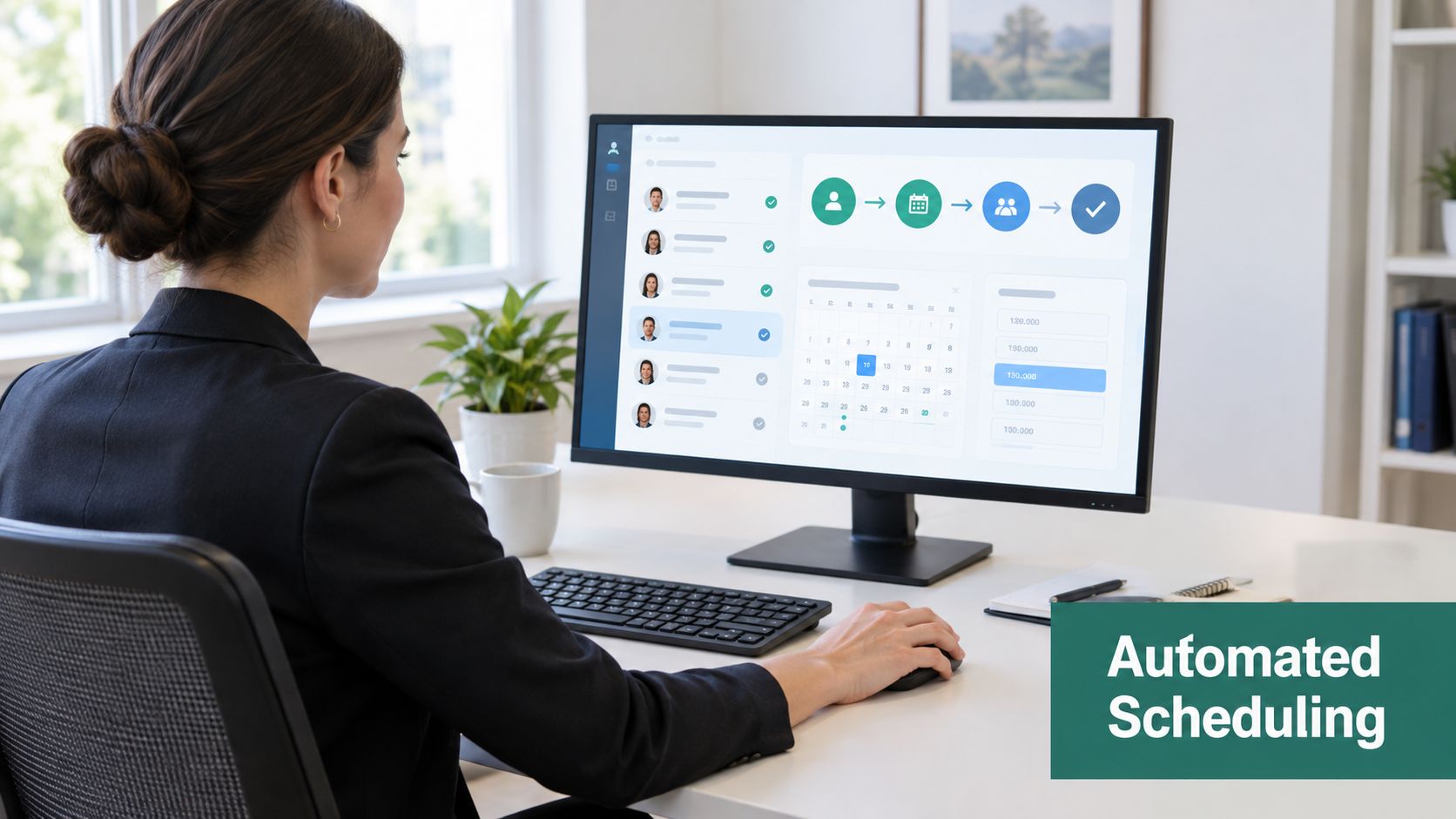
Use a small state machine instead of a pile of unrelated automations:
For virtual interviews, include the platform, dial-in details, backup contact, and a test instruction where appropriate. Teams that need a consistent process for multi-person calls can use this reliable conference call setup guide when standardizing meeting logistics.
Keep decline replies, late reschedules, accessibility accommodations, and unusual panel conflicts human. Let the system handle confirmations, routine nudges, calendar updates, and status writing. This balance is central to recruitment workflow automation, because automation should remove repetitive coordination without turning exceptions into dead ends.
A single generic link rarely serves every role well. The right interview scheduling template changes the slot design, reminder channel, calendar language, and ownership model according to the hiring scenario.
For volume hourly hiring, reduce friction above all else. Offer short self-serve slots, make booking easy on mobile, and use SMS confirmations where candidates have opted into text communication. The invitation line can be direct: “Choose a quick interview time that works for you, and we'll send the details by text and email.”
Professional roles need more context. Use longer panel blocks, attach interviewer briefs, and include the evaluation focus in the internal calendar description. For a clinical or specialist position, the candidate-facing copy might say: “Your conversation will cover your experience, role-specific judgment, and questions about the team. Please review the preparation guide before choosing a time.” Candidates interviewing for physician roles may also benefit from preparation resources such as these tips for physician contract negotiation, provided the content is relevant to the stage and employer.
Panel interviews require a named scheduler owner. The system should find a mutual opening across required interviewers, attach the agenda, and identify who handles a conflict. Don't send separate uncoordinated invitations for sessions that candidates perceive as one interview loop.
Cross-time-zone hiring needs visible time-zone labels on every option. Add working-hours guards, avoid presenting local times that fall outside the candidate's normal day, and provide an async-friendly reschedule route when the overlap is narrow.
| Scenario | Slot Length | Automation Rules | Reminder Channel | Invite Title Format |
|---|---|---|---|---|
| Volume hourly | Short screening block | Mobile booking, limited daily capacity, quick fallback | SMS and email | [INTERVIEW] [Role] – Quick Screen – [Name] |
| Professional | Extended conversation or panel block | Interviewer brief, buffer protection, coordinator review for exceptions | [INTERVIEW] [Role] – Structured Interview – [Name] |
|
| Panel or executive | Coordinated multi-calendar block | Require all essential interviewers, attach agenda, assign scheduler owner | Email plus internal interviewer alert | [INTERVIEW] [Role] – Panel Loop – [Name] |
| Cross-time-zone | Role-dependent block | Display local time zones, enforce working-hours guards, enable async reschedule | Email and approved SMS | [INTERVIEW] [Role] – [Stage] – [Name] – [Time Zone] |
Maintain one shared library when the process is common. Create separate variants when the role family has different durations, interviewers, compliance requirements, or candidate communication preferences. A shared library prevents drift, while scenario-specific branches prevent a retail hiring flow from inheriting the complexity of an executive panel.
Speed and attendance aren't identical goals. Scheduling analysis cited in Cronofy's candidate-expectations coverage found 71–72% show rates for interviews booked within 24 hours, compared with 91–92% for interviews scheduled 24–72 hours ahead. The operational implication is important: don't optimize for the earliest possible slot at the expense of reasonable preparation time.
Configure booking windows so candidates can choose from times that begin after the immediate period and remain available through a practical short-term range. The template should make the available start and end windows explicit, while still allowing a coordinator to intervene when a candidate has a genuine constraint.
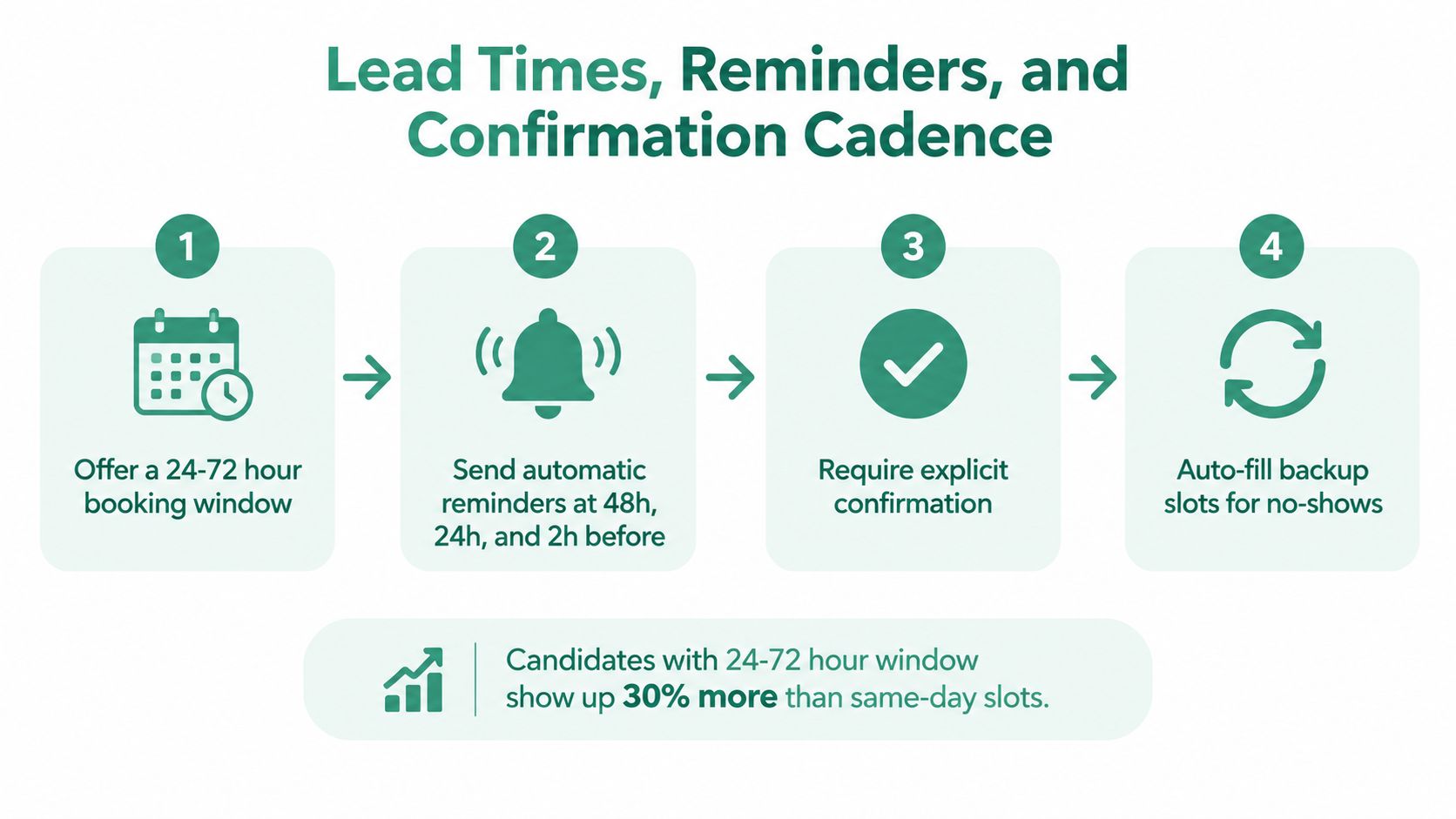
The sequence should be visible in the ATS:
Use copy that is short enough to read on a phone.
Twenty-four-hour reminder
Hi [Candidate Name], your interview for [Role] is tomorrow at [Time, Time Zone]. Join here: [Meeting Link]. Need another time? [Reschedule Link]. For help, reply to this email.
Two-hour reminder
Your [Role] interview starts in two hours at [Time, Time Zone]. Join here: [Meeting Link]. If something has changed, contact [Coordinator Name] at [Contact].
Reschedule link email
Hi [Candidate Name], please choose a new time for your [Role] interview here: [Reschedule Link]. The options reflect your local time zone. If none work, reply directly and a coordinator will help.
Don't send reminders after a reschedule, and cap the number of automated messages. Every reminder should include a one-click human contact path, especially for panel and clinical roles where an unexpected issue may require judgment.
Treat the interview scheduling template as a versioned operating asset. A healthcare system rolling out a new template shouldn't ask whether the emails “feel better.” It should compare how the new rules affect the path from application to booked interview, how often candidates move appointments, and how much recruiter coordination remains.
Track four core measures:
A useful review compares a baseline period before rollout with a post-rollout period, then segments the results by role family and requisition source. If scheduling attempts rise, the slot window may be too narrow or interviewer availability may be inaccurate. If show rates fall while booking speed stays stable, review the reminder timing, calendar clarity, and candidate preparation instructions. If time-to-scheduled stays flat, the bottleneck may have moved to approval, interviewer capacity, or a later stage.
A lightweight comparison can use two reminder cadences or two booking-window configurations across similar requisitions. Keep the invitation language, role, interview format, and ownership model as consistent as possible so the result points to the rule being tested rather than to unrelated differences.
Review the workflow quarterly:
Teams can use best practices for reporting to make these reviews more consistent. The key is attribution. If the ATS doesn't log template versions, teams end up guessing whether an outcome came from better copy, a wider booking window, a new reminder, or a change in interviewer capacity.
Talent Pronto can support this workflow with conversational screening, structured scorecards, ATS and HRIS integrations, and interview scheduling options for qualified candidates. Visit Talent Pronto to see how its hiring platform can connect screening results with the next scheduling step.

Talent Pronto is an AI-powered hiring platform built around Anna, our intelligent AI that conducts 24/7 conversational screening, evaluates candidates against specific job requirements and compliance needs, and schedules interviews. Run everything on the Talent Pronto ATS, our all-in-one applicant tracking system with a branded careers site and Anna built in, or keep your existing ATS and let Anna integrate with Greenhouse, Ashby, iCIMS, Jobvite, Lever, Oracle, and more. Either way, we help organizations reduce time-to-hire and build stronger teams.