Learn how recruitment workflow automation streamlines hiring with AI screening, scoring rubrics, and ATS integration to cut time-to-hire and improve outcomes.
A recruiter opens the ATS on Monday morning and finds more than two hundred new applications, a hiring manager asking for a shortlist, three qualified candidates waiting for replies, and interview availability scattered across four calendars. By lunch, the team has spent most of its energy moving information between systems, not evaluating people.
That pattern explains why recruitment workflow automation should be treated as a post-application problem first. Sourcing and application intake may already be automated, but qualification, scheduling, structured evaluation, and decision coordination still create the longest queues. The strongest workflow doesn't remove recruiter judgment. It gives that judgment cleaner evidence, faster handoffs, and fewer administrative obstacles.
The recruiter starts with resume triage. One application mentions the required certification in a resume summary, another lists equivalent experience under a different job title, and a third includes the relevant work in a project description. Each profile needs a close read before anyone can decide whether it belongs in the next stage.
Then the messages begin. A hiring manager wants to know how many candidates have been screened. One applicant asks whether the role supports a particular shift. Another wants an update after submitting an assessment. The recruiter answers each question separately, searches for the correct status, and tries to avoid sending a generic message to someone who has already moved forward.
Scheduling creates the next bottleneck. A candidate offers several times, but one interviewer is unavailable, another calendar hasn't been updated, and the panel needs a video link. The recruiter sends a new email, waits for replies, and then returns to the ATS to record what happened. By the end of the day, the team has processed activity, but the shortlist may still be unfinished.
Practical rule: Automate the handoff around human judgment, not the judgment that requires context, empathy, or accountability.
A coordinated workflow changes the sequence. Resume data is normalized when the application arrives. A conversational screen asks consistent follow-up questions. Answers feed a role-specific rubric, qualified candidates receive the next-step message, and scheduling checks availability without requiring a recruiter to act as a calendar intermediary. The ATS receives the status and supporting evidence automatically.
The recruiter still reviews the scorecard, investigates unusual answers, speaks with candidates, and makes recommendations to the hiring manager. The difference is that the day ends with an organized queue and clear next actions, rather than an inbox full of unfinished transfers.
Recruitment workflow automation is the orchestration layer between application and offer. It connects predictable tasks, structured information, and human review so a candidate can move through the funnel without every handoff waiting for manual intervention. It isn't the same as AI, and it isn't merely a collection of ATS notifications.
A useful workflow has five connected components.
A conversational screen asks candidates about experience, availability, motivation, and role-specific requirements in plain language. Unlike a static form, it can ask a follow-up when an answer needs clarification. The output should be recorded as structured evidence, not treated as an unexplained recommendation.
Parsing turns varied resumes into consistent fields, such as job history, skills, certifications, and education. Normalization matters because candidates describe similar experience differently. A recruiter shouldn't have to identify every variation manually before the workflow can compare profiles.
A rubric translates the hiring team's criteria into observable categories and weighted scores. For example, a healthcare role might separate credential status, patient-facing experience, and shift availability. A technical role might score specific competencies independently rather than collapsing everything into a vague fit label.
Scheduling tools compare availability, offer suitable slots, send confirmations, issue reminders, and update the candidate stage. They handle the coordination layer while recruiters retain control over interview design and final evaluation.
The ATS remains the recruiting system of record. At offer acceptance, standardized candidate and role data should flow into the HRIS to create the employee record, trigger onboarding, and establish payroll records, as explained in this guide to ATS and HRIS integration. Field mapping and bi-directional sync reduce duplicate entry and make the recruiting-to-HR handoff more reliable.
Rule-based automation handles triggers, such as sending an acknowledgment after an application. AI can interpret language, summarize information, or match meaning. An agentic layer can take the next permitted action using workflow context. Readers who want a foundation in the underlying technology can review how AI assistants work, but the operational test is simple: does the system move accurate information to the next stage?
The ideal output is a ranked, reviewable shortlist. Each candidate record should show what the person said, how the answer maps to the rubric, what remains uncertain, and what the recruiter needs to do next.
The industry's visible automation story often begins with sourcing, but the larger operational gap appears after a candidate applies. A 2026 hiring-automation study found that 57% of organizations already report using automation agents in hiring, while 94% don't offer automated interview scheduling at the point of application and 99% have no inline voice-agent capability according to the study. The same report found that fewer than 1% have fully integrated qualification workflows, while the median company operates at roughly 17% of its maximum automation potential.
That gap creates a queue at every transition. Recruiters review resumes, copy qualifications into notes, request missing information, chase interview availability, summarize screens for hiring managers, and update the ATS after each conversation. None of those tasks is individually dramatic. Together, they delay decisions and make candidate status difficult to understand.
| Hiring Stage | Currently Automated | % of Recruiter Hours | Automation Maturity |
|---|---|---|---|
| Application intake and routing | Commonly automated | Not consistently reported | Relatively mature |
| Qualification and early screening | Limited in most organizations | Not consistently reported | Low |
| Interview scheduling and reminders | Rare at application point | Not consistently reported | Low |
| Decision coordination and summaries | Often manual | Not consistently reported | Fragmented |
| Offer acceptance and HRIS handoff | Automatable through integration | Not consistently reported | Dependent on system connectivity |
Teams should map the actual work before buying another sourcing tool. Count how many times a recruiter re-enters the same candidate information, how long a qualified applicant waits for a screen, and how many messages are needed to book a panel. For roles with substantial applicant volume, these handoffs often represent more recoverable capacity than additional search functionality.
Credential-heavy hiring adds another decision point. When the workflow must confirm licenses, training, or education, teams can use a structured process and then compare credential verification services before choosing how external checks fit into the stack.
The 2026 benchmark found that hiring automation averaged only 21%, reinforcing the distinction between adoption and coverage in the benchmark report. Employers may have automation present while leaving the most consequential post-application coordination manual. That is where downstream workflow design can produce the clearest operational return.
A legacy ATS chatbot usually follows a script. It asks for a job title, years of experience, location, or work authorization, stores the responses, and routes the applicant according to predefined rules. That approach can improve intake consistency, but it doesn't necessarily test whether the candidate's experience meets the role's requirements.
An agentic screening layer works with a different objective. It asks two-way questions, interprets free-text answers, probes for depth, identifies contradictions that need human review, and creates a structured scorecard tied to the job rubric. It still shouldn't make the final hiring decision. The employer remains responsible for advancement and rejection decisions.
| Capability | Legacy ATS Chatbot | Agentic Screening Layer |
|---|---|---|
| Primary job | Collect fields and route applicants | Explore qualifications and coordinate next steps |
| Conversation | Predefined prompts | Follow-up questions based on responses |
| Evaluation | Basic filters or routing rules | Per-criterion scores tied to a rubric |
| Evidence | Form responses | Responses, transcripts, rationale, and flags |
| ATS update | May pass status fields | Can write structured results and stage updates |
| Recruiter control | Rule configuration | Human review, calibration, and decision authority |
The difference isn't the label on the product page. Test the workflow in a demo. Ask the system to evaluate a candidate whose relevant experience uses different language from the job description. Then ask what happens when an answer is incomplete or contradictory.
A screening assistant should make review easier, not make accountability disappear. Teams comparing conversational approaches can also examine this overview of a chatbot for recruitment, while keeping the evaluation focused on observable behavior rather than marketing language.
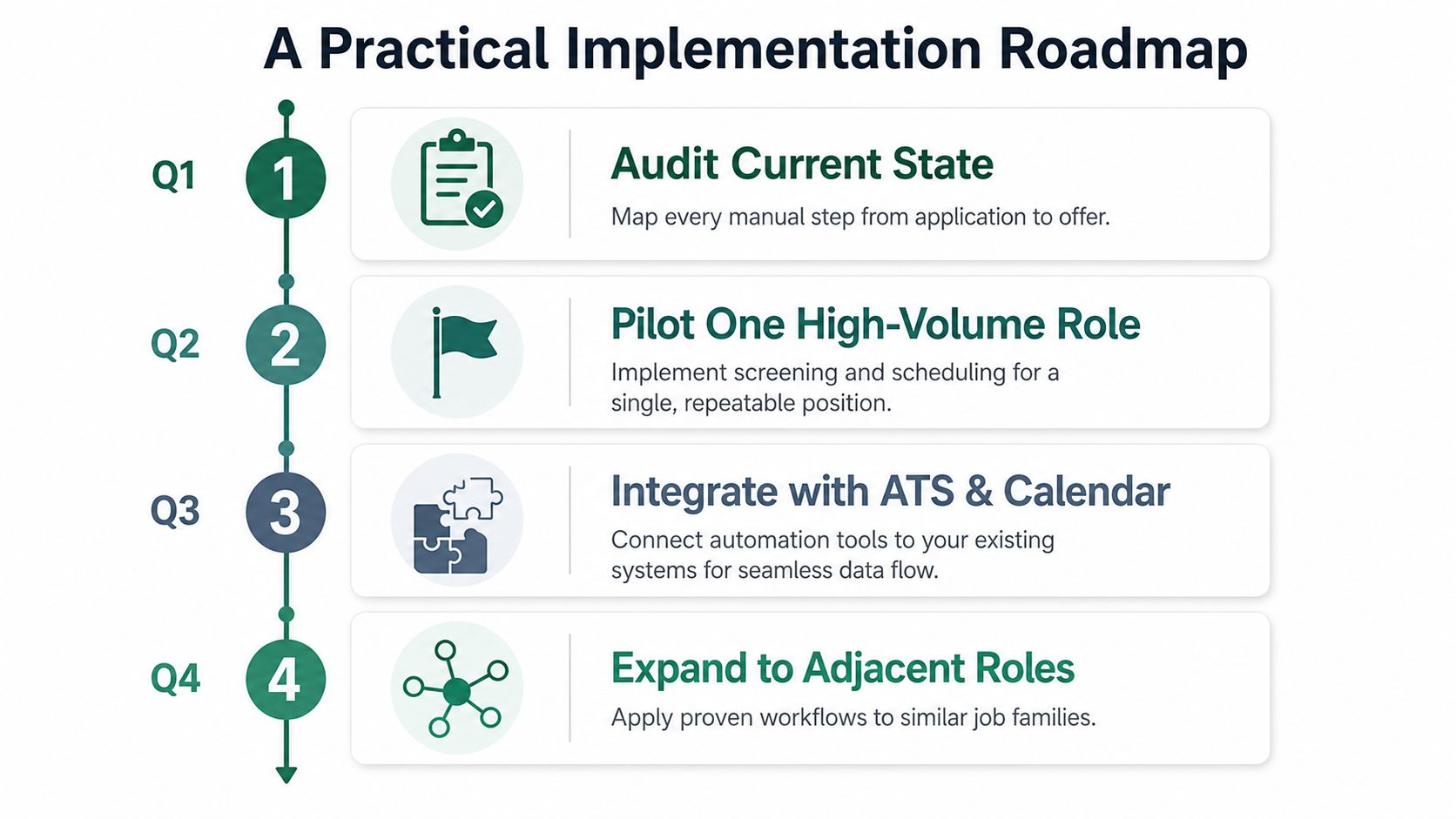
Start with one workflow, not a technology inventory. A practical rollout can fit inside a quarter when the team chooses a repeatable role, defines its criteria, and gives recruiters time to test the experience.
Use the first week to map every manual step from application to offer. Record who owns each handoff, where information is stored, which messages are repeated, and where candidates wait. Include exceptions, such as incomplete applications, withdrawn candidates, rescheduled interviews, and missing credentials.
The audit should end with a baseline process map and a short list of high-frequency delays. Don't automate a step just because it exists. Automate it because it repeats, follows clear rules, and creates avoidable queue time.
Run the pilot over two to three weeks, using one position with stable requirements and enough applicant flow to reveal problems. Begin with screening and scheduling, then compare the automated scorecards with recruiter decisions. A pilot is successful when the team can explain both good matches and questionable matches.
Train recruiters to read evidence, not just scores. Hold calibration sessions with hiring managers so everyone agrees on what each criterion means before the workflow handles live candidates.
Allow three to five weeks for integration work, testing, permissions, field mapping, and exception handling. Connect the workflow to the ATS, calendar, assessment tools, background-check process, HRIS, and reporting layer where appropriate. Guidance on HRIS integration is useful because a technically connected system can still fail if fields, ownership, and status rules are unclear.
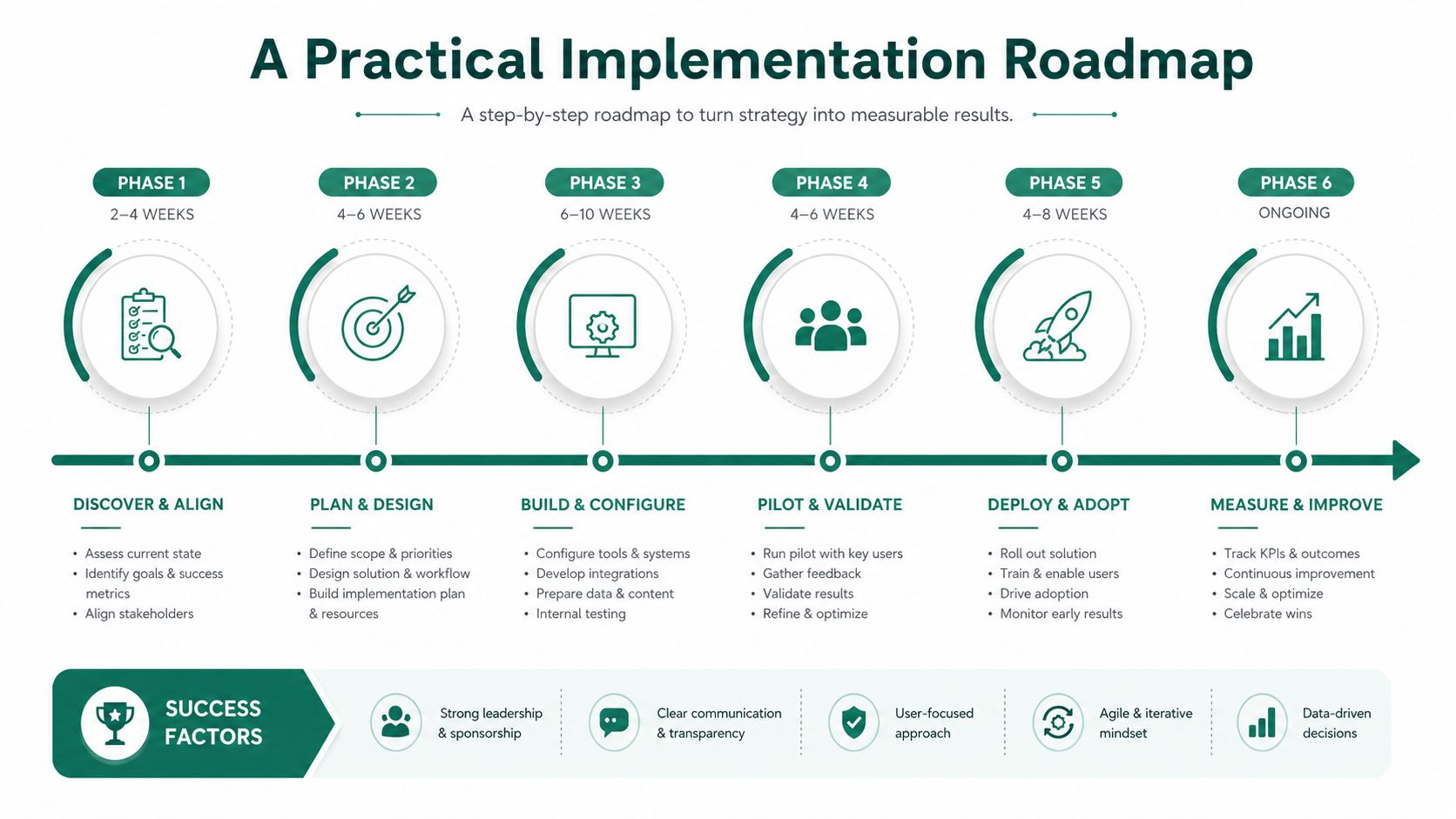
Use the following month to apply the tested workflow to similar job families. Reuse the integration and operating model, but review every question and scoring rule. Adjacent roles often share a workflow structure without sharing the same qualifications.
Pause the rollout when recruiters see unexplained score changes, candidates report confusing prompts, records fail to synchronize, or the shortlist consistently conflicts with agreed criteria. A pause is a control mechanism, not a failure. Correct the rubric, workflow rule, or integration before expanding the error.
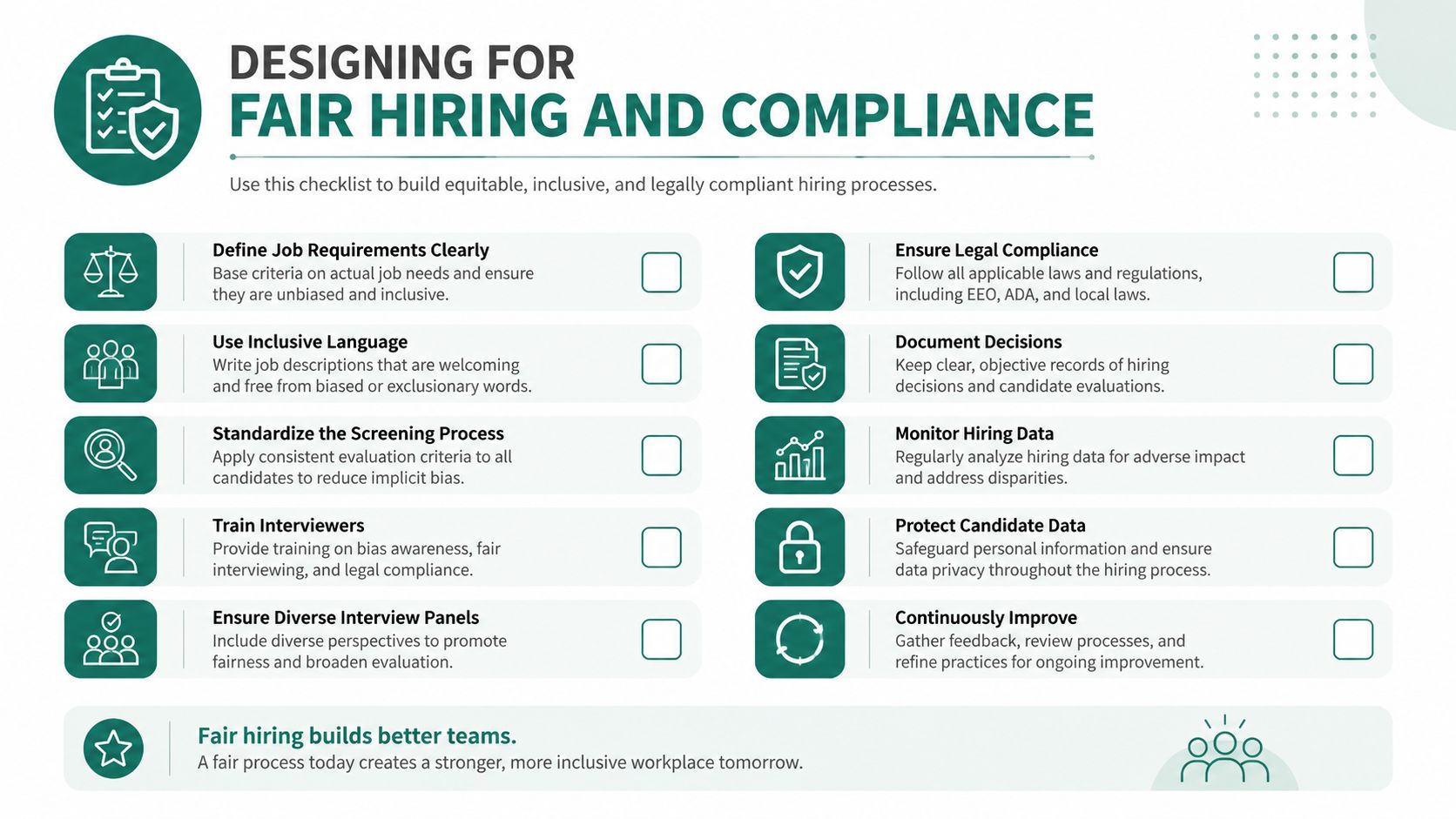
Fair hiring requires more than removing names from a resume. An employer needs to know what the system asked, what the candidate answered, how the rubric was applied, and who reviewed the outcome.
That requirement matters across jurisdictions. New York City has required annual bias audits for automated employment decision tools since 2023, while California added meaningful human oversight, bias testing, and record-retention requirements in October 2025. Texas and Illinois introduced candidate-notice and impact-assessment rules effective January 1, 2026, and Colorado added broader disclosure and documentation obligations from June 30, 2026 as summarized in this compliance overview. In the EU, hiring AI is treated as high-risk, emotion recognition in job applications has been prohibited since February 2, 2025, and broader high-risk obligations ramp up around August 2026.
A reviewable workflow should preserve:
Structured interviews offer a strong foundation because standardized question sets and scoring rubrics create comparable evidence. A synthesis reports validity around 0.42 to 0.51 for structured interviews versus 0.19 to 0.38 for unstructured interviews in this comparison of structured and unstructured interviews. Applicant-reaction research also found that candidates generally perceive structured formats as fairer than unstructured interviews in the cited study.
Run bias audits on historical outcomes regularly, rather than treating launch approval as permanent. Review selection rates, score distributions, completion patterns, overrides, and adverse-impact indicators across relevant demographic groups. When a pattern appears, revisit the question, the weighting, the data, and the human review process. Highly structured interviews have also been associated with no demographic similarity effect, which supports tight standardization as one fairness control in this research summary.
Keep the job criteria, validation records, audit outputs, model and rubric versions, candidate notices, reviewer training records, and remediation decisions ready for inspection.
The post-application workflow can serve different industries without rebuilding the platform. Teams change the question library, scoring rubric, escalation rules, documentation, and scheduling constraints. This separation keeps industry requirements in the content and governance layer, rather than scattering them across duplicate systems.
A healthcare employer may ask about active credentials, clinical setting experience, shift availability, and role-specific documentation. A credential response can trigger verification and route incomplete records for human review. The workflow preserves the decision trail for compliance checks, while requirements such as Joint Commission documentation shape access and reviewer permissions.
Manufacturing teams often manage hourly hiring against production schedules. Screening can cover shift preference, transportation, safety training, and willingness to complete clearance checks. Scheduling should support production windows and group interviews, while keeping safety criteria unchanged when the team is under pressure to fill roles quickly.
Hospitality employers may need multilingual conversational screens, tip-pool eligibility confirmations, and same-day booking across several properties. The workflow can route each candidate to the correct location, apply property-specific rules, and write the result to the same ATS connection.
Technology teams can replace vague culture questions with structured competency prompts. A screen might request a concrete example of responding to a production incident, collaborating across functions, or making a technical trade-off. The rubric can identify missing evidence without treating personality similarity as a qualification.
| Industry | Key Question Library | Compliance Focus | Scheduling Constraint |
|---|---|---|---|
| Healthcare | Credentials, patient-facing experience, shifts | License and documentation controls | Rotating coverage and clinical availability |
| Manufacturing | Shift preference, safety experience, clearance | Safety and eligibility records | Production schedules and group sessions |
| Hospitality | Language preference, location, eligibility | Consistent notices and property rules | Same-day booking across properties |
| Technology | Technical competencies, collaboration, problem solving | Explainable scoring and structured review | Panels across specialized interviewers |
Calendar coordination becomes a separate design concern for distributed teams. Employers can evaluate tools that sync calendars for hiring teams, then test permission settings, time-zone handling, cancellation behavior, and interviewer privacy before connecting them to live workflows.
A practical transfer test is simple: can a talent operations team reuse a proven screening pattern for another business unit by changing its content and controls, rather than copying every integration? If so, the architecture can support industry variation while keeping qualification, scheduling, and decision coordination manageable.
A healthy automation program improves the flow of evidence and decisions, not just the number of messages a bot handles. Track the time from qualification to interview booking, the rate at which candidates complete the screen, the consistency of scorecard ratings across reviewers, and adverse-impact ratios across demographic groups.
The benchmark should be operational. If scheduling gets faster but recruiters wait longer for hiring-manager feedback, the workflow has moved the bottleneck rather than removed it. If completion rises while qualified candidates disappear from the shortlist, the team has optimized activity instead of hiring quality.
Avoid vanity metrics such as chatbot deflection when they aren't connected to downstream outcomes. A high number of automated conversations means little if candidates receive unclear next steps or hiring managers don't trust the resulting evidence.
Common failure modes include stale rubrics, dependence on one model output, integration drift after an ATS change, and a recruiter-experience gap where automation speeds candidate interactions but makes internal approvals harder. Review the workflow quarterly, refresh criteria with hiring managers, test integrations, and preserve a clear human escalation path.
The next design questions involve multi-step agentic orchestration, more detailed audit documentation for automated employment decision tools, and skills-graph connections that combine career-site data with internal mobility systems. Teams that define their evidence, permissions, and review standards now will be better prepared to adopt those capabilities without surrendering control.
Talent Pronto offers 24/7 conversational screening, role-specific questions, structured scorecards, interview scheduling, and ATS or HRIS integrations for teams that need to coordinate the post-application funnel. Visit Talent Pronto to see how a reviewable screening and hiring workflow could fit your current stack.

Talent Pronto is an AI-powered hiring platform built around Anna, our intelligent AI that conducts 24/7 conversational screening, evaluates candidates against specific job requirements and compliance needs, and schedules interviews. Run everything on the Talent Pronto ATS, our all-in-one applicant tracking system with a branded careers site and Anna built in, or keep your existing ATS and let Anna integrate with Greenhouse, Ashby, iCIMS, Jobvite, Lever, Oracle, and more. Either way, we help organizations reduce time-to-hire and build stronger teams.