Ai powered talent intelligence platform - Transform hiring with our AI-powered talent intelligence platform. Streamline screening, leverage analytics, & boost
A recruiter opens the ATS on Monday morning and sees the same problem again. Hundreds of applicants for one role, a handful for another, and no reliable way to tell who deserves attention first. Hiring managers want speed. Compliance teams want consistency. Candidates want answers now, not three days from now.
That's where an AI-powered talent intelligence platform starts to matter. It doesn't replace recruiter judgment. It helps teams organize signal from noise, ask better early-stage questions, rank people against role criteria, and move qualified applicants forward without turning the process into a black box. If you're staffing nursing shifts, production lines, public sector roles, or hard-to-fill technical jobs, the value isn't just automation. It's matching the system to your industry's ROI metrics and compliance needs.
For leaders hiring into emerging roles, niche job boards can also show how specialized candidate markets behave. A listing like Blockchain Jobs is a useful reminder that candidate expectations, screening questions, and market signals vary sharply by role family.
An AI-powered talent intelligence platform is software that brings together recruiting data, labor market signals, and role-specific evaluation logic so teams can screen, rank, and move candidates more consistently. Think of it as a layer above basic applicant storage. A traditional ATS stores records. A talent intelligence platform tries to interpret them.
That difference matters when your recruiting team is overwhelmed. Manual review often breaks down at the top of the funnel because recruiters have to triage too quickly. One person scans resumes for keywords. Another cares about industry context. A third values transferable skills. The result is inconsistency before the first interview even starts.
An effective platform helps by combining automation with structured evaluation. It can parse resumes, ask follow-up questions, schedule next steps, and generate scorecards tied to the actual job. For HR leaders, that means fewer bottlenecks. For talent acquisition leaders, it means a process that can scale without feeling random.
Practical rule: If your team can't explain why one candidate advanced and another didn't, you don't have an intelligence problem only. You have a process design problem.
The strongest platforms are especially useful when roles carry different operational stakes. A hospital might care about licensure, shift flexibility, and speed to staffing. A manufacturer may care more about certification history, attendance patterns, and plant-specific requirements. A government agency may prioritize auditability and rule-based controls. The same category of software can support all three, but only if it's configured for the work, not just installed.
Most confusion around this category comes from one simple issue. People hear “AI recruiting” and assume it means a smarter keyword filter. That's too narrow.
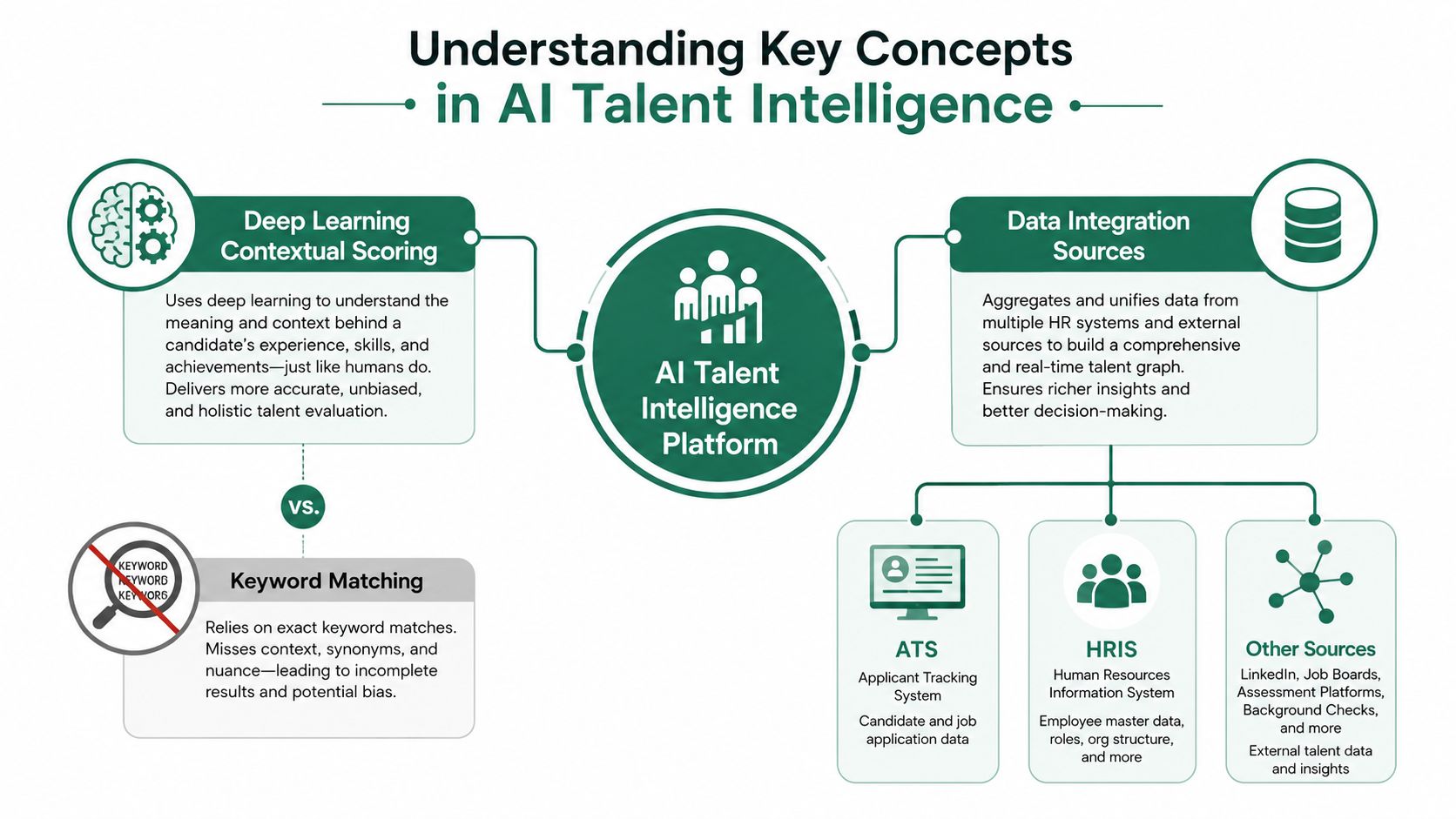
Traditional resume screening behaves like a basic librarian. It checks whether the exact words on a job description appear on a resume. If the role asks for “inventory planning” and the candidate wrote “supply coordination,” a keyword filter may miss the match.
Contextual scoring works more like a strong curator. It looks at the relationship between skills, experience, role patterns, and adjacent evidence. The system asks, in effect, “Does this person appear capable of this work?” rather than “Did this person repeat the same phrase?”
That's why deep learning-based contextual scoring feels different in practice. The platform can weigh job history, skill clusters, certifications, project signals, and behavioral responses together. It also helps explain non-obvious fits, such as a technician moving into field service or a coordinator growing into operations.
A talent intelligence platform becomes useful when it connects data that usually lives in separate places. That may include your ATS, HRIS, interview notes, external labor market data, professional profiles, or skills repositories. If those sources stay isolated, the platform can't produce reliable recommendations.
As of 2026, over 63% of AI talent acquisition platform vendors have embedded generative AI features, including job description generation, outreach drafting, and feedback summaries, and those features reduce recruiter time-per-hire by an estimated 28–34%, according to Research Intelo's AI talent acquisition software market report.
A useful mental model is this. The ATS is the filing cabinet. People analytics is the reporting layer. A talent intelligence platform is the system that tries to turn all those records into hiring decisions. If your team wants a broader grounding in workforce metrics, this overview of people analytics helps connect recruiting data to wider HR decision-making.
Even outside recruiting, organizations already understand the value of systems that centralize operational inputs. Tools like volunteer software solve a similar coordination problem in a different setting by bringing people, schedules, and workflows into one view.
The question isn't whether AI can read a resume. The question is whether your system can connect candidate evidence to the realities of the role.
A strong platform usually combines four capabilities. Each matters for a different reason, and each solves a different hiring bottleneck.
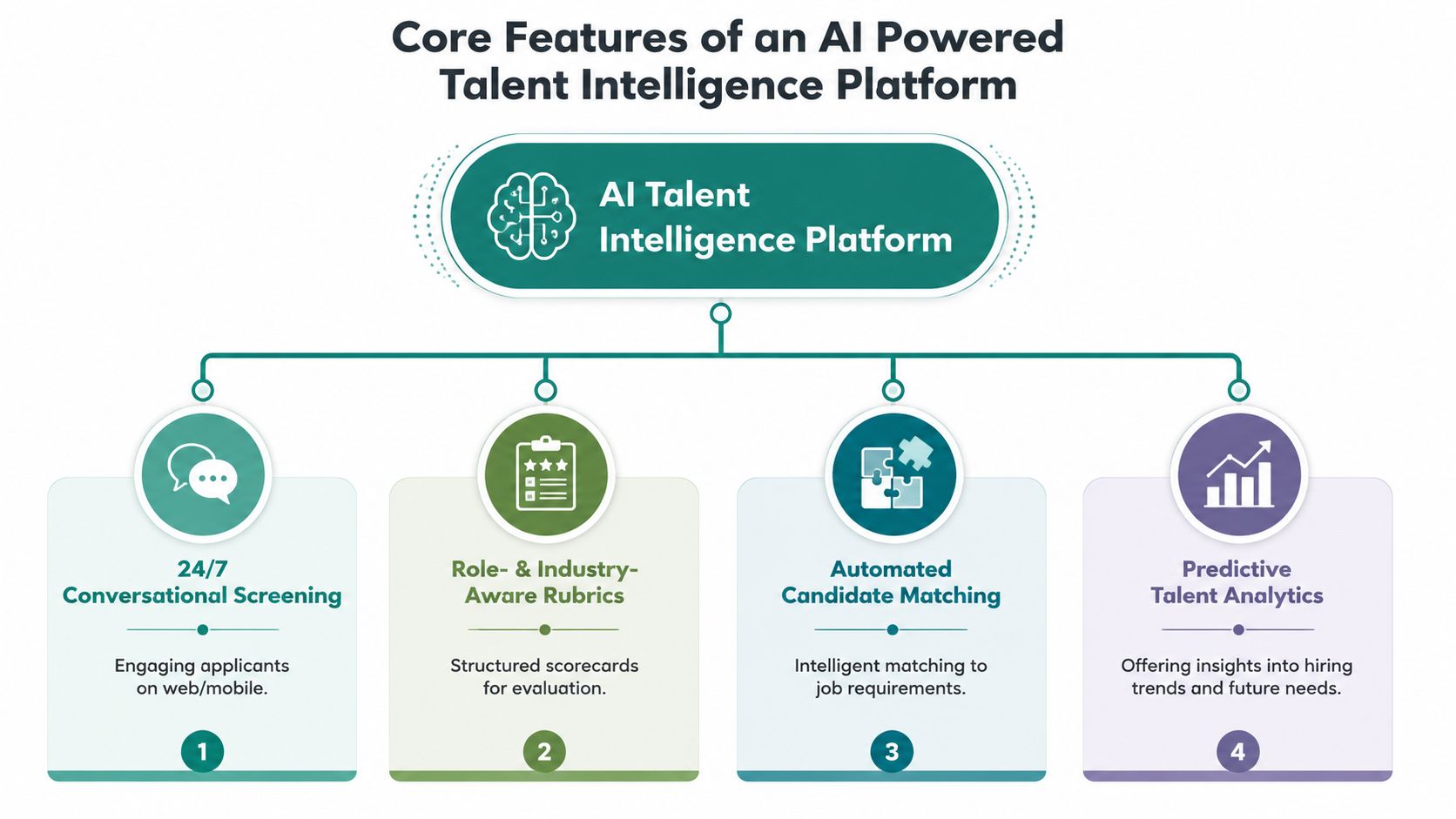
This is the feature many teams notice first because it changes candidate flow immediately. Instead of collecting only static application forms, the platform can ask follow-up questions on web or mobile, clarify availability, gather role-relevant details, and move qualified applicants toward scheduling.
That matters in high-volume hiring because speed at the top of the funnel often determines whether good candidates stay engaged. In practice, conversational screening is less like a chatbot FAQ and more like a structured first-round intake. It can ask a warehouse candidate about shift preferences, a nurse about credentials, or a sales applicant about territory experience.
Some employers use platforms such as Eightfold for broad enterprise talent workflows, while others use more screening-focused tools. Talent Pronto, for example, is one option that conducts 24/7 conversational screening, evaluates candidates against role criteria, and syncs with systems like Greenhouse, iCIMS, Paylocity, ADP, and Workday.
A related resource on how teams improve hiring in Latin America is useful here because skills-based hiring becomes more important when titles and local job conventions vary across markets.
The second pillar is the rubric. Here, many systems either earn trust or lose it.
A good platform doesn't just produce one mystery score. It breaks evaluation into criteria that recruiters and hiring managers can inspect. For example, an industrial maintenance role might include safety background, machinery exposure, troubleshooting depth, schedule fit, and credential status. A software role might weigh language proficiency, architecture experience, collaboration examples, and domain familiarity.
AI-powered talent intelligence platforms achieve ≥95% field-level accuracy in resume parsing by using enterprise skills ontologies with criteria-based ranking and per-criterion explanations, according to Codersarts' enterprise architecture blueprint for an AI-powered hiring system.
That explainability matters because recruiters need to challenge the output. A scorecard should help a human ask, “Why did the system rank this person highly?” If the answer is clear, teams can calibrate. If it isn't, they shouldn't trust it.
Here's a short explainer that complements this point for teams evaluating an AI resume screening tool.
The third pillar is integration. If the platform doesn't connect to your ATS or HRIS, recruiters end up copying data between systems, and the promised efficiency fades fast.
Strong integrations let candidate status, notes, scorecards, and scheduling updates move back into systems such as Greenhouse or Workday. That's what turns AI from a side experiment into part of the operating workflow.
Matching engines matter here too. The better systems don't only compare resumes to jobs. They can reverse-match jobs to candidates, identify adjacent skill fits, and highlight hidden internal or external pipelines. That's particularly useful when a hiring team struggles with “perfect profile” thinking and misses strong near-fit candidates.
To see one vendor's framing of these workflows in action, this video gives a practical product view:
The fourth pillar is analytics. At this stage, the platform starts to influence strategy rather than just processing applicants.
Good dashboards help leaders spot where candidates drop off, which roles stall, whether screening criteria are too narrow, and how recruiter workload is distributed. They also help hiring managers see whether the early funnel is producing comparable evidence.
Instead of one giant dashboard, look for analytics in layers:
A platform becomes strategic when it helps leaders change hiring behavior, not when it simply makes reporting prettier.
A generic ROI story won't satisfy most stakeholders. Finance wants measurable efficiency. Hiring managers want faster staffing. Compliance teams want a defensible process. That's why industry tailoring matters.
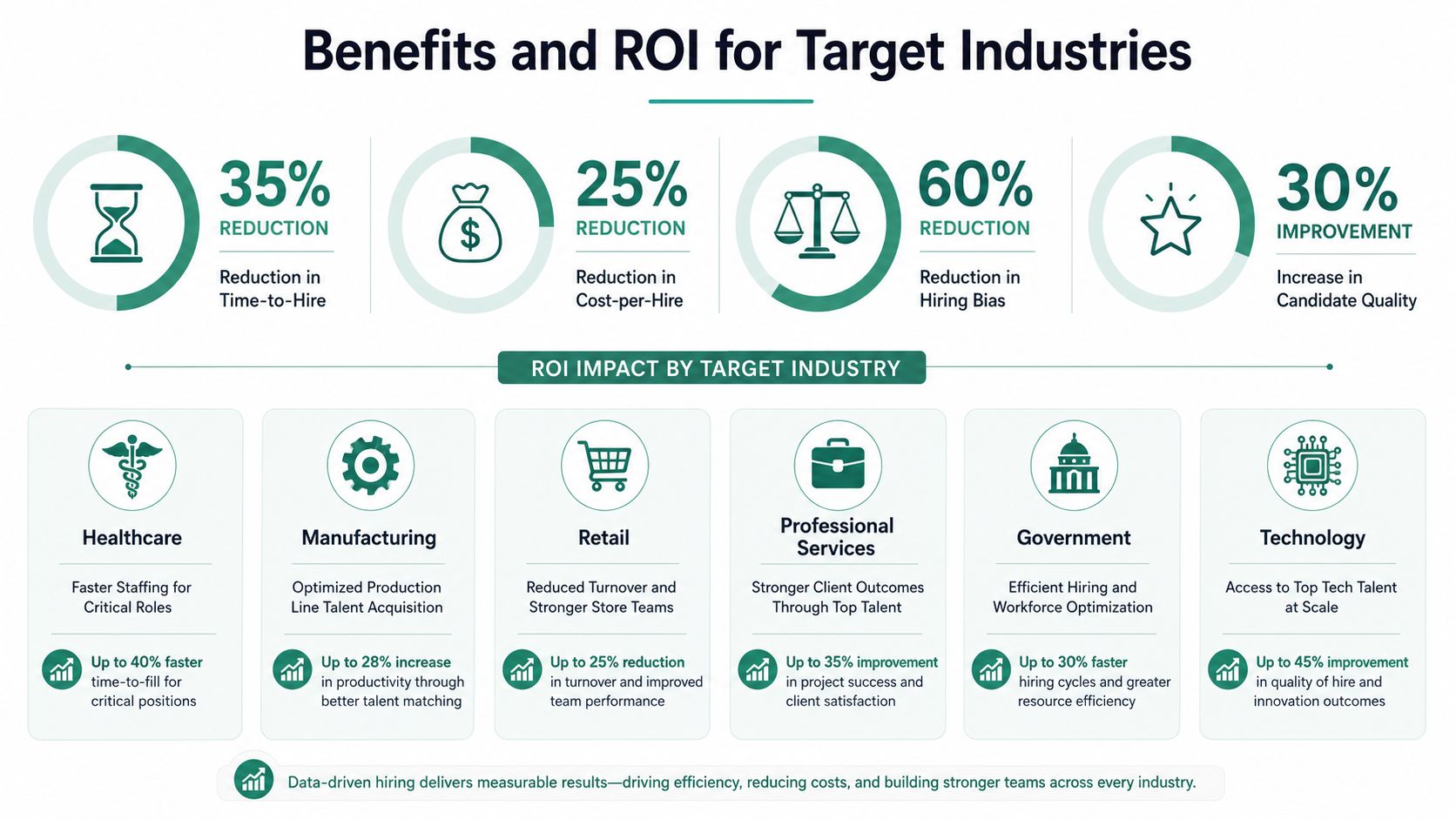
Healthcare often values vacancy reduction in licensed roles, fewer delays in first-round screening, and stronger documentation. Manufacturing usually looks harder at staffing continuity, plant downtime risk, and the ability to identify adjacent skill fits. Retail and hospitality care about speed, applicant responsiveness, and seasonal flexibility. Government teams often focus on fairness controls, audit trails, and process consistency.
That means the same platform may deliver different forms of value. The point isn't to chase one universal metric. It's to connect the technology to the cost of hiring friction in your environment.
Enterprises deploying AI-powered talent intelligence platforms achieve a 22% reduction in time-to-fill, a 15% improvement in hiring outcome accuracy, and 20–40% reductions in cost-per-hire, according to OVI-ME's market landscape and platform economics analysis.
Those numbers become more meaningful when translated into operational terms.
| Industry | Common ROI lens | What platform value often looks like |
|---|---|---|
| Healthcare | Speed to qualified shortlist | Faster review of credentialed applicants and cleaner early documentation |
| Manufacturing | Continuity of staffing | Better matching for role-adjacent skills and reduced screening backlog |
| Retail and hospitality | Applicant responsiveness | Faster engagement and smoother movement through early funnel steps |
| Professional services | Recruiter productivity | Less manual coordination and more time spent on high-value candidates |
| Government | Auditability | Clear criteria, structured scorecards, and better decision traceability |
| Technology | Candidate quality and speed | Faster identification of qualified specialists in competitive markets |
There's another important angle. ROI isn't only about doing the same work faster. It's about reallocating recruiter time. If a platform handles mechanical screening, recruiters can spend more effort on candidate relationships, hiring manager calibration, and offer-stage risk.
Boardroom test: If you can't tie the platform to a cost of delay, a cost of inconsistency, or a compliance exposure, the business case will sound weak.
This is also where buyers should stay cautious. Many vendors emphasize speed metrics because they're easier to market. Long-term hire success is harder to prove publicly, especially in role-specific ways. Leaders in healthcare, manufacturing, and government should ask whether the platform supports the outcome data they need, not just early-funnel acceleration.
The best way to understand fit is to look at how different sectors would use the same capability differently.
A health system usually feels pain at the top of the funnel first. Recruiters need to identify license status, schedule flexibility, location fit, and role readiness quickly. An agentic screening layer can run those checks before a recruiter reviews the slate, which is especially useful when applicants arrive after hours or across multiple facilities. Organizations using agentic AI talent platforms report a 33% reduction in time-to-fill by using AI Interviewers that conduct first-round screening and summarize candidate responses, according to Eightfold.
A manufacturer may use the same approach for very different questions. Instead of licensure, it may screen for equipment familiarity, shift constraints, safety routines, and certification history. The value isn't just speed. It's filtering on job reality rather than title similarity.
Retail hiring often swings between constant volume and sudden surges. A talent intelligence platform can keep applicant communication moving when store managers don't have time to chase every candidate. Professional services teams often use it to standardize early evaluation across offices or practice groups, reducing drift between recruiters and interviewers.
Government hiring adds another layer. Teams need consistency, explainability, and a process they can defend later. In that setting, the platform's scorecard design and audit trail matter as much as its ranking logic.
Here's a simple comparison framework:
| Industry | Time-to-Fill Reduction | Cost-per-Hire Reduction | Accuracy Improvement |
|---|---|---|---|
| Healthcare | Qualitative gains from faster first-round screening and better role-fit triage | Qualitative savings from reduced manual intake work | Qualitative improvement through structured criteria |
| Manufacturing | Qualitative gains from identifying shift-fit and role-adjacent talent earlier | Qualitative savings from lower screening friction | Qualitative improvement through more consistent matching |
| Retail | Qualitative gains from always-on candidate engagement | Qualitative savings from less coordinator effort | Qualitative improvement through standardized intake |
| Professional Services | Qualitative gains from reduced recruiter backlog | Qualitative savings from workflow automation | Qualitative improvement through shared scorecards |
| Government | Qualitative gains where process delays happen early | Qualitative savings from cleaner handoffs and documentation | Qualitative improvement through auditable evaluation logic |
One caution matters across all sectors. Long-term quality of hire still needs validation. Public content in this category often highlights speed, but buyers should ask whether the vendor helps track later outcomes for AI-matched hires compared with traditional sourcing.
Most implementation problems don't come from the model. They come from unclear criteria, messy workflows, and weak ownership.
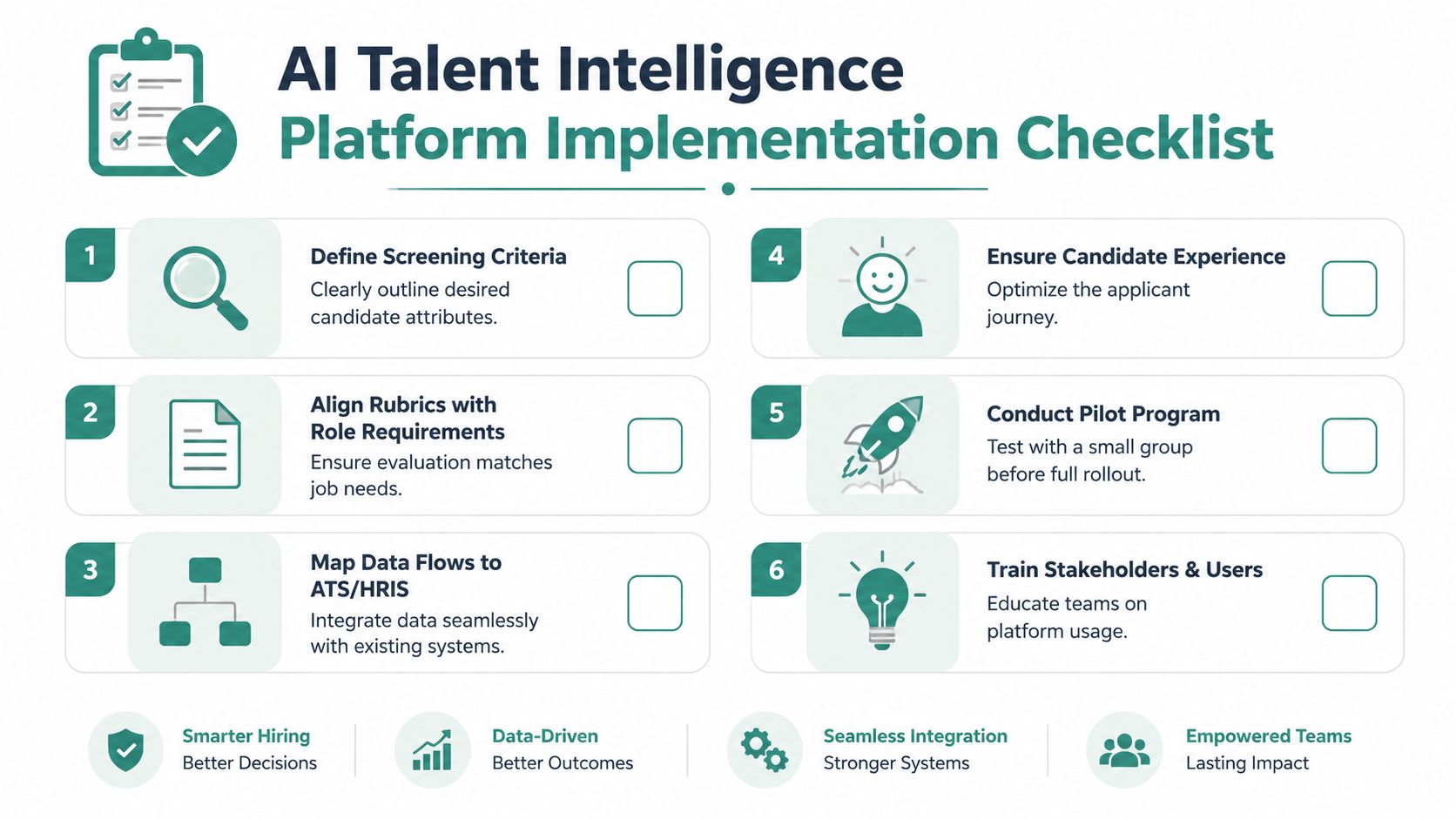
If you want a rollout that sticks, start smaller than your ambition.
Define screening criteria first. Don't begin with the vendor demo. Begin with the actual decision points recruiters and hiring managers use in the first stage. Separate must-haves from nice-to-haves.
Align rubrics to role reality. A registered nurse, forklift operator, claims analyst, and software engineer shouldn't share the same evaluation structure. Build rubrics around job-relevant evidence.
Map ATS and HRIS data flows. Decide what should sync automatically, what should remain human-reviewed, and where scorecards will live. Integration friction is one of the fastest ways to lose adoption.
Design the candidate experience. Choose which questions can be asked conversationally, how much screening is reasonable, and when candidates should be handed to a person.
Run a pilot on a contained role family. Pick one area with clear pain, stable volume, and a hiring manager willing to give feedback. That creates a cleaner baseline than launching everywhere at once.
Train recruiters and hiring managers together. If recruiters understand the scorecard but managers don't, calibration fails. If managers trust the platform but recruiters don't, usage stalls.
A useful checkpoint is whether the team can answer this in one sentence: “What decision is the platform helping us make earlier and more consistently?”
The strongest vendor questions are operational, not theatrical. Ask things that reveal whether the product will hold up in your environment.
Ask every vendor to show a real scorecard, a real workflow, and a real exception path. If they only show polished automation, you're not seeing the system under pressure.
Many buyers assume that structured AI screening is automatically fairer than human screening. It can be. It isn't by default.
A system can score every applicant consistently and still produce bad outcomes if the underlying criteria are weak, the data is outdated, or the logic isn't monitored. Consistency is helpful, but consistency applied to poor inputs just scales the problem.
Experts warn that AI can hallucinate skills or outdated data without human validation, so recruiters must audit sources, apply market context, and treat AI as a critique partner rather than definitive authority, as discussed in SocialTalent's analysis of AI talent market intelligence.
That point matters most in roles where market context changes fast. A system may overvalue an old certification, infer a skill too generously, or miss regional labor realities. Recruiters still need to challenge outputs.
For healthcare, government, and other regulated environments, guardrails should be visible and documented.
Use this as a working standard:
If your team is building a formal governance process, this security compliance and fair hiring page is a practical example of the kinds of controls buyers should expect vendors to document.
Fair hiring isn't a feature box. It's an operating discipline built into workflow, review, and documentation.
An AI-powered talent intelligence platform is most useful when it solves a real hiring bottleneck with clear business stakes. For some teams, that's screening volume. For others, it's consistency, compliance, or recruiter capacity. The strongest results usually come when leaders define the role-specific criteria first, connect the platform to existing systems, and measure outcomes that matter to their industry.
If you're evaluating this category, don't start with a company-wide rollout. Start with one role family, one hiring workflow, and a short list of metrics your stakeholders already care about. That may be time-to-fill, screening capacity, process consistency, or audit readiness. Then inspect the scorecards, challenge the rankings, and refine the rubric.
This technology is most valuable when recruiters trust it enough to use it and challenge it at the same time.
If you want to see how an AI screening workflow can fit into real hiring operations, Talent Pronto offers a practical example. The platform uses conversational screening, role-based evaluation, structured scorecards, and ATS or HRIS integrations to help teams manage early-stage hiring with more consistency.

Talent Pronto is an AI-powered hiring platform built around Anna, our intelligent AI that conducts 24/7 conversational screening, evaluates candidates against specific job requirements and compliance needs, and schedules interviews. Run everything on the Talent Pronto ATS, our all-in-one applicant tracking system with a branded careers site and Anna built in, or keep your existing ATS and let Anna integrate with Greenhouse, Ashby, iCIMS, Jobvite, Lever, Oracle, and more. Either way, we help organizations reduce time-to-hire and build stronger teams.