Discover how an AI resume screening tool works, key features, benefits, risks, implementation steps, ROI metrics, and industry use cases for HR teams.
Monday morning often starts the same way for HR teams. A role goes live on Friday, applications pile up over the weekend, and by the time recruiters log in, there are far more resumes than anyone can read carefully. Strong candidates get buried next to rushed applications, keyword-stuffed resumes, and people who look qualified only at first glance. The problem isn't recruiter effort. It's volume.
That pressure explains why the AI resume screening tool has moved from a niche add-on to a standard part of hiring operations. When teams need to review applicants quickly without losing consistency, automation becomes less of a convenience and more of a workflow necessity. If you're rethinking your funnel, RedactAI's modern hiring playbook is a useful companion resource because it looks at the broader process changes that make hiring systems work better.
A recruiter hiring for nursing, customer support, or warehouse operations doesn't usually struggle with finding applicants. The struggle is sorting them fast enough to keep the good ones engaged. Manual review turns into triage. People skim. They guess. They look for familiar titles and obvious keywords because there isn't enough time to do much else.
That workflow is exactly why AI screening has spread so quickly. As of 2026, approximately 82% of large corporations globally utilize AI or ATS-based automation to screen and shortlist resumes, marking a major shift toward algorithmic filtering in enterprise hiring, according to Stealth Agents' 2026 AI resume screening statistics.
An AI resume screening tool doesn't replace recruiter judgment. It changes where recruiters spend it.
Instead of reading every resume from top to bottom, the system helps teams:
Practical rule: If your team feels forced to choose between speed and consistency, your screening process is already asking humans to do machine work.
For HR professionals, that's the essential starting point. The question isn't whether AI belongs in hiring. The question is how to use it in a way that improves throughput without creating new fairness or compliance problems.
Most AI screening systems feel mysterious until you picture them as a funnel. At the top, candidates send resumes and answer questions in different formats. At the bottom, recruiters need a ranked group of applicants with clear reasons for review. The tool's job is to narrow chaos into structure.
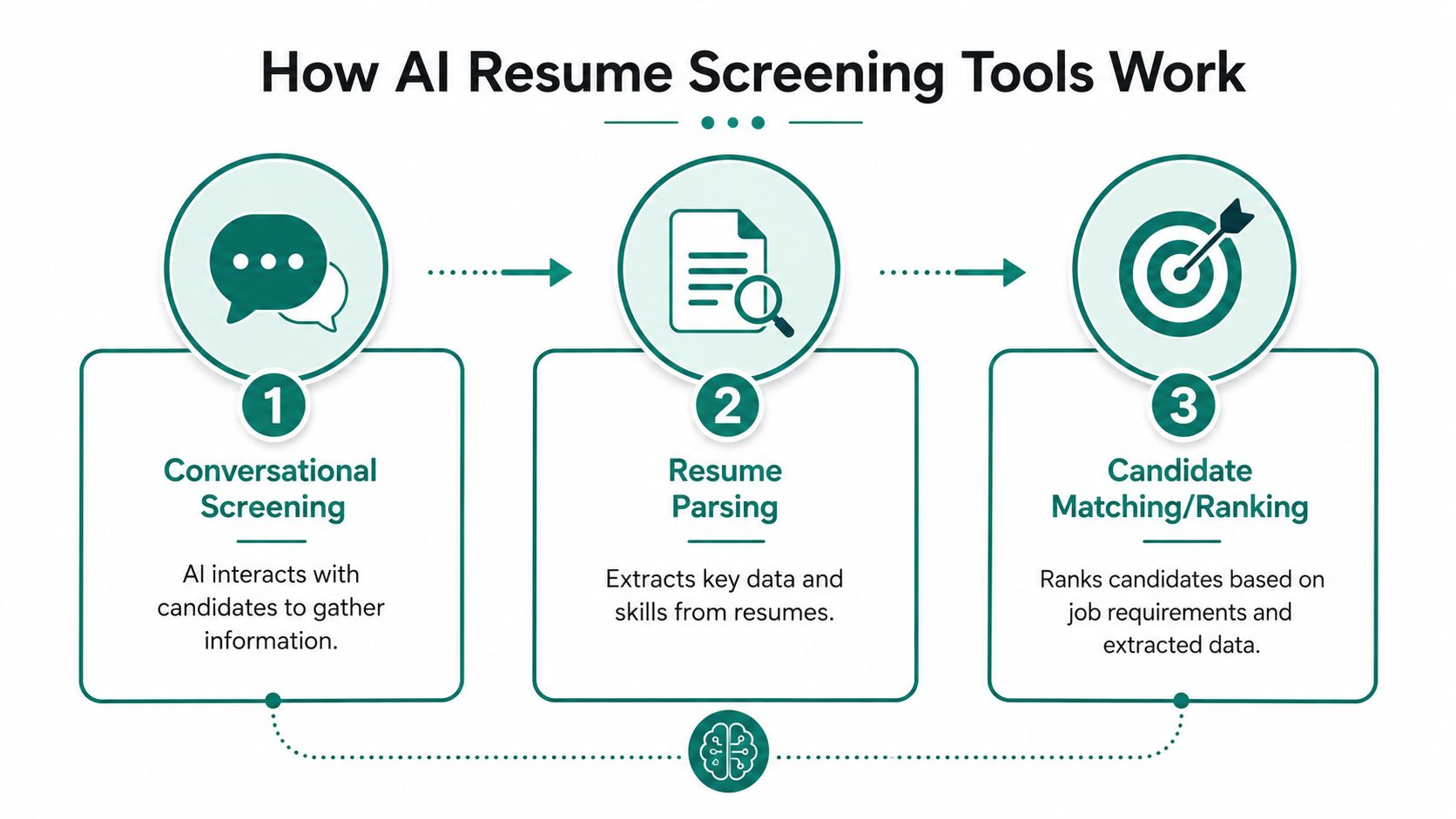
Some tools begin before resume scoring even starts. They ask candidates role-related questions through chat or mobile flows. That matters because resumes often leave out useful context. A candidate may have shift flexibility, a required certification, or recent hands-on experience that isn't obvious from a document alone.
Think of conversational screening as the intake nurse in a busy clinic. It doesn't make the final diagnosis. It gathers the information that helps the rest of the process work.
The second step is resume parsing. The system reads an unstructured file and extracts fields like skills, education, employers, tenure, credentials, and experience history.
Research on screening architecture describes a layered process in which Layer 1 extracts structured data from unstructured documents, Layer 2 scores contextual relevance using cosine similarity metrics and SBERT embeddings, and Layer 3 uses predictive modeling trained on historical hiring data to forecast candidate success, as outlined in the JATIT paper on AI screening architectures.
That sounds technical, so here's the plain-English version:
The final output is usually a score, rank, or structured summary. Better systems don't just reward exact keyword overlap. They look for contextual similarity. A resume that says "patient intake and EMR coordination" may still match a healthcare support role even if the job description uses slightly different language.
A useful screening tool should help a recruiter say, "I understand why this person ranked here," not just, "The system gave them a score."
That explainability is where confidence starts. If the ranking can't be understood, it can't be trusted.
Two products can both claim they use AI and still behave very differently in practice. One may collect answers and route candidates into folders. Another may ask specific questions, score against a rubric, create structured notes, and sync decisions back to the ATS. HR buyers need to spot that difference early.
Start with the criteria that affect daily recruiter work:
If your organization is shifting toward skills-based hiring for legal and support roles, this guide to recruiting paralegals based on skills is useful because it shows how hiring criteria can be built around demonstrated ability rather than resume pedigree alone.
| Feature | AI Screening Tool | Legacy ATS Chatbot |
|---|---|---|
| Conversational depth | Asks follow-up questions tied to role criteria | Usually collects basic application details |
| Resume understanding | Parses and interprets candidate information in context | Often relies on basic form capture or keyword triggers |
| Scoring output | Produces structured scorecards and ranking signals | Commonly routes candidates without rich evaluation |
| Recruiter usability | Supports side-by-side comparison and review | Often requires extra manual interpretation |
| Integration value | Can sync statuses, notes, and scheduling workflows | May sit beside the ATS rather than work within it |
| Compliance support | Better suited for documentation and repeatable criteria | Limited visibility into how candidate screening occurred |
Ask direct questions, not broad ones.
A demo should answer those questions with evidence inside the product, not with marketing language.
The appeal of screening automation is easy to understand. HR teams want faster review, more consistent early-stage evaluation, and less recruiter time spent on repetitive sorting. But the same system that improves order can create blind spots if nobody checks how it behaves over time.
AI screening tools can support fairness and auditability when they apply the same criteria to each applicant. Talent Pronto notes that these systems can reduce bias and compliance exposure by using uniform screening protocols, documented scorecards, and clear evaluation criteria, as described in its guide to how AI screening supports fair hiring.
In practice, that helps with three common pain points:
For employers managing regulated hiring environments, this broader checklist on 2026 HR compliance for Ireland employers is worth reviewing alongside any screening rollout.
Bias doesn't disappear just because software is involved. It changes form.
A tool may score consistently and still reflect flawed assumptions in the rubric, the training data, or the model update process. That's one of the hidden costs many guides skip. If a vendor changes the model behind the scenes, shortlist behavior can change too. HR teams may not notice until candidate mix, pass-through quality, or complaint patterns start shifting.
You should also review a vendor's security, compliance, and fair hiring materials before rollout, especially if applicant data passes through multiple systems.
Don't treat "AI-powered" as evidence of fairness. Treat it as a process that needs monitoring, documentation, and regular review.
Use AI screening as a structured first pass, then keep humans accountable for advancement decisions. A practical review routine usually includes:
The best outcome isn't fully automated hiring. It's more disciplined hiring.
Rolling out an AI resume screening tool works best when HR, recruiting operations, IT, and hiring managers agree on what the tool is supposed to do before configuration begins. Most implementation trouble comes from skipped setup decisions, not from the technology itself.
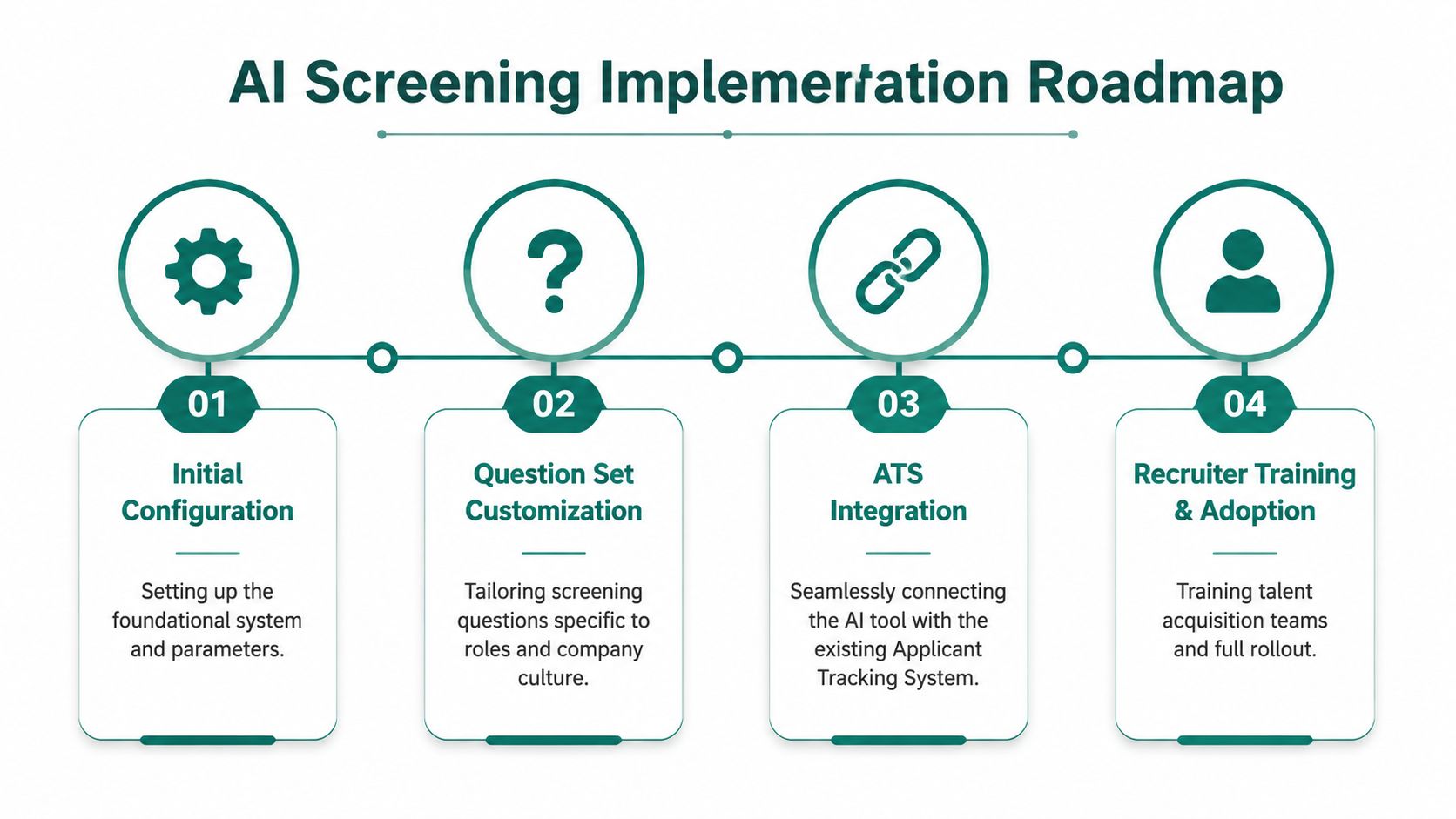
Start small. Choose one or two roles with steady applicant flow and clear hiring criteria.
The early tasks usually include:
If your team uses Greenhouse, this overview of how AI screening works with Greenhouse shows what a connected workflow can look like.
The next phase is connection, validation, and testing. Teams confirm that records sync correctly, statuses update cleanly, and scorecards appear where recruiters work.
A useful pilot doesn't ask, "Does the tool run?" It asks:
Start with one hiring lane where volume is painful and criteria are clear. That gives your team a clean signal on whether the workflow helps.
Training should be simple and role-based. Recruiters need to know how to read outputs, override when needed, and document exceptions. Hiring managers need to understand what the screening score means and what it doesn't.
Implementation isn't finished when the integration works. It's finished when the team trusts the process enough to use it consistently.
If you want budget support for an AI screening rollout, you need to connect technology performance to HR metrics executives already care about. That usually means time-to-hire, cost-per-hire, recruiter workload, and shortlist quality.
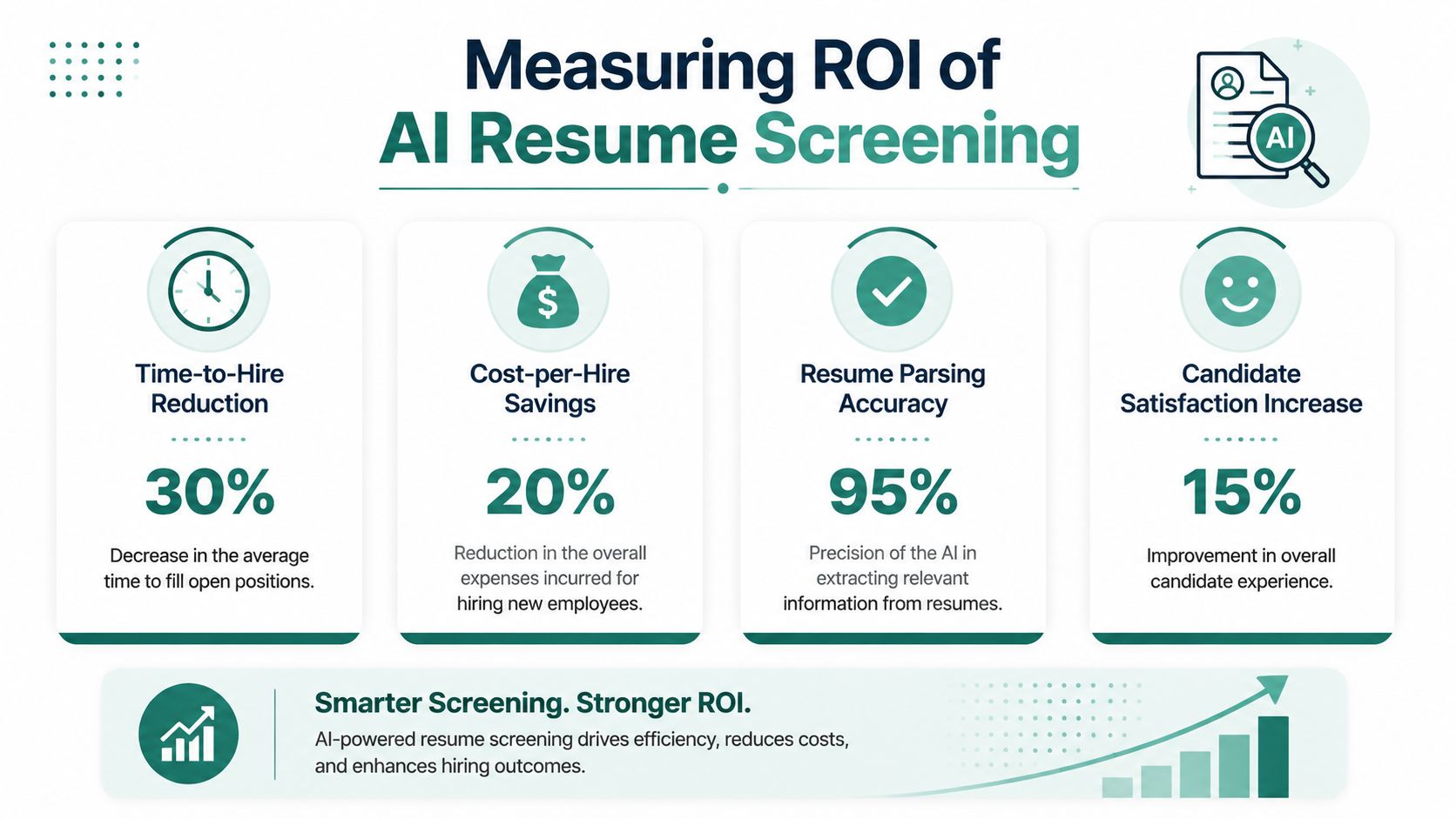
According to Second Talent's AI in recruitment statistics, AI resume screening tools achieve 89 to 94% accuracy in core functions, with resume parsing at 94% accuracy and skill matching at 89% accuracy. The same source reports cost savings of up to 65% per hire and a drop in time-to-hire from 42 days to 14 days when AI screening is integrated with related workflow automation.
Those figures matter because they map directly to operational questions:
If you're reporting results across systems, HRIS integration planning for recruiting workflows becomes part of the ROI story, not just a technical side topic.
A simple HR dashboard should track:
| Metric | Why it matters |
|---|---|
| Time-to-hire | Shows whether screening is removing bottlenecks |
| Cost-per-hire | Connects automation to financial impact |
| Parsing and matching quality | Indicates whether the system is reading candidate data well |
| Recruiter screening time | Shows how much manual work is being reduced |
| Interview conversion from screened candidates | Helps assess shortlist quality |
Don't measure success only by speed. Fast screening that floods managers with weak candidates isn't efficiency. It's just moving the bottleneck downstream.
The strongest ROI appears when a team shortens cycle time and improves review quality at the same time.
Hiring volume doesn't look the same in every sector, but the early-stage problem is familiar. Too many applicants, too little time, and too much variation in how people present their experience. That's why industry use cases matter. They show how the same technology adapts to different hiring realities.

Healthcare recruiters often hire under constant urgency. Shift requirements, licensure, patient-facing experience, and scheduling constraints all matter early. Talent Pronto states that healthcare providers face annual turnover rates exceeding 75%, which helps explain why conversational screening and fast scheduling can be so useful in clinical hiring environments, according to its LinkedIn company information.
In that setting, a screening assistant can ask practical questions up front. Is the nurse licensed in the required state? Can the candidate work nights? Does the applicant have recent experience in the specialty unit? Those details save recruiters from chasing basic eligibility after the fact.
These teams often care less about polished resumes and more about readiness for shift work, equipment familiarity, attendance reliability, and location fit. A strong AI screening flow can collect that information in a consistent way.
The benefit here isn't flashy. It's operational. Recruiters stop guessing from sparse resumes and start reviewing candidate answers tied to job realities.
Hospitality employers deal with high-volume, mobile-first applicants. Many candidates apply quickly and expect quick responses. In this context, always-on conversational screening can keep applicants engaged outside business hours and move qualified people toward scheduling faster.
A restaurant group, hotel operator, or retail chain usually needs early signals on availability, customer-facing experience, and work authorization. A chatbot that only collects name and email doesn't solve much. A screening assistant that evaluates fit against role criteria does.
Public-sector HR teams need documentation. They need repeatable criteria, records of what was asked, and evidence that screening was handled consistently. Structured scorecards and saved screening logs are especially useful here because they support defensible review processes.
In regulated hiring, the value of automation often shows up in documentation quality as much as in speed.
Smaller teams usually don't have dedicated recruiting operations staff. Founders, HR generalists, and hiring managers all touch hiring. That makes consistency hard.
Employers using AI hiring assistants that conduct conversational screening interviews discover 2 to 3 times more qualified applicants than they identified through manual screening alone, according to G2 information on Talent Pronto. For a startup, that kind of lift can change whether a lean team spends its week sorting applicants or interviewing strong ones.
An AI resume screening tool helps most when the team needs structure before it needs scale. It creates repeatability early, which is often what growing companies lack.
An AI resume screening tool works well when it solves a practical HR problem. Too many applications. Uneven early-stage reviews. Delays that cause good candidates to disappear. The technology matters, but the operating model matters more.
The strongest teams evaluate tools carefully, define role-specific criteria, monitor fairness, and measure results in business terms. They don't buy software to replace recruiter judgment. They use software to protect it from overload.
If you're choosing a platform, keep the checklist simple. Look for explainable scoring, structured scorecards, strong integration, documented compliance support, and a workflow recruiters will readily use. Run a pilot on one hiring lane, measure what changes, and inspect the shortlist quality closely.
Then decide whether the tool is improving hiring or just automating noise.
If you're exploring conversational screening as part of that pilot, Talent Pronto is one option to review. It uses an AI assistant to engage applicants, ask role-specific screening questions, prepare structured scorecards, and support interview coordination so HR teams can tighten the early hiring funnel without losing documentation and consistency.

Talent Pronto is an AI-powered hiring platform built around Anna, our intelligent AI that conducts 24/7 conversational screening, evaluates candidates against specific job requirements and compliance needs, and schedules interviews. Run everything on the Talent Pronto ATS, our all-in-one applicant tracking system with a branded careers site and Anna built in, or keep your existing ATS and let Anna integrate with Greenhouse, Ashby, iCIMS, Jobvite, Lever, Oracle, and more. Either way, we help organizations reduce time-to-hire and build stronger teams.