Use structured interview questions to assess behavioral, technical, cultural, and compliance competencies with consistent, role-specific hiring criteria.
More interview questions don't automatically produce better hiring decisions. A large question bank often creates the opposite problem: interviewers choose different prompts, candidates provide incomparable evidence, and scoring becomes a matter of instinct. Structured interview questions create value when each prompt maps to a defined competency, every comparable candidate receives the same core question, and the evaluator uses observable scoring anchors.
That consistency has a substantial evidence base. A 1994 meta-analysis covering 86,311 people found higher operational validity for structured interviews than unstructured interviews, .44 versus .33 in the McDaniel meta-analysis. Later synthesis has continued to place structured interviews among the strongest common selection methods, with mean validity around .42 in recent commentary from Industrial and Organizational Psychology.
The eight approaches below cover behavioral, technical, cultural, judgment, work-sample, panel, and compliance-related evidence. Together, they can support a hiring workflow that is more comparable and defensible. Talent Pronto may assist with conversational screening, follow-up probing, and structured scorecards, while employers retain advancement and rejection decisions.
Past experience becomes useful evidence only when the interviewer separates the candidate's contribution from the team's result. A Behavioral Event Interview, often organized through Situation, Task, Action, Result, does that by asking for a concrete event rather than a general opinion.
A healthcare interviewer might ask, “Tell me about a time you had to manage a difficult patient interaction. What was the situation, what did you do, and what was the outcome?” A manufacturing manager could ask about identifying a process inefficiency. A technology hiring team might ask for an example of collaborating with someone who disagreed with the candidate.
The scoring target should be the evidence inside the story. Did the candidate clarify the problem, explain their personal actions, use an appropriate process, and report a credible result? “We fixed it” is weaker evidence than a response that identifies the candidate's decision, the constraints, and how the result was verified.

Use follow-ups such as “What was your role specifically?” and “What would you do differently?” The purpose isn't to pressure candidates into a perfect narrative. It's to distinguish direct experience from rehearsed generalities and to capture learning, accountability, and judgment.
A practical BEI design includes:
Before building the set, recruiters can use guidance on how to write interview questions to connect each prompt to an observable competency. Talent Pronto can deliver these questions conversationally and organize responses for review, but the employer decides whether the evidence meets the hiring bar.
A competency-based interview starts with the job, not a collection of popular prompts. The hiring team defines the capabilities required for success, describes what those capabilities look like in practice, and then writes questions that elicit evidence for each one.
For a healthcare role, the framework might include clinical knowledge, patient communication, empathy, problem-solving, and compliance awareness. A manufacturing position may require safety compliance, technical aptitude, teamwork, adaptability, and process improvement. A technology role could combine technical problem-solving, collaboration, ownership, learning agility, and communication.
The advantage is comparability. Every candidate is assessed against the same dimensions, even when their examples come from different industries. A nurse may demonstrate problem-solving through patient triage, while a production supervisor demonstrates it through equipment downtime. The evaluator can still assess how each person identifies issues, prioritizes action, and follows through.
A competency label alone isn't a rubric. “Strong communicator” means different things to different interviewers unless the team defines observable behavior. For patient communication, a strong response might explain how the candidate checked understanding, adjusted language, documented the interaction, and escalated concerns appropriately. For safety compliance, the rubric might look for stopping unsafe work, protecting people nearby, reporting the issue, and following the correct procedure.
Build the framework with hiring managers and high performers, then test it against real work. Review whether the questions distinguish essential capability from background familiarity. A candidate shouldn't receive a high score merely because they use the organization's preferred vocabulary.
Scoring principle: Rate the evidence of the competency, not the confidence, accent, or conversational style of the person presenting it.
Keep the model current as tools, regulations, and responsibilities change. Role-aware question sets help Talent Pronto preserve a consistent structure while adapting prompts for healthcare, manufacturing, technology, retail, and other environments. Employers should still review the model and approve the criteria before using it.
Technical interviews fail when they test trivia that the job rarely uses. They work better when questions resemble the decisions, troubleshooting, and explanations the person will handle after hiring.
A software candidate might be asked, “Walk me through how you would design a scalable API for a healthcare data system. What challenges would you anticipate?” A clinical candidate could explain how they'd triage chest pain and shortness of breath. A manufacturing candidate might diagnose a CNC machine producing parts outside tolerance. A pharmacy candidate could explain contraindications and monitoring requirements for metformin in a patient with reduced kidney function.
These prompts produce different evidence from behavioral questions. The interviewer can assess technical accuracy, sequencing, risk awareness, assumptions, and the candidate's ability to explain trade-offs. For regulated or safety-sensitive work, the rubric should distinguish an incomplete answer from a dangerously confident one.

Set the minimum technical standard before interviewing. A junior support role shouldn't receive the same system-design prompt as a senior platform engineer. Likewise, a manufacturing operator may need to identify safe troubleshooting steps, while an engineering lead must explain process controls and long-term corrective action.
Use role-specific scenarios rather than abstract knowledge checks. Score basic competency, proficiency, and expertise with descriptions that evaluators can recognize. A proficient response may identify the likely causes, ask for missing information, and propose a safe diagnostic sequence. An expert response may also explain failure modes, monitoring, and prevention.
Technical screening should not stand alone. A candidate can know the right answer but struggle to communicate with patients, operators, customers, or peers. Pair technical prompts with behavioral or situational questions, then route qualified candidates to a hands-on assessment where appropriate. Talent Pronto can present technical questions conversationally and organize answers against employer-defined criteria, while subject-matter experts retain responsibility for validating the standard.
Behavioral questions ask what candidates have done. Situational questions ask what they would do when faced with a realistic job problem. That distinction matters when applicants have limited relevant experience, are changing careers, or will enter a role with unfamiliar procedures.
Give every candidate the same scenario and score the response against predefined benchmarks. In healthcare, the prompt might involve an upset patient questioning clinical competence after a long wait. In hospitality, it could involve a colleague whose performance is damaging team morale. In manufacturing, the candidate might discover a safety violation that threatens production timelines. In technology, a major client may object to a feature and threaten to end the contract.
The best scenarios contain enough context to reveal prioritization without turning into a puzzle. The candidate should have to balance service, safety, communication, policy, or delivery. Avoid questions that reward guessing the interviewer's personal preference.
A weak answer may ignore the safety issue or blame another person. An acceptable answer may identify the concern and notify the right stakeholder. A strong answer may protect affected people, gather facts, communicate transparently, document the decision, and prevent recurrence. The rubric should describe these behaviors before interviews begin.
Use current high performers and lower performers to test whether the scenario produces meaningfully different evidence. If everyone gives the same vague answer, improve the prompt or the scoring anchors. If the scenario depends on knowledge candidates couldn't reasonably have, move it into the technical assessment.
AI-assisted screening can deliver identical scenarios and permitted follow-up probes across applicants. That supports consistency at the early stage, but it doesn't make the underlying rubric valid automatically. Employers need to review whether the scenario is job-related and whether scoring remains fair for candidates with different communication styles.
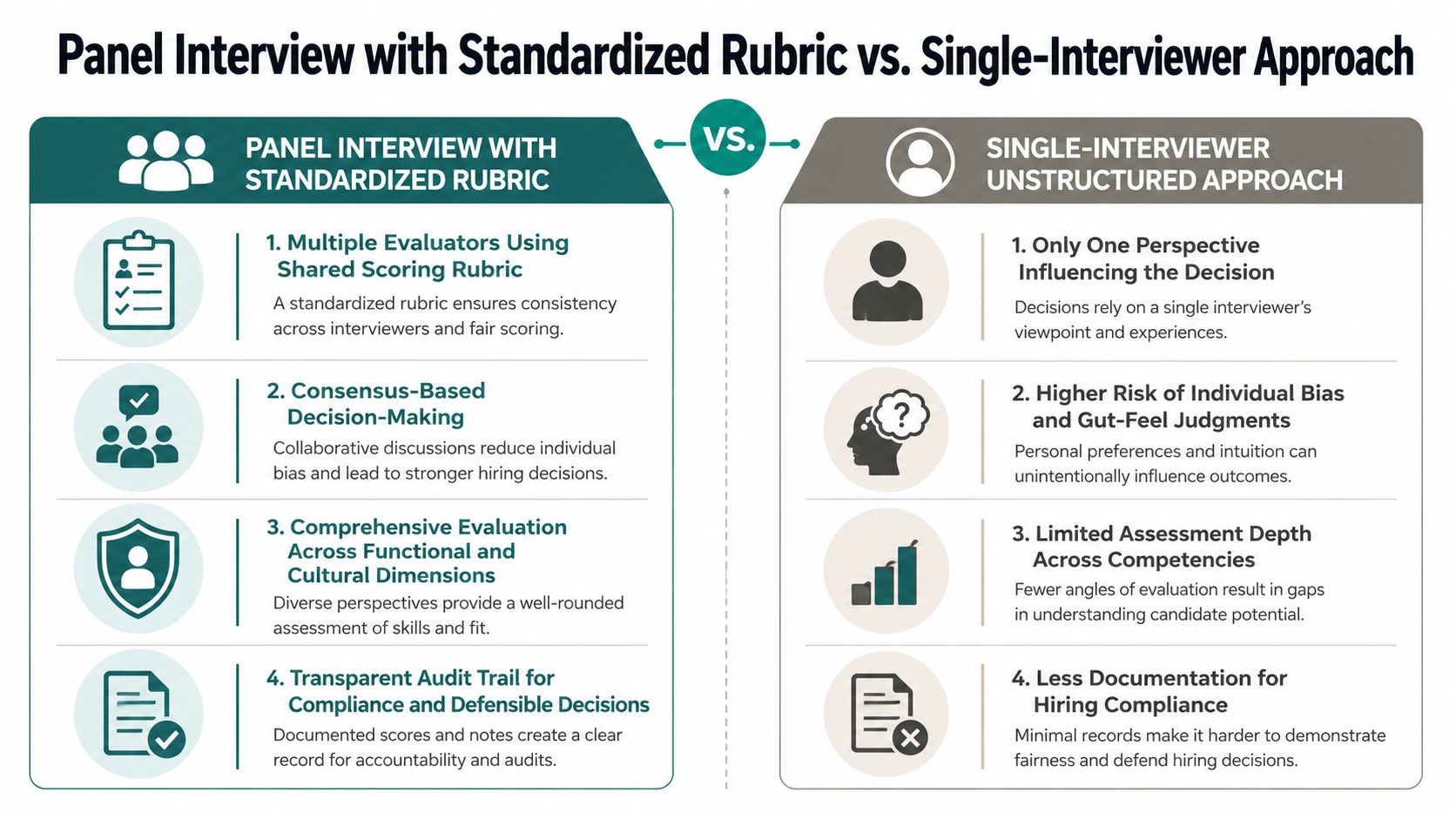
Panels add perspectives, but multiple interviewers can also multiply confusion. Without a shared rubric, one panelist may focus on technical depth, another on personality, and another on an unrelated personal impression. The candidate then receives one collective conversation but the employer records inconsistent evidence.
A healthcare leadership panel might include a chief medical officer, nurse manager, and HR director. A technology engineering panel could include a hiring manager, peer engineer, and product manager. A manufacturing supervisor panel might bring together the plant manager, safety officer, and operations lead. Each person should evaluate the same agreed competencies, not invent a separate test.
Have panelists record independent scores and rationales before the group discusses the candidate. This prevents the first confident speaker from anchoring everyone else. Consensus should reconcile evidence, not erase disagreement.
Keep the group small enough to manage. Assign each evaluator a defined area of observation, but give everyone the same core questions and anchors. A technical evaluator can assess troubleshooting, while HR can monitor job-relatedness and communication, yet neither should substitute personal preference for the rubric.
Use descriptors that explain what each rating means. The interview scoring rubric guidance can help teams think through anchors, evidence, and consistency. Structured scoring also supports the operational benefit identified by the U.S. Office of Personnel Management's structured interview guidance, which describes how limiting discretion in elicitation and evaluation can improve interviewer agreement.
Panelists should receive calibration practice, especially for roles where a weak decision creates safety, clinical, legal, or operational risk. For additional preparation in healthcare contexts, candidates may also consult CliniRoo medical interview preparation. Talent Pronto can coordinate early-stage scorecards, but the employer remains responsible for the final panel decision.
A work sample asks candidates to produce something that resembles the job. That makes the evidence concrete. Instead of asking a software engineer whether they can debug code, ask them to debug a small feature. Instead of asking a customer-service candidate whether they're empathetic, give them realistic customer complaints and score the responses.
Examples vary by role:
The trade-off is candidate burden. A poorly designed exercise can demand unpaid work, depend on tools unrelated to the job, or advantage candidates with more free time. Keep the task focused on frequent, high-impact responsibilities and provide clear instructions, context, and permitted tools.
Define success criteria before candidates begin. For a coding sample, that may include working behavior, maintainability, and reasoning. For a clinical case, it may include safe prioritization, appropriate escalation, and clinical rationale. Optional practice samples can reduce anxiety without revealing the scored task.
A virtual job tryout can be useful when the organization needs a realistic task in an asynchronous format. See how virtual job tryouts work for a related approach to presenting job-relevant exercises.
This video provides another practical visual reference for comparing structured evaluation approaches:
Talent Pronto may help with early conversational qualification and routing, while the employer or qualified assessor should evaluate specialized work products where professional judgment is required.
Critical incident questions reveal how candidates reason when the answer isn't obvious. They're especially useful for leadership, healthcare, public-sector, engineering, and operations roles where competing obligations can make a fast decision unsafe or incomplete.
A healthcare leadership prompt might ask how the candidate would respond if a respected physician appeared to have cognitive decline affecting patient care. A government candidate might need to resolve conflicting directives from senior officials on a public-safety matter. A technology leader could discover a serious security vulnerability shortly before launch. In manufacturing, the dilemma might involve a production-saving quick fix that compromises safety standards.
These questions should contain real tension. If the scenario has one obvious answer and no meaningful trade-off, it belongs in a basic compliance or technical screen. A useful critical incident includes incomplete information, affected stakeholders, time pressure, ethical risk, or consequences that the candidate must weigh.
Don't score only the final decision. Ask, “What would you consider first?”, “Walk me through your reasoning,” and “What would you do if the circumstances changed?” Look for evidence that the candidate protects people, gathers relevant facts, recognizes authority and escalation paths, communicates with affected stakeholders, and documents the decision.
A sound rubric can evaluate:
The approach is demanding, so reserve it for roles where judgment is central. Conversational systems can present the incident and ask approved probes consistently, but human reviewers should interpret nuanced reasoning and retain control of the hiring outcome.
A phone screen is often the first real filter, and it's where inconsistency can spread fastest. One recruiter asks about availability, another focuses on personality, and a third skips a required qualification. Candidates then advance based on different evidence.
A standardized script fixes the basic workflow. Every applicant receives the same core questions in the same order, with defined criteria for advancing. Healthcare screening might cover experience with a patient population or technology, motivation, and availability. A technology screen could address technical background, a meaningful project, and work authorization. Manufacturing questions might cover equipment experience, safety history, and shift availability.
The early screen shouldn't attempt to predict everything. Its job is to verify essential qualifications, identify obvious constraints, and gather enough structured evidence for a fair next-step decision. Complex technical judgment belongs later, with the right assessor.
Use a small set of must-have questions focused on qualifications, availability, communication, and job-related fit. Define advance, hold, and review criteria before launch. A knockout question should be absolutely necessary for the job, not a convenient proxy for preference.
Allow limited follow-up probes when an answer is unclear, but define when those probes are permitted. Screeners should use a consistent tone and explain what happens next. This matters for candidates who are working shifts, applying from mobile devices, or managing other responsibilities.
Talent Pronto supports conversational screening across web and mobile, including role-aware behavioral, technical, situational, and compliance questions. Its virtual assistant, Anna, can engage candidates at any hour and prepare structured scorecards for recruiter review. Employers can also compare this model with external approaches to hiring cold callers when evaluating different outreach workflows, but the screening criteria should remain tied to the role.
A standardized screen can also coordinate interview scheduling after review. Talent Pronto integrates with common ATS and HRIS systems, while employers decide who advances and who is rejected.
| Method | Implementation Complexity 🔄 | Resource Requirements ⚡ | Expected Outcomes 📊 | Ideal Use Cases 💡 | Key Advantages ⭐ |
|---|---|---|---|---|---|
| Behavioral Event Interview (BEI) / STAR Method | Moderate, needs trained interviewers and rubric calibration | Low–Moderate, time for training and scoring; can be AI-assisted | Strong behavioral insight and comparable structured responses; good predictive validity | Leadership, communication roles, soft-skill assessment, cultural fit | Evidence-based, scalable, reduces interviewer bias, defensible documentation |
| Competency-Based Interview Framework | High, requires job analysis and defined competency models | High, workshops, evaluator training, ongoing maintenance | High alignment to role requirements; objective, auditable comparisons | Role families, succession planning, large-scale standardized hiring | Reduces bias, improves predictability, customizable to role needs |
| Technical Skills Assessment Interview | Moderate–High, build realistic tasks and scoring criteria | Moderate, SMEs, testing platforms, periodic updates | High technical signal; effectively filters unqualified candidates early | Software engineers, clinicians, skilled trades, technical operations | Objective technical validation; saves hiring manager time; reduces risky hires |
| Structured Situational Interview (Hypothetical) | Moderate, design scenarios and clear benchmarks | Low–Moderate, scenario development and rubric creation | Good assessment of judgment and decision approach; fair to limited-experience candidates | Customer service, supervisory roles, roles needing ethical judgment | Standardized, scalable, assesses decision-making and values alignment |
| Panel Interview with Standardized Rubric | High, coordinate panelists and consensus process | High, multiple evaluators' time and training required | Very comprehensive evaluation; increased reliability and defensibility | High-stakes hires, cross-functional or executive roles | Multiple perspectives reduce individual bias; strong validity and audit trail |
| Work Sample and Job Simulation Test | High, develop realistic, scored tasks and validation | High, infrastructure, evaluator time, candidate time investment | Very high predictive validity; objective work products for evaluation | Coding, clinical case assessments, data analysis, customer interactions | Most predictive method; fair to diverse candidates; preferred by applicants |
| Critical Incident & Decision-Making Interview | High, craft complex incidents and experienced scoring | Moderate–High, SMEs, trained evaluators, time for probing | Deep insight into judgment, trade-offs, and value alignment; differentiates leaders | Executive leadership, crisis management, healthcare leadership, public sector | Reveals reasoning quality and ethics; predictive for high-stakes decisions |
| Structured Phone Screen with Standardized Script | Low, standard script and pass/fail rubric | Low, minimal interviewer time; easily automated by AI | Rapid pass/advance decisions; screens basic qualifications and communication | High-volume early-stage screening (retail, hospitality, healthcare, tech) | Highly efficient and scalable; reduces interviewer inconsistency; 24/7 automation possible |
The strongest process doesn't use all eight approaches for every job. It combines methods according to the evidence the role requires, the stage of hiring, and the burden placed on candidates.
Start with a competency framework. Define the knowledge, behaviors, judgment, and compliance requirements that matter for successful performance. Write observable anchors before interviewing, then use tools to create interview question sets only as a drafting aid. The hiring team still needs to validate every prompt against the job.
Use a structured phone screen for essential qualifications and basic logistics. Standardized questions can prevent avoidable inconsistency in a high-volume funnel. Next, use behavioral questions for evidence of past teamwork, resilience, ownership, or problem-solving, and situational questions when you need to evaluate judgment from candidates with limited directly comparable experience.
Add technical prompts or a work sample when the role depends on demonstrable expertise. A software engineer may need both a technical discussion and a practical coding task. A healthcare role may require clinical reasoning within the person's scope. A manufacturing position may require safe, systematic troubleshooting. Match the assessment to actual work rather than testing impressive but irrelevant knowledge.
Reserve critical incidents and panels for positions where complex judgment, leadership, safety, or cross-functional consequences justify deeper evaluation. Panelists should score independently before discussion, use the same anchors, and document the evidence behind their ratings.
Consistency doesn't mean asking rigid questions without listening. Recent I-O psychology commentary reports structured interview validity around .42, while also highlighting meaningful variability across implementations in its discussion of structured interviews beyond mean validity. The practical lesson is that standardization alone isn't enough. Competency selection, question quality, scoring calibration, and implementation discipline all matter.
Fairness also requires active monitoring. A 2025 meta-analysis of accent bias in employee interviews found that standard-accented interviewees were favored over non-standard-accented interviewees across a substantial evidence base, with unique effects covering k=41 and N=7,596, and multilevel effects covering k=120 and N=20,873 in the published analysis of accent bias. Structure can improve comparability, but it doesn't erase bias linked to accent, language background, or response style. Use job-related anchors, independent scoring, and review of fairness signals rather than treating uniform delivery as proof of equity.
Talent Pronto can support 24/7 conversational screening, role-aware question sets, follow-up probing, structured scorecards, and ATS or HRIS coordination. It can help employers standardize early evaluation without making final hiring decisions. Review question sets as roles change, document evidence at every stage, and keep advancement and rejection decisions with accountable hiring professionals.
Talent Pronto offers conversational screening for behavioral, technical, situational, and compliance questions, with structured scorecards tied to role-specific criteria. Visit Talent Pronto to see how you can standardize early screening while keeping hiring decisions with your team.

Talent Pronto is an AI-powered hiring platform built around Anna, our intelligent AI that conducts 24/7 conversational screening, evaluates candidates against specific job requirements and compliance needs, and schedules interviews. Run everything on the Talent Pronto ATS, our all-in-one applicant tracking system with a branded careers site and Anna built in, or keep your existing ATS and let Anna integrate with Greenhouse, Ashby, iCIMS, Jobvite, Lever, Oracle, and more. Either way, we help organizations reduce time-to-hire and build stronger teams.