Discover a step-by-step customer service evaluation framework with KPIs, scorecards, and automated scoring for actionable insights.
Customer service evaluation has a measurement problem. In the U.S., average NPS fell from 31.7 in 2012 to 19.8 in 2021, with swings of over 23 points, showing why a single survey snapshot can't explain service performance or guide durable improvement. Qualtrics' longitudinal NPS analysis makes the broader point clear: customer perceptions move, so evaluation has to be continuous and operational, not a quarterly reporting exercise.
A useful system connects what happened in an interaction with what the business does next. It combines customer feedback, quality reviews, operational outcomes, structured rubrics, representative sampling, evaluator calibration, automation, and documented follow-through. The dashboard is only the visible layer. The test is whether a recurring failure gets assigned, corrected, verified, and prevented from returning.
Customer service evaluation is the disciplined process of judging whether interactions meet defined customer, operational, compliance, and brand standards. It's broader than asking whether a customer was satisfied. A customer may give a positive rating after a pleasant conversation even though the issue remains unresolved, while another may rate a necessary policy interaction poorly despite accurate and respectful handling.
NPS became influential because it simplified loyalty measurement. It was introduced in a 2003 Harvard Business Review article by Fred Reichheld, Bain & Company, and Satmetrix as an alternative to more complex satisfaction surveys. Its central question asks how likely a person is to recommend a company, and the score subtracts the share of detractors from promoters, creating a standardized percentage-based benchmark for tracking service over time. IBM's overview of NPS explains why the metric became a practical customer-experience reference point.
A complete framework needs several connected parts:
Weak programs usually fail at the connection points. A scorecard may identify poor authentication handling, but no owner is assigned to update the workflow. A dashboard may show low first-contact resolution, but analysts don't separate policy limitations from agent behavior. A coaching plan may be delivered, but nobody checks whether the same failure appears in later interactions.
Practical rule: Every evaluation finding should produce a named action, an accountable owner, and a verification method.
A mature customer service evaluation process asks four questions. Did the representative follow the required behavior? Did the customer receive a correct and complete resolution? Did the interaction create downstream work, such as a repeat contact or escalation? Did the organization fix the underlying cause when the problem appeared repeatedly?
That last question is where many teams carry execution debt, the gap between knowing what customers need and consistently changing the operation. Scores are useful signals, but they don't close the loop by themselves. The operating model must connect evidence to action.
Begin with the business problem, not the metric already displayed in a dashboard. “Improve customer service” cannot guide sampling, scoring, or coaching. A usable goal names the customer or operational issue, the intended change, the accountable team, and the period for review.
A support leader dealing with repeat contacts might target incomplete resolutions within one contact reason. A customer-experience leader concerned with loyalty could review recommendation behavior alongside complaint recovery and unresolved cases. A workforce leader may monitor handle time, but accuracy and resolution must remain alongside it. Faster handling that produces another contact has shifted work rather than reduced it.
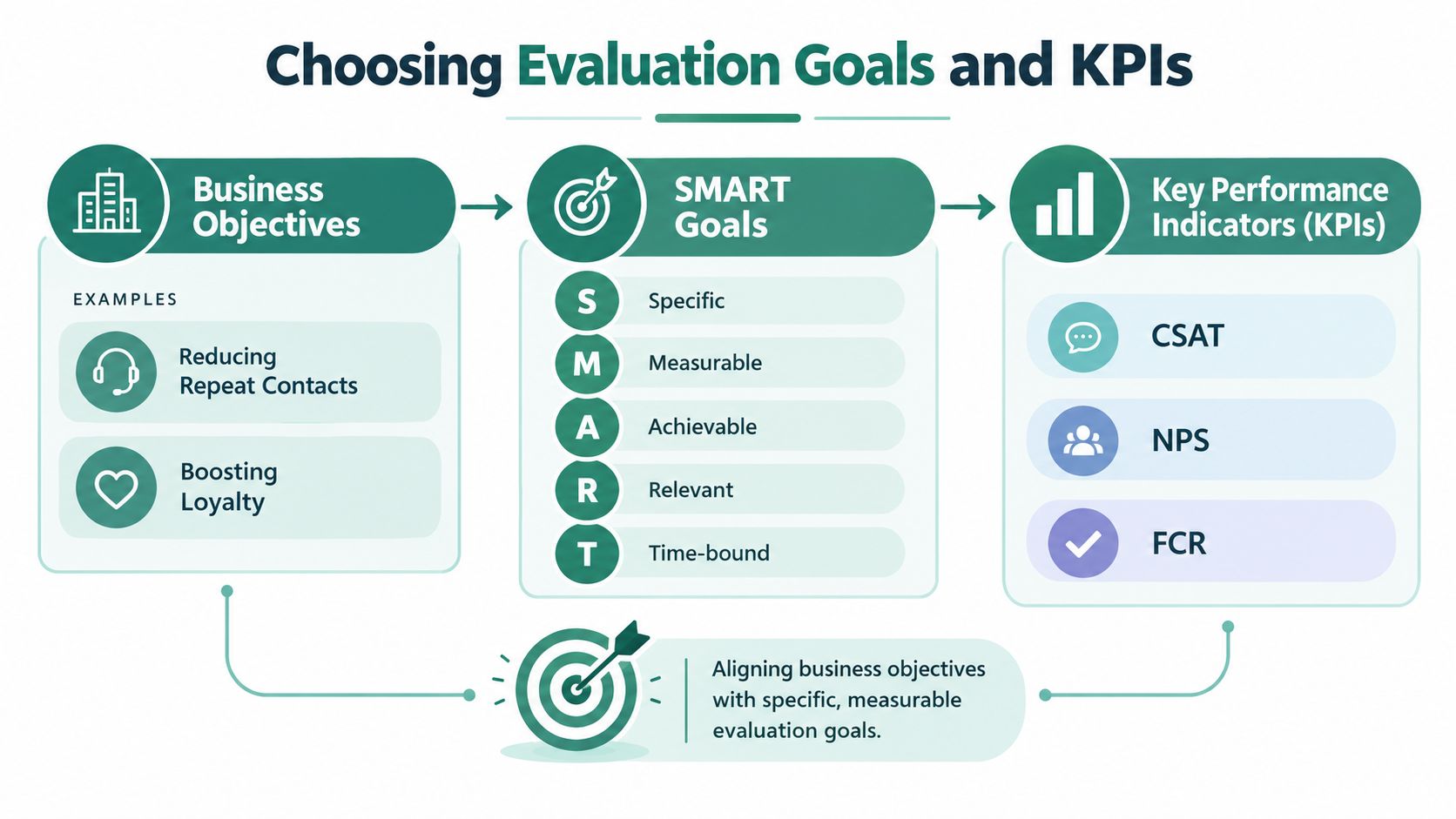
Use SMART criteria to convert an objective into an evaluation plan:
| Business objective | Evaluation goal | Primary KPI | Supporting KPI | Team that acts |
|---|---|---|---|---|
| Reduce repeat contacts | Identify and correct incomplete resolutions for a defined contact reason | FCR | Quality score, repeat-contact rate | QA, operations, training |
| Boost loyalty | Improve interactions that influence willingness to recommend | NPS | CSAT, quality score | CX, service leadership |
| Improve customer sentiment | Detect behaviors associated with positive or negative feedback | CSAT | Sentiment, quality score | Team leaders, coaching |
| Control service effort | Remove avoidable handling steps without weakening resolution | AHT | FCR, quality score | Workforce, operations |
| Strengthen interaction quality | Standardize required behaviors across channels | Quality score | CSAT, compliance results | QA, team leaders |
The matrix sets priorities. It does not require tracking every available measure. CSAT stays close to the interaction and supports immediate feedback. NPS addresses loyalty and recommendation behavior. FCR tests whether the customer's need was resolved without another contact. AHT can expose process friction and workload, but lower handling time is not automatically better. A quality score can cover accuracy, clarity, empathy, ownership, and compliance only when the rubric defines observable evidence.
Set a baseline before choosing a target, then review it after process or policy changes. External support performance benchmarks provide context, while internal results and customer outcomes should set the operating threshold. Benchmarks help identify unusual performance, but they cannot explain whether a low score reflects agent behavior, product limitations, or an unrealistic workflow.
Keep speed, advocacy, and resolution in separate roles rather than compressing them into one undifferentiated score. Add guardrails that trigger investigation. If AHT improves while FCR and quality decline, the process may be transferring effort to customers or back-office teams. If NPS rises while complaint resolution slows, the gain may come from a limited interaction group.
A KPI set should be small enough to act on and broad enough to resist gaming. Review measures together, record the interpretation, and assign the next action to a named owner. For example, a fall in FCR should lead to a sample review by contact reason, a check of policy and workflow constraints, and a follow-up measurement after the change. The dashboard starts the conversation. Calibration and execution determine whether the evaluation improves service.
A scorecard turns “good service” into observable evidence. Without one, evaluators tend to reward communication styles they personally prefer, overlook channel-specific constraints, and apply different standards to similar interactions. The result is a number that looks precise but doesn't support fair coaching.
Start by defining each criterion in behavioral language. “Shows empathy” is vague. “Acknowledges the customer's stated concern, avoids blame, and explains the next step in plain language” gives a reviewer something they can identify in a transcript or recording. Add failure conditions, evidence requirements, and an escalation rule for high-risk interactions.
One published example uses six factors totaling 100%, with Customer Confidence and Resolution weighted at 20% and Customer Impact Insight weighted at 20%. The remaining dimensions include self-awareness, commitment to development, clarity of approach to objections, and adaptability. The published rubric example offers a concrete reference for building a weighted assessment rather than relying on an overall impression.
| Factor | Weight | Example behavior |
|---|---|---|
| Self-Awareness | 15% | Recognizes the effect of their wording and identifies a service improvement |
| Commitment to Development | 15% | Applies feedback and describes a specific way to build the relevant skill |
| Customer Impact Insight | 20% | Connects the response to customer confidence, effort, and likely outcome |
| Clarity of Approach to Objections | 15% | Addresses resistance directly and explains the solution without defensiveness |
| Adaptability | 15% | Adjusts explanation, pace, or channel behavior to the customer's needs |
| Customer Confidence and Resolution | 20% | Provides an accurate resolution or a clear, owned next step |
A weighted score still needs a consistent scale. A simple scale can distinguish missing behavior, partial execution, and reliable execution, provided the definitions are written before reviewers begin. Require comments that point to evidence, not personality judgments. “The agent sounded unsure” is weak. “The agent gave two conflicting timelines and didn't confirm which one applied” is coachable.
Customize the rubric by role and channel. A voice representative may need a criterion for call control, while an email specialist needs accuracy, structure, and readability. A social-care team may require public-to-private transition handling. Keep core dimensions stable when comparisons matter, but add channel-specific criteria where the customer risk differs.
Document what should happen when criteria conflict. If an agent is warm but provides incorrect information, accuracy must take priority. If a fast response omits a required verification step, speed shouldn't offset the compliance failure.
Teams building hiring and service scorecards can compare approaches in these customer service scorecard examples. The useful lesson is simple: the rubric should make two independent reviewers more likely to reach the same conclusion.
Sampling determines what your QA team can see. If the sample contains only easy contacts, one channel, or interactions selected by supervisors, the resulting score describes the selection process rather than the customer experience. Traditional QA programs often review only 1–5% of interactions, which leaves unseen failures and can create biased coverage, as documented in customer support QA benchmark guidance.
A practical sampling plan begins with an inventory of interaction sources. Include phone, chat, email, social messaging, escalations, transfers, reopened cases, and contacts handled by automated systems when those interactions affect the customer journey.
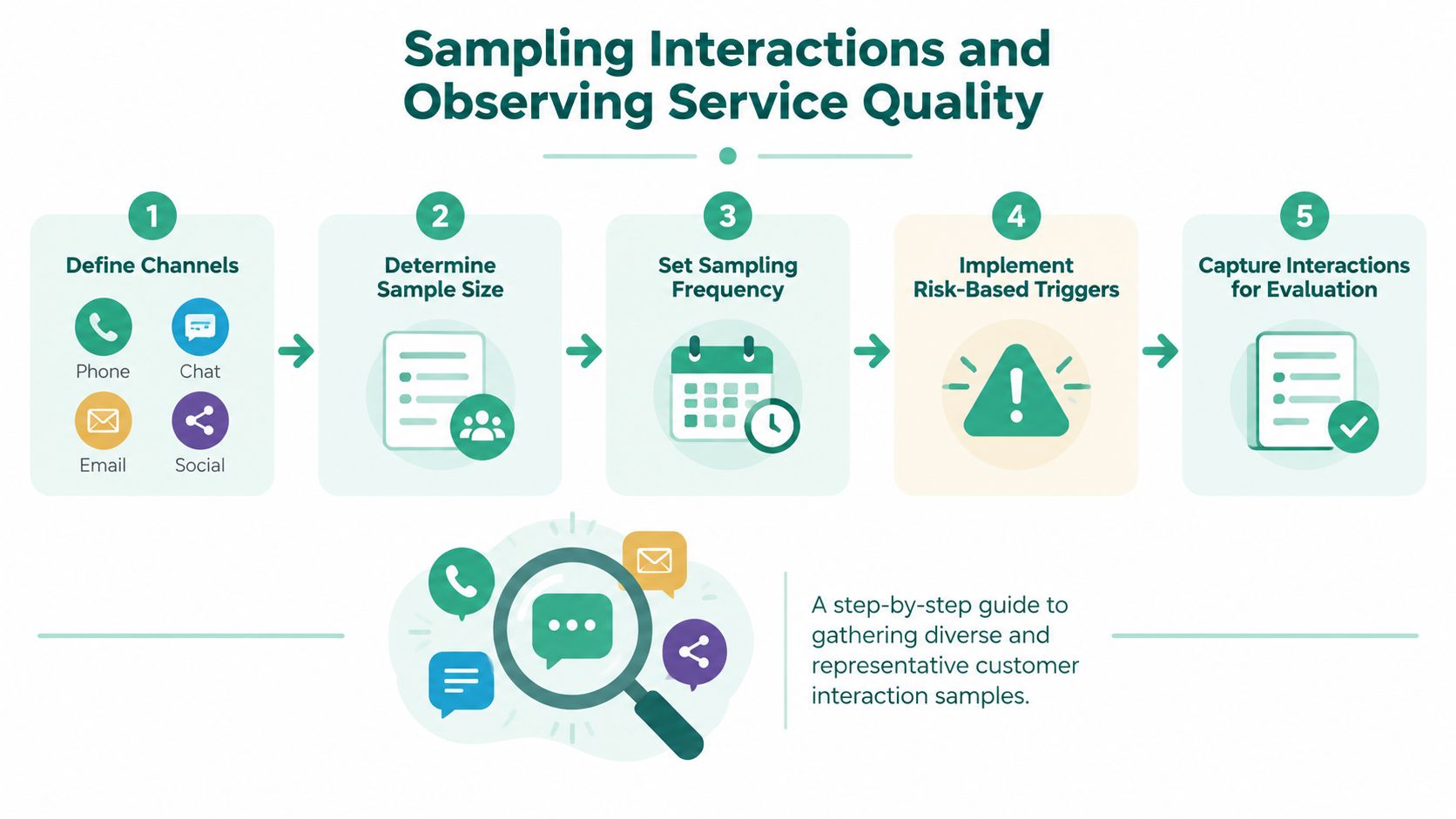
Random sampling helps estimate ordinary performance. Targeted sampling finds risk and explains unusual outcomes. Use both rather than pretending one method answers every question.
Don't confuse volume with representativeness. A large sample from chat can't validate phone quality, and a high-performing day shift can't stand in for overnight coverage. Track sample coverage by channel, team, language, tenure, and issue type. If a segment is missing, label the gap instead of presenting the overall score as complete.
Use live monitoring and silent listening to understand pace, interruptions, tool use, and escalation behavior. Use recordings and transcripts for repeatable scoring, precise coaching evidence, and cross-rater review. Transcripts are efficient, but they can hide tone, hesitation, or overlapping speech, so reviewers should return to the recording when those details affect the judgment.
Capture the interaction outcome as well as the interaction behavior. A polite conversation that creates another contact is different from a concise conversation that solves the issue. The sampling plan should make those differences visible without turning every case into a manual investigation.
Calibration is where a rubric becomes an operating standard. Two evaluators can read the same interaction and disagree because they interpret “ownership,” “clear explanation,” or “appropriate empathy” differently. If managers compare their scores without resolving those differences, the team receives mixed coaching and agents lose trust in the process.
Schedule calibration around real work, not abstract definitions. Select interactions that represent common ambiguity, recent policy changes, high-risk behaviors, and borderline scores. Have each rater score independently before the discussion. Revealing the scores afterward prevents the first reviewer's opinion from anchoring everyone else.
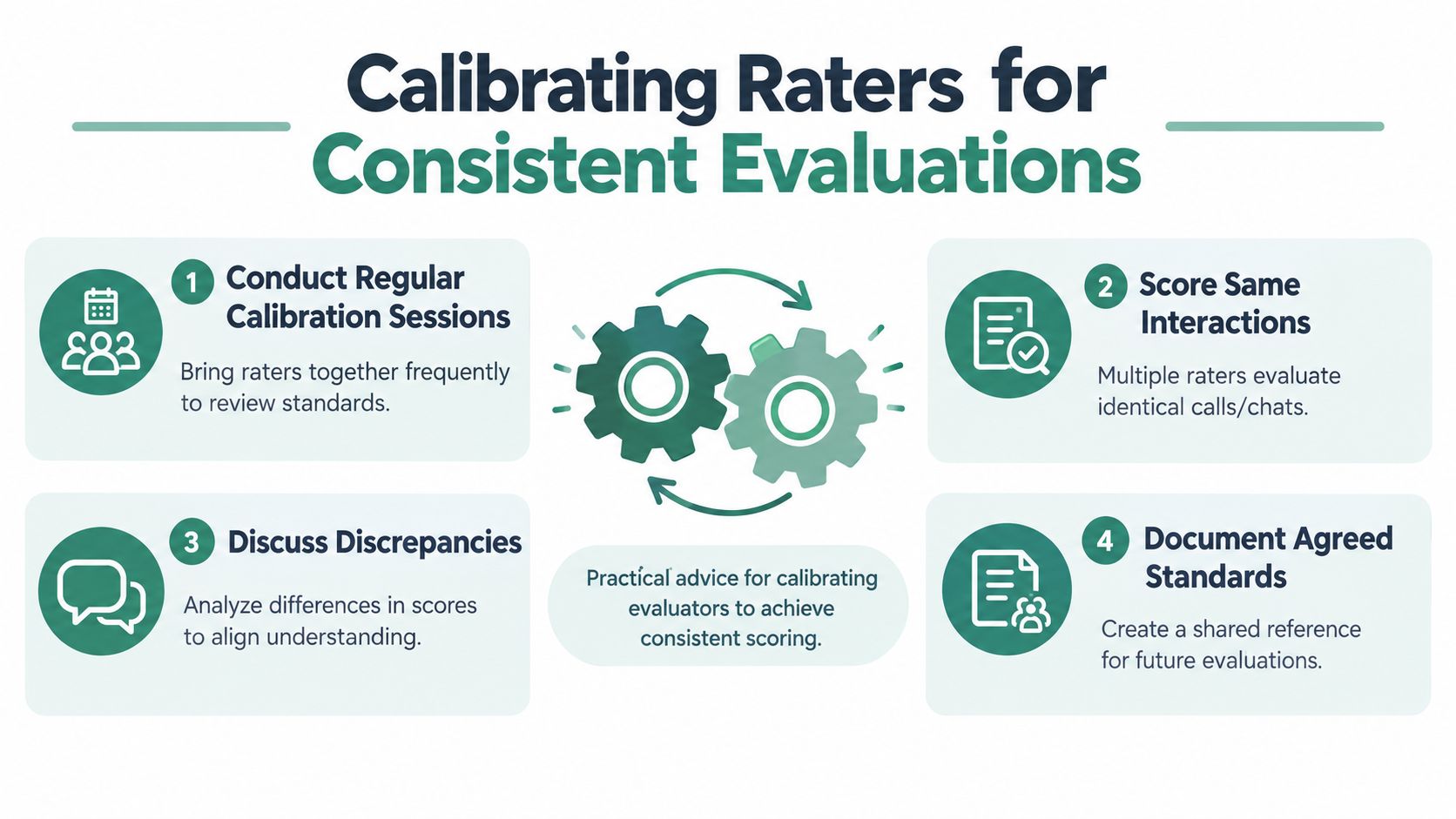
A useful session follows a tight sequence:
Blind scoring can reduce status effects and knowledge of the agent's identity. A bias checklist can prompt reviewers to ask whether they judged the behavior, the outcome, or the representative's style. Don't let “professionalism” become a proxy for accent, personality, or communication preference.
A calibration log should include the interaction identifier, disputed criterion, competing interpretations, final standard, policy reference, and rubric version. Version control matters because a score is only meaningful relative to the standard in force at the time.
Calibration is not a meeting about who is right. It's a controlled way to make the standard more precise.
Structured hiring methods follow the same logic. A structured interviewer training resource can help interviewers use fixed questions, evidence-based probing, and consistent scoring rather than improvising from candidate to candidate. Structured interviews are also associated with fairer applicant outcomes by reducing the influence of characteristics, including sex, on interviewer decisions, according to UK government guidance on structured interviews.
Automation expands review coverage, while humans define quality and handle exceptions. A workable process uses AI to capture, organize, and prioritize evidence. Reviewers remain accountable for rubric design, high-risk decisions, and cases that fall outside normal patterns.
Evaluation pipelines may combine transcription, speaker separation, redaction, intent detection, sentiment analysis, behavioral tags, rule-based scoring, and language-model-assisted review. One benchmarked QA process reported up to a 95% match between predicted QA CSAT and survey-based agent CSAT, after calibration against post-contact outcomes. The SQM Group's call-center benchmark study describes the process.
Use deterministic rules for requirements that should be clear and repeatable. Examples include authentication, required disclosures, correct disposition selection, and adherence to an escalation path. Use AI-assisted review for context-dependent patterns such as intent, sentiment, clarity, ownership, and emerging objection themes.
Route exceptions to a human reviewer. Trigger review when an interaction involves a vulnerable customer, a complaint, a possible compliance breach, conflicting signals, or low model confidence. The system should display the evidence supporting a score, including the relevant transcript or event, rather than presenting only a final label.
Conversational screening can ask role-specific behavioral and technical questions, produce structured transcripts, and prepare an initial scorecard for human review. Talent Pronto's virtual assistant, Anna, follows this model by screening applicants through conversation, evaluating responses against employer-defined criteria, and supporting ATS and HRIS workflows. Teams can review Talent Pronto's AI interview assistant for more context. Employers still make advancement and rejection decisions.
A practical deployment path includes:
Teams assessing enterprise AI agent deployments should apply the same controls to conversational systems. The central trade-off is coverage versus control. Automation finds more signals and shortens review cycles, but weak governance can scale inconsistent judgment at the same speed. Calibration results should therefore feed rubric changes, reviewer coaching, and targeted rechecks, not stop at a dashboard score.
A dashboard becomes useful when it answers an operational question. “What is the quality score?” is descriptive. “Which failure is driving repeat contacts for this issue type, and who can remove it?” leads to action.
Build views that connect customer perception, observed behavior, and outcome. Show KPI trends over time, performance distributions, channel differences, issue categories, escalation paths, and repeat-contact patterns. Segment the results by team, location, shift, tenure, product, language, and workflow version. Aggregation hides root causes, especially when one channel carries a harder mix of contacts.
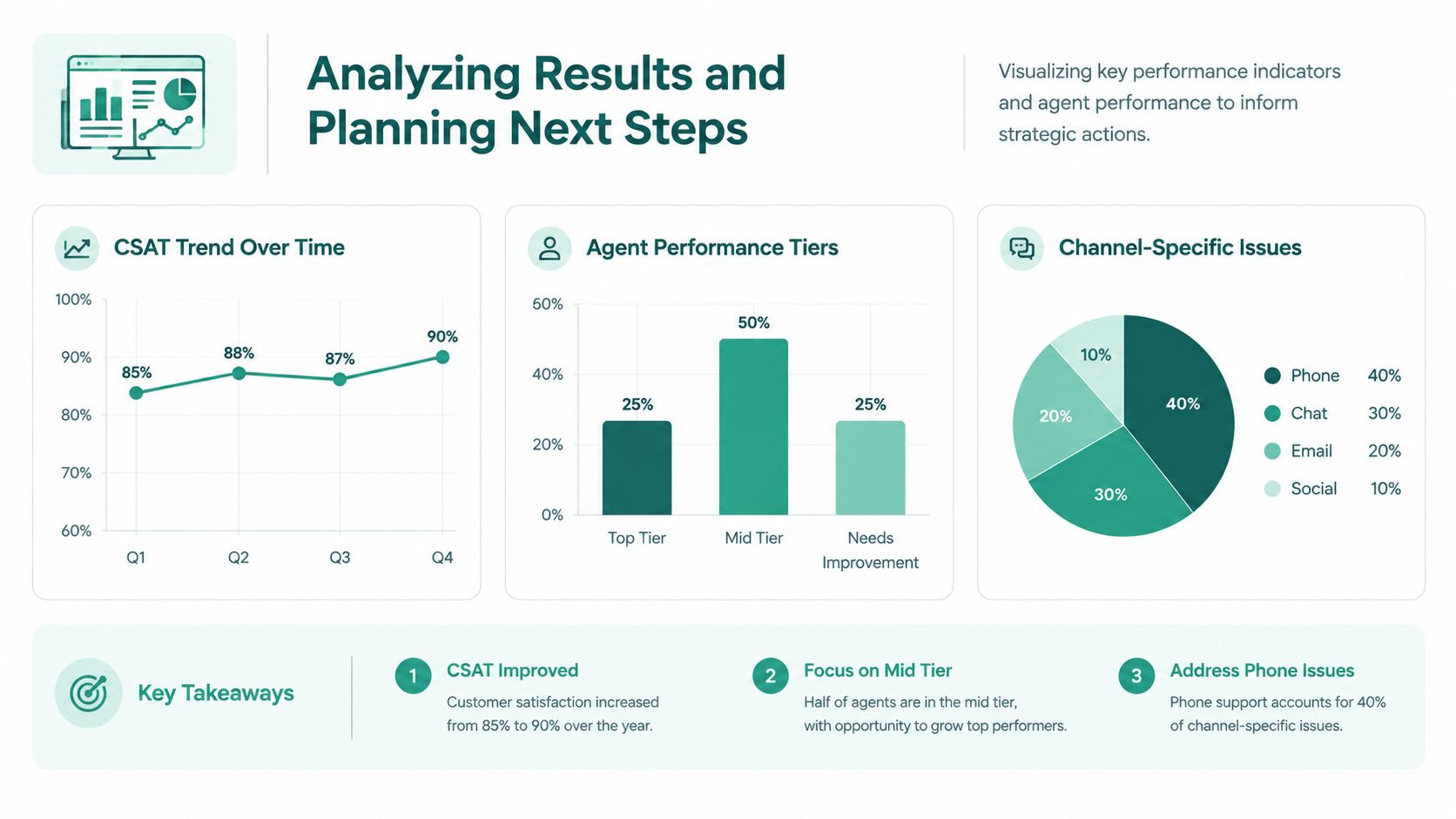
Use a simple action record for every material finding:
| Finding | Evidence | Action | Owner | Verification |
|---|---|---|---|---|
| Customers receive inconsistent timelines | Reviewed interactions and complaint themes | Rewrite the response guide and add a timeline prompt | Operations | Recheck sampled interactions after rollout |
| Agents transfer a recurring issue unnecessarily | Transfer reasons and case outcomes | Update routing and train affected teams | Support operations | Compare transfer and resolution patterns |
| A policy explanation creates confusion | Low clarity scores and repeat questions | Simplify language and add a knowledge-base example | Content, training | Review comprehension and downstream contacts |
| A representative misses a required behavior | Criterion-level score and interaction excerpt | Deliver targeted coaching with practice | Team leader | Rescore future interactions |
Don't send every problem to training. Training fits skill and behavior gaps. Process updates fit broken tools, unclear ownership, conflicting policies, and unnecessary handoffs. Product or knowledge-base work fits recurring information failures. When the same issue appears across agents, treat it as a system problem before treating it as an individual problem.
The operating climate makes this distinction urgent. In 2026, 53% of customers said their expectations had risen, while 51% reported that businesses still fell short when assistance was needed, according to Verint's State of Customer Experience 2026 report. Evaluation should therefore include execution measures, such as whether owners completed fixes, whether escalations were handled correctly, and whether time-to-fix improved.
Set a regular rhythm for frontline coaching, QA calibration, operational review, and executive trend analysis. Each meeting should distinguish new signals from open actions. Close an item only when the owner has implemented the change and a later sample confirms the intended behavior or outcome.
For broader context on interpreting feedback and choosing improvement actions, Exerta's customer satisfaction insights can complement your internal analysis. The final discipline is simple: don't celebrate a better dashboard until the customer-facing process has improved and stayed improved.
Talent Pronto helps employers run structured conversational screening, evaluate customer service candidates against role-specific criteria, and generate comparable scorecards for human review. Visit Talent Pronto to see how Anna can support consistent early-stage evaluation and connect screening insights to a more reliable hiring process.

Talent Pronto is an AI-powered hiring platform built around Anna, our intelligent AI that conducts 24/7 conversational screening, evaluates candidates against specific job requirements and compliance needs, and schedules interviews. Run everything on the Talent Pronto ATS, our all-in-one applicant tracking system with a branded careers site and Anna built in, or keep your existing ATS and let Anna integrate with Greenhouse, Ashby, iCIMS, Jobvite, Lever, Oracle, and more. Either way, we help organizations reduce time-to-hire and build stronger teams.