Explore 10 examples of scorecards with rubrics, evidence, interpretation tips, and ATS automation guidance for consistent hiring decisions.
A free-form interview is far less predictive of later performance than a structured one. The landmark review by Schmidt and Hunter, which synthesized 85 years of selection research, reported a corrected validity coefficient of r = 0.51 for structured interviews versus r = 0.38 for unstructured interviews. That evidence helps explain why practical examples of scorecards use fixed criteria, standardized questions, behavioral anchors, and written evidence instead of relying on interviewer intuition alone. The structured-scorecard research summary
A scorecard is useful when it turns candidate impressions into comparable evidence. The right design depends on the hiring problem: strategic recruiting performance needs a different operating system from a software engineering assessment, a reference check, or an AI-assisted screening flow.
The examples below use a two-part approach. First, choose the model that matches the decision you need to make. Then configure the criteria, evidence fields, scoring anchors, independent review, calibration process, and ATS workflow around that model. Structured scoring should support employer judgment, not replace it. If you need a practical way to connect screening with real-time interview answers, treat the resulting transcript as evidence for human review, not as an automatic hiring decision.
A Balanced Scorecard, or BSC, works best when the hiring team needs to evaluate the recruiting function rather than one applicant. It adapts the familiar four-perspective framework, financial, customer, internal process, and learning and growth, to talent acquisition operations.
A practical recruiting BSC might connect financial discipline with cost-per-hire and budget adherence, hiring-manager outcomes with satisfaction and candidate quality, internal process health with workflow bottlenecks, and learning and growth with interviewer training or process improvement. The point isn't to collect every available recruiting metric. It's to show whether faster hiring is creating better business outcomes or merely moving candidates through the funnel more quickly.
Give each perspective a clear owner and a defined review cadence. Weight the perspectives according to the organization's current constraint. A health system struggling with clinical vacancies may prioritize quality and speed differently from a government agency focused on process traceability.
Use the scorecard to ask operational questions:
Practical rule: A recruiting BSC should trigger a decision. If nobody can explain what they'll change when a measure moves, the measure probably doesn't belong.
The trade-off is administrative weight. A BSC can become a reporting exercise if the team adds too many indicators, assigns unclear ownership, or lacks historical context. Start with a small set of role-relevant measures, document definitions, and connect each result to an ATS stage or operating review. Use trend views to diagnose process problems, but keep applicant-level scorecards separate from department-level performance reporting.

Behavioral scorecards evaluate what candidates have done in situations relevant to the role. Ask each candidate the same role-specific questions, listen for Situation, Task, Action, and Result details, then record evidence against defined competencies.
The approach fits leadership, customer service, healthcare coordination, sales, operations, and other roles requiring judgment or collaboration. A scorecard should reward evidence, not polished storytelling. It should separate a candidate who explains personal actions and outcomes from one who describes what “we” did without clarifying their contribution.
Use five to seven focused competencies, a recommendation supported by a published structured interview scorecard template. Select criteria tied to role risk, such as prioritization, conflict management, ownership, communication, or resilience.
Define behavioral anchors for every competency:
A one-to-five scale works when each level has written meaning. The number matters less than consistent interpretation. Have interviewers score independently before discussion. Compare the evidence, not preferences for a candidate. Require one or two lines of evidence for each score, so later reviewers can distinguish a documented observation from an impression.
Practical rule: A score is only useful when another reviewer can understand why it was assigned.
The scorecard can become rigid if interviewers read questions mechanically. Train them to use neutral probes such as “What did you do next?” and “How did you know it worked?” A detailed interview scoring rubric can give interviewers shared language for judging responses.
For implementation, map competencies to ATS interview forms and require evidence before submission. In conversational screening, use the same anchors to flag incomplete examples for human follow-up. Calibrate by reviewing a small set of scored responses, identifying where reviewers interpreted the anchors differently, and revising the definitions before the next interview cycle.
Technical scorecards are strongest when they assess the work a person will perform. For a software developer, that may include code review, debugging, system reasoning, and a small implementation task. For a manufacturing engineer, it could involve interpreting a process failure, applying safety requirements, and explaining a corrective action. For healthcare IT or pharmaceutical research, the rubric should reflect domain controls, documentation, and technical judgment.
The scorecard should separate knowledge, application, and communication of technical reasoning. A candidate may remember terminology yet struggle to diagnose a real problem. Another may use an unconventional method while producing a sound result. A binary pass or fail can obscure that difference.
Create a skill hierarchy from foundational capability to advanced ownership. Then choose assessment methods that expose the required behavior:
Use weighted competencies only where the job analysis supports them. A mission-critical skill may deserve more influence than a nice-to-have tool. Keep the scoring anchors observable, such as “identifies the failure mode, explains the diagnostic path, and proposes a safe remediation,” rather than “seems technically strong.”
Automated testing can increase consistency, but it introduces its own risks. Timed environments may disadvantage candidates who need more context, online assessments raise integrity concerns, and short exercises can miss capabilities that emerge during collaborative work. Give human reviewers access to the candidate's work and reasoning, not only a platform-generated score. The ATS should store the assessment result, reviewer evidence, and decision status as separate fields.

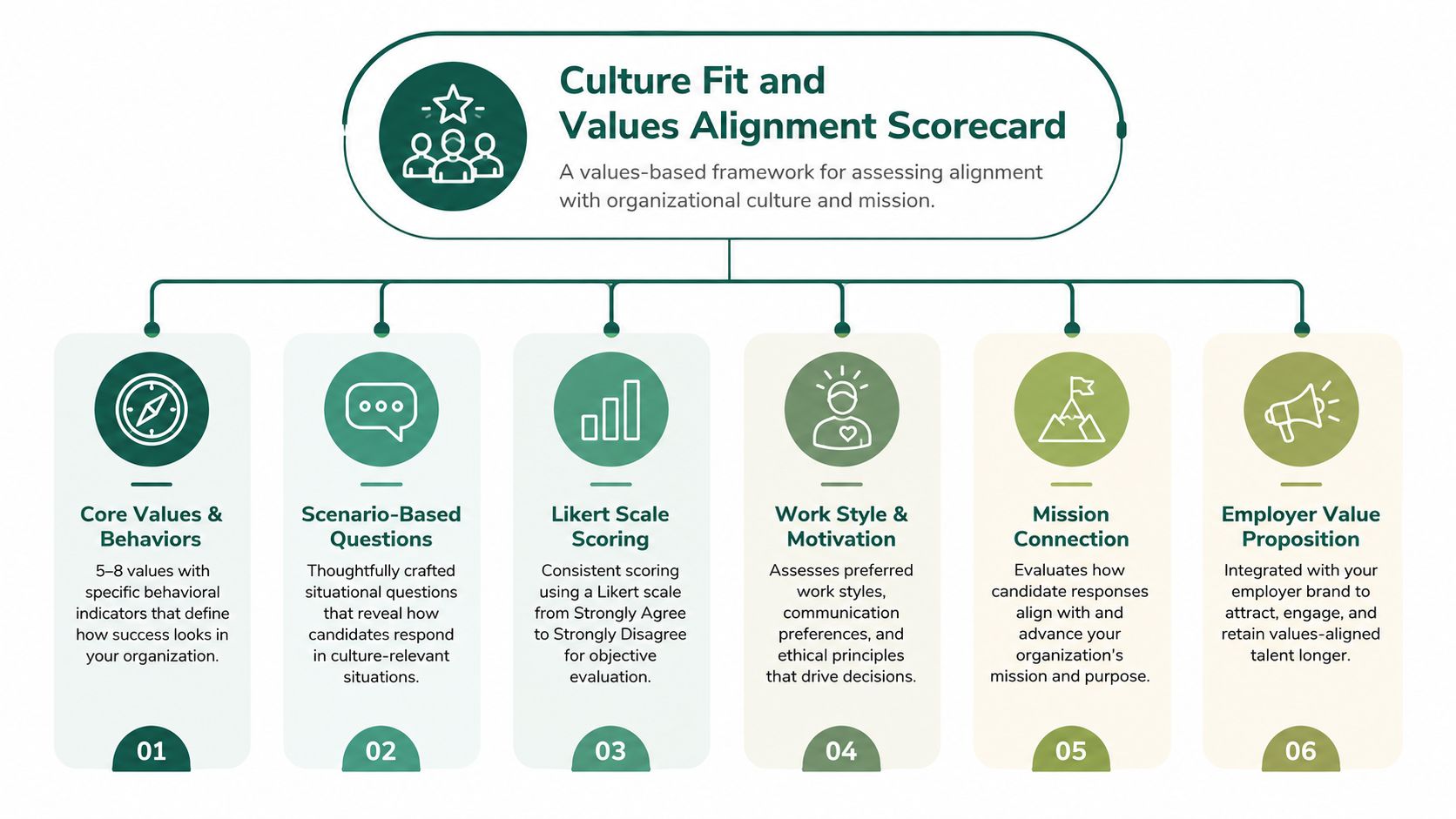
Culture scorecards can improve hiring conversations, but they're also one of the easiest ways to encode similarity bias. “Culture fit” becomes unsafe when it means liking the same people, sharing the same background, or communicating in the same style. A defensible version scores job-relevant behaviors connected to explicit organizational values.
For a hospital, the rubric might examine how a candidate handles patient dignity, escalation, and cross-functional accountability. A biotech company may assess scientific integrity, documentation discipline, and constructive challenge. A nonprofit may focus on mission stewardship and resource judgment. These are assessable behaviors, not personality preferences.
Write each value as a behavioral statement. “Collaboration” is too broad. “Shares relevant information early, invites the expertise needed to resolve risk, and gives direct feedback respectfully” gives interviewers something to assess.
Scenario questions are usually more useful than agreement statements. Ask what the candidate would do when speed conflicts with safety, when a senior colleague makes an error, or when a team rejects their proposal. Then evaluate the reasoning against the organization's stated principles. A practical culture fit assessment framework can help teams distinguish values alignment from personal affinity.
Avoid using Likert-style responses as a standalone filter. Candidates can select the answer they believe the employer wants, and reviewers may interpret the same response differently. Combine scenario evidence with a separate recommendation field, and require reviewers to explain which behavior supports the rating.
“Hire for shared standards, not shared personalities.”
Review the scorecard for exclusionary signals. If the rubric rewards constant availability, a particular communication style, or an undefined sense of “energy,” rewrite it. The best culture scorecards make expectations transparent while leaving room for different backgrounds, working styles, and perspectives.
A competency matrix is a grid that maps the capabilities required for a role against proficiency levels. It's particularly effective for healthcare credentialing, manufacturing certification, professional services, and internal mobility because it shows both current strengths and development gaps.
The matrix should distinguish knowledge, experience, and demonstrated capability. A candidate may have used a tool for years without handling complex cases. Another may have less formal experience but demonstrate advanced problem-solving in a practical exercise. Keeping those dimensions separate prevents tenure from becoming a substitute for evidence.
Set the required level for each competency before reviewing candidates. Use labels such as novice, intermediate, advanced, and expert, but define them behaviorally. “Advanced” might mean the candidate handles ambiguous work independently, identifies downstream risks, and coaches others. “Intermediate” might mean the candidate completes standard work reliably and escalates exceptions appropriately.
A useful matrix records:
The grid can reveal that a candidate is strong in core work but needs development in a secondary area. That makes it more useful than a single composite score for deciding role level, onboarding support, or internal transfer. It also helps hiring managers discuss trade-offs without pretending every competency has equal importance.
The risk is complexity. Large matrices create inconsistent scoring and heavy administration. Keep only competencies tied to successful performance, use a small number of proficiency definitions, and require an evidence note before a reviewer can submit a level. A heat map may make the profile easy to scan, but it must link back to the underlying evidence.
A comparative scorecard turns several candidate evaluations into an operational decision system. It works well for high-volume recruiting, provided the ranking follows minimum qualification checks. A strong interview score cannot offset a missing license, incompatible schedule, or failed safety requirement.
Set up two separate decision paths:
Keep these paths visible in the ATS. A failed requirement should stop automatic ranking rather than disappear inside a composite total.
For each candidate, store the score, supporting evidence, confidence, and recommendation as separate fields. Recommendations might be Strong Hire, Hire, No Hire, or Strong No Hire. Testask's structured scorecard guidance supports defined rating scales, behavioral anchors, evidence fields, and an explicit recommendation field.
The ranking view should expose why a candidate holds a position. Reviewers can use prompts such as:
Require independent ratings before the hiring discussion. During calibration, compare the reasoning behind unusually high or low scores. Do not average away disagreement. A wide gap may point to vague anchors, inconsistent questions, or incomplete evidence.
A candidate-ranking workflow in the ATS can calculate the order, flag missing qualification fields, and preserve reviewer notes for audit. A conversational screening workflow can collect structured answers first, then route qualified candidates to the same rubric used in later interviews. Candidate ranking system guidance offers practical guidance for designing that process.
The final rank remains a decision aid. Hiring managers should review the complete record, confirm required conditions, and document why the selected candidate fits the role better than the alternatives. This preserves judgment without creating an opaque leaderboard.
Inclusive hiring depends on a consistent evidence trail, not a demographic score. The scorecard should show whether every candidate received a comparable opportunity to demonstrate job-related capability, where applicants exited, and whether reviewers applied the rubric consistently. Demographic identity must not become a hiring score, and representation targets must not replace qualification standards.
Build the controls into the assessment before interviews begin. Use the same core questions and instructions, then define acceptable evidence for each competency. Review the wording for signals that reward similarity, penalize an accent or communication difference, or treat an unconventional career path as a weakness without linking it to performance.
The scorecard can track candidate source, stage progression, panel composition, question consistency, and documented reasons for advancement or rejection. Where demographic information is lawfully collected, restrict access and use it to monitor the process, not to score interviewers or candidates.
Use a short review panel:
Replace vague culture fit language with observable behaviors tied to safety, service, collaboration, integrity, or role execution. A candidate should be assessed against those behaviors, not familiarity with the existing team. Review demographic patterns carefully as process signals, without forcing every trend into a positive or negative conclusion.
Use the scorecard to inspect decisions, not to claim that a form removes bias.
In practice, an ATS can require completed evidence fields, preserve reviewer notes, and support later audits. A conversational screening workflow can ask the approved questions consistently, record structured answers, and route candidates into the same rubric used by interviewers. Keep human review in the loop, especially when an answer is incomplete or the role involves judgment that automation cannot assess reliably.
Legal compliance also depends on the employer's broader practices, applicable law, data handling, and review by qualified counsel. The scorecard creates traceability. It does not provide legal clearance or guarantee an unbiased outcome.

A screening scorecard decides whether an applicant meets the role's entry requirements and should receive human review. For high-volume hiring, conversational screening can present the same questions through web or mobile, accept responses outside business hours, and send structured answers to the ATS.
Separate three fields in the rubric: eligibility, evidence, and recommendation. Eligibility records requirements such as certification, location, work authorization, schedule, or relevant experience. Evidence captures the candidate's exact response or a concise transcript-based note. Recommendation records whether the application advances for employer review, with the reason attached.
Questions should reflect the job and its risks. A clinical workflow can test compliance and scenario judgment. A manufacturing workflow can examine safety behavior and troubleshooting. A technology workflow can combine technical questions with behavioral probes. Each question needs scoring anchors, acceptable evidence, and a rule for incomplete or ambiguous answers.
A workable process has these control points:
Automation should standardize questions and documentation, not make the final hiring decision.
Artificial intelligence can improve consistency and response speed, yet thresholds can create false negatives. Test them against reviewed answers, monitor incomplete sessions, offer an opt-out where available, and route uncertain cases to a person. Conversational screening tools can prepare structured scorecards automatically, but the employer should retain advancement and rejection authority. Talent Pronto's model, for example, uses its virtual assistant Anna to conduct conversational screening and prepare structured scorecards while employers retain final decisions.
Candidates should know when they are entering an automated stage and how to request human assistance or a traditional process. Preserve the response, rubric result, exception reason, and reviewer decision in the ATS. A machine-generated label alone cannot show why an applicant advanced or stopped.
A reference and background check scorecard tests the evidence behind a candidate's claims before an offer. Use the same core questions for candidates competing for the same role, while documenting consent, privacy limits, applicable law, and what each source can legitimately confirm.
Start with the decision risk, then choose the evidence. For a role requiring independent delivery, ask references about responsibilities, reliability, work quality, judgment, collaboration, and supervision. Capture the reference's relationship, length of contact, and firsthand knowledge. A direct supervisor describing repeated work carries a different evidentiary weight from a peer recalling a brief interaction.
Score evidence in separate fields, not one blended impression:
A discrepancy requires examination before judgment. Titles differ, records may be incomplete, and candidates may describe practical responsibilities rather than formal titles. Ask the candidate to explain the difference, record the response, and let the hiring team apply the same rule to comparable cases.
Background checks need their own controls. Criminal-record and other historical information can create collateral consequences, while inconsistent procedures can raise discrimination and privacy concerns. Limit access, document authorization, and apply job-related criteria. Store the check status, source, finding, reviewer, and unresolved question in the ATS so another reviewer can reconstruct the decision.
For conversational or recruiter-led workflows, use a required follow-up prompt when an answer conflicts with the application. Route unclear or sensitive results to HR or legal review, and pause adverse communication until that review is complete. Talent Pronto's virtual assistant Anna can conduct conversational screening and prepare structured scorecards, while employers retain final decisions.
The final recommendation should explain what was confirmed, what remains uncertain, and why the evidence supports the outcome. A mixed reference belongs in that record, not in an unsupported numerical shortcut.
A role-specific scorecard turns job analysis into a hiring system. It defines the work, sets evidence standards, and gives interviewers a consistent way to interpret results.
Start with the decisions the role must handle. For clinical nursing, score patient safety, escalation, documentation, and credentials. For manufacturing engineering, assess process control, root-cause analysis, safety judgment, and equipment reliability. Retail management may require workforce planning, customer recovery, inventory discipline, and coaching. Government roles can include public accountability, procurement rules, and documentation.
Each example needs its own rubric logic. Treat credentials and other qualification rules as gates. Rate job capabilities with behavioral anchors that describe weak, acceptable, and strong evidence. Match each criterion to an assessment source, such as a structured interview, work sample, simulation, technical task, portfolio, certification, or reference. Weight capabilities according to job risk, then keep the final recommendation separate from component ratings.
A practical record can include:
A score is only useful when reviewers know how to read it. Require evidence for every rating, flag missing or contradictory evidence, and discuss borderline cases during calibration. Compare ratings against the same anchors, not against another candidate's personality or interview style.
Specialized templates require ownership. Assign a reviewer, keep version history, record why criteria changed, and validate updates when duties, technology, regulations, or operating models shift. A rubric built for one department should not transfer automatically to another role.
Conversational screening can apply the same controls. Configure early questions for healthcare, manufacturing, retail, government, or technology, then send structured answers to the ATS for recruiter review. Talent Pronto's virtual assistant Anna can conduct conversational screening and prepare structured scorecards. The employer retains the final decision.
| Scorecard | 🔄 Implementation Complexity | ⚡ Resources & Time | 📊 Expected Outcomes (Impact) | Ideal Use Cases | 💡 Key Advantages / Tips ⭐ |
|---|---|---|---|---|---|
| Balanced Scorecard (BSC) for Talent Acquisition | High, cross-functional setup, weighting design | Requires historical data, analytics tools, periodic reviews | Strategic alignment, holistic hiring metrics, trend visibility | Enterprise hiring, workforce planning, leadership roles | Encourages strategic hiring; start with 4–6 core KPIs; adjust weights quarterly. ⭐💡 |
| Behavioral Interview Scorecard | Medium, rubric & interviewer training needed | Interviewer training, calibration sessions; moderate time per interview | Strong predictor of on-the-job behavior; consistent evidence trail | Roles needing soft skills, leadership, customer-facing positions | Use STAR probes and anchored rubrics; train interviewers to reduce bias. ⭐💡 |
| Technical Skills Assessment Scorecard | High, SME design, secure test development | Assessment platforms, proctors/reviewers; moderate–high cost and setup time | Objective skills validation; predictive for technical performance | Engineering, IT, lab, R&D, manufacturing technical roles | Use tiered testing, SME input, combine automated and human review. ⭐💡 |
| Culture Fit & Values Alignment Scorecard | Medium, define behavioral indicators; rater calibration | Scenario design, rater training, ongoing validation | Better retention and team cohesion; risk of homogeneity if misused | Mission-driven orgs, healthcare, startups, nonprofits | Use behaviorally‑anchored questions; pair with diversity efforts. ⭐💡 |
| Competency Matrix Scorecard | High, many competencies, multi-source scoring | Multiple assessment sources, consolidation tools; time‑intensive | Holistic capability profile; supports development and succession | Credentialing, complex roles, succession planning | Start with 8–12 critical competencies; calibrate regularly. ⭐💡 |
| Candidate Ranking & Comparative Scorecard | Medium, weighting methodology and calibration | ATS integration, scoring templates; efficient for volume | Ranked shortlists, faster selection, auditable decisions | High-volume hiring, large applicant pools, shortlist creation | Define criteria upfront; review outliers and avoid numeric overreliance. ⭐💡 |
| Diversity & Inclusive Hiring Scorecard | Medium, metrics, policy alignment, training | Data tracking, sourcing partnerships, ongoing training | Improved representation and reduced bias risk when paired with culture work | Organizations addressing demographic gaps or regulatory needs | Combine diversity goals with quality metrics; use blind review and audits. ⭐💡 |
| Screening Interview Scorecard (AI & Structured) | Low–Medium, standardized scripts; AI validation needed | Conversational AI or screening tools; one-time setup, scales easily | Rapid qualification, lower screening load, faster time-to-hire | High-volume screening, 24/7 sourcing, retail, hospitality | Screen must-haves first; monitor false negatives and add human review for borderlines. ⭐💡 |
| Reference & Background Check Scorecard | Medium, legal/compliance complexity | Third‑party checks, reference calls; cost and time per candidate | Validates claims, reduces negligent-hiring risk, uncovers unseen issues | Safety‑sensitive, regulated, senior or credentialed roles | Use vendor checks, document verbatim feedback, investigate discrepancies. ⭐💡 |
| Role‑Specific / Industry‑Specific Scorecard Templates | High, SME input and frequent updates | Subject-matter experts, pilot testing, annual maintenance | Higher predictive validity and job readiness; faster onboarding | Clinical nursing, pharma, manufacturing, specialized technical roles | Pilot templates, validate against performance, involve hiring managers. ⭐💡 |
The best scorecard isn't the most elaborate template. It's the one that helps trained reviewers make the same kind of job-relevant judgment, with enough evidence for another person to understand the decision later.
Start by defining the criteria that matter for the role. Separate minimum requirements from assessable competencies. A certification, license, schedule requirement, or legal condition may be a gate, while communication, troubleshooting, ownership, or leadership can be evaluated through structured questions and work samples.
Next, write observable anchors. “Strong communicator” isn't an anchor. “Explains a complex issue in a way the intended audience can act on, checks understanding, and adjusts when the first explanation fails” is closer to one. Give each rating level a behavioral meaning, and require a short evidence note for every competency. Research summarized by PIN's interview scorecard guidance describes the value of structured scales, weighted competencies, behavioral anchors, and written evidence. The cited review places structured scoring around .51, compared with approximately .20 for unstructured interviews, and notes that rigorous methods can reach .57. Those figures are useful context, but they don't make a poorly designed rubric valid.
Choose the appropriate model from the examples above. Use a behavioral scorecard for past-action evidence, a technical scorecard for demonstrated capability, a competency matrix for level and development decisions, a comparative scorecard for a defined candidate pool, and a screening scorecard for early qualification. Use a Balanced Scorecard when the question concerns recruiting operations and business alignment rather than one applicant.
Test the draft with hiring managers before launch. Ask them to score the same sample responses independently. Where ratings diverge, revise the anchor or the question. Calibration should focus on evidence, not on persuading people to accept a predetermined score. Reviewers should submit individual ratings before group discussion so the first confident opinion doesn't become the team's default.
Connect scorecard fields to ATS stages. Store the question, competency, rating, evidence, confidence, reviewer, recommendation, and status as distinct data. If AI or conversational screening is involved, keep the transcript or answer-level evidence available for human review. Use automated outreach, scheduling, and status synchronization to reduce manual work, but retain employer control over advancement and rejection.
Talent Pronto can support role-specific conversational screening, structured scorecards, automated candidate outreach, interview scheduling, and ATS or HRIS synchronization. Its platform can engage applicants through conversational workflows, ask behavioral and technical questions, prepare rubric-based results, and connect with systems such as Greenhouse, iCIMS, Paylocity, ADP, and Workday. Those capabilities can improve process consistency, but employers still need to validate questions, review evidence, monitor candidate opt-outs, and make the final decision.
Finally, treat every scorecard as a living operating document. Review weights, evidence quality, reviewer disagreement, false negatives, and inconsistent decisions regularly. A template that looked sensible at launch may stop matching the job, the workforce, or the compliance environment. Keep the structure stable enough for comparison, and update the content when evidence shows that the workflow needs to change.
Talent Pronto provides 24/7 conversational screening, role-specific behavioral and technical questions, structured candidate scorecards, automated outreach, scheduling, and ATS or HRIS synchronization. Visit Talent Pronto to connect scorecard-based hiring with a more consistent early-stage workflow while keeping final hiring decisions with your team.

Talent Pronto is an AI-powered hiring platform built around Anna, our intelligent AI that conducts 24/7 conversational screening, evaluates candidates against specific job requirements and compliance needs, and schedules interviews. Run everything on the Talent Pronto ATS, our all-in-one applicant tracking system with a branded careers site and Anna built in, or keep your existing ATS and let Anna integrate with Greenhouse, Ashby, iCIMS, Jobvite, Lever, Oracle, and more. Either way, we help organizations reduce time-to-hire and build stronger teams.