Learn how to reduce hiring bias with structured interviews, blind screening, diverse panels, and audit-ready metrics. Practical guide for fair hiring in 2026.
You've got two candidates who can do the job. Both answer the same questions, both have relevant experience, and both meet the stated requirements. Yet one interviewer spends extra time discussing a shared university, another penalizes a candidate for giving a concise answer, and a third lets one impressive project shape the entire evaluation. By the end of the day, the panel feels confident, but nobody can clearly explain why the decision was fair.
That's the challenge in learning how to reduce hiring bias. Good intentions aren't enough when the process gives personal preference room to influence sourcing, screening, interviews, and debriefs. Fair hiring requires a system that makes job-related evidence easier to use than instinct.
Most hiring bias isn't produced by one openly prejudiced decision-maker. It's produced by a sequence of ordinary decisions made without consistent controls. A recruiter interprets a vague job description, a hiring manager asks whatever comes to mind, interviewers score candidates against different standards, and the panel then treats the loudest opinion as the most credible.
That process invites affinity bias, the tendency to favor people who feel familiar, along with halo effects, horns effects, confirmation bias, and recency bias. A shared hobby can create warmth. A prestigious employer can make every answer sound stronger. A hesitant opening response can color the rest of an interview. None of these impressions necessarily measure the candidate's ability to perform the work.
The evidence supports a structural response. A quasi-experiment using videotaped interviews rated by 386 business students found that interviewers favored racially similar applicants less in high-structure interviews than in low-structure interviews. The study concluded that increasing structure can suppress racial similarity bias in employment interview ratings. Read the study on interview structure and racial similarity bias.
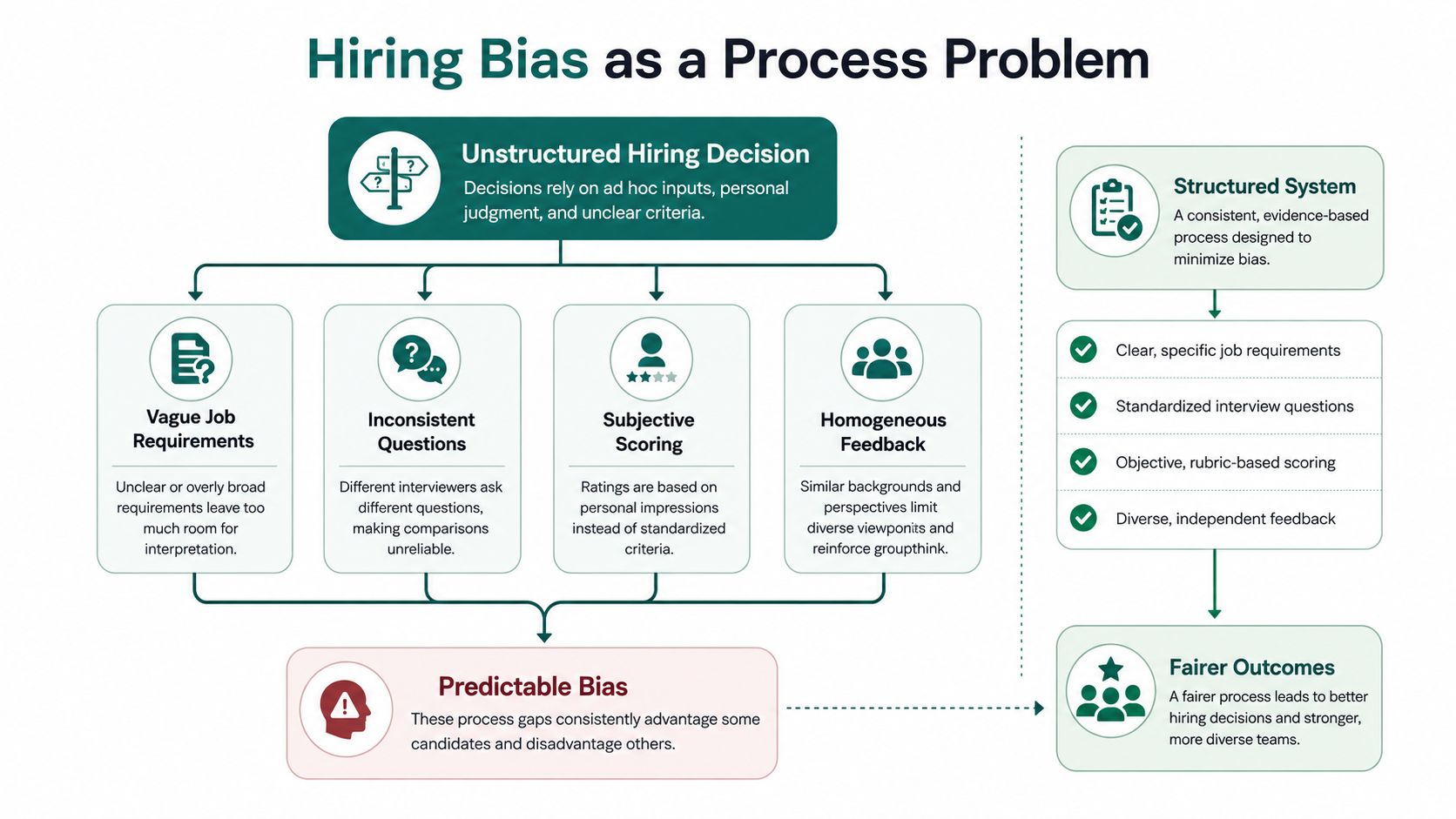
A fair process starts before the first interview. The hiring team should:
This is an engineering problem. The inputs are job requirements, questions, scoring rules, panel assignments, and candidate data. The outputs are progression rates, scores, offers, and hires. If the outputs look uneven, inspect the process instead of assuming individuals will correct themselves through awareness alone.
A structured interview isn't a friendly conversation with a scorecard attached. It's a controlled assessment designed to give candidates comparable opportunities to demonstrate job-related capability.
Start with a documented job analysis. Identify the outcomes, recurring tasks, decisions, and competencies that distinguish effective performance. Every interview question should connect to that analysis. If a question can't be tied to a real requirement, remove it.
A high-structure interview should also standardize the mechanics:
A peer-reviewed review describes structured interviews as using standardized, behaviorally or situationally anchored questions, careful scoring rubrics, interviewer training, and controls that improve interrater agreement and reduce bias. It also notes that blinded interviews can further reduce halo, horns, and affinity bias. Review the evidence on structured interviews and bias reduction.
Don't let interviewers improvise questions about hobbies, family, alma maters, or lifestyle. Those topics create opportunities for affinity bias without producing reliable evidence about job performance.
Don't permit a post-interview gut override. If an interviewer believes the rubric missed something, they should document the job-related evidence and request a rubric review, not replace the score with a feeling.
Finally, don't compare candidates to one another inside the rubric. Compare each person with the defined bar for the role. The strongest candidate in one interview batch may still fall short of the requirements, while a candidate in a weaker batch may meet them.
For a mid-level customer success role, the scorecard might assess four competencies: customer problem solving, communication, account ownership, and cross-functional collaboration.
| Competency | Score 1 (Below Bar) | Score 2 (Approaching) | Score 3 (Meets Bar) | Score 4 (Exceeds Bar) |
|---|---|---|---|---|
| Customer problem solving | Describes reacting without diagnosing the customer's underlying issue | Identifies some contributing factors but needs substantial guidance | Diagnoses the problem, explains the response, and connects it to customer impact | Anticipates root causes, manages trade-offs, and shows how the solution prevented recurrence |
| Communication | Gives unclear answers and omits relevant context | Communicates the basic response but misses important stakeholder needs | Explains decisions clearly and adapts communication to the audience | Creates alignment across difficult stakeholders and makes complex issues easy to act on |
| Account ownership | Waits for direction and doesn't define next steps | Completes assigned actions but shows inconsistent follow-through | Sets priorities, tracks commitments, and closes the loop with customers | Builds a proactive account plan and identifies risks before they affect the relationship |
| Cross-functional collaboration | Blames other teams or works around them | Involves partners after problems emerge | Coordinates effectively with internal teams to resolve customer needs | Creates repeatable collaboration practices that improve outcomes across accounts |
Use a documented hiring bar rather than forcing artificial ranking across candidates. A panel can require evidence of meeting the bar across all four competencies, while treating an exceptional score as supporting evidence rather than a substitute for a missing core skill.
Calibration matters before the first live interview. Give panelists sample answers, have them score independently, compare their reasoning, and resolve disagreements about what each score means. The interview scoring rubric guide can help teams turn broad competencies into observable evaluation criteria.
A recruiter opens an application and immediately recognizes the candidate's former employer. That familiarity can shape the review before job-related evidence receives proper attention. Blind screening reduces some of those triggers by hiding a candidate's name, photo, school, graduation year, address, and similar identifying details.
It does not make evaluation objective by itself. Work history, job titles, accomplishments, writing style, and career progression remain visible, and those signals can carry bias. Configure blind review to remove irrelevant identity cues while preserving the information needed to assess scope, results, and relevant experience.
The ATS should carry the hiring criteria into each stage as structured fields, not as a paragraph buried in the job description. Store required competencies, acceptable evidence, knockout requirements, and review status as separate fields. Automated matching can then identify resume phrases, application responses, or screening answers associated with those fields and send the evidence to a recruiter for review.
Require the system to show the matched text, the criterion it relates to, and any requirement that remains unverified. A score without rationale creates another opaque judgment layer. Give reviewers a way to correct a match, record why it was wrong, and flag patterns for regular audit.
Structured interview guidance reviewed by McGill recommends basing questions on job analysis, asking every applicant the same questions, limiting prompts, using better question types, asking more questions or conducting longer interviews, controlling ancillary information, and postponing applicant questions until after the assessment. See the structured interview design guidance.
Automated screening introduces a distinct risk. Research on automated employment decision tools has documented how systems can reproduce or amplify patterns in historical data, especially when prior outcomes reflect narrow ideas about who succeeds. A model trained or tuned on historical hiring outcomes may therefore reproduce preferences embedded in those outcomes.
Test the tool before launch with known examples, including qualified applicants whose experience follows less familiar paths. Review selection patterns by stage, inspect false negatives, and pause automated rules that rely on proxies such as school, employer prestige, career gaps, or writing style without a clear job-related reason.
The operating rule is direct: remove as much unstructured discretion as possible before the first human conversation, but keep humans accountable for final selection. Automation can organize evidence and prioritize review. It should not decide who deserves an opportunity.
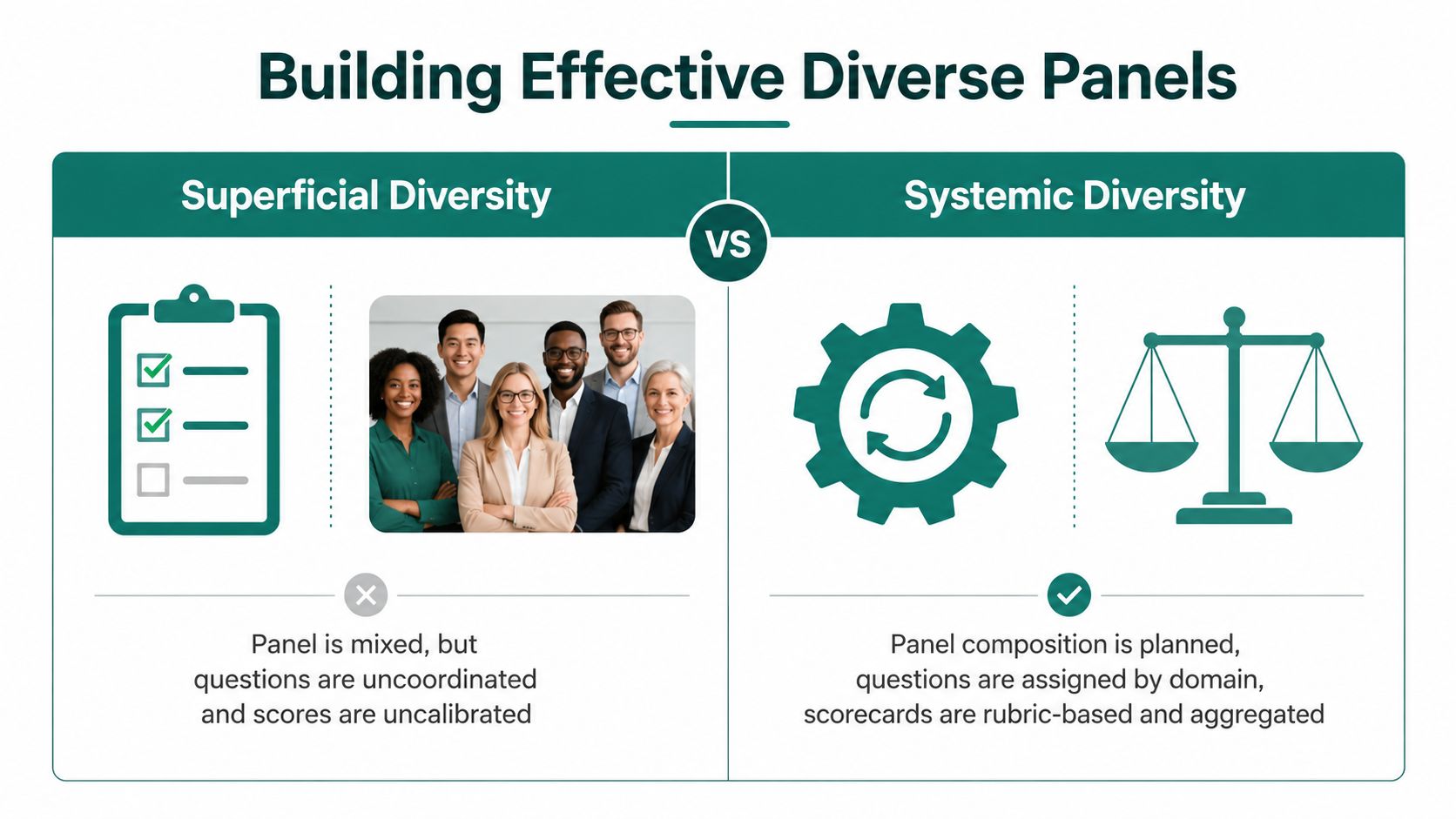
A diverse panel doesn't reduce bias merely because its members have different identities. It works when the panel's composition, question ownership, scoring process, and debrief behavior are designed together.
Build variety across function, tenure, professional background, and demographic perspective. Rotate seats so the same small group doesn't dominate every hiring loop. Assign each interviewer a competency area, but give everyone the same core instructions, scoring scale, and evidence standard.
A panel should follow a disciplined sequence:
A homogeneous panel can still behave fairly, but it has fewer built-in challenges to shared assumptions. A varied panel with uncoordinated questions can still behave unfairly. Composition is a design input, not a substitute for process discipline.
A yearly slideshow about unconscious bias may raise vocabulary, but it won't reliably change hiring outcomes. Training should occur where decisions happen, inside interview preparation, scorecard review, and debriefs.
Invest in three formats:
Avoid generic modules that never alter the interview kit. Post-hoc exercises that ask people to justify an already-made decision also arrive too late. Training delivered without scorecards, panel roles, or debrief controls gives people awareness but leaves the workflow unchanged. Teams looking to deepen this work can use a practical resource on unconscious bias training.
For a broader framework on measuring inclusive recruitment outcomes, connect panel design to funnel reporting rather than treating inclusion as a training completion exercise. Document panel assignments, facilitator ownership, calibration attendance, and training completion so the organization can audit who participated and which controls were active.
A short visual example can make the difference between representation and operating discipline easier to discuss.
A hiring process can feel fair while producing unequal outcomes. You need stage-level metrics to see where candidate groups are progressing differently and whether a particular interviewer, panel, source, or decision gate is driving the difference.
Track conversion ratios at every stage, broken out by candidate demographic where lawful and appropriate, and by source. Review application-to-screen, screen-to-interview, interview-to-debrief, debrief-to-offer, and offer-to-acceptance movement. A strong application-to-screen ratio paired with a collapsing screen-to-interview ratio points toward screening criteria or recruiter review. Stable movement until the debrief, followed by a sudden drop, points toward panel scoring or discussion behavior.
Use adverse impact ratios as a screening signal, not as a final legal conclusion. The four-fifths rule is a useful sanity check, but interpretation requires context, appropriate sample sizes, and qualified legal or statistical review. Use this adverse impact overview to structure your audit.
| Funnel Stage | Metric to Track | What It Signals | Likely Process Step to Audit |
|---|---|---|---|
| Application to screen | Conversion by demographic group and source | Whether sourcing or initial review may be filtering unevenly | Job requirements, source mix, blind review settings |
| Screen to interview | Progression rate and adverse impact ratio | Whether screening evidence is being interpreted differently | Resume criteria, recruiter calibration, automated matching |
| Interview to debrief | Competency score distribution | Whether interviewers apply different standards | Question quality, anchors, interviewer calibration |
| Debrief to offer | Panel override rate and score deltas | Whether discussion changes evidence-based evaluations | Facilitator practice, speaking order, consensus rules |
| Offer to acceptance | Acceptance rate by group and role | Whether the process or offer experience creates unequal outcomes | Candidate communication, flexibility, compensation process |
Build a quarterly dashboard that compares current cohorts with a rolling baseline. Flag any stage where a group's conversion falls more than 10 percentage points below baseline, then attach the flag to a named process step rather than a vague statement about diversity. The threshold is a triage rule, not proof of discrimination.
Small cohorts can create unstable ratios. Don't treat one unusual result as a trend. Suppress or qualify results where sample sizes are too small for a meaningful comparison, aggregate across appropriate periods or roles, and involve privacy, legal, and analytics partners before reporting sensitive demographic data.
Track interviewer score dispersion and panel override rates alongside conversion. If one interviewer consistently gives much higher or lower scores than peers, inspect calibration and question ownership. If panels frequently overturn independent scores during discussion, examine who speaks first, who facilitates, and whether the rubric is specific enough.
Every dashboard flag needs an action owner, a remediation date, and a follow-up measurement. Otherwise, the report becomes a record of concern rather than a mechanism for change.
Conversational AI screening belongs between application and human interview, where consistency and documentation matter most. It shouldn't replace the hiring team. It should create a standardized, auditable interaction that gives reviewers comparable evidence before they invest interview time.
A practical ATS workflow looks like this:
Talent Pronto can be configured as one example of this model. Its conversational assistant, Anna, conducts text-based screening, asks role-specific questions, prepares structured scorecards, and integrates with ATS and HRIS platforms including Greenhouse, iCIMS, Paylocity, ADP, and Workday. The employer still controls advancement and rejection decisions.
The employer should own the rubric. Configure weighting by competency, define what evidence supports each score, and require human review for borderline candidates. Every override should be logged with the reviewer, decision, and job-related reason.
That audit trail matters because automated consistency isn't the same as fairness. A model can apply the same flawed rule to everyone. It can inherit bias from historical data, encourage reviewers to over-trust a score, or create a poor candidate experience if applicants don't understand why an AI step exists.
Use specific safeguards:
Before adopting any AI screener, ask:
AI reduces bias only when it follows the same discipline as the rest of the hiring system. Consistent questions, job-related criteria, human authority, and inspectable records are the product. Automation is the delivery layer.
Don't try to rebuild every role at once. Choose one high-volume or high-friction role, establish the controls, measure what changes, and then scale what survives contact with real hiring.
Document the job analysis for one role. Define the competencies, outcomes, essential requirements, and evidence that demonstrates capability. Draft the interview rubric, create the ATS scorecard, assign question ownership, and run a calibration session with the pilot panel.
Enable blind resume review where feasible. Configure or pilot an AI screener only after the job-analysis matrix and rubric are approved. Assign a varied panel, standardize the interview flow, and collect candidate feedback about clarity, accessibility, and the screening experience.
Report funnel conversion ratios by demographic group and source. Run an adverse-impact check on the pilot, inspect score dispersion and panel overrides, and document remediation actions. Decide whether to scale, modify, or stop each control based on evidence rather than enthusiasm.
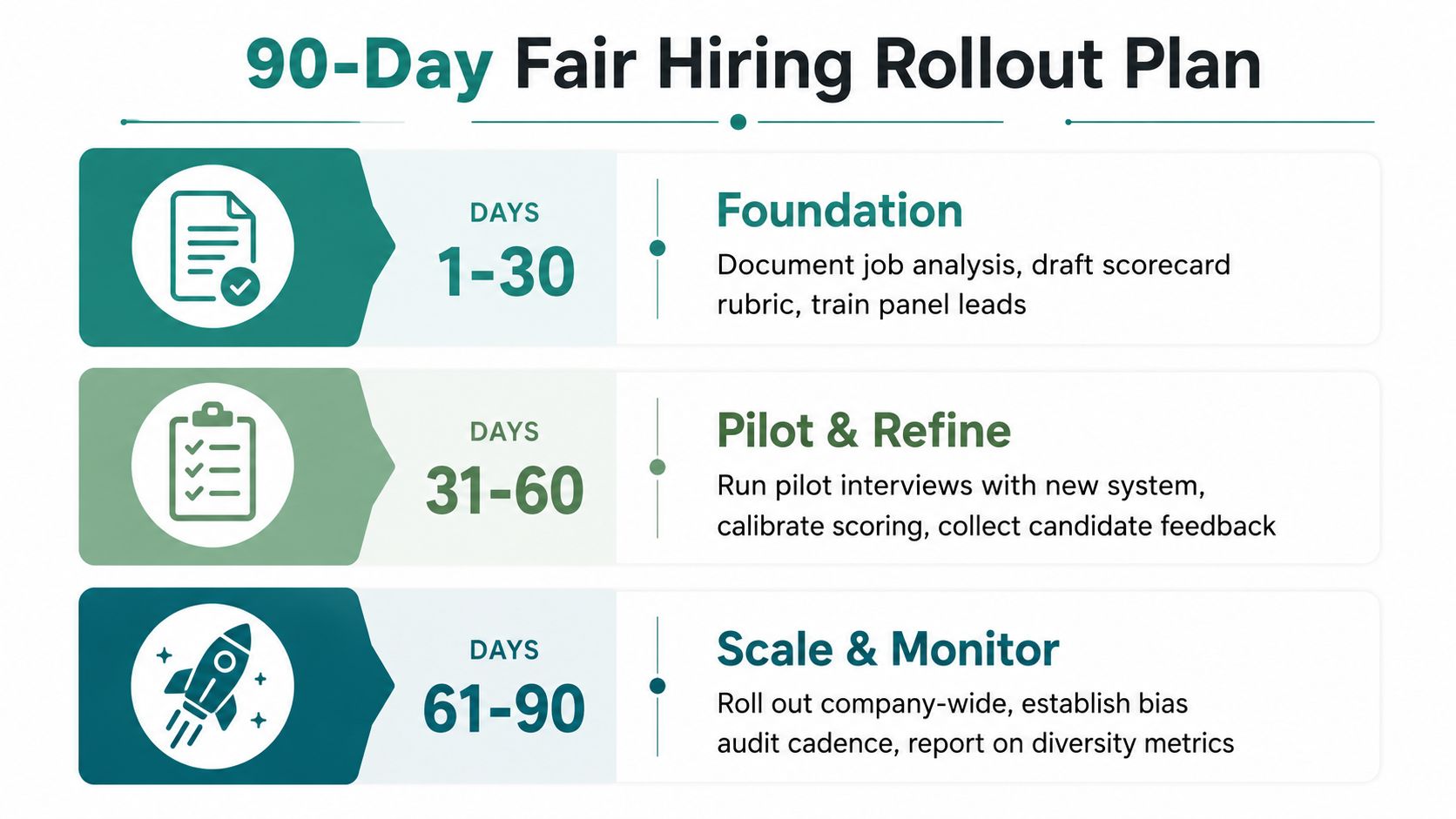
Set a fixed review cadence, such as a quarterly operating review, and define the trigger for action before results arrive. A flagged stage, repeated override pattern, or persistent score discrepancy should prompt a process change, not another awareness presentation.
Talent Pronto offers ATS-connected conversational screening, employer-defined rubrics, structured scorecards, candidate outreach, scheduling support, and funnel analytics for teams that want to standardize early evaluation while keeping final decisions with human reviewers. Visit Talent Pronto to evaluate whether its screening workflow fits your fair-hiring pilot.

Talent Pronto is an AI-powered hiring platform built around Anna, our intelligent AI that conducts 24/7 conversational screening, evaluates candidates against specific job requirements and compliance needs, and schedules interviews. Run everything on the Talent Pronto ATS, our all-in-one applicant tracking system with a branded careers site and Anna built in, or keep your existing ATS and let Anna integrate with Greenhouse, Ashby, iCIMS, Jobvite, Lever, Oracle, and more. Either way, we help organizations reduce time-to-hire and build stronger teams.