Discover how healthcare staffing software improves scheduling, credentialing, and compliance. Learn key features and ROI metrics.
Shopping for healthcare staffing software often happens as if it's a scheduling app with a few healthcare fields attached. That's the wrong mental model. The job is harder, because the platform has to act as a compliance and labor-optimization control layer that blocks bad assignments, protects patient safety, and keeps fill decisions tied to actual credential status, not hopeful assumptions.
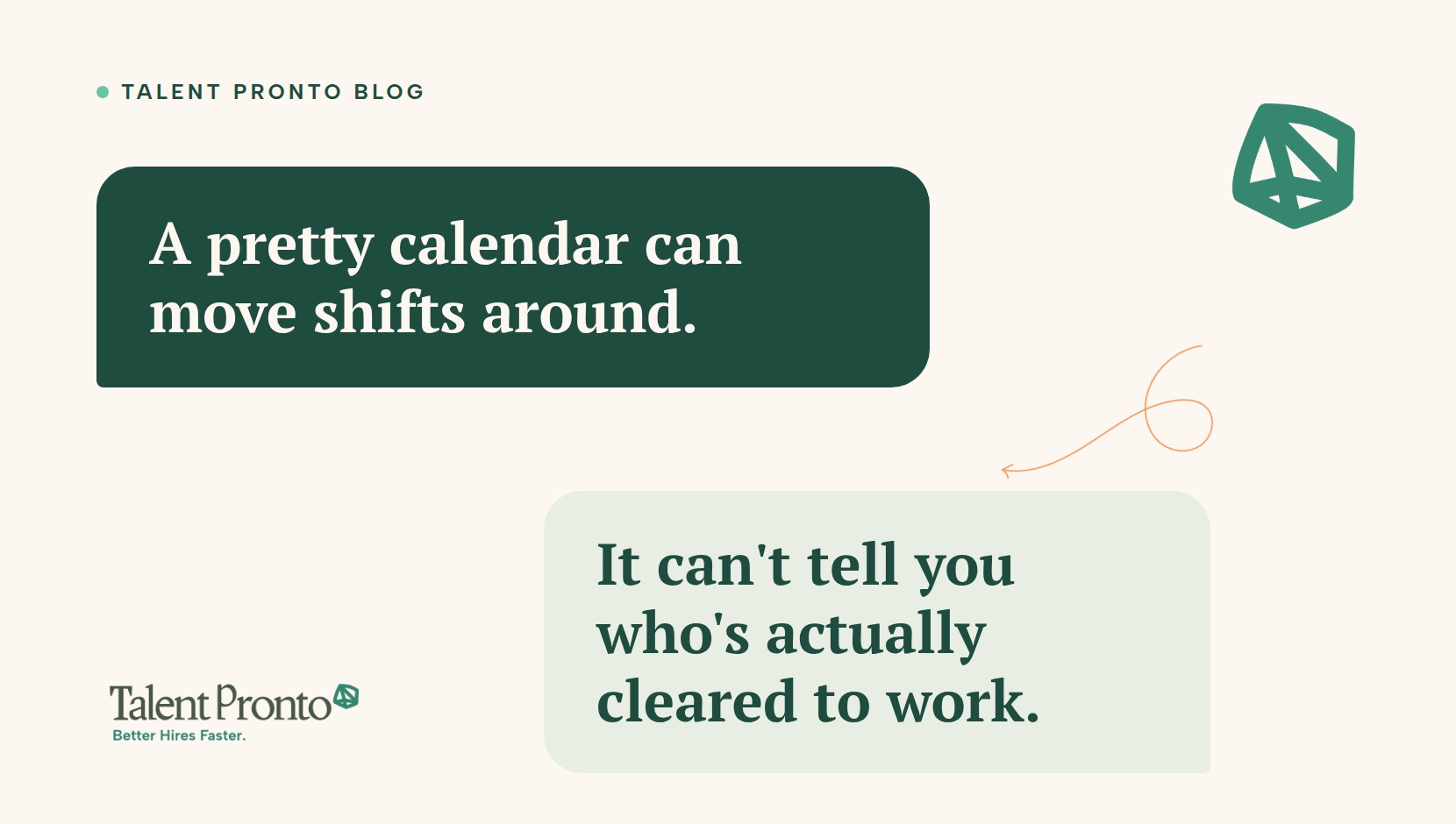
If a vendor leads with prettier calendars and faster drag-and-drop scheduling, push back. The question isn't whether the system can move shifts around. The question is whether it can stop the wrong person from entering the fill workflow, match the right worker to the right unit, and reduce the chaos that shows up later in payroll, billing, and audit prep.
A platform that lets you drag-and-drop nurses onto shifts without checking whether a state license has expired is a scheduler, not healthcare staffing software. Healthcare breaks that model fast. A missed license, a stale certification, or a facility-specific restriction does not stay an admin issue. It becomes assignment risk.
The system has to enforce license status, certification expirations, document completeness, and facility-specific compliance requirements before an assignment is offered or confirmed. That is why healthcare-specific platforms matter more than general ATS or CRM tools. The decision point lives at the schedule layer, where credential status determines whether a candidate can be placed. A candidate can look perfect in a database and still be unusable for a shift if the compliance layer does not clear them.
Practical rule: if a platform cannot block a non-credentialed worker before the shift is presented, it is not acting like a true healthcare staffing control system.
The architecture also has to support a full operational loop. Leading platforms combine ATS, credential tracking, shift scheduling, and VMS integration so staffing teams can source, qualify, place, and redeploy workers in one flow. In multi-state settings, that matters even more because rules change by jurisdiction and specialty, and the software has to keep pace without turning every fill into manual research.
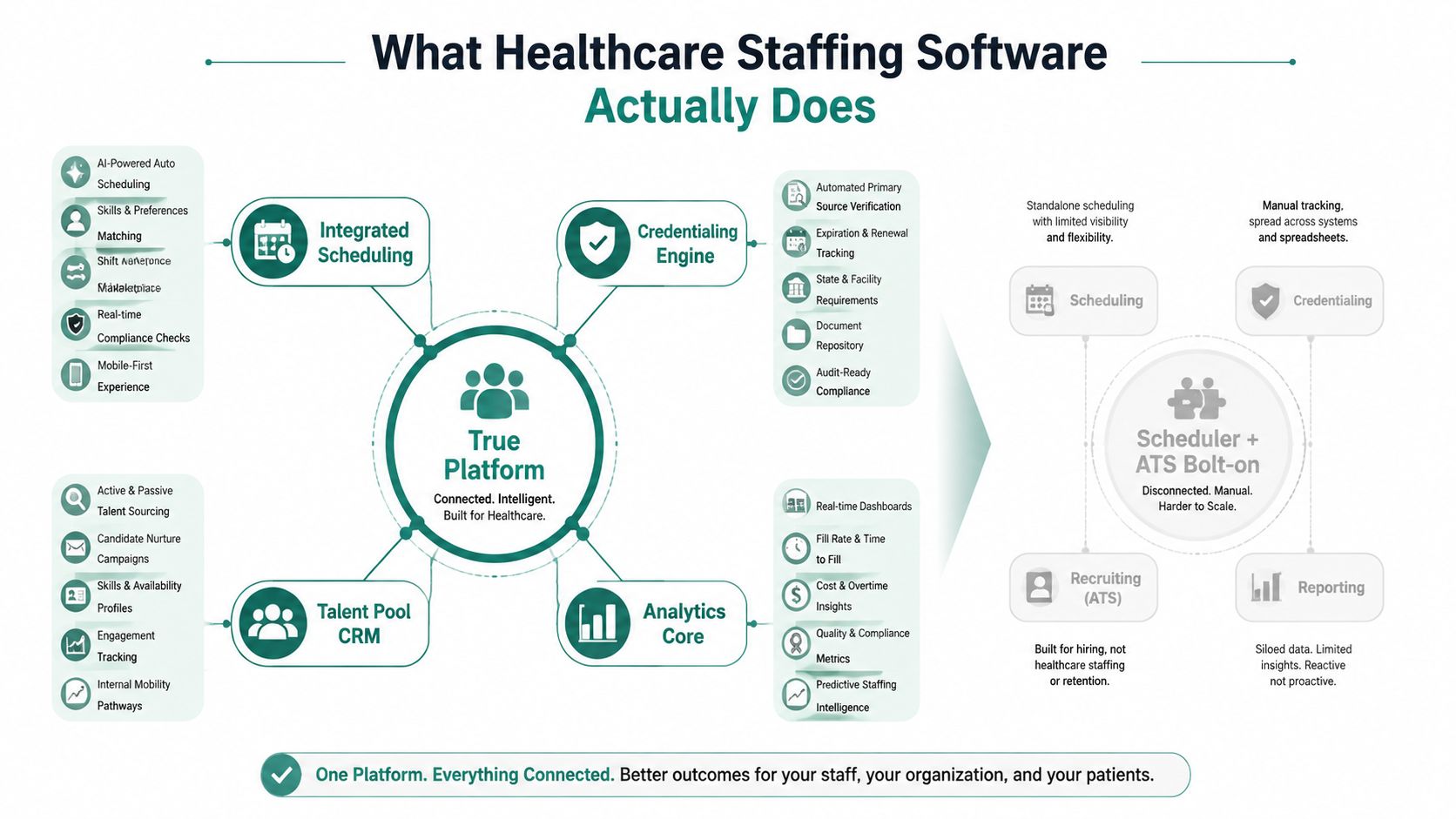
For a broader view of how healthcare hiring workflows connect to staffing operations, see Talent Pronto's healthcare industry page. The useful takeaway is simple. If the platform only helps you store candidates and move calendars, it is incomplete. If it helps your team prevent bad assignments and route qualified people into open shifts with less friction, you are looking at the right category.
A credible platform should help staffing teams answer three questions fast. Who is qualified, who is available, and who can legally and safely work this shift now. Anything less is just a workflow wrapper.
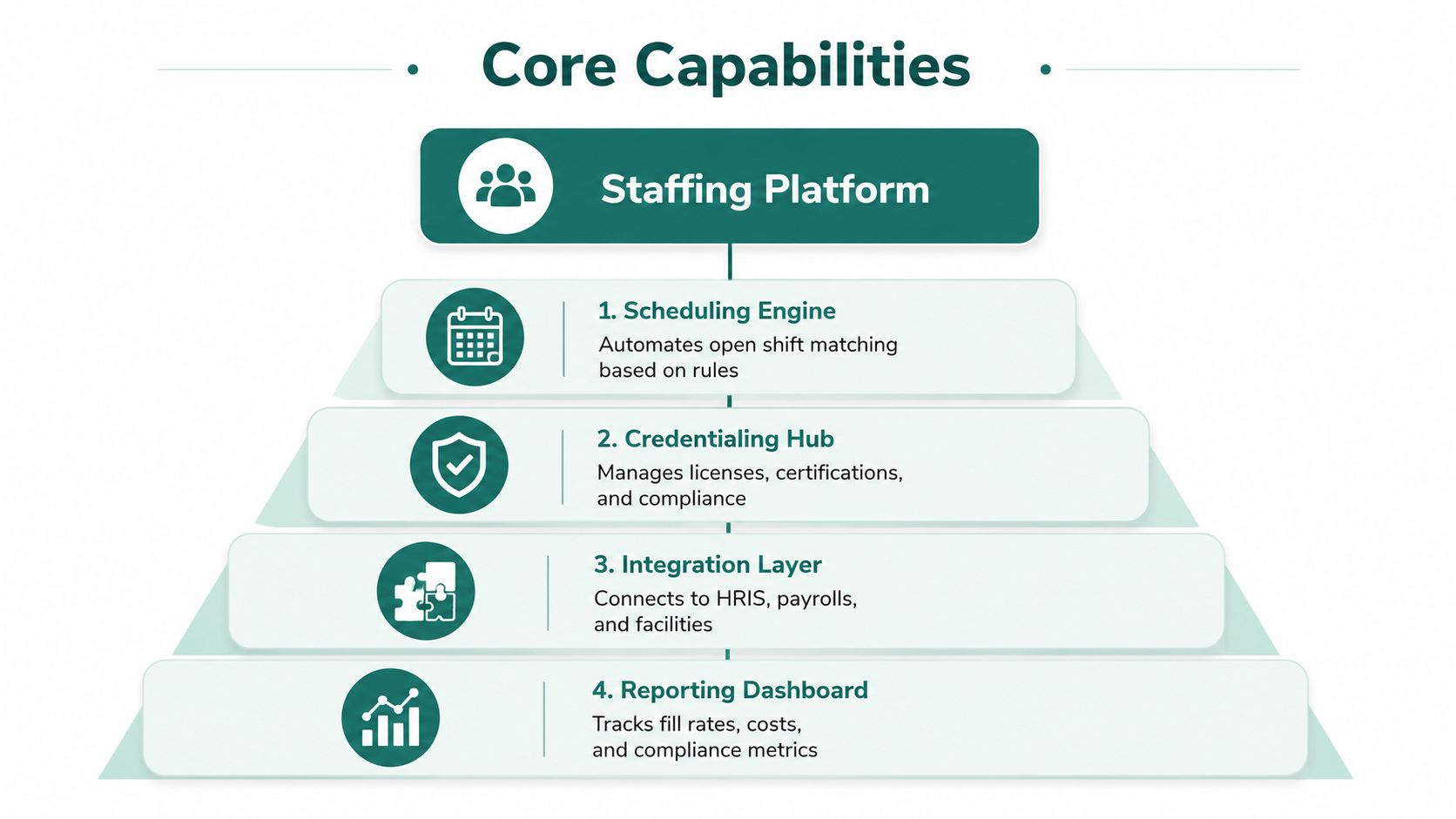
The easiest way to judge healthcare staffing software is to stop looking at feature lists and ask what job each feature performs. Scheduling should reduce open-shift drag. Credentialing should block risk. Integrations should remove duplicate work. Reporting should tell you what the operation is doing, not what the demo script promised.
Scheduling engine means the system can match open shifts based on rules, not manual memory. In healthcare, that includes specialty, unit, availability, and labor constraints, not just “who's free.” If a vendor can't show how it handles last-minute call-offs or float coverage, the scheduling module is too shallow.
Credentialing hub means licenses, certifications, immunizations, and expirations live in a place that affects assignment decisions. Healthcare software proves its value here. A document repository that doesn't stop a bad placement is clerical storage, not operational control.
Integration layer should connect to the systems your team already uses. In practice, that means ATS and HRIS tools such as Greenhouse, iCIMS, and Workday, so recruiters aren't rekeying the same person into three systems. If a vendor treats integrations like a future add-on, expect adoption friction and data drift.
Reporting dashboard should track fill rates, costs, and compliance signals in a way that managers can act on. Don't ask whether the dashboard looks modern. Ask whether it shows the exceptions that cost your team time.
The best demos show the exception path first, because that's where healthcare staffing platforms usually fail.
Ask the vendor to walk through a real assignment, not a generic user journey. Use a nurse with an expiring credential, a shift on a specialty unit, and a facility rule that should block placement until the record is complete. Then watch whether the software enforces the rule without manual intervention.
If you want a parallel example of structured screening and scorecards in hiring workflows, Talent Pronto's healthcare recruiting software overview is a useful comparison point. The point isn't that staffing and recruiting are the same. It's that both categories need structured decisions, not loose notes and manual judgment.
Compliance in healthcare staffing is not a post-check. It has to be a pre-check. If a platform waits until after a shift is filled to notice a missing license or incomplete file, the system has already failed the job it was bought to do.
The sequence should start with a new assignment request, then run an automated check on license status, certification expirations, and document completeness. If anything is missing, the assignment should go on hold before the worker is offered the shift. That's the difference between a healthcare-grade workflow and a generic scheduling tool.
Platforms that do this well also carry the logic into facility-specific rule validation. That matters in multi-state and multi-specialty environments because a worker can be cleared for one client and blocked for another. The software has to understand those distinctions without asking staff to babysit every exception.
Healthcare teams also benefit when ATS, credential tracking, shift scheduling, and VMS data sit in one loop. That reduces the gap between sourcing and placement, which is where a lot of compliance risk hides. The same rule set should also support rules-based matching, because the right worker is rarely just the most available worker.
The best systems don't stop at alerts. They also help with automated expiration notices, attendance verification controls such as geofencing, and rule-driven pay calculations for overtime and differentials. Those details matter because they reduce the downstream mess that spills into payroll and billing.
For general workforce context, TP Training's CPR First Aid White Card with TP is a useful reminder that credential requirements aren't abstract. Different roles carry different compliance expectations, and software has to respect that reality instead of flattening it into a simple status field.
If your team still checks credentials in spreadsheets after scheduling, the platform isn't carrying the risk. Your people are.
Buyers waste too much time on polished interfaces and not enough on failure modes. A strong vendor conversation should feel like an operational audit. If the platform can't prove it understands healthcare constraints, keep moving.
Start with the most important test. Can the system prevent non-credentialed workers from entering the fill workflow? If the answer is no, the rest of the pitch doesn't matter much. Then ask how the platform evaluates availability, specialty, patient population experience, and equipment certifications in one matching layer.
Mobile behavior matters too. Healthcare staffing lives on phones, not just desktops, so workers need fast interaction and clear communication. Ask how the system handles alerts, confirmations, and status updates across SMS, email, and in-app channels. The slower the response loop, the worse the coverage problem becomes.
Integration questions should be blunt. What syncs, how often, and with which systems. If the platform can't sit cleanly beside your ATS, HRIS, payroll, and facilities workflow, your team will fall back into duplicate entry.
Here's a checklist you can use in demos.
| Capability | What to Ask the Vendor | Why It Matters |
|---|---|---|
| Credential enforcement | Can the system block assignment before a worker is presented for a shift? | Prevents compliance gaps from reaching the schedule |
| Rules-based matching | How does it weigh specialty, availability, and facility requirements together? | Reduces manual sorting and bad-fit placements |
| Mobile communication | Can workers respond, confirm, and update status from mobile channels? | Shortens the time between open shift and coverage |
| Integrations | Which ATS, HRIS, payroll, and facility systems sync natively? | Cuts duplicate entry and data drift |
| Reporting | Can managers see exceptions, coverage gaps, and workflow bottlenecks quickly? | Makes the platform useful beyond day-to-day scheduling |
For a broader lens on operational software selection, the Clarity healthcare RCM insights page is a useful reference because it treats healthcare systems as connected workflows, not isolated tools. That's the right mindset here too.
Don't let the vendor stay in happy-path territory. Ask what happens when a credential expires the night before a shift, or when a worker qualifies for one facility but not another. If the platform starts leaning on manual workarounds, it's not enforcing control, it's documenting exceptions.
ROI in healthcare staffing software is not a promise. It's a measurement problem. If you can't baseline the operation before rollout, you won't know whether the platform improved anything or just moved the work around.
Track fill rate, time-to-credential, compliance incident frequency, hours-to-billing accuracy, and manual coordination hours saved. Those numbers connect directly to the platform's core jobs. If scheduling is better, fill rate should reflect it. If credentialing is stronger, incidents should drop. If integration is clean, billing accuracy should improve.
Use the dashboard as an audit tool, not a vanity report. A platform that reduces coordinator back-and-forth but leaves billing reconciliation messy is only solving part of the problem. Likewise, a system that looks efficient but still depends on email threads to confirm coverage is hiding labor, not eliminating it.
The business case also sits inside a bigger market move. The global healthcare staffing & scheduling software market was valued at USD 2.53 billion in 2024 and is projected to grow at a 13.49% CAGR from 2025 to 2030, reaching USD 5.36 billion by 2030 (Grand View Research). That's a sign buyers see these systems as operational infrastructure, not optional admin software.
Document current performance before implementation starts. Capture how long credential checks take, how many manual touches each shift requires, and how often billing or compliance errors appear. Then compare against the same metrics after rollout.
For a stronger measurement mindset in workforce tooling, Talent Pronto's data analytics in human resources article is a useful adjacent read. The logic carries over. If leadership can't see the numbers, it won't trust the software.
Finance teams don't buy “better visibility.” They buy evidence that exceptions dropped and manual reconciliation got smaller.
The hard part isn't signing the contract. The hard part is getting the rules right, the data clean, and the workflow connected without breaking live operations. Teams that skip that work usually blame the software when the core problem is implementation discipline.
A phased rollout beats an enterprise-wide switch every time. Start with one facility, one specialty, or one shift type, then prove the workflow before expanding. That gives your team room to find bad data, ambiguous rules, and broken handoffs while the blast radius is still small.
The biggest rollout mistake is assuming the platform will interpret your staffing rules for you. It won't. If one department calls a certification by one name and another uses a different label, the system will only be as good as the definitions you load into it. That's why phased implementation works, because it forces teams to clean the data instead of hiding behind broad rollout language.
Integration sequencing matters too. Connect credentialing before you turn on heavy scheduling logic, then bring in ATS and HRIS syncs once the assignment rules are stable. If you do everything at once, nobody can tell where the failure is coming from.
This kind of software only works if staff use it. That's why mobile-first worker interaction, fast alerts, and simple approval flows matter so much. If the experience is clunky, coordinators will keep using side channels, and the system will never become the source of truth.
The broader market has already shown that buyers are moving toward cloud delivery. In the U.S. healthcare staffing and scheduling software market, cloud-based deployment held 35.08% share in 2024, and time and attendance was the largest application segment at 28.06% (Grand View Research). That lines up with what I see in the field. Teams want real-time visibility, not another system that lives in a back office.

Roll out the rules before you roll out the scale.
Use four filters and don't let the conversation drift. First, does the platform enforce credentials at the schedule layer. Second, does it support rules-based matching instead of keyword sorting. Third, does it integrate cleanly with your ATS, HRIS, payroll, and facility systems. Fourth, can you measure outcomes within 90 days without debating the data.
If a vendor can't show those things in a live demo, you're not buying control. You're buying another place for work to pile up. The right platform is the one your team will use consistently because it makes the right action easier than the wrong one.
Talent Pronto helps healthcare teams automate early-stage screening with structured conversations, scorecards, and ATS or HRIS integrations, so candidates move through the funnel with less manual effort. If you're comparing staffing and hiring workflows together, visit Talent Pronto and see how a screening layer can support a tighter operational handoff.

Talent Pronto is an AI-powered hiring platform built around Anna, our intelligent AI that conducts 24/7 conversational screening, evaluates candidates against specific job requirements and compliance needs, and schedules interviews. Run everything on the Talent Pronto ATS, our all-in-one applicant tracking system with a branded careers site and Anna built in, or keep your existing ATS and let Anna integrate with Greenhouse, Ashby, iCIMS, Jobvite, Lever, Oracle, and more. Either way, we help organizations reduce time-to-hire and build stronger teams.