Discover the evidence behind unconscious bias training, common pitfalls, and strategies that actually drive change.
Most advice about unconscious bias training starts with the wrong question. It asks whether people can be made more aware of bias, then treats awareness as if it were the same thing as fairer hiring. The research doesn't support that leap, and HR teams that keep making it will keep buying workshops instead of changing outcomes.
If you want better decisions, the core issue is not whether people can define bias. It's whether your hiring system makes it hard for bias to survive. That means training has to sit inside structured criteria, repeatable evaluation, and accountable decision-making, or it stays a morale exercise with a polished slide deck.
People often assume that once a manager learns how unconscious bias works, hiring becomes fairer. That assumption is too simple. Knowing that bias exists is closer to knowing smoking is harmful than to quitting, because insight doesn't automatically change habits, incentives, or decision structures.
A major evidence review by the UK Equality and Human Rights Commission looked at 18 papers and found a mixed picture. The training could improve awareness of implicit bias, but there was no evidence that it reliably changed behaviour or eliminated bias. The same review noted that some interventions reduced the strength of implicit bias, yet did not reduce it to neutral levels, and it found insufficient evidence that training improved workplace equality outcomes such as representation in leadership or pay equity. UK Equality and Human Rights Commission evidence review
That gap matters because hiring is full of fast judgments. A manager can leave a session convinced they're more objective and still revert to gut feel the next day, especially if the process rewards speed, agreement, and familiarity. The problem isn't that awareness is useless, it's that awareness alone is too weak for a workflow that keeps handing humans vague criteria and high discretion.
Practical rule: If your training doesn't change how candidates are screened, scored, or compared, it probably won't change who gets hired.
The policy response should start there. Teams that only train interviewers but leave job descriptions broad, interviews unstructured, and final decisions undocumented are asking people to overcome a system that still nudges them toward subjective choice. That's why the more useful conversation isn't “Is training good or bad?” It's “Which parts of the hiring process does training support, and where do structural controls have to do the heavy lifting?”
If you want a clear primer on how bias shows up during hiring conversations, this interview bias overview is a useful companion read.
The strongest evidence doesn't argue for abolishing all training. It argues for being honest about what the training can do. The UK government summarized a large review of 492 studies with more than 87,000 participants, and it reported that changes in unconscious-bias measures were not associated with changes in behaviour. It also said there is currently no evidence that unconscious bias and diversity training changes behaviour in the long term or improves workplace equality, and it warned about possible back-firing effects when participants are told stereotypes are unchangeable. UK government ministerial statement on unconscious bias training
A separate government-cited evidence report reached the same broad conclusion, finding that changes in unconscious-bias measures were not tied to changes in behaviour and that some interventions may even backfire by reinforcing stereotypes or triggering reactance when bias is framed as unavoidable. UK government evidence report That's an important distinction for HR teams, because it means the failure isn't merely about attendance or delivery quality. The more common failure is that the intervention is built to raise awareness, not to interrupt decisions.
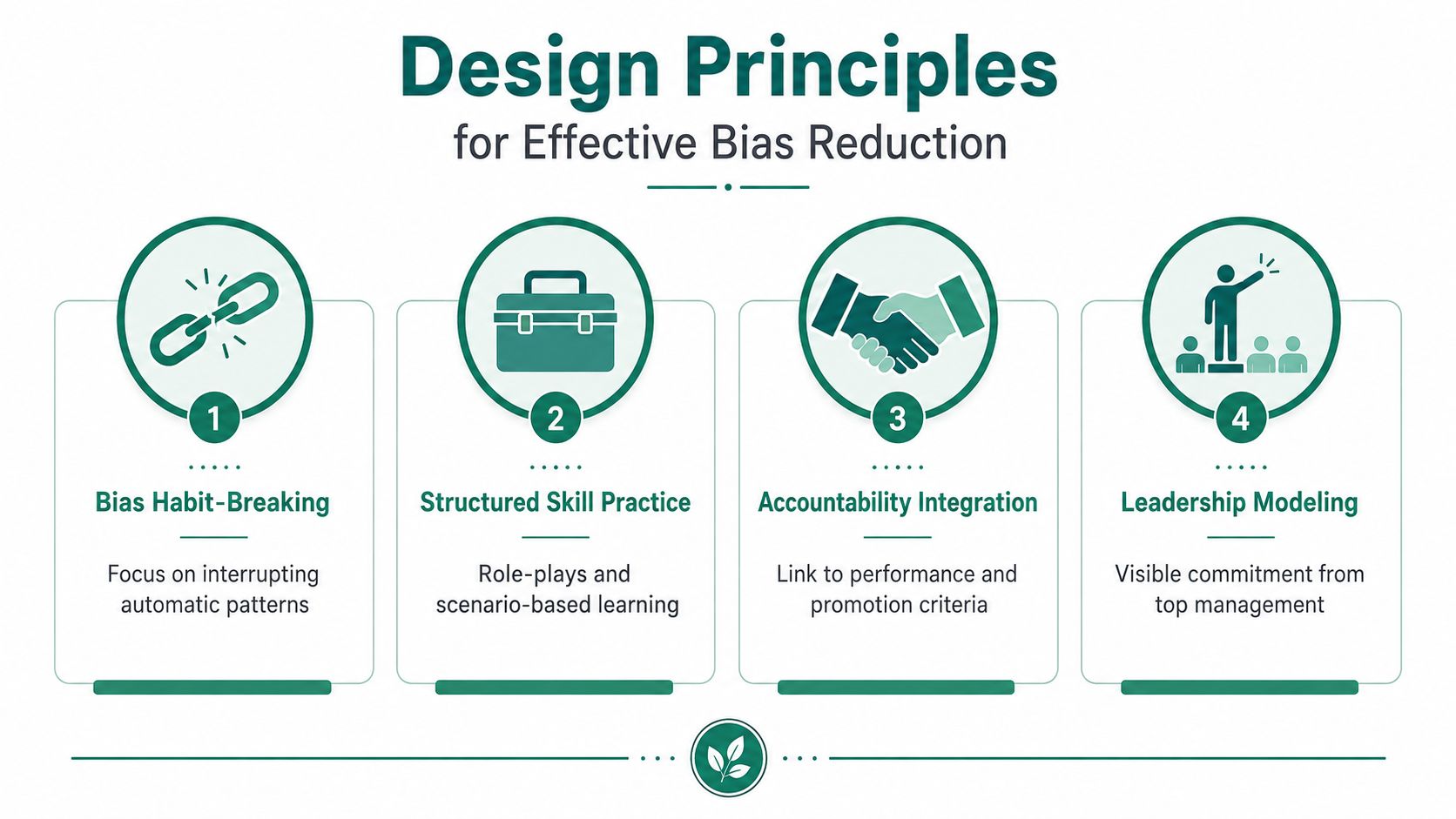
A peer-reviewed review of bias-reduction research points in a different direction. It found that the most effective interventions are not generic awareness sessions but structured approaches such as bias habit-breaking training. In one field study, that approach was associated with a 43% increase in hiring of members of underrepresented groups. Peer-reviewed review of bias reduction research
That contrast is the key strategic insight. The evidence isn't saying “training never matters.” It's saying the content, format, and surrounding process matter more than the label unconscious bias training itself. A workshop that leaves participants with a stronger vocabulary but no practical decision tools is unlikely to move outcomes. A structured intervention that teaches people how to interrupt automatic judgments, then reinforces that behavior inside real hiring decisions, has a much better chance of being useful.
Bottom line: The research supports bias-reduction as a design problem, not a branding problem.
For teams that want a broader evidence-based framing of learning design and practice, the Access Courses Online EBP guide is a helpful reminder that good practice starts with evidence, not intuition. The same logic applies here. If a program can't connect its content to a behavior, and that behavior to a hiring outcome, it's not a strategy, it's a seminar.
The question HR should ask is not whether to train. It's how to train in a way that supports actual decisions. The Princeton review notes that effective UBT needs sharper design choices, including using an Implicit Association Test with debriefing, teaching bias theory rather than only statistics, and embedding concrete bias-reduction strategies. It also argues that high-stakes, regulated, and cross-cultural hiring contexts need adaptation, not one-size-fits-all DEI modules. Princeton review on unconscious bias training
That's where many programs go wrong. They try to make everyone attend the same message, regardless of whether the audience is a recruiter, a compliance-heavy manager, or a global hiring lead working across legal regimes and cultural norms. A better design is narrower and more operational.
That's the practical standard. Training should help people act differently inside a process that already constrains discretion. If it doesn't, the best-case result is temporary awareness. The worst case is a backfire, where participants leave feeling the bias problem is either solved or impossible to solve, and both beliefs can blunt action.
The most common mistake is treating unconscious bias training like a compliance event. That mindset produces tidy completion reports and weak hiring outcomes. It also encourages managers to think the organization has “done DEI” because people sat through a module, which is exactly how bias survives inside a system that never changed.
| Common pitfall | Why it hurts | Better alternative |
|---|---|---|
| Framing stereotypes as unchangeable | It can trigger reactance or reinforce the belief that bias is fixed | Frame bias as a pattern people can interrupt with practice |
| One-off sessions with no reinforcement | Lessons fade before they reach a live hiring decision | Add refreshers, manager prompts, and process checkpoints |
| Measuring success by attendance | Completion says nothing about hiring quality or fairness | Track candidate flow, interview consistency, and decision rationale |
| Treating training as the whole strategy | It leaves the actual decision process untouched | Pair training with standards, scoring, and review controls |
Those corrections are not cosmetic. They change where bias gets caught. A one-off event tries to persuade people to become more careful forever. A better system makes the careful choice the default.
A useful practical test is to ask where, exactly, bias can enter your process. If the answer is “anywhere a manager feels like it,” the program is too loose. If the answer includes defined criteria, consistent scoring, and documented tradeoffs, the process has a fighting chance.
The research already warned against programs that frame stereotypes as fixed. It's worth taking that seriously in training content as well as facilitator language. Avoid telling people that bias is just an unchangeable human flaw. That framing can make the problem feel inevitable, and inevitability is an excuse that hiring teams use very quickly.
Operational question: Which decision in your hiring process would become more objective if the training disappeared tomorrow?
If the answer is “none,” the training is doing too little. If the answer is “the team would lose a useful prompt, but the process still holds,” then you're closer to a workable model. That model usually includes more than one safeguard, because one safeguard alone is easy to bypass when a hiring manager is convinced they already know the candidate.
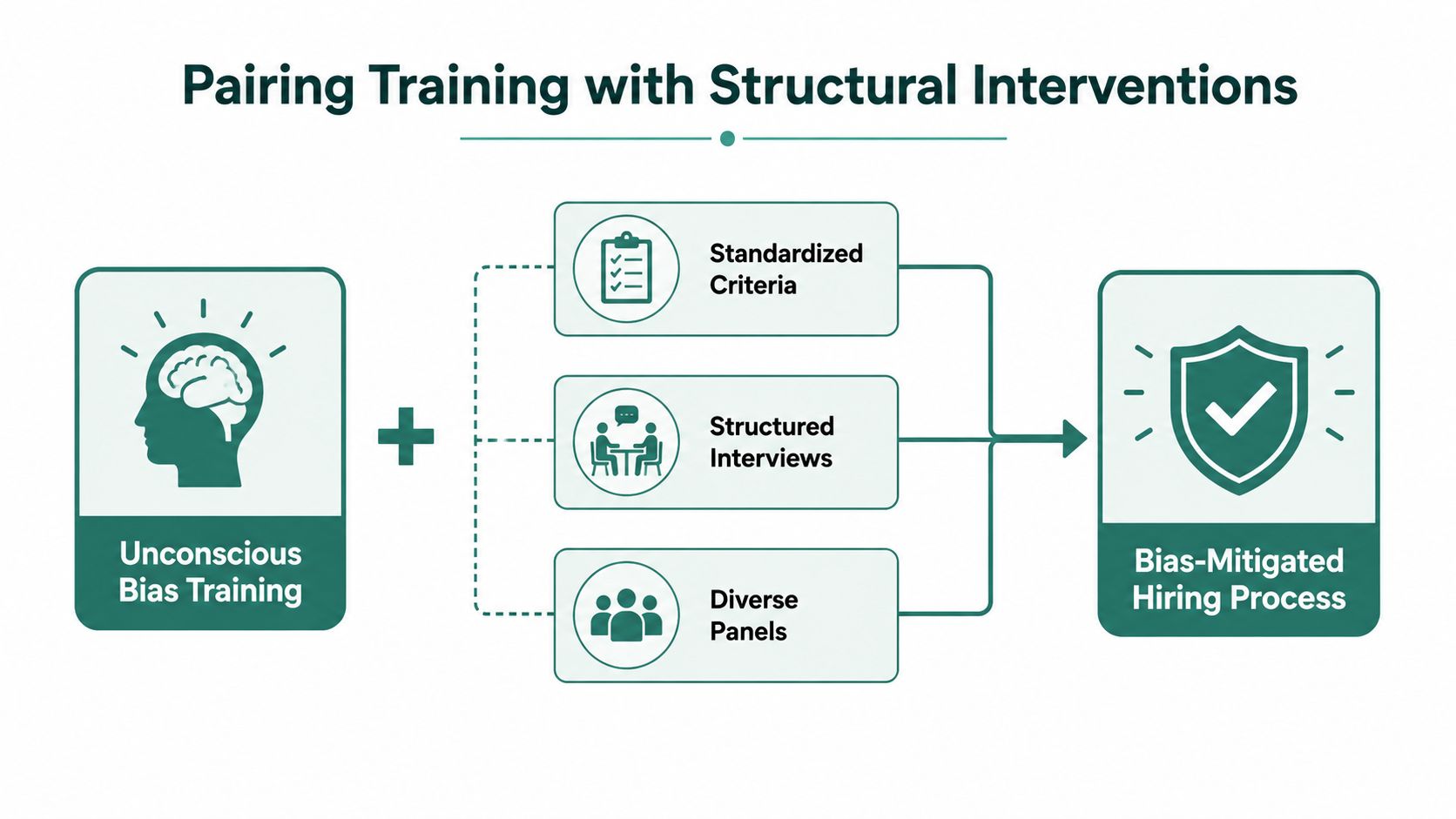
Training starts to matter when it sits beside structural controls that make subjective judgments harder to smuggle through. Standardized criteria, structured interviews, and objective evaluation systems are not add-ons. They're the scaffolding that keeps awareness from collapsing back into instinct.
The cleanest place to begin is the job description. If the posting is vague, managers will screen on proxies like pedigree, polish, or similarity. Clear outcomes, required competencies, and role-specific evidence reduce that drift before anyone reaches the interview stage. From there, use blind resume review where appropriate, consistent scoring rubrics, and written rationale for decisions so the reasons can be reviewed later.
Those steps do more than tidy up process. They create what many teams call bias interrupters, the checkpoints where subjective judgment has to pass through a standard before it can affect outcomes. A structured interview guide is one interrupter. A rubric tied to job competencies is another. A rule requiring documented justification for borderline decisions is another.
This is also where automation can help, but only if it standardizes rather than guesses. Automated screening should not be treated as a shortcut around human judgment. It should be used to make early evaluation more consistent so humans spend their time on the few decisions that need deeper review.
For a practical guide on interview consistency, the interviewer training resource is a useful reference point for how structured questioning supports better decisions. The bigger point is simple. Training without structure produces hopeful intent. Structure without training can become rigid bureaucracy. Together, they make hiring more defensible.
If those answers are fuzzy, bias has room to move. If they're clear, training has something real to reinforce. That's the difference between a culture message and an operating system.
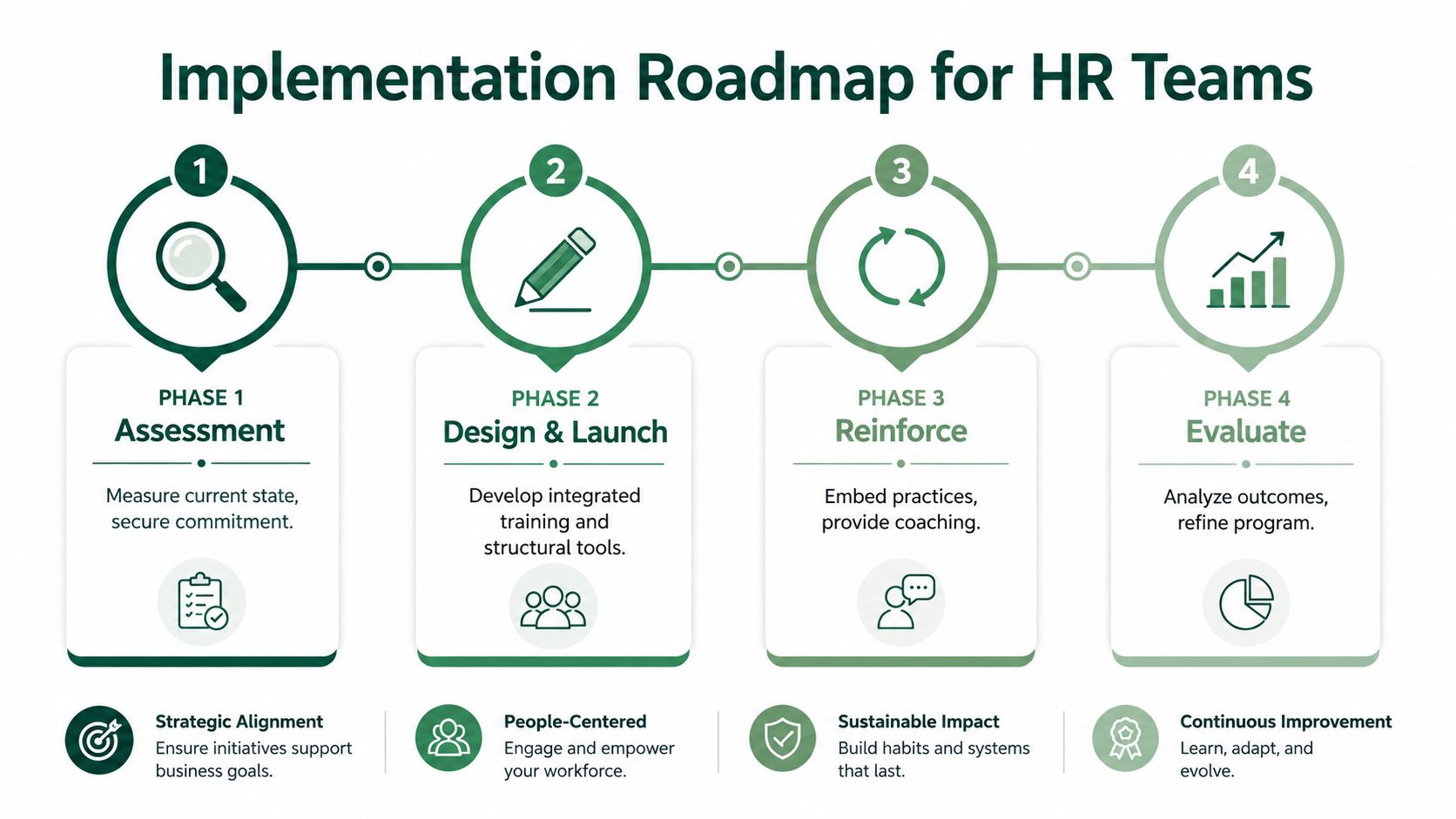
A workable rollout starts with diagnosis, not rollout decks. Phase one is a baseline review of where bias is likely entering the process, who owns each decision, and which groups are being filtered out at each stage. If leaders don't agree on the current state, they'll argue about solutions before they understand the problem.
Assessment should identify the biggest leak points, usually job design, screening, and interview scoring. HR can pull the current requisitions, rubrics, and rejection reasons, then compare them for consistency. Executive sponsors should be briefed with a plain statement of risk and a plain statement of opportunity, because vague commitment rarely survives a budget meeting.
Design and launch should focus on one or two hiring paths first, not the whole company. That lets teams build standardized criteria, structured interview guides, and targeted training for the managers who make decisions. The launch works best when the training content references those live tools, not abstract examples that never appear in the workflow.
Practical rule: Don't launch training before the process can absorb it. Otherwise, managers learn the language of fairness without the mechanics of fairness.
Reinforcement is where most programs underperform. Managers need follow-up nudges, scorecard use, and coaching after real interviews, not just a launch webinar. This is also the point to tie fair-hiring practices into performance expectations and manager calibration meetings, so the program stops depending on memory.
Evaluation has to measure more than participation. If the system only tracks completion, it's blind to whether the process changed. Review funnel movement, scorecard consistency, and the reasons people are advanced or rejected, then adjust the rubric or training when patterns show drift.
For organizations that need a broader compliance lens, the Nick Norris harassment training resource is a useful reminder that workplace training works best when it's part of a larger risk and conduct framework. Bias reduction belongs in the same category. It's a policy-and-process issue, not a standalone learning event.
The operational takeaway is blunt. Start with one hiring lane, prove that structure changes decision quality, then expand. That sequence is slower than buying a module, but it's how HR teams build a program that survives leadership turnover, legal scrutiny, and the next budget cycle.
Automation helps when it removes variation from the earliest steps of hiring. A system that conducts 24/7 conversational screening for every applicant, asks role-specific questions, and produces structured scorecards creates a more consistent first pass than ad hoc recruiter screening. That consistency matters because it reduces the number of moments where a manager's mood, rush, or familiarity can shape who advances.
This is especially useful when the screening tool is built around job criteria rather than generic conversation. Role- and industry-aware question sets give employers a way to compare candidates against the same standard, while customized scoring rubrics keep the evaluation tied to evidence. The result isn't mechanical hiring. It's more disciplined hiring.
Automation should handle repetition. It should collect answers consistently, surface strong candidates quickly, and document the basis for early-stage comparisons. It should also reduce the manual bias exposure that comes from relying on whoever happens to be available to screen resumes on a given day.
It should not make the final hiring call. Advancement and rejection still belong to the employer, because human judgment is needed to weigh context, culture, and team needs. The value of automation is that it narrows the field using stable criteria, then hands off a cleaner decision set.
If you're evaluating tools, this AI resume screening guide is a good lens for understanding how structured screening supports auditability. The important thing is the design principle, not the brand name. The right system makes early hiring decisions more comparable and less dependent on who reviewed the application first.
For HR teams under pressure to hire at scale, that can change the day-to-day reality. Recruiters spend less time sifting through inconsistent submissions, hiring managers get fewer unstructured candidate packets, and decision records become easier to review later. That's not a replacement for judgment. It's a way to make judgment easier to defend.
If you want to move from bias awareness to a hiring process that holds up under scrutiny, visit Talent Pronto and see how structured conversational screening, role-specific scoring, and ATS-integrated workflows can support more equitable early-stage hiring. It's a practical next step for teams that are done treating unconscious bias training as the whole answer.

Talent Pronto is an AI-powered hiring platform built around Anna, our intelligent AI that conducts 24/7 conversational screening, evaluates candidates against specific job requirements and compliance needs, and schedules interviews. Run everything on the Talent Pronto ATS, our all-in-one applicant tracking system with a branded careers site and Anna built in, or keep your existing ATS and let Anna integrate with Greenhouse, Ashby, iCIMS, Jobvite, Lever, Oracle, and more. Either way, we help organizations reduce time-to-hire and build stronger teams.